Manga from the past

My wife received another care package from her sister. She was doing some cleaning up in the house of their childhood. She sent a bunch of manga that my wife bought in her teens. It’s a good example of the shōjo manga that girls were reading in the seventies.
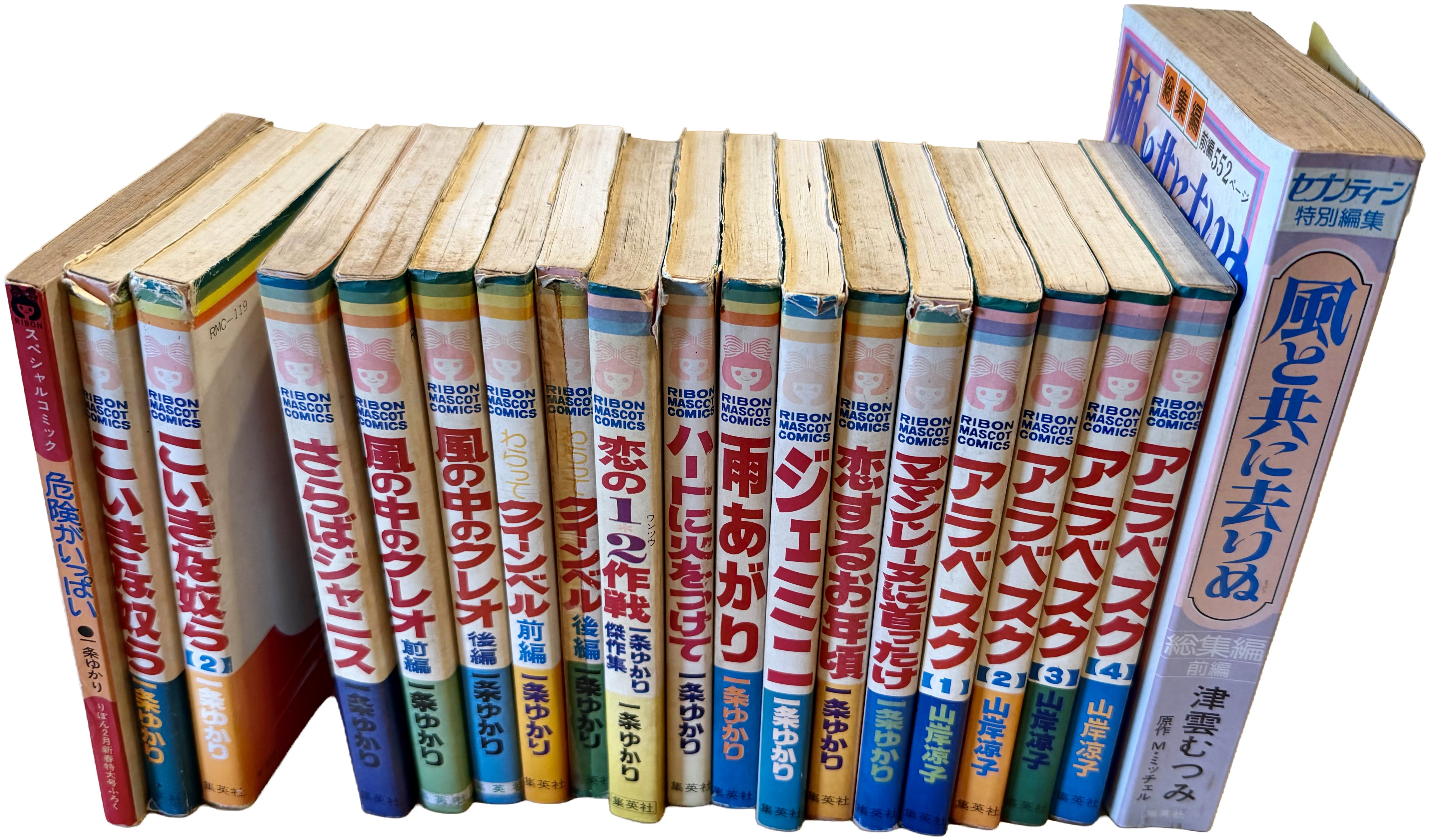
Those manga were mostly aimed at young teen girls and the style of the artwork would probably be seen as old-fashioned today. For those reasons, it is unlikely that any publishers would be interested in translating them. I find this a little sad, because those titles were good and popular entertainment at the time and people today should be aware of this. You cannot understand the history of manga without knowing this…

The first fourteen books are all by the same mangaka: Yukari Ichijo (一条ゆかり). I have already talked about her; I guess my wife liked her stories a lot. It’s mostly romantic comedies.
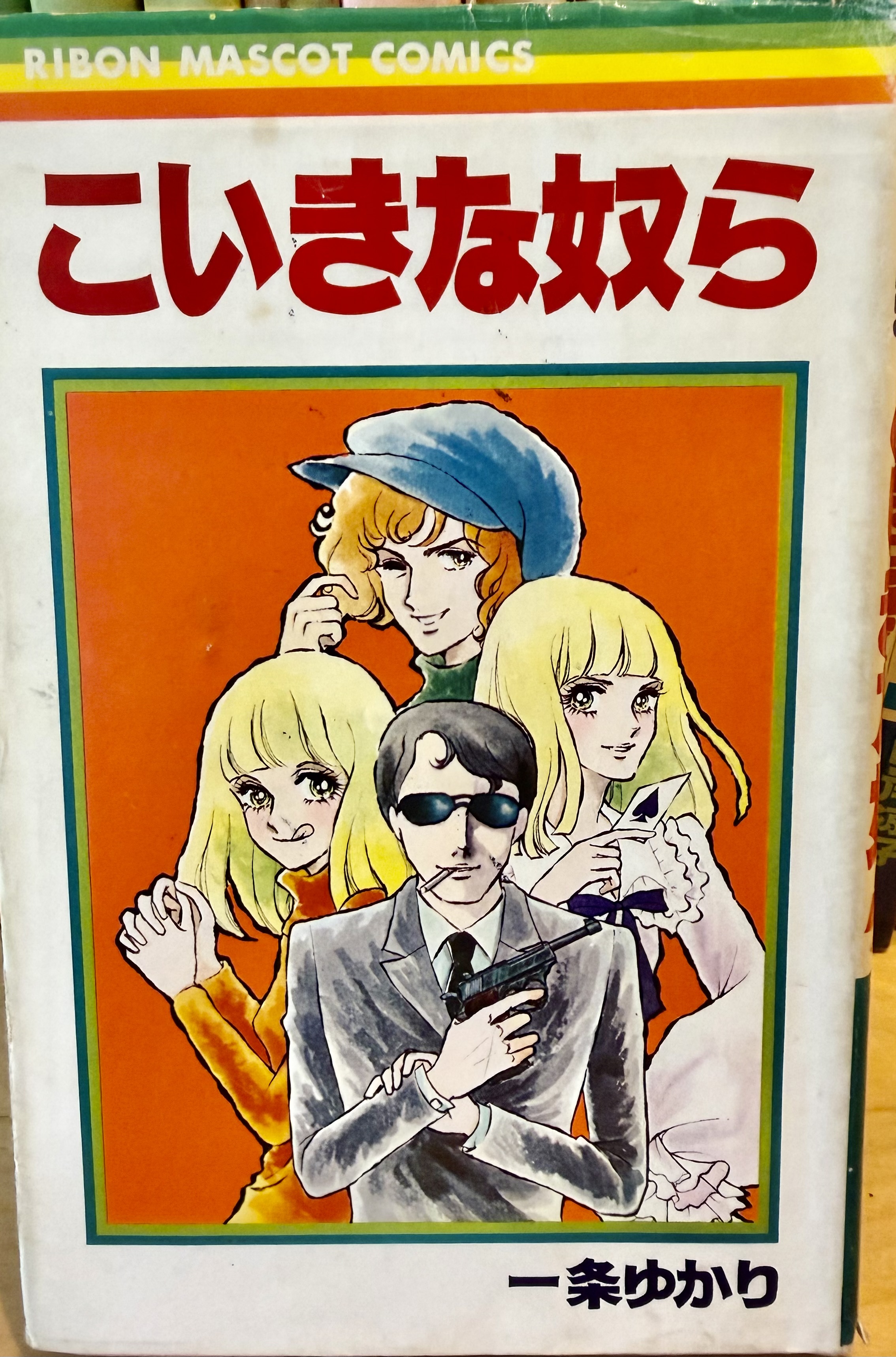
The Cool Guys Vol. 1-2 (こいきな奴ら / Koikina Yatsura), by Yukari Ichijo, Shueisha (Ribon Mascot Comics). It was serialized in Ribon magazine from January 1974 to March 1977 and compiled in two tankōbon in August 1975 and March 1978. It’s composed of four parts published in yearly special issues: “Act 1: Judes Judith” (Jan. 1974), “Act 2: Esper Hunting” (Feb. 1975), “Act 3: Full of Danger” (Feb. 1976) and “Act 4: Dormie III’s Heritage” (Feb. & March 1977). You can see an excerpt here.
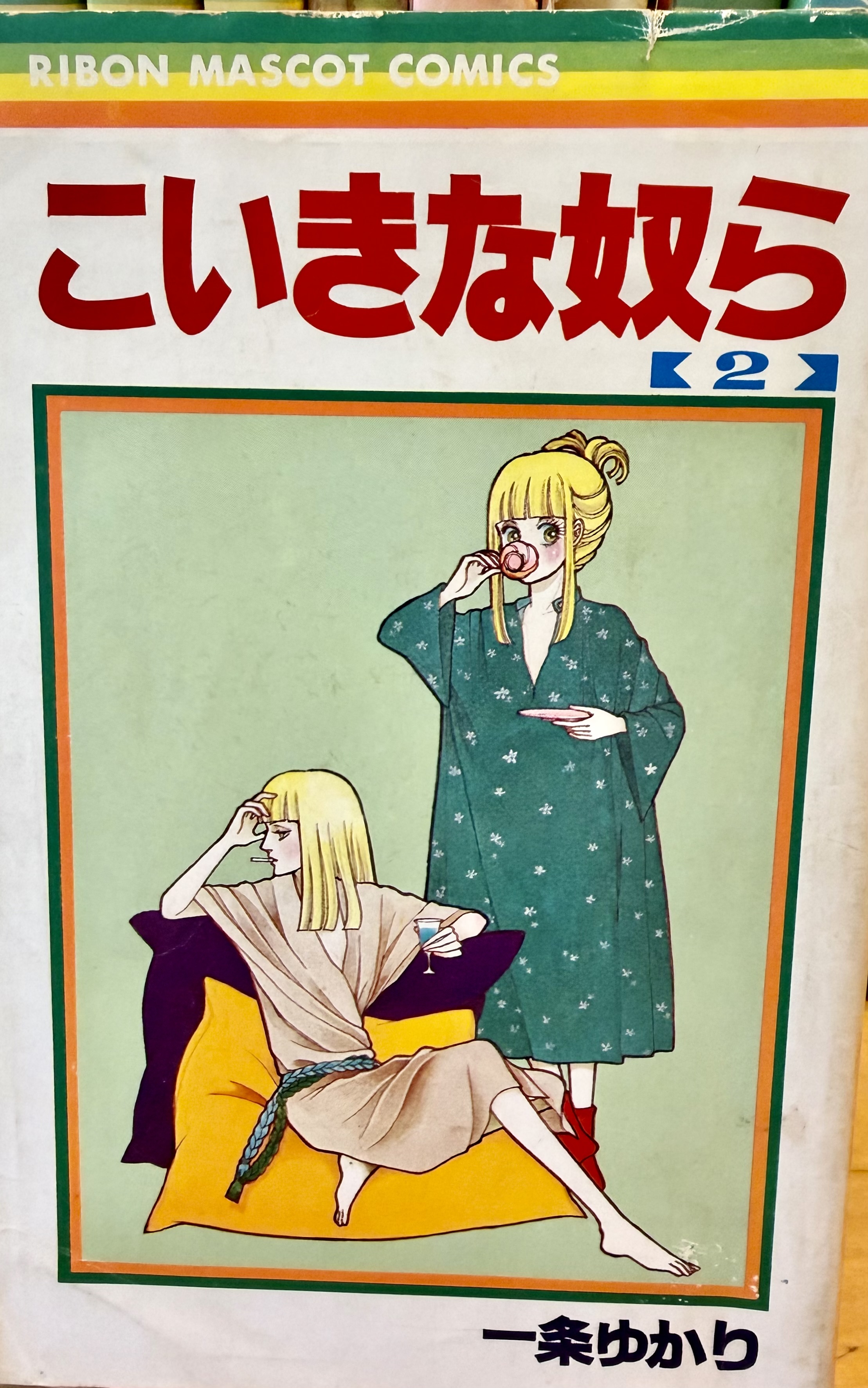
“The adventures of twins dedicated to finding out who killed their beloved parents!  The son of the Count and Countess of Grasse, Judes and his sister Judy, are beautiful twin siblings who are well-known in Paris. The two suspected that their parents had suddenly died in an accident, but with the help of a fellow pickpocket and an ex-killer, they set out to investigate the truth…! A fashionable and popular comic book with thrills and suspense!” (From Manga Updates)

Koikina Guys ACT-III: Full of dangers (こいきな奴ら ACT III: 危険がいっぱしい / Koikina Yatsura Act. III: Kiken ga ippashii),  by Yukari Ichijo, Shueisha. Ribon February New Year’s Special Issue (Vol. 22, No. 3) Supplement – ​​February 1976 (りぼん2月新春特大号(第22巻第3号)付録 昭和51年2月). This is the Ribon yearly special issue with Act III of the previous books. [Google]
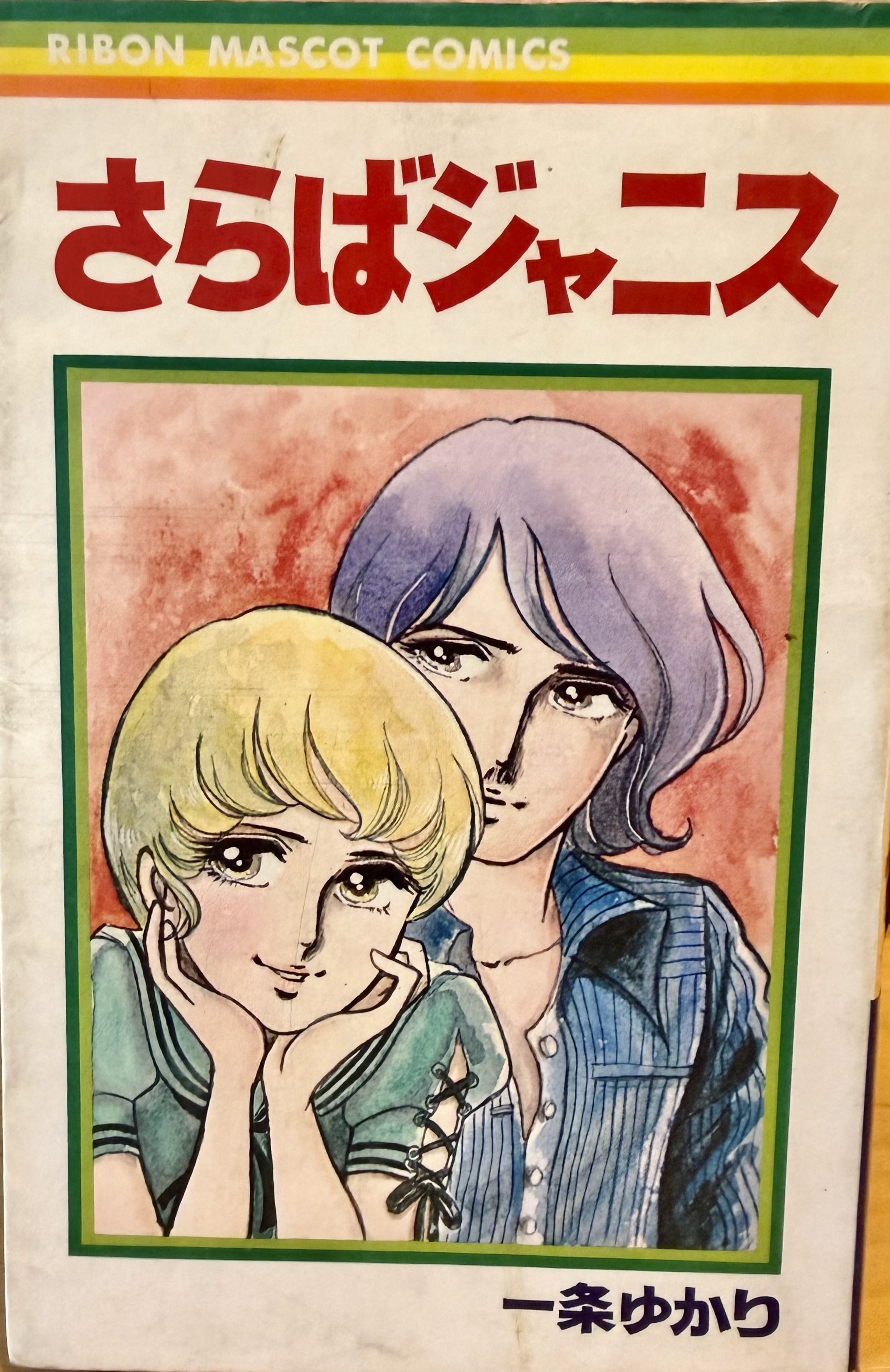
Farewell, Janis (さらばジャニス / Saraba janisu), by Yukari Ichijo, Shueisha (Ribon Mascot Comics), 202 pages. Serialized in Ribon magazine and compiled in one volume in 1972. You can read an excerpt here. [Manga Updates]

“Janis discovers a new way of life at a school with a free-spirited atmosphere! Mr. Farrow, a traveler, is dissatisfied with his son Janis’s feminine nature and subjects him to a harsh, Spartan upbringing. However, after reading a letter left by his late mother expressing her wish for him to “live freely,” Janis resolves to leave home… A unique romantic story about a beautiful boy with a girl’s heart.” (From Amazon)
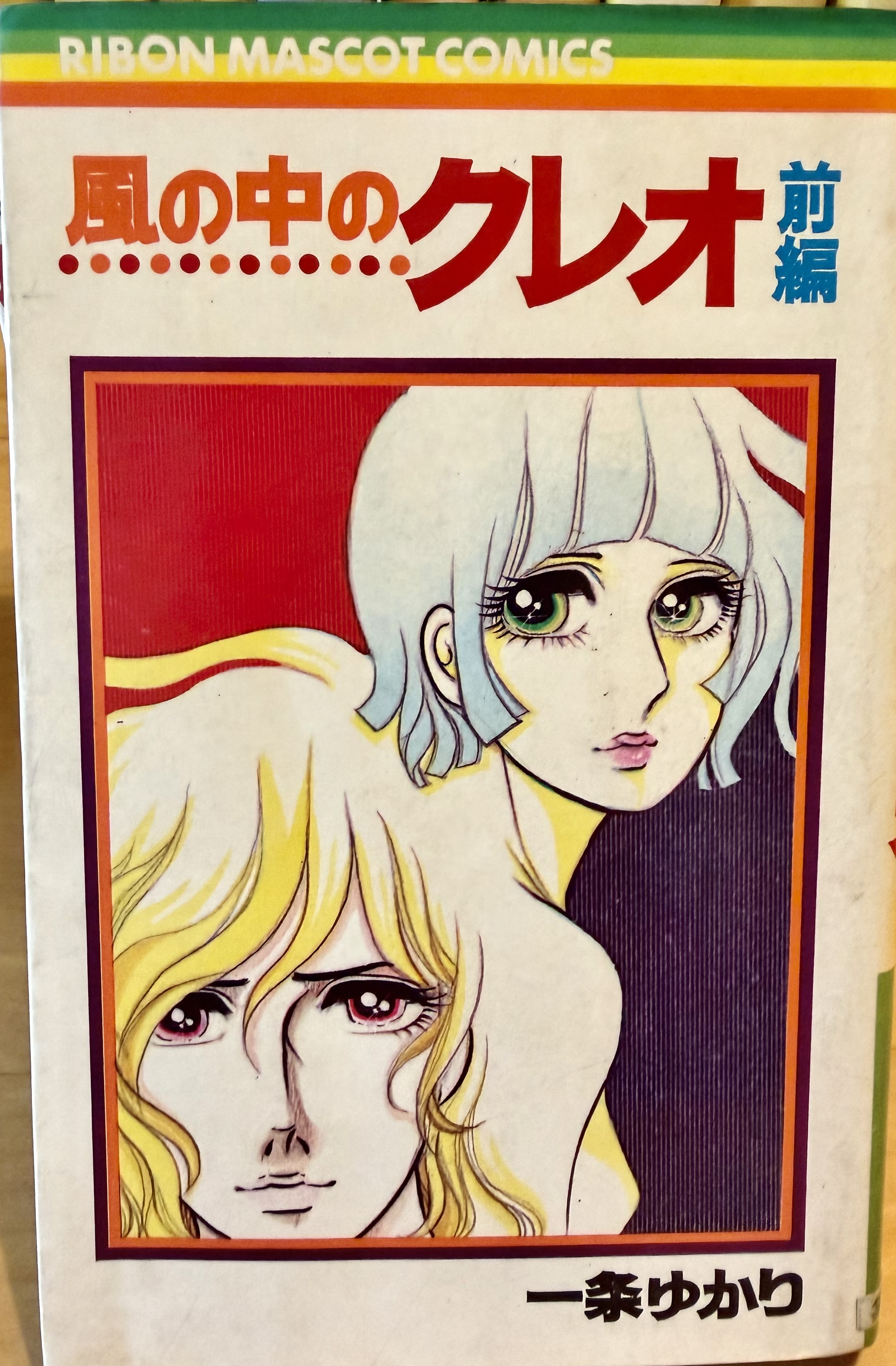
Cleo in the Wind: Part 1-2 (風の中のクレオ / Kaze no naka no Kureo), by Yukari Ichijo, Shueisha (Ribon Mascot Comics). Serialized in Ribon magazine (Aug. ’70 – Feb. ’71) and compiled in two volume in 1971. You can see an extract here. [AmazonMangapediaManga Updates]

“What is the shocking fate of love between young Cleo and Belle? Velvet (commonly known as Belle), who attends high school, is curious about Cleo’s existence. Cleo is popular with the girls, but he is also insufferable. Belle considers using him as the model for a novel, but… Part one of a dramatic love story about Belle falling for a naive young man. [Vol. 1 also includes the short stories: Twenty Days of Love / Poem of the Wind]” (From Shueisha)
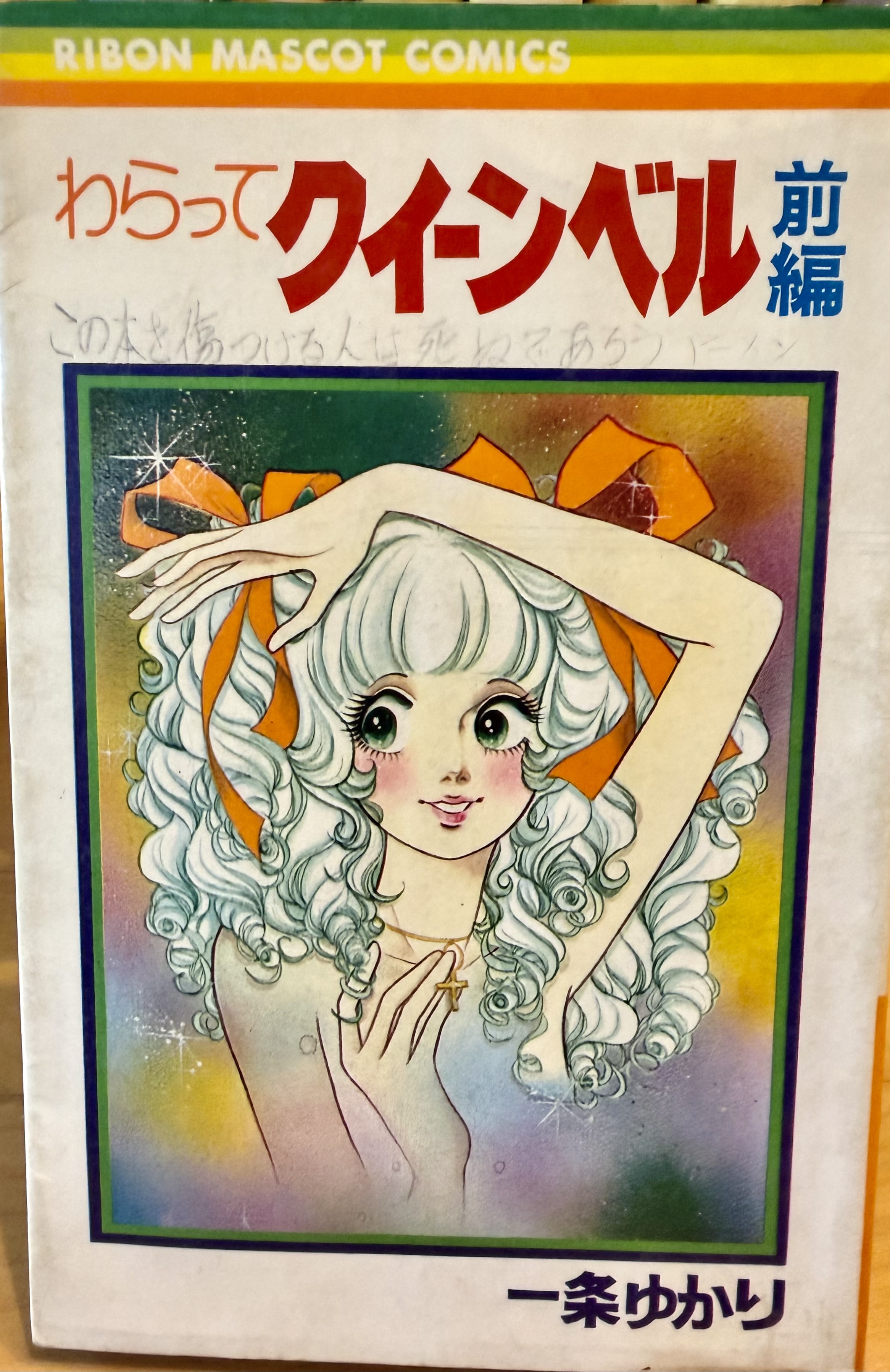
Smile, Queen Bell Part 1-2 (わらってクイーンベル / Waratte kuinberu), by Yukari Ichijo, Shueisha (Ribon Mascot Comics). Serialized in Ribon magazine (April to September 1973) and compiled in two volume in 1973. You can see an extract here. [AmazonMangapediaManga Updates]

“Queen Bell grew up without knowing her father and lost her mother at a young age. Queen, who was living in a boarding school in Switzerland, receives news that her father has passed away. Queen, confused, visits England and learns that she is the only daughter of a millionaire, but then a mysterious duo appears…!?” (From Amazon)
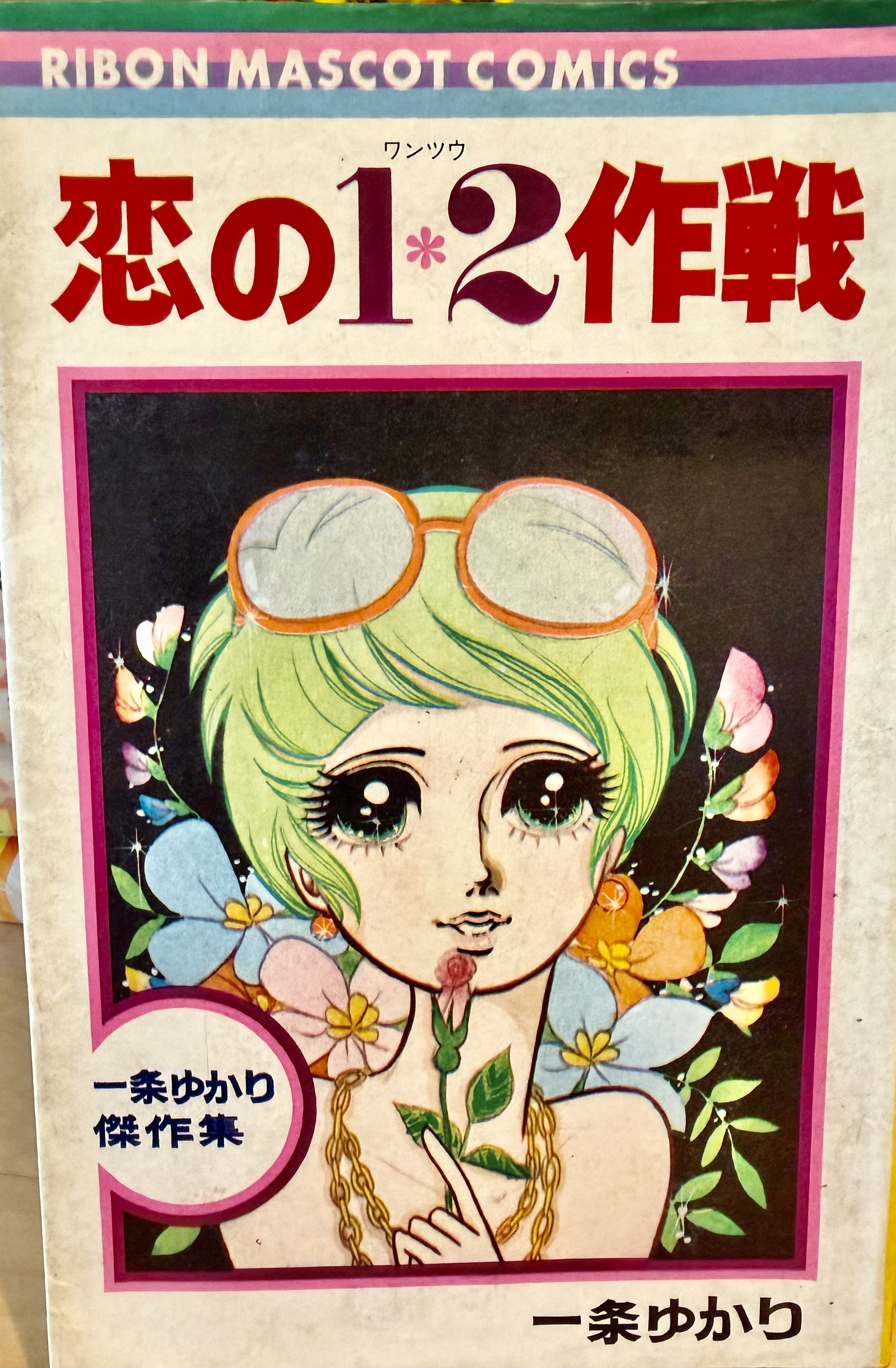
Love Strategy One-two (ワンツウ 恋の1•2の作戦 / Koi no 1•2 no sakusen), Yukari Ichijo Masterpiece Collection, Shueisha (Ribon Mascot Comics). Serialized in Ribon magazine (in the new year special issue of 1970) and compiled in one volume in August 1970. You can see an extract here. [AmazonManga Updates]

“Brothers and sisters who are neighbors… Who is in love with whom? College students Jean and Pierre get a failing grade and end up studying with their younger brothers Henri and Jam at a relative’s house in a rural town. However, there were wonderful sisters living in the house next door, and the boys’ hearts were disturbed! A neighborhood romantic comedy with an unexpected twist!” (From Amazon)
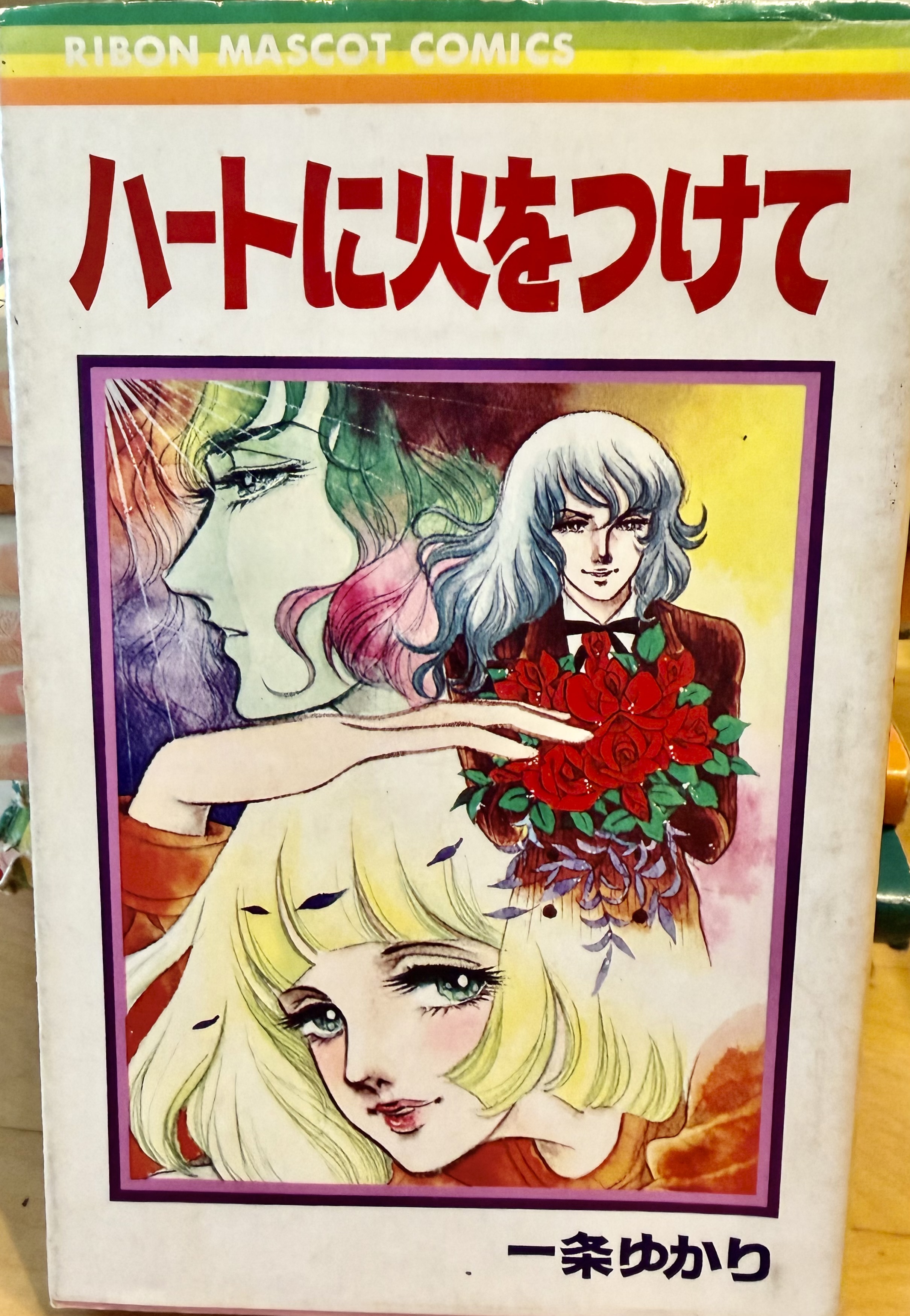
Light a fire in my heart (ハートに火をつけて / Hāto ni hi o tsukete), by Yukari Ichijo, Shueisha (Ribon Mascot Comics). Serialized in Ribon magazine and compiled in one volume in 1973. You can see an extract here. [AmazonManga Updates]

“A flame of love ignited in a world of glamour! During winter break, Josée—whose older sister is the actress Cécile Donahue—meets Gillan, the older brother of her best friend Angela, at a club. However, Gillan discovers that Cécile is actually Josée’s mother… A stylish romance filled with the games of love. [Also includes: Winter in Shellfield / Ami… A Male Friend]” (From Amazon)
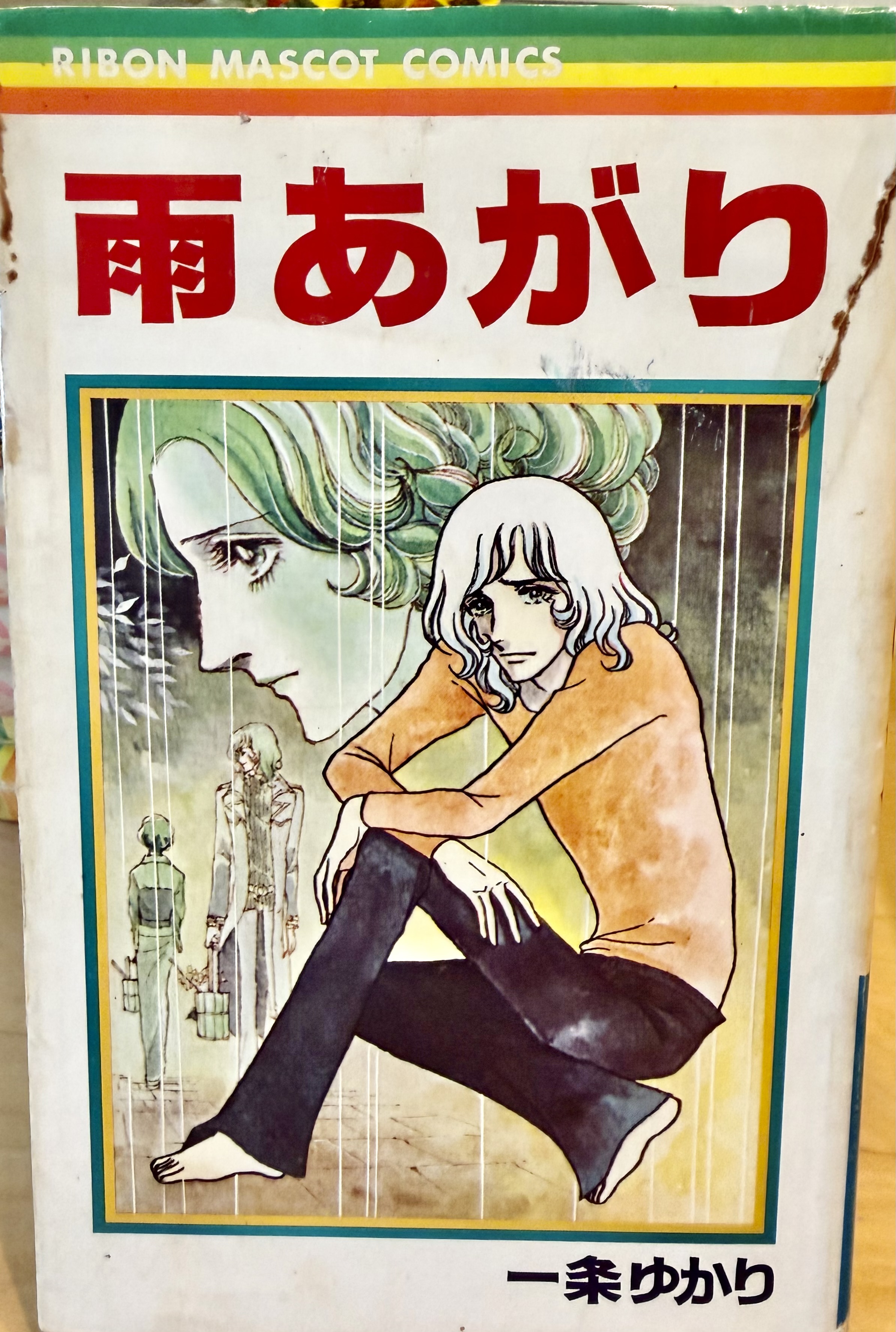
After the Rain (雨あがり / Ame agari), by Yukari Ichijo, Shueisha (Ribon Mascot Comics). Serialized in Ribon magazine and compiled in one volume in 1971. You can see an extract here. [AmazonManga Updates]

“Akihiko, a college student, is captivated by the beauty of an older woman he meets while visiting the grave of his deceased mother. However, that night, he was told by his father that he wanted to “introduce someone whom he was thinking of marrying” and that was exactly the woman he met during the day. It is a work that depicts Akihiko’s love with nowhere to go, who suffers from his feelings for a woman who has become a young mother-in-law.” (From AI Overview)
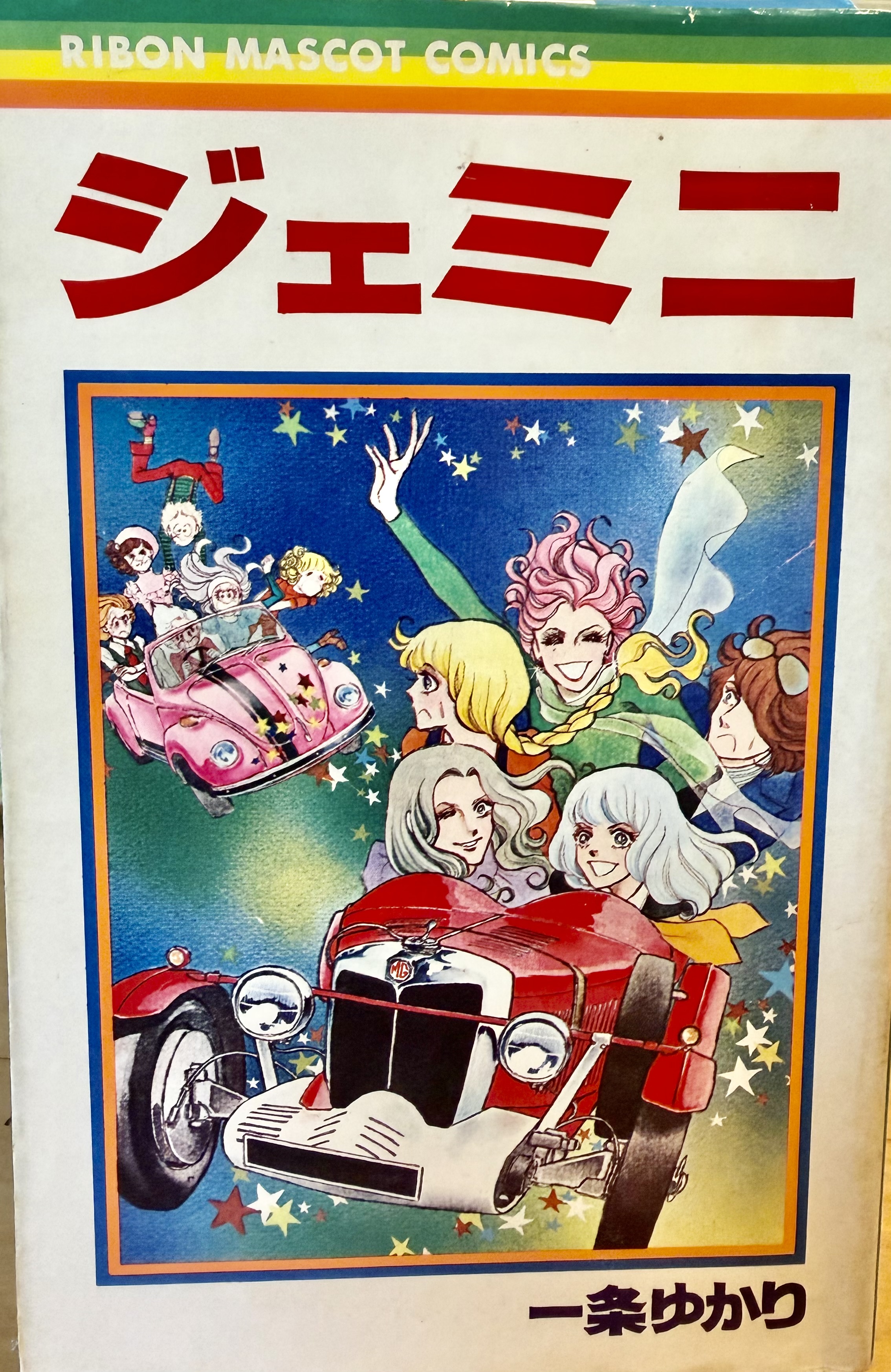
Gemini (ジェミニ), by Yukari Ichijo, Shueisha (Ribon Mascot Comics). Serialized in Ribon magazine (April ’75 issue) and compiled in one volume in December 1975. You can see an extract here. [AmazonManga Updates]

“What will be the fate of the skinny girl who lives in the mansion of her beautiful brothers? Gemini is a poor female student who is busy working part-time. One day, she gets into a car accident at school, and her life changes drastically when the driver turns out to be Shelfy, the girl’s idol! A pure love story of a girl who loves cars.”
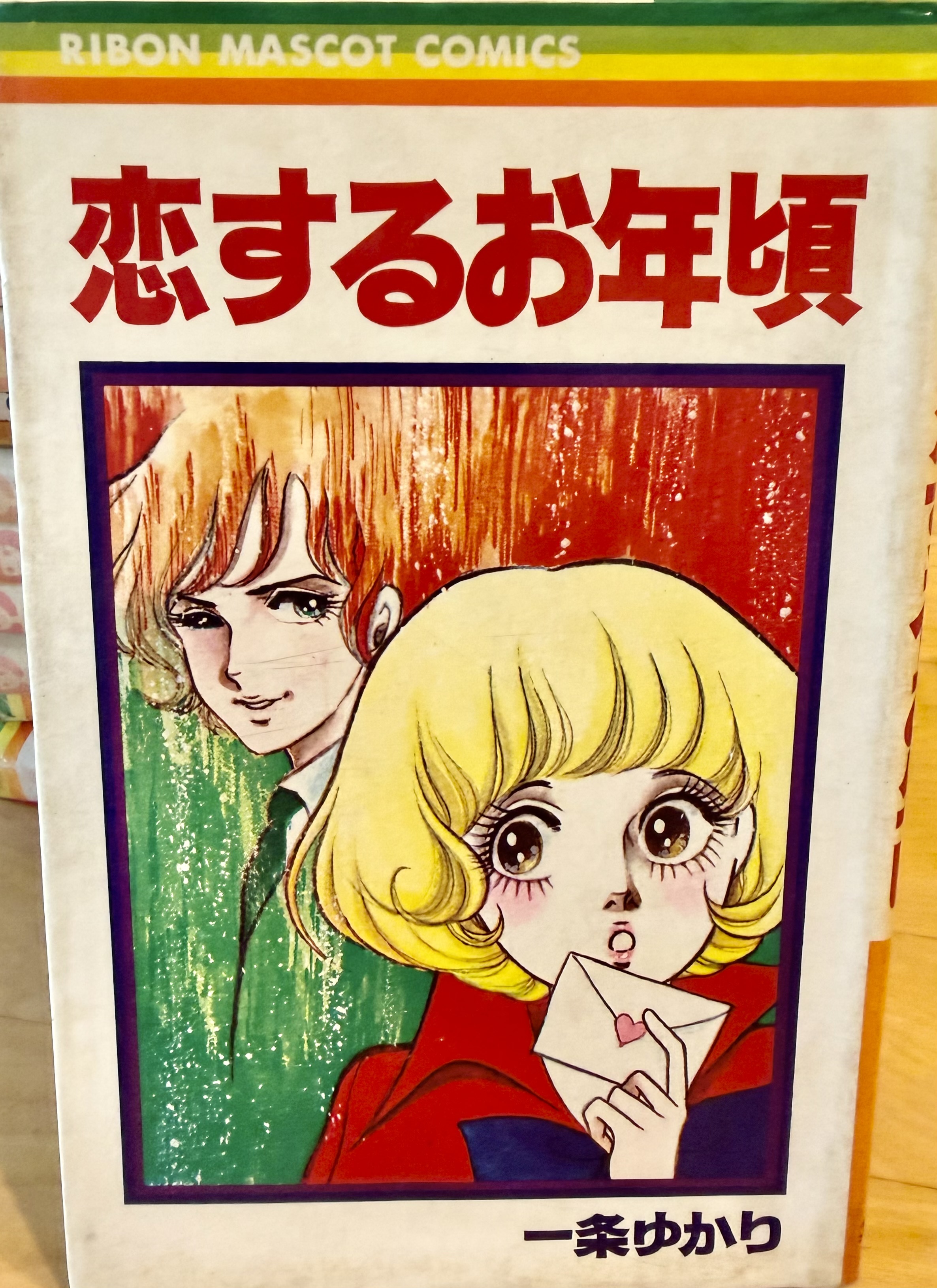
The Age of Falling in Love (恋するお年頃 / Koisuru o toshigoro), by Yukari Ichijo, Shueisha (Ribon Mascot Comics). Serialized in Ribon magazine (Jan. & Feb. ’71 issues) and compiled in one volume in 1973. You can see an extract here. [AmazonManga Updates]

“School love situation between an innocent girl and a slightly bad boy. 16-year-old Hoshi Ainoko has a crush on her delinquent classmate Jun Hirose, but does he like her best friend Mana? One day, Noko helps Hirose-kun sneak out of class and lies to their teacher… Youthful graffiti full of love troubles.” (From Amazon)
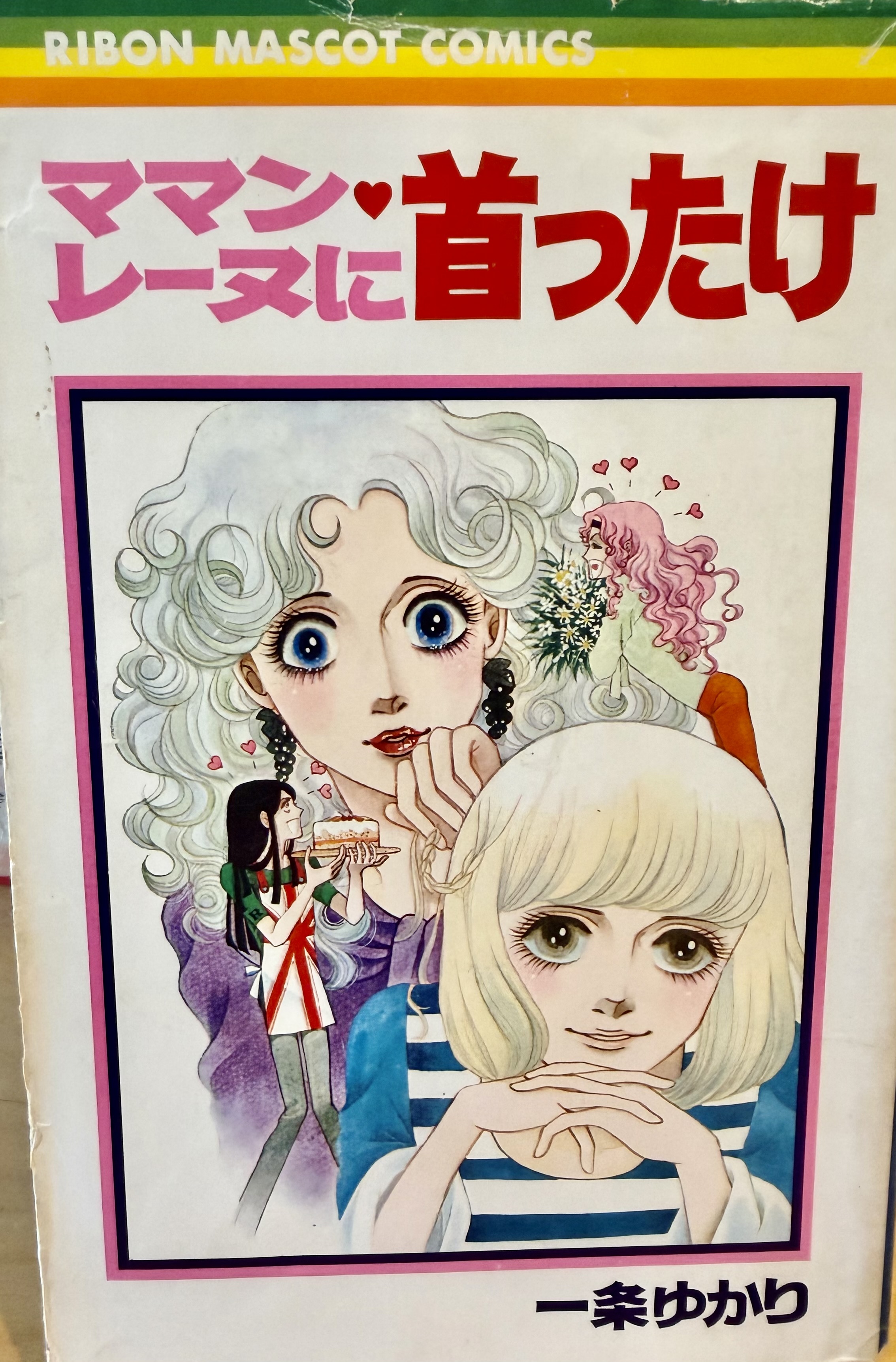
Smitten with Maman Reine (ママン・レーヌに首ったけ / Maman Reenu ni Kubittake), by Yukari Ichijo, Shueisha (Ribon Mascot Comics). Serialized in Margaret magazine (#33 1975) and compiled in one volume in 1976. You can see an extract here. [AmazonManga Updates]

“All boys, including superstars and friends, are in love with Maman!? Matthew’s Maman is not good at housework. After the old maid left, there was chaos in the house. Her son Matthew is one of the most popular boys at school, but there are rumors that he’s his mother’s boy! The definitive romantic comedy about unique lovers!”

The next four volumes are by Ryoko Yamagishi (山岸凉子). She’s a member of the Year 24 Group, a movement of female mangaka, all born around the same year (Showa 24 or 1949), that contributed in the 1970s to the innovative development of shōjo manga. None of her works has been translated, but she is mostly known for Shiroi Heya no Futari (1971, about a romance in an all-girls boarding school in France), Hi Izuru Tokoro no Tenshi (1980-84, about Prince Shōtoku who spread Buddhism in the 6th century, won the 1983 Kodansha Manga Award), and Maihime Terpsichora (2000-06, about the harsh reality behind young ballet dancers hopeful, won the Tezuka Osamu Cultural Prize in 2005) and…

Arabesque vol 1-4 (アラベスク), by Ryoko Yamagishi, Shueisha (Ribon Mascot Comics). Serialized in Ribon magazine (Oct. ’71 to Apr. ’73) and compiled in four volumes in 1972-74. An extract is available here. [AmazonManga UpdatesWikipedia JP] 

A story about Russian ballet. “Nonna Petrova, a tall, sixteen-year-old ballet student in Kiev, is unaware of her unique balletic brilliance. Having low self-esteem due to the unwanted comparison with her talented older sister, Nonna is “discovered” by leading ballet dancer Yuri Mironov, and, under his guidance, is led to stardom.” (From Manga Updates)

The last volume is by Mutsumi Tsukumo (津雲むつみ). She’s mainly known for Colorful Time and From the End of Darkness (which both won the Japan Cartoonists Association Award in 1976 and 1993). Several of her titles were also adapted into TV drama (“I’m a man!”, “Wind Ring Dance“, “Hanai Yumei” and “Let me hear the words of love“). She died of lung cancer in 2017. This manga is a faithful adaptation of the famous 1936 Margaret Mitchell’s novel, Gone with the Wind (which is one of my wife favourite story and movie).
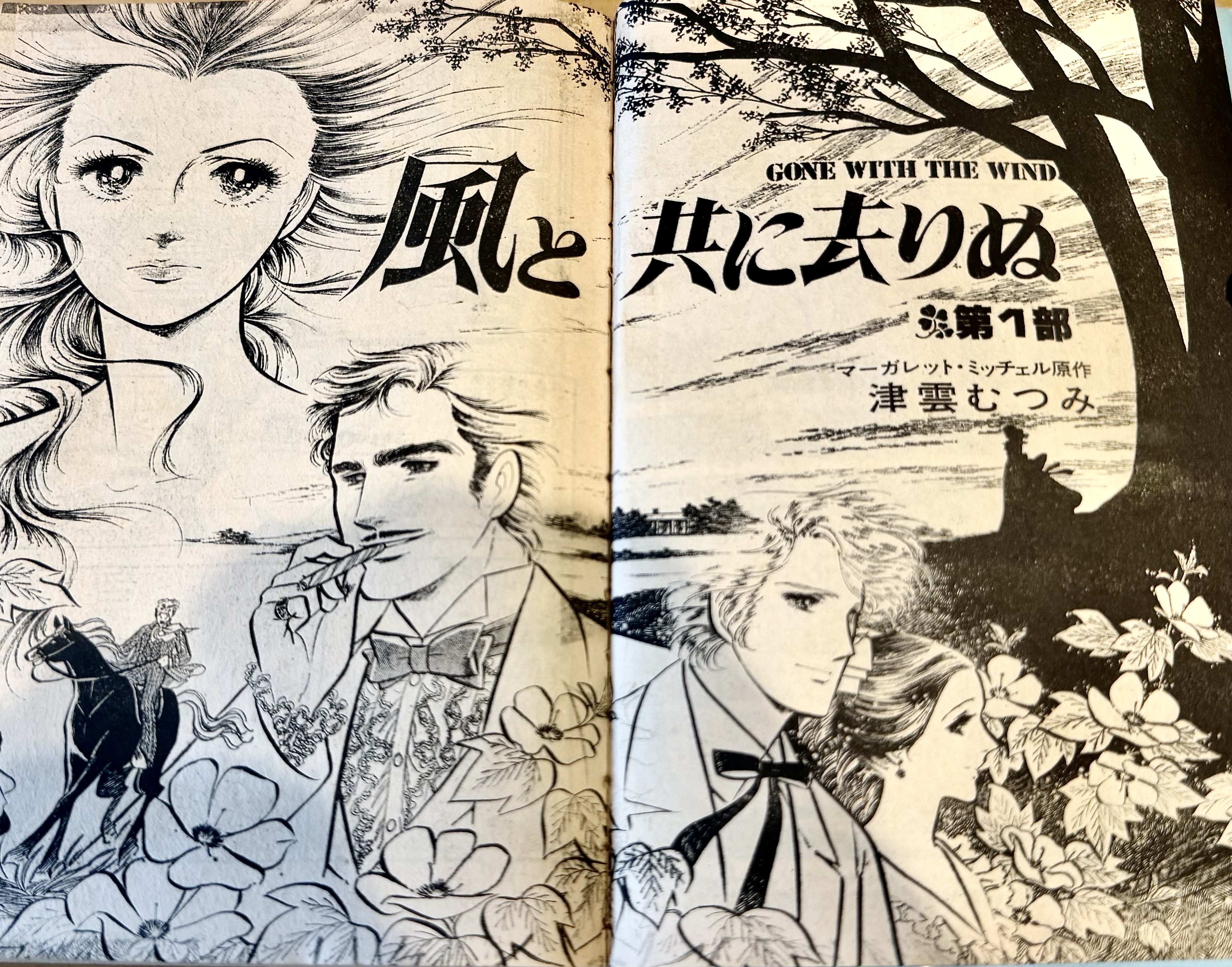
Gone with the Wind, Part 1 (風と共に去りぬ第1部 / Kaze to Tomo ni Sarinu), by Mutsumi Tsukumo, Based on the work by Margaret Mitchell. Seventeen Special Limited Edition, 552 pages, 380 yen. It was serialized in Shueisha Weekly Seventeen between 1977 and 1979 and compiled in two volumes in 1978-1980. [Manga Updates]

“Tara is a town in the southern United States just before the Civil War. Scarlett, the daughter of a squire, is proud and beautiful, and a socialite who captivates any man. However, Ashle, whom she loved, ends up marrying Melanie… Mutsumi Tsugumo vividly depicts this timeless masterpiece. An epic story of intertwined love and hate begins――!!” (From Amazon)

Pictorial chronicles [002.026.230]

Pérille en la demeure

[ iPhone 17 Pro, Jardin botanique & Domus, 2026/08/14 & 16 ]

Perilla frutescens / Pérille / Perilla / cultivar ‘Britton (bicolor)‘ & ‘Red

La Pérille aromatique est une plante condimentaire d’origine asiatique qui a un usage alimentaire, médicinal et ornemental. La variété la plus utilisée est la Perilla frutescens var. crispa fo. Purpurea et est le plus souvent connu sous son nom japonais de shiso (シソ / 紫蘇) — qui dérive lui-même du nom chinois (zǐsū). Son feuillage coloré en a d’abord fait une plante ornementale, mais comme elle est comestible et odorante elle a rapidement été utilisée en cuisine: en salade, dans les marinades (漬物 / Tsukemono), en jus, séché en poudre sur le riz (おにぎり / 御握り/ onigiri), pour faire de l’huile (avec les graines), comme colorant (notamment dans les umeboshi ou beni shōga), comme épice (pour aseptiser la viande entre autres) ou encore comme édulcorant. En herboristerie ou phytothérapie, elle est utilisée comme antiallergique. Son goût, sans être désagréable, ne m’a jamais beaucoup enthousiasmé, mais je dois avouer qu’en été, elle permet de concocter des plats rafraîchissants. Il y en a partout dans notre jardin.

Anime & manga update [002.026.228]

Anime & manga update

NHK World Japan continues to be a great source of information about Japanese culture with their documentary series. This time nothing much to report about anime and manga in itself, but I’ve seen several interesting documentaries about Japanese culture, history and life.

Sugamo Diary

From the “Broadcasters’ Eye” series, “Sugamo Diary: The Life of a Class B/C War Criminal” is an anti-war documentary about the diary of a Japanese war criminal. “Near the end of World War II, a Japanese soldier executed four American POWs. A year later, he was sent to Sugamo Prison and sentenced to death. His six-year diary offers a personal reflection on war.” Toji Kentaro was a young man with a sharp mind. He accepted his fate. He understood that the Japanese had a collective responsibility for the war (Japan being the aggressor and the people passively agreeing with its military) and that he was wrong to have killed prisoners. However, they would have been killed anyway, whether he was the executioner or somebody else. He was angry, because he had just found out that his mother was killed in the bombardment. And those airmen were responsible for it, so he volunteered to behead them. After all, they were themself criminals, having just bombed civilians. Also wasn’t the court hypocritical to condemn him to death for having killed those soldiers, who had just killed his mother ? Where does “Justice” stops ? An incredibly insightful reflection on war. This episode was broadcast on August 15, 2026 and will be available as Video On Demand until August 22, 2026.

Otagiri Vegetables Are Delicious

From the same  Broadcasters’ Eye” series, I noticed an older episode titled “Otagiri Vegetables are Delicious – Depopulation and Aging: The Future of Farming.” 85-year-old Sakai Masayuki lives in Otagiri, in Nagano Prefecture. He’s fighting to keep farming alive as depopulation and aging take a major toll on the area. Join him as he explores possible new solutions to the many problems ahead. This episode was broadcast on November 29, 2025 and will be available as VOD until November 29, 2026.

Picture Brides

Another older episode, this time from the documentary series “Documentary 360”. Titled “Picture Brides: Echoes from Beyond the Frontier,” it tells the story of singer song writer Hana Hope who discovers the history behind the Picture Brides and all those Asian women who helped built America. “A hundred years ago, “picture brides” crossed the ocean to America with just one engagement photo. We have unearthed audio tapes in which they reflect on their lives! This is the story of three generations who found their place in America.” This episode was broadcast on September 12, 2025 and will be available as VOD until September 12, 2026.

Kurashiki: Feline Friends

Finally, no video viewing on the internet would be complete without a cat video. “Kurashiki: Feline Friends” is an episode of the short documentary series “A Cat’s-Eye View of Japan” where Iwago Mitsuaki, a globetrotting wildlife photographer and filmmaker, offers the best of a vast collection of cat footage he took in Japan. “A cat rides his owner’s shoulder through Kurashiki, a city known for its beautiful white-walled storehouses. Friends Mikan and Mame visit a shop for a meal and even offer the shopkeeper some help.” This episode was broadcast on August 15, 2026 and will be available as VOD until August 22, 2026.

Paululum Rideamus [002.026.227]

Funny Life Lessons

Cartoons in the newspaper funnies are not just merely entertainment. They are also often exercises in modern philosophy. We like a cartoon not only because it is funny, but because it touches something in us, making us think “That’s so true”. It makes us smile and it makes us reflect on our human condition.

Here are two examples that I found in my readings this week (from June’s newspapers — yes, I know, I’m late in my readings):

© 2026 Mediagraphics, Inc. Dist. by Andrews McMeel Syndication

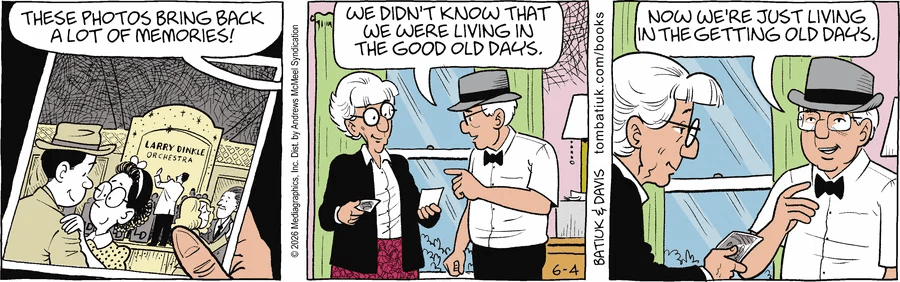
The “CrankShaft” story (titled “The Good Old Days, Getting Old Days”) reminds me in a funny way that I am getting old and nostalgic. Each day brings new pains and I cannot do as much as I did before, besides just getting older each day. And it’s only now that we realize how good we had it when we were young, without ever being conscious of how lucky we were. Carpe Diem ! Live in the present and enjoy every moment of it !

©2026 Mark Parisi Dist by Andrews McMeel

The “Off The Mark” story reminds us that the best cure to feeling down is to go out and exercise, surrounded by the beauty of nature. However, if we want to keep being able to make those regenerative walks, we have to take good care of our natural environment (Please Reduce, Reuse, and Recycle — also keep the park clean!). Sitting inside and staring at your phone is the worse thing you can do for your health. Believe me, there is nothing like a good walk in the park, looking at greenery, flowers, birds and other creatures!

Keep reading (even cartoons!) and keep learning. That’s the only way to constantly improve yourself. Ja ne !

Pictorial chronicles [002.026.213]

Le parc en juillet / The park in July

[ iPhone 17 Pro, Parc Frédéric-Back, 2026/07/19 & 31]

Juillet est le mois où le parc est à son plus coloré. On y retrouve de nombreuses fleurs, notamment des Échinacées, des Topinambours, des Monardes, et de la Carotte sauvage (dont le nom est tellement plus poétique en anglais: Queen Anne’s lace, ou dentelle de la reine Anne). On remarque que les ouvriers travaillent à l’aménagement d’une nouvelle section du parc, le Boisé Ouest, qui en sera la colline la plus élevée et qui devrait ouvrir en juin 2017. On note également que des Bernaches ont fait un retour dans le parc, probablement chassées par les incendies de forêts du nord. Le parc est donc à son meilleurs et il fait si bon s’y promener.

July is the month when the park is at its most colourful. There are many flowers there, including Echinacea, Jerusalem artichokes, Bergamot, and Wild Carrot (whose common name is so much more poetic: Queen Anne’s lace). We note that workers are working on the development of a new section of the park, the Boisé Ouest, which will be its highest hill and which should open in June 2017. We also note that Geese have made a return to the park, probably driven out by the forest fires in the north. The park is therefore at its best and it is so good to walk there.

Visite au musée [002.026.181]

La Grèce des Héros: Au temps de Troie

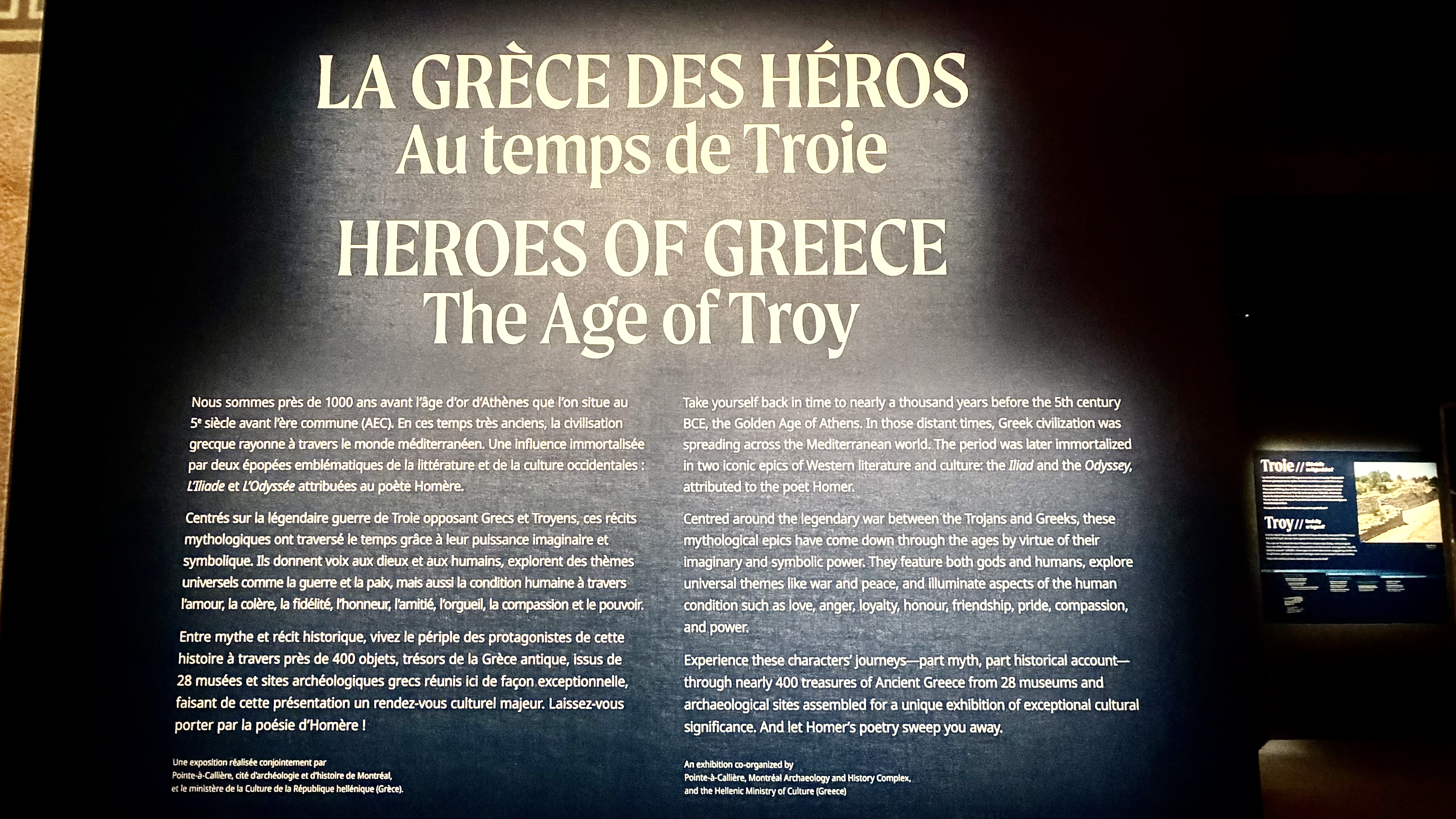
Nous sommes allé faire une petite visite à Pointe-à-Callière, le musée d’archéologie et d’histoire de Montréal, pour découvrir l’exposition “La Grèce des Héros: Au temps de Troie” qui y est présentée du 4 juin 2026 au 7 mars 2027. Elle nous offre près de 400 objets authentiques (et quelques reproductions) qui s’étalent de l’âge du bronze à l’âge du fer pour explorer les mythes et la réalité de l’âge des Héros autour de thèmes comme Homère et son oeuvre (lIliade et l’Odyssée sont les éléments principaux du cycle troyen), les villes de Troie (Ilion / Hisarlik) et de Mycènes (et la civilisation mycénienne), les Héros et les dieux. La guerre de Troie a-t-elle vraiment eut lieu ? Hélène, Achille, Hector, Agamemnon et Ulysse ont-il vraiment existé ? Probablement car, comme un historien le disait dans une vidéo de l’exposition, les mythes c’est comme la fumée: il n’y a jamais de fumée sans feu…

C’est une exposition intéressante avec beaucoup d’objets et de présentations audio-visuelles. Comme toujours à Pointe-à-Callière, c’est une exposition éducative qui offre aux jeunes des jeux et un cahier d’activités à compléter. Toutefois, je n’y ai rien trouvé  d’excitant. Il y a quelques pièces intéressantes, mais l’objet le plus iconique (le masque d’Agamemnon) est une reproduction… Cela vaut quand même la peine d’y faire une visite. J’y ai pris plus de deux-cent photos, dont en voici quelques unes:

Vocabulaire des descriptions: AEC, Zeus, Olympe, Pénélope, amphore, lébès, pyxide, skyphos, Acropole d’Athènes, Argilos, Andros, canthare, linéaire B, Palais de Nestor, Pylos, civilization minoenne, Henrich Schliemann, kylix, olpé, Penthésilée, Amazones, marbre pentélique, sirène. 

Pictorial Chronicles [002.026.172]

Joyeux solstice d’été ! / Happy summer solstice!

[ iPhone 13 Pro, Parc Frédéric-Back, 2022/07/15 ]

Champs de Rudbeckie / Field of black-eyed Susan (Rudbeckia hirta)

Le solstice d’été [EN] (aussi appelé solstice de juin ou solstice boréal) est le moment de l’année où le soleil est au zénith du tropique du Cancer et où la durée du jour est la plus longue. C’est un moment qui a de tout temps été célébré (du moins depuis le néolithique), sans doute pour des raisons agricoles (conjurer le mauvais sort, appeler à de bonnes récoltes et à la fécondité). Il revêt une grande importance pour les cultes solaires, mais aussi dans la plupart des religions du monde. À Rome, par exemple, les festivités consistaient surtout au festival Vestalia [EN]. Dans les cultures nordiques, on célèbre le “Midsummer” et le christianisme lui célèbre la Saint-Jean, caractérisée par de grands feux de joie qui rappellent de façon non équivoque le feu sacré des cultes solaires ou des Vestales. [Pour plus d’infos lire HistoryIn Rome With UsNuncSmithsonian Mag]

Images du chat-medi [002.026.171]

Haïku Félicien

Félix, le combattant balafré
Félix, adorable sac à puces
Félix, éternel gardien du jardin

Félix nous a finalement quitté. Lui qui était la preuve vivante que les chats ont neufs vies. Il est maintenant soulagé des peines et misères qui l’affligeaient. Puisses-t-il avoir enfin atteint la félicité. Tu nous manquera malgré tout…

The B5 curse

After hearing Lorien tell Sheridan (S04, Ep05) that reanimating him had cut his life short and that he had only twenty more years to live, making him die in his sixties, I just realized, by total chance, that half the main actors of the Babylon 5 series did die in their sixties (well, many of them anyway) !

Still alive are:

Apparently, I am not the only one to think this weird… I guess that fighting the Shadows was quite unhealthy !

Binge watching

Several years ago, I was bored and there was nothing notable on TV, so I started watching again the entire new series of Battlestar Galactica (2003-2009, 76 episodes). Last year, my mind needed to escape reality a little, so I watched again the entire series of The Expense (2015-2019, 62 episodes). It was so great ! They don’t do TV series like that anymore (save maybe on Apple TV, but series are too short and are released too slowly).

Now, I just started watching Babylon 5 again (1993-1998, 110 episodes). It’s a bit older, and it shows in the quality of the graphics, but it’s great nonetheless. That should keep my mind busy for a while…

I am wondering what I should watch again when I am done with B5. Maybe Game of Throne (2011-2019, 73 episodes) ? Unless, by that time, I am able to start this Anime old-timers’ Club I’ve been thinking about. I am quite eager to watch anime again, but I find it a little sad to watch by myself. So far, no volunteers have come forward, but I’ll see if I can meet interested people at Otakuthon… I surely would like to watch again series like Mospeada, Orguss, Kimagure Orange Road, Gundam, Star Blazers, etc. Or I might start just by myself. We’ll see… Anyone ?

Memoria maiorum

J’ai récemment acquis une peinture que j’aimais bien. Ma soeur en avait hérité au décès de ma mère et, comme elle faisait du ménage pour réduire un peu ses biens, elle me l’a transmise. Elle a été peinte par une “cousine” de ma mère, Clémence Gélinas Gauthier (1925-2015; parente, étrangement, non par les Gauthier — qui était le nom de famille de son mari — mais par les Gélinas). Elle avait entreprise la peinture comme passe-temps et démontrait un certain talent. Toutefois, cette peinture (et une autre avec un sujet similaire) représente beaucoup pour moi. Ce n’est pas seulement une peinture exécutée par une “tante”, mais aussi un important souvenir de la terre de mes ancêtres.

Selon ce qu’a écrit ma mère dans son livre Le tour du Québec en 70 ans: récit de Laure Gauthier, avant de prendre sa retraite en 1983, mon père avait décidé de travailler comme preneur de son sur un dernier film — une série documentaire de l’Office National du Film comportant cinq court métrages intitulée Le coeur et le riz tournés au Bangladesh par Michel Régnier — afin de voir s’il serait intéressé à reprendre son métier dans l’entreprise privé une fois à la retraite. À la fin du tournage, en mai 1983, ma mère est allé le rejoindre en Europe et, pendant six semaines, ils ont visité les lieux d’origines de nos ancêtres : Apt-en Provence (pour les Carbonneau), Rouen (pour les Gauthier), Saintes (pour les Gélinas), Lisieux (pour les Labelle), Chenehuttes-les-Truffeaux (pour les Lemay), et, finalement, le Perche (pour les Pelletier). Ils rapportèrent de ce voyages de nombreuses photos, et “tante” Clémence s’en inspira pour immortaliser en peinture deux de ces lieux ancestraux.

La Cristerie

La Cristerie, Peinture de Clémence Gélinas Gauthier (1925-2015)

Cette peinture est la première que j’ai acquise, en 2017, au décès de ma mère. Elle représente La Cristerie, la maison ancestrale de Guillaume Pelletier, à Brésolettes (Orne). En fait, c’est la maison de son père, Éloy. C’est là où il est né en 1598 et où il a habité jusqu’à son mariage à Michelle Mabille en février 1619.

La Cristerie est une maison de ferme probablement construite durant ou avant le XVIe siècle. Elle est situé dans la commune de Brésolettes, à environ cinq kilomètre au nord de Tourouvre, dans la Forêt domaniale du Perche et de la Trappe (dans la clairière de Bresolettes), sur la Route de la Clairière de Bresolettes.

Par la suite, Guillaume Pelletier ira s’établir dans le compté de Tourouvre proprement dit, à La Gazerie, le village natale de sa femme.

Église Saint Aubin de Tourouvre

Église Saint Aubin, Peinture de Clémence Gélinas Gauthier (1925-2015)

Cette peinture-ci, je l’ai acquise il y a quelques semaines. Elle représente l’Église Saint Aubin située sur la Place Louis Debray (au 15, rue du 13 Août 1944) à Tourouvre (une commune de l’arrondissement de Mortagne-au-Perche, dans le département de l’Orne en Normandie). C’est dans cette église datant du XVe siècle (mais reconstruite plusieurs fois entre le XVe et le XVIIIe siècle, et où l’on retrouve des vitraux du XVIe siècle mais aussi du XIXe siècle, commémorant l’émigration en Nouvelle-France et la visite d’Honoré Mercier), que Guillaume Pelletier et Michelle Mabille se sont mariés en 1619, et où leurs enfants (Claude [né le 11 février 1622], Guillaume [né le 26 février 1624] et Jean [né le 12 juin 1627]) ont été baptisés.

En étant originaire de la Forêt du Perche, Guillaume était tout naturellement un travailleur du bois: bûcheron, vendeur de bois et charbonnier. Toutefois, le système féodal rends la vie dure au paysan français, déjà à la merci des saisons, qui ne cesse de s’endetter sous les nombreuses taxes et impôts (cens, taille, dîme, gabelle, etc.) et toujours contraint par les multiples restrictions de l’Ancien Régime. Ainsi, après avoir entendu l’offre des frères Noël et Jean Juchereau, représentants de Robert Giffard de Mortagne qui recrutait des gens pour développer des terres en Nouvelle-France, Guillaume ne pu résister à l’appel de la liberté et à l’idée de posséder sa propre terre hors du joug de l’Ancien Régime.

En mars 1641, après le décès de sa belle-mère, Guillaume vends donc ses possessions de Tourouvre et prends la route de La Rochelle avec son épouse, son frère Antoine et son cadet, Jean, seul survivant de ses trois fils. Là, il monte à bord d’un navire pour la Nouvelle-France. Après s’être engagé comme artisan (scieur de long, charpentier et charbonnier), il peut enfin, trois ans plus tard, en avril 1644, acheter sa propre terre à Beauport. Il la cède d’abord à son frère Antoine, mais il la reprends après la mort par noyade de ce dernier, son canot s’étant renversé aux abord des chutes Montmorency le 3 octobre 1647. Guillaume n’y sera pas juste un paysan et un ouvrier, car il sera aussi un membre respecté de sa communauté. En effet, le Journal des Jésuites nous apprends qu’il est nommé syndic adjoint de la Communauté des Habitants de la Nouvelle-France le 9 août 1653. Il mourra quelques années plus tard, chez lui à Beauport, le 28 novembre 1657 à l’âge de cinquante-neuf ans.

Quand à son fils Jean, il n’a que quatorze ans lorsqu’il arrive en Nouvelle-France. Il travaille probablement au côté de son père. En 1646, à l’âge de dix-neuf ans, il se met au service des Jésuites comme “donné”. Ses parents reçoivent cent francs pour sa première année et il est habillé tout de neuf. Il accompagne le Père Jérôme Lalemant d’abord à Trois-Rivières, puis jusqu’en Huronie, dans la Baie Georgienne, pour y établir le Fort de Sainte-Marie-des-Hurons. De retour à Beauport l’année suivante, il se fiance à Anne Langlois, mais ils doivent attendre deux ans pour qu’elle soit en âge de se marier (douze ans). La mariage est célébré à Québec le 9 décembre 1649. Ils auront sept enfants et Jean meurt en février 1698, à l’âge de soixante-et-onze ans, à Sainte-Anne-de-la-Pocatière. Il est enterré à la Rivière-Ouelle. Son fils Charles (1671-1748) reprendra sa terre de Saint-Roch et perpétuera la famille en ayant quinze enfants (sur deux mariages, dont le second avec Marie-Barbe Saint-Pierre). Viendront ensuite Pierre (1731-1797), Jean-Baptiste (1765-1825), Zéphirin (1805-1854), Louis-Elzéar (1836-1905), Jean-Baptiste (1864-1930), Jules-Alphonse (1891-1964), Claude-Eugène (1928-2015) et moi-même…

Bibliographie

  • GAGNON, Marie-Paul. Conduit par l’étoile (Récit historique romancé). La Pocatière: La Ferrée-Pinguet, 2000. 162 p.
  • GAUTHIER, Laure. Le tour du Québec en 70 ans: Récit de Laure Gauthier. Laval, 2001. 146 p.
  • MONTAGNE, Mme Pierre. Tourouvre et les Juchereau. Québec: Société Canadienne de Généalogie, 1965. 192 p. [WorldCat]
  • PELLETIER, Maurice. Guillaume Pelletier et son fils Jean. Montreal, 1976. 24 p. (Tiré-à-part des Mémoires de la Société Généalogique Canadienne Française, vol. XXVI, no 4, 1975). [WorldCat]


To live or to exist, that is the question

Pearl Before Swine (The Gazette, 2024/10/25 A12) 10/25 © 2024 Stephen Pastis / Dist. By Andrew McMeel Syndication.

This is the million-dollar question… and it’s haunted me ever since I read it. Have I truly lived, or have I merely existed? I have serious doubts about this. I see two sides to it. On the one hand, we have truly lived when we have a “fulfilling” (socially) life that leaves us serene and happy. On that front, I’m not so sure I’ve succeeded. On the other hand, we have truly lived if we have a sense of accomplishment, of having achieved things, of having contributed to society. On that front, I’ve made a lot of effort, and I believe that everywhere I’ve been, I’ve left my mark. I probably won’t be remembered for generations, but I’m still satisfied with my accomplishments

Ceci est la question qui tue… et qui me hante depuis que je l’ai lue. Ai-je vraiment vécu  ou ai-je simplement existé ? J’ai un grand doute à ce sujet. J’y vois deux aspects. D’une part, on a vraiment vécu quand on a une vie “bien remplie” (socialement) qui nous laisse sereins et heureux. De ce côté, je ne suis pas si sûr d’avoir réussi. D’autre part, on a vécu si on a un sentiment d’accomplissement, d’avoir réalisé des choses, d’avoir contribué à la société. De ce côté, j’ai fait beaucoup d’efforts et je crois que partout où je suis passé j’ai laissé ma marque. On ne se souviendra probablement pas de moi pendant des générations, mais je suis quand même satisfait de mes accomplissements

Anime Old-timer’s Club

In preparation for my retirement in a year, I’ve been going through old stuff and thinking about how I will spend and organize my time. Of course, it really means falling back on the trio of my old subject of interests: science-fiction literature, Roman history and Japanese culture (mostly anime & manga).

Strangely, thinking about the old days made me quite nostalgic of those simpler times when I was “holding salon” and entertaining guests in a regular basis to watch and discuss anime. I REALLY miss watching anime. However, I feel that watching anime by myself would be sad and pathetic…

So… I’ve been thinking about going back to conventions to reconnect with the fandom. And also forming a group of old-timers like me who would gather periodically (every week or month) to watch (or rewatch) old anime and discuss them. Anime from the golden age (the 80s and 90s), but also more recent stuff (if there is anything good). It is much easier to find these days. I happen to have a HUGE collection of DVDs and there are plenty of stuff to watch on streaming sites like Crunchyroll and RetroCrush.

It would need to be a small and select group (three or four people, because my salon is not very big). If you are an old-timer (or someone of any age, but interested in old anime), living in the Montréal area, and would be interested in participating, please contact me (in the right column of the blog, there is a series of social media links, including email).

Club des Anciens Fans

En prévision de ma retraite dans un an, je me suis replongé dans mes vieilles affaires et j’ai réfléchi à la façon dont j’occuperai mon temps. Bien sûr, cela signifie surtout me replonger dans mes trois passions de toujours : la science-fiction, l’histoire romaine et la culture japonaise (principalement les animés et les mangas).

Étrangement, repenser à cette époque m’a rendu nostalgique de ces moments plus simples où je “tenait salon,” recevant régulièrement du monde pour regarder et discuter d’animés. Les animés me manquent énormément. Cependant, regarder des animés seul me paraîtrait triste et pathétique…

Du coup… j’envisage de retourner aux conventions pour renouer avec le milieu. Et aussi de former un groupe de vieux fans comme moi, qui se réuniraient régulièrement (chaque semaine ou chaque mois) pour regarder (ou revoir) de vieux animés et en discuter. Des animés de l’âge d’or (les années 80 et 90), mais aussi des productions plus récentes (s’il y en a de bonnes). C’est beaucoup plus facile à trouver de nos jours. J’ai une énorme collection de DVD et il y a plein de choses à regarder sur les plateformes de streaming comme Crunchyroll et RetroCrush.

Il faudrait un petit groupe limité (seulement trois ou quatre personnes, car mon salon n’est pas très grand). Si vous êtes un fan de longue date (ou quelqu’un de tout âge qui s’intéresse aux vieux animés), que vous habitez dans la région de Montréal et que vous souhaitez participer, n’hésitez pas à me contacter (vous trouverez des liens vers mes réseaux sociaux, y compris mon adresse courriel, dans la colonne de droite du blog).

Pain is my friend

You’ve probably noticed that I often talk about pain. At my age, it is normal to always feel pain somewhere on your body. Someone once said that if old people wake up in the morning and don’t feel any pain, it’s because they’re dead.

However, it has been worse lately. With all the freezing and unfreezing due to the yo-yo temperature around the zero-degree Celsius, we had lately (it seems after all that Groundhog Day should have predicted six more weeks of winter) there is often ice on the ground. The snow melt and then the water refreezes. It is most dangerous when it snows again. Last week, a fine layer of snow was covering some ice. I was careless. I was in a hurry. I was taking a short cut through the park near my work, and I slipped on a patch of ice hiding beneath the snow. I didn’t fall. It’s always worse when you don’t fall. I caught myself with a complex equilibrium movement, but my left foot was left behind in an awkward position and I twisted my ankle. It was quite painful for several days, but quickly diminished.

That accident must have unknowingly caused more injuries, because last weekend, when I was simply picking up a garbage bag on the floor, my back exploded in an electric shock of pain and I couldn’t walk straight anymore without excruciating pain. Since then I’ve been careful, put heat, taken anti-inflammatory & pain reliever as well as doing light exercise. Every day there was a slight improvement with less stiffness and easier movements, but it’s been a week now and I’m still not fully recovered and still in pain… I feel (and walk) like I’m eighty! I just need to be patient.

I also must learn to live with my pain. I’ve created this “litany against pain” (inspired by the Dune’s Bene Gesserit Litany Against Fear): Pain is my friend. I will face my pain. I must not let the pain change the way I do things. I will use my pain to keep a clear mind. And when the pain has gone, I will remain active…

I can’t wait for spring and warmer weather when I can walk in the park without feeling stiff and pain being just an afterthought… 

A day at the museum [002.026.074]

Torlonia Collection

The Collection

The Torlonia Collection is probably the biggest private collection of ancient art in the World. It was gathered in the 19th century by a family of rich ennobled Italian bankers, the Torlonia, through the acquisitions of other collections and archaeological digs on their own estates. To showcase the collection’s 620 sculptures, Prince Alessandro Torlonia founded the Torlonia Museum in 1875. The museum closed during WW2 and the collection was put in storage in 1960. It was therefore out of the public sight for a very long time. Following an agreement with the Italian government, the Torlonia Foundation was created in 2014 to conserve and promote the collection and a new museum was opened in 2016.

A special selection of the collection, comprising nearly sixty pieces (only one-tenth of the collection!), was gathered for a travelling exhibition. It was first exhibited at the Villa Caffarelli of the Capitoline Museum of Rome from 14 October 2020 to 27 February 2022. Then it went to the Gallerie D’Italia in Milan (from 25 May to 18 September 2022), to the Louvres Museum, in Paris (France), from 26 June 2024 to 6 January 2025, to the Art Institute of Chicago (from 15 March 2025 to 29 June 2025) and the Kimbell Art Museum, in Fort Worth (Texas), from September 14 2025 to January 25 2026. It is now shown at the Montreal Museum of Fine Art from 14 March to 19 July 2026, after which time the exhibition will return to Italy.

“Statue of Leda and the Swan” composition; the “modern” additions are in dark blue

The first room introduces us to the collection as well as to the conservation and restoration work done by the Laboratori Torlonia. A great emphasis is put on the fact that most ancient sculptures were not found complete and some restorative work was done on them at some point. Each descriptive panel clearly shows for each piece that the sculpture combines ancient and later elements (characterized as “modern”, the restoration could date from the Renaissance or the 18/19th century). Sometime, it even includes parts of another ancient work that was not originally related to the sculpture. For example, on the Germanicus statue (the only bronze work of the collection), both arms, the right leg and its draped stump support as well as the head are all “modern” restorative additions. In the case of the “Statue of Leda and the Swan”, the head, both arms, the cloth, the left foot as well as the head of the swan are also later additions.

Funerary statuary

The next room shows how the Romans used art (monuments and sculptures) to commemorate the death of their loved ones. We particularly note the statue of a couple holding hands, the funerary monument of a fourteen year-old boy, and two sarcophagi illustrating the labours of Hercules, one with a lid depicting a reclining couple.

“A population of statues”

The Romans surely loved their sculptures as they were everywhere in their cities and their homes. They were not only the expression of the Romans appreciation for art, but also a form of visual communication. Monuments, reliefs and statuary were used for advertising, for commemoration, for showing off one’s status, and also for political propaganda. Today, they can also tell us a lot about the Roman culture: their clothing, hairstyles, beliefs, occupations, architecture, etc. Statuary is not only beautiful, it is also, in many ways, useful. Notable are a statue of a youth and, particularly, the Portus relief which was probably a votive offering from a merchant to bring good luck. It depicts in detail the harbour of Portus, with its building (the lighthouse!) and ships, as well as many auspicious symbols and protective deities, and still shows some traces of polychromy.

Imperial portraits

For me, one of the most interesting aspects of Roman sculpture is the imperial portraits. They are usually an idealized portrait of the emperor which (along with coinage) serves the imperial propaganda by making the emperor easily recognizable and promoting his greatness. This exhibition uses them to explain the strategies of succession, where emperors use strategic adoptions and marriages to ensure their dynastic continuity. Notable are the portraits of Augustus, Marcus Aurelius, Lucius Verus, Crispina, Commodus, Septimius Severus, young Commodus and Julia Domna.

Lucius Verus

I would be lying if I was not admitting that the main reason for me to visit this exhibition was not to see the bust of the emperor to whom I dedicated seven years of higher education. It is really nice to be able to see this bust of Lucius Verus in Montreal. However, the Torlonia Collection holds another bust of Verus that is unfortunately not part of this exhibition. It is sad because it is a beautiful one: an antique black marble head on a “modern” alabaster bust with armour and paludamentum coming from the Giustiniani Collection (MT 350). I was also hoping to see a relief from the Palazzo Giraud-Torlonia depicting a Clementia scene where Verus stands with a kneeling barbarian, probably coming from a triumphal arch or the arch of Divus Verus. I have never seen it and it was not part of the exhibition (it’s not even mentioned in the collection’s catalogue).

Realism of life

One characteristic of Roman sculpture, in opposition to its Greek counterpart which tended to be more formal and sober, is that it depicts life with great realism and even, sometimes, a little extravagance. Whether they represent children (often as gods or with animals), a goddess or old men, the body and facial features are realistic and includes genitals, love handles, wrinkles and warts. Also, contrary to common belief, the statuary was never plain white marble, but was generally painted with rich and vivid colours, of which we can sometimes still find traces. Notable are the statues of Cupid and Psyche, a boy with dogs, crouching Aphrodite, the old man of Otricoli and Euthydemus of Bactria.

The Myths & Gods

Another thematic very popular in sculptures is the depictions of myths and gods: the labours of Hercules, Leda and the Swan, the Mithraic mysteries, the personification of the Nile, Apollo, Aphrodite, Artemis Ephesia (with her multiple breasts) or Athena.

Conclusion

I’ve been waiting to see this exhibition for several months now and I am really glad it is finally here. I intend to go visit several times. It is a unique chance to see this exceptional collection and to be able to appreciate Roman sculptures without having to travel far. Of course, I am a little disappointed that the exhibit didn’t include more imperial portraits (particularly of Lucius Verus). Also, despite having studied ancient history, I am quite surprised (and disappointed) to discover that those superb pieces of art are largely made of restorations (I wouldn’t say they are “fake”, but the vision of the original artist might have been distorted by the perception that we had of it in the Renaissance or the 19th century). I knew that noses, fingers and genitals often had to be recreated or that sometimes heads were swapped, but I never imagine that the restoration work was so extensive.

Nevertheless, this is an exceptional exhibition that everyone interested in art or ancient history must see. The Torlonia Collection: Masterpieces of Roman Sculpture exhibition takes place at the Montreal Museum of Fine Arts until July 19, 2026. Don’t miss it.

Mediagraphy

For further information, you can consult those web sites:

  • Wikipedia: Torlonia Family [FR / EN / IT], Torlonia Collection [FR / EN], Alessandro Torlonia [FR / EN / IT], Torlonia Museum [FR / EN / IT].