Anime & manga update [002.026.297]

Japanese culture update 

NHK World Japan documentary series continue to be a great source of information about Japanese culture, history and life — including popular culture like anime and manga. Here are some interesting Video On Demand (VOD) that I have recently noticed.

Manben

The latest episode of the documentary series “Manben: Behind the Scenes of Manga with Urasawa Naoki” is dedicated to Sugimura Shinichi. “Manga artist Urasawa Naoki takes you behind the scenes of how manga is made with guest Sugimura Shinichi. Learn Sugimura’s digital drawing techniques as he works on the climax of Last Pleasure Boat.” This episode was broadcast on October 23, 2026 and will be available as VOD only  until October 31, 2026. Fascinating! You better watch it fast !

Detective Conan Special

I’ve recently watched a rerun of an interesting episode of the documentary series Anime Manga Explosion dedicated to the popular Gosho Aoyama manga and anime. “This episode spotlights Detective Conan, a mystery series loved for more than 30 years. We introduce the appeal of the original manga and go behind the scenes of the anime’s production, exploring how mysteries are adapted for animation and how the characters are designed with respect for the source manga. We also follow the scenario meetings where the anime’s original stories are created, and highlight the dedication of the staff behind this long-running series.” This episode was originally broadcast on July 25, 2026 and will be available as VOD until July 25, 2027. 

Iki: The Aesthetic of Edo

In this episode of the documentary series Spiritual Explorers, “Our explorer gains an insight into “iki,” a unique aesthetic cultivated by the people of Edo, now known as Tokyo. Defined by modesty and compassion, it endures to this day.” This episode was originally broadcast on August 19, 2026 and is available as VOD until August 19, 2027.

Venice 2026 & Focus on Tanaka Kinuyo

The latest episode of the documentary series J-Flicks is dedicated to this year’s Venice Film Festival and offers a focus on Tanaka Kinuyo. “We check out “Look Back” by KOREEDA Hirokazu and TSUKAMOTO Shinya‘s “Mr. Nelson, Did You Kill People?“, both screened at the Venice Film Festival, and the classic “Love Letter” by TANAKA Kinuyo.” This episode was broadcast on October 17, 2026 and is available as VOD until January 17, 2027.

And some news from Anime News Network:

Passeurs culturels

J’ai récemment reçu les épreuves d’un nouvel article qui parle de moi.

Suite au colloque sur l’internationalisation de la BD auquel j’ai participé en mai 2024 et où s’est tenu la table ronde “Initier la vague anime et manga”  — qui avait déjà résulté en un interview sur le blogue de Bounthavy Suvilay, enseignante et journaliste française — cette dernière a écrit un nouvel article à mon sujet, intitulé “Transfert culturel du manga : Toren Smith et Claude J. Pelletier, les passeurs du Canada.” Cet article paraîtra bientôt dans le No 64 de la Revue internationale d’études canadiennes, publiée par la University of Toronto Press. 

La sortie de ce numéro annuel est prévue pour l’automne 2026. Malheureusement, je ne crois pas que ce soit une revue qui ait une grande diffusion. Le site de la revue mentionne qu’il est possible de s’abonner ($79.00 pour un numéro !), mais les articles des numéros précédents semblent disponibles en ligne. La revue n’apparaît pas dans les catalogues des bibliothèques de la Ville de Montréal, ni de la BANQ. Toutefois, selon WorldCat, elle se retrouve dans la plupart des bibliothèques universitaires (Concordia, McGill McLennan, UdeM, UQAM).

De toute façon, je suis presque gêné d’être comparé à Toren Smith qui a tant fait pour la diffusion de l’anime et du manga en Amérique du Nord. Mais, bon, c’est l’œuvre d’une vie, alors j’imagine que je dois l’assumer… C’est vrai que le magazine Protoculture Addicts (et plusieurs autres de mes projets) ont grandement contribués à faire connaître l’anime et le manga, et que ce fut un travail de pionnier qui a eut une certaine influence, mais cela n’est pas du tout au même niveau de ce qu’a accompli le regretté Toren Smith. Et je n’ai rien fait tout seul. Cela a toujours été le travail d’une équipe. Je me vois surtout comme un chef d’orchestre… C’est néanmoins toujours réconfortant de voir son dur labeur reconnu.

Voici donc le résumé de l’article en question:

“Cet article examine le rôle central des passeurs culturels dans la diffusion et l’appropriation du manga et de l’anime en Occident, à travers les parcours de Toren Smith et de Claude J. Pelletier. Le premier a traduit et édité des mangas emblématiques, tandis que le second a créé un réseau d’information spécialisé, contribuant à la reconnaissance du manga hors du Japon, au Canada. L’analyse révèle les mécanismes de sélection, d’adaptation et de médiation qui ont permis ce transfert culturel. Les choix éditoriaux de ces intermédiaires reflètent leurs préférences personnelles et les tendances de la culture jeune nord-américaine. Leurs efforts ont non seulement rendu ces œuvres accessibles, mais ont aussi favorisé leur appropriation, donnant naissance à des créations hybrides inspirées du manga et de l’anime.”

Abstract: 

“This article examines the central role of cultural intermediaries in the dissemination and appropriation of manga and anime in the West, through the trajectories of Toren Smith and Claude J. Pelletier. The former translated and edited iconic manga, while the latter created a specialized information network, contributing to the recognition of manga outside Japan, specifically in Canada. The analysis reveals the mechanisms of selection, adaptation, and mediation that made this cultural transfer possible. The editorial choices of these intermediaries reflect both their personal preferences and the prevailing trends in North American youth culture. Their efforts not only rendered these works accessible but also fostered their appropriation, giving rise to hybrid creations inspired by manga and anime.”

Lorsque l’article sera publié, et s’il est disponible en ligne, j’en ajouterai ici le lien.

Anime & manga update [002.026.283]

Japanese culture update 

NHK World Japan documentary series continue to be a great source of information about Japanese culture, history and life — including popular culture like anime and manga. Here are some interesting Video On Demand (VOD) that I have recently noticed.

Anime Studio: Toei Animation

This new episode of the documentary series Anime Manga Explosion introduces us to one of the main anime studio of Japan. “This episode spotlights TOEI ANIMATION, an anime studio marking its 70th anniversary. We trace the studio’s history, beginning with the story behind The White Snake Enchanteress, Japan’s first full-color feature-length animated film. We then follow Mazinger Z, which helped create a new business model for Japanese anime, and Dragon Ball, which carried Japanese anime around the world. Finally, we step inside production on the studio’s current series, One Piece, to see the craft behind the animation.” This episode was broadcast on October 9, 2026 and will be available as VOD only until October 17, 2026.

Anime Journal

This is a new documentary series about anime fandom. “This new program digs deep into what overseas fans loved about the anime released this year and how the translators of one anime, Akane-banashi, approached its traditionally Japanese subject matter.” This episode will air on October 14, 2026 (12:30 AM, 04:30 AM, 12:30 PM, 7:30 PM).

Deep Dive with Hideo Kojima

The documentary series Game-Genome explores the inner workings of video games. This episode is about Death Stranding. “Half a century since the birth of video games, we explore how legendary titles have shaped our ideas and created a new culture. “DEATH STRANDING” won new plaudits for its uncanny predictions of our experiences during the pandemic. Program guests share their love for the game, and why it’s captivated so many. Renowned developer Hideo Kojima guides us on a deep dive into his creation and explores his inspiration and motivations. A special, expanded episode with new footage in response to the reaction to the original broadcast.” This episode was broadcast on June 24, 2023 and is available as VOD until September 5, 2027.

Mother 2 (EarthBound)

Another episode of the documentary series Game-Genome. “MOTHER 2 is a classic RPG known internationally as EarthBound. Its creator, Itoi Shigesato, joins longtime fans to discuss how the game was made, revealing secrets behind its lasting popularity.” This episode was broadcast on September 12, 2026 and is available as VOD until September 12, 2027.

Some more news from Anime News Network:

And one more thing …

A dear friend, from the Protoculture days, brought to my attention this AI re-edit of the first episode of Robotech Macross, “Boobytrap”. It is a perfect transposition of the anime into a “live-action“ produced by AI. That’s quite something. Exploring on this subject, I also found on Youtube this AI-produced “live-action” titled  Macross Robotech The Movie: The Future Meets The Past. It seems to be in several parts (here another one). It tells a different story using the Robotech characters. Interesting. Is this the future of movies ?

Anime & manga update [002.026.277]

Japanese culture update 

NHK World Japan documentary series continue to be a great source of information about Japanese culture, history and life — including popular culture like anime and manga. Here are some interesting Video On Demand (VOD) that I have recently noticed.

White Flag: Mizuki Shigeru and the War

This episode of the “Documentary 360” series is about Mizuki Shigeru. “Manga artist Mizuki Shigeru’s masterpiece “White Flag” comes to life as an anime. His story was based on a WWII soldier who defied his superiors to protect his men. What truly happened on “Iwo Jima”?” This episode was broadcast on September 11, 2026 and is available as VOD until September 11, 2027. A GREAT documentary !

Bread

This episode of the short documentary series “Japan Delish” is about Japanese bread.  “Ever heard of an-pan?! From fruit sandwiches to curry-filled delights, Japanese bread is full of delicious surprises!” This episode was broadcast on December 6, 2025 and is available as VOD until December 5, 2026.

Sake Truth

This episode of the documentary series “Time and Tide” is about sake.  “Sake is gaining attention worldwide for its rich and complex flavors. We explore various aspects of Japan’s national drink, from the koji that determines the flavor to medieval innovations that laid the foundation for sake-making today. We also shine a light on heated sake, or kanzake, and examine the science behind how heat affects its flavor profile.” This episode was broadcast on December 19, 2025 and is available as VOD until December 19, 2026.

Some more news from Anime News Network:

And one more thing …

I forgot. I wanted also to mention this book just recently released in English. It is described as: “In this captivating collection of dialogues, renowned manga artist, writer and painter Mari Yamazaki and art historian Nicole Coolidge Rousmaniere — lead curator of the Art of Mangaexhibit at the de Young Museum and The Brooklyn Museum — explore the patterns of human history to find a roadmap for optimism in the modern world.” (Contributors includes one of my favourite mangaka and one of my favourite translators !) [2026/10/05]

  • YAMAZAKI Mari & COOLIDGE-ROUSMANIERE Nicole  (Translated by Frederik L. Schodt & Beth Cary). Happiness Theories; A Manga Artist & An Art Historian Find Wisdom in 3,000 Years and in LIFE. Shueisha, sept. 2026. 228 pg. $24.99. 979-8-950818-07-3 [Amazon • Goodreads • Les libraires]

Anime & manga update [002.026.249]

Japanese culture update 

NHK World Japan documentary series continue to be a great source of information about Japanese culture, history and life — including popular culture like anime and manga. Here are some interesting Video On Demand (VOD) that I have recently noticed.

Again, not much news about anime & manga this week, but there is always something interesting about Japanese culture. Now, let’s talk about food. 

In North America, we don’t think much about the use of fermentation to produce food, even though we use it constantly to process beer, bread, cheese, kombucha, wine, yogurt, etc. However, in Japan, they take this process very seriously. Much more of their food uses fermentation (for example in gyoshō, miso, nattō, sake, shōchū, shōyu, etc.).  It was long used not only to preserve food, but also to enhanced its flavour. The funny thing is that I discovered this fact while watching an anime: Moyashimon (about which my wife and I wrote a very interesting article in PA #96: 52-55; the series is available on Crunshyroll; it is based on a manga and has also spawn a live-action TV drama series).

I was reminded of all this while watching an episode of the NHK World Japan documentary series Trails to Oishii Tokyo:

Japan’s Fermented Foods Go Global

“More than just a longer shelf life, Japan’s fermented foods offer enhanced flavor and nutrition. Unlock secrets to the culture’s longevity, starting with koji mold cultivation that dates back 600 years. Get an inside look at how the foods are taking the world by storm as we join a miso workshop in Paris and view the largest sake brewery in the U.S. Introducing Japanese fermentation—the foundation of the island nation’s renowned cuisine.” This episode aired on August 19, 2023 and will be available as VOD only until September 11, 2026. Better hurry watching it !

However, the Trails to Oishii Tokyo series offers many more interesting food documentaries:

Shiso

“Shiso: a Japanese herb gaining fans worldwide. Refreshing shiso is key in Japanese cuisine, which features a lot of raw fish. See how shiso’s leaves, flowers and seeds are all used in oishii dishes.” This episode was broadcast on August 28, 2024 and is available as VOD until September 1, 2027.

Japanese Frozen Foods

“Japan is now a frozen foods powerhouse. Cutting-edge technology and producers’ passion keep the hits coming. Dive into the world of Japanese frozen foods that are turning the world upside down.” This episode was broadcast on August 7, 2026  and is available as VOD until August 7, 2027.

Gourmet Canned Food?!

“Canned food is no longer just for storage or emergencies — it has become fine cuisine. Join us in this special episode as we explore the frontlines of Japan’s uniquely evolved canning industry.” This episode was broadcast on October 17, 2025 and is available as VOD until May 15, 2027.

Some more news from Anime News Network:

Anime & manga update [002.026.234]

Japanese culture update

NHK World Japan documentary series continue to be a great source of information about Japanese culture, history and life — including popular culture like anime and manga. Here are some interesting Video On Demand (VOD) that I have noticed this week.

Comiket

Our Comiket’s History: 50 Years of Love : “First held in 1975, Comiket has long shaped Japan’s creative culture from manga and anime to games and cosplay. The committee, exhibitors, volunteers, fans, and cosplayers share their devotion to it.” This episode was originally broadcast on April 25, 2026 and will be available as VOD until April 25, 2027.

National Museum of Japanese History

Japanese Life and Culture: A Journey Through 37,000 Years ~National Museum of Japanese History~ : “The National Museum of Japanese History boasts a vast collection that traces everyday life and culture through Japan’s history. Andy [Pompilio] and Shaula [Vogue] will travel through time to explore life, culture, and the wisdom and spirituality of Japan.” This episode was originally broadcast on December 5, 2025, with an edit on Jan. 27, 2026; it will be available as VOD until December 5, 2026.

Tokyo National Museum

Explore the Tokyo National Museum : “The Tokyo National Museum is home to a collection of some 120,000 objects of beauty and interest, mainly Japanese art and craft pieces along with work from the Asian mainland and historical artifacts. The museum houses 89 items deemed by the Japanese government to be of especially high value and designated as national treasures. Paying a visit to this historic museum that is celebrating its 150th anniversary are Andy [Pompilio] and Shaula [Vogue], hosts of NHK WORLD-JAPAN’s popular program DESIGN TALKS plus. They marvel at the majestic building, visit an exhibit that offers insights into 30,000 years of creativity in Japan, and revel in the first ever exhibit of every national treasure in the museum’s possession — an experience that will surely make art aficionados across the world jealous. The two also get a glimpse of the future of museums, experiencing high-definition imagery, 3D computer graphics, and other cutting-edge digital technology. Come join us on this 50-minute adventure exploring the Tokyo National Museum, something not to be missed by anyone visiting the metropolis.” This episode was originally broadcast on January 7, 2023  and will be available as VOD until January 24, 2027.

Other notable news

Anime & manga update [002.026.228]

Anime & manga update

NHK World Japan continues to be a great source of information about Japanese culture with their documentary series. This time nothing much to report about anime and manga in itself, but I’ve seen several interesting documentaries about Japanese culture, history and life.

Sugamo Diary

From the “Broadcasters’ Eye” series, “Sugamo Diary: The Life of a Class B/C War Criminal” is an anti-war documentary about the diary of a Japanese war criminal. “Near the end of World War II, a Japanese soldier executed four American POWs. A year later, he was sent to Sugamo Prison and sentenced to death. His six-year diary offers a personal reflection on war.” Toji Kentaro was a young man with a sharp mind. He accepted his fate. He understood that the Japanese had a collective responsibility for the war (Japan being the aggressor and the people passively agreeing with its military) and that he was wrong to have killed prisoners. However, they would have been killed anyway, whether he was the executioner or somebody else. He was angry, because he had just found out that his mother was killed in the bombardment. And those airmen were responsible for it, so he volunteered to behead them. After all, they were themself criminals, having just bombed civilians. Also wasn’t the court hypocritical to condemn him to death for having killed those soldiers, who had just killed his mother ? Where does “Justice” stops ? An incredibly insightful reflection on war. This episode was broadcast on August 15, 2026 and will be available as Video On Demand until August 22, 2026.

Otagiri Vegetables Are Delicious

From the same  “Broadcasters’ Eye” series, I noticed an older episode titled “Otagiri Vegetables are Delicious – Depopulation and Aging: The Future of Farming.” 85-year-old Sakai Masayuki lives in Otagiri, in Nagano Prefecture. He’s fighting to keep farming alive as depopulation and aging take a major toll on the area. Join him as he explores possible new solutions to the many problems ahead. This episode was broadcast on November 29, 2025 and will be available as VOD until November 29, 2026.

Picture Brides

Another older episode, this time from the documentary series “Documentary 360”. Titled “Picture Brides: Echoes from Beyond the Frontier,” it tells the story of singer song writer Hana Hope who discovers the history behind the Picture Brides and all those Asian women who helped built America. “A hundred years ago, “picture brides” crossed the ocean to America with just one engagement photo. We have unearthed audio tapes in which they reflect on their lives! This is the story of three generations who found their place in America.” This episode was broadcast on September 12, 2025 and will be available as VOD until September 12, 2026.

Kurashiki: Feline Friends

Finally, no video viewing on the internet would be complete without a cat video. “Kurashiki: Feline Friends” is an episode of the short documentary series “A Cat’s-Eye View of Japan” where Iwago Mitsuaki, a globetrotting wildlife photographer and filmmaker, offers the best of a vast collection of cat footage he took in Japan. “A cat rides his owner’s shoulder through Kurashiki, a city known for its beautiful white-walled storehouses. Friends Mikan and Mame visit a shop for a meal and even offer the shopkeeper some help.” This episode was broadcast on August 15, 2026 and will be available as VOD until August 22, 2026.

Capsules de curiosité

Il faut croire que je ne sors pas souvent, reclus dans mon refuge urbain, car je viens tout juste de découvrir que Solaris avait une chaîne YouTube… depuis 2021 ! On y retrouve en autres des rencontres avec des auteurs (comme Philippe-Aubert Côté, Vic Verdier, Éric Gauthier, la rédaction de Brins d’Éternité, Dave Côté, Geneviève Blouin, Mathieu Lauzon-Dicso, Ariane Gélinas, Claude Bolduc, Francine Pelletier, Jonathan Reynolds, Frédérick Durand, Pascal Raud, Jean-Louis Trudel, etc.) mais surtout, plus récemment, les fascinantes capsules du Cabinet des curiosités surnaturelles de Sébastien Chartrand:

  1. Les créatures fantastiques I : Dragons (3:28)
  2. Les créatures fantastiques II : Reptiles (3:29)
  3. Les créatures fantastiques III : Bestiaire marin (3:35)
  4. Les créatures fantastiques IV : Coquillages (4:23)
  5. Les créatures fantastiques V : Les oiseaux (3:32)
  6. Les créatures fantastiques VI : Les végétaux (4:13)
  7. La Géographie de l’impossible I : Le septentrion fantastique (3:37)
  8. La Géographie de l’impossible II : Les mystérieuses cités d’or (2:43)
  9. La Géographie de l’impossible III : Les continents imaginaires (4:02)
  10. La Géographie de l’impossible IV : Les reines noires mythiques (3:43)
  11. La Géographie de l’impossible V : Fabuleuses colonies scandinaves (4:02)
  12. La Géographie de l’impossible VI : Mystérieuse Sibérie (4:52)
  13. Les machines merveilleuses I (4:10)
  14. Les machines merveilleuses II (3:37)
  15. Les machines merveilleuses III (2:30)
  16. Les machines merveilleuses IV (3:50)
  17. Les machines merveilleuses V (3:22)
  18. Magie et sciences occultes I (3:34)
  19. Magie et sciences occultes II (3:37)
  20. Magie et sciences occultes III (3:41)

Attention, il faut être inscrit à YouTube pour voir les vidéos (et parfois, hélas, il y a de la publicité). Chose amusante, il y a apparemment un réglage qui donne la possibilité de visionner les vidéos avec un doublage IA dans la langue de votre choix (principalement l’anglais; vous allez dans “paramètres”, “Piste audio” et sélectionnez la langue de doublage) ! À voir absolument si vous êtes fervent de sciences naturelles et surnaturelles ! Bon visionnement…

(Mise à jour le 2026/08/22)

Anime & manga update [002.026.214]

Anime & Manga update 

NHK World Japan continues to be a great source of information about Japanese culture with their documentary series, and many of them are about anime & manga. Here are some recent documentaries that I found interesting:

Anime Manga Explosion

The latest episode of this documentary series is offering us a Detective Conan Special, which is “a mystery series loved for more than 30 years. We introduce the appeal of the original manga and go behind the scenes of the anime’s production, exploring how mysteries are adapted for animation and how the characters are designed with respect for the source manga. We also follow the scenario meetings where the anime’s original stories are created, and highlight the dedication of the staff behind this long-running series.”This episode was broadcast on July 25, 2026 and will be available as Video-On-Demand (VOD) until July 25, 2027.

Manben

The latest episode of “Manben: Behind the Scenes of Manga with Urasawa Naoki” is dedicated to Oshimi Shuzo. “Check out manga artist Oshimi Shuzo, whose trauma-probing stories have led to many screen adaptations. Learn how manga can be self-therapy as he works on Blood on the Tracks and Welcome Back, Alice.” This episode was broadcast on July 18, 2026 and will be available as Video-On-Demand (VOD)  until July 18, 2027.

AI x Anime

An episode of the documentary series “Deeper Look” was dedicated to the impact of AI on anime. Titled The Future of Animation in the Age of AI, it asked the question: “Is generative AI a creative revolution or chaos? Rob Salkowitz, technology and pop culture analyst, examines the impact on the animation industry.” This episode was broadcast on February 2, 2026 and will be available as VOD until February 2, 2027.

Animated Documentary

It is August, therefore NHK is offering a lot of stories about the atomic bombings of Hiroshima and Nagasaki. This is a nice animation titled Iwata’s Grandma that retell the personal experience of Chizuko. “Why does Iwata’s Grandma refuse to be in photos? This animation documentary is based on a picture book about the atomic bomb tragedy, but conveys kindness and hope rather than fear and anxiety.” This episode was broadcast on July 31, 2025 and will be available as VOD until July 29, 2027.

Barefoot Gen

The documentary series “Project X: Unsung Heroes” is offering an episode titled “Barefoot Gen: Bridging the Divide”. It is another story about the atomic bombings of Hiroshima and Nagasaki, but this time it focuses on a group of young Japanese and American in the 70s (including Oshima Masahiro, Jim Peck, and Alan Gleason) who were impressed with the depth of the manga Barefoot Gen by Nakazawa Keiji and decided to form “Project Gen”to translate it in English. A must-see documentary! “The true story of how amateur translators brought a manga about the Hiroshima atomic bombing to the US and the world, bridging cultural divides and spreading a message of peace.” This episode was broadcast on August 1, 2026 and will be available as Video-On-Demand ONLY UNTIL August 8, 2026.

Netflix Japanese drama

I am almost done with watching the 151-episode morning drama series Mampuku (まんぷく / lit. “full stomach” or “stuffed”). I have already talked about it in a previous update, but I can only add that, if you like Japanese culture and food, this is a must-see series. It is the story of the couple who, through a lot of hardship, invented the instant ramen and the cup noodles ! I just bought some Nissin package instant ramen to celebrate this show. When I am done with this show I will most probably continue with another morning drama. This 15-minute format is really a blast !

So far, I could find just another Japanese Morning Drama series on Netflix: Soar High! (舞いあがれ! / Maiagare!) about a young woman who wants to become a pilot. It is a 2022 126-episode series with Haruka Fukuhara, Katsunori Takahashi and Hiromi Nagasaku. “Passion. Dedication. Flight. With a childhood dream in her heart, Mai toils to become a pilot — but the long path to her first takeoff never deters her.” [Wikipedia]

Other notable news

The digital manga service Omoi has announced at Otakon that it will release Shinji Wada‘s Delinquent Detective: Sukeban Deka shojo manga on its manga reader app this fall. It has also acquired fifty-four manga titles from Kodansha, including many manga by Osamu Tezuka (Apollo’s Song, Ayako, Black Jack, Buddha, Dororo, Message to Adolf, MW, Ode to Kirihito, Princess Knight, The Book of Human Insects), Moyoco Anno’s Sakuran and Ai Yazawa’s Paradise Kiss. Omoi is a digital manga service that makes it easy to read hundreds of legally licensed manga series across a variety of genres and publishers, for one low price (Premium: $4.99 US / mo). It distributes manga from English manga publishers like Kodansha and J-Novel Club, as well as exclusive series licensed directly from Japan. Fans can read manga on Web, iOS, and Android, and Omoi pays royalties back to publishers based on readership data. (Sources: ANN, Omoi)

Drawn & Quarterly has announced at the San Diego Comic-Con the acquisition of Shigeo Ito’s Marmalade Princess  and Hinako Sugiura‘s Miss Hokusai manga to be released respectively in spring and fall 2027. (Source: ANN)

Anime & Manga update [002.026.179]

Anime & Manga update 

NHK World Japan continues to be a great source of information about Japanese culture with their documentary series, mostly those about anime & manga. 

Anime Manga Explosion

The latest episode of the documentary series “Anime Manga Explosion”is dedicated to animation director Kameyama Yohei. His directorial debut was the series Milky☆Subway: The Galactic Limited Express (which was his graduation project). It is “a sci-fi comedy about a group of convicts who turn an interplanetary express train into chaos”. The young director shares his thoughts behind the series, and presents the first half of the uncut theatrical version. This style is not my cup of tea, but it offers a glimpse of what’s popular in anime lately. This episode aired June 27 at 11:10 PM and June 28 at 05:10, 10:10 AM and 04:10 PM. It should also be available soon as Video On Demand.

Another notable episode is the “Sound! Euphonium Special”. It is a coming-of-age story set in a high school brass band from Kitauji High School Music Club located in Uji, Kyoto. The story (響け! ユーフォニアム / Hibike! Yūfoniamu) was first published as a series of fourteen light novels by Ayano Takeda (Takarajimasha Bunko, 2013-2024, translated in English by Yen Press) and was later adapted into seven manga (2014-2017), a thirty-nine episode anime series (by Kyoto Animation, 2015-2024, available from Crunchyroll), an OVA (2023) and five movies (by Kyoto Animation, 2016-2026). The author shares how she inspired herself from her own experience in a band and we see how Kyoto Animation adapted the series and go behind the scene for an inside look at The Final Movie. This episode was broadcast on May 30, 2026 and will be available as VOD until May 30, 2027.

Netflix Japanese drama

It seems that Netflix has acquired lately a lot of Japanese TV dramas. I have already seen several of them, which are all excellent: Asura, Bayside Shakedown (read the article), Midnight Diner (read my comment), Midnight Diner: Tokyo Stories, Quartet, Samurai Gourmet (read my comment), and  The Makanai. However, I have recently discovered three new NHK TV series that are quite promising:

Descending Stories: A Life in Rakugo : “Based on the beloved manga, this live-action series follows a master of rakugo — a traditional form of Japanese storytelling — and his apprentice”. 2018, 10 episodes, cast: Masaki Okada, Ryō Ryūsei, Riko Narumi, Aya Ōmasa and Ikusaburo Yamazaki. It is based on the manga Descending Stories: Showa Genroku Rakugo Shinju (昭和元禄落語心中 / Lit. “Flourishing Shōwa – Rakugo Double Suicide”, Kodansha, 2010-2016, translated in English by Kodansha USA) which was also adapted into an OVA (2015) and an anime TV series (Studio Deen, 2016-2017, available on Crunchyroll). [AsianWiki • IMDb • MyDramaList • Wikipedia]

Tokyo Salad Bowl (東京サラダボウル) : “An eccentric detective and a guarded interpreter bond over international cuisine as they tackle cases involving Tokyo’s foreign residents and tourists”. 2025, 9 episodes, Cast: Nao, Ryuhei Matsuda. Based on a manga by Kuromaru (黒丸). [DramaWiki • IMDb • JPC • Kodansha JP • MyDramaList • Wikipedia JP]

Mampuku (まんぷく  / lit. “full stomach” or “stuffed”) : “Food-loving Fukuko weds a bold entrepreneur. Through war and failure, she stands by him — and helps him invent instant noodles. Based on a true story”. 2018, 151 episodes (15 min.), Cast: Sakura Ando (Fukuko Imai), Hiroki Hasegawa (Manpei Tachibana), Yuki Uchida (Saki Imai), Keiko Matsuzaka (Suzu Imai). This Japanese TV drama tells the story of Masako and Momofuku Andō (their names were changed in the story), founder of Nissin Foods and the inventors of instant ramen (Nissin Chicken Ramen) and cup noodles. [AsianWiki • IMDb • MyDramaList • Wikipedia]

Mampuku is probably the most interesting of those shows, because it is a period drama, centered around conquering hardship (generally for a female heroine), but mostly because it is one of those very popular NHK “Morning Drama” (aka 連続テレビ小説 / Renzoku Terebi Shōsetsu / lit. “serial TV novel” or 朝ドラ / Asadora / lit. “Morning drama”). This trend started in April 1961 with Musume to Watashi (娘と私 / lit. “A Daughter and Me”) with daily fifteen-minute episodes airing from Monday to Friday at 8:00 AM (with an omnibus airings on Saturday) and has continued to this day (the current show being The Scent of the Wind). Mampuku is the  99th Asadora series to air on NHK! The only other Asadora that I’ve seen (which was in a way very similar to Mampuku) was Massan (マッサン, Sept. 2014 – March 2015, 150 episodes) which tells the story of Ellie and Masaharu Kameyama, based on the life of Rita and Masataka Taketsuru who helped establish whisky production in Japan and founded the Nikka Whisky Distilling company.  

I just hope that Netflix will bring us more of those Japanese morning drama.

Other notable news

Netflix has announced that Cyberpunk: Edgerunner is getting a second season that will premier this fall. Cyberpunk: Edgerunner 2 will feature new characters (Weak Kingsley, Talia Yang, Roman Carax, and D). The 10-episode series is directed by Kai Ikarashi, with script by Masahiko Otsuka, character designs by Ichigo Kanno and Bartosz Sztybor as producer and showrunner. It is based on polish CD PROJEKT RED‘s Cyberpunk 2077 videogame, itself based on Mike Pondsmith‘s Cyberpunk tabletop RPG game series. (Source: ANN)

Anime News Networks offers an interview with Yōhei Kameyama on his breakout hit, Milky☆Subway: The Galactic Limited Express.

The new adaptation of Ghost in the Shell by director Mokochan and studio Science SARU was premiered at Annecy Animation Festival on June 22. Anime News Network’s Kevin Cormack gives us a review. It seems “Phenomenally faithful” to the manga. Amazon Prime will start streaming the show worldwide starting from July 7.  I can’t wait to see this. 

A new live-action series based on Tohru Fujisawa’s GTO: Great Teacher Onizuka manga has been announced. Onizuka is now 52-year-old and teaches at the Seishin Academy. The same actor than the first series (Takashi Sorimachi) is playing the role, with the original director (Satoru Nakajima) and scriptwriter (Kazuhiko Yukawa) returning as well. It will premiere on Kansai TV and Fuji TV on July 20 (Source: ANN).

Crunchyroll has announces their release schedule for the summer 2026 season. Nothing exciting. Check Anime News Networks for the full listing.

Taiga Sassa’s manga Isabella Bird in Wonderland, which started in 2013, will end on September 15 with the 137th issue of Kadokawa’s Harta magazine. (Source: ANN)

Naoki Urasawa will launch on August 12 the new manga series Saigo no Manga Kyōshitsu (The Final Manga Classroom) in the September issue of Shogakukan’s Big Comic Original Special (Big Comic Original Zōkan). (Source: ANN)

NHK announced that Nao Iwamoto’s Marronnier Ōkoku no Shichinin no Kishi (The Seven Knights of the Marronnier Kingdom) manga will be adapted into a TV anime series that will air on NHK Educational in October. (Source: ANN)

Pictorial Chronicles [002.026.172]

Joyeux solstice d’été ! / Happy summer solstice!

[ iPhone 13 Pro, Parc Frédéric-Back, 2022/07/15 ]

Champs de Rudbeckie / Field of black-eyed Susan (Rudbeckia hirta)

Le solstice d’été [EN] (aussi appelé solstice de juin ou solstice boréal) est le moment de l’année où le soleil est au zénith du tropique du Cancer et où la durée du jour est la plus longue. C’est un moment qui a de tout temps été célébré (du moins depuis le néolithique), sans doute pour des raisons agricoles (conjurer le mauvais sort, appeler à de bonnes récoltes et à la fécondité). Il revêt une grande importance pour les cultes solaires, mais aussi dans la plupart des religions du monde. À Rome, par exemple, les festivités consistaient surtout au festival Vestalia [EN]. Dans les cultures nordiques, on célèbre le “Midsummer” et le christianisme lui célèbre la Saint-Jean, caractérisée par de grands feux de joie qui rappellent de façon non équivoque le feu sacré des cultes solaires ou des Vestales. [Pour plus d’infos lire History • In Rome With Us • Nunc • Smithsonian Mag]

The B5 curse

After hearing Lorien tell Sheridan (S04, Ep05) that reanimating him had cut his life short and that he had only twenty more years to live, making him die in his sixties, I just realized, by total chance, that half the main actors of the Babylon 5 series did die in their sixties (well, many of them anyway) !

Still alive are:

Apparently, I am not the only one to think this weird… I guess that fighting the Shadows was quite unhealthy !

Anime & Manga update [002.026.138]

Anime & Manga update

NHK World Japan continues to be a great source of information about Japanese culture with their documentary series. 

Anime Manga Explosion 

Notable is the episode of Anime Manga Explosion  dedicated to Anime Sound, where voice actor Otsuka Akio reveals the techniques behind iconic lines from My Hero Academia and Bleach: Thousand-Year Blood War, and composer Inai Keiji talks about the music recording session for the new anime Star Wars: Visions Volume 3 The Duel: Payback. It aired on November 29 last year, but remains available as VOD until November 29, 2026.

The latest episode of Anime Manga Explosion is dedicated to “That Time I Got Reincarnated as a Slime, a fantasy series that has grown from a web novel into a hit anime. Original creator Fuse makes his first-ever TV appearance to share the passion behind the story. We also go behind the scenes at the anime studio [Eightbit], revealing production secrets from the very beginning of the series. Plus, we look at innovative production methods being used for the upcoming new season.” This episode aired on April 25, 2026 and will be available as VOD until April 25, 2027. 

Manben

The latest episode of Manben: Behind the scenes of manga with Urasawa Naoki is dedicated to Umino Chica (Honey and Clover). Urasawa Naoki takes us behind the scene of the production of the mangaka new series, March Comes in Like a Lion! The 21st episode of Manben Neo originally aired on November 22, 2025, with an extended version airing on March 19, 2026. The subtitled version aired on May 8, 2026 and will be available as VOD until May 8, 2027.

And other news

The spirit of the times is definitely one of nostalgia. Anime Expo, which will be held from July 2-5 at the Los Angeles Convention Center, has announced that it will host “the first official North American screening” of the 1984 movie The Super Dimension Fortress Macross: Do You Remember Love?. The screening will take place on July 5 at 12:00 p.m. PDT. (Source: ANN)

The highly anticipated reboot of Patlabor is finally out. Patlabor EZY File 1 (機動警察パトレイバー EZY / Kidō Keisatsu Patlabor EZY) premiered on May 15th — with File 2 coming on August 14th (more details on ANN, see the trailer on Youtube). The two-part movie is animated by J.C.Staff and directed by Yukata Izubuchi, with a script by Kazunori Itō, character design by Masami Yuuki, animation directed by Takamitsu Satou, costume design by Akemi Takada and music by Kenji Kawaii. I can’t wait to see this one. In the meantime, you can read the review on Anime News Network.

Bandai Namco Filmworks has announced two more films for the Votoms franchise, with the first one premiering on November 20. Armored Trooper VOTOMS: Die Graue Hexe / The Grey Witch (装甲騎兵ボトムズ灰色の魔女 / Sōkō Kihei Botomuzu Haiiro no Majo) is produced by Sunrise and Production I.G and directed by Mamoru Oshii, with mecha design by Shinobu Tsuneki and Yoshiro Sono and music by Kenji Kawai. It will be part of Sunrise’s 50th anniversary commemoration. See the trailer on Youtube (Source: ANN)

Revue de ‘zines [002.026.108]

Revue de ‘zines

Je continue (tant bien que mal) mon perpétuel rattrapage sur les magazines et autres ‘zines pertinents dans mon champ d’intérêt… Pour vous éviter le souci de courir après l’information, j’en épluche donc le contenu pour vous. C’est plein de bonnes suggestions de lectures… (Faute de temps et d’énergie, j’ai limité ou omis les hyperliens. Si vous voulez en savoir plus sur un auteur, un titre ou un sujet, vous pouvez consulter par vous-même soit Google ou Wikipedia!)

Animeland #252 (Octobre-Décembre 2025)

Ce numéro nous offre un dossier sur Evangelion et Gainax: le studio Gainax, expo sur les 30 ans de Nadia, entrevue avec Hiroaki Inoue (ex VP de Gainax), Infographie: Gainax en 30 productions, Contexte et Conséquences: Le third impact de l’animation japonaise, Origine et Production: la création d’Eva, rencontre avec Kazuya Tsurumaki (réal. Adj.), Mahiro Maeda, Yôji Enokido (co-scén.), portrait de Hideaki Anno, Le manga: l’autre version d’Eva, rencontre avec Yôko Takahashi (interprète de l’Opening), Yûsuke Matsui (animateur 3D), les 30 ans d’Eva (panel à Japan Expo). On y trouve également un bref dossier sur les héritiers de Gainax: le studio Trigger et rencontre avec l’animateur Yoshimichi Kameda.

Le numéro se conclut sur une série de chroniques: Wish List (nous offre une sélection de mangas, anime et goodies), Aparté (rencontre avec le mangaka KENT, auteur de Great Kaiju Gaea-Tima, et Takeshi Koike, réalisateur de Redline), et Hommage (Éric Legrand, voix de Végéta et Deiya).

Wow, que de souvenirs. Lire sur l’âge d’or de l’anime me rend très nostalgique. À lire absolument pour tous fans d’anime.

Animeland #254 (Avril-Juin 2025)

Ce numéro nous offre un dossier sur One Piece : le manga, portrait de Eiichirô Oda (créateur), les Vivre Cards, l’univers étendu, les anime, l’exposition Emotion, rencontres avec Hisashi Kagawa (Chara-designer), Tatsuya Nagamine et Kenji Yokoyama (directeur et animateur), Vincent Chansard (animateur), Noureddine Widad (producteur) et les voice actors.

On retrouve également un dossier sur les 70 ans du studio Toei Animation: l’histoire du studio, rencontres avec Shin’ya Hasegawa et Katsuyoshi Nakatsuru (animateurs),

Le numéro se conclut sur une série de chroniques: Wish List (nous offre une sélection de mangas, anime et goodies — où je note la parution de Le coeur de Thomas [Moto Hagio, Akata], Thermae Rome Redux [Mari Yamazaki, Casterman], Mai The Psychic Girl [Kazuya Kudô & Ryôichi Ikegami, Vega]), Hommage (Kiriko Nananan, Blue), Aparté (rencontres avec Yumiko Shirai, Wombs; Mujirushi Shimazaki & Kuroimori, Erio, The Electric Doll; Koré Yamazaki, Ancient Magnus Bride), et Postface.

À lire pour tous fans d’anime.

dBD #197 (Nov.-Déc. 2025)

Dans le cahier actualités on mentionne la parution de Lézards Rêveurs par Giraud/Moebius chez Moebius Production. On y retrouve également un article sur la parution chez Delcourt de Dessus-Dessous: L’Intégrale (1903-1905) par Gustave Verbeek.

À la une de ce numéro, on retrouve une entrevue avec Elene Usdin & Boni sur Detroit Roma chez Sarbacane. Les entrevues se poursuivent avec Philippe Ghielmetti (graphiste des Blake et Mortimer), Régis Loisel (sur La Dernière Maison juste avant la forêt, avec Jean-Blaise Djian, chez Rue de Sèvres), Dorothée de Monfreid (sur Fantasie Lyrique: Dans les coulisses de l’Opéra de Paris, chez Dargaud), Thierry Smolde (sur Moonlight Express, avec Clérisse, chez Seuil), Ugo Bienvenu (sur Arco, chez Denoël Graphic et le long-métrage d’animation du même titre), Jean Dytar (sur Les Sentiers d’Anahuac, avec Romain Bertrand, chez Delcourt), Philippe Richelle (sur Un flic sous l’Occupation T.1, avec Beuriot, chez Glénat), Pierre Dubois (sur La Vallée des Oubliés, avec Henriet & Usagi, chez Le Lombard), Thierry Gloris (sur Malgré Nous – Intégrale, avec Terray, chez Soleil)

Et finalement quelques rubriques : dans le Cahier Critique on commente des parutions récentes, “Ça vaut le détour” commente quelques titres supplémentaires, “Le Territoire des Mangas” nous présente sur deux pages les nouveautés du genre (Tough, L’Héritier du Dragon T.1 [Tsuya Saruwatari, Delcourt], Héritages: Les Gouttes de Dieu T.1 [Tadashi Agi &Okimoto, Glénat], Veux-tu que je tue pour toi ? T.1 [Yukiaki Kurando & Sousou Sakakibara, Soleil], Völundio: Chroniques des lames sacrées T.1 [Nanaki Nanao, Doki Doki], Nano Machine T.1 [GGBC, Great H & Wolya, Pika], Moscow 2160 [Kumo Kagyu, Kôtarô Sekine & Noboru Kannatuki, Kurokawa], et Quand je ne serai plus là [Osamu Yamamoto, Le Lézard Noir]), puis L’Art de la couverture (La Guerre de Lucas, par Laurent Hopman & Renaud Roche, chez Deman), et Humeur (Angoulême: Morne plaine!).

Une lecture indispensable pour se tenir au courant des nouveautés en BD.

dBD #198 (Jan.-Fév. 2026)

Dans le cahier actualités on mentionne la parution de UFO Robot Goldorak (Go Nagai, chez Isan-Sha). On y retrouve également un article sur les lauréats 2025 des prix Landerneau (Chabouté pour Plus loin qu’ailleurs), BD Boum (Kerascoët pour Au chant des grenouilles), Papiers Nickelés (Christelle Pissavy-Yvernault & David Amram pour La Véritable Histoire des éditions Dupuis), Meilleure Revue BD (Dessableur) et Grand Prix de la critique ACBD 2026 (Romain Bertrand & Jean Dytar pour Sentiers d’Anahuac).

À la une de ce numéro, on retrouve un Hommage Frank Pé (présentation, lettre de Rodolphe Massé, et entrevue datant de 2024).  Les entrevues se poursuivent avec Philippe Lacheau (sur le film Marsupilami), Philippe Caza (sur sa carrière, Le Monde d’Arkadi Intégrale Luxe et L’Âge d’Ombre chez Les Humanoïdes Associés), Arnaud Le Gouëfflec & Julien Solé (sur Gotlib, une vie en BD, chez Fluide Glacial), Marcello Quintanilha (sur El Dorado, chez Le Lombard), Cyril Bonin (sur Karl, chez Sarbacane), et Mathieu Gabella (sur Le Serment avec Bourgouin, chez Glénat).

Et finalement quelques rubriques : dans le Cahier Critique on commente des parutions récentes (dont Dans la tête de Sherlock Holmes T.3, par Liéron & Dahan, chez Ankama; et Les Noces des lucioles T.1 par Oreco Tachibana, chez Glénat), “Ça vaut le détour” commente quelques titres supplémentaires, “Le Territoire des Mangas” nous présente sur deux pages les nouveautés du genre (Le garçon et le dragon [Idonaka, Doki Doki], Emerging Intégrale [Masaya Hokazono, Kurokawa], Pompoko [Isao Takahata, Glénat], Mon Petit Nid Douillet [Chiaki Ida, Soleil], BJ Alex T.1 [Mingwa, Kbooks], Divines T.1 [Kamome Shirahama, Pika], H2 T.1 [Mitsuru Adashi, Delcourt/Tonkam]), puis Les expos du mois, L’Intégrale du mois (Frank Cappa – Intégrale par Manfred Sommer, chez Nouveau Monde), Portfolio (Jared Muralt, Buglands), Éternel (Gotlib Oeuvre complète 1967, chez Dargaud/Fluide Glacial), L’Art de la couverture (Dans la tête de Sherlock Holmes, par Cyril Liéron &  Benoit Dahan, chez Ankama), Avant-Première (Cyril Bonin, Karl) et Humeur.

Une lecture indispensable pour se tenir au courant des nouveautés en BD.

Métal Hurlant HS Hellfest (Juin 2025)

Ce numéro regroupe 30 récits et 12 articles (que je n’ai parcourue qu’en diagonale) sur le thème de Hellfest (un festival français de musique métal qui a lieu en juin à Clisson). Comme pour les numéros que j’ai commentés précédemment, la plupart des styles (extrêmement variés) des artistes n’étaient pas vraiment de mon goût, mais j’ai trouvé quelques-uns de ces courts récits intéressants et tous méritaient (sans doute) d’être lus.

Ce numéro nous présente donc les récits suivants: “Hellfest in Hell” (par Pat Mills & Olivier Ledroit, 9 pages couleurs), “Holy Grail” (Arnaud Le Gouëfflec & Sagar, 9 pgs coul.), “Goatface et le sorcier maléfique” (Rune Ryberg, 9 pgs coul.), “Jurafest” (Jaouen Salaün, 7 pgs en bichromie), “Metal” (Nicolas Barberon & Olivier Martin, 4 pgs coul.), “Punk Inferno” (Marc Caro, 5 pgs B&W), “Sisyphe” (Fabrizio Dori, 9 pgs coul.), “Fête de l’enfer” (Pierre Alary, 5 pgs coul.), “Confiance Nordique” (Miguel Vila, 9 pgs coul.), “TRU2C” (Alexandre Ristorcelli, 7 pgs coul.), “Rock Star” (Romane Granger, 7 pgs coul.), “La Fleur du Mal” (Michaël Sanlaville, 9 pgs coul.), “Journal d’un hellfesteur” (Camille Burger, 11 pgs coul.), “La meute des damnés” (Hugues Micol, 7 pgs B&W), “Féminazgoules” (Élizabeth olleville & Juliette Étrivert, 7 pgs coul.), “Mes chers agneaux” (Thomas Bidault, 7 pgs coul.), “La lourde musique du hasard” (Jerry Frissen & Manolo Carot, 6 pgs coul.), “Soloverdose” (Nikola Witko, 5 pgs en bichromie), “Holy Metal Guts” (Gwendal Briec, 9 pgs B&W),  “Gueules de métal” (Juanjo Guarnido, 3 pgs coul.), “Le gentleman tranquille” (Matthew Allison, 4 pgs coul.), “Metalhead” (Pixel Vengeur, 5 pgs coul.), “Metalhead” (Bouzard, 7 pgs coul.), “Black Nap” (Aseyn, 5 pgs — pas lu car trop chargé), “A very curious girl” (Erwann Surcouf, 11 pgs coul.), “Super Super” (Vuillemin, 4 pgs coul.), “The curse of thirst” (Prozeet, 9 pgs coul.), “The Myling” (Lane Milburn, 9 pgs coul.), “Battle Metal” (Adrien Mangold & Pierre Dheur, 9 pgs coul.), et “The Ultimate Blasphemy” (Pat Mills & Thimothée Montaigne, 5 pgs B&W).

Horrible et très inégal, et n’offre de l’intérêt que si vous êtes fan d’heavy métal, un genre en BD qui n’est pas propice à de beaux dessins, ni à de belles histoires.

Métal Hurlant N°16 (Août 2025)

Ce numéro regroupe 26 courts récits et 8 articles (que je n’ai parcourue qu’en diagonale) sur le thème du développement humain qui peut être à la fois bénéfique et maléfique, sous le titre “On n’arrête pas le progrès”! Comme pour les numéros que j’ai commentés précédemment, si souvent les styles (extrêmement variés) des artistes n’étaient pas toujours de mon goût, j’ai toutefois trouvé la plupart des courts récits plutôt intéressants — quoique tous méritaient sans doute d’être lus. J’ai mis en caractères gras les titres les plus intéressants (narrativement et/ou graphiquement)…

Ce numéro nous présente donc les récits suivants: “Alterego” (par Xavier Doriso & Moissonne, Stéphane Servain, 13 pages couleur), “Le vétéran” (Fred Duval & Elvire De Cock, 5 pgs coul.), “Détox” (Koren Shadmi, 9 pgs coul.), “Fixe-Temps” (Edgar Sandi Martinès, 9 pgs en duotone — tellement chargé que j’ai abandonné la lecture!), “Mon meilleur ami” (Yohan Radomski & Alessio Fioriniello, 9 pgs coul.), “Illusion perdue” (Jérôme Lavoine, 9 pgs coul.), “La Terre est une prison” (Swann Metallica & Caloucalou, 5 pgs coul.), “Seconde Génèse” (Cédric Mayen & Marianne Alexandre, 9 pgs coul.), “Blind Box” (Yang Weilin, 11 pgs coul.), “L’enfant intérieur” (Étienne Appert, 9 pgs coul.), “Doc-Trin’ 146” (Thomas Ferroul, 9 pgs coul.), “En négatif” (Ceti, 8 pgs coul.), “L’utérus de dieu” (Facundo Nehuén Lopez, 9 pgs coul.), “Sarrebourg” (Florian Breuil, 5 pgs coul.), “La fin” (Jeff Legrand & Allanva, 6 pgs coul.), “Les champions” (Alejandro Jodorowsky & Iness, 4 pgs coul.), “Histoire de guerre” (Fabio Ruotolo, 5 pgs coul.), “L’extase du Révérend Cole” (Pierre Léauté & ADC, 9 pgs coul.), “Nimrod” (FAFNER, 11 pgs coul.), “Je n’aime que toi” (Alice Geslin & Luca Albanese, 9 pgs coul.), “Opossum” (Alberto Pagliaro, 9 pgs coul.), “Le sabot de Vénus” (Matéo Lavina & Florian Genthial, 9 pgs coul.), “Traducteur universel” (Antoine Dodé, 10 pgs coul.), “Le voyageur” (Mislav Tomasinjak, 11 pgs coul.), et “Erreur 404” (Jean-Pierre Dionnet & Jorg De Vos, 17 pgs coul.).

Inégal, mais une bonne lecture quand même.

Pour plus d’Infos: [ Goodreads • Humanos • Nelligan • Wikipedia ]

Anime & Manga update [002.026.088]

Anime & Manga update

Crunchyroll

I just learned a couple of days ago that Crunchyroll is now available as a subscription on Apple TV (9to5Mac, AppleInsider, CNET, Engadget, MacRumors). The world’s largest anime library is now available as a channel on the Apple TV app in the USA, Canada, UK and Australia. It offers a one-week free trial and, after that, subscription is $9.99 per month.

The streaming platform offers over a thousand anime titles that can be searched alphabetically or by genres (action, adventure, comedy, drama, fantasy, romance, sci-fi, etc.). It is full of classics (or more recent series) that I would like to watch (or rewatch): Akira, Arte, Captain Harlock, City Hunter, Genesis Climber Mospeada, Gunbuster, Japanese Anime Classic Collection, Kimagure Orange Road, Legend of the Galactic Heroes, Library War, Mazinger Z, Mobile Suit Gundam, Moyashimon, Orguss, Phoenix, Planetes, Record of Lodoss War, Robotech, Star Blazers: Space Battleship Yamato, The Apothecary Diaries, Vinland Saga — just to name a few. And there is so much to discover !

I will certainly consider subscribing to Crunchyroll. Although, I subscribed for over a year to RetroCrush and watched just a couple of episodes of a series (I think it was Dear Brother) and never used it again until I cancelled it recently… I should wait until I have more time…

Anime Pilgrims

NHK World Japan continues to be a great source of information about Japanese culture with their documentary series. The latest episodes of Anime Manga Explosion are dedicated to Yamashita Shingo (key animator on Naruto Shippuden) and MAO (latest title from Takahashi Rumiko).

There is a new series about anime tourism titled Anime Pilgrims. Fans visit the real-life settings of iconic anime productions to offer a glimpse into Japan’s deep culture, history, and hidden charms. Two episodes are available:

In “Hokkaido: Golden Kamuy”, cosplayer Yuriko Tiger explores the real locations behind the hit anime Golden Kamuy to discover the hidden history of Otaru (in Hokkaido) and the rich traditions of the indigenous Ainu people. The 15-minute episode was broadcast on March 22, 2026 and is available as Video-On-Demand (VOD) until March 21, 2027.

In “Nagasaki: The Colors Within”, anime singer and superfan MindaRyn from Thailand visits Nagasaki, the backdrop of the 2024 acclaimed film The Colors Within, to uncover the reality behind Japan’s ‘hidden Christian‘ history. The 15-minute episode was broadcast on March 29, 2026 and is available as VOD until April 5, 2026.

A day at the museum [002.026.074]

Torlonia Collection

The Collection

The Torlonia Collection is probably the biggest private collection of ancient art in the World. It was gathered in the 19th century by a family of rich ennobled Italian bankers, the Torlonia, through the acquisitions of other collections and archaeological digs on their own estates. To showcase the collection’s 620 sculptures, Prince Alessandro Torlonia founded the Torlonia Museum in 1875. The museum closed during WW2 and the collection was put in storage in 1960. It was therefore out of the public sight for a very long time. Following an agreement with the Italian government, the Torlonia Foundation was created in 2014 to conserve and promote the collection and a new museum was opened in 2016.

A special selection of the collection, comprising nearly sixty pieces (only one-tenth of the collection!), was gathered for a travelling exhibition. It was first exhibited at the Villa Caffarelli of the Capitoline Museum of Rome from 14 October 2020 to 27 February 2022. Then it went to the Gallerie D’Italia in Milan (from 25 May to 18 September 2022), to the Louvres Museum, in Paris (France), from 26 June 2024 to 6 January 2025, to the Art Institute of Chicago (from 15 March 2025 to 29 June 2025) and the Kimbell Art Museum, in Fort Worth (Texas), from September 14 2025 to January 25 2026. It is now shown at the Montreal Museum of Fine Art from 14 March to 19 July 2026, after which time the exhibition will return to Italy.

“Statue of Leda and the Swan” composition; the “modern” additions are in dark blue

The first room introduces us to the collection as well as to the conservation and restoration work done by the Laboratori Torlonia. A great emphasis is put on the fact that most ancient sculptures were not found complete and some restorative work was done on them at some point. Each descriptive panel clearly shows for each piece that the sculpture combines ancient and later elements (characterized as “modern”, the restoration could date from the Renaissance or the 18/19th century). Sometime, it even includes parts of another ancient work that was not originally related to the sculpture. For example, on the Germanicus statue (the only bronze work of the collection), both arms, the right leg and its draped stump support as well as the head are all “modern” restorative additions. In the case of the “Statue of Leda and the Swan”, the head, both arms, the cloth, the left foot as well as the head of the swan are also later additions.

Funerary statuary

The next room shows how the Romans used art (monuments and sculptures) to commemorate the death of their loved ones. We particularly note the statue of a couple holding hands, the funerary monument of a fourteen year-old boy, and two sarcophagi illustrating the labours of Hercules, one with a lid depicting a reclining couple.

“A population of statues”

The Romans surely loved their sculptures as they were everywhere in their cities and their homes. They were not only the expression of the Romans appreciation for art, but also a form of visual communication. Monuments, reliefs and statuary were used for advertising, for commemoration, for showing off one’s status, and also for political propaganda. Today, they can also tell us a lot about the Roman culture: their clothing, hairstyles, beliefs, occupations, architecture, etc. Statuary is not only beautiful, it is also, in many ways, useful. Notable are a statue of a youth and, particularly, the Portus relief which was probably a votive offering from a merchant to bring good luck. It depicts in detail the harbour of Portus, with its building (the lighthouse!) and ships, as well as many auspicious symbols and protective deities, and still shows some traces of polychromy.

Imperial portraits

For me, one of the most interesting aspects of Roman sculpture is the imperial portraits. They are usually an idealized portrait of the emperor which (along with coinage) serves the imperial propaganda by making the emperor easily recognizable and promoting his greatness. This exhibition uses them to explain the strategies of succession, where emperors use strategic adoptions and marriages to ensure their dynastic continuity. Notable are the portraits of Augustus, Marcus Aurelius, Lucius Verus, Crispina, Commodus, Septimius Severus, young Commodus and Julia Domna.

Lucius Verus

I would be lying if I was not admitting that the main reason for me to visit this exhibition was not to see the bust of the emperor to whom I dedicated seven years of higher education. It is really nice to be able to see this bust of Lucius Verus in Montreal. However, the Torlonia Collection holds another bust of Verus that is unfortunately not part of this exhibition. It is sad because it is a beautiful one: an antique black marble head on a “modern” alabaster bust with armour and paludamentum coming from the Giustiniani Collection (MT 350). I was also hoping to see a relief from the Palazzo Giraud-Torlonia depicting a Clementia scene where Verus stands with a kneeling barbarian, probably coming from a triumphal arch or the arch of Divus Verus. I have never seen it and it was not part of the exhibition (it’s not even mentioned in the collection’s catalogue).

Realism of life

One characteristic of Roman sculpture, in opposition to its Greek counterpart which tended to be more formal and sober, is that it depicts life with great realism and even, sometimes, a little extravagance. Whether they represent children (often as gods or with animals), a goddess or old men, the body and facial features are realistic and includes genitals, love handles, wrinkles and warts. Also, contrary to common belief, the statuary was never plain white marble, but was generally painted with rich and vivid colours, of which we can sometimes still find traces. Notable are the statues of Cupid and Psyche, a boy with dogs, crouching Aphrodite, the old man of Otricoli and Euthydemus of Bactria.

The Myths & Gods

Another thematic very popular in sculptures is the depictions of myths and gods: the labours of Hercules, Leda and the Swan, the Mithraic mysteries, the personification of the Nile, Apollo, Aphrodite, Artemis Ephesia (with her multiple breasts) or Athena.

Conclusion

I’ve been waiting to see this exhibition for several months now and I am really glad it is finally here. I intend to go visit several times. It is a unique chance to see this exceptional collection and to be able to appreciate Roman sculptures without having to travel far. Of course, I am a little disappointed that the exhibit didn’t include more imperial portraits (particularly of Lucius Verus). Also, despite having studied ancient history, I am quite surprised (and disappointed) to discover that those superb pieces of art are largely made of restorations (I wouldn’t say they are “fake”, but the vision of the original artist might have been distorted by the perception that we had of it in the Renaissance or the 19th century). I knew that noses, fingers and genitals often had to be recreated or that sometimes heads were swapped, but I never imagine that the restoration work was so extensive.

Nevertheless, this is an exceptional exhibition that everyone interested in art or ancient history must see. The Torlonia Collection: Masterpieces of Roman Sculpture exhibition takes place at the Montreal Museum of Fine Arts until July 19, 2026. Don’t miss it.

Mediagraphy

For further information, you can consult those web sites:

  • Wikipedia: Torlonia Family [FR / EN / IT], Torlonia Collection [FR / EN], Alessandro Torlonia [FR / EN / IT], Torlonia Museum [FR / EN / IT].

Anime & manga updates [002.025.363]

Anime & manga updates

NHK World Japan continues to be a great source of information about Japanese culture with their documentary series.

Medalist (メダリスト)

The NHK World Japan documentary series Anime Manga Explosion latest episode is a special about “Sports Manga & Anime”. After an overview of the Japanese beloved genre that is sports manga and anime, exploring with anime critic Fujitsu Ryota how the portrayal of sports evolved over time, and how have creators refined their craft, the documentary focus on the “the production of the figure skating anime Medalist to find out how animators capture the subtle movements and atmosphere of the rink.” This episode aired on December 27, 2025 and is available as VOD until December 27, 2026.

Medalist is a manga about figure skating. Created by Tsurumai Kada (つるまいかだ — the gender, age or identity of this artist has not been disclosed), it is serialized in Monthly Afternoon since May 2020 and has been compiled, so far, in thirteen tankōbon (volumes) at Kodansha. It has been translated in English and published by Kodansha USA (12 vol. so far) and in French by Nobi Nobi (Coll. Genki, 11 vol. so far). It has won the Next Manga Award in 2022,  the Shogakukan Manga Award in 2023 and the Kodansha Manga Award in 2024. A novel adaptation by Jun Esaka is also being published by Kodansha KK Bunko since January 2025 (2 vol. so far).

It is the story of fifth grade student Inori Yuitsuka who dreams to become a great figure skater, but since her sister injured herself in a competition, her mother doesn’t want her to even try. Then she meets Tsukasa Akeuraji, an athlete who has seen his skating dream crushed and is now considering becoming a coach. Together they will find the motivation to reach for Olympic Gold !

The story has been animated by ENGI studio into a 13-episode television series (one season so far), directed by Yasutaka Yamamoto, with screenplay by Jukki Hanada, character design by Chinatsu Kameyama and music by Yuki Hayashi. It was airing in Japan on TV Asahi and is currently streaming on Disney+ and Hulu.

It’s a story about perseverance. It’s funny, the style is rather cartoony, but the storytelling is quite average and the inking is very uneven, often too light, sometimes too heavy and always sketchy. All the characters are over the top psychos! No wonder kids now-a-day are having mental problems… The anime is very faithful to the manga.

Japanese library

The documentary series Document 72 Hours offers an interesting report on a public library in Kanazawa. Titled “Beyond the Books at a Kanazawa Library” it talks about a library that “resembles a sublime theater and offers more than 1.1 million books. For three days, we asked people what books piqued their interest and how they spend their time here.” This episode was initially aired on March 3, 2025 (rebroadcast on December 28th) and is available as VOD until March 29, 2026. It is not directly related to anime or manga, but it’s about two of my main pole of interest: Japanese culture and libraries.

Anime & manga updates

NHK World Japan continues to be a great source of information about Japanese culture with their documentary series.

The Apothecary Diaries Special

The documentary series “Anime Manga Explosion” offers a special on the manga and anime The Apothecary Diaries. It is a fantasy story based on a novel where, in a country inspired by the Tang dynasty’s China, a young girl trained as an apothecary is solving mysteries. The author (Hyūga natsu) and anime director (Naganuma Norihiro) talk about how the story and the anime were produced. This episode aired in May 24, 2025 and will be available as Video On Demand (VOD) until May 24, 2026.

Anime Sanctuaries

There was a documentary series named “Anime Sanctuaries” where the description said “Did you know that a lot of your favorite anime are based in real-life locations? Join us on a pilgrimage around Japan to the “Sanctuaries” that are the inspiration of some of the greatest anime!” Unfortunately, I missed it, there are no VOD available and no more air date. Sorry! Keep an eye and maybe they will broadcast it again.

It was probably referring to the Seichi junrei phenomenon where fans go to visit locations featured in their favourite series. It is also referred as “Anime Tourism.” You can find more information on the following sites: Anime-88 Spots • Connect • DeepLog • Japan Travel • LivingInJapan • TMDb • WebJapan.

Plastic Models

The documentary series “Japanology Plus Mini“ offers an episode about Plastic Models: “Japan’s plastic models are popular worldwide. Shizuoka City leads the nation in plastic model shipments. We look at the city’s plastic model industry, from its history to the latest developments.” It was first aired on November 1 & 2, 2025 and will be available as VOD until November 1, 2026.

More Than Books

This is not about anime or manga, but it talks about a great interest of mine. The documentary series “Today’s Close-up” offers an episode about a new type of Japanese library. Titled “More Than Books: Libraries as Community Hubs” it is described as this: “So-called “lively libraries” that promote new concepts, such as allowing people to chat, eat and drink are gaining popularity, resulting in a sharp increase in users in an era of declining population. Some facilities use books and magazines to promote intergenerational exchanges and resolve local issues. In addition, some local governments have focused on their libraries’ ability to attract users by allowing people to use them for free as a key part of urban development. We visit a library in Gifu that has seen its visitor numbers increase tenfold. What is the potential for public spaces to evolve into places for everyone?” It was aired on November 6, 2025 and will be available as VOD until November 13, 2025.

Revue de ‘zines [002.025.285]

Revue de ‘zines

Je continue (tant bien que mal) mon perpétuel rattrapage sur les magazines et autres ‘zines pertinents dans mon champ d’intérêt… Pour vous éviter le souci de courir après l’information, j’en épluche donc le contenu pour vous. C’est plein de bonnes suggestions de lectures… (Faute de temps et d’énergie, j’ai limité ou omis les hyperliens. Si vous voulez en savoir plus sur un auteur, un titre ou un sujet, vous pouvez consulter par vous-même soit Google ou Wikipedia!)

dBD #195 (Juil.-Août 2025)

Dans le cahier actualités on mentionne la parution d’une étude sur le Boy’s Love (par Mayra Sudal & Priscilla Reculard, chez Ynnis), du manga Nikuko du port de pêche (par Kanako Nishi & Sugisaku, chez Rue de Sèvres), et de deux nouveaux numéros HS de Métal Hurlant: Hellfest et Le cahier de vacances. On y retrouve également un article sur la “Censure & BD: Des liaisons dangereuses?”

À la une de ce numéro on retrouve une entrevue avec Stanislas sur son nouvel album La Fin du monde, chez L’Association. Les entrevues se poursuivent avec Arthur H & Alfred (sur La solidité du rêve, chez Casterman), Dominique Ziegler, Baladi et Denis Robert (sur leurs livres Chacal Hebdo [chez Hoochie Coochie] et Mohicans, connaissez-vous Charlie? [chez Julliard et Florent Massot en poche], Sylvain Repos (sur Yojimbot T.4: Flammes de carbone, chez Dargaud), et Nicolas Presl (sur La ville, chez Atrabile).

“Le Territoire des Mangas” nous présente sur deux pages les nouveautés du genre : Earth Expansion T.1 (par Yasshaa! & Hajime Yamamoto, chez Akata), Centuria T.1 (par Tohru Kuramori, chez Kurokawa), Beryl, De Paysan à Maître d’armes T.1 (par Kazuki Satô, chez Nobi Nobi!), Crows T.1 (par Hiroshi Takahashi, chez Kana), et la réédition de Les Années Douces (par Jirô Taniguchi, chez Casterman).

Dans le Cahier Critique je note seulement Le journal de Hanako par Machiko Kyô, chez IMHO (Top!; “Dessinatrice étonnantes par les sujets qu’elle traite, Machiko Kyô s’est intéressée dans le triptyque Girl x War x Fantasy à la place des femmes japonais pendant la Seconde Guerre mondiale. (…) récit au trait onirique (…)”).

Et les rubriques : Expo du mois (“La lampe Cuny en dessin” à la galerie des Tanneries), L’Inédit du mois (Héros de BD: dessin collectif [G. Pichard, C. Godard, Druillet, Tardi, Tabary, N. Claveleux, F’Murr, JJ Loup, R. Franc, Moebius, S. Clerc, C. Montellier, O. Clavel, Mordillo, JC Forest, Reiser, E. Bilal, Gotlib, JC Mézières] par paru dans Le Bulletin des jeunes en 1977), L’Art de la couverture (Vincent avant Van Gogh, par Sergio Salma, chez Glénat), Intégrale (F’Murr), Avant-Première (extrait de Alva Odyssée, par Aksel Studsgarth & Daniel Hansen, chez Glénat), Hommage (François M. Froideval), et Humeur.

Changement de formule pour s’adapter à l’évolution du marché. Le magazine devient bimestriel, avec plus de pages (128) et plus de rubriques qui accorderont plus de place au auteurs…

Une lecture indispensable pour se tenir au courant des nouveautés en BD.

Métal Hurlant N°13 (novembre 2024)

Ce numéro regroupe 28 courts récits et 11 articles (que je n’ai parcourue qu’en diagonale) sur le thème de la vengeance! Comme pour les numéros que j’ai commentés précédemment, plusieurs des styles (extrêmement variés) des artistes n’étaient pas vraiment de mon goût, mais j’ai trouvé quelques-un des courts récits plutôt intéressants — quoi que tous méritaient sans doute d’être lus. J’ai mis en caractères gras les titres les plus intéressants (narrativement et/ou graphiquement)…

Ce numéro nous présente donc les récits suivants: “Eolarf et Hieronimus” (par Thomas Bidault, 7 p. couleurs), “Tu te souviendras de moi” (par Kevin Sullivan & Simon Leclerc, 9 p. coul.), “Perpetuum vendetta” (par Marc Caro & Cecyle Bay, 7 p. coul.), “Good Boy” (par Matthew Allison & Jonathan Wayshak, 9 p. N&B/coul.), “Hine-Nio-Te-Pô” (par Joseph Callioni, 8 p. coul.), “Vengeance divine” (par Marvin Paval & Fabio Ruotolo, 9p. coul.), “Force de frappe” (par Miguel Vila, 9p. coul.), “Qui vole un oeuf…” (par Lars Gabel, 5 p. coul.), “L’Ombre perdue” (par Nikola Pisarev, 9 p. coul.), “Blattaria” (par Gwendal Briec, 7 p. coul.), “Le vide qui nous sépare” (par Valentin Ramon, 7 p. coul.), “Sous terre” (par Elie Huault, 7 p. N&B), “Le loup qui gagne est celui que tu nourris” (par Jerry Frissen & Afif Khaled, 7 p. coul.), “La Dame du jardin” (par Miguel Martinez Barbero, 7 p. coul.), “Pyrosphore” (par Jacques Després, 9 p. N&B), “Le reliquat” (par Matthew Sheean, 7 p. coul.), “Squash” (par Koren Shadmi, 9 p. coul.), “La machine qui rêve” (par Thierry Martin, 9p. coul.), “L’Oeil du singe” (par Akeussel, 7 p. coul.), “Grenouilles chevauchant un serpent” (par Florian Breuil, 7 p. coul.), “Cthulhu à la montagne” (par Pixel Vengeur, 6p. coul.), “Le voleur Hermès doit mourir” (par Rune Ryberg, 9 p. coul.), “L’Honneur exige satisfaction” (par Simon Roy & Artyom Trakhanov, 9 p. coul.), “Le petit secret” (par Pog & Sagar, 7 p. coul.), “Forme humaine” (par Zoeami, 5 p. coul.), “Viatinni” (par Ké Clero & Toth’s, 9 p. coul.), “La corneille” (par Eliot, 9 p. N&B/coul.), et “L’Échappée” (par Alberto Belmonte, 7 p. coul.).

Une belle découverte quand même.

Pour plus d’Infos: [ Goodreads • Humanos • Nelligan • Wikipedia ]

[ Translate ]

Old Books (Part 3): Historia Augusta

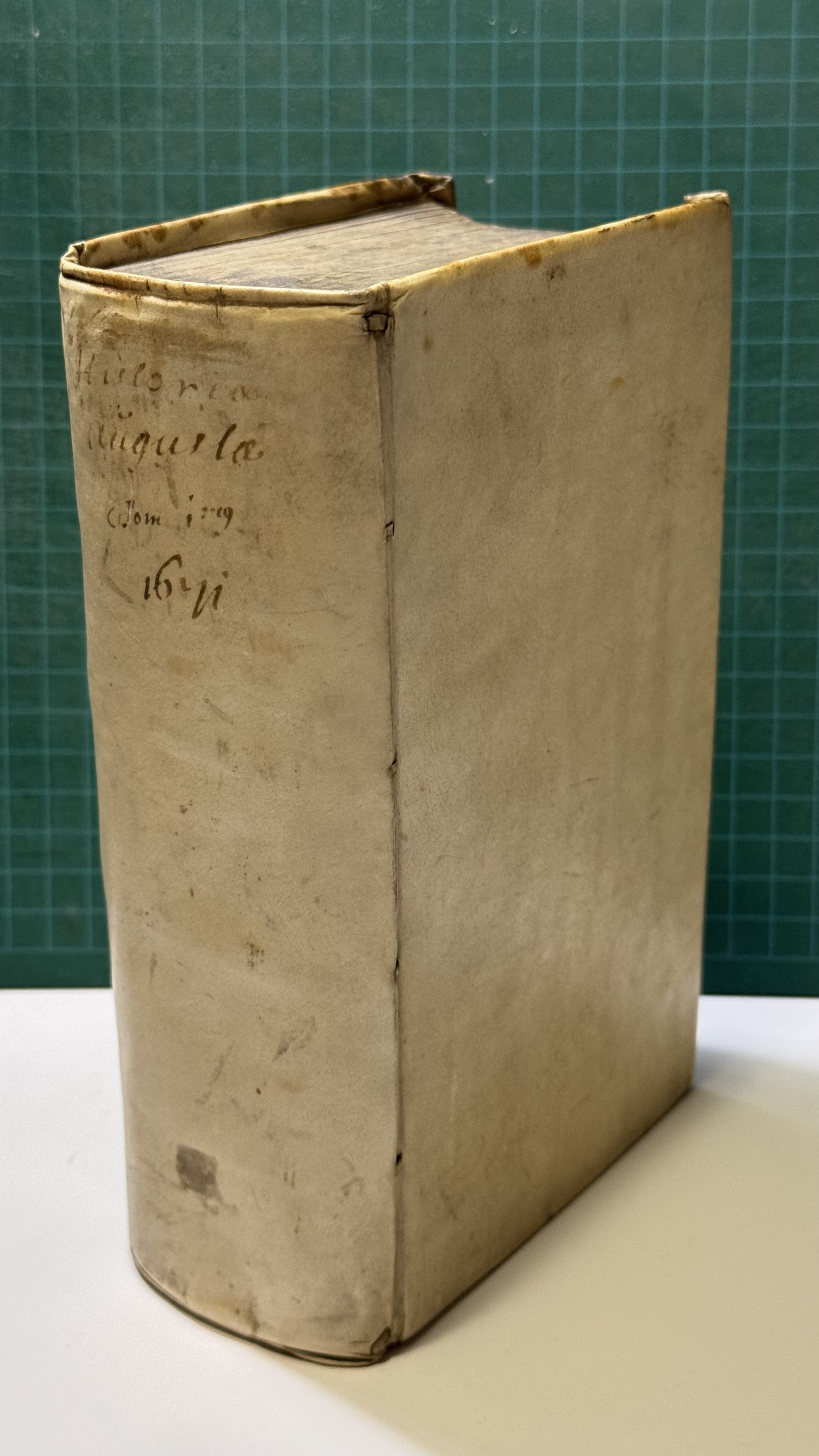
Something funny happened on the way to the forum antiquarian book fair this weekend. Or, actually, at the antiquarian book fair. I found a book that I had been looking for for a long time and that I thought I would never find: a 17th-century Latin edition of the Historia Augusta.

For eight years, I worked on my Master and PhD thesis dedicated to the “Vita Veri” (a biography of the Roman Emperor Lucius Verus) which is part of the Historia Augusta (a compilation of biographies of Roman emperors from the 2nd and 3rd centuries probably written in the 4th century CE, supposedly by six authors: Aelius Spartianus, Vulcacius Gallicanus, Julius Capitolinus, Trebellius Pollio, Aelius Lampridius and Flavius Vopiscus). Therefore this book has a great sentimental value for me. It is only the first of two volumes, but that’s the one that counts for me since it’s the volume containing the “Vita Veri.”

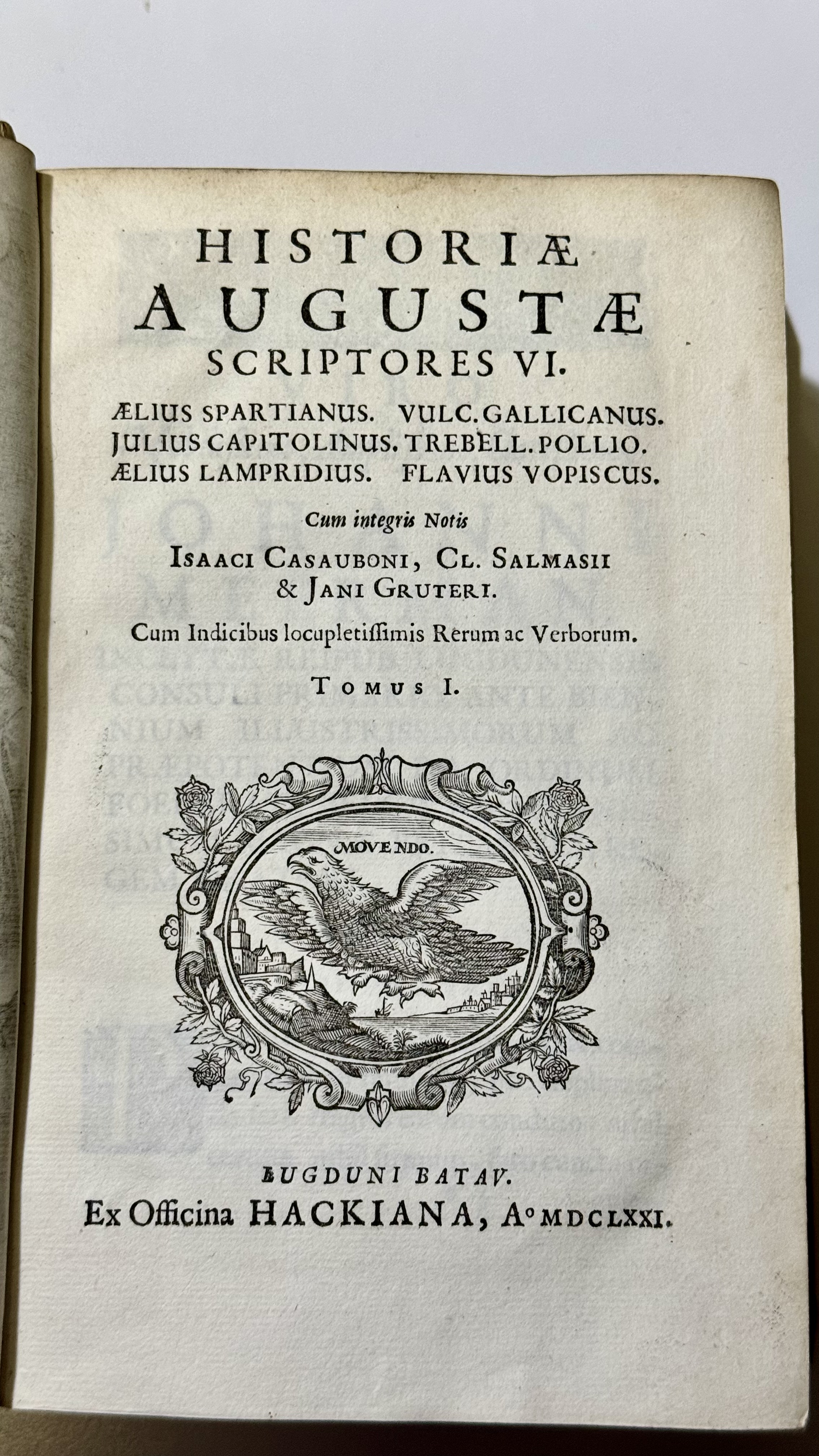
The book is a vellum-bound volume (of two), in small quarto (12.6 x 19.7 x 6.4 cm), with 1,144 pages (16 of introductions, 1049 of text and 79 of indexes). The title page offers this information:

HISTORIAE AUGUSTAE
SCRIPTORES VI
.

AELIUS SPARTIANUS. VULC[acius] GALLICANUS.
JULIUS CAPITOLINUS. TREBELL[ius] POLLIO.
AELIUS LAMPRIDIUS. FLAVIUS VOPISCUS.
Cum Integris Notis
ISAACI CASAUBONI, CL[audi] SALMASII
& JANI GRUTERI.
Cum Indicibus locupletiffimis Rerum ac Verborum.

TOMUS I. [of 2]

LUGDUNI BATAV[orvm]. [Leiden, Netherlands]
Ex Officina HACKIANA [Johannes Hackius], A•MDCLXXI. [Anno 1671]

This first volume contains two introductions (one introduction by the publishers and a preface to the readers), an index of the authors cited, the biographies of Roman emperors from Hadrian to Severus Alexander (including erudite commentaries by Isaac Casaubon, Claude Saumaise and Jan Gruter), and concludes with three indexes (the first of “memorable things and words” from the text, the second of “memorable things and words” from the commentaries and the third of the “Greek things and words which occur in the commentary and is worthy of remembrance”).  It was published in Leiden (Netherland) by Johannes Hackius in 1671.

The book is in suspiciously good condition for the price (listed as $175 USD or $220 CDN, but the guy let me have it for $180). It also has a superb vellum binding and a beautiful engraved frontispiece. The seller listed the condition as “Very Good.” He describes it on his online catalogue as having “little staining to the binding. One page is lacking a portion to the right-side margin, not affecting text. There is very little foxing or staining throughout.” [That Guy With The Books]

The book clearly had some restoration (which were not disclosed by the seller). If you look at the inside of the binding, you can see that it was reinforced with modern cardboard. The very small amount of foxing and staining made me doubt for a moment of the authenticity of the book (there are forgeries on the market), so I looked closely at the ink and texture of the paper. It all seems alright to me (but I’m not an expert) and the seller is a reputable one, therefore I should trust him, and concluded that the book should be genuine.

This is not one of my oldest books (in fact it is the most recent I have for the 16-17th century period) and I already have an in quarto. However, its very good condition and the fact that it’s about a subject that is quite dear to me, make it one of my most precious books (along with the works of Lucian of Samosata).

[ AbeBooks • Hathitrust • That Guy With The Books • WorldCat ]

On the subject of “old books” you can find more information in those articles:

[ Traduire ]

Antiquarian Book Fair 2025

Like every year, this week-end I went to visit the Antiquarian Book Fair (EventBrite, CLAQ, Le Devoir) hold at the Concordia University in September. I always hope to find something interesting, but I also dread to find something interesting because it will means that I will spend too much money.

To ensure that I greatly reduce the chances of spending money, I give myself very strict criteria for purchasing a book: I am looking only for 16th or 17th century editions of classical latin authors that are under two-hundred dollars !

I had a quick look around the room, and right at the beginning I found an interesting book: the Annals (Ab excessu divi Augusti Historiarum Libri) by Tacitus, in three volumes, for $250. Unfortunately, it was slightly over budget (but 3 volumes!) and only an 18th century edition with a veal on cardboard binding. Too recent for my taste.

After checking a little more than half of the tables, I hit the mother load. The table of Zubairul Islam, also known as That Guy With The Books. He always has interesting stuff, but usually quite expensive. I immediately noticed two latin in folio (I’ve always dreamed to have an in folio) that were, as expected, too expensive:

  • An illustrated compilation of the plays by Plautus (Ex emendationibus, adque commentariis Bernardi Saraceni, Ioannis Petri Vallae Plauti comoediae XX), 1511, in folio, Condition: Poor. $1,534.00 USD [That Guy With The Books]

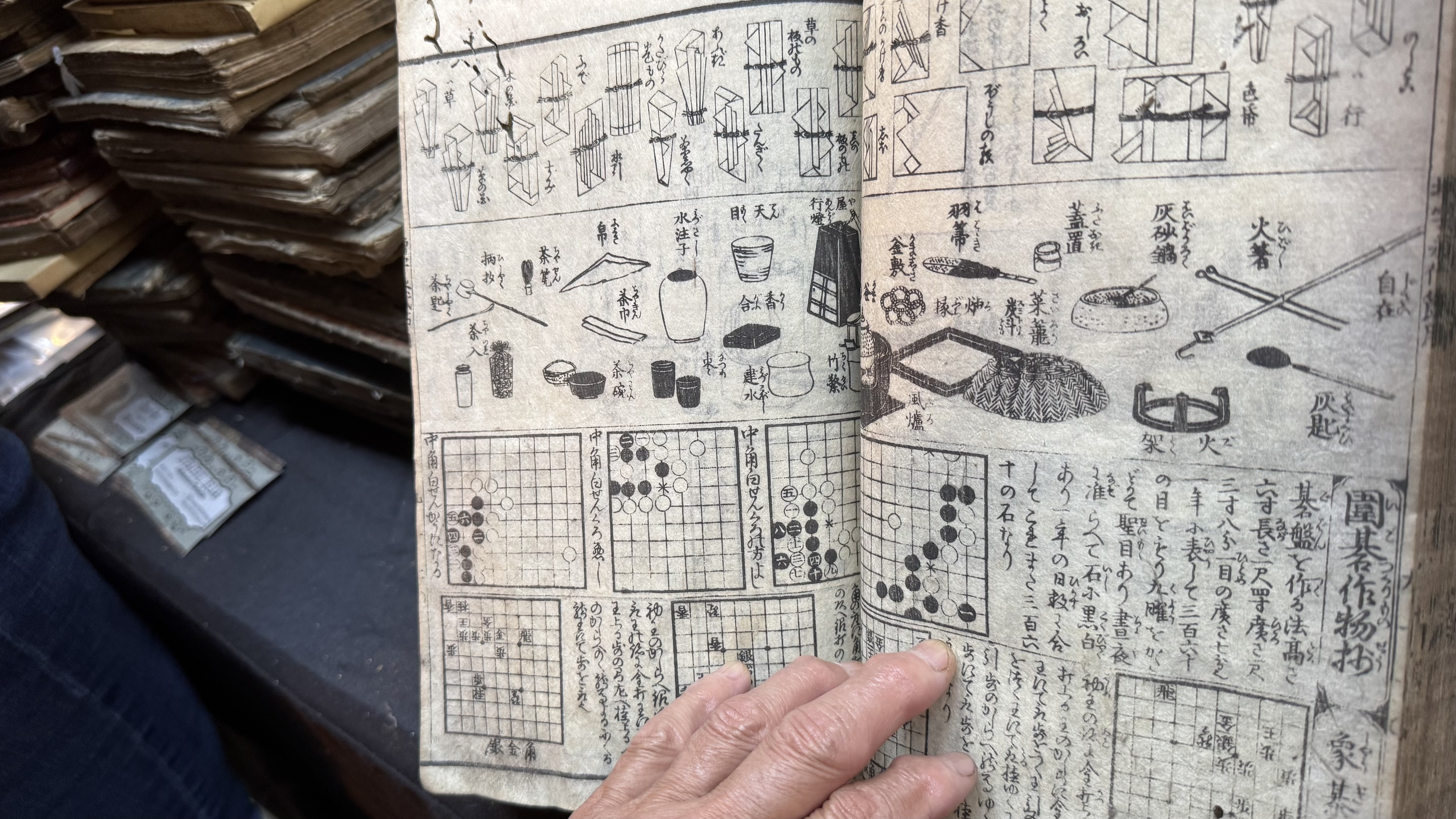
He also had something quite rare: a load of books from Japan (and, of course, in Japanese). Most quite expensive, but some affordable (but, since I can’t read Japanese — and, even for Japanese people, the old script can be quite difficult to read — there was no use buying any however interesting they were). Although one was really interesting as it was some sort of encyclopedia explaining, with lots of illustrations, how to do stuff, but, even if it was in a bad shape, it was old and must have been quite expensive (so I didn’t even bothered to ask the price).

Then I saw something that really made me regret to have come to the book fair. A book that I have been looking for for years and that I thought I would probably never find: an old latin edition of the Historia Augusta ! That’s the book I was studying for my Master and my PhD ! I was so excited that my hands were shaking (or my sugar level was crashing, I am not sure which) ! It was the first of two volumes (emperors biographies from Hadrian to Severus Alexander) published in Leiden by Johannes Hackius in 1671. It was a small in quarto of over a thousand pages, in very good condition and with a superb vellum binding. It was listed at $220, so slightly over budget, but, seeing I was hesitating, the guy offered it to me at $180. I couldn’t refuse, so I took it right away ! (I will talk of this book more in details in a separate blog entry).

I reluctantly finished to go through the rest of the room, hoping I would not find anything else interesting. I didn’t. 

Why purchase an expensive book that I can’t even read ? For the simple joy of having in my hands a beautiful, precious object, a cultural artifact of human history. It’s like hanging on the wall an expensive painting or putting a trinket ornament on a bookshelf. Just for looking at it and thinking about all the people who have also hold it in their hands before me…

For information on previous Antiquarian book fairs you can check to following links: Antiquarian Book Fair / SLAM. You can also check the updated list of my old books collection. 

[ Traduire ]

Anime & manga updates [002.025.256]

Anime & manga updates

Manben: Otomo

Urasawa Naoki & Otomo Katsuhiro

Another update on Manben: The latest episode of the NHK World documentary series Manben: Behind the Scenes of Manga with Urasawa Naoki (which introduces us to mangaka like Morohoshi Daijiro, Shigeru Mizuki, Nishi Keiko, Chiba Tetsuya, or Iwamoto Nao) is about Otomo Katsuhiro, the internationally renowned legend who created a masterpiece that shaped and revolutionized manga. Urasawa discuss his work with Otomo over the original pages of his manga Domu.

The episode originally aired in Japan on March 24, 2025, but the English version just aired on September 12 and 13, 2025 and is now available to view as VOD (Video on Demand) until September 27, 2025.

Paper film: The curious origins of color Anime

“Much of the first animation came out of France in the early 20th century, but developed mainly in the United States with the rise of film. In Japan, black and white animation began in the nineteen tens, but colour didn’t become prominent until the nineteen sixties. Except for a brief little-known chapter. A U.S. researcher has rediscovered and successfully restored coloured anime created here in the nineteen-thirties. (…) In the 1930s, Japan produced animated movies on paper, not celluloid. A U.S. professor has been restoring existing films, which were known for their full color.”

This news story aired on September 4th, 2025 and is now available as VOD. The 7-min. clip is also available on Youtube.

Adapting Anime Costumes for Live-Action

Direct Talk interviews the stylist and costume designer Nakahara Sachiko who “translates the looks of popular Japanese anime and manga characters into costumes for live-action adaptations. She talks about making an impact on the global stage.” The show aired on July 22, 2025 and is now available as Video On Demand (VOD) until July 22, 2026.

History Uncovered: The Hiroshige Code

“Influential ukiyo-e artist Utagawa Hiroshige‘s “100 Famous Views of Edo“, a series of prints encoding his view of the changing face of Japan.”  Art historian Toshinobu Yasumura, Professor Timon Screech, Hinohara Kenji and Manabu Oishi discuss, interpret and explain the messages hidden in Hiroshige’s art. This episode of “Time and Tide” aired on August 30, 2025 and is now available as Video On Demand (VOD) until August 29, 2026.

[ Traduire ]

Yukari ICHIJO

At the end of February, my wife received a care-package from her sister in Japan. She was doing some decluttering in their parents’ house and she sent my wife a bunch a manga that she had bought in the 70s. They are still in a perfect condition. That’s quite a memorabilia… It includes four manga series: the complete Versailles no bara by Riyoko IKEDA (10 vol.), the complete Designer by Yukari Ichijo (2 vol.), the complete Tea Time by Yukari Ichijo (2 vol.), and the first two volumes (of seven) of Suna no Shiro also by Yukari Ichijo. My wife never got to read the end of the latter because she left Japan. She particularly liked Yukari Ichijo, not because she cared much about her stories, but mostly because she greatly appreciated her shōjo style.

Everybody knows about IKEDA’s Versailles no Bara, but ICHIJO is not very well known in the West. However, Yukari ICHIJO (一条ゆかり) is an important and popular mangaka in Japan as she has published nearly fifty titles and received a couple of prizes for her work: the Kodansha Manga Award  for Yūkan Club in 1986 and the Japan Media Arts Festival Excellence Prize for Pride in 2007.

Her real name is Noriko Fujimoto and, even if she is considered to have greatly contributed to the development of Shōjo manga with her beautiful style and was actually born in 1949, she is generally NOT considered a member of the the Year 24 Group, probably because her themes, narratives and art style are more traditional and less “innovative” than the works of the Group.

Several of her titles were adapted as TV dramas (Designer, Tadashii Ren’ai no Susume, Suna no Shiro), movie (Pride) or anime OVA (Yūkan Club). So it is no surprise that her most well known titles are Yukan Club (1981) and Pride (2003). Her works are generally typical shōjo manga offering romantic thrillers stories with themes of conflits or family problems. For more information: AniList • ANN • AsianWiki • Google • Manga Updates • Wikipedia (Jp / Fr).

I often complained that manga publishers don’t tap enough (or even at all) into the goldmine of manga published in the 70s and 80s. There is a veritable untapped mine of manga out there that I wish were picked up for translation. That’s why I would like to introduce you, as best as I could, to those three titles that I have in my hands (but cannot read!):

デザイナー / Designer

A melodrama about professional success and revenge. It is the story of Ami, a successful model, and her rivalry with Reika, a fashion designer. However, Ami doesn’t know who her parents were and when she discover her mother’s identity, she will only seek revenge on the woman who abandoned her. 2 vol., 1974, serialized in Ribon (Shueisha). For more information: ANN • Goodreads • Google • Manga Updates • Wikipedia Jp.

ティー♥︎タイム / Tea Time

This manga offers us, in two parts, a school romance about the love lives of three handsome, but tortured boys. Shion lives in the mansion where his sister committed suicide. As a tribute to her, he swore never to love anyone again. At his new high school, he reunites with his old friends Souji and Kaoru… and then he meet Shirakawa Mai… It also includes five short stories: He… (彼… / Kare…; 24 p), Beware of Jill (ジルにご用心 / Jiru ni goyōshin; 47 p), How about the bride? (花嫁はいかが⁉︎ / Hanayome wa ikaga⁉; 24 p), Night Fairy (夜のフェアリー / Yoru no fearī; 23 p), and Yukari’s Mini Mini Melhen (ゆかりのミニミニめるへん / Yukari no mini mini meruhen; 2 p).  2 vol., 1976, serialized in Ribon (Shueisha). For more information: Amazon Jp • Google • Manga Updates • Shueisha • Shueisha Reader.

砂の城 / The sand castle

Suna no Shiro depicts the forbidden love of a young couple and their complicated feelings. “In a quiet area of France during WWII, a very young orphan boy was left on the steps of a large mansion on the same day that a daughter was born to the bourgeois family living there. From that day on, Francis and Natalie grew up together and found themselves falling deeply in love. As talk of their marriage began to stir, Natalie suddenly lost her parents to a plane crash, leaving her aunt as her guardian. This aunt, vehemently opposed to Natalie’s engagement to a mere orphan, drove Natalie and Francis to run away together. Unfortunately, they were caught. Rather than be torn apart from each other, Natalie and Francis decide to spend eternity together by jumping off a cliff….” [from MangaUpdates] However, in a cruel twist of fate, both survived, neither knowing what happened to the other. Francis has lost his memory, marries and has a son. When both Francis and his wife tragically die, Natalie decides to take in the boy, but, with time, his resemblance to Francis haunts her… 7 vol., 1977-1981, serialized in Ribon (Shueisha). This manga is available as scanlation (Jshoujo Scans). It was also adapted into a Fuji TV daytime drama in 1997. For more information: Goodreads • Manga Updates • MyAnimeList • MyDramaList • Wikipedia [JP / EN].

[ Traduire ]

La Littérature romaine (4)

Littérature pré-républicaine (3)

IIe siècle AEC

Voici la suite de la liste des auteurs romains de l’époque “pré-républicaine” (archaïque) pour le IIe siècle AEC. Je les présente chacun dans de brèves notices biographiques, par ordre chronologique. 

Poète romain, il aurait écrit, en vers septénaires trochaïques, une histoire de la poésie latine, dont il fait remonter les origines à la deuxième guerre punique. Il n’en reste que des fragments, cités notamment par Aulu-Gelle. D’après Cicéron, il aurait fait partie du cercle littéraire de Catulus et aurait été un ancien esclave et secrétaire de Caius Gracchus. Il était partisan des populares et s’opposait donc aux optimates.

Homme politique romain. Sa connaissance du grec lui permet, en 155, de servir d’interprète au sénat pour les ambassadeurs d’Athènes. Nous lui devons une histoire de Rome (Annales Aciliani) écrite en grec et publiée en 142 (subséquemment traduite en latin, possiblement par Claudius Quadrigarius). Si seuls quelques fragments ont survécu, elle est citée par plusieurs auteurs romains (Denys d’Halicarnasse, Cicéron, Plutarque, Tite-Live).

Poète romain originaire d’Antium. Il aurait été influencé par Quintus Ennius et aurait fait parti du cercle de Catulus. Fervant de néologisme, il ne reste de ses Annales que quelques fragments cités par des ouvrages ultérieurs.

Historien romain, possiblement d’origine étrusque, qui aurait écrit (entre 159 et 146 AEC) des Annales qui couvrait en quatre ou cinq livres l’histoire de Rome allant de la période pré-romuléenne à la troisième guerre punique (sans toutefois mentionner la destruction de Carthage en 146), et dont seulement une quarantaine de fragments ont été préservés. Son oeuvre a probablement été éclipsée parce qu’elle était de qualité inférieure au Origine de Caton.

  • Nom: Polybe (Πολύϐιος)
  • Date: 200 – 120 AEC
  • Genre: Histoire, Traité

Homme politique et militaire (hipparque) grec, originaire de Mégalopolis en Arcadie, il participe à la Troisième guerre de Macédoine qui oppose la Ligue achéenne à Rome. Après la victoire romaine à la bataille de Pydna, il est envoyé à Rome comme otage et se retrouve dans l’entourage des Scipions. Cela fait de lui un témoin privilégié de l’expansion de la République romaine, car il prends également part à la troisième guerre punique, où il assiste à la destruction de Carthage, et à la troisième guerres celtibères, alors qu’il participe à la prise de Numance. Par la suite, il joue un rôle administratif crucial dans l’intégration de l’Achaïe (Grèce central) à la République alors qu’elle devient une province romaine. Toute cette expérience lui permettra d’écrire les Histoires (Ἱστορίαι / Historíai) qui chroniques les conquêtes méditerranéennes de la République et dont nous n’avons conservé que cinq des quarante volumes qui composaient l’oeuvre (traduction publiée aux Belles Lettres (Coll. des Universités de France, série Grecque), chez Gallimard (Coll. Quarto), chez Loeb, mais aussi disponible dans le domaine publique dont Wikisource [FR/EN] — voir mon commentaire). On lui connait également quelques ouvrages mineurs (Éloge de Philopœmen, Traité de tactique, Traité sur les régions équatoriales, La Guerre de Numance) qui sont tous perdus.

  • Nom: Manius Manilius
  • Date: 196 – c115  (IIe s. AEC)
  • Genre: Traité (Droit)

Homme d’état (sénateur, proconsul d’Hispanie Ultérieure [155],  consul [149]), militaire (il participe au siège de Carthage durant la troisième guerre punique) et jurisconsulte romain. Il est considéré par Sextus Pomponius comme l’un des trois fondateurs du droit civil romain. Membre du cercle des Scipions, il aurait écrit trois livres de ius civile, dont une collection de formules pour les contrats de vente. Son oeuvre est perdue, mais souvent citée par les auteurs classiques (Varron, Cicéron, Brutus).

Térence est un dramaturge et poète comique d’origine berbère (né à Carthage, possiblement de la tribu libyenne “Afri”). D’après la Vita Terentii de Suétone, il serait arrivé à Rome comme jeune esclave, propriété du sénateur Terentius Lucanus. Il reçoit une bonne éducation et est rapidement affranchi. Il est un protégé des Scipions, auprès de qui il côtoie un milieu littéraire. On l’accuse toutefois de plagiat. Malgré sa brève carrière, il est néanmoins considéré comme le deuxième grand dramaturge romain à qui l’on doit six comédies qui nous sont toutes parvenues: L’Andrienne [écrite en 166], l’Hécyre [165], l’Heautontimoroumenos [163], l’Eunuque [161], le Phormion [161] et les Adelphes [160]. Son oeuvre est traduite en français aux Belles Lettres (Coll. Budé), en anglais chez Loeb et disponible dans le domaine publique (Project Gutenberg, Wikimedia).

Juriste et historien romain, il a écrit une histoire de la deuxième guerre punique composée de sept livres (prennant comme sources Caton et Silenus Calatinus) ainsi que des Annales (dont Brutus a fait la synthèse). Il ne reste rien de son oeuvre juridique, mais son histoire, dont il ne reste que quelques citations par Tite-Live et Cicéron, a été très appréciée et constitue la première véritable monographie historique romaine.

Riche propriétaire terrien originaire de Campanie, il fréquentait le cercle de Scipion Émilien et est considéré comme le fondateur de la satire romaine. Sa poésie est très variée (à l’origine satura signifiait “mélange”) et utilise une métrique plutôt diverse (septénaires trochaïques, sénaires iambiques, distiques élégiaques, hexamètres dactyliques, etc., et certaines oeuvres seraient même plutôt des épigrammes). Il parodie les séances du sénat, commente des procès, attaque la nobilitas progressiste et se moque des hellénistes ou de collègues qui se prennent trop au sérieux. En créant une forme de comédie qui critique et se moque, il définit un nouveau genre poétique typiquement romain qui fera des émules (Juvénal, Horace, Perse). Ses Satires auraient été compilées en trente livres dont il ne reste aujourd’hui que 1 378 vers, qui ont été traduit aux Belles Lettres et dont une édition de 1845 est également disponible sur Gallica.

Dramaturge et poète comique romain qui a écrit plus d’une centaine (mais seulement treize titres sont connus) de fabulae palliatae inspirées de Ménandre (pour les sujets) et de Plaute (pour sa métrique diverse) et dont il ne nous reste que des fragments (environ deux-cent vers). Ses comédies étaient si charmantes et grâcieuses qu’elles avaient été surnommées Novella Sirena et restaient populaire même à l’époque de Cicéron. Dans son palmarès des auteurs comiques, Volcatius Sedigitus le place en septième position, entre Térence et Quintus Trabea.

Homme d’état (tribun de la plèbe [149], préteur [136], consul [133], censeur [120], sénateur) et militaire (165-152) romain d’origine plébéienne, il a fait passé la loi Lex Calpurnia de repetundis qui réprimait les abus financiers des gouverneurs et établissait le premier tribunal pénal permanent romain (quaestio perpetua). Il a écrit des Annales en sept ou huit volumes, racontant l’histoire de Rome de sa fondation jusqu’en c146, dont il ne reste qu’une quarantaine des fragments.

Homme d’état (sénateur, questeur [145], édile curule [135], préteur [132] et consul [129]) et militaire romain (campagnes contre les Iapydes et les Istriens) d’origine plébéienne, il était partisan des optimates. Il a écrit un ouvrage de droit constitutionnel sur la magistrature romaine, Libri magistratuum, composé d’au moins treize livres, dont nous n’avons conservé que quelques fragments (cités par Varron, Aulus-Gelle, Dionysios d’Halicarnase, Pline et Macrobe). Il aurait possiblement aussi écrit un ouvrage d’histoire.

Dramaturge romain originaire de Ombrie, il aurait écrit une quarantaine de tragédies mythiques et deux praetextae qui se divisent en deux cycles (les Pélopides / guerre de Troie et la guerre de Thèbes). Sa réplique la plus célèbre (souvent citée, notamment par Caligula) est Oderint, dum metuant. On lui doit également plusieurs traité de philologie (Didascalia, Pragmatica, Sotadei, Annales, Parerga et Praxidica). Il ne subsiste de son oeuvre que quelques fragments qui ont été regroupés dans une traduction aux Belles Lettres.

Homme politique (sénateur, tribun de la plèbe [131], préteur [123], consul [120]) et orateur romain d’origine plébéienne, il se range du côté des frères Gracques (Caïus Sempronius Gracchus et Tiberius Sempronius Gracchus) durant leur tentative de réforme sociale visant à diminuer les pouvoirs du Sénat au profit des comices (chevaliers et plèbe). Vers 131, il est chargé de l’application de la Lex Sempronia de comitiis (lex Papiria) qui réforme la procédure du vote des comices centuriates et prends part au triumvirat agraire chargé de la commission qui applique la lex Sempronia, loi qui met en place une réforme agraire visant à redistribuer les terres pour limiter les grandes propriétés en faveurs de la plèbe. Les travaux de la commission sont houleux et rencontre l’opposition de Scipion Émilien. Il propose également un loi permettant aux tribuns d’être élu pour des années successives, mais il est défait par Scipion. Après la mort de Scipion et des Gracques, il se rapproche des conservateurs et supporte les Optimates. En 120, il devient consul et plaide la défense de Lucius Opimius. Toutefois, son support des Gracques lui a valut beaucoup d’ennemis et il est accusé de corruption en 119. Il doit alors se suicider (ou, selon Valère Maxime, partir en exil). Cicéron fait l’éloge de son talent d’orateur, mais rien ne subsiste de ses plaidoiries ou de ses discours politiques.

Militaire romain (tribun militaire [134-133]) d’origine plébéienne, il participa au siège de Numance. Membre du cercle des Scipions, il a écrit une histoire contemporaine de Rome où il ne se contente pas de raconter les faits, mais aussi en analyse les causes et conséquences dans un but pédagogique. C’est donc le premier véritable historiographe romain. Son Rerum Gestarum Libri, constitué d’au moins quatorze livres, couvre dans un style très simple principalement la troisième guerre punique. Il s’inspire de Polybe et continue même là où ce dernier s’est arrêté. Il ne subsiste de cette oeuvre qu’une quinzaine de fragment (mentionnés par Cicéron et cités par Aulus-Gelle ainsi que quelques grammairiens tardifs).

Homme politique (tribun militaire [134-132], préteur [119], légat en Numidie [109-107] et en Asie [94], Consul [105], sénateur), militaire (guerre de Jugurtha, campagne contre  les Cimbres et les Teutons, dont la bataille d’Arusio) et orateur romain d’origine plébéienne, il s’exile à Mytilène puis à Smyrne après avoir été accusé de corruption en 92.  Stoïcien, il aurait écrit de nombreux discours, des traités de droit, une autobiographie, une vie de Scipion Émilien et plusieurs ouvrages d’histoire en grec (dont un consacré à la guerre de Numance).  Rien ne subsiste de son oeuvre sinon quelques mentions par Cicéron, Plutarque ou Isidore de Séville.

Chevalier et stoïcien, originaire de Lanuvium, il s’est consacré à l’enseignement (il a été le maître [grammaticus] de Varron et de Cicéron) et à la philologie. Nous lui devons des ouvrages commentant le chant des Saliens, la loi des Douze Tables, ainsi que l’oeuvre de Plaute (Commentarium de proloquiis), et probablement un ouvrage de glossographie et un traité de rhétorique (Rhetorica ad Herennium), dont il ne reste que des fragments. Il devait son surnom au fait qu’il écrivait beaucoup de discours pour d’autres et utilisait donc souvent un stilus pour écrire (sur une tablette de cire).

  • Nom: Titus Albucius
  • Date: c150 – c103 (fin du IIe s. AEC)
  • Genre: Philosophie

Homme politique  (Préteur et propréteur en Sardaigne [105-104], Questeur) et orateur romain, il était amateur de culture grecque. Accusé de mauvaise gestion (en 103), il se serait exilé à Athènes pour y faire des études de philosophie (épicurisme) et aurait écrit des prières qui sont mentionnés par Cicéron.

Dramaturge romain qui aurait écrit une quarantaine de comédies, principalement du genre fabula togata, qui traite de sujets contemporains reflétant la vie quotidienne et dont nous n’avons conservé qu’une centaine de fragments (environ quatre-cent vers).

Homme politique (Préteur [109], Consul [102], Proconsul [101], Légat [90]) et militaire romain d’origine plébéienne, il est du parti des optimates et défend la République contre la rébellion armée des populares en 101. En 88, il prends parti pour Sylla lors de la guerre civile contre Caius Marius. Il est accusé de trahison lors de la victoire de ce dernier et doit se suicider en 87. Il aurait été l’instigateur d’un cercle littéraire incluant les poètes Valerius Aedituus, Porcius Licinus, Archias et Aulus Furius. Orateur admiré de Cicéron, il aurait écrit des Mémoires (Liber de consulatu et de rebus gestis) sur son consulat, ainsi que de la poésie sentimentale, et même érotique, dont il ne subsiste que des fragments.

Homme politique (Pontife [99-87], Questeur [96], Édile curule [90] et sénateur), avocat et dramaturge romain, d’origine Patricienne et membre de la famille des Iulii Caesares (de la gens Iulia à laquelle appartenait Jules César). Il est assassiné par les partisans de Marius lorsque celui-ci fait son entrée à Rome en 87. Grand orateur, il faisait usage d’humour dans ses discours. On lui connait trois tragédies sur des thèmes grecs (Adrastus, Tecmesa et Teutras) dont il ne reste que des fragments.

Militaire, magistrat (Préteur [78] et possiblement propréteur de Sicile [77]) et historien romain, il a écrit une Histories de Rome d’au moins douze à vingt-trois livres, racontant la guerre sociale [91-88] ainsi que la première et la seconde guerre civile entre Marius et Sylla [88-82], dont il ne reste que quelques fragments cités par Cicéron, Salluste, Tacite, Velleius Paterculus et le grammairien Nonius Marcellus. Il aurait également traduit en latin les Milesiae fabulae, un recueil de contes érotiques et picaresques par Aristide de Milet, qui aurait inspiré Pétrone pour son Satyricon. Alors qu’il était le légat de Pompée en Crète lors d’une campagne contre des pirates de la mer Égée, il meurt dans un conflit opposant Metellus Creticus à Pompée.

Dramaturge romain originaire de Bononia, en Gaule cisalpine, qui aurait écrit soixante-dix pièces (dont Macchus Miles, Leno, Pappus Agricola), principalement des Atellanae Fabulae et des satires (politiques, sociales, mythologiques et religieuses) dont nous ne connaissons que quelques fragments. Il est reconnu pour avoir introduit moins d’improvisation dans l’Atellane et avoir utilisé un language plus quotidien et rustique, voir obscène.

  • Nom: Volcātius Sedīgitus
  • Date: ? – ? (fin du IIe s. / début du Ier s. AEC)
  • Genre: Poésie (Didactique)

Grammairien et philologue (critique littéraire) romain possiblement d’origine Celte, qui est connu pour un poème didactique en vers sénaires lambiques, le De Poetis, où il énumère par ordre de mérite et commente les principaux auteurs comiques latins, dont il ne reste que quatre fragments (vingt vers) cités par Varron, Suétone et Aulu-Gelle. Selon Pline, son surnom lui viendrait du fait qu’il soit né avec de la polydactylie (mains de six doigts, sex digitī).

Historien romain qui aurait écrit des Annales en au moins vingt-trois volumes allant du sac de Rome par les Gaulois en 390 jusqu’à Sylla en 82 et intitulé, selon Plutarque, Discussion des temps (Elegchos chronôn). Il n’en reste moins d’une centaine de fragments cités par Tite-Live, Aulu-Gelle, Sénèque, Plutarque, Macrobe et Orose.

  • Nom: Valerius Antias
  • Date: ? – ? (fin du IIe s. / début du Ier s. AEC)
  • Genre: Histoire

Historien romain qui a écrit des Annales racontant, en au moins soixante-quinze livres, l’histoire de Rome de sa fondation jusqu’à son époque (au moins jusqu’en 91 ou même 78), en accordant plus d’importance à l’histoire récente. Nous n’en avons conservé que soixante-dix fragments, cités surtout par Tite-Live (qui le considérait peu fiable car il avait tendance à exagérer), Aulu-Gelle et  Denys d’Halicarnasse. Certains croient qu’il aurait vécu plus vers la fin du Ier siècle AEC, car il n’est jamais mentionné par Cicéron.

Prochainement: La littérature de la République (époque classique, Ier siècle AEC)

[0. Index] [1. Intro] [2. Archaïque] [3. IIIe siècle] [4. IIe siècle] [5. République]

[ Translate ]

La Littérature romaine (3)

Littérature pré-républicaine (2)

IIIe siècle AEC

Voici donc la liste des auteurs romains de l’époque “pré-républicaine” (archaïque). Je les présente chacun dans de brèves notices biographiques, par ordre chronologique. Je commence avec les auteurs du IIIe siècle AEC.

  • Nom: Appius Claudius Caecus
  • Date: avant 341 – ? (début du IIIe s. AEC)
  • Genre: Poésie, Rhétorique, Grammaire, Traité (Droit)

Homme d’État romain (il fut sénateur,  censeur [312], par deux fois consul [307 & 296], dictateur, interroi par trois fois, préteur, édile curule par deux fois, questeur, tribun militaire par trois fois), il est l’instigateur de la voie Appienne, de l’aqueduc Appia et une variété de pomme importée de Grèce porte également son nom (à ne pas confondre avec la “pomme d’Api”). Il est le premier auteur latin que nous connaissions. Il aurait introduit à Rome des principes pythagoriciens et nous lui devons un recueil de sentences morales en vers saturniens (Sententiae), un discours contre Pyrrhus [280], des ouvrages de grammaire et un traité de droit privé (De usurpationibus).

  • Nom: Attilius
  • Date: ? (IIIe – IIe s. AEC)
  • Genre: Théâtre

Dramaturge et poète comique reconnu pour avoir écrit des fabula palliata. Plusieurs philologues de son époque (dont Volcatius Sedigitus) le place en cinquième position au palmarès des principaux poètes comiques romains après Statius, Plaute, Naevius et Licinus et juste avant Térence. Il aurait également traduit en latin le Électre de Sophocle.

Poète et dramaturge comique latin, rival et critique de Térence, il est surtout connu pour ses fabulae palliatae. Nous ignorons tout de sa vie et de son oeuvre dont il ne reste rien.

Poète et dramaturge comique latin, il est surtout connu pour ses fabulae palliatae et fabulae togatae. Nous ignorons tout de sa vie et de son oeuvre dont il ne reste que quelques fragments, cités par Cicéron.

  • Nom: Livius Andronicus
  • Date: 285 – 204 (AEC)
  • Genre: Théâtre, Poésie épique, Poésie lyrique

La première pièce de théâtre romaine est l’oeuvre de Livius Andronicus, un affranchis d’origine grecque (de Tarente). L’oeuvre, dont le titre nous est inconnu, fut jouée durant les Ludi scænici de 240 pour célébrer la victoire romaine de la première guerre punique. Par la suite, il semble avoir écrit surtout des adaptations latines de pièces ou de mythes grecs (tant des tragédies [Achilles, Ajax mastigophorus, Equus Troianus, Ægisthus, Hermiona, Danaé, Andromède, Tereus] que des comédies [Gladiolus, Ludius, Verpus]). Il consacra la fin de sa vie à adapter en vers saturniens latins le poème épique d’Homère, l’Odyssée, sous le titre Odusia. En 207, lors de la deuxième guerre punique, il fut chargé par les pontifes de composer un poème lyrique qui fut chanté en procession par un choeur de jeunes filles afin d’obtenir les faveurs de Junon. De son oeuvre, seul quelques fragments nous sont parvenus.

  • Nom: Cnaeus Naevius
  • Date: 275 – 201 (AEC)
  • Genre: Théâtre, Poésie épique

Originaire de Capoue, il s’installe à Rome après avoir participé à la première guerre punique. Toutefois, il doit s’exiler à Utique après s’être opposé à de grandes familles plébéiennes (les Metelli et les Scipions). De son oeuvre, il ne reste qu’une centaine de vers. Il aurait introduit à Rome le théâtre comique (il en écrit une trentaine), produit une dizaine de tragédies s’inspirants d’Euripide et d’Eschyle, puis écrit une épopée, Bellum Punicum, où il raconte les guerres puniques à la façon d’Homère.

Originaire d’Ombrie, Plaute est le premier grand dramaturge romain. Il était très populaire de son vivant et demeure même de nos jours un écrivain de renom (ayant influencé des auteurs “modernes” comme Shakespeare et Molière) mais cela tient sans doute du fait que c’est l’un des premiers auteurs romains dont plusieurs oeuvres nous ont été conservées intégralement. Il écrit principalement des comédies (souvent des farces grossières ou absurdes, des Tragi-comédie), qui sont fortement inspirées par la comédie nouvelle grecque (Ménandre par exemple) tout en ayant un caractère très romain. Il en aurait écrit plus de cent-trente, mais seulement une vingtaine nous sont parvenues intactes (Amphitruo [texte], Asinaria [texte — voir mon commentaire], Aulularia [texte], Bacchides [texte], Captivi [texte], Casina uel sortientes [texte], Cistellaria [texte], Curculio, Menaechmi [texte], Mercator [texte], Miles gloriosus [texte], Mostellaria [texte], Poenulus [texte], Pseudolus [texte], Rudens [texte], Stichus [texte], Trinummus [texte], Truculentus [texte]), et une trentaine d’autres nous sont connues que par des fragments. Son oeuvre est disponible aux Belles Lettres (Coll. Budé), à la Harvard University Press (Coll. Loeb Classical Library), et aussi dans le domaine public: Project Gutenberg, Wikisource [FR/EN].

Homme d’État romain (sénateur, préteur), il participe à la guerre contre le peuple Gaulois des Insubres et à la deuxième guerre punique. Après la défaite de Cannes, il est envoyé à Delphes pour apaiser la colère d’Apollon. Il est le premier auteur romain à écrire une histoire de Rome (Annales) qui ne nous est malheureusement parvenue que par des fragments (dont la liste des monarques romains). Il est toutefois cité par de nombreux historiens antiques. Il écrit en grec, sans doute pour faire de son oeuvre une propagande pro romaine à l’intention de la Grande Grèce et des royaumes hellénistiques.

Homme d’État romain (sénateur, préteur) d’origine étrusque, il participe à la deuxième guerre punique et est même fait prisonnier d’Hannibal vers 208 mais sera libéré après la bataille de Zama en 202. Il profite de cette expérience pour écrire une histoire de Rome (Annales), de ses origines mythologiques jusqu’à la guerre contre Carthage. Cette oeuvre ne nous est pas parvenue, mais est citée par les historiens antiques (comme Tite-Live, Denys d’Halicarnasse et Florus).

D’origine Messape (sud de l’Italie; il parle donc l’osque et le grec), il arrive à Rome par une carrière militaire et s’y trouve des protecteurs puissants (dont Caton et les Scipions). Il est considéré comme le “père de la poésie latine” car il adapte en latin l’hexamètre grec pour remplacer le vers saturnien, utilisé jusque là par les poètes latins, par l’hexamètre dactylique et a ainsi eut une grande influence sur la littérature latine (sur des auteurs comme Virgile, Horace, Cicéron, Apulée).  De son oeuvre (du théâtre mais surtout de la poésie) il ne reste que des fragments. Nous lui connaissons surtout l’Épicharme, l’Évhémère, les Satires, les Annales de la République romaine (une épopée en dix-huit chants) et le Hedyphagetica (un poème gastronomique sur les poissons).

Catus est un homme d’État romain (sénateur, édile curule [200], consul [198], censeur [194]). Il est le premier jurisconsulte romain et nous lui devons le Tripertita (un traité juridique qui explique et commente la loi des Douze Tables, et présente la procédure judiciaire) qui établit les bases du droit romain. L’ouvrage est malheureusement perdu.

  • Nom: Marcus Porcius Cato
  • Date: 234 – 149 AEC
  • Genre: Histoire, Traités (Agriculture, Militaire), Rhétorique

Caton l’Ancien est un homme d’État et un militaire romain (tribun [214], questeur [204], édile curule [199], préteur [198], consul [195], tribun militaire [191], puis censeur [184]) originaire de Tusculum. Il a participé à de nombreuses campagnes militaires durant la deuxième guerre punique (dont le siège de Tarente et la bataille du Métaure) et la guerre antiochique. Il prêche une politique conservatrice, basée sur des valeurs romaines plus austères, en opposition à l’hellénisme défendu par les Scipions. Il propose également une position plus aggressive face à Carthage (“Il faut détruire Carthage” disait-il) qui mènera éventuellement à la troisième Guerre Punique. Il est également un auteur prolifique: on lui doit une centaine de discours (Orationes), De agri cultura (un traité sur l’agriculture — voir mon commentaire), Origines (une histoire des villes italiennes), De Re Militari (un traité militaire), De lege ad pontifices auguresque spectanti (de la loi sur les prêtres et les augures), Praecepta ad Filium (Préceptes à l’intention de son fils), Historia Romana (une histoire de Rome), Carmen de moribus (traité de morale) et Apophthegmata. De la plupart de ces oeuvres nous n’avons que des fragments, et seul son traité sur l’agriculture a été conservé intégralement [publié dans la Collection Budé aux Belles Lettres et dans la collection Loeb Classical Library (Harvard Univ. Press), mais également disponible dans le domaine public: Remacle, Project Gutenberg, Univ. of Chicago].

Caecilius Statius est un dramaturge et poète d’origine Gauloise qui se spécialisait dans la comédie d’inspiration grecque (fabula palliata). On lui connait une quarantaine d’oeuvres dont seulement quelques fragments (environ 280) nous sont parvenus.

  • Nom: Pacuvius
  • Date: 220 – 130 AEC
  • Genre: Théâtre

Marcus Pacuvius était d’origine gréco–osque (né à Brundisium et mort à Tarentum, dans le sud de l’Italie). Il était le neveu et l’élève d’Ennius, et fréquentait le Cercle des Scipions. Poète et dramaturge, il s’est surtout consacré à la peinture. S’il composa des comédies et des satires, il est surtout connu pour ses tragédies. Nous lui connaissons une douzaine de pièces, inspirées de tragédies grecques, dont il ne reste que des fragments (environ 400 vers).

[0. Index] [1. Intro] [2. Archaïque] [3. IIIe siècle] [4. IIe siècle] [5. République]

[ Translate ]

Anime & manga update [002.025.228]

Anime & manga update: Manben

Another update on Manben: The latest episodes of the NHK World documentary series Manben: Behind the Scenes of Manga with Urasawa Naoki (which introduces us to mangaka like Shigeru Mizuki, Nishi Keiko, Chiba Tetsuya, or Iwamoto Nao) is about Morohoshi Daijiro, a master of mystery. We see him ink a draft of the stand-alone short story 俺が増える(“Ore ga Fueru” / lit. “I will increase”) for the ongoing anthology Daijiro Morohoshi Theater (Moroboshi daijirō gekijō serialized in Shogakukan’s Big Comic Zōkan-gō [Big Comic Special] and compiled in vol. 3 — of six tankōbon so far). The episode originally aired in Japan in November 2020 (available on Youtube), but the English version just aired on July 16, 2025 (at 09:10 PM) and July 17, 2025 (at 03:10 AM, 09:10 AM, and 03:10 PM) and should be soon available to view as VOD (Video on Demand).

Daijiro Morohoshi is a mangaka specializing in strange, horror, mystery or folklore stories. In 1970, he made his debut in COM magazine. In 1974, he was selected for the 7th Tezuka Award for the short story “Seibutsu Toshi” and he won the fourth Tezuka Osamu Cultural Prize in 2000 with Saiyū Yōenden. His works have not been very successful and he is not very well known in the West (his only works translated are BOX: Qu’y a-t-il dans la boite? published in French by Le Lézard Noir and Shiori et Shimiko partially (5 vol.) published in French by Doki Doki), but he received enormous recognition from his peers (he is known as the “manga artist of manga artist”) particularly for his detailed style. His majors works are Yōkai Hunter (1974), Mud Men [1975-82], Ankoku Shinwa [1976], Kōshi Ankokuden [1977-78] and Saiyū Yōenden [1983, ongoing].

For more info: ANN • Manga Updates • Wikipedia [EN • FR • JP]

[ Traduire ]

Revue de ‘zines [002.025.214]

Revue de ‘zines

Je continue mon perpétuel rattrapage sur les magazines et autres ‘zines pertinents dans mon champ d’intérêt… Pour vous éviter le souci de courir après l’information, j’en épluche donc le contenu pour vous. C’est plein de bonnes suggestions de lectures… (Faute de temps et d’énergie, j’ai limité ou omis les hyperliens. Si vous voulez en savoir plus sur un auteur, un titre ou un sujet, vous pouvez consulter par vous-même soit Google ou Wikipedia!)

Animeland #250 (Avril – Juin 2025)

Ce numéro très spécial (#250!) nous offre un dossier volumineux (146 p.!) et exhaustif sur Lady Oscar et le manga shôjo : le shôjo manga avant La Rose de Versailles, le manga de La Rose de Versailles, portrait de Riyoko Ikeda, les autres oeuvres de Riyoko Ikeda (Bara Yashiki no shôjo, Freesia no Asa, Très cher frère… (lire mon commentaire), Orpheus no Mado, Claudine, Ayako, Ten no Hate Made-Poland Hishi), l’interprétation de Takarazuka, l’archétype de la fille-prince, les autrices phares des années 1970 (Yasuko Aoike, Ryôko Takashina, Waki Yamato, Yukari Ichijô, Yumiko Ôshima, Ryôko Yamagishi, A-ko Mutsu), Moto Hagio (portrait, entrevue), la galaxie Margaret, l’anime de La Rose de Versailles, adaptation française, portrait d’Osamu Dezaki (Dir.), entrevue avec Michi Himeno (char. Design), le studio TMS,  entrevues avec Keiichi Ishiyama, Shiro Aono et Yuuji Toki, et, finalement, un bref portrait de Eiko Hanamura et la prépublication exclusive de son histoire courte “Une autre moi” (30 pages, en collaboration avec Akata) complètent ce dossier.

Le numéro se conclut avec quelques chroniques: Japon (Le dit du Genji) et Jeu Vidéo (rencontre avec Daisuke Ishiwatari, créateur de Guilty Gear).

Une lecture incontournable et essentielle pour tous fans d’anime et de manga (il est toutefois impardonnable d’avoir omis Eroica de la liste des oeuvres de Riyoko Ikeda).

Canal BD #159   (Fév. – Mars 2025)

Canal BD est un autre périodique dédié à la bande dessinée, mais que je n’ai pas l’habitude de lire souvent, car il n’est pas disponible à ma bibliothèque locale (quoi que je puisse l’avoir par prêt entre biblio). De plus, c’est un magazine qui est plus orienté pour les libraires (Canal BD étant une chaîne de librairies — avec des listes de parutions sans beaucoup de détails et beaucoup de publicités), il n’offre que des présentations (et non des commentaires critiques) et couvre très peu les mangas.

La section “Gros Plan” nous introduit à Daemon (Ronoan Toulhoart & Vincent Brugeas, chez Le Lombard) et Première Dame (Jean-Philippe Payraud & Didier Tronchet, chez Glénat). Dans la section “Sélection” on présente des parutions récentes avec un peu plus de détails. J’y note Arzak: Destination Tassili (Moebius, chez Moebius Prod). La section “Jeunesse” fait de même, mais pour les parutions jeunesse. La section “Interview” nous offre une entrevue avec Mathieu Bablet et Guillaume Singelin (sur Shin Zéro, chez Rue de Sèvres).  La section “Meilleures Ventes” présente Blake et Mortimer #30: Signé Olrik (Yves Sente & André Juillard, chez Ed. Blake et Mortimer) pour la BD et Instinct T.1 (inoxtag chez Michel Lafon – c’est du manga ça?), My Hero Academia T.40 (Kohei Horikoshi, chez Ki-oon) et One-Punch Man T.30 (Yusuke Murata, chez Kurokawa) pour le manga. La section la plus intéressante pour moi est sans doute “BD du Monde” où l’on retrouve Tokyo, ces jours-ci T.2 (Taiyô Matsumoto, chez Kana) et Frères du Japon (Taiyô Matsumoto, chez Delcourt), ainsi que Dohohedoro: Chaos Edition T.1 (Q-Hayashida, chez Soleil).

Une lecture intéressante pour se tenir au courant des nouveautés en BD. Par contre, ce qui est le gros avantage de ce magazine c’est qu’il est aussi disponible gratuitement en ligne!

dBD #193 (Mai 2025)

Dans le cahier actualités on mentionne la parution du premier volume du magazine de prépublication collectif Manga Issho (300 pages offrant 18 auteurs et 14 histoires, fruit de la collaboration entre les éditeurs Altraverse, Kana, Planeta Comic et Star Comics, 4,90 €, chez Kana), de Shotaro Ishinomori: Il était une fois le roi du manga (par Claude Leblanc, chez IMHO), et de Harem End (Shintaro Kago, chez IMHO). On retrouve également un article qui souligne les vingt-cinq ans de la maison d’édition L’Employé du Moi. De plus, suite à la “Mauvaise Humeur” de Frédéric Bosser dans le #192, Dany réplique avec des précisions sur l’affaire Spirou et la Gorgone Bleue — Dupuis ayant cessé la commercialisation de l’album suivant des accusations de racisme à l’égard de Dany & Yann.

À la une de ce numéro on retrouve une entrevue avec Matthieu Bonhomme (sur Charlotte Impératrice T.4, avec Nuri, chez Dargaud). Les entrevues se poursuivent avec Alain Ayroles & Hervé Tanquerelle (sur La terre verte, chez Delcourt), Jean-Paul Krassinsky (sur De pierre et d’os, d’après Bérengère Cournut, chez Dupuis), Homs (sur Le Diable et Coral, chez Dargaud), et Matz (sur L’Or du spectre, avec Philippe Xavier, chez Le Lombard et Les papillons ne meurent pas de vieillesse, avec Frédéric Bézian, chez Casterman).

On retrouve également un article sur l’art de la couverture en prenant pour exemple Enfermé: Mathurin Réto, pupille à Belle-Île de Julien Hillon et Renan Coquin. Dans la même idée, on nous présente (à l’occasion de la parution de L’art de Bretécher chez Dargaud et de l’exposition Signé Bretécher au musée de la BD d’Angoulème) quelques crayonnés de recherche pour des planches d’Agrippine et du Destin de Monique.

Le Coup de Coeur du Mois va à Lisa Blumen pour Sangliers (chez L’Employé du mois). Il n’y a toujours aucune section sur les mangas dans ce numéro. Dans le Cahier Critique je note Louve T.1 par Miyako Miiya, chez Rue de Sèvres (Super!; “Une succession de chapitres qui se grignotent comme des histoires courtes. Un récit plein de poésie, porté par un dessin charbonneux à l’effet saisissant”).

Une lecture indispensable pour se tenir au courant des nouveautés en BD.

dBD #194 (Juin 2025)

Dans le cahier actualités on mentionne la parution de Tout savoir sur les Chevaliers du Zodiaque et les héros en armure (par Bounthavy Suvilay, chez Ynnis), Saint Seiya Deluxe T.1 (par Masami Kurumada, chez Kana), Tanaki & Amane (par Fumi Yoshinaga, chez Soleil), Dragon Ball: Le roi démon Piccolo T.1 (version colorisée, par Akira Toriyama, chez Glénat), et Dog Signal T.1 (par Saya Miyauchi, chez Soleil). On retrouve un article sur le festival d’Angoulème et la controverse qui entoure la gestion de ses organisateurs, L’Humanité en appellant même au boycott pour l’an prochain.

À la une de ce numéro on retrouve une entrevue avec James Tynion IV (sur The Nice House by the Sea T.1 avec Alvaro Martinez Bueno, Something is Killing the Children T.8 avec Werther Dell’Edera, The Department of Truth T.5 avec Martin Simmonds, Le Déviant T.1 avec Josh Hixson, et L’Étrange Quotidien de Christopher Chaos T.1 avec Tate Brombal & Isaac Goodhart, tous chez Urban Comics).  Les entrevues se poursuivent avec Stéphane Oiry (sur Les héros du peuple sont immortels, chez Dargaud), Elie Huault (sur Cometa, chez Les Humanoïdes Associés), Bruno Duhamel (sur Whisky, avec David Ratte, chez Grand Angle), et Pierre Alexandrine (sur L’Amourante, chez Glénat). On retrouve également un article sur l’art de la couverture en prenant pour exemple Les Parrains: Il était une fois à New York T.1-3 par David Chauvel, Erwan Le Saëc & Thomas Ehretsmann, chez Delcourt.

Côté mangas on nous offre (enfin!) une entrevue avec Usamaru Furuya (sur La Musique de Marie, chez IMHO et Je voudrais être tué par une lycéenne T.1-2, chez Delcourt). La chronique Ça vaut le détour mentionne également Le Gardien des étoiles (par Isuzu Uemura, chez Rue de Sèvres; “un manga humaniste et apaisant”).  Et dans le Cahier Critique je note Watership Down (par James Sturm & Joe Sutphin, d’après Richard Adams, chez Mr Toussaint Louverture), Sorcières T.1 par Daisuke Igarashi, chez Delcourt (Super!; “réédition (…) de ce manga atypique précédemment paru chez Casterman en 2007”), et Great Kaiju Gaea-Tima T.1 par Kent, chez Ki-oon (Super!; “postulat narratif audacieux (…), l’intrigue promet quelques développements intéressants”).

Une lecture indispensable pour se tenir au courant des nouveautés en BD.

[ Translate ]

Anime & manga update [002.025.208]

Anime & manga update

Update: Young Magazine English version

NHK World News reports that Kodansha  announced that, to commemorate the magazine’s 45th anniversary, it is releasing a special English-language edition of Young Magazine, its popular magazine for young adults. According to NHK World Japan, “Young Magazine USA will have about 1,000 pages featuring 20 titles on themes including Sci-Fi and cyberpunk.” Kodansha will hand out the special edition at Anime NYC in August 21-24 and at Kinokuniya  bookstores in the US from August 21 to November 10. It is unclear if this will be a one-shot edition or if more issues of the magazine are planned. According to ANN, “Readers will be able to vote for their favorites among 16 eligible titles, with the winners earning serialization on the K MANGA App.” [Sources: ANN • NHK World Japan]

The Professionals

Another interesting TV series on NHK WORLD Japan is “The Professionals“ about “exceptional people who are breaking new ground and making a difference in their area of expertise.” There are currently eight episodes available. Yesterday, I watched an interesting episode about Honda Tsuneyuki, a toy developer who designs capsule toys. He introduced capsule toys of unprecedented size: 7-centimetre ! In this documentary, we follow him as he is producing the capsule toy of a big Gundam head.

“A Tiny Universe in the Palm of Your Hand: Honda Tsuneyuki, Toy Developer” aired July 25 (10:10 PM) and July 26 (06:10 AM, 11:10 AM, 05:10 PM), but should be available as VOD soon.

Anime & Manga Explosion !

The latest episode of the NHK WORLD Japan documentary series “Anime & Manga Explosion !” is about anime and manga adapting mythological themes. The first part tells us about the anime adaptation of Masami Kurumada’s manga Saint Seiya directed by Morishita Kozo. The second part talks about a manga inspired by the Japanese folk tale of Momotaro (with a serious twist!): Tougen Anki by Yura Urushibara — which has just started airing on Nippon TV as an anime adaptation by Studio Hibari under the direction of Ato Nonaka. In this episode they mentioned Anime News Network !

“Classic Tales Reborn: SAINT SEIYA / TOUGEN ANKI” aired July 26 (11:10 PM) and July 27 (05:10 AM, 10:10 AM, 04:10 PM), but should be available as VOD soon. There are eight episodes of  “Anime & Manga Explosion !” currently available as Video On Demand (VOD).

[ Traduire ]

Anime & manga updates [002.025.194]

Anime & manga updates

Manben

I’ve talked about “Manben” a couple of years ago, but here’s another update.

The latest episodes of the NHK World documentary series Manben: Behind the Scenes of Manga with Urasawa Naoki (which introduces us to mangaka like Shigeru Mizuki, Nishi Keiko or Chiba Tetsuya) is about Iwamoto Nao, a popular shojo manga artist known for her rich worlds of fantasy, romance, and adventure. Over a four-day period, we see her work on pages for Seven Knights of the Marronnier Kingdom. The episode originally aired in Japan in October 2020, but the English version just aired on July 12, 2025 (at 09:10 PM) and July 13, 2025 (at 03:10 AM, 09:10 AM, and 03:10 PM) and should be soon available to view as VOD (Video on Demand).

Iwamoto Nao (岩本 ナオ) is a shōjo mangaka who made her debut when she received the 10th Gekkan Flowers Comic Audition Golden Flower Award for her work “Sono Kanojo no Sonzai” which was subsequently published in the May 2004 issue of Monthly Flowers. She also received in 2009 the 55th Shogakukan Manga Awards in Shojo category for Machi de Uwasa no Tengu no Ko. She is mostly known for the latter as well as for Kin no Kuni Mizu no Kuni and Marronnier Oukoku no Shichinin no Kishi, but she has published more than half a dozen titles:

  • スケルトンインザクローゼット [Sukeruton in za Kuroozetto / Skeleton in the Closet] : a collection of 7 stories, serialized in Flowers, Shogakukan, 2005.
  • イエスタデイ、イエス ア デイ[Iesutadi Iesu a Di / Yesterday, Yes a Day] : serialized in Flowers, Shogakukan, 2006, 1 vol.
  • あめなしむらやくば さんぎょうか けん かんこうがかり [Amenashi-mura Yakuba Sangyou-ka ken Kankougakari ]: serialized in Rinka, 2007, 3 vol.
  • 町でうわさの天狗の子 [Machi de Uwasa no Tengu no Ko / lit. “The Tengu Child Rumored in Town”] : serialized in Flowers, Shogakukan, 2007, 12 vol. Translated in French by Kazé as Spiritual Princess. [Nelligan]
  • ジャイキリ読んで〇〇してきました [Jaikiri Yonde Maru Maru Shite Kimashita / lit. “I Started Doing 〇〇 After Reading Giant Killing”] : an essay manga published in “Giant Killing extra”, Kodansha, 2010.
  • 金の国水の国 [Kin no Kuni Mizu no Kuni / lit. “Gold Kingdom and Water Kingdom”] : serialized in Flowers, Shogakukan, 2014, 1 vol. It was adapted into an anime movie in 2023 and translated in English by Seven Seas. Also translated in French by Akata as Les noces de l’or et de l’eau.
  • 七叶树王国的七名骑士 [Marronnier Oukoku no Shichinin no Kishi / lit. “Seven famous swordsmen of the Seven Leaf Kingdom”] : serialized in Flowers, Shogakukan, 2016, 10 vol., ongoing series. Translated in French by Akata as Les 7 chevaliers du royaume des Marronniers.
  • 岩本ナオ 古今東西しごと集 [Iwamoto Nao Kokon Touzai Shigoto-shuu / lit. “Nao Iwamoto: A collection of work from around the world, past and present”] : an anthology collecting 4 stories to celebrate her 15th year anniversary in the industry, Shogakukan, 2019.

[ AniList • ANN • Goodreads • LesLibraires • MangaUpdates • Nelligan • Wikipedia ]

Léviathan

The anime adaption of Scott Westerfeld‘s young adult novel series, Leviathan, is now available on Netflix. Produced by Studio Orange (Trigun Stampede, Beastars), it is set in an early twentieth century alternate steampunk past and tells the story of an Austrian fugitive prince and a Scottish airman in disguise who find themselves aboard the HMS Leviathan, a genetically engineered airship, fighting mechanized war machines in order to prevent a world war.

I have now watch half of the twelve episodes of the series and I must say that I am VERY impressed with this anime. It is quite faithful to the original book (of course, like all adaptation, there are a few shortcuts here and there, and some changes, but it is very respectful of the original) and the animation is of very high quality. It is somewhat reminiscent of Gundam (character designs) and Miyazaki (particularly the watercolour storyboard of the end credits by Christopher Ferreira & Alex Alice). It is an excellent work that I strongly recommend to all anime fans, particularly if you already know the novels or if you are interested in alternate history and steampunk.

Leviathan, Japan, 2025, anime series, 12 episodes of 25 min.: Dir.: Christophe Ferreira; Scr.: Yuichiro Kido, Yukata Yasunaga (based on Scott Westerfeld’s novels); Studio: Qubic, Orange; Anim. Prod.: Tokuya Ogawa, Daigo Ikeda; Voice dir.: Yoshimi Iide;  Char. Des.: Ayumi Kurashima;  Mecha des.: Takehiko Hoashi, Shinobu Tsuneki;  Creature des.: Le Yamamura;  Art dir.: Tadashi Nakajima;  Ed.: Edit Room Seyama, Rie Matsubara; Mus.: Nobuko Toda, Kazuma Jinnouchi, Joe Hisaishi (op & closing theme); Prod.: Katrina Minett, Yoshihiro Watanabe; Distr.: Netflix; Cast: Natsumi Fujiwara (Dylan), Ayumu Murase (Alek), Shunsuke Sakuya (Volger), Yasuhiro Mamiya (Klopp), Mie Sonozaki (Dr. Nora Barlow), Ivan Shibata (Newkirk), Fairouz Ai (Lilit), Hiroki Touchi (Tesla), Ikuko Tani (Nene), Genta Nakamura (Hoffman), Daichi Hayashi (Rigby), Satoshi Niwa (Matthews), Naoto Kobayashi (Thomas), Yukitaro Namura (Hirst), Michio Hazama (George Darwin), Takahiro Fujiwara (Pavel), Naomi Kusumi (Zaven), Tessyo Genda (Sultan).

[ ANN • IMDb • Wikipedia ]

[ Traduire ]