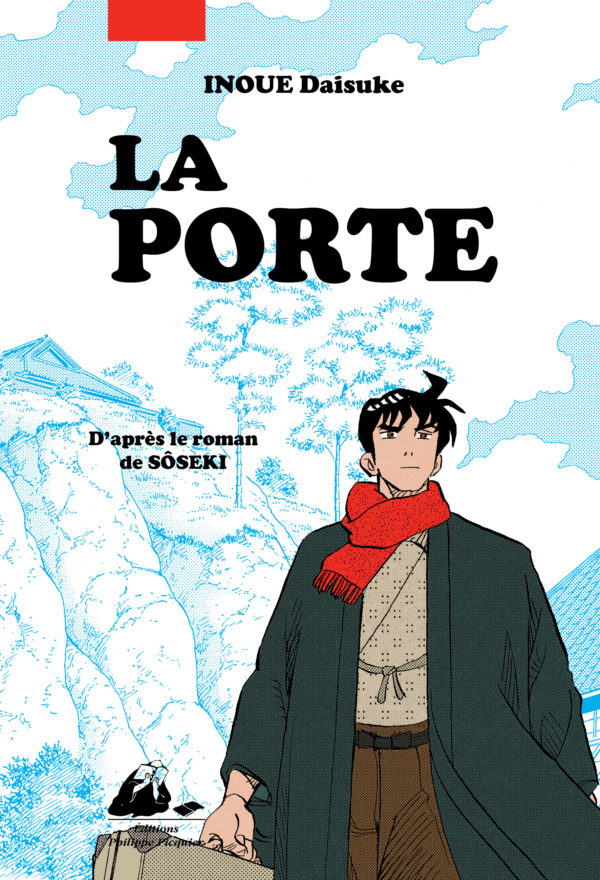
La Porte

La_Porte-covSôsuke et O-Yone vivent avec le poids d’un secret qui ombre de mélancolie leur amour tendre et leur jeunesse. L’heure est-elle venue de payer leur dette ? Pour savoir ce qu’il en est vraiment, Sôsuke se retrouve devant la porte d’un temple zen.

Un grand roman de Sōseki magistralement adapté en manga, dans le décor attachant du Japon d’il y a cent ans.”

[Texte du site de l’éditeur et de la couverture arrière]

Les Éditions Philippe Picquier se spécialisent dans la publication d’auteur japonais. Récemment ils ont commencé à inclure dans leur catalogue des adaptations en manga de classique de la littérature japonaise. En général, le style graphique de ces adaptations est très simple, alors que l’effort est surtout mis sur l’adaptation du texte (de façon assez similaire à la fameuse collection “Classiques” chez Soleil). Toutefois, même si ces mangas ne paie pas trop de mine visuellement, ils sont plutôt intéressant à lire car il nous font (re-)découvrir des classiques.

La Porte (門 / Mon) est une adaptation du roman éponyme de Natsume Sōseki par INOUE Daisuke (un ancien élève de Tezuka). Le roman original a été publié au Japon en 1910 — c’est le dixième roman de Sōseki, qui est surtout connu pour Je suis un chat (1905) et Botchan (1906). L’adaptation a été sérialisé dans Garaku no Mori et publié au Japon par Homesha en 2010.

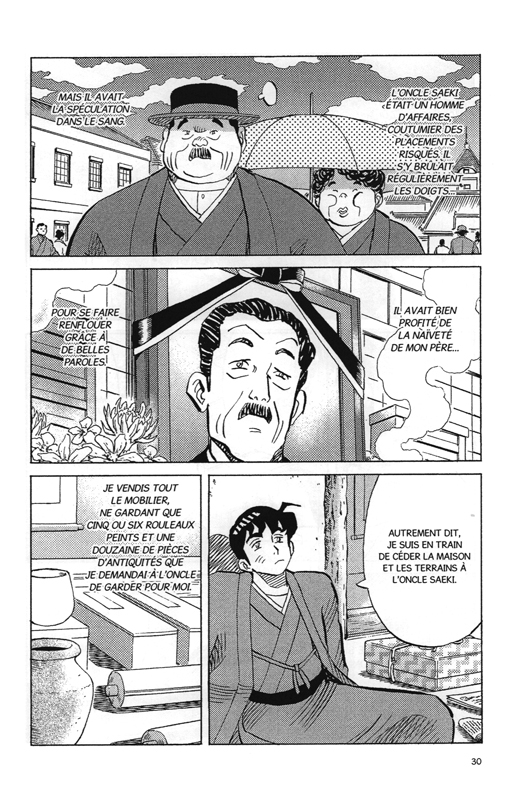
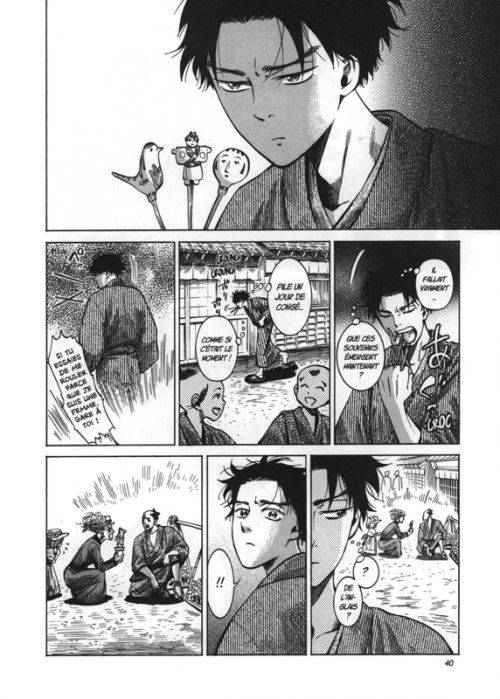
La_Porte-p030

Page 30

Nonaka Sōsuke est un jeune fonctionnaire mélancolique et indécis (un grand flanc mou comme on dirait ici) qui mène une vie ennuyeuse avec son épouse O-Yone. On découvre leur parcours, leur vie quotidienne: O-Yone tombe malade, Koroku — le jeune frère de Sōsuke — leur rend visite, ils apprennent que leur oncle a dilapidé leur héritage et, surtout, le secret qui les ronge nous est révélé. O-Yone était la fiancé de Yasui, un ami de Sōsuke, mais ils tombèrent amoureux l’un de l’autre et s’enfuir ensemble. Cette union répréhensible les mis au banc de la société et la culpabilité garda leur mariage infécond. L’angoisse de sa situation étant devenue intolérable, Sōsuke veut changer sa vie et décide d’aller méditer dans un temple zen. Mais il doit réaliser que c’est au-delà de ses capacités et que la porte de l’éveil lui restera fermé.

L’histoire, qui ne semble pas progresser ni apporter de résolution aux personnages, nous apparait comme incomplète. Mais peut-être était-ce là le sujet dont Sōseki voulait traiter: Sōsuke découvrant ses limites et ses responsabilités… même si il lui est impossible de changer son destin. Cela constitue sans doute une intéressante réflection philosophique mais demeure peu divertissant. En effet, le style sobre et épuré (un peu trop simple à mon goût) de INOUE et le récit lent et contemplatif de SÔSEKI en fait une lecture un peu morne. Toutefois, La Porte nous permet de découvrir l’oeuvre de Sōseki et d’avoir un aperçu de la vie quotidienne à l’ère Meiji. C’est donc décevant mais quand même intéressant.

La porte par INOUE Daisuke (dessin) et SÔSEKI (texte). Arles: Éditions Philippe Picquier, février 2018. 224 p., 15 x 22 cm, 15,50€  / C$ 27.95. ISBN 978-2-8097-1275-9. Extrait disponible sur le site de l’éditeur. Pour lectorat adolescent (14+). stars-2-5

Vous trouverez plus d’information sur les sites suivants:

[ AmazonBiblioGoodreadsGoogleWikipediaWorldCat ]
© Inoue Daisuke / HomeSha, 2010. © Éditions Philippe Picquier pour la traduction française – Tous droits réservés.

[ Translate ]
Capsules

Fête Nationale

Bonne Saint-Jean à tous!

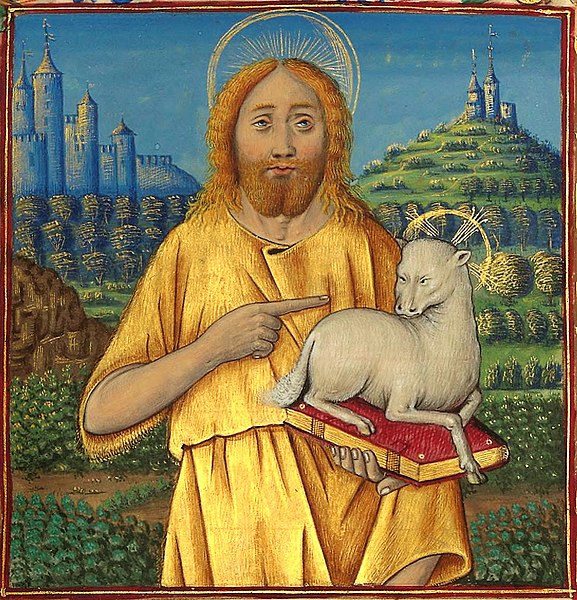
Saint-Jean-Baptiste_et_l'Agneau_de_DieuNe trouvez-vous pas étrange qu’un état qui viens de passer une loi pour forcer la laïcité célèbre l’anniversaire d’un saint catholique comme fête nationale? N’est-ce pas absurde, voir hypocrite? Comprenez-moi bien: j’ai toujours été en faveur de la laïcité mais une laïcité pour tous et pratiquée dans le libre choix.

De toute façon, je crois qu’il est malgré tout plus approprié de se baptiser dans la bière au nom du solstice (fête de la musique, midsummer, etc.) que pour célébrer Saint Jean le baptiste

Vive l’été !

[ Translate ]

top

[ Illustration: “Saint-Jean-Baptiste et l’Agneau de Dieu”, par Liénard de Lachieze (enlumineur français du XVe s.), Missel romain copié en 1492 pour l’évêque de Comminges Jean de Foix, feuillet 252r. (Sources: Wikimedia; BnF – Gallica, ms. latin 16827).]

Gentleman Jack

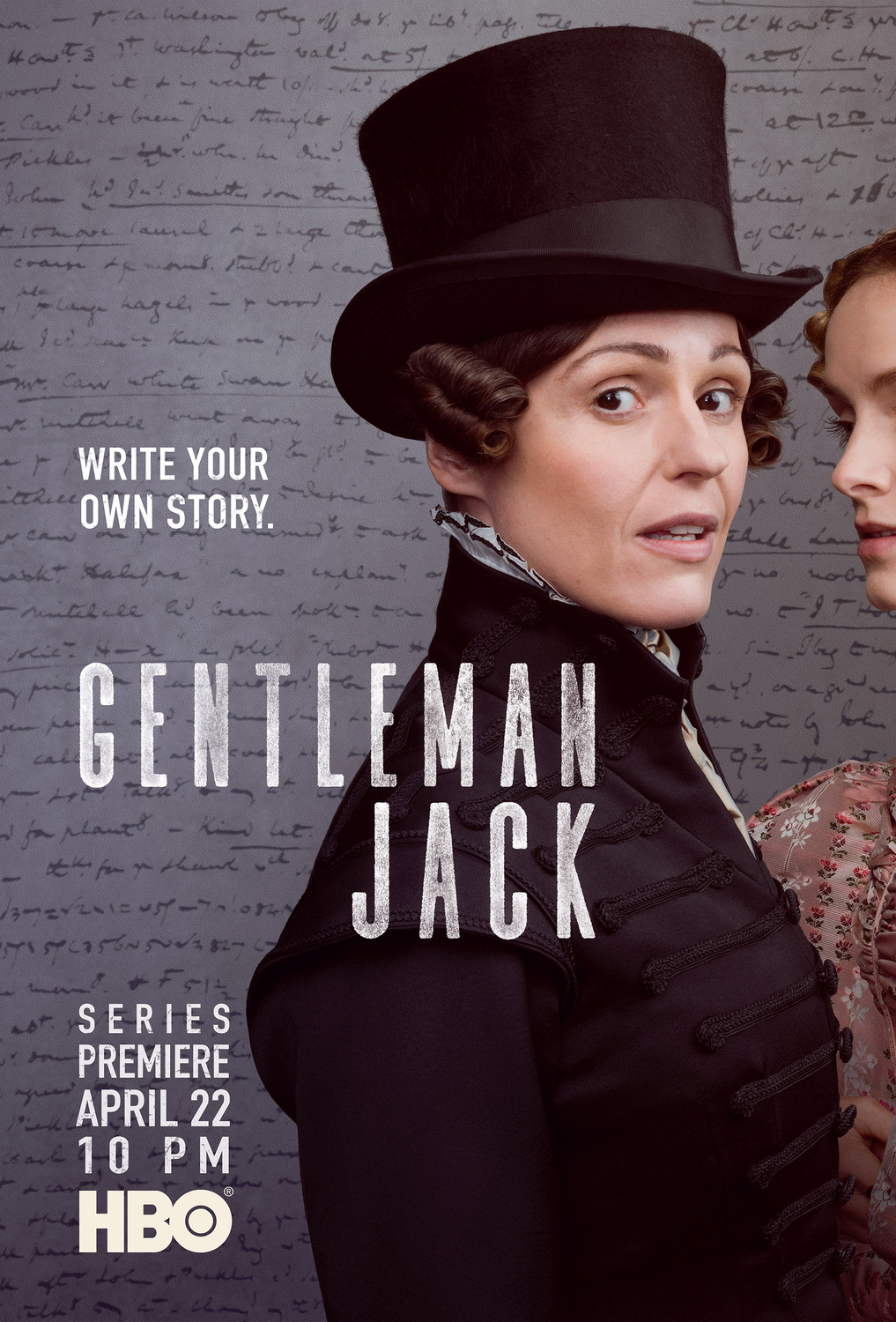
GentlemanJack-posterThis is another fascinating TV series that I am compelled to introduce to my readership. HBO has finally realized what PBS knew for a long time: well produced costume drama British TV series can be very popular in America too! They are now starting to co-produced Brit TV series in order to bring them over this side of the Atlantic, but their choice of titles is more edgy or controversial than what PBS is doing. And I am very grateful for that.

Gentleman Jack tells the story of Anne Lister, a landowner and industrialist from Halifax, West Yorkshire. She is known for being the first well-documented “modern lesbian”, as she left coded diaries chronicling in details her daily life, including her romantic relationships and the workings of her Shibden Hall estate and business. Set in 1832, the series mostly tells about her venture in coal mining and her relationship with Ann Walker. It started mainly for the challenge of the conquest and partly for financial interest, but she quickly becomes quite fond of the wealthy heiress. First, I was shocked by how she was planning to win her affection, but I quickly realized that if a man would have been doing the same thing it would have appeared totally normal! 

The acting is excellent (Lister is played by Suranne Jones and Walker by Sophie Rundle) and the story (created by Sally Wainwright) is well written and quite funny. The series is interesting not only because it displays the beautiful English countryside and makes us discover the eccentricity, boldness and modernity of Anne Lister, but above all because it opens a window on the way of life of the English country folks and small nobility at a time when everything is about the change. 

Gentleman Jack is an excellent historical drama that deserves your attention. It was well received by the critics (with ratings of 8.0 on IMDb and of 87% / 93% on Rotten Tomatoes). The first eight-episode season just ended, but it is still streaming on HBO. A second season has already been announced. I can’t wait to hear again the ending credits’ catchy tune by O’Hooley & Tidow!stars-4-0

To learn more about this title you can consult the following web sites:

[ GoogleHBOIMDbOfficialWikipedia ]

[ Traduire ]

Capsules

Chernobyl

Chernobyl_2019_MiniseriesI really must bring this TV mini-series to your attention. Chernobyl is a superb five-part historical TV drama co-produced by HBO and Sky UK. It is about the events that led to and the aftermath of the nuclear reactor disaster that occurred in north Ukraine on April 26th 1986. The story focuses mostly on the scientist Valery Legasov (played by Jared Harris) who is sent to the site of the disaster, along with the Council of Ministers’ deputy chairman Boris Shcherbina (played by Stellan Skarsgård), to assess the damage and oversee the cleanup effort. Legasov also ask his colleague Ulana Khomyuk to investigate the cause of the reactor explosion. 

The storytelling is surprisingly accurate (although a few facts were tweeked for dramatization purpose). It tells a dark, somber story but, on top of that, the ambiance of the show itself (the sets that look like you were really in the 80s soviet era, the solemn music, the slow pace of the show) create a dark, oppressive (almost horrific) feeling that is quite depressive. However, that’s what makes the show so spot on. 

The accuracy is such that even the selected actors looks like the part (although they are — and speak — mostly British English, but the acting is so good that you don’t really care). The only character that didn’t historically exist was Ulana Khomyuk (played by Emily Watson) which was created as a composite character representing all the scientists that worked along Valery Legasov. They even shot in Ukraine and Lithuania to get the soviet vibe of the location. The last episode concludes with a “where are they now”-style epilogue that explains what happened after and shows real footage of the characters and events (on a backdrop of gloomy Russian chorus). It is really chilling!

It is an incredible miniseries, very well crafted, visually stunning in how everything look so drab and grey, quite compelling and that rings so true. It shows the extent of the human stupidity and the deep flaws of the USSR society and political system. However, the message is also extremely pertinent for today as it poses the question “What is the cost of lies?” (in an obvious reference to the Trump White House)… A must see.

I am not the only one who greatly appreciated this series as it was very well received by the critics (ratings of 9.6 on IMDb and of 96% on Rotten Tomatoes). To learn more about this series you can check the accompanying podcast where screenwriter Craig Mazin discuss the production (available on Youtube, Spotify or Apple) and the series is still available for streaming on HBO.stars-4-5

To learn more about this title you can consult the following web sites:

[ GoogleHBOIMDbWikipedia ]

[ Traduire ]

Capsules

Cabinets of curiosities

My nephew, Sébastien, has just started a blog (in French) about how he is building and assembling his own cabinet of curiosities. It is very interesting. He is suggesting lots of crafty and thrifty ways to create such cabinet. I particularly like his entry about old books. He is very creative (he is a writer after all) and has a very strong background in science (molecular biology); he really succeeds to combine both aspects with great ingenuity. With this blog he is sharing his passion for the scientific wonders and natural oddities of the past. I am quite impressed. It is fascinating and I recommend to have a look.

My nephew also reminds us that my great friend Mario Tessier, the venerable and learned scholar known as the “Futurible”, had introduced us to the history of the cabinet of curiosities in one of his famous “Carnets” published in Solaris #191 (p. 111-125). It is quite an edifying article that I encourage you to read if you want to push further your knowledge on this subject.

AthenianTetradrachma

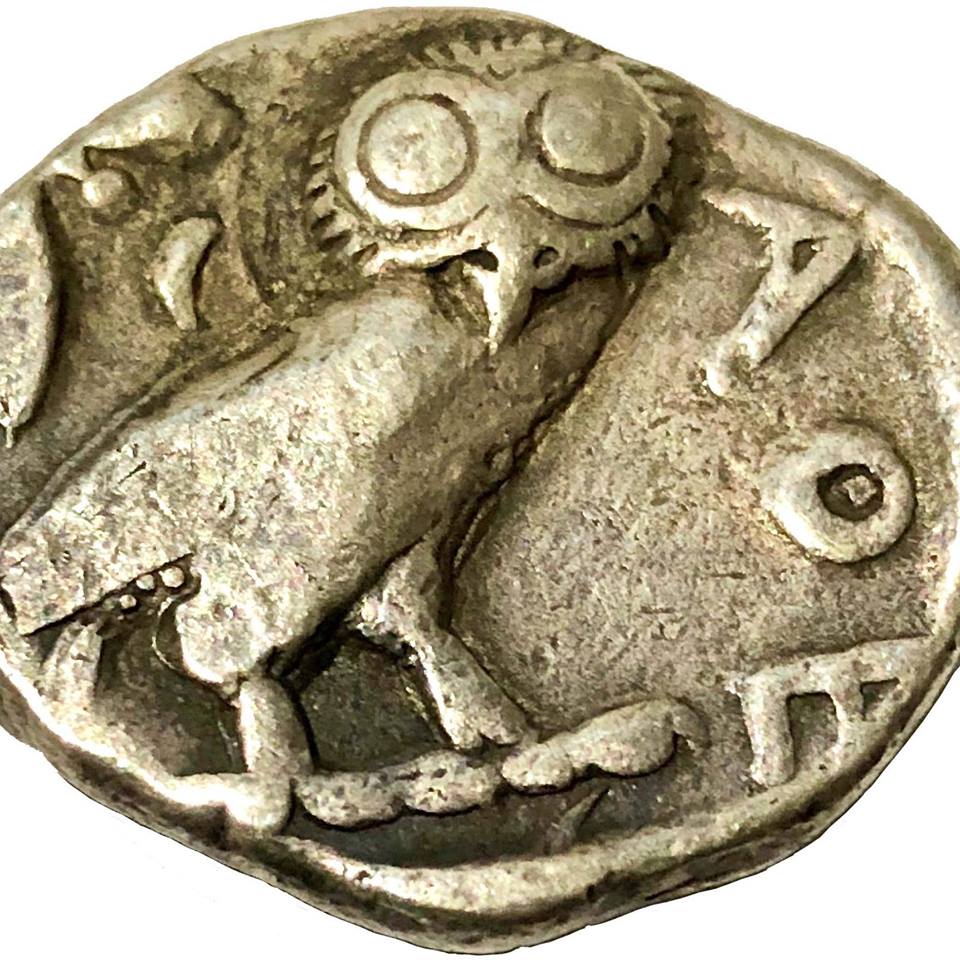
Athenian Tetradrachma (5th c. BCE)

I have myself been collecting such curiosities since I am a child. When I settled in my home I placed a glass case in the center of the library room where I gathered a few of those items collected over the years. Unfortunately, for lack of space, it is a small display and most of my collection is still in boxes, spread around the house on top of bookshelves or even (for my most precious items like my Athenian tetradrachma, my Marc Antony or Lucius Verus denarii or my Leo I the Thracian solidus) in a safe. I have already introduced my collection in an entry about old books. However, inspired by my nephew, let me now elaborate a little more about my own cabinet of curiosities.

Old_Books-1593_IMG_0105

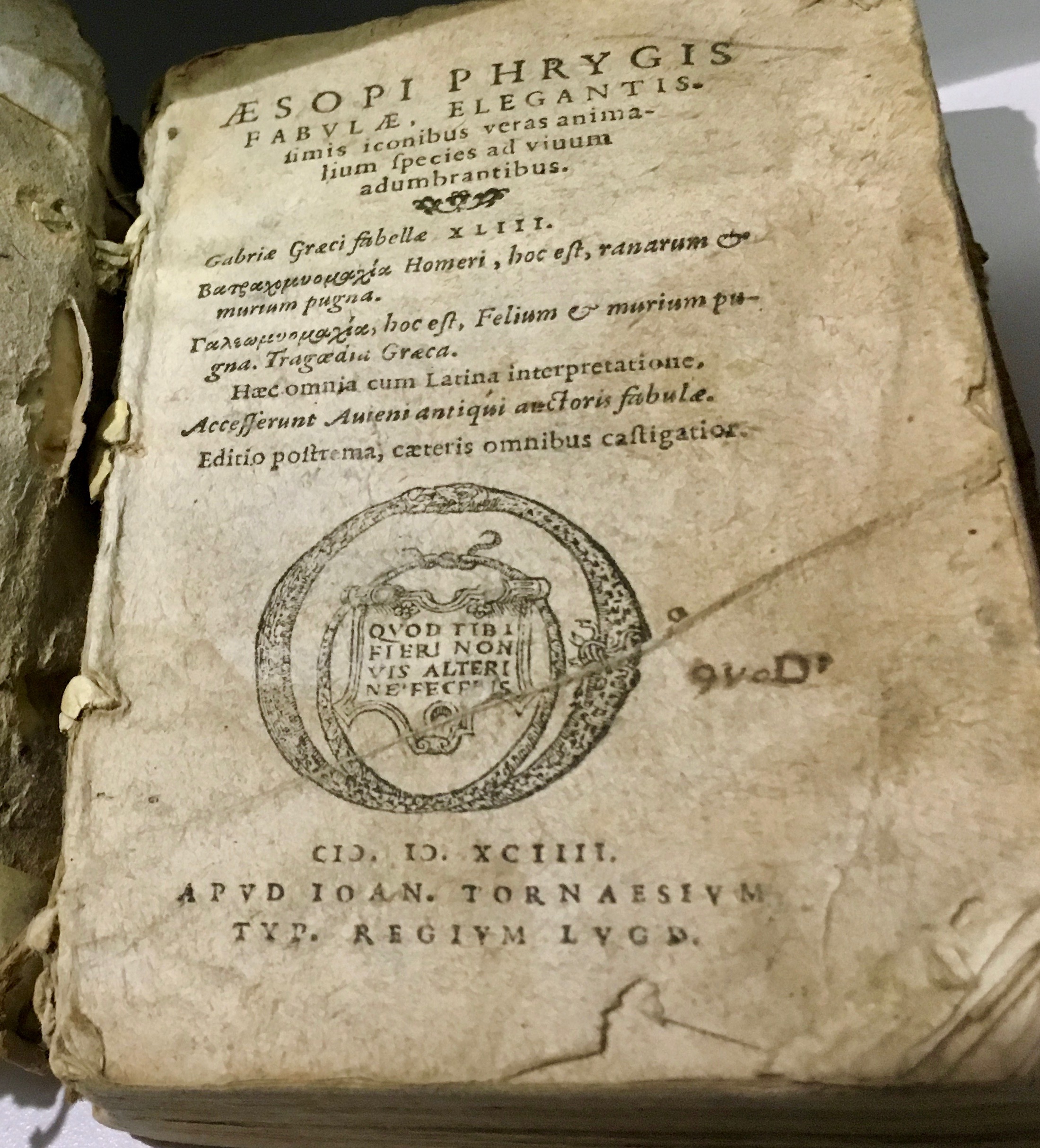
Aesope’s Fables [1593]

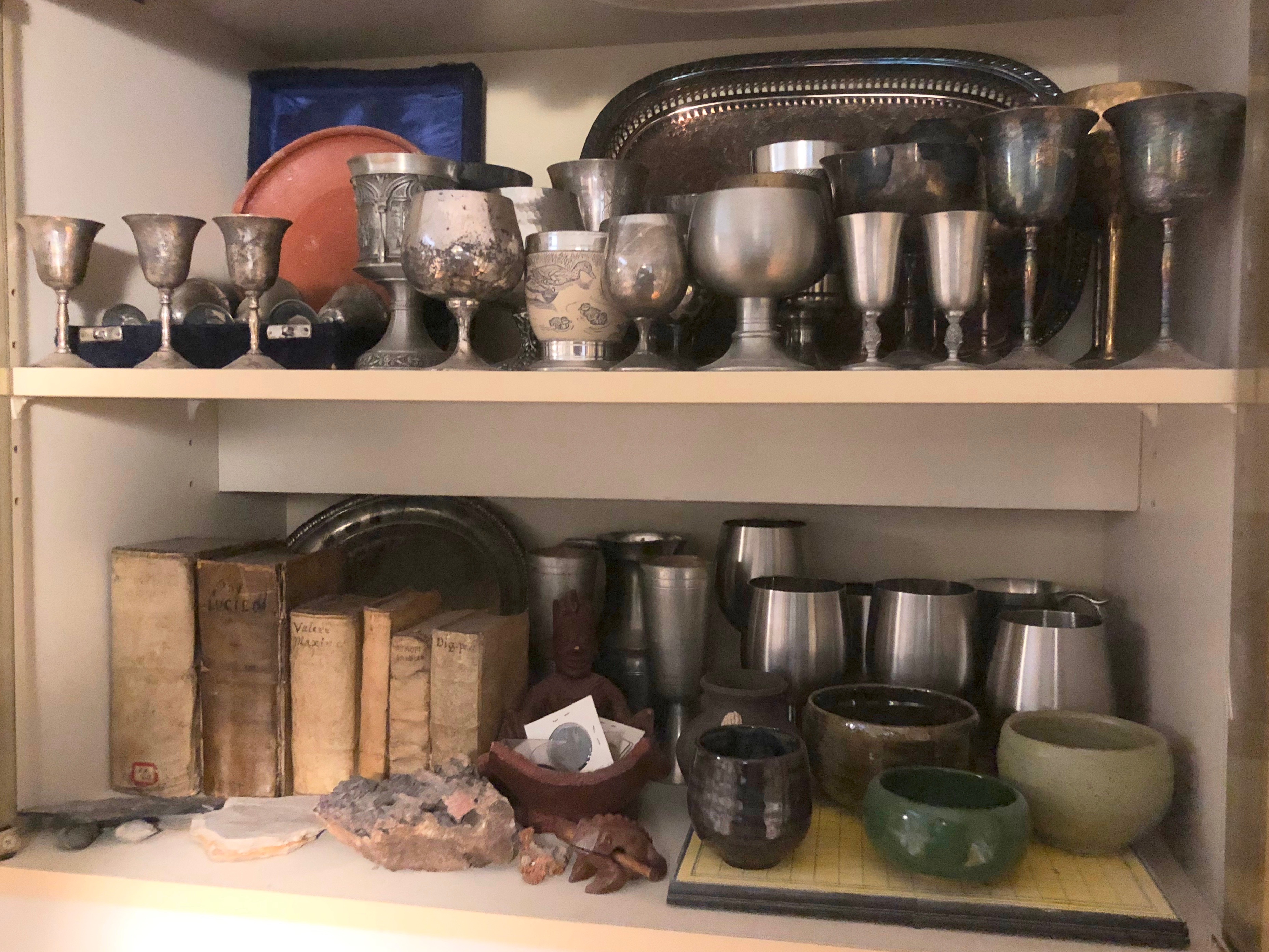
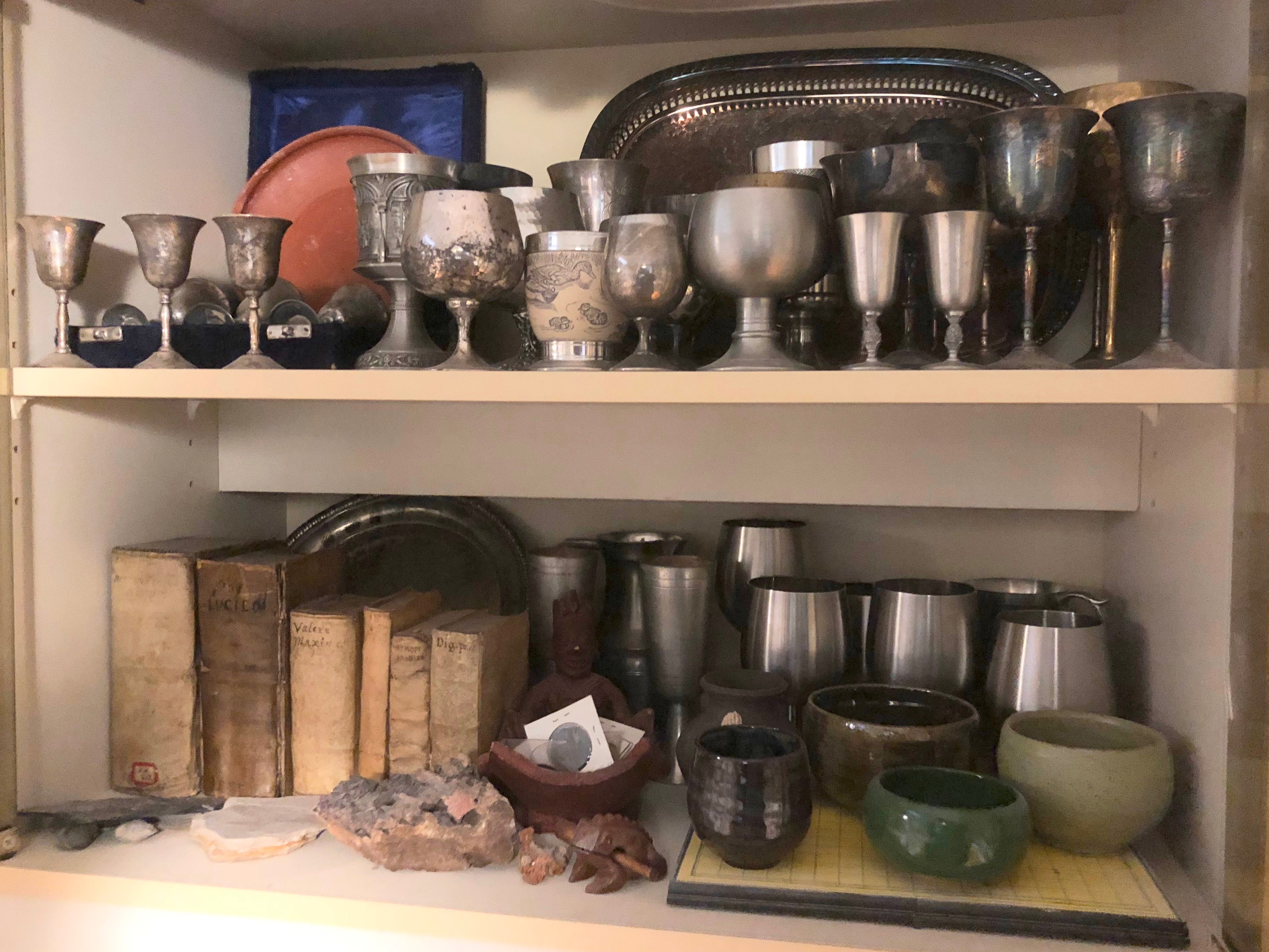
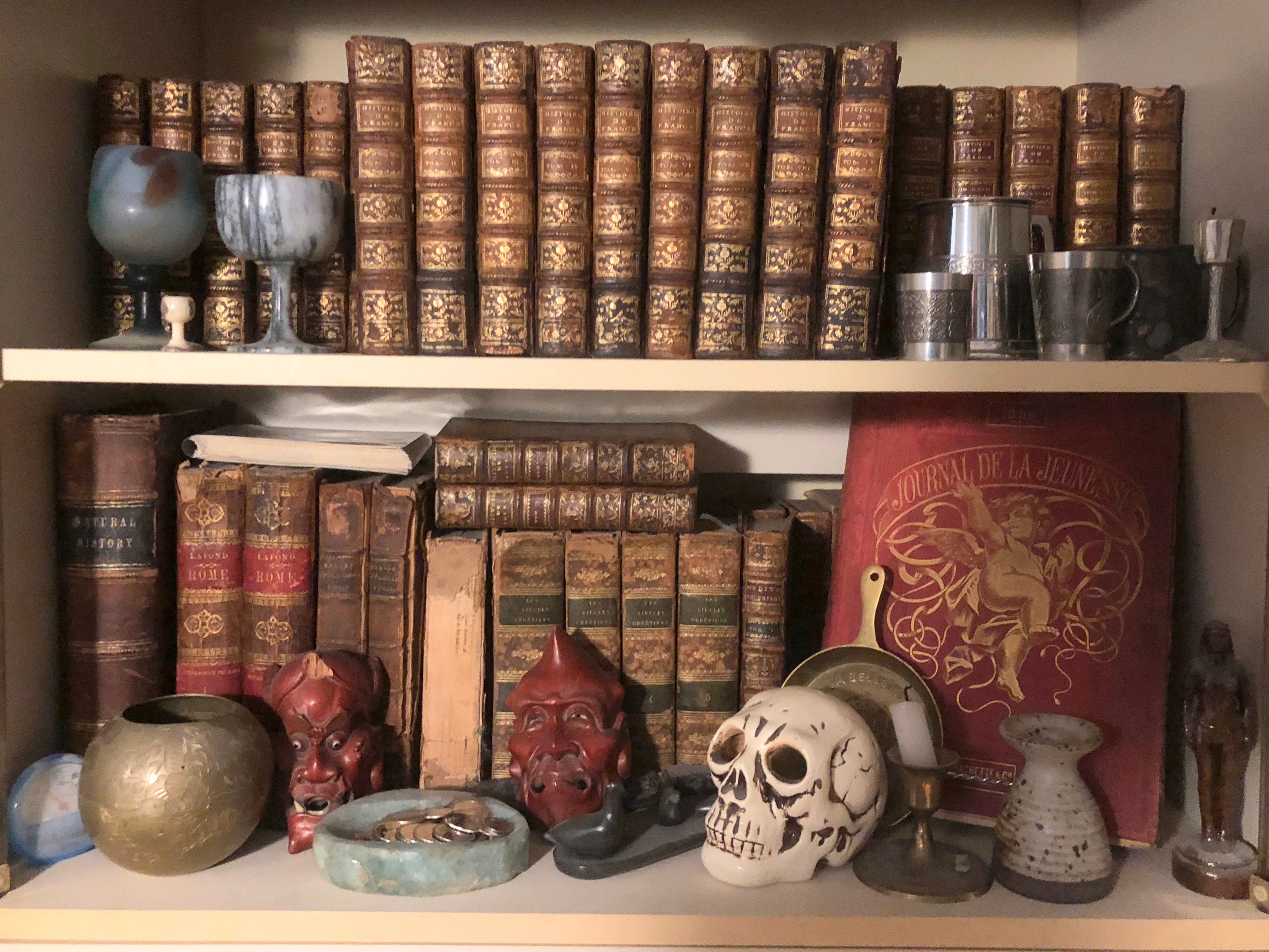
Of course, most of my collection is articulated around books — mostly old ones. However, as a kid, I started collecting stones, minerals, fossils and coins (very few of those are displayed). At some point, because I was studying the origin of metallurgy in ancient Mesopotamia, I started collecting metal cups (mostly in silver and tin — choose wisely your graal!) and my roman studies prompted me to acquire many greek, roman and byzantine coins. Whenever I can I try to add some antiquities (pseudo or authentic) or pieces of old technology (but those are rare and expensive, so I’ve acquired them so far from family or friends). But I am mostly into old books and metal stuff… Here is the core of my cabinet of curiosities:

IMG_4320

Left side

Top: my collection of cups and (plated) silver plates; note the authentic 4th c. roman terracotta on the left. Bottom: my oldest books (16th-17th c.), some fossils, amethyst and native copper samples, a few coins, more metal cups and some Japanese-style tea cups (on top of a portable Go board).

IMG_4313

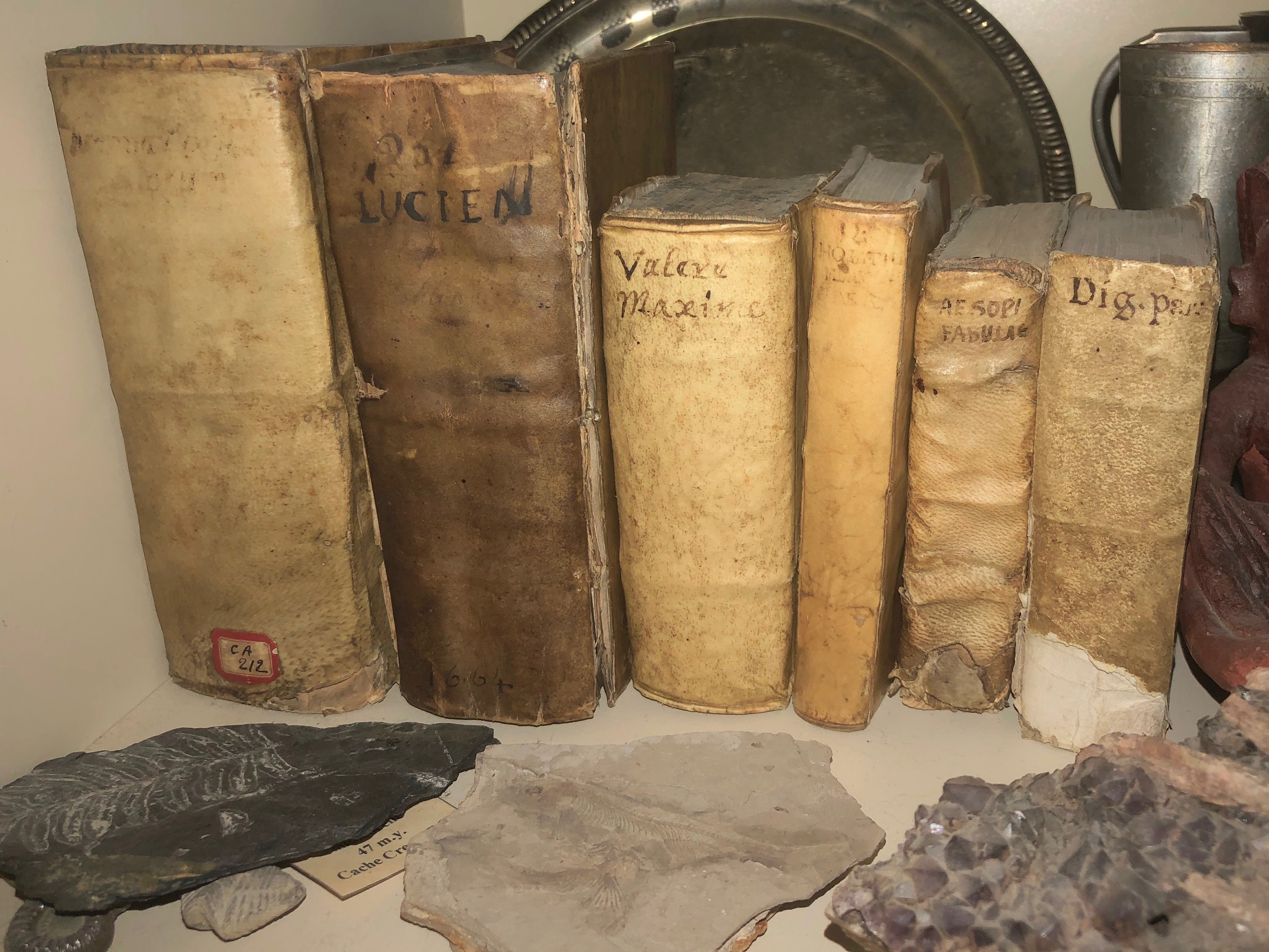
My oldest books

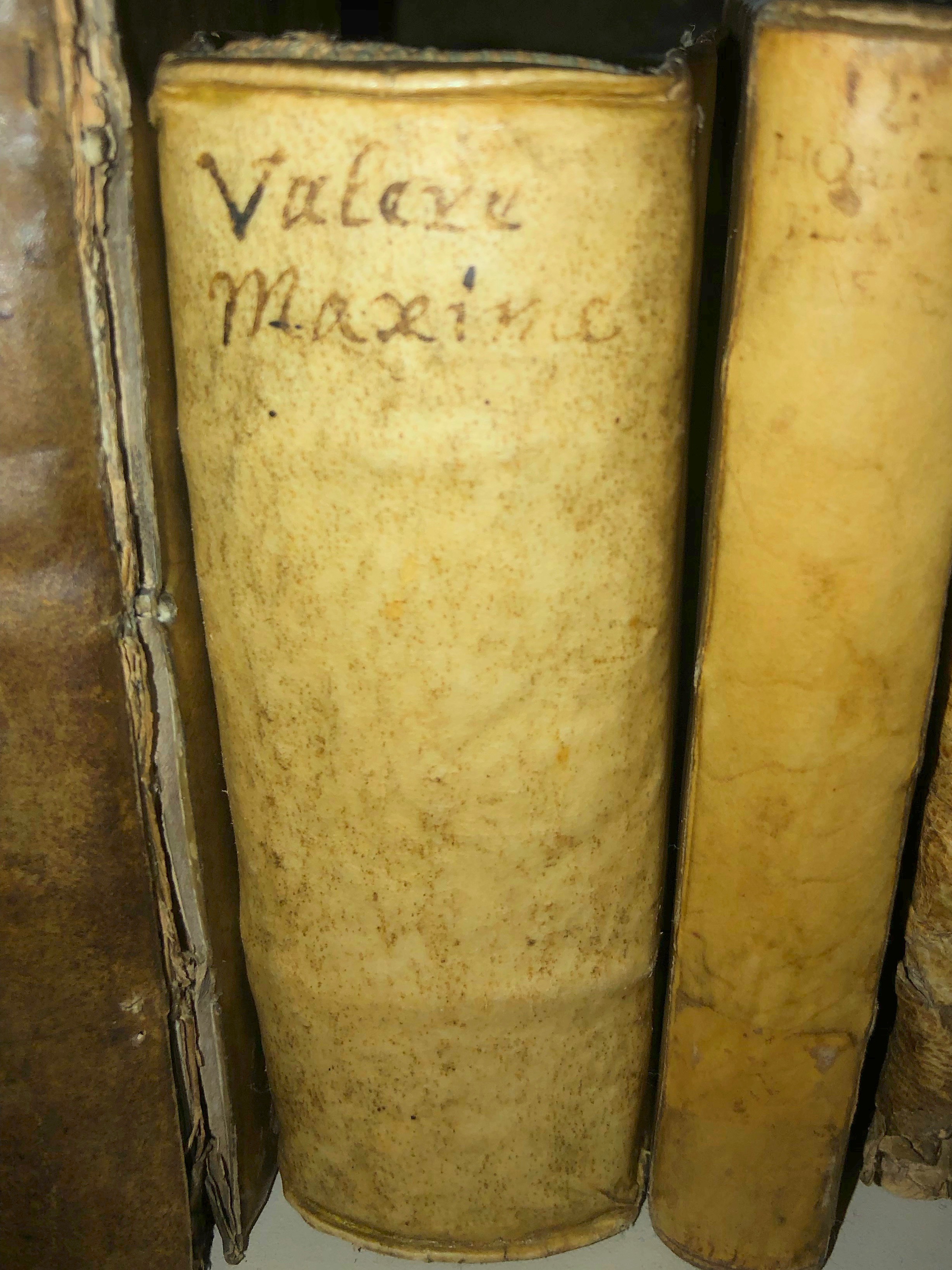
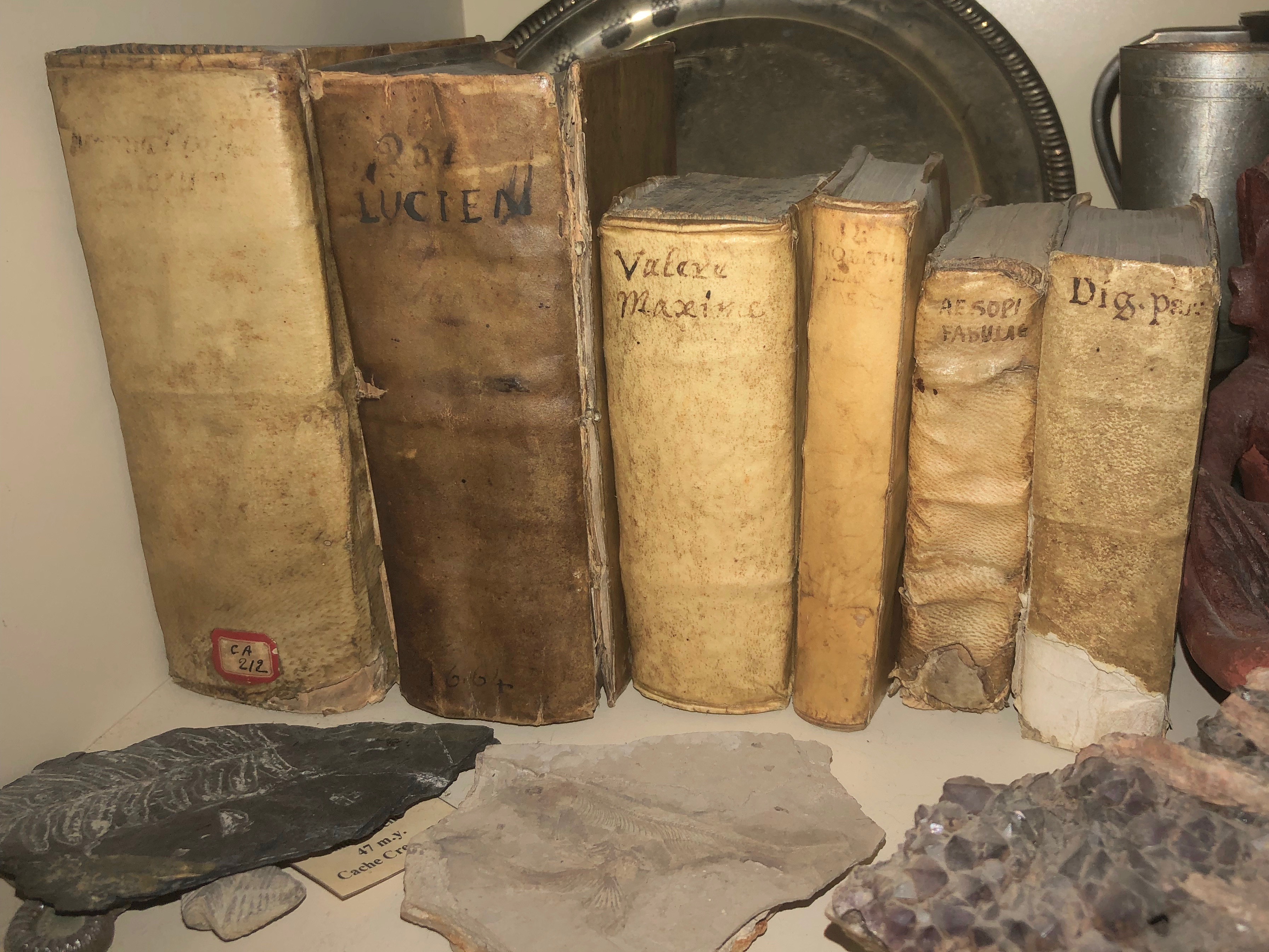
Detail of the fossils and old books (Svmma Omnivm Conciliorvm et Pontificvm [1633], Lucien [of Samosata] [1664], Valerius Maximus Factotum ac dictorum memorabilium libri IX [1659], Qvinti Horatii Flacci Poemata [1643], Aesopi Phrygis: Fabulae [1593], and [Iustiniani Augusti] Digestorum sev pandectarum (Pars quarto [liber XX-XXVII]), De Pignoribvs et hypothecis [1581]).

IMG_4322

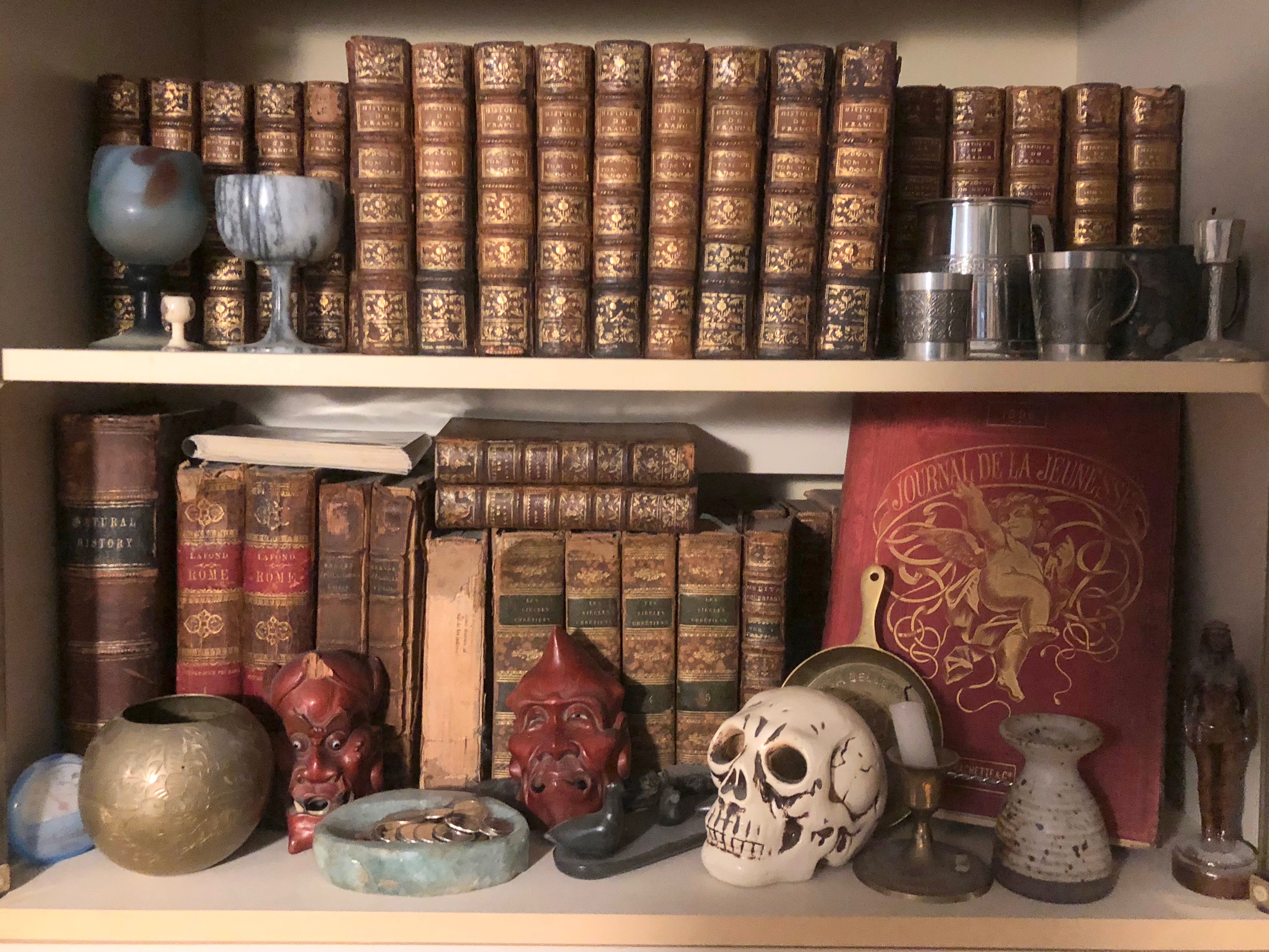
Right side

More old books (18th-19th c.), metallic gobelets, non-metallic cups (the smallest is in walrus ivory), a pair of small wooden masks of unknown origins (Balinese? Malaysian?), an (half-hidden) incised Malian knife with leather scabbard, some Inuit art, a false skull (an ashtray in pottery) and various mementos.

IMG_4743

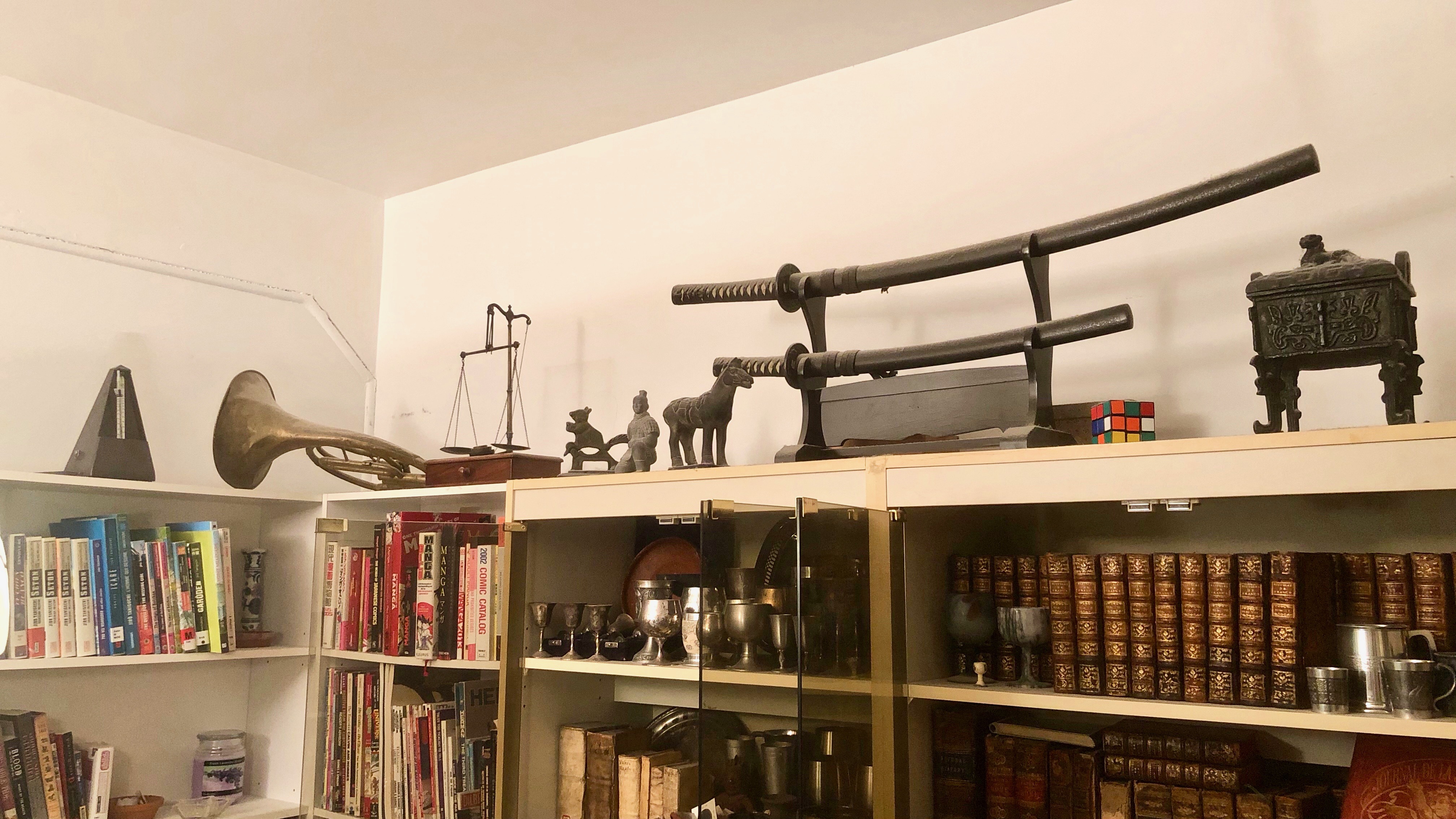
On top of the shelves: a metronome, my grandpa’s French horn, an 18th c. tradesman’s balance scale, Chinese art reproductions, fake katanas, an original Rubik’s Cube and an authentic (undated) Chinese ding (ritual bronzes).

IMG_4744

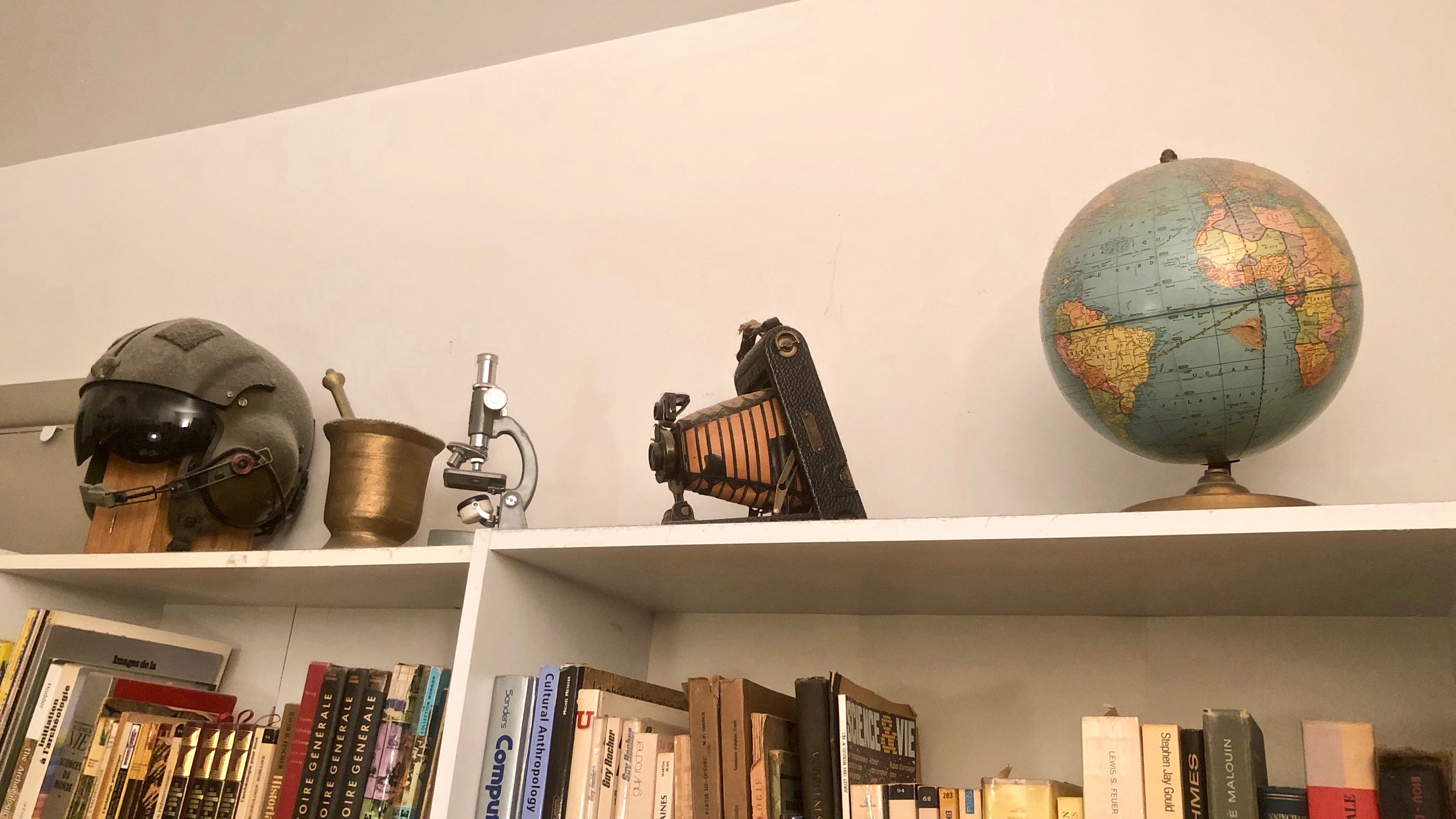
On top of the shelves: a 70s helicopter’s pilot helmet, an (African? Undated) bronze mortar & pestle, a transportable Lumex microscope, an old 1-A Kodak Jr folding camera [1912] and a terrestrial globe (60s or 70s).

I have many more interesting items that I could display. Following my nephew’s example, I will do my best in the future to find clever ways to share them with visitors (and seek to acquire — or make — new ones; although I am far less creative than Sébastien). And you, do you have a cabinet of curiosities?

To be continued?

[ Traduire ]

Ad Astra VI

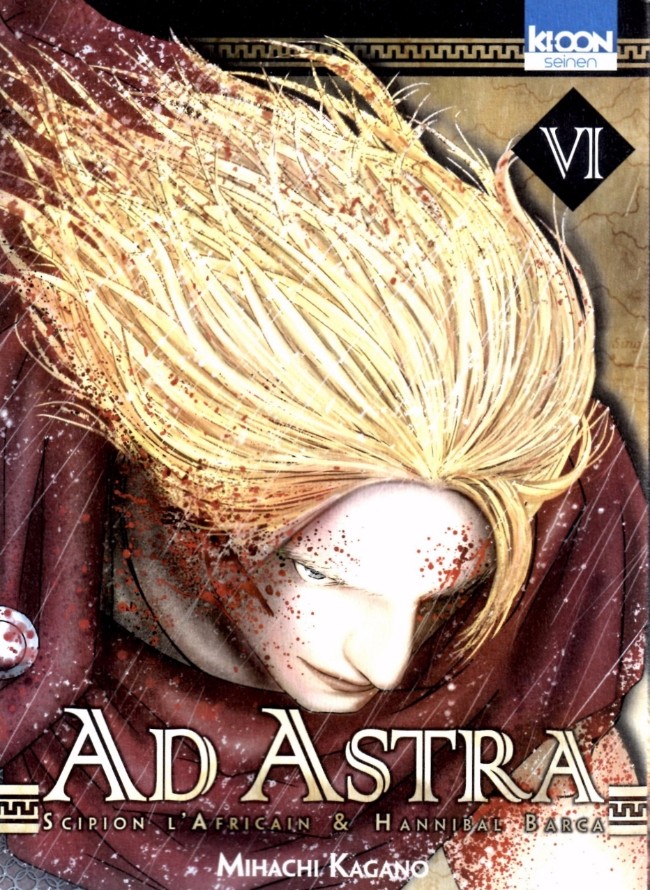
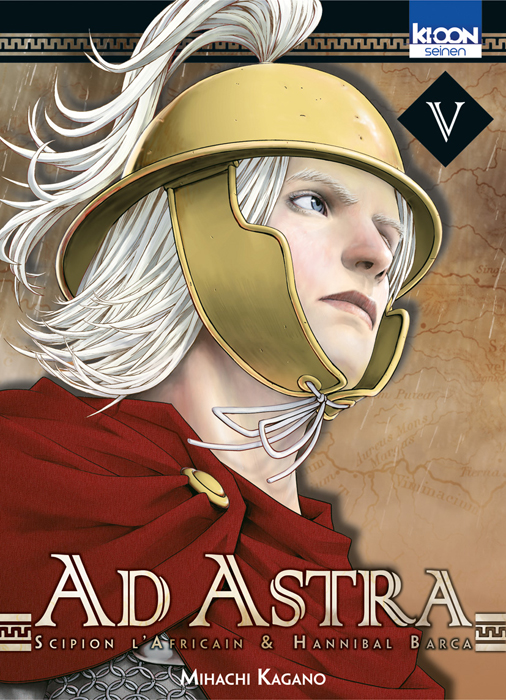
AdAstra-v06-covMalgré les réserves d’Aemilus, Varron reste fidèle à son plan. Il lance son immense armée contre les troupes carthaginoises, persuadé d’avoir identifié la stratégie de l’ennemi : profiter du terrain pour prendre l’adversaire au piège.

Mais rien ne se passe comme prévu et, dès le début des combats, la cavalerie romaine se fait décimer ! Tandis qu’Aemilius, blessé, cherche à préserver Scipion du carnage, le second consul prend lâchement la fuite. Si l’infanterie de Rome domine encore, la bataille ne fait que commencer…

Bravoure, complots et stratégie… Plongez au cœur des batailles qui opposèrent les légendaires Hannibal et Scipion !” (Texte de la couverture arrière)

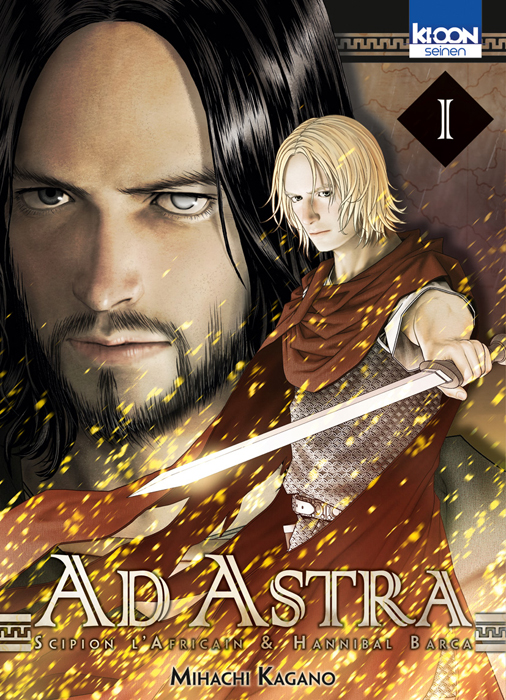
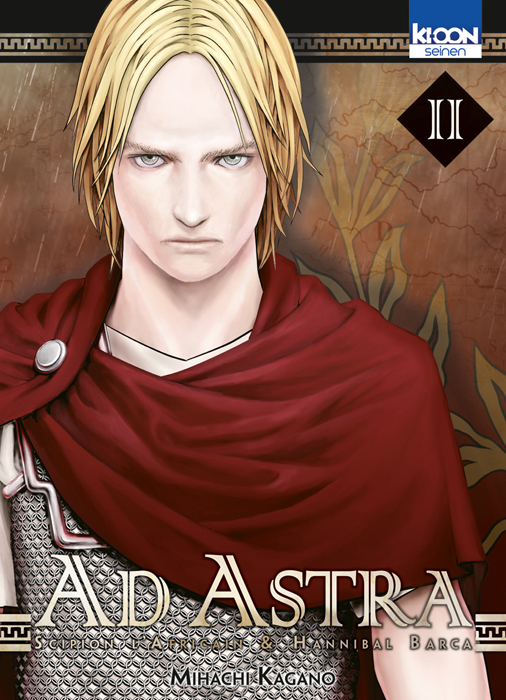
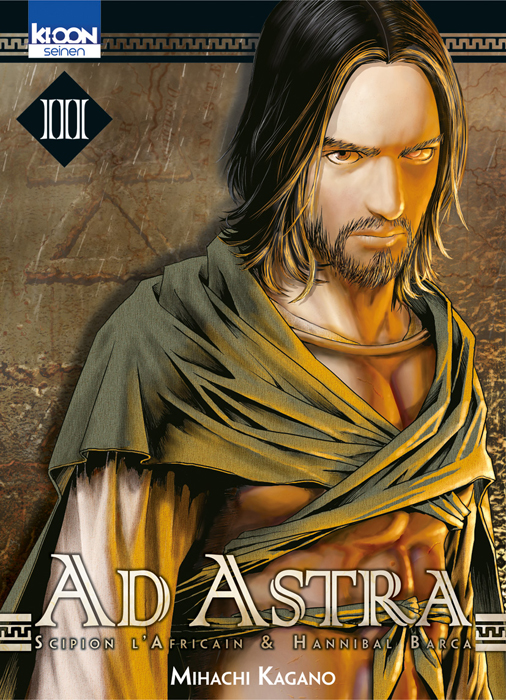
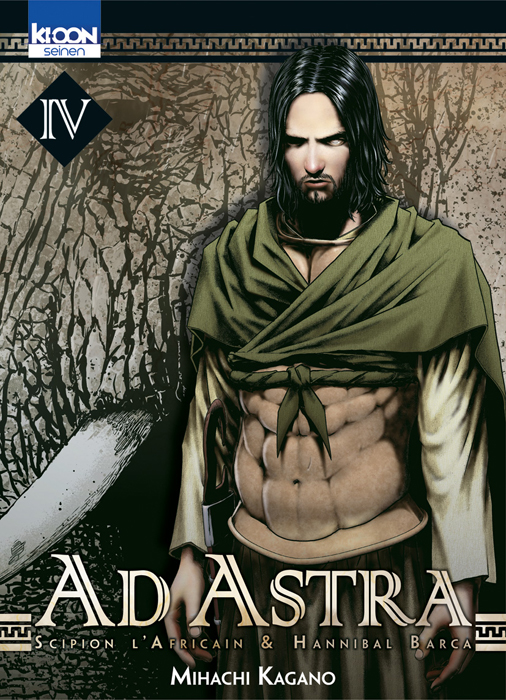
Ad Astra: Scipion l’Africain & Hannibal Barca (アド・アストラ -スキピオとハンニバル- / Ad Astra – Scipio to Hannibal) est un manga seinen historique par Mihachi KAGANO (dont c’est le premier titre) qui raconte les faits saillants de la deuxième guerre punique qui opposa Rome et Carthage. Il a été prépublié dans le magazine Ultra Jump (entre mars 2011 et février 2018), puis compilé en treize volumes chez Shūeisha. La version française paraît chez Ki-oon.

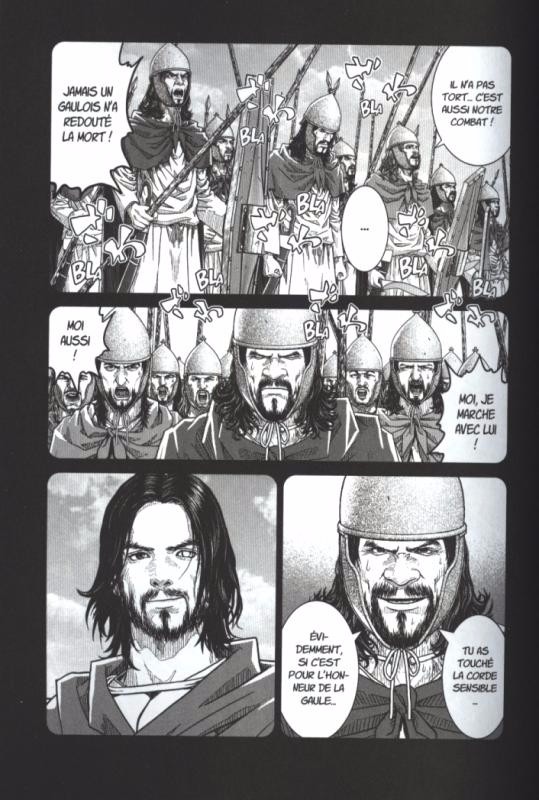
AdAstra-v06-p21Le sixième volume est entièrement consacré à la bataille de Cannae et à ses suites immédiates. Encore une fois, les romains sont victimes de la brillante stratégie d’Hannibal. Toutes les batailles précédentes n’ont servi qu’à convaincre les romains qu’ils commençaient à comprendre sa stratégie afin qu’il puisse à nouveau les surprendre. Il commence par rassurer ses alliés gaulois en affirmant qu’ils vaincront malgré leur infériorité numérique (80,000 romains contre 50,000 alliés Carthaginois) et de lourdes pertes mais que cela en vaut la peine pour se venger du joug romains et pour l’honneur de la Gaule! Après avoir feint la retraite, les Carthaginois encerclent les romains et les massacrent. Minucius et Aemilius sont tué par Giscon. Scipion, qui avait reçu l’ordre de rester en retrait avec la cavalerie, décide de mobiliser les 10,000 hommes restés au camp en renfort mais ceux-ci refusent. Leur dernier ordre était de garder leur position et, Aemilius étant mort et Varron ayant “retraité” (fuit), il n’y a plus de généraux pour donner de nouveaux ordres.

Les pertes romaines sont lourdes: 60,000 morts (dix fois plus que les Carthaginois!) et 10,000 prisonniers (dont Rome refusera de racheter la liberté)! Maharbal est d’avis que les Carthaginois devraient profiter de la victoire et marcher sur Rome mais Hannibal refuse, ne voulant pas prendre de front un ville défendu par une muraille. Maharbal réponds “Tu sais vaincre, Hannibal, mais tu ne sais pas profiter de la victoire!” Par dépit, il massacre les villages environnants (Caius qui a survécu à la bataille mais a perdu un oeil, en est témoin). Hannibal envoi son frère Magon à Carthage pour réclamer des renforts. À Rome, Fabius reprends le pouvoir et envoi les soldats survivants en Sicile, sous le commandement de Marcellus. Scipion décide de suivre le cursus honorum et de briguer office pour éventuellement devenir consul même si la tâche se révèle ardue (“Per aspera ad astra” d’où le titre du manga). Il défit Marcellus pour obtenir son soutien à l’édilité mais celui-ci le punis. Lorsque Marcellus est rappelé en Italie pour défendre la Campanie contre Hannibal, Scipion demande à l’accompagner…

Ad Astra est un manga très bien dessiné — le style en est clair et précis. Le récit est fluide, intéressant et très instructif pour ceux qui s’intéresse à l’histoire et à la civilisation romaine. Cependant, malgré que le récit laisse de côté de nombreux détails historiques (si l’on compare à Tite-Live), ce manga s’étire sur treize volumes. Nous n’en sommes donc qu’à la moitié de l’histoire! Cela reste quand même, avec Pline, le manga historique idéal pour les amateurs d’histoire romaine.

Ad Astra: Scipion L’Africain & Hannibal Barca Vol. VI, par Mihachi KAGANO. Paris: Ki-oon, juin 2015. 210 pages, 13 x 18 cm, 7,90 € / $16.98 Can. ISBN 978-2-35592-829-1. Pour un lectorat adolescent (14 ans et plus). stars-3-5

Pour en savoir plus vous pouvez consulter les sites suivants:

[ AmazonBiblioGoodreadsGoogleWikipediaWorldCat ]

Ad Astra Publius Cornelius Scipio Africanus Major & Hannibal Barca © 2011 by Mihachi Kagano / SHUEISHA Inc.

Voir mes commentaires sur les volumes précédents:

ad_astra-v01 ad_astra-v02 ad_astra-v03 AdAstra-v04-cov AdAstra-v05-cov

[ Translate ]

Capsules

Il Nome della Rosa

MV5BYTdhYzc0MmMtZDQwNS00ZTdlLTgzZmYtZWIxYzE4Zjk0YzQ4XkEyXkFqcGdeQXVyNTY2MzkxMjc@._V1_I stumbled by chance upon this TV series adaptation of the Umberto Eco famous novel (I thought I had read it, but, since I cannot remember anything about it, now I have doubt). I had seen, a long time ago, the movie adaptation with Sean Connery (and I have re-watched it just after seeing the series just for the fun of it!) and I was quite curious to see what it would look like as an eight-episode series (over six hours!)… 

The story is set in 1327. Brother William of Baskerville (an English Franciscan, whose name alludes both to Sherlock Holmes and William of Ockham), followed by the young novice Adso of Melk (the son of a German Lord), reaches an isolated Benedictine abbey in the Alps to participate in a debate between the Franciscan Order and the Avignon papacy about whether the Church should be poor as Christ was—a debate that would determine the very survival of the Franciscan Order. Upon arrival at the abbey the two find themselves caught up in a chain of mysterious deaths. William, a medieval sleuth, must untangle this knot of suspects (any of the multiple factions in the abbey, including a group of Heretics hiding amongst the Benedictines)—before the Dominican papal Inquisitor Bernardo Gui burn anyone at the stake—in order to solve the mystery that seems linked to the fabulous Abbey’s library and a coveted rare book!

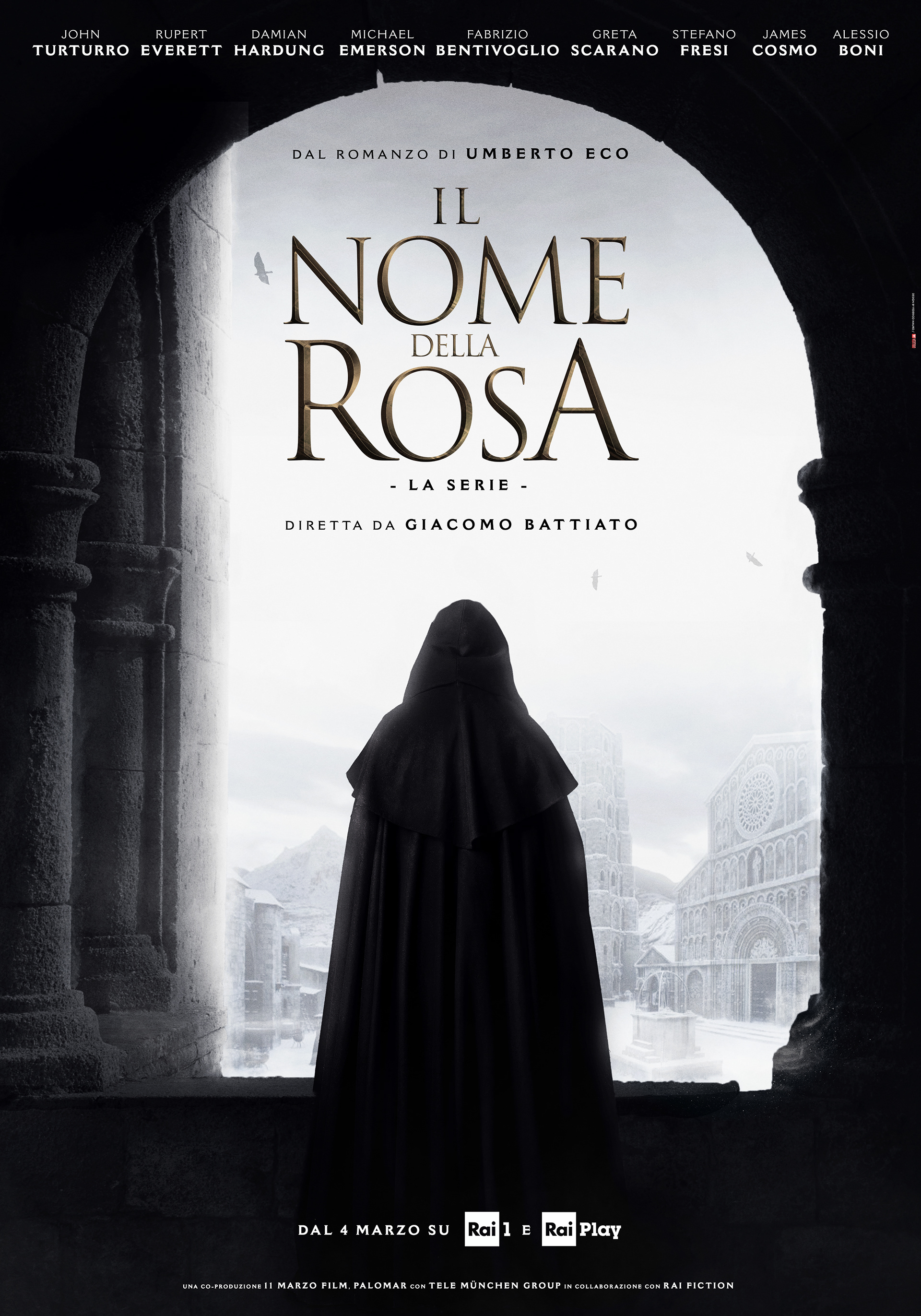
The TV series is an Italo-German co-production, created, co-written and directed by Giacomo Battiato, starring John Turturro (William), Rupert Everett (Bernardo), Damian Hardung (Adso), Fabrizio Bentivoglio (Remigio), Greta Scarano (Margherita / Anna), Richard Sammel (Malachia), Tchéky Karyo (Pope John XXII), James Cosmo (Jorge) and Michael Emerson (the Abbot). It doesn’t have the star power of Jean-Jacques Annaud’s movie (Sean Connery, F. Murray Abraham, Christian Slater, Michael Lonsdale, Ron Perlman) but still offers many known actors. Strangely, despite being shot in Rome’s Cinecittà Studios, the movie was filmed in English. It aired on RAI in Italy, on BBC in the U.K. and on Sundance TV in the U.S. 

While the movie focuses on the heart of the mystery (the murders and the book), the TV series has ample time to develop around the multiple elements that the movie left out: how William and Adso met, who are the Dulcinian heretics, the Inquisition’s past of William, the particular and what’s at stake in the debate between the papacy and the Franciscan, who is the peasant girl that Adso meets and falls in love with.

Although I liked the movie a lot because of its multiple charms and its great photography, the TV series is a very good production that seems more faithful to the book — and it offers more plot and action. It is a beautiful, very interesting historical drama (I can only dream of all those old books!) which will hopefully soon stream online (possibly on Amazon Prime) so it will be more readily available. I enjoy it and recommend it to all aficionados of medieval history, rare books and mystery novels. stars-3-5

To learn more about this title you can consult the following web sites:

[ GoogleIMDbRAIWikipediaYoutube ]


[ Traduire ]

Capsules

“Natural History” – final research

NHa-000_IMG_4392

My mystery book

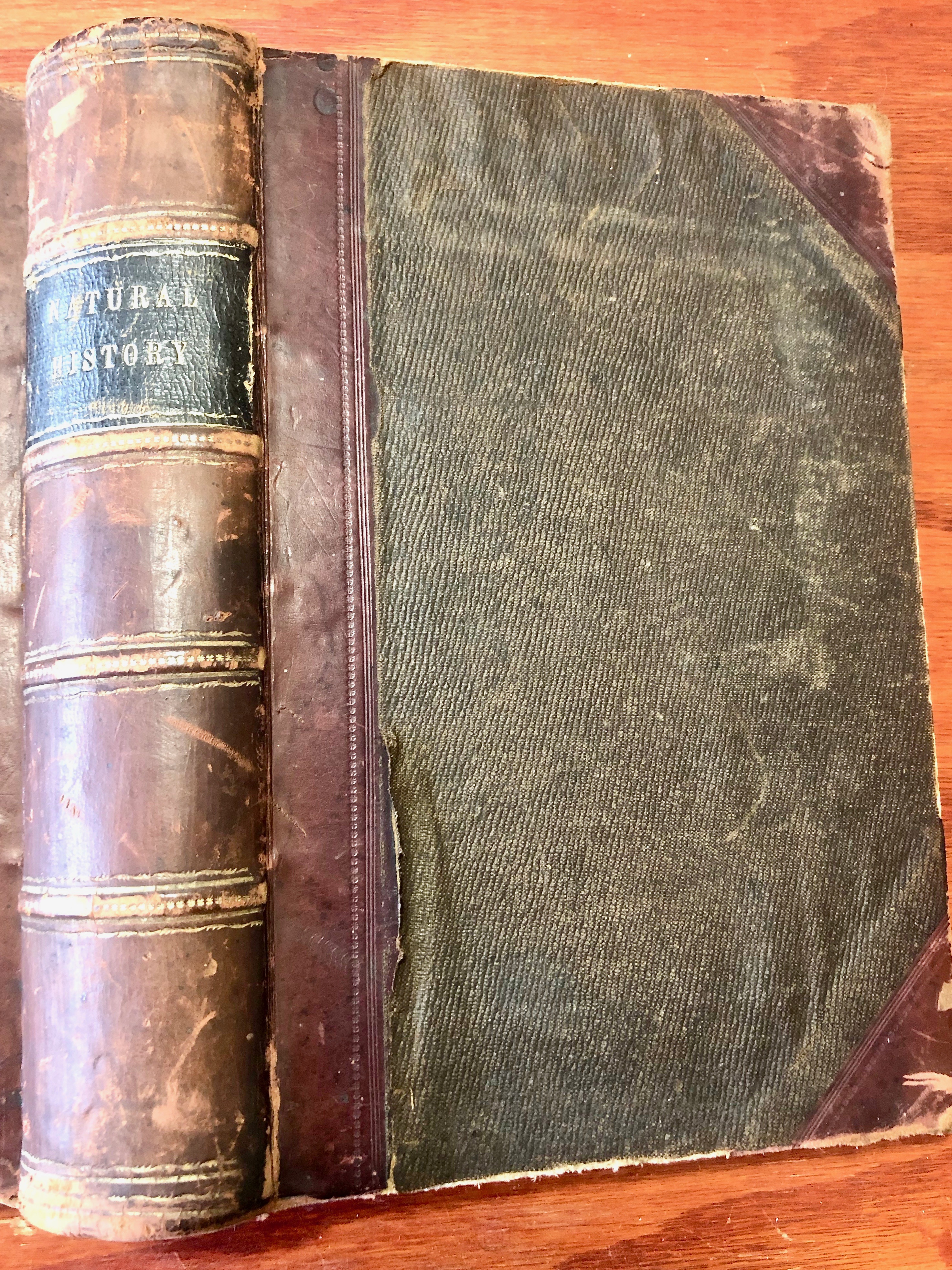
Recently, the interest for one of my old books was rekindled when I found some new information about it on the internet. Since the prefatory pages of the book are missing the author and date of publication are unknown. I had only the title, Natural History, and the publisher:  William Milner of Halifax. Further investigation on WorldCat revealed more details allowing me to identify two possible authors for the book. Finally, I was able to compare my book with a microfiche copy at the University of Montreal, definitively identifying it as Richard COPE’s Natural History, which lead me to order a monograph about the work of William Milner in order to (hopefully) learn even more on this particular edition.

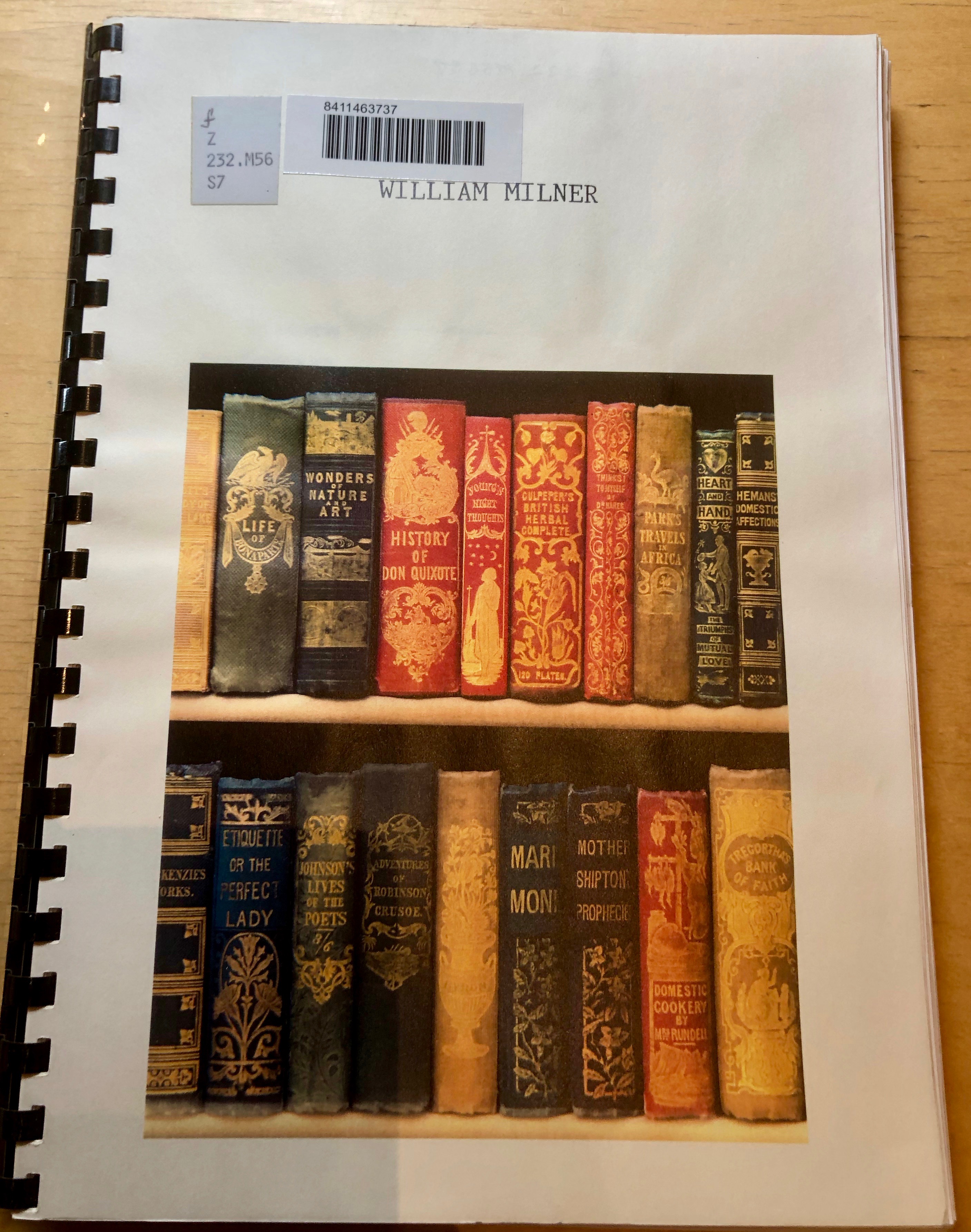
IMG_4437A little less than three weeks after filing the Inter-Library Loan (PEB) request, the Bernard BARR’s document about William Milner arrived at the National Library (BAnQ). Unfortunately, the whole process was utterly disappointing. The NYPL refused to lend its copy, so the book came from the University of St-Andrews’ library in Fife, Scotland, therefore the loan incurred a fee of $C 42.00 ! Not only the book was just a self-published monograph of sixty single-side pages with a simple plastic spiral binding, but the lending library requested that it had to be consulted on site, at the BAnQ. The book was on hold at the National Collection, a secure place where you have to check your coat and bag in a locker room before entering and you have to put all the material you need (notebook, pen, laptop, wallet, etc) in a basket that you carry with you. It was the first time I was visiting that place and it was all quite unexpected. Luckily, the staff was very nice and helpful. Instead of spending hours reading the book, I was allowed to digitize a copy on the photocopier (its control menu was not user-friendly at all and source of many frustrations). 

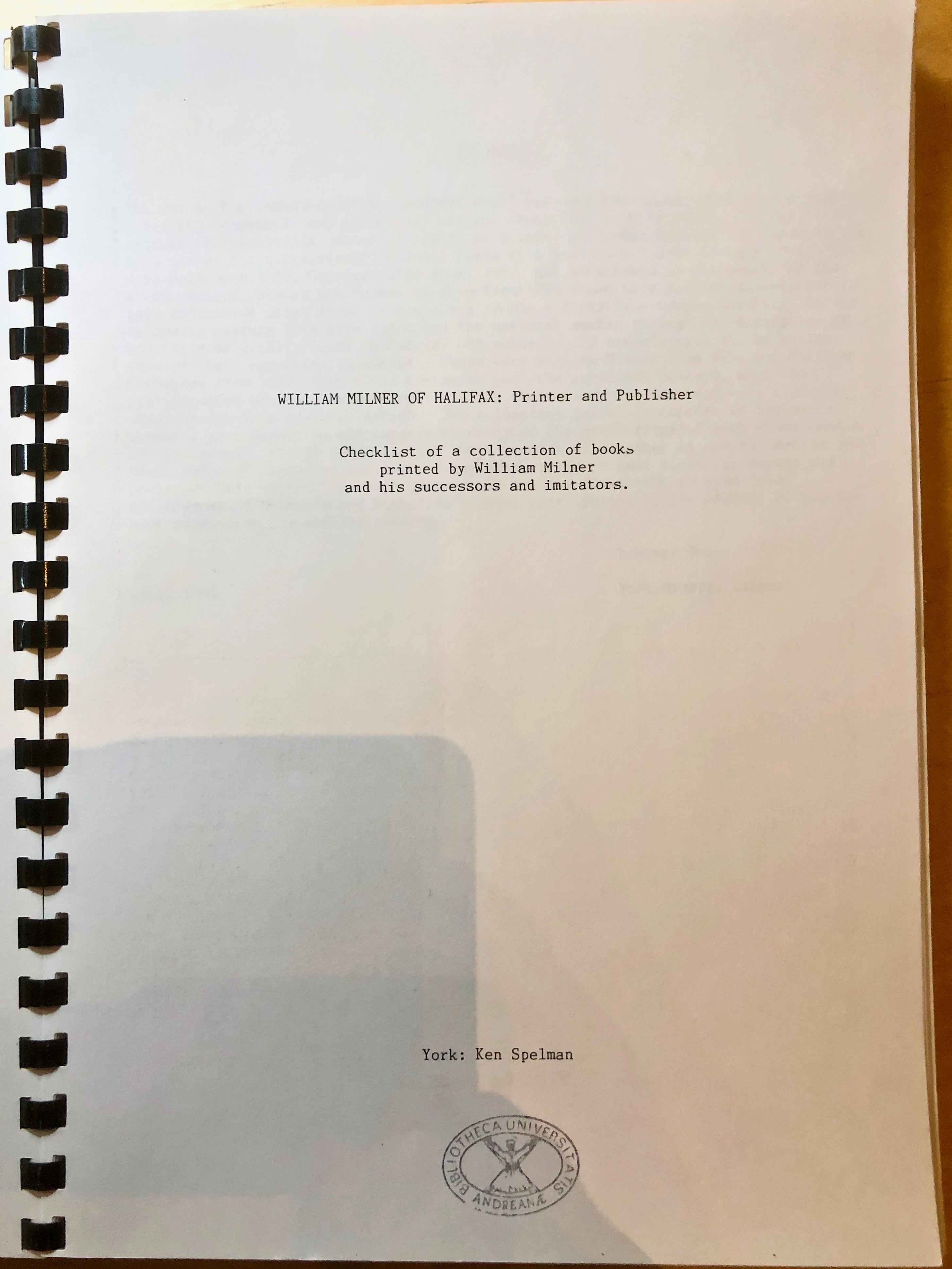
IMG_4441The book title is: “William Milner of Halifax: printer and publisher. Checklist of a collection of books printed by William Milner and his successors and imitators.” The only publishing information is “York: Ken Spelman”. No author is listed on the cover, but the notice from the University of St-Andrews’ library is helpful on that subject: the author is NOT Bernard BARR (who simply wrote the foreword) nor Ken Spelman (the “publisher”, but who was given as author by Amazon) but Peter MILLER and T. FOTHERGILL (who compiled the information).

Disappointingly, the book is of little use to me. It is far from exhaustive; its main source of information seems to be the Spelman’s bookshop collection as well as a few articles in Yorkshire’s newspapers and historical magazines (the bibliography also list a few references that briefly mention Milner, like Victor E. NEUBURG, The Popular Press Companion to Popular Literature, pp. 132-33 or Leslie SHEPARD, The History of Street literature, pp. 104-106). I was expecting a complete list of all titles published by Milner but it seems that such reference doesn’t exist. A search on Google doesn’t yield much either. In fact, the most useful tool in this research was probably WorldCat

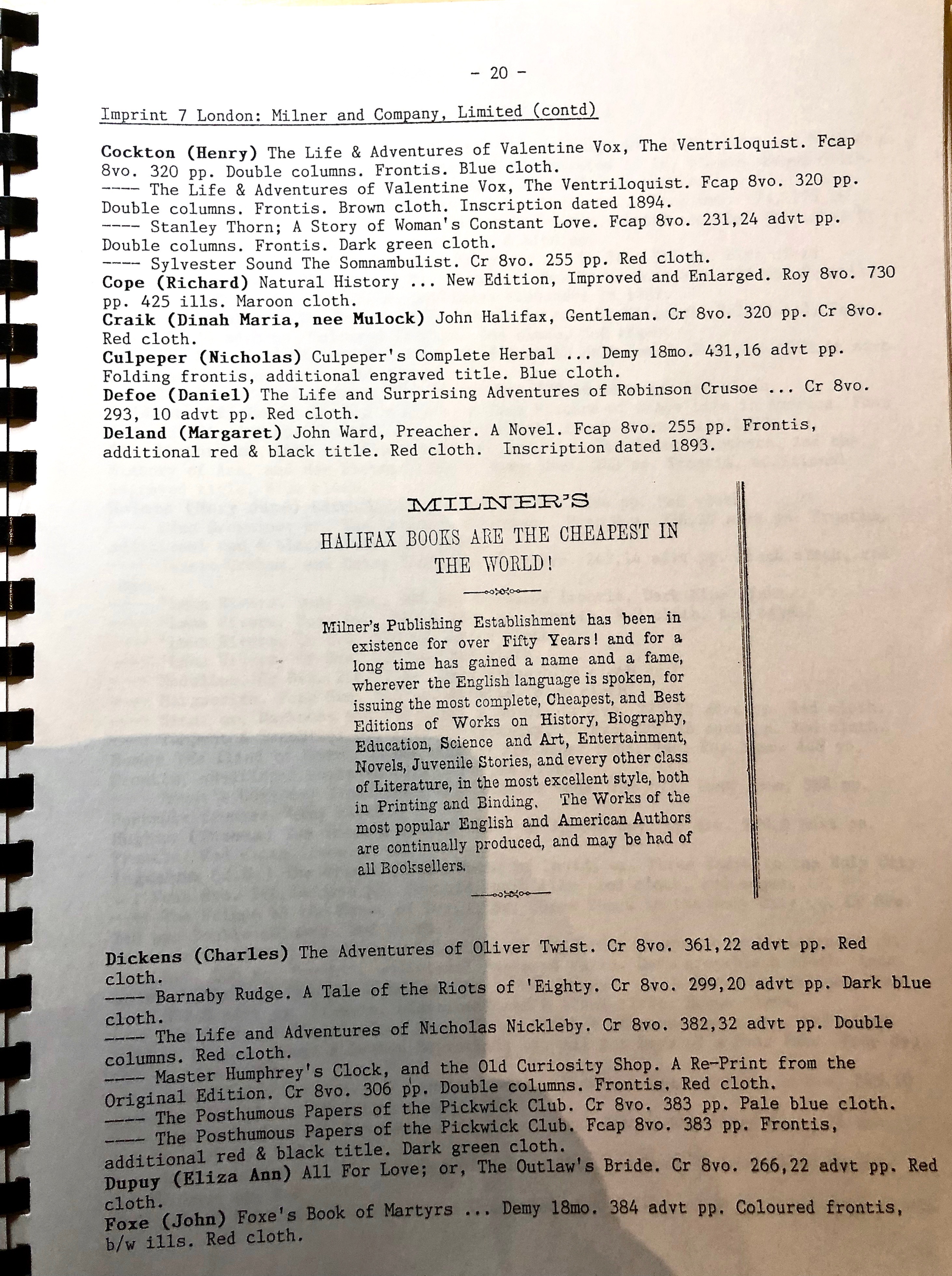
IMG_4440William Milner of Halifax: printer and publisher mentions Richard COPE’s Natural History only ONCE (“Cope (Richard) Natural History … New Edition, Improved and Enlarged. Roy 8vo. 730 pp. 425 ills. Maroon cloth”) in what the book calls the “Imprint 7”—which falls into the third incarnation of the publishing company, Milner & Co, located in London between 1883 and maybe 1900. “Maroon cloth” seems to describe well the cheap cover of my edition (and “Roy 8vo” means that it is a Royal octavo format, i.e. 10″ by 6¼” or 253 mm x 158 mm, therefore about the same size than my copy) but my book was clearly printed during the “Imprint 1” period (Halifax: William Milner, 1834-1851). Also the copy that I have seen at the University of Montreal unmistakably falls into the same imprint as it is dated from 1846 (while mine unfortunately has no printing date left—or never had one as it happened often with this publisher). This fact confirms that the Miller/Fothergill monograph is obviously incomplete.

I was not able to acquire more precise information on my book. However, it was not a complete waste of time since it has allowed me to learn more about the printing industry in nineteen century England. It seems that William Milner was a pioneer of cheap literature and remains an unsung hero of the poor Englishmen as he provided them with affordable literary classics (selling for as little as a shilling or even a sixpence) that would have without any doubts further their education and culture. Several other publishers, like William Nicholson, followed his example. 

IMG_4444

The Spelman’s collection ?

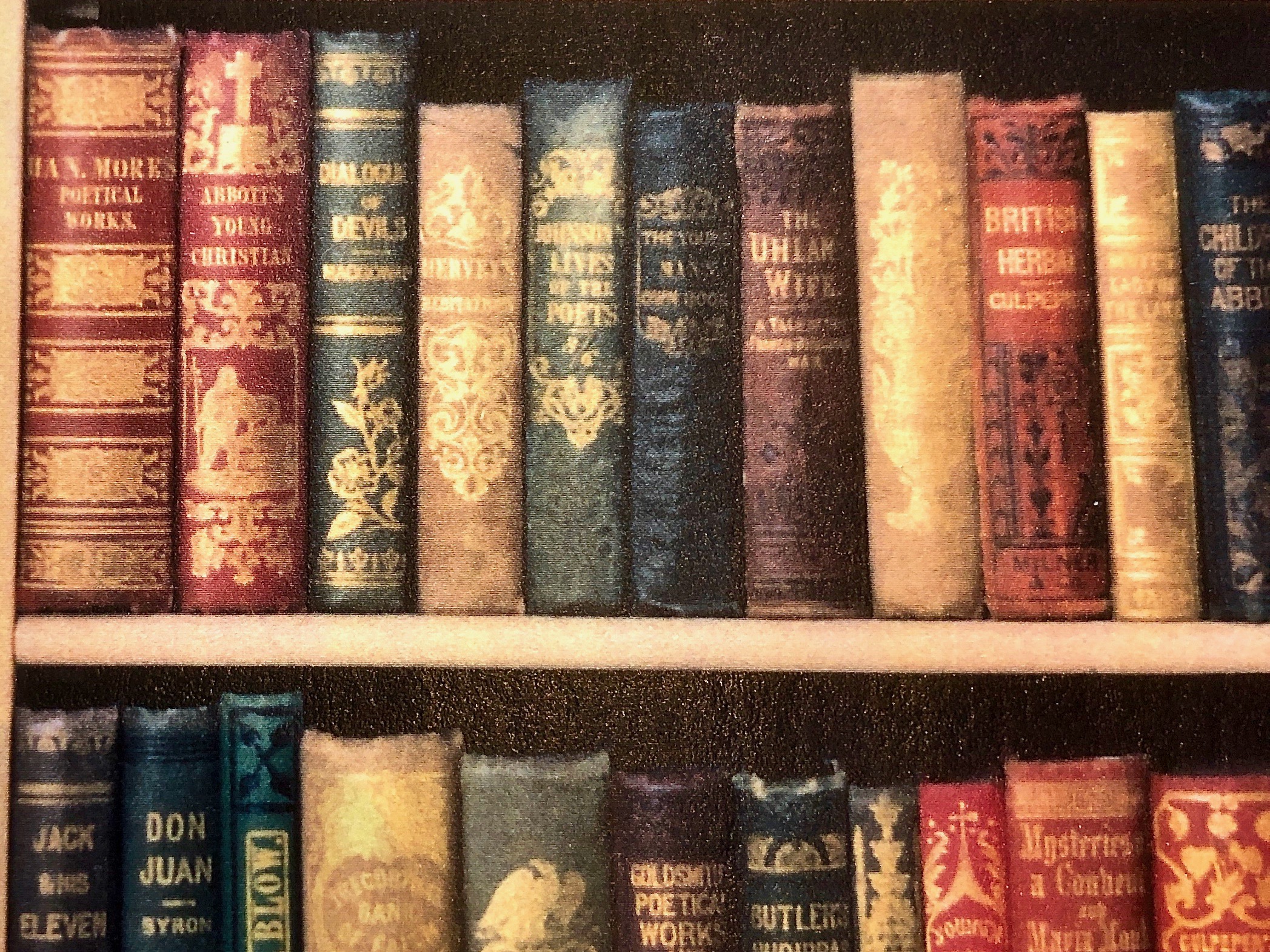
They printed books not only in great quantity (printing titles by the ten of thousands with total circulation often amounting over a hundred thousand!) but also in variety as they covered a large array of subject matter (from BurnsPoems, to Uncle Tom’s Cabin, Arabian Nights, Bunyan’s Pilgrim’s Progress, Defoe’s Robinson Crusoe, Richard Johnson’s The Seven Champion of Christendom, etc.) and offered a “range of plain and variously ornamented styles to suit differing tastes and pockets” [cf. Bernard Barr’s introduction to William Milner of Halifax and Shepard’s History of Street Literature]. The life of those publishers (and particularly of William Milner) and their cultural missionary work would certainly make quite an interesting subject for a historical TV series. 

[ Traduire ]

Isabella Bird 4

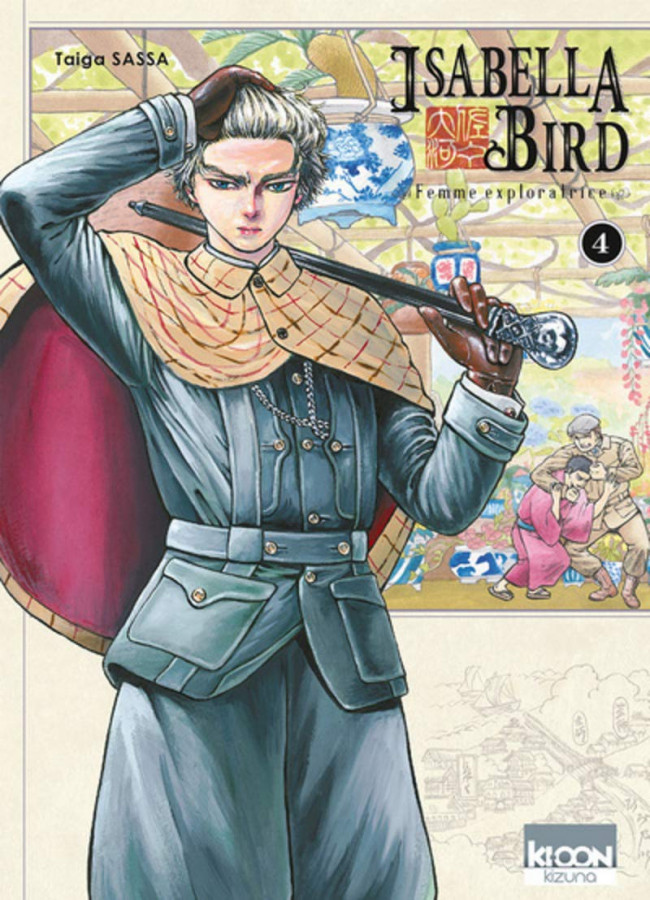
IsabellaBird_4-cov“Des choses se trament à Tokyo… Le botaniste Charles Maries souhaite récupérer son interprète, et malheureusement le contrat qu’il a établi avec Ito est toujours valable. Les Parkes ont beau lui mettre des bâtons dans les roues, le chasseur de plantes est prêt à tout pour parvenir à ses fins ! 

Inconsciente de la menace qui plane sur son expédition, Isabella Bird a quant à elle atteint Niigata, première grande étape de son voyage. L’aventurière se prépare maintenant à partir vers le nord, pour ce qui devrait être la partie la plus éprouvante du périple…

Lancez-vous à la découverte d’un Japon traditionnel désormais disparu à travers les yeux de l’intrépide Isabella Bird! Basé sur les écrits réels de l’aventurière, Isabella Bird, Femme Exploratrice est un récit passionnant sur les rencontre de deux mondes, dessiné avec un rare souci du détail par Taiga Sassa, nouveau talent prometteur !”

(Texte de la couverture arrière)

Isabella Bird, femme exploratrice (ふしぎの国のバード / Fushigi no Kuni no bādo [Bird] / littéralement: “Bird au pays des merveilles”) nous offre le récit de voyage de la célèbre exploratrice britannique au Japon du début de l’ère Meiji en se basant sur sa correspondance avec sa soeur Henrietta qui fut publiée en 1880 sous le titre Unbeaten Tracks in Japan.

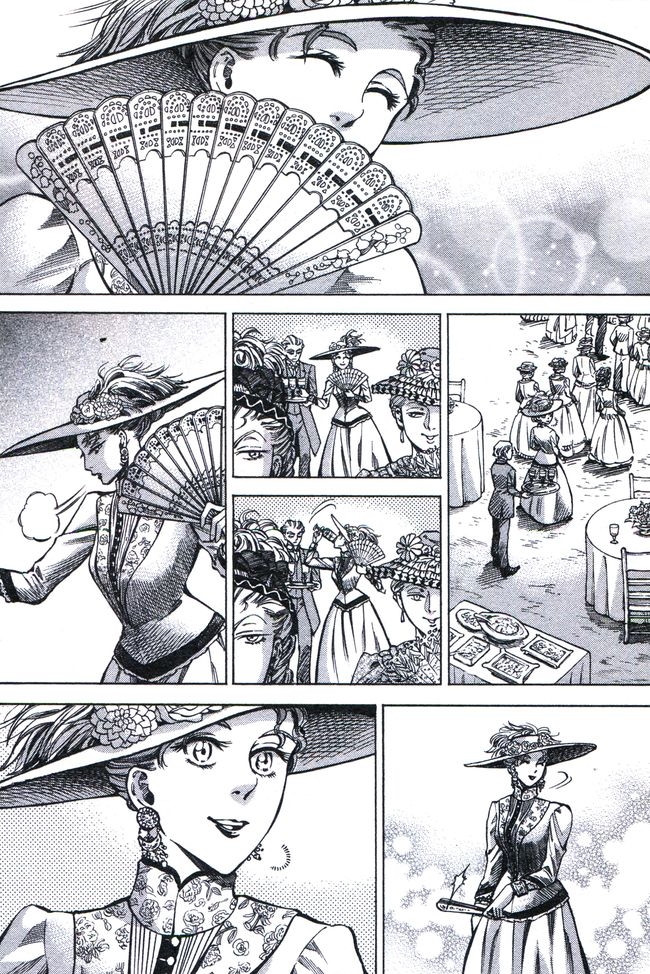
IsabellaBird_4-p040

Page 40

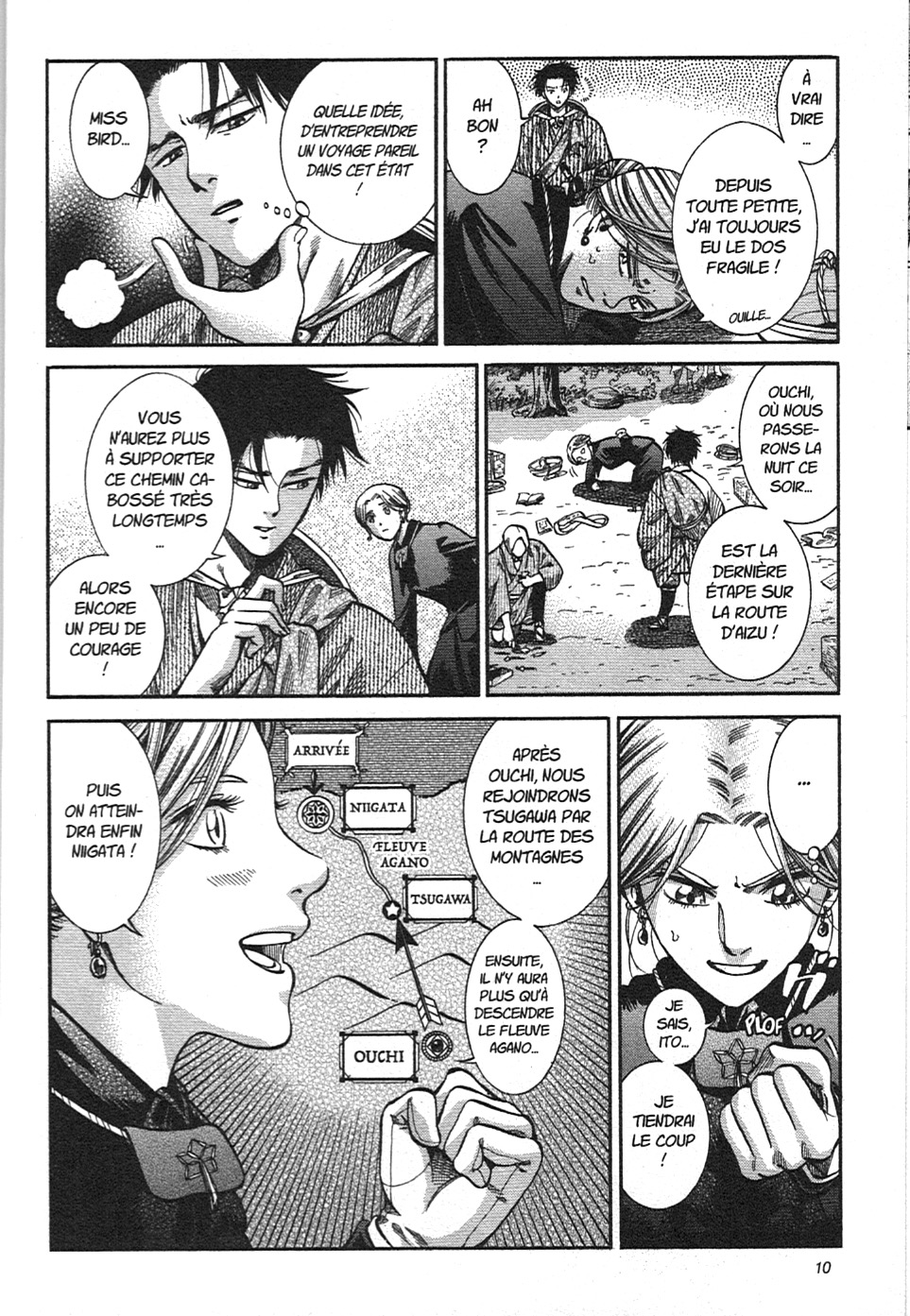
5 juillet 1878, Ito—l’interprète et guide de Isabella—se remémore sa rencontre avec le botaniste Charles Maries et les abus qu’il a subit sous son service. Le 12 juillet, ils quittent Niigata et, après avoir traversé le fleuve Shinano, prennent la longue route d’Echigo qui les mène vers Yamagata, puis Akita et, ultimememnt, à Aomori. Faute de chevaux, ils continuent la route à dos de vaches… Ils rencontrent un groupe de “bokka” (des femmes portant des marchandises sur leur dos). L’une d’elles, O-yu, est intéressée à apprendre l’écriture. Le 15 juillet, ils arrivent à Yamagata. Ils visitent l’hôpital local et Isabella est surprise (et un peu choquée) de voir les locaux habillés à l’occidental. La ville interdit même les habits traditionnels dans un effort d’entrer dans la modernité et d’obtenir la reconnaissance de l’Occident. Le dos d’Isabella la fait souffrir. 

IsabellaBird_4-p183

Page 183

À l’étape de Tateoka, ils rencontrent un vieux couple d’aveugles, lui est anma (masseur) et elle est azusa-miko (nécromancienne qui utilise une sorte d’arc pour appeler les esprits). Isabella est surprise que Ito, qui normalement  abhorre les superstitions, croit au chamanisme. Ito reçoit une lettre de sa mère, auprès de laquelle Maries s’est plaint de son ingratitude. Il joint une note à la lettre enjoignant Ito de revenir à son service sous peine d’être poursuivi en justice. Il lui offre une augmentation et l’averti qu’Isabella souffre d’une maladie qui ronge ses vertèbres et que le voyage pourrait lui être fatal! Et cette mise en garde est confirmée par les prédictions de la voyante… Il ne sait que faire et se sent dans une impasse. Le dernier chapitre raconte une anecdote de la vie de Fanny Parkes, l’exubérante épouse du ministre plénipotentiaire britannique Harry Parkes.

Au fur et à mesure que le récit avance, ce manga s’épanoui sous nos yeux. L’histoire est non seulement captivante mais elle est riche en détails tant géographiques, botaniques que ethniques sur la culture Japonaise de l’ère Meiji. On y discute entre autre l’épineuse question du développement d’un pays: est-ce que modernisation devrait nécessairement vouloir dire occidentalisation? La tentation est grande de chercher à imiter pour plaire et ainsi évider la condescendance et le mépris des impérialistes du genre de Charles Maries. Le style graphique est encore un peu inégal mais demeure généralement très riche, détaillé et précis. C’est même superbe par moment. C’est donc un excellent manga historique que je recommande chaudement.

Isabella Bird, femme exploratrice T04 par Taiga SASSA. Paris: Ki-oon (Coll. Kizuna), août 2018. 208 pg, , 13 x 18 cm, 7,90 € / $14.95 Can., ISBN 979-10-327-0305-2. Pour lectorat jeune (7+). stars-4-0

Vous trouverez plus d’information sur les sites suivants:

[ AmazonBiblioGoodreadsWikipediaWorldCat — Youtube ]

© 2017 Taiga Sassa. All Rights reserved.

Voir mes commentaires sur les volumes précédents (cliquez sur l’image pour activer le lien):

IsabellaBird-v1-cov IsabellaBird-v2-cov IsabellaBird-v3-cov

[ Translate ]

Capsules

A new beautiful era of harmony

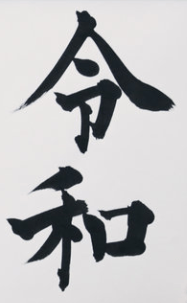
ReiwaThe Japanese government has announced last night that the name of the new Japanese era will be Reiwa (令和).

Each time that there is a new emperor, Japan’s calendar start a new era (時代 / jidai) or period (元年 / gannen). The era name (年号 / nengō or 元号 / gengō) is always selected carefully and has a great cultural significance. However, today it is mainly used only on government official paperwork (driving licenses, official calendar, etc.). Everyday use generally follows the Gregorian calendar. The previous era of modern Japan are Meiji (Prince Mutsuhito, 1868-1912), Taishō (Prince Yoshihito, 1912-1926), Shōwa (Hirohito, 1926-1989) and Heisei (Akihito, 1989-2019). Reiwa will be the 248th era name of Japanese history.

This change usually happens upon the death of the emperor, as his son ascend to the Chrysanthemum Throne. However, this time, the emperor Akihito chose to abdicate for health reason on April 30th and he will be succeeded by his elder son, Naruhito, on May 1st. Another departure from tradition is the fact that, in the past, the name was inspired by Chinese literature. This time, the panel of experts selected to choose the name took the idea from Japanese classical literature, as it is derived from the ancient poem anthology Man’yōshū. 

The first character of the name, Rei [], means good fortune (the “auspicious wave of energy of the plum blossoms carried by the wind”) and the second character, Wa [], means   gentle, harmonious or peace and tranquility.  It could therefore be translated as “fortunate harmony” or “auspicious harmony” (although some seems to translate it as “redolent harmony”).

The announcement was well received by the Japanese as they expect the name to embody their hope for a better future

[ Traduire ]

“Natural History” quest – a sequel

NHa-000_IMG_4392

My mystery book

My quest to identify a mystery book simply titled “Natural History” continues…

Today I went to the National Library (BAnQ) to renew my membership and request an Inter-Library Loan (PEB)  for Bernard BARR’s book about William Milner. Hopefully this time it will work and the fee won’t be too expensive. While I was there I had a look at their impressive manga collection and borrowed a volume of The Walking Dead comics (I am a book geek in various spectrum!)…

I have decided not to request an Inter-Library Loan (PEB) for Richard COPE’s book (the most likely candidate for the identity of the mystery book) but to directly go the University of Montreal library to check the copy they have and compare it to my book. After all, I am already downtown, so why not take the time now to resolve this question. It can be found at the media division (médiathèque) of the Library of Letters and Humanities (Bibliothèque des Lettres et sciences humaines – BLSH). Actually, they don’t have a copy of the book itself but a copy on microfiches.

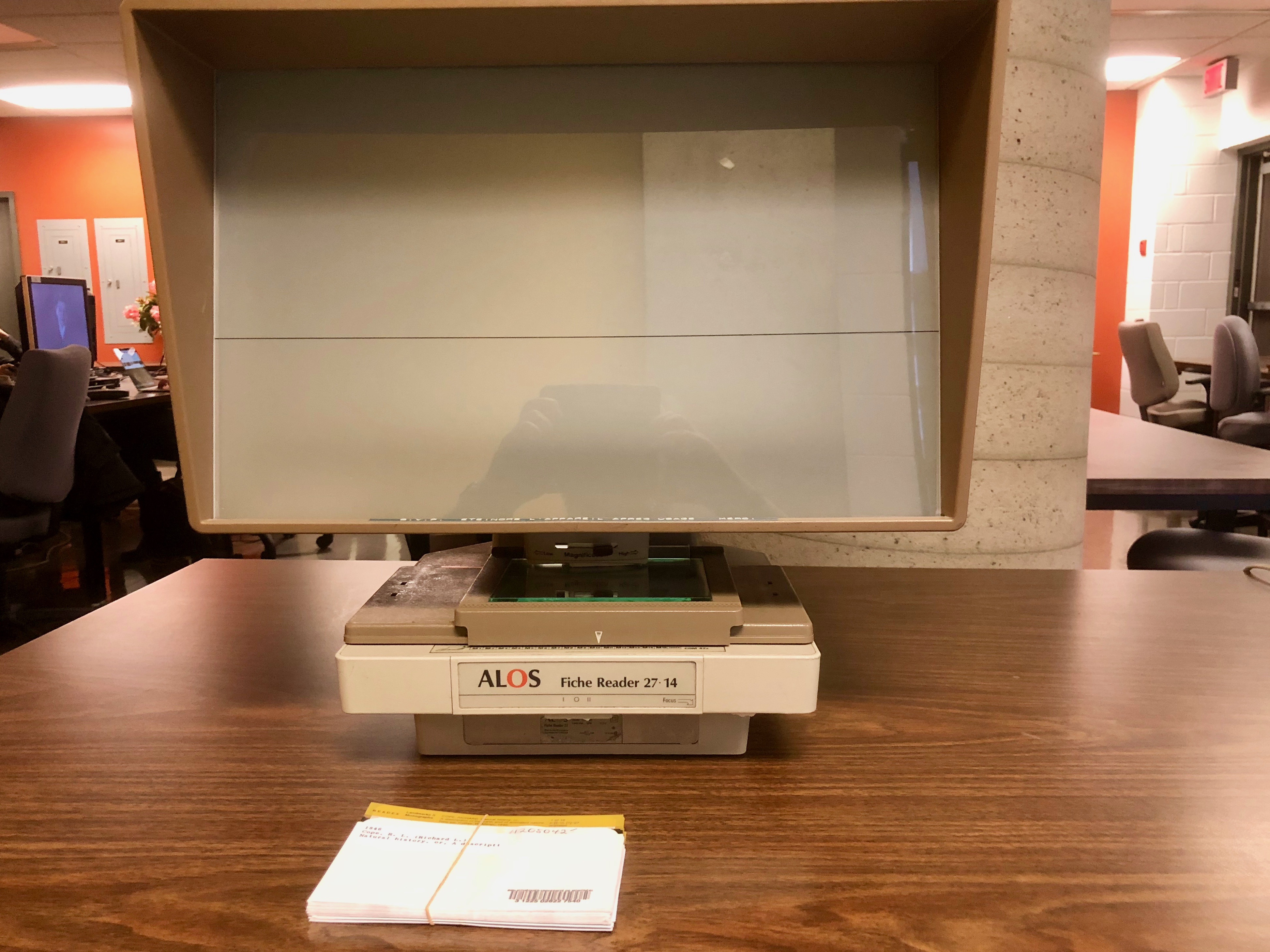
Unfortunately, despite the fact that the online catalog indicated an “on shelf” status, the entire Landmark Microfiche collection had been boxed as the media section is about to be moved. I was a little pissed but convinced the clerk to at least open a few boxes to see if he couldn’t find the microform set that I needed. He was clearly unwilling to help and said “You know, we’re closing in an hour and half!”. But I just needed ten minutes… It would be easy if they had been boxed alphabetically: since the author is “COPE” it would be in the first boxes. He reluctantly opened the first five boxes and indeed it was there (in box four)! I sat at one of the microform reader and had a look. Unfortunately, this machine was not equipped to make copies, so I simply took pictures with my iPhone (which I had to put together later at home, converting them from negative to positive). I took my time, but after fifteen minutes I was done. However, I could finally confirm the identity of my book!

First, I’ve been able to see the pages that were missing from my book (although nothing in the binding let us suspect that something is missing—or maybe the binding was changed at some point in the past?), mostly the title page, the introductory remarks (indicating that the original publishing date is 1840) and the index of subjects:

For me the most important aspect was to be able to see the title page:

NATURAL HISTORY;

OR,
A DESCRIPTION OF THE EARTH AND OF ANIMATED NATURE,
COMPILED FROM THE WORKS OF
BUFFON, GOLDSMITH, CUVIER, SHAW, VAILLANT, HUMBOLT, AUDUBON. &c., &c.

A NEW EDITION, IMPROVED AND ENLARGED

BY RICHARD COPE, LL.D., F.A.S.,
Author of the Pulpit Synopsis, Religious Anecdotes, Domestic Altar, &c., &c., &c.

“Creation teems with life,
From the gay flies that people the sunbeam,
To the huge whale whose home is in the deep,
And the wise elephant that shades him in the forest.”
MONTGOMERY

WITH FOUR HUNDRED & TWENTY-FIVE ENGRAVINGS
OF BIRDS, BEASTS, FISHES, REPTILES, &c.

HALIFAX:
PRINTED AND PUBLISHED BY WILLIAM MILNER,
CHEAPSIDE.
MDCCCXLVI. [1846]

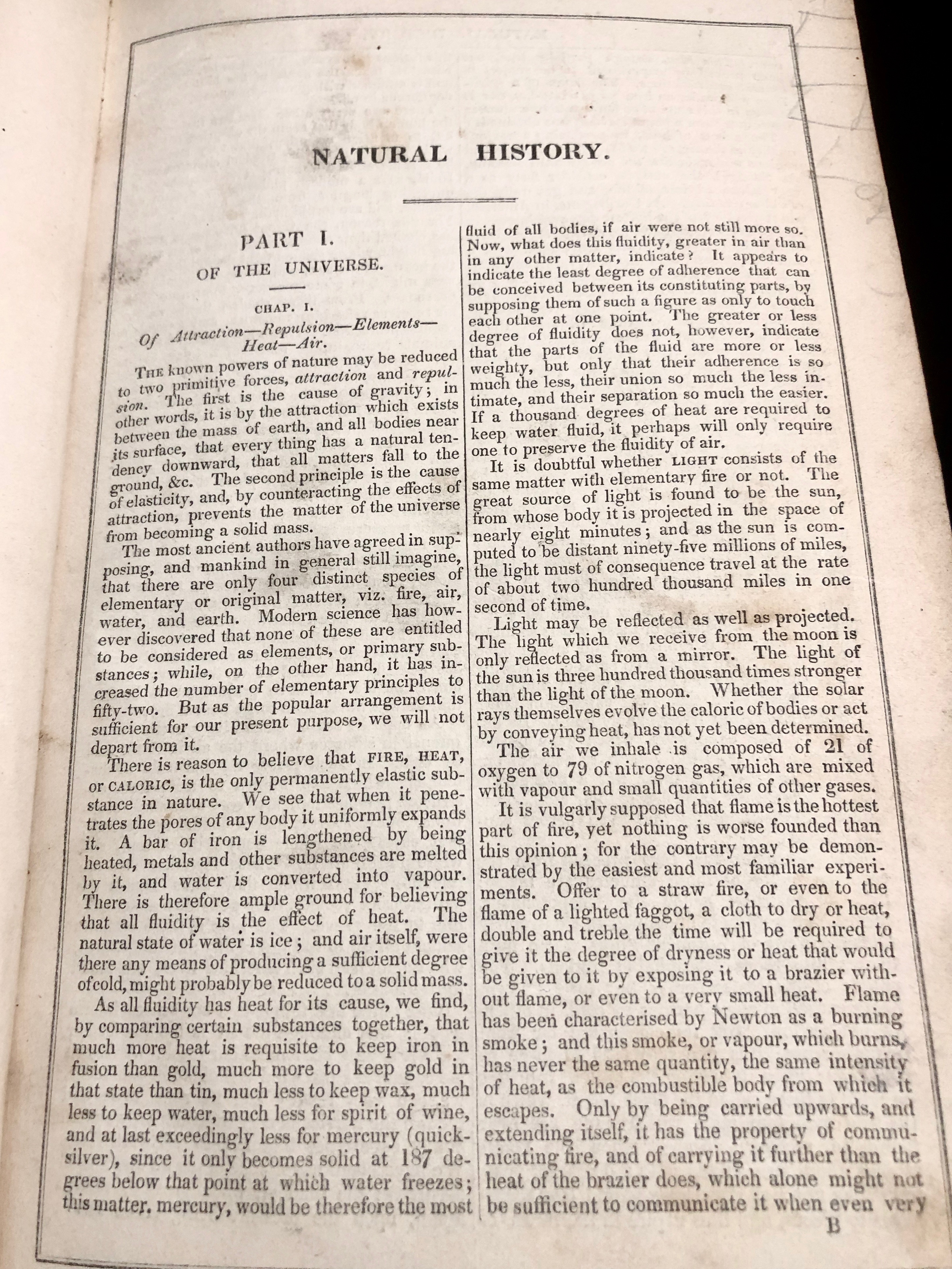
If we compare a few pages, we can see that it is the same book (my copy (a) on the left and the Université de Montréal microfiche copy (b) on the right):

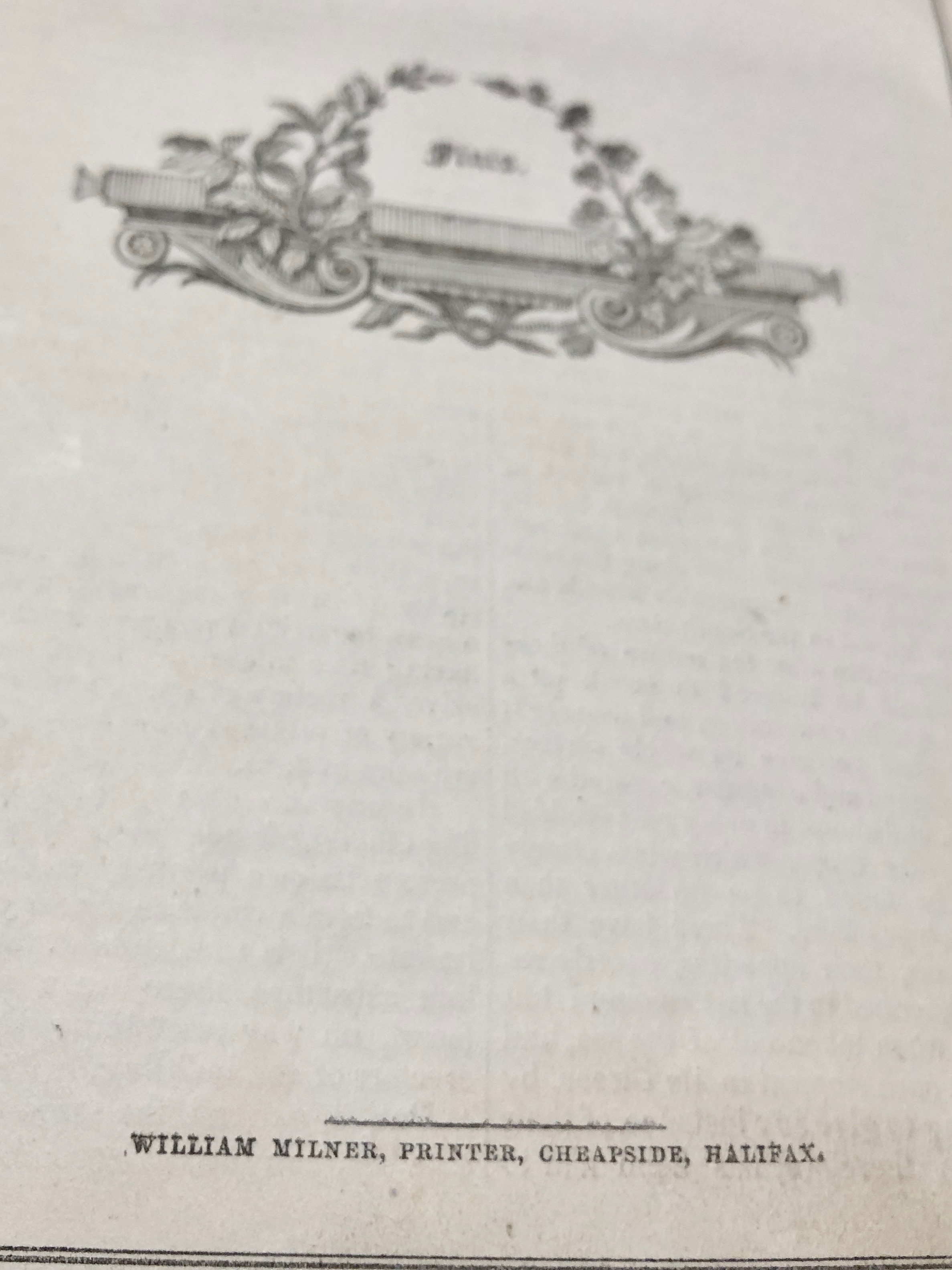
After comparison it is evident that the layout and the type are exactly the same. Beside the missing pages, the only differences are (possibly) the cover (my cover is a simple cloth on board, with raised bands and the title hot-stamped in gold on the spine while the microfiche copy is illustrated—although it is not clear if this is really a cover illustration or an inside cover page) and (definitely) the line of text at the very bottom of the last page of my book (“WILLIAM MILNER, PRINTER, CHEAPSIDE, HALIFAX.”) is completely missing for the microfiche copy. My conclusion is that it is indeed the same book, although a different edition (either a cheaper one or a different year of publication — but, save for the last page, it is clearly the same printing plates). 

Now that I have identified for sure the book as Natural History by Richard COPE, I only have to wait for the Bernard BARR’s book to see if I can learn more details about the publisher,  William Milner, and maybe also about the various editions of COPE’s Natural History. So, it is still to be continued…

[ Traduire ]

A Gentleman’s Murder

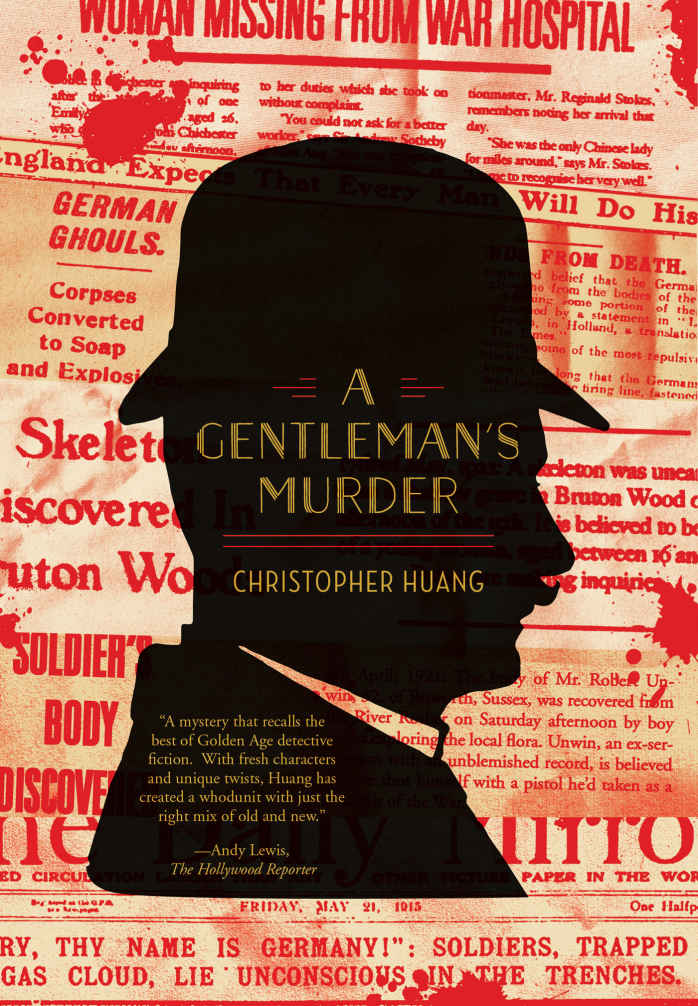
522362267When the newest member of Eric Peterkin’s London club is found stabbed to death, Eric throws himself into a quest for the truth: missing nurses, morphine addiction, shell shock. The Great War is over, but the memories remain…” (From the publisher’s website)

The year is 1924. The cobblestoned streets of St. James ring with jazz as Britain races forward into an age of peace and prosperity. London’s back alleys, however, are filled with broken soldiers and still enshadowed by the lingering horrors of the Great War. 

Only a few years removed from the trenches of Flanders himself, Lieutenant Eric Peterkin has just been granted membership in the most prestigious soldiers-only club in London: The Britannia. But when a gentleman’s wager ends with a member stabbed to death, the victim’s last words echo in the Lieutenant’s head: that he would “soon right a great wrong from the past.” 

Eric is certain that one of his fellow members is the murderer: but who? Captain Mortimer Wolfe, the soldier’s soldier thrice escaped from German custody? Second Lieutenant Oliver Saxon, the brilliant codebreaker? Or Captain Edward Aldershott, the steely club president whose Savile Row suits hide a frightening collision of mustard gas scars? 

Eric’s investigation will draw him far from the marbled halls of the Britannia, to the shadowy remains of a dilapidated war hospital and the heroin dens of Limehouse. And as the facade of gentlemenhood cracks, Eric faces a Matryoshka doll of murder, vice, and secrets pointing not only to the officers of his own club but the very investigator assigned by Scotland Yard.” (From the book flap)

In the roaring twenties, in the heart of the British Empire, a member of the Britannia Club is murdered. Eric Peterkin, a young half-Chinese man who usually spend his time reading submissions for a London publisher, cannot resist the urge to solve this mystery (with the occasional help of his sister Penny and his friend Avery). However, in order to discover who killed Benson—a man he barely knew—he will have to solve a cold case as well as a third murder. Amongst the prominent members of the club, who has done it? Aldershott, the club president? Bradshaw, the club secretary? Norris? Parker? Saxon? Wolfe? They all had possible motive and opportunity. Everything seems rooted in Flanders and in the manor turned into a makeshift hospital where some of them recovered or worked during the war…

A Gentleman’s Murder is  murder mystery novel inspired by the Golden Age of Detective Fiction. It follows all the rules of the genre (the Knox’s “Decalogue”) save for rule no. 5 (“no Chinaman must figure in the story”). It is set in the world of the military and retired officers’ club. The story particularly address the question of PTSD (or, as it was called then, “shell shock”) and, to a lesser extend, “the soldier’s disease” (aka morphine addiction).  As the author says in the book (p. 322) “Some scars weren’t visible. And some deaths weren’t physical.” The novel also talks about racial bias, as the character, who is half-English and half-Chinese, often struggle to be taken seriously because he doesn’t look like a gentleman. The author has probably drawn from his personal experience as he made his military service in Singapore (a city-state with the dual British and Chinese heritage) and is himself of Chinese origin.

The author seems to favour the post-WWI era because it is a beautiful era and doesn’t involved the complex methodology that investigators have to deal with in modern times (like DNA)—the mystery must remains in the reach of the amateur sleuth. As the author write in his postface, the 20s was a delicious time to write about because it was an exciting age of transition: you still have in place all the Victorian manners and mores but also all the innovation brought by the modern world (like telephone, radio, cars, electricity, etc.).

The story, which includes several unforeseeable twists, is very well written. The characters are detailed and quite believable. It seems that lots of efforts were put in describing all the setting with rigour (although most of the locations are fictional). Crime novel (particularly if set in the 20s) is a prolific genre and it’s hard to have such story not feel a little cliché. The only other caveat I can see is that the story offers so many characters and the protagonist takes so much time to imagine each possible permutation of culpability and action for EACH of those numerous suspects that, after a while, it gets a little tiring and confusing. It is almost impossible for the reader to guess who the murderer is — but, in this case, it is probably better that the dénouement come with a surprise.

A Gentleman’s Murder is a good novel. It is agreeable to read and, like all good murder mystery, you go through each new chapter with anticipation, reading faster and faster as the climax approaches. I recommend it warmly particularly because it is written by a local author. Christopher Huang, although born in Singapore, now lives in Montreal.

The publisher, Inkshares, is also of interest. It is a reader-driven publisher, which means that their books and authors are selected not by editors but by readers—through contests, pre-orders (as a form of crowdfunding you need 750 pre-orders to get published) and how much interest an online draft of the story is getting (i.e. follows, shares, and reads). Authors will receive 35% of net receipts (gross revenue minus the cost of production and distribution) in exchange of a full publishing service (editing, design, printing, marketing, as well as both direct and wholesale distribution). That seems a fair deal. It is an improvement on the self-publishing type publisher, where a publisher will “assist” an author in publishing his/her book. A good example of this type of publisher is the indie ebooks distributor Smashwords (one of my friends is using this service). Would-be writers have more and more options to publish their work.

A Gentleman’s Murder, by Christopher Huang. Oakland: Inkshares, July 2018. 348 pages. US$ 15.99 / C$ 19.99. ISBN 978-1-94264-595-5. For young adult readership (16+). stars-3-0

To learn more about this title you can consult the following web sites:

[ AmazonBiblioGoodreadsGoogleInksharesWorldCat ]

© 2018 Christopher Huang

[ Traduire ]

A Natural History Investigation Update

Here’s a quick follow up on my research to identify one of my old books…

My first attempt to get Bernard BARR’s book about William Milner failed because the Montreal libraries have a policy not to get an Inter-Library Loan (PEB) if it will incur a fee for the borrower. Actually, I wouldn’t have minded but I’ll check if the National Library (BAnQ) has a similar policy. The last resort would be to travel to NYC where the NYPL has a copy… Or I could get a copy through Google books or Amazon… Although, it doesn’t seem available… We’ll see…

In the meantime, I dug deeper into WorldCat and found possible candidates for my book.

The first candidate could be: Georges Louis Leclerc BUFFON, comte de. Natural History (containing a full and accurate description of the animated beings in nature : illustrated with upwards of three hundred engravings of birds, beasts, fishes, reptiles, insects, etc.). Milner & Co., [188-?], 224 pages. Interesting description of the binding (red cloth over boards stamped with black ink, gilt title on top board, gilt spine ornaments) but it’s too recent and there’s not enough pages to be my book…

The second candidate looks more interesting: Richard COPE & Thomas BEWICK, Natural History (or a description of the earth and of animated nature, compiled from the works of Buffon, Goldsmith, Cuvier, Shaw, Vaillant, Humboldt, Audubon, &c.). Milner & Co., [1860]. It was first published in 1840 and has 730 pages, its size is 23 cm and includes 425 engravings [by or after T. Bewick]. I could compare my book with it since the Université de Montreal has a copy (but is it available to the public? And it doesn’t say which specific library…). There’s another edition of 1846 (but the size is 27 cm) again with a copy at the UdeM. Among the numerous editions (many seems to be microform copies) of the same book, the oldest seems to date from 1842. One specifically says “by William Milner, Cheapside, 1846” (with also a copy at the UdeM!). Too bad there are no pictures. 

The Cheapside 1846 edition seems the best option, so I’ll first see if I can get it through Inter-Library Loan (despite the age of the book). If not, I’ll go to the UdeM to investigate further… 

To be continued

[ Traduire ]

Je suis un chat

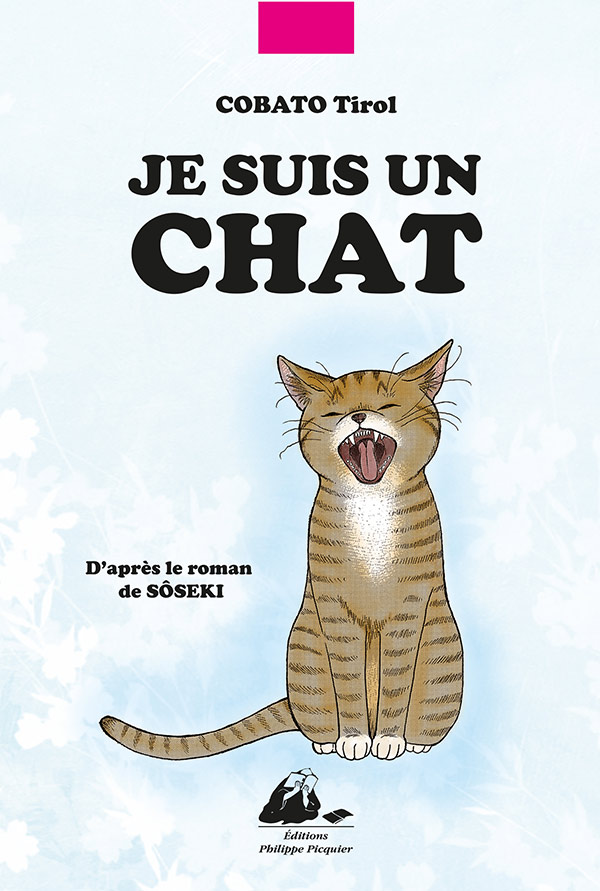
Je-suis-un-chat“Le célèbre roman de Sôseki devient un manga. Célèbre et désopilant. Vue par l’œil ironique d’un chat doté de remarquables talents d’observation et d’analyse, voici la vie d’un professeur d’anglais et de son entourage au début du vingtième siècle, lorsque le Japon est secoué par l’essor des valeurs mercantiles venues d’Occident.

Le professeur Kushami, double de l’auteur, sa famille, ses visiteurs, l’étudiant amoureux, le tireur de pousse-pousse, le riche industriel, la maîtresse de koto, sans oublier les chats, l’univers fantaisiste et débridé du roman est parfaitement restitué, avec toute sa richesse et sa profondeur.”

(D’après le site de l’éditeur; voir aussi la couverture arrière)

Je suis un chat (吾輩は猫である / Wagahai wa, neko de aru / lit. “Moi qui suis un chat”) est l’adaptation en manga d’un classique de la littérature japonaise par le romancier Sôseki. Le roman avait d’abord été publié en feuilletons dans la revue littéraire Hototogisu entre 1905 et 1906. 

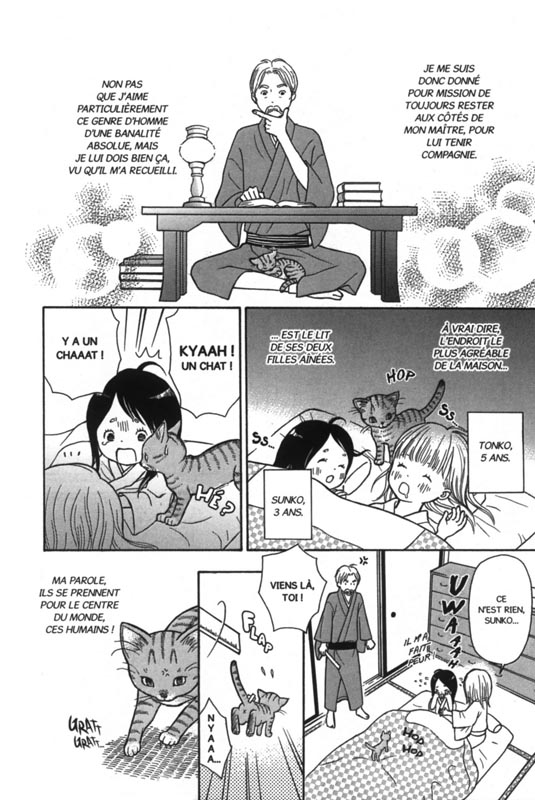
9782809711905_pgKushami est professeur de littérature anglaise à l’ère Meiji et tout un monde orbite autour de lui: ses étudiants (Meitei, Kangetsu), ses amis, sa famille, ses voisins. Le témoin de cette vie quotidienne est un chat sans nom, qui prends ici la place d’un narrateur omniscient. Il s’agit d’un récit satirique, qui parodie la classe moyenne japonaise ayant adopté tant bien que mal les coutumes de l’occident et qui se prends des airs arrogants. Une bonne partie de l’intrigue se déroule autour des spéculations sur le possible marriage de Kangetsu avec Tomiko, la fille des Kaneda — un riche marchand. Malheureusement, l’histoire finit mal pour le chat…

Le récit est très amusant et assez proche de l’oeuvre originale. Par contre, le style graphique est plutôt décevant: il est très simple (épuré, voir primitif) mais il fait tout de même le travail et illustre bien le récit. C’est une excellente façon de faire connaître cet oeuvre de Natsume Sōseki — dont le personnage est un peu l’alter ego de Sōseki qui était lui aussi professeur de littérature anglaise.

Je suis un chat, par Cobato Tirol (Traduction par Patrick Honnoré). Arles: Éditions Philippe Picquier, août 2016. 208 pages, 14,50€ / C$ 26.95, ISBN-13 : 978-2-8097-1190-5. Pour lectorat de tout âge. stars-3-0

Pour en savoir plus vous pouvez consulter les sites suivants:

[ AmazonBiblioGoodreadsGoogleWikipediaWorldCat ]

© Tirol Cobato / Home She, 2010. © Éditions Philippe Picquier 2016 pour la traduction française.

A noter que l’on retrouve d’autre mangas aux Éditions Philippe Picquier:

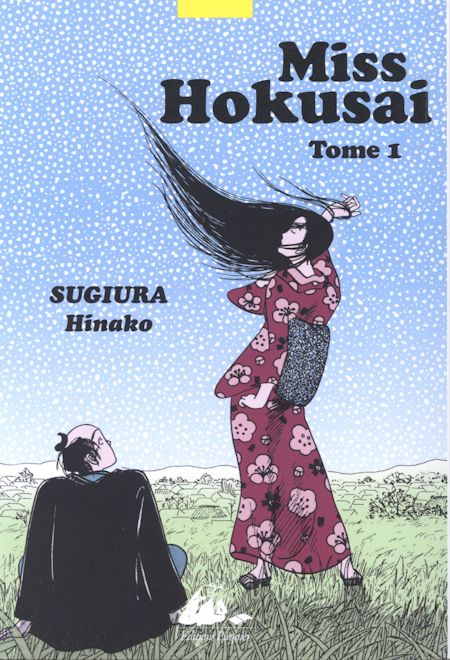
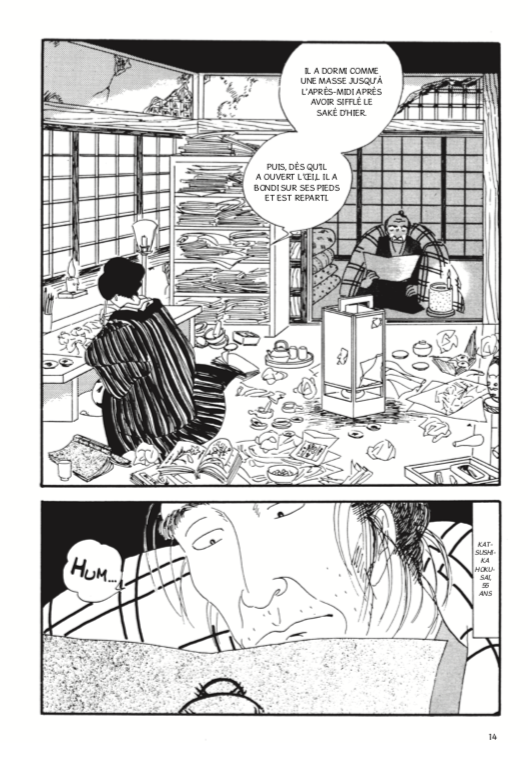
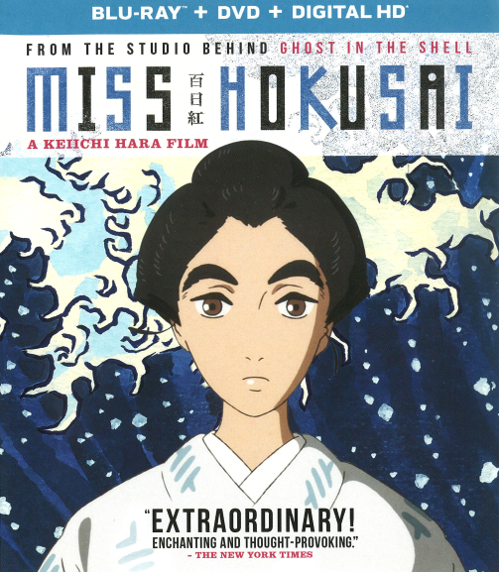
Miss Hokusai Tome 1, par SUGIURA Hinako.
Dix Nuits Dix Rêves, par KONDÔ Yôko (D’après le roman de Sôseki).
La porte,  par INOUE Daisuke (d’après le roman de Sôseki).

[ Translate ]

Capsules

Latest acquisition

A couple of years ago I’ve talked about my collection of ancient books. Well, I just made a new acquisition. I never thought I would find more interesting (but affordable) books to add to this collection…

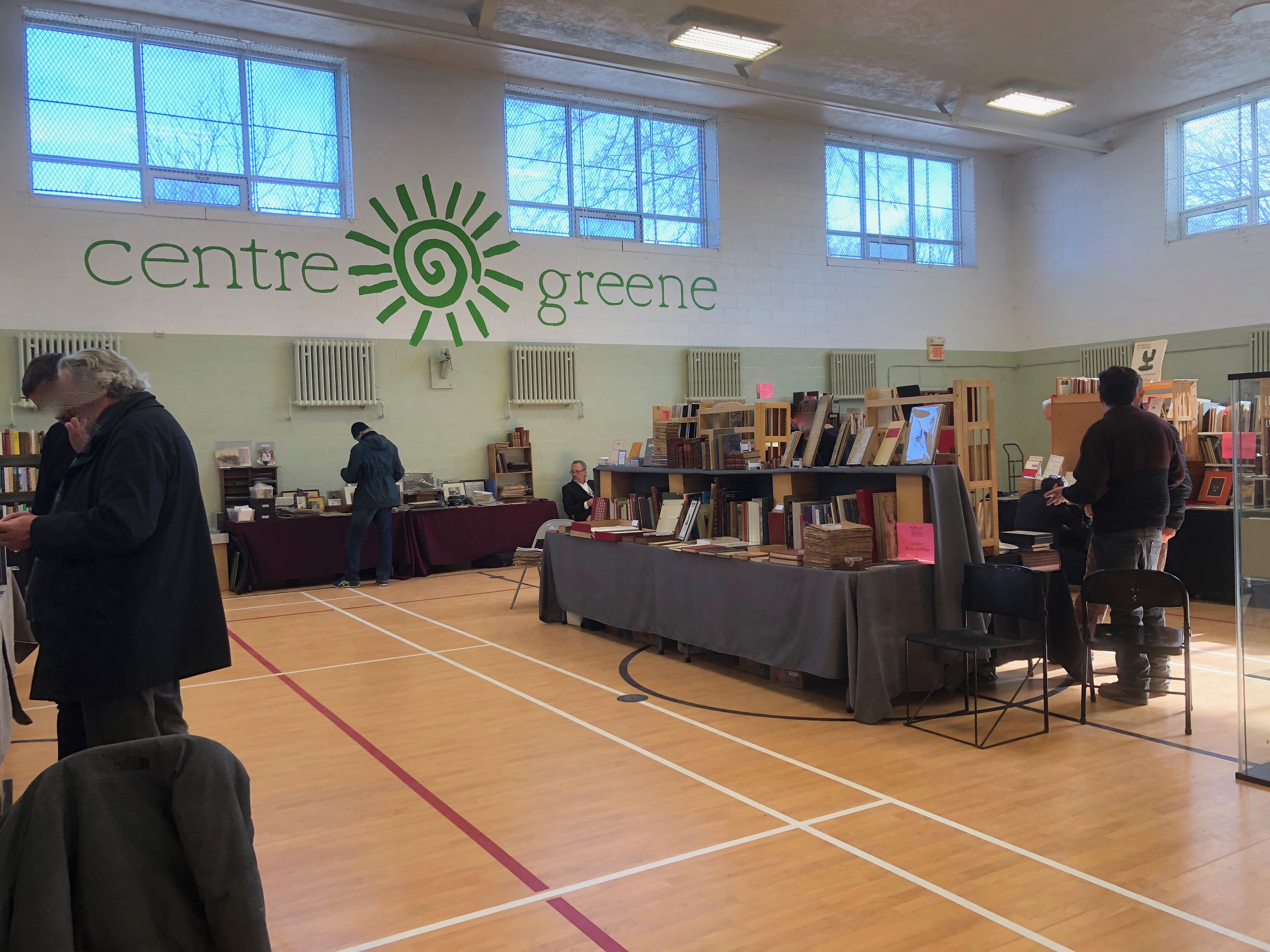
This week-end I went to the Westmount Book Fair at the Green Center in Westmount. I’ve been hearing about this bi-annual antiquarian book fairs for a while and always wanted to have a look but was always too busy. When I saw another one advertised on facebook, I thought now was the time. Although I was rather apprehensive that I would find a very interesting (and expensive) book.

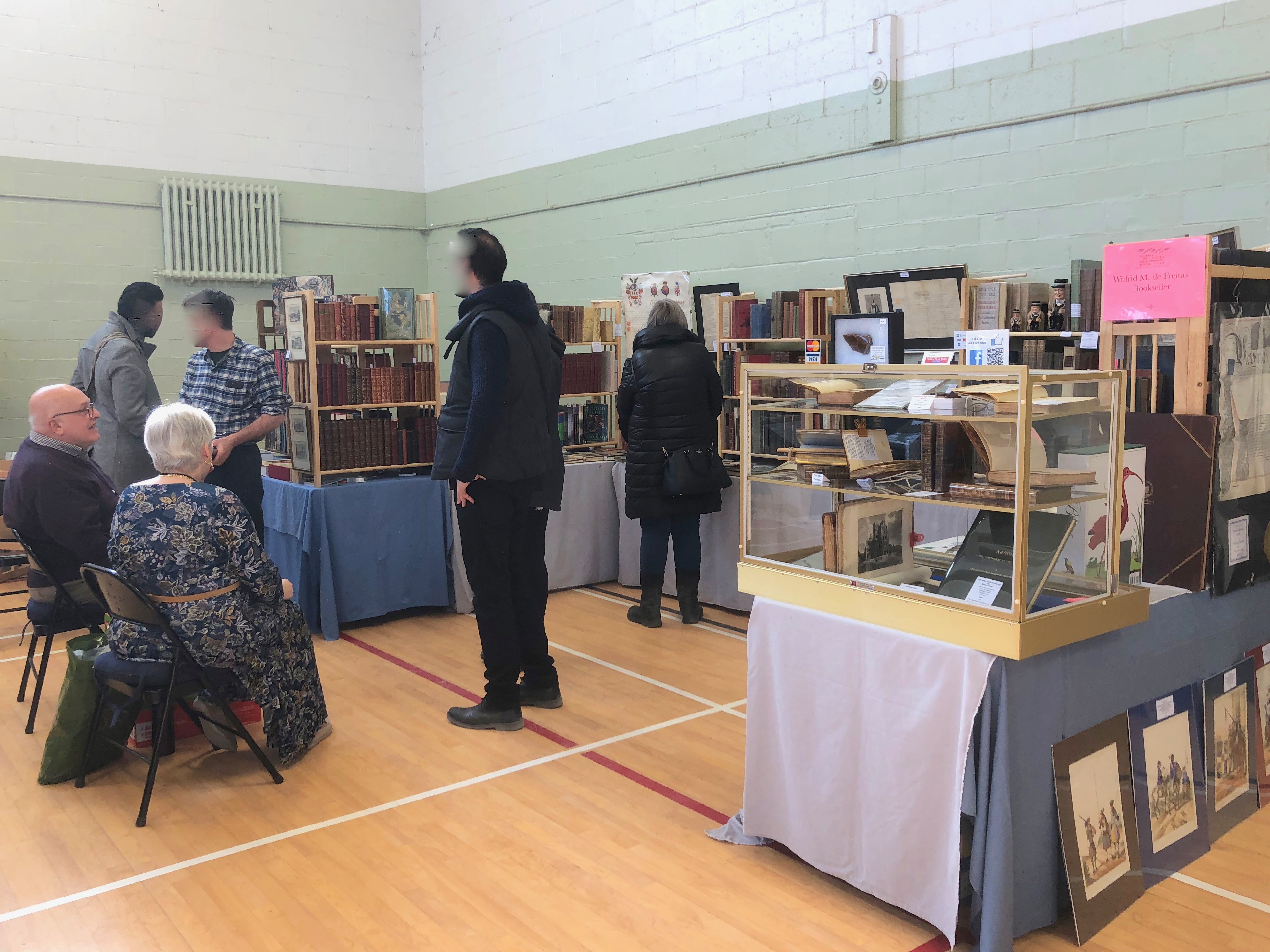
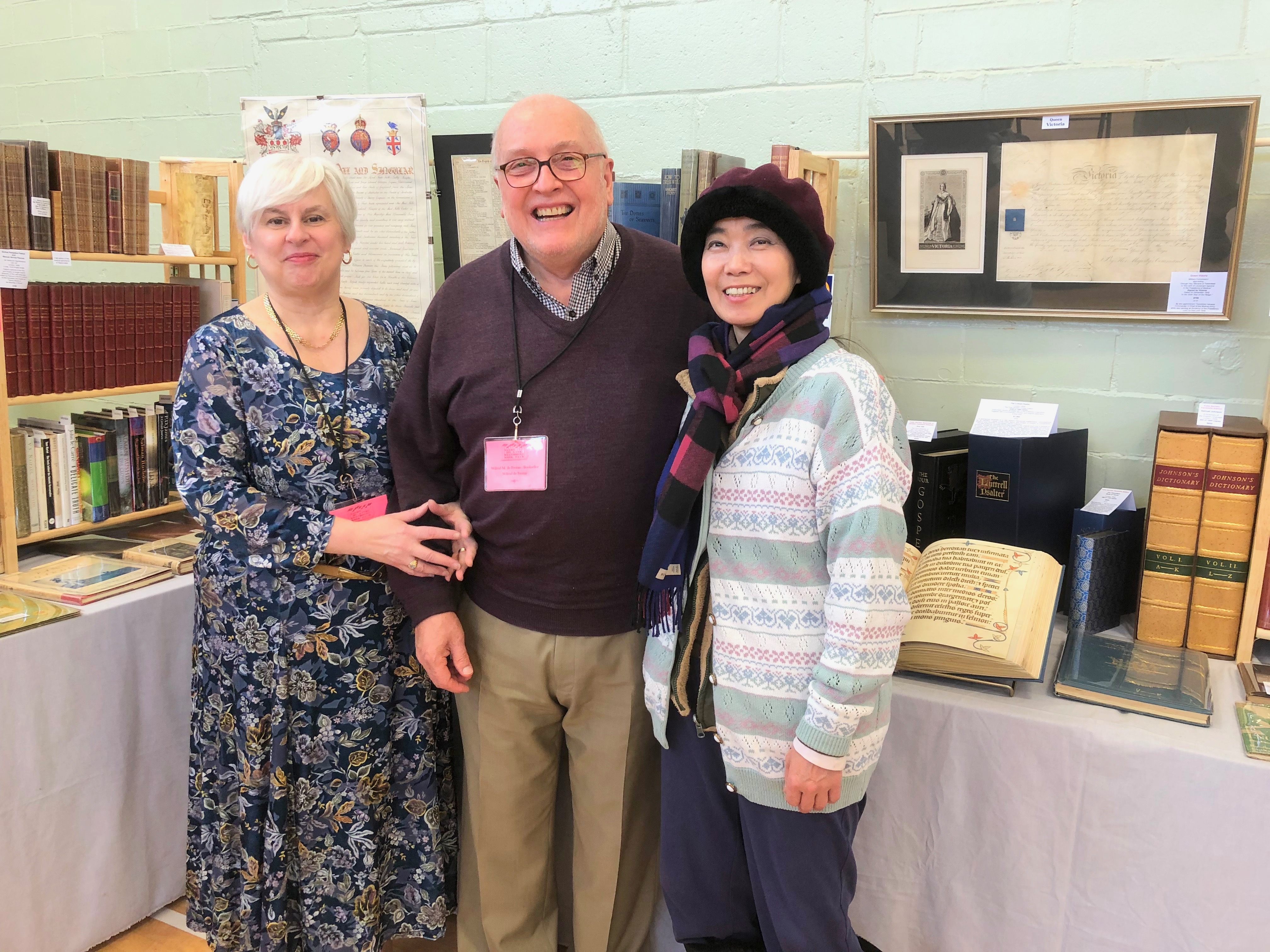
The Westmount Book Fair was organized by Wilfrid M. de Freitas, who is himself a bookseller. It was the 27th edition of what is advertised as “the smallest ancient books fair in Canada, where booksellers from Quebec and Canada will help you discover a wide selection of books, brochures, maps, printed matter and small papers”. It was indeed a small venue with a little more than a dozen stands.

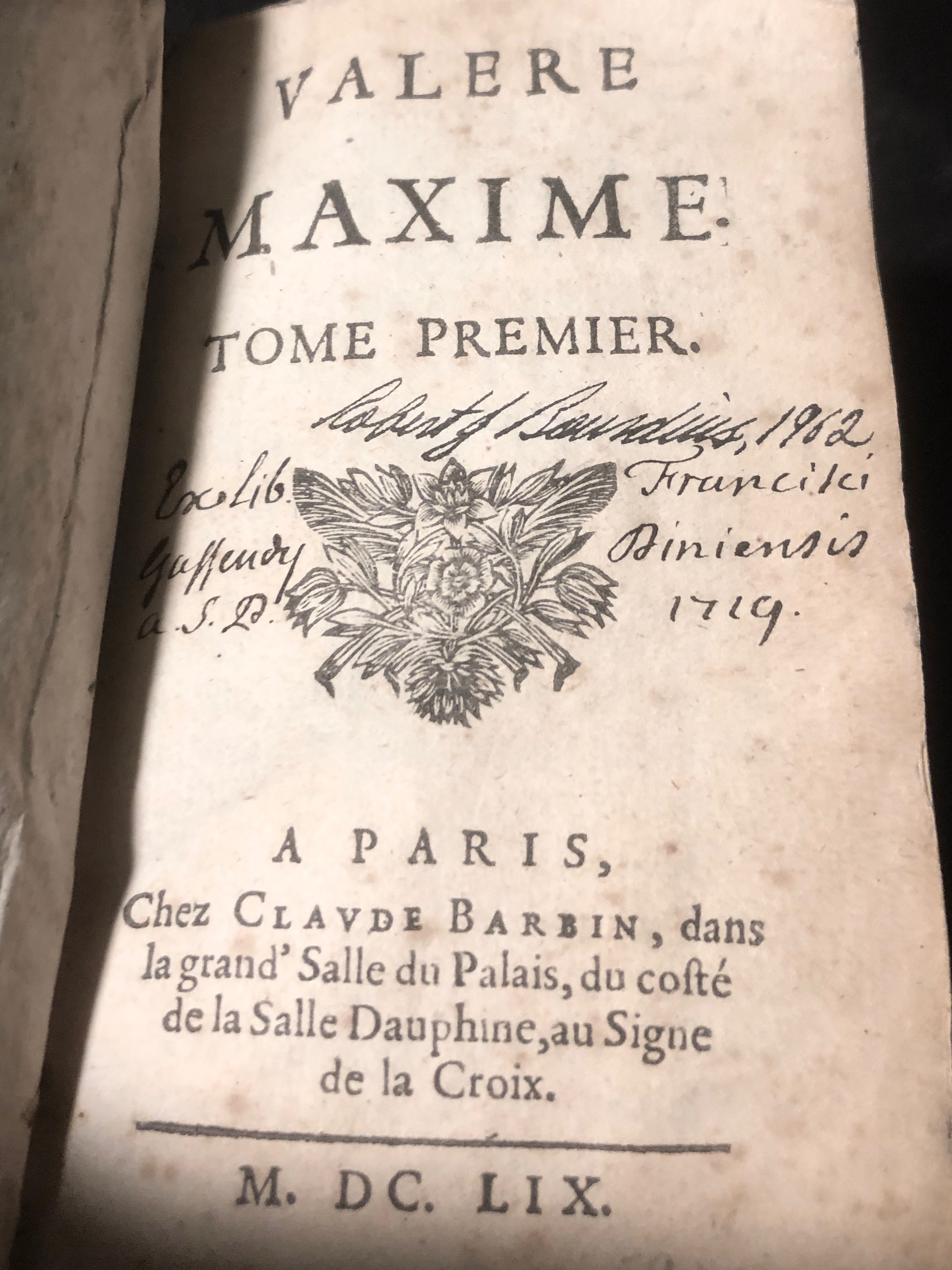
I took a quick look and identified all the books the would interest me and fit into my unfortunately small budget: the Caesar commentaries (in French, 1763, $125), the work of Tacitus (2 vols in latin, 1772, $350), and the work of Valerius Maximus (1659, $275). More affordable but out of my subjects of interest for this type of books (ancient authors, 16th to 18th century editions) there was also a Short French Dictionary (in English, 1701, only $100). There was also a big format velum book (about 25 cm hight and 8 cm thick) from the 17th century about mythology (a mere $5000 !), the works of Bossuet in a big volume ($4500), a few sheets from German old books (incunable?) or a large format book (in-folio) about the myth of the wandering jew illustrated by Gustave Doré for which I didn’t even dare looking for the price tag. Out of interest and price range, I also noticed the first annual compilation of the bande-dessinée magazine Pilote ($500-$700). It gave me a few interesting books to choose from. After, deliberating over the interest (age, condition of the binding, subject) and the price, I finally chose the Valerius Maximus. It was the only 17th century edition in my list, in relatively good condition and at an affordable price. It was sold by Mr. de Freitas and he even gave me a small discount.

IMG_4317VALERE MAXIME, A PARIS, CLAVDE BARBIN, dans la grand’ Salle du Palais, du cofté de la Salle Dauphine, au Signe de la Croix. M.DC.LIX. [1659]”

The title of the book (which doesn’t appear on the first page) is “Factotum ac dictorum memorabilium libri IX” [nine books of memorable deeds and sayings]. The binding (pork skin?) includes two volumes (it’s 4.5 cm thick), in the sextodecimo format (in-16, in this case 8 x 12.75 cm) . According to the note from Mr. de Freitas, it’s the second edition in French, translated by Jean Claveret. It is a collections of a thousand historical anecdotes, many lifted from earlier Roman writers, re-drafted by Valerius Maximus as moral and social models. It was written during the reign of Tiberius (around around CE 30 or 31). It is quite interesting…

The Collection (or my cabinet of curiosities)


The next book fair, organized by the Confrérie de la Libraries Ancienne du Québec, will be the 36th Antiquarian Book Fair held at the Concordia University (Pavillon McConnell, 1400 bout Maisonneuve O.) Saturday September 28th (from 12:00 to 18:00) and Sunday September 29th (from 11:00 to 17:00).

IMG_4304While having my nose in old books, I decided to do some more research on one of my (very interesting) books on which I have little information. It’s an octavo volume (15 x 24 x 5 cm) titled Natural History. It has a cardboard cover, covered with brown cloth and thin leather. It doesn’t have a title page and the only publisher information appear on the very last page: “WILLIAM MILNER, PRINTER, CHEAPSIDE, HALIFAX.” I first thought it was printed in the maritime provinces in mid-19th century (I think my father purchased it in Gaspésie in the 60s, for $35). It has 730 pages and is in average condition (yellowed pages and several stains, little tears in the cloth of the cover).

It seems inspired by Pliny’s Naturalis Historiae, but it is not its translation as it has a different content organization and covers more modern subjects: Part I : Of the Universe, Part II-XXII: Animals (mostly mammals), Part XXIII: Unclassified Animals, Part XXIV-XXX: Birds; then A History of the Fishes in General (including cetaceous, crustaceous, frogs, lizards, serpents, turtles, and insects !) Part I-XII.

With a closer examination and more research, I discovered new information about this book. First, it seems that the printer is NOT from Nova Scotia but rather from England. Cheapside is a street in Halifax, West Yorkshire, England. William Milner (1803-1850) is a printer who was known for publishing lots of cheap books (selling for sixpence (2 pence) and a shilling (5 pence)). He apprenticed as a printer, but started publishing his own books, first with local printers and then setting up his own press in the 1830s (or in 1844). After his death, his stepsons took over the business under the name Milner & Sowerby. Therefore, my books must have been published between the 1830s and 1850. I will try to find more about this publisher. There is a book that seems to list some of his production, so I will probably start there. To be continued…

[ Traduire ]

Victoria S03

VictoriaS03What first interested me into this series was the fact that Jenna Coleman (one of the best Doctor Who companions) had the starring role. But, of course, it was also a very good British historical TV drama, so that was plenty of reasons to follow it. 

In season 3, Queen Victoria and Prince Albert are now older (close to their 30s) and have already six children. This time the story is less political (although it covers the machinations of the foreign secretary, Lord Palmerston, and the monarchy being threaten by anarchists, the revolutionary wind from France or the Chartists) and is more centred around the family. The couple struggles as they become disenchanted with each other, bringing the various type of emotions that any couple would experienced with time, but having their differences being fanned by the plotting of Victoria’s estranged sister, Feodora. Albert exhaust himself trying to find his own place (with pet projects like being the Chancellor of Cambridge or organizing the Great Exhibition). They try to give the unruly Bertie (the future king Edward VII) a proper education.

When it comes to the personal life of monarchs I am not sure if this story is truly historical — it is probably mostly dramatized — but it is quite interesting. It was well received (rating of 8.2 on IMDb as well as an average tomatometer of 84% for the whole series and an audience score of 81% for Season 3 on Rotten Tomatoes) and is well worth watching. stars-3-5

To learn more about this title you can consult the following web sites:

[ GoogleIMDbPBSWikipediaYoutube ]

[ Traduire ]

Capsules

They Shall Not Grow Old

91lwssevehl._sl1500_That movie has been hyped so much that when I finally got to see it I was rather disappointed. It is not really a documentary as the picture are shown as it is without any context (places, dates or names). It is just footage of the First World War (the war to end all wars they said, but it ended up being the most useless, senseless war of all time) with voiceover by survivors who describe their experience. Not all footage has been restored, retimed and colourized — but most of it. And I am wondering when those testimonies were recorded — as the voice sounded like old men and the recording seems of pretty good quality, so it must have been done at a time when they already had good equipment, although the sound had probably been restored the same way the pictures were. Both the original footage and the audio recording of the British soldiers come from the archives of the Imperial War Museum and the BBC.

All in all, the movie is still pretty interesting as it give us the chance to witness the Great War in colour, as it was experienced by the men who fought it. It gives a really good impression of what it must have felt like. The war is not an impersonal historical event anymore as we get closer to the soldiers. It is a fit tribute for the 100th anniversary of the end of the war. I was expecting more visually, but Peter Jackson’s team did a really good work (it’s a great technological feat to gather, edit and restore all this footage) and it is therefore a must-see movie. Through this those young men will indeed never grow old and hopefully such horror will never be repeated.

The movie was shown on the BBC and is already available on Blu-ray & DVD in U.K.. It was shown in theatre for one day in North America and hopefully will be picked up for broadcast (Netflix? Amazon?) and released in DVD/Blu-ray soon. The critical response was very positive (8.6 on IMDb and 98% on Rotten Tomatoes). stars-3-0

To learn more about this title you can consult the following web sites:

[ AmazonGoogleIMDbWikipediaYoutube ]

[ Traduire ]

Capsules

Mrs Wilson

mrswilsonThis three-part historical drama is set in Britain during and after WW2 (in the ‘50s & ’60s). When her husband dies, in the early sixties, Alison Wilson is already distraught. They lived comfortably in their little cottage. She’s a typist and Alexander is a spy novelists (and retired MI6 officer). They have two sons, Gordon and Nigel, and they were happy. However, as she tries to come around organizing her husband funerals, she receives the visit of a woman, Mrs Gladys Wilson, who claim to be Alec’s widow! Her happy world quickly crumbles as she struggles with one question: was her husband really the man he claimed to be? Was it just a lie? 

She knew Alex/Alec was a spy because they met at the Secret Intelligence Service headquarters where they were both working during the war. She starts her own investigation, questioning Alex’s handler at MI6, some colleagues in the Intelligence Service, Gladys’ son. She becomes obsessed with this quest to discover who the man she thought she knew for twenty-two years really was. The deeper she digs in his past the more secrets she discovers! Through flashbacks, she relives their history together until she understands who he really was. When she comes to term with the truth, she becomes a nun, but she never could tell her sons about their father until after she died—she had written everything down. 

It is a beautiful and compelling story told in the manner of a spy or mystery novel. The most interesting part is that it is a true story — and the cool twist is that Alison Wilson is played by actress Ruth Wilson, he own grand-daughter! Alexander ‘Alec’ Wilson wrote twenty-four novels, mostly inspired by his career in the secret service and his huge imagination. He was a bigamist who had seven children with several wives. Many aspects of his life are still a mystery as, even today, the Foreign Office still consider his files as ‘sensitive’.

Mrs Wilson is a very interesting historical drama, beautifully filmed and cleverly told. I enjoyed it greatly and recommend it warmly. It was well received by the critics (with rating of 88% on Rotten Tomatoes and 7.4 on IMDb). It aired on BBC One in late November / early December and will premieres on PBS Masterpiece Sunday, March 31, 2019, 9/8c (and will subsequently be available on Dvd, iTunes Store and Prime Video). Don’t miss it! stars-3-5

To learn more about this title you can consult the following web sites:

[ GoogleIMDbWikipediaYoutube ]

[ Traduire ]

Capsules


Notable News (w42-w53)

It has been a little more than two months since the last entry of our journal. The weather has been relatively gray, since we’ve had very little snow so far, as it was—more often than not—rain and freezing rain, and lots of ups and downs in the temperature. The most notable events on the domestic front included a strange saga over the video of a panel at the book fair, where I also attended the launch of Solaris #208 and did a capsule interview with Catherine Sylvestre. We had again a problem of flicker in our electricity (strangely only on one side of the house), so bad that one night I thought my apartment had become a disco! Finally, we found the source of the problem (old wirings) and hired an electrician for a temporary fix but we will have to change the electrical entry in spring.

Somehow my sister’s cats managed to start the shower while she was on vacation. It lasted about twenty minutes before we realized that water was dripping from my bathroom’s ceiling. Luckily this small flood was relatively contained but we had to mopped the floor for a couple of hours in the middle of the night. The damage is limited but we will have to redo our bathroom’s ceiling…

The work-place was not too much a strain on my mental health, beside the continuing problem with the ventilation and heating system (strangely when this happens at another library of the borough they close immediately while we have to endure and work in very unpleasant conditions—that’s so unfair!) and some dubious decision on age classification of some mangas (Bride Stories, Nausicaa & Mafalda for kids! Are you joking?)!

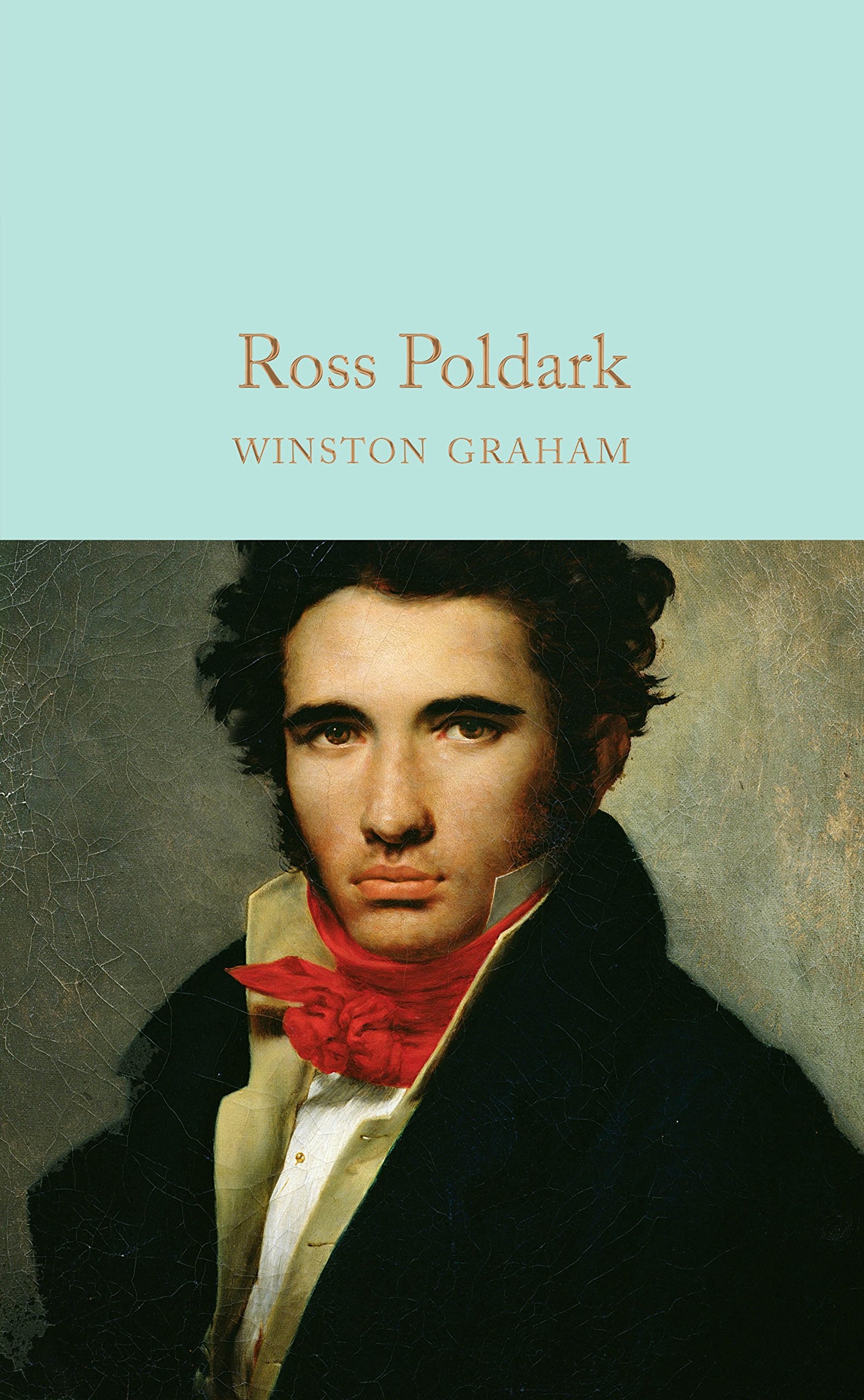
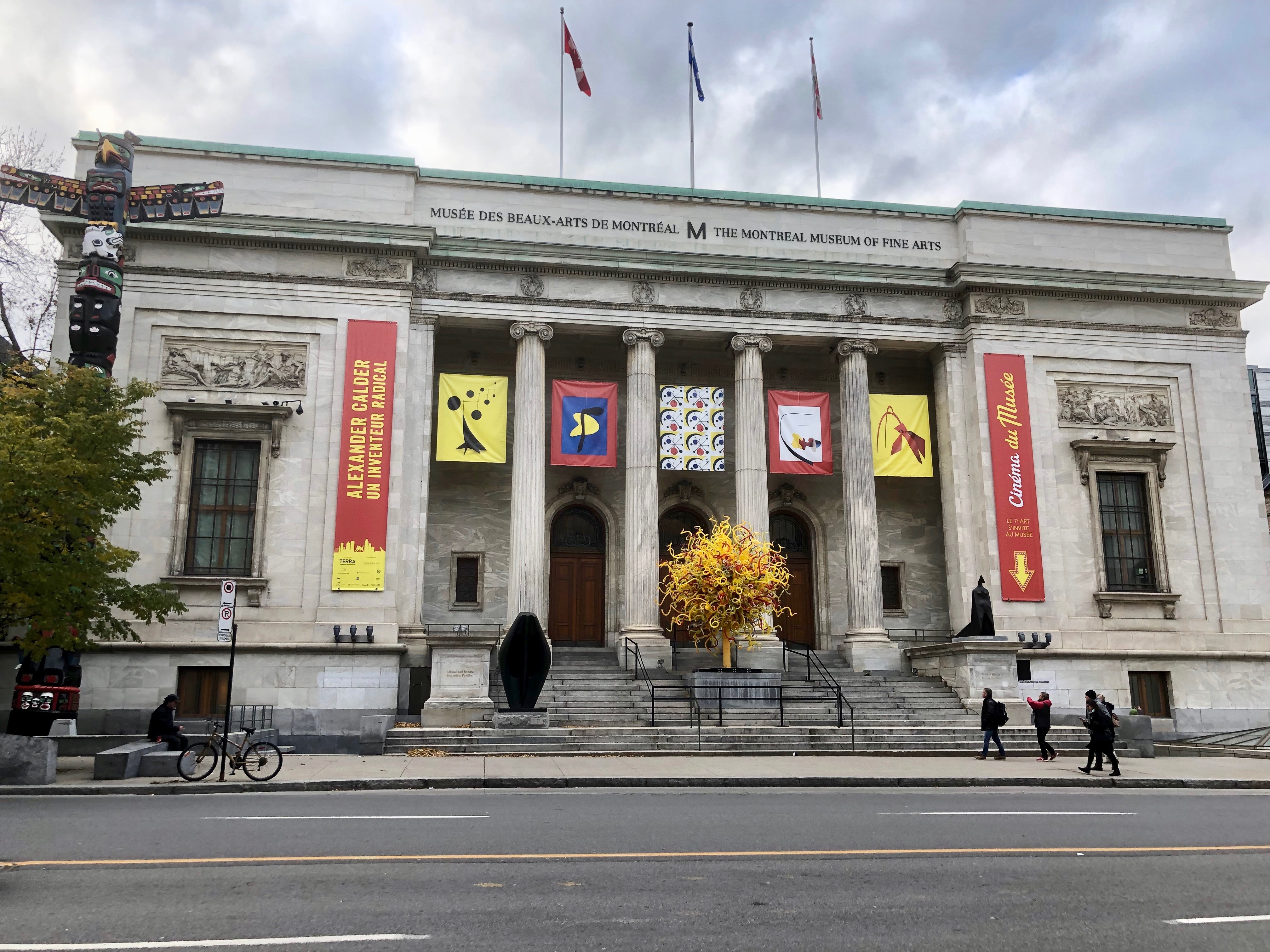
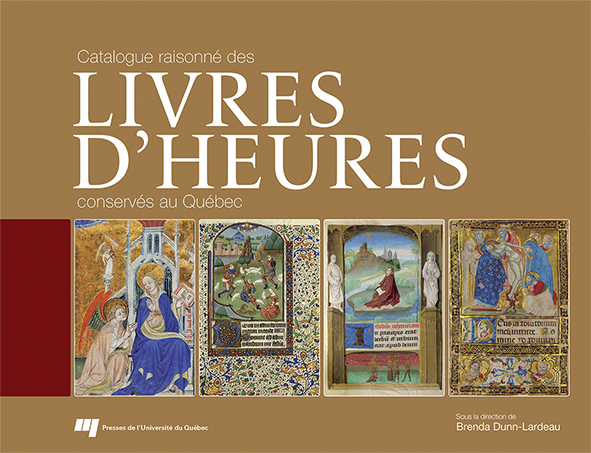
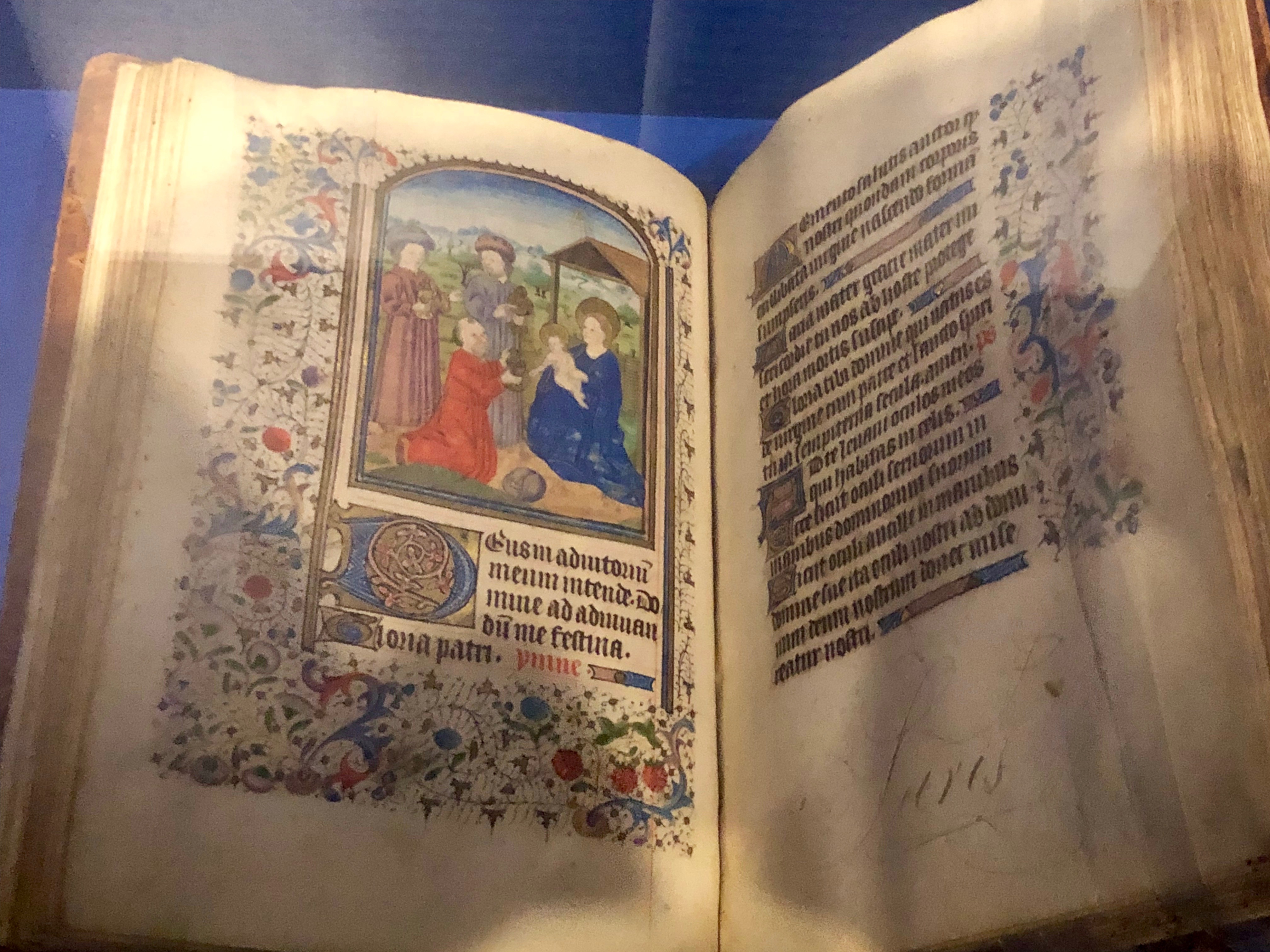
readings2018Apple announced new Macs and iPads. We attended the vegan fest again, visited the Book of Hours and the Calder exhibits. I reached my reading goal for the year (fifty books! But, as usual, it was mostly comics and mangas). This allowed my to comment on  a few books (C Comme Cthulhu, Le Chat du Rabbin 8, Isabella Bird 3, Nous rêvions de robots, Pline 6, Ross Poldark, and a book about the New Yorker’s cartoons). I also wrote about the works (bande dessinée) of Philippe Gauckler: Convoi, Prince Lao and Koralovski. Unfortunately, I still watch too much TV and movies (A place to call home season 6, Mars season 2, Murder on the Orient Express, Outlaw KingPicnic at Hanging RockRBG, Solo, Transformer: The Last Knight, Traverlers season 3). Finally, I took some time to reminisce about the fanzine era and the old Protoculture days.

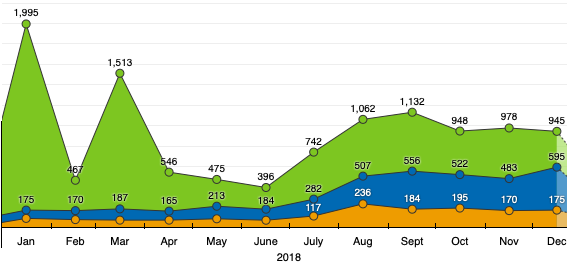
2018blogstatsI just completed my first year with WordPress.com so I don’t have much basis to compare this year’s statistics (although I remember that with Internic’s hosting I had ten times more traffic so either they were calculating it differently or I lost some followers in the switch or WordPress is not promoting the traffic as well). There is also a slight difference between WordPress’ and StatCounter’s numbers. Anyway, in 2018 I posted 319 entries (a 16% increase), acquired 68 followers and received (if we round up a little) an average of a thousand views per month or 350 visitors per month (about 135 returning visitors per month). It is not as much as I would I’ve liked but it is a beginning. The most important is that it keeps increasing from month to month. I’ll keep improving the blog and (hopefully) writing more so it will be at its best when I retire and make it my main occupation (in about 3064 days!). 

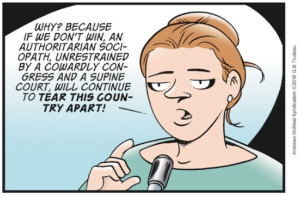
doonesbury-20181021

Doonesbury (2018/10/21)

On the world stage, the months of November and December had their lots of typhoon, floods, wildfires, tsunami, and violent protests in France, but it is mainly the U.S. Mid-term elections that retained the attention. In reaction to Trump’s insane White House, people went to the ballot with numbers not seen in nearly a century allowing the Democrats to retake the House by electing many young candidates, including several women (95), members of racial minorities (two Muslim and two Native Americans) or of the LGBT! Space exploration was also in the news as we landed another probe on Mars, explored more asteroids and mini-planets, and China landed a probe on the far-side of the moon.

All in all, 2018 was a very challenging year for everyone, so let’s hope that 2019 will be much better.

Through all this I tried to stay acquainted with the affairs of the world and gathered a few notable news & links — which I now share with you (in both french or english, slightly categorized, but in no particular order — note that, to save on coding time, the links will NOT open in a new window as usual), after the jump.

[ Traduire ]
Continue reading

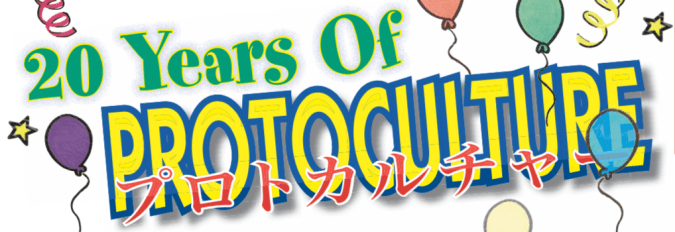
20 Years of Protoculture

20YoP-heading

This article was first published in Protoculture Addicts #94 (Nov.-Dec. 2007): 21-27. It was celebrating the 20th anniversary of the magazine. For this version, I have added a few details and corrections, and I have omitted some illustrations (but added some new ones), as well as removed the sidebars (Uh?! for episodes 1-6, Top Uh?!, Where are they now) and the articles’ index that were part of the original article.

It might be hard to believe, but this magazine has been in publication for twenty years. I, myself, am amazed by this fact. Twenty years already? It didn’t feel that long. But, yeah, I’ve spent nearly half my life working on Protoculture Addicts, and I don’t regret a single moment of it. Like any anniversary, it makes me nostalgic (well, the fact that I am listening to soundtracks from Macross, Mospeada and Robotech while writing this certainly add to this feeling). It makes me think of the good ol’ years, of friends that I have not seen in a long time. But there’s no time for melancholy— anniversaries need to be celebrated! In the past, when I wanted to do a special issue, I usually added more colour. 

Unfortunately, I cannot do that now since we are already full-colour and we are still not big enough to add goodies like a free DVD. However, I quickly realized that the best way to celebrate the magazine was to tell you its story. I am sure that, once you know a little more about where it’s coming from, you’ll better appreciate the magazine. After all, it started like an episode of Comic Party or Doujin Work—a crazy idea in the mind of a bunch of idle college kids. So please, gather around, be quiet (gee, I feel like Uncle Carl when he was telling one of his anecdotes), and listen to this very special anime story… 

[ Traduire ]

Continue reading

The Complete Cartoons of The New Yorker

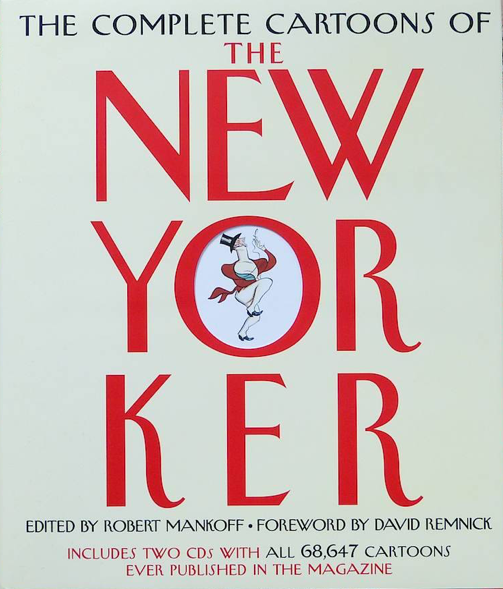
CompleteCartoonsNewYorker-covI acquired this phenomenally huge book in a sale earlier this fall and I paid only fifteen dollars for it. I have always liked the single-panel cartoons (often referred to as “gag cartoon”, in the likes of what you find in the series “For Dummies”, or in Herman or Bizarro, and, of course, in newspapers’ editorial cartoons) and the most iconic of those could be found in the magazine The New Yorker. So I was quite pleased with this acquisition. However, it is the type of nightstand book that you savour slowly and it took me a couple of months to go through its 655 pages and over 2,000 cartoons (about two weeks of actual reading). Unfortunately the used copy I purchased did not include the two CDs with all 68,647 cartoons ever published in the magazine (if so it would have taken me much more time to read!).

A New Yorker cartoon is usually made of one drawing (but sometimes of the sequence of two or three), plus a funny caption. Most of the time all the humour is in the caption… Here are some examples:


The cartoons are organized into the eight decades during which the magazine was published (from its founding in 1925 until the publication of the book in 2004) and each period is introduced by an essay by one of the magazine’s most distinguished writers: 1925-34 (introduction by Roger Angell), 1935-44 (Nancy Franklin), 1945-54 (Lillian Ross), 1955-64 (John Updike), 1965-74 (Calvin Trillin), 1975-84 (Ian Frazier), 1985-94 (Mark Singer) and 1995-2004 (Rebecca Mead). The book starts with an Editor’s Note by Robert Mankoff and a Forword by David Remnick, and concludes with an index of Artists.


In addition, for each era, you find a brief overview of a predominant theme (the depression, drinking, nudity, television, cars, the space program, slipper dogs, business culture, the internet and politics) as well as a brief profile (including a mini-portfolio) for a key cartoonist (Peter Arno, George Price, James Thurber, Charles Adams, William Steig, Saul Steinberg, George Booth, Jack Ziegler [about whom I’ve already talked], Roz Chast, and Bruce Eric Kaplan).
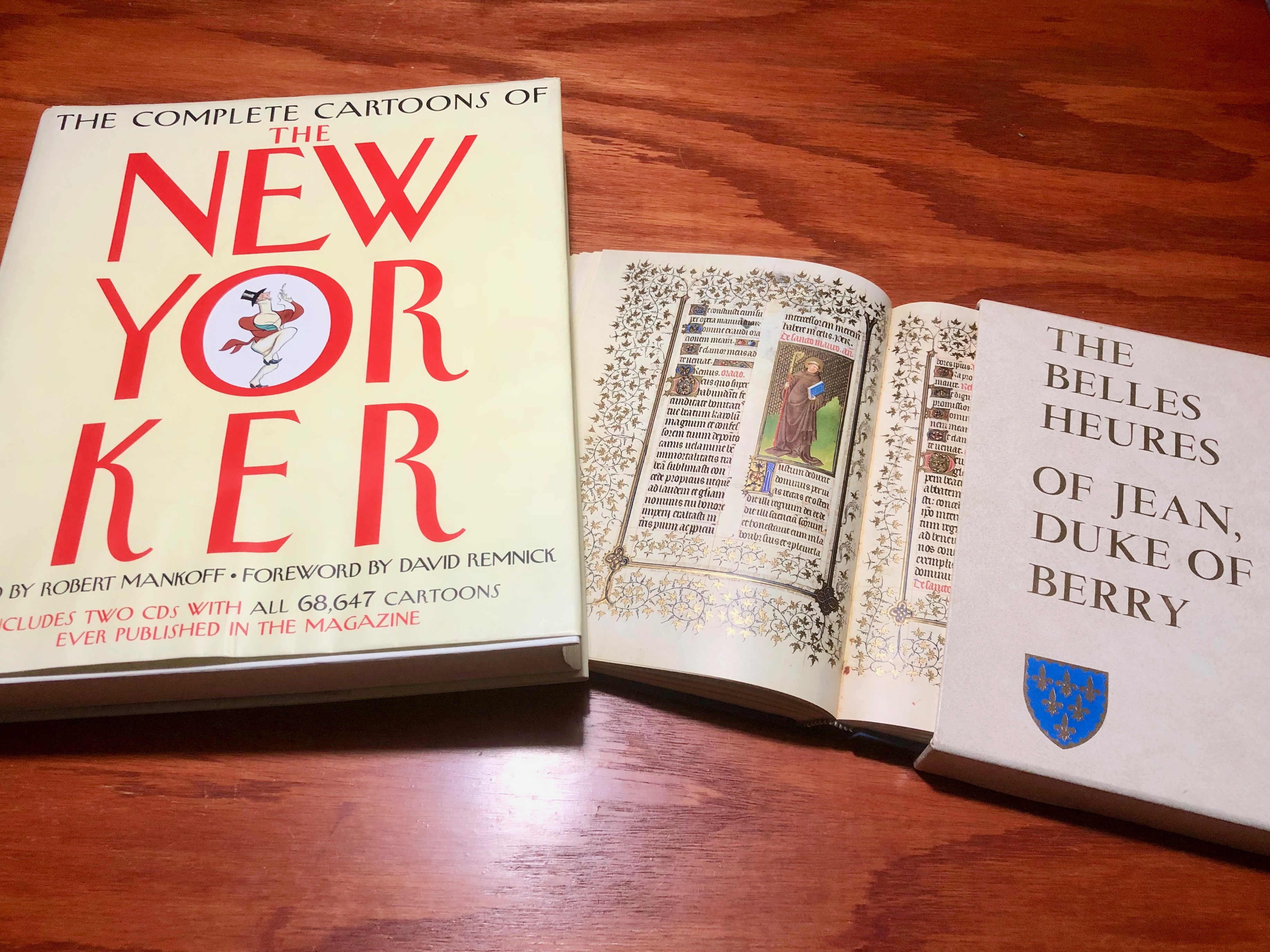
In a way, this book chronicles the history of the magazine, but also the history of the American society. Therefore, it is much more than just a funny reading as it provides great insights and understanding of the socio-politics of each era.

For me, the cartoons were funny most of the time (not LOL, but a chuckle or quiet giggle), but I also often didn’t get it (particularly the older ones — I guess culture change with time or the context was lost to us as sometimes you needed to be there to understand). However, I enjoyed reading this book immensely. If you have a chance, it is worth the time and therefore highly recommended. stars-3-5

To learn more about this title you can consult the following web sites:

[ AmazonBiblio MtlGoodreadsGoogleWikipediaWorldCat ]

[ Traduire ]

Capsules

Outlaw King

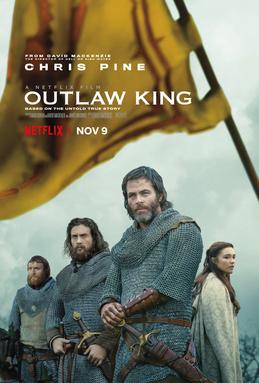
OutlawKingPosterOutlaw King is a movie about the other hero of the 14th-century War of Scottish Independence. As Braveheart told us about William Wallace, this story is about Robert the Bruce. When the Scottish monarch died without a descendent, the lords called upon Edward I of England to chose a successor, a process known as the Great Cause. Instead he invaded Scotland and seized power. The Scottish lords rebelled but the superior English army prevails and the lords finally submitted. Only Wallace continues to fight. However, when he is captured and killed, the civil unrest convinces Robert the Bruce to take arms again. He is crowned king of the Scots in 1306 and, despite being outnumbered and a series of early defeats (like the battle of Methven), he succeeds, through guerrilla warfare, to push back the invader and finally defeat Edward II at the Battle of Bannockburn in 1314. He remains King of the Scots until his death in 1329 and is succeeded by his son, David. Ultimately, through his daughter Marjorie, one of his descendants (James VI/I, son of Mary, Queen of Scots) will reign over both Scotland and England (1603-1625). He is still today revered as a national hero.

This is a beautiful and enthralling historical movie about honour, power, courage and strength. Unfortunately, like most movies, it favours drama over historical accuracy. I particularly like the gritty and realistic depiction of the period, which feels just like Outlander (the first season is similarly about the Jacobite rising of 1745 culminating with the defeat at the Battle of Culloden) or Game of Thrones (some actors of this series appear in the movie: James Cosmo, Stephen Dillane and Clive Russell), but without the fantasy elements. 

Outlaw King, starring Chris Pine (Star Trek), Florence Pugh and Aaron Taylor Johnson, premiered at TIFF in September and was released on Netflix (and select theaters) on November 9th. It is rated R because of some full frontal nudity and graphic violence. The movie was liked but without too much enthusiasm (rating of 63% / 68% on Rotten Tomatoes, 7.0 on IMDb). It is very interesting if you are a fan of Scottish historical action movies, but remains quite entertaining nevertheless. stars-3-5

To learn more about this title you can consult the following web sites:

[ GoogleIMDbNetflixRotten TomatoesWikipedia ]

[ Traduire ]

Capsules

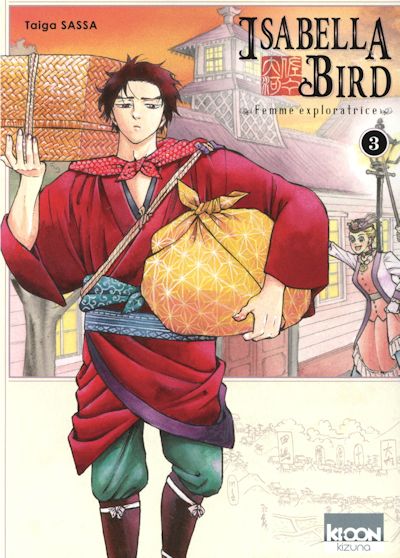
Isabella Bird: Femme Exploratrice, vol. 3

IsabellaBird-v3-cov“Le Japon du XIXe siècle hors des sentiers battus !”

“Pour rejoindre Niigata, première étape de son périple, Isabella Bird a choisi une voie secondaire, rarement empruntée par les voyageurs étrangers. Au fur et à mesure que l’intrépide exploratrice s’enfonce dans la campagne japonaise, l’agitation des grandes villes et la splendeur des sites historiques s’effacent devant la misère du monde rural… Aux divers chocs culturels s’ajoutent des conditions de voyage de plus en plus difficiles, si bien qu’Ito lui-même a du mal à faire face à cet aspect de son pays qu’il ignorait. Mais l’aventurière refuse de se laisser abattre, et c’est sans fléchir qu’elle s’engage sur le dernier tronçon de la route d’Aizu !”

“Lancez-vous à la découverte d’un Japon traditionnel désormais disparu à travers les yeux de l’intrépide Isabella Bird ! Basé sur les écrits réels de l’aventurière, Isabella Bird, femme exploratrice est un récit passionnant sur la rencontre d deux monde; dessiné avec un rare souci du détail par Taiga Sassa, un nouveau talent prometteur !”

[ Texte de la couverture arrière ]

Je continue la lecture de cette série dont j’ai déjà commenté le deux premiers volumes.

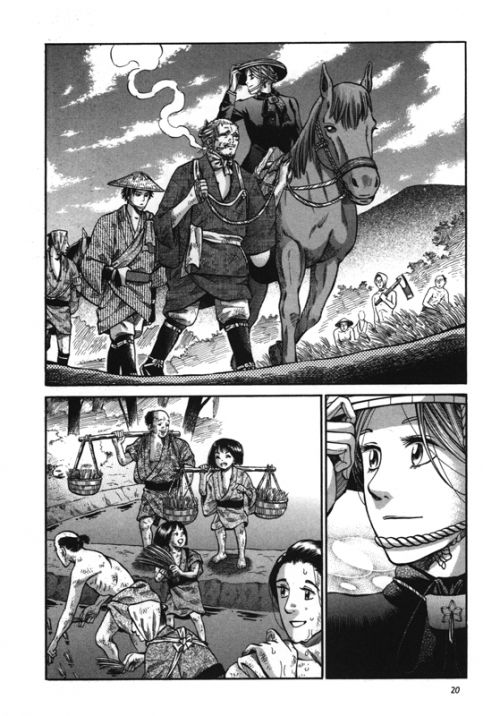
IsabellaBird-v3p010Juin 1878. L’exploratrice britannique Isabella Bird et son guide japonais Tsurukichi Ito continuent leur chemin sur la route d’Aizu en direction de l’île d’Ezo (Hokkaido). La route est difficile et les villages qu’ils rencontrent sont plongés dans une pauvreté si grande qu’elle surprend même Ito. Pourtant les villageois semblent travaillants et déterminés. Le palefrenier engagé pour prendre soin des chevaux leur explique que la région a été dévastée par la guerre de Boshin. L’armée de l’ouest, menée par les clans de Satsuma et de Chōshū, y a écrasé l’armée de l’est. Les paysans ont été enrôlés de force dans l’armée, beaucoup sont morts, les villages ont été pillés et brûlés. Dix ans plus tard la région n’a toujours pas récupéré. 

IsabellaBird-v3p020À Tsugawa (Aga), l’expédition fait des emplettes, Ito se bourre de friandises et prépare un repas gastronomique pour Isabella. Elle en profite pour commenter (à sa soeur, à qui elle écrit) que la gastronomie japonaise, par la propreté des ses instruments, “la parcimonie et la précision de chaque geste, la délicatesse de la présentation, l’incroyable variété des mets, absolument tout, est imprégné d’une beauté particulière”. Le lendemain, ils prennent une barque pour un voyage mouvementé sur le fleuve Agano jusqu’à Niigata, où Isabella passe quelques temps chez les Fyson. 

Pendant ce temps à Tokyo, un botaniste nommé Charles Maries rencontre le consul général Harry Parkes et James Hepburn car il désir poursuivre en justice Isabella parce qu’elle lui aurait volé son guide, Ito, qui était toujours sous contrat avec lui. Maries considère que son travail pour découvrir de nouvelles plantes est beaucoup plus important que les pérégrinations sans conséquences d’une simple voyageuse. Parkes objecte qu’au contraire l’intelligence sur la géographie et les moeurs des habitants de régions reculées fournit par les aventuriers est indispensable au développement de la diplomatie et des échanges commerciaux de l’Empire Britannique! Il lui refuse donc son support.

Isabella Bird est un autre manga historique au récit passionnant et instructif, mais aussi plein d’humour. La fluidité de l’action est assez bonne. Et, si le dessin est loin d’être parfait (parfois les proportions ou les expressions des personnages sont bizarres), il demeure très agréable à l’oeil et surtout bien détaillé pour donner une très bonne expérience de lecture. À travers le récit divertissant des aventures d’Isabella Bird, nous découvrons deux cultures assez opposées: celles de l’Angleterre Victorienne et celle du Japon de la restauration Meiji. C’est un sujet très intéressant et je recommande donc chaudement ce manga.

Isabella Bird, femme exploratrice T03 par Taiga SASSA. Paris: Ki-oon (Coll. Kizuna), avril 2018. 208 pg, , 13 x 18 cm, 7,90 € / $14.95 Can., ISBN 979-10-327-0248-2. Pour lectorat jeune (7+). stars-3-5

Vous trouverez plus d’information sur les sites suivants:

[ AmazonBiblioGoodreadsGoogleWikipediaWorldCat — Youtube ]

© 2016 Taiga Sassa. All Rights reserved.

[ Translate ]

Capsules

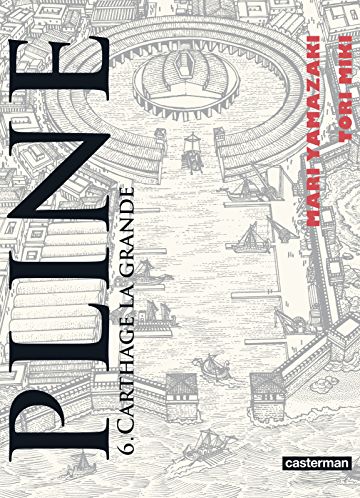
Pline vol. 6: Carthage La Grande

pline-v6-cov“Dans le tome précédent : Au terme d’une traversée mouvementée, Pline, Euclès et Félix, flanqués de deux nouveaux compagnons, débarquent à Stromboli. Les uns exultent de se rapprocher de leur terre natale, d’autres se réjouissent simplement de fouler à nouveau la terre ferme… Les plus clairvoyants sentent planer le danger.”

“L’Histoire a retenu son nom. Mais que savons-nous du plus grand savant de l’Antiquité ?”

“Après une traversée mouvementée, Pline et sa suite débarquent enfin sur la côte africaine. Carthage et son animation, puis le désert et ses dangers, s’offrent au regard du naturaliste pendant qu’à Rome, les intrigues politiques et l’instabilité de Néron annoncent de funestes événements.”

Pline et ses compagnons arrivent enfin dans le port affluent de Carthage. Il y rencontre son ami Vespasien, qui attend de prendre officiellement le poste de gouverneur de la province d’Afrique. On apprend que le jeune garçon que Pline à recueillit est d’origine Phénicienne. L’expédition se lance  alors dans la désert en direction d’Alexandrie!

Pendant ce temps à Rome, Poppée donne naissance à une fille, qui ne survit malheureusement pas longtemps. Néron retrouve l’esclave Plautina qu’il abuse pour oublié que ses responsabilités le rendent misérable. Et Tigellin complote afin de faire d’une pierre deux coups — à la fois contre les chrétiens et pour la spéculation immobilière — d’une façon qui changera le visage de Rome à jamais…

Extraits des pages 5 à 9

Ce fascinant manga historique nous offre un récit à la fois instructif et captivant. Le graphisme de Mari Yamazaki et Tori Miki est plutôt détaillé (de plus en plus avec chaque nouveau volume) et fort agréable à l’oeil. Ce manga est très recommandé particulièrement si la Rome antique vous intéresse. J’attend avec impatience le volume 7 qui devrait paraître en janvier 2019!

Pline, vol. 6: Carthage La Grande, par Mari Yamazaki et Tori Miki. Paris: Casterman (Coll. Sakka), juin 2018. 200 pg, 13.3 x 18.2 cm, 8,45 € / $15.95 Can (ePub/PDF: 5,99 €), ISBN: 978-2-203-15361-5. Sens de lecture original, de droite à gauche. Pour lectorat adolescent (14+). stars-3-5

Pour en apprendre plus sur ce titre vous pouvez consulter les sites suivants:

[ AmazonBiblioGoodreadsGoogleWikipediaWorldcat ]

Pline © 2017 Mari Yamazaki, Tori Miki • 2018 Casterman pour la traduction française.

Voir mes commentaires sur les volumes précédents:

[ Translate ]

Capsules

Ross Poldark

RossPoldark-cov“Returning home from a grim war in America, Ross Poldark is reunited with his beloved Cornwall and family. But the joyful homecoming he had anticipated turns sour; his father is dead, his estate in derelict,  and the girl he loves has become engaged to his cousin. However, his sympathy for the destitute miners and farmers of the district leads him to rescue a half-starved urchin girl from a fairground brawl and take her home — an act that will change the entire course of his life.”

“Ross Poldark is the first novel in Winston Graham’s sweeping saga of Cornish life in the eighteenth century. First published in 1945, the Poldark series has enthralled readers for over seventy years.”

I first discovered this story through the TV series (the 2015 BBC adaptation with Aidan Turner and Eleanor Tomlinson, not the previous 1975 adaptation with Robin Ellis and Angharad Rees) which aired on PBS as part of the Masterpiece show. It is an excellent and beautiful historical drama, very well written and with great actors. It really shows all the aspects of the Georgian era’s society in Cornwall (the westernmost county of England): mostly the sentimental struggle of the main characters, of course, but how they manage to survive at a time when the local mining industry is starting to fail, and how the living conditions of the common people (miners, farmers, fishermen) could be so starkly contrasted with those of the nobility. It also subtlety talks about the political, moral or religious issues of the era. It was all fascinating and I couldn’t resist wanting to see what the books looked like (or at least the first volume).

The book series was written by Winston Graham, who based the story on many aspects of his own life. He was born in Manchester in 1908 but lived in Perranporth, Cornwall, for thirty years (1925-1960). He first met his wife when she was thirteen year-old and the character of Demelza is partly based on her. The series includes twelve volumes which were written in two periods. The first four volumes (Vol. 1: Ross Poldark, Vol. 2: Demelza, Vol. 3: Jeremy Poldark, Vol. 4: Warleggan) were written between 1945 and 1953. In 1973, after a long hiatus, he resumed the series and wrote eight more volumes (Vol. 5: Black Moon, Vol. 6: The Four Swan, Vol. 7: The Angry Tide, Vol. 8: The Stranger From The Sea, Vol. 9: The Miller’s Dance, Vol. 10: The Loving Cup, Vol. 11: The Twisted Sword, Vol. 12: Bella Poldark), the last one being published in 2002, just a year before his death. The first seven volumes are set in the eighteenth century (1783-1799) and depict the life of Ross and Demelza, while the last five volumes, set in the nineteenth century (1810-1820), are centred around their children.

[ WARNING: The following MAY contain traces of spoilers! People allergic to the discussion of any plot’s elements before seeing/reading the story themselves are strongly advised to take the necessary precautions for their safety and should avoid reading further. ]

The first volume starts as Ross Poldark (a young British army officer, member of the low and rural English nobility) comes back from fighting on the losing side of the American War of Independence. He has been wounded in the leg and his face is scarred. Unfortunately, he quickly learn that, during his two years absence, his dissolute father has died, their mine has been closed, his two lazy domestic have let his house and domain (Nampara, located near Truro) go into disrepair, and — worse of all — his young fiancé, Elizabeth, believing he had been killed, is now engaged with his cousin Francis! However, he has a strong character and doesn’t despair: he simply roll-up his sleeves, repair the house, plow the land and makes plans to get financing in order to re-open the mine. He is certainly not perfect and has a quick temper but he is a good man, and, seeing the plight of the local villagers, will do his best to help them and always fight for justice. His exceptional social position (privileged but still a gentleman farmer) allows him the move around flawlessly between the social classes, in both the peasantry, the mine workers on one side and the nobility on the other. 

Ross struggles to forget Elizabeth, his first love, and avoids meeting her. He helps his cousin, Verity, in her amorous affair with the captain Andrew Blamey, but it puts him at odds with his family, and deepen the rift with Francis. After the birth of their child, Geoffrey Charles, Francis is gambling too much at the instigation of George Warleggan and Elizabeth is seeking Ross’ help. The family more or less reconciles on Christmas 1787. His choice of Pascoe’s Bank to finance his business (and eventually some personnal enmities) will put Ross on a collision course with George Warleggan, the son of a blacksmith who became a banker and industrialist.

However, the most life-changing event will occur when Ross saves a thirteen year-old girl from a fairground brawl (started over the abuse of her puppy dog, Garrick). He takes her into his household as a kitchen maid and she grows up admiring Ross. But, at seventeen year-old, fearing that Ross could send her back to her abusive father, she seduces him. They will soon after marry despite all the gossips. Ross will slowly learn to love her. She is a coarse young woman but beautiful and, with the help of Verity, will quickly learn the manners of the nobility. She will always see Elizabeth as a rival, but, despite their tumultuous relationship, Ross will somehow be happy. This is as much her story as his.

Winston Graham’s writing is beautiful and easy to read. The story is not only captivating because of its drama, but also because of its description the Georgian society. However, there are substantial differences between the book and the TV series. For examples: Demelza has black hair and not a beautiful red mane like on TV; she boldly seduces Ross in the book while they simply “fall in love” in the adaptation. The book tend to be more realistic in its description, showing more violence and grit, while the TV series is more reserved. But that’s to be expected. On the other side, the TV adaptation shows more easily the beauty of the Cornish countryside. 

I greatly enjoyed reading this first volume (even if I already knew the story), but I am not ready to engaged in the long commitment required by such a large series. However, I strongly recommend it. Also, take note that I read the edition from the superb MacMillan Collector’s Library but there is another edition, the Pan Macmillan media tie-in edition [ Amazon / Goodreads ], which is probably more widely available.

Ross Poldark – A Novel of Cornwall, 1783-1787, by Winston Graham. London: Pan MacMillan (MacMillan Collector’s Library), 2016. 460 pg. £9.99 / $10.00 US. ISBN 978-1-909621-51-0. For readers fourteen year-old and above. stars-3-5

To learn more about this title you can consult the following web sites:

[ AmazonBiblioGoodreadsGoggleWikipediaWorldCat ]

© Winston Graham 1945.

[ Traduire ]

Books of Ours

MBAMOn October 16th, after a lengthy trek in the Mount Royal Park to admire the autumn foliage, we went to the Museum of Fine Arts to have a look at a small exhibition about books of hours. Titled “Resplendent Illuminations” the exhibit displays Books of Hours from the medieval and Renaissance eras (13th to the 16th Century) but the interesting part is that they are all from Quebec (seven private and public collections). The exhibit, born from in-depth academic research, offers more than 50 artifacts (leaves, complete manuscripts, prints) and is held at the MMFA (pavillon Jean-Noël Desmarais – niveau S2) from September 5, 2018 to January 6, 2019.

Created for the Christian faithfuls (not for men of the cloth but for lay people), Books of Hours offered a collection of calendar of holy and religious feasts as well as passages from the gospels and prayers. They were used for devotion but also to learn reading. What’s characterize them however is that they were personalized with family information (births and weddings) and illuminated with miniature paintings (illuminations) illustrating the life of Christ, the saints or the Virgin Mary. Very minute and beautiful art.

It is really amazing that the faithfuls of New France would bring such beautiful manuscripts with them (or order them abroad) to express their devotion and that those books ended up being so well preserved. Unfortunately, to satisfy the thirst of modern collectors, such beautiful manuscripts were often cut open and sold by the pages (to maximize profits). That’s why many of the artifacts displayed are simple folio. I am quite surprised to see that most Books of Hours are so small, usually in duodecimo book format (each folio has been folded four times to make twelve leaves or twenty-four pages). A detail that I didn’t know: some books of hours were produced AFTER the invention of the printing press (c1450)… The exhibit display seven of those, where wood- and metal cuts replaced illuminations.

Catalogue_raisonné_des_livres_dHeuresThe catalog of this magnificent exhibit (and more) has been published (in French): Catalogue raisonné des livres d’Heures conservés au Québec, edited by Brenda Dunn-Lardeau. Québec, Presses de l’Université du Québec, 2018. 468 pages. $48 (softcover)/$55 (hardcover), ISBN 978-2-7605-4975-3. [ Amazon / BAnQ / Biblio / WorldCat ]

It is a small exhibit (only two rooms) but it is quite enlightening and well-worth seeing for all (ancient) books lovers. You really should take the time to go see it.

Here are some pictures that I took as a memento:

First room

Second room

More pictures are available on my Flickr album. View the legends for all pictures after the jump

[ Traduire ]

Continue reading

Pictorial chronicle

Today’s bounty

Today I took a day off at the library to go… visit another library! This afternoon, my wife and I went to the Atwater Library and Computer Center. Founded in 1828 as the Montreal Mechanics’ Institution (the first in continental British North America) to “educate workers for the emerging industries”, it is now registered as charity and acts as a community library, digital learning centre and meeting place. It is a private library but it is opened to everyone (for an annual membership fee of $35 — and, as they say, “[u]nlike municipal libraries, we don’t ask people to show ID documents or proof of their address”). Like all anglophone cultural institutions it relies mostly on donations and volunteer service. It receives over 100,000 visitors annually as it offers “courses and workshops to help young and old master technology in the digital age, (…) literary and educational events, financial literacy sessions, exhibitions on literature and history, (…) and much more.” The library is housed in a heritage building (built between 1818 and 1820) located in Westmount (1200 Atwater Ave., corner of Tupper St.). It is a beautiful place. The floor of the mezzanine is made of glass panels. It has a respectable collections of books and audio-visual documents (nearly 40,000 titles).

Our main reason to visit the library was its Annual Fall Books sale. The donations of documents that doesn’t make it to the library’s collection are sold to help raise funds. There’s a wide selection of new and used books, CDs, DVDs available at very reasonable prices (between $0.50 for paperbacks and $1 for hard covers, to a range of $5 to $20 for larger art books). There was a lot of interesting books, but I had to limit myself because most of them were rather voluminous. I found quite a bounty.

Today's Bounty

It purchased only two books but they were quite a find. First, I got The Complete Cartoons of the New Yorker ($15, a huge book of 11.25 x 13.25 inches, 2 inches thick and weighting about six pounds!) which presents a collection of the editorial and comical illustrations published in the famous magazine since its founding in 1925 up to 2004 (date of publication of the book). I really love those cartoons and can’t wait to read that (although it’s quite heavy to manipulate)! [ Amazon / Biblio / Goodreads / WorldCat ]

Since I am currently writing about Books of Hours, it is quite serendipitous that the second book I purchased was The Belles Heures of Jean, Duke of Berry ($5). It offers colour reproductions (with commentary) of every folio of the beautiful devotional illuminated manuscript (now hosted in The Cloisters Collection of the New York Metropolitan Museum of Art). It was commissioned around 1409 by Jean, duc de Berry to the Limbourg brothers just a few years before they also illustrated the more famous Très Riches Heures for the same patron. It is a very beautiful and amazing book. It will probably take me a while before going through it.  [ Amazon / Biblio / Goodreads / Wikipedia / WorldCat ]

[ Traduire ]

Notable News (w32-w41)

Since our previous status report, nearly three months ago, a lot has happened. On the domestic front, I am happy to say that I have felt improvement at work. I guess I found better ways to deal with all the irritant “mammoths” (a plethora of usual absurdities, incompetence, and running arounds that made me crazy and drained my energy). However, following the “heat episode” I mentioned earlier, I complained to the union. The union director for the borough came to the workplace and said he could not do anything. A few weeks later he submitted his report to the employers. His conclusion? The section head and the three employees who left early because the excessive heat made them sick … should have stayed at work to show solidarity with their colleagues! Who needs a heartless employer when you have a union of traitors and assholes like that! A real nest of collusion. Madness!

As I keep saying, library work can be quite physical and exhausting (who knew!). I remember someone saying that, at my age, “if you don’t feel pain somewhere when you get up in the morning, it means that you’re dead!” Well, I can say that I feel quite alive. Pain is good. It certainly makes me feel I am there.

What has probably helped is that it has been a very good time for writing. My mind felt clear, I’ve been producing a lot, and everything was doing so well that I could only fear that it would all crash down soon. Maybe it’s the Algernon’s syndrome  or, to paraphrase Nelligan, “I am happy, so happy, that I am afraid to burst into tears!” Hopefully not… It is true that I wrote a lot, mostly about movies (Winchester, The Guernsay Literary and Potato Peel Pie Society, Isle of Dogs, Ready Player One, Mary and the Witch’s Flower, Ex-Libris: The New York Public Library), particularly with the coverage of the World Film Festival (list of Japanese films, red carpet, Samurai’s Promise, Zone Out, Life in overtime, Think again, Junpei, The Miracle of Crybaby Shottan, wrap-up). After a while I had enough of movies and it felt like I should go back to comment on books and manga—which I did with The Ghost in the Shell 1.5: [Human Error Processer], Un siècle d’Animation Japonaise, Souvenirs d’Emanon, Le Guide du Mauvais Père 4 and The Little Broomstick. I also wrote a suggestion list of adult manga. With all this the blog’s stats have soared!

I kept busy. I took walks in the park or visited the museum, a farm fair or the Italian week. I also reflected on the electoral conundrum (before accomplishing my citizen’s duty —in anticipation— with disappointing results), against Facebook, about writing (1, 2, 3) and about reading (or not). 

Eventually, by mid-September, everything started to slow down again and I wrote less. So many things to do. I feel that I cannot accomplish anything. What I need is more time! Time… Time is the enemy. We fight it to do more. We fight it hoping not to get old too fast and still have a little time left to do more. I wrote a haiku.

I started writing in a new notebook. The thirty-fifth. Some could be surprised that, in this digital age, one would still use a paper notebook. However, I find this physical form strangely reassuring. After all, electronic information can be so vulnerable. The good old notebook doesn’t need any batteries and fears only fire and water. Its sequential way of working—to write, read (or re-read)—is so much more appropriate for the human brain capacity. It is easier to get an overview of the text, to positioned yourself in the three dimensions of the writing. It’s more confortable for me. Of course, most of the time, it is just a glorified to-do or grocery list, but it serves as backup for my capricious memory. That way, in a few scribbles, I can preserves ideas that would otherwise be too fleeting to be useful. It is also the witness of my daily life.

I’ve watched a few interesting TV series. First, The Miniaturist mini-series. It is good and yet disappointing. It looks similar to the Girl with a Pearl Earring. It’s another show about the powerlessness of women in the end of the Middle Age (or early Enlightment). It concludes with an open-ending. “I can do this”, she says… I also binge-watched the first season of the Jack Ryan TV series on Amazon Prime (a thriller similar to 24), the new seasons of Walking Dead, Doctor Who and also the very good Press TV series. 

Apple has announced new products (iPhone and watch) and released new operating systems. How come, when you do a software upgrade, you always loose something you like? Why is removing something cool and useful is considered an upgrade? New operating systems always offer a basket of frustration…
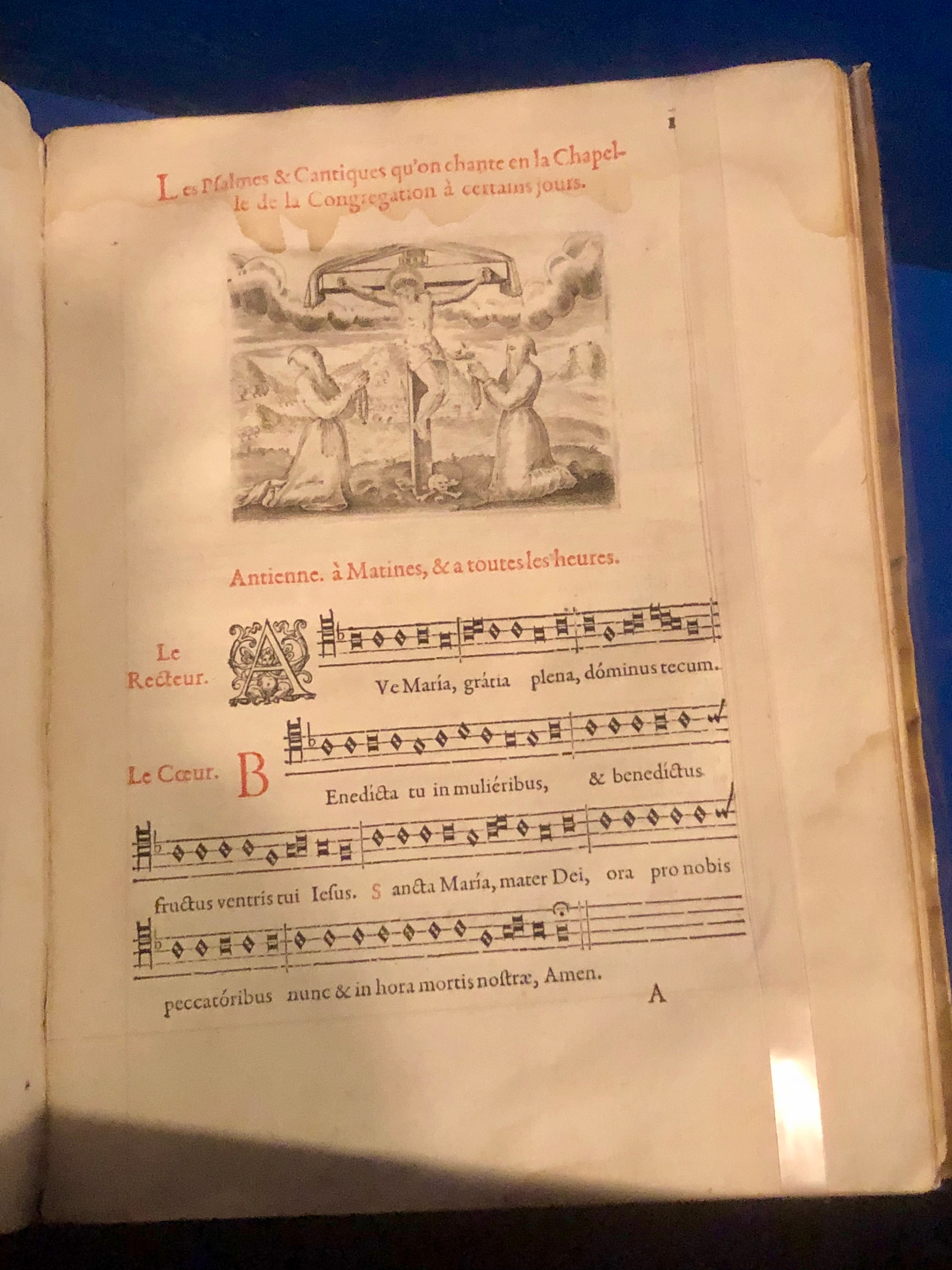
I am trying to improve my reading habits by reading more, more often and better literature than just manga. I started with The Little Broomstick by Mary Stewart and I am currently reading the first novel of the Poldark series by Winston Graham. But it is hard. In the olden days, I could read about sixty pages in an hour. Now, I read only a few hours per week, before going to bed, and barely thirty pages per hour. After two or three days of starting a new book, I am barely at page fifty! What’s happened to me? Fortunately, as I go forward, it is starting to get better… However, manga are pilling up on my nightstand, so I will soon have to pay attention to them…
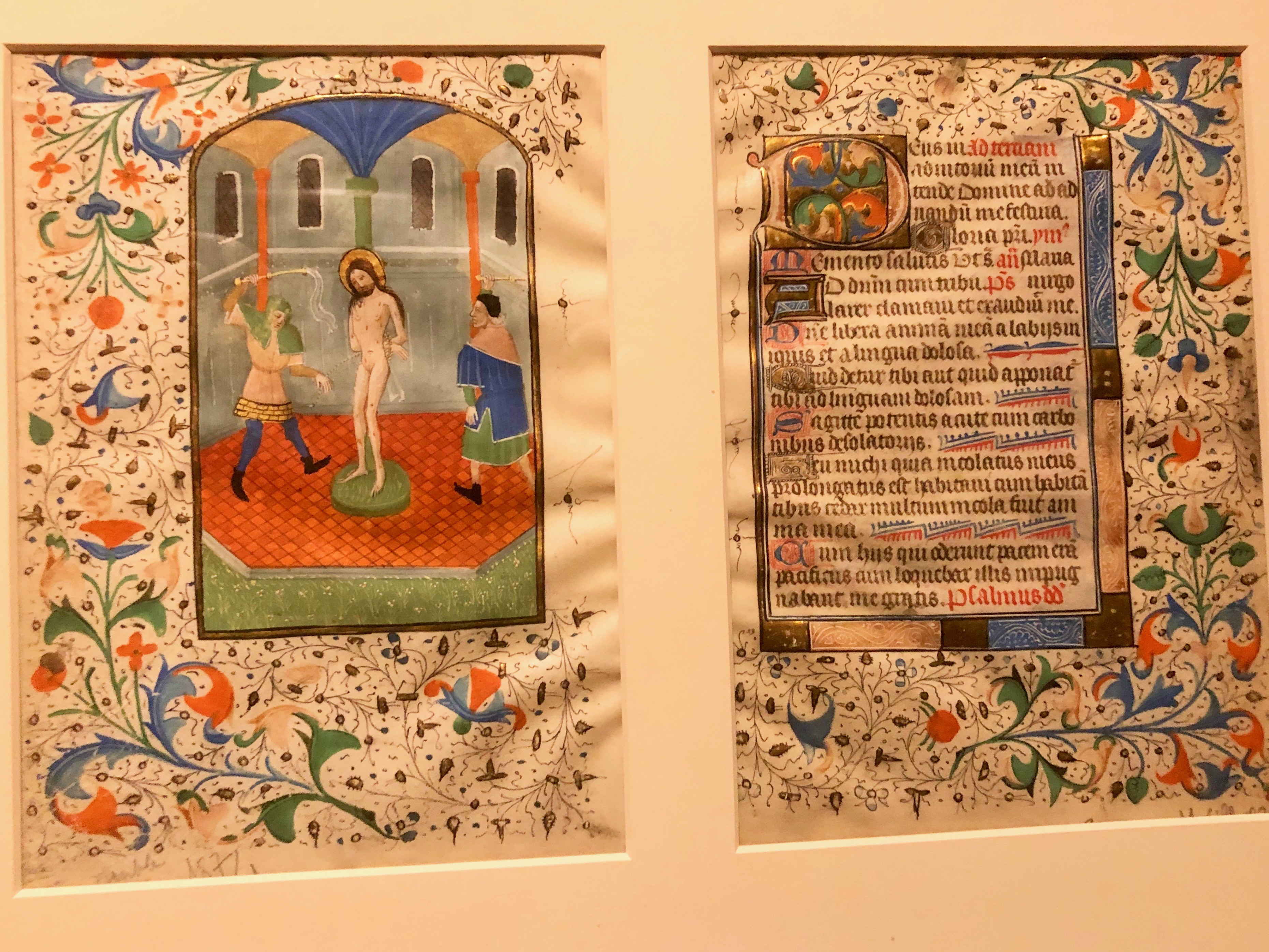
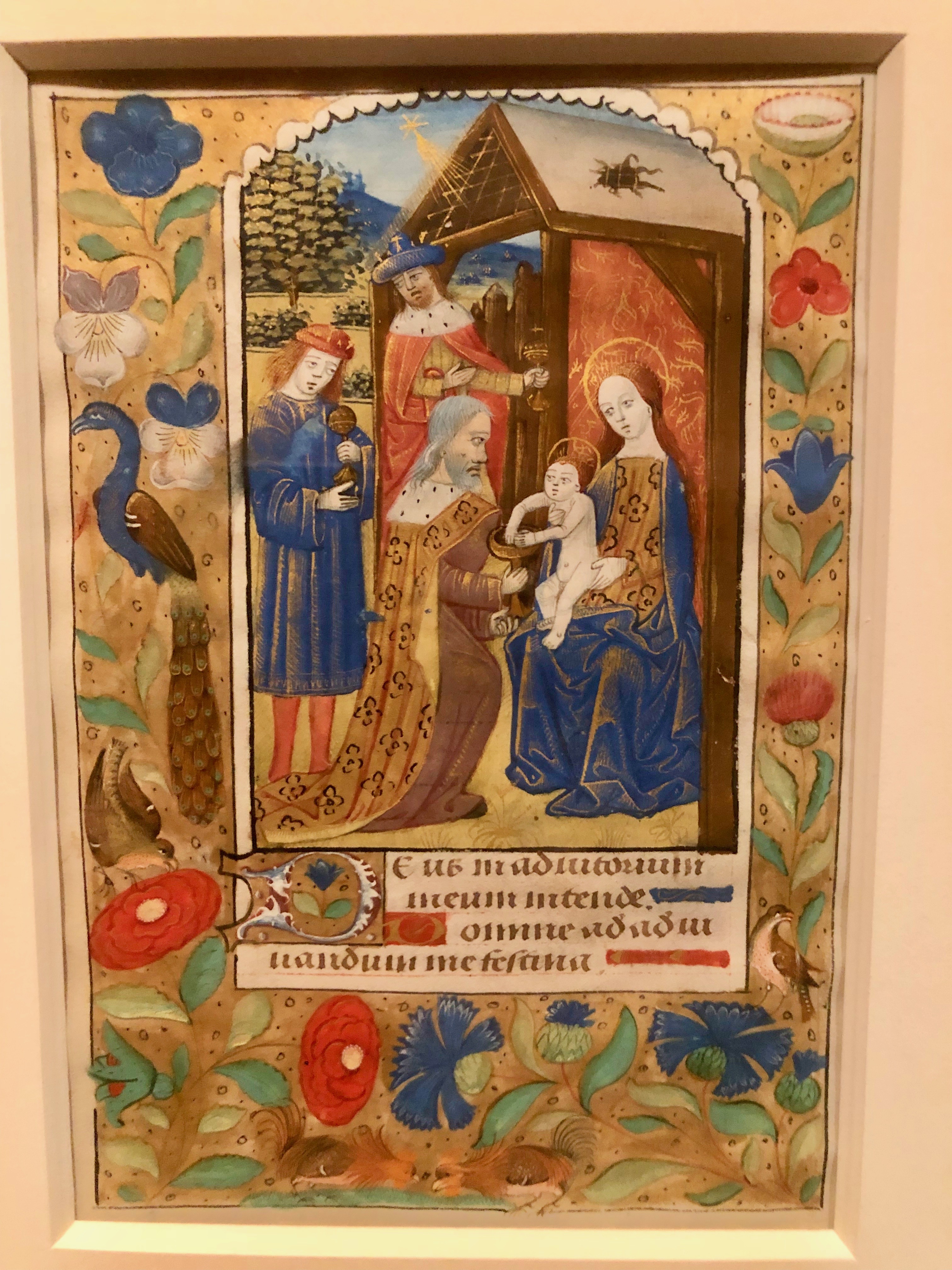
“Summer is officially dead. It smells like Fall outside and I heard a flight of geese passing over the house”. Then, Fall officially came. It got colder and rainy. We even had some light snow. It became a little warmer for a while, but now we can feel that Winter is around the corner. Flowers and plants are shrivelling, twisting and taking the brownish colour of death. Winter is coming…

The lights have started to flicker again. Same time than last year…

On the world stage, we find the usual disasters (increasing numbers of earthquakes, floods, hurricanes and volcanoes) but my attention had been particularly focused on the trumpian saga of corruption scandals (Stormy Daniels, the Mueller’s investigation, of course, but particularly the Kavanaugh confirmation) growing in a crescendo as the midterm elections are closing by. Such craziness! (For all the details see the 2018 events for the months of August, September and October as well as the links bellow).

Despite all this, I surprisingly succeeded to stay acquainted with the affairs of the world and gathered over two-hundred notable news & links — which I now share with you (in both french or english, slightly categorized, but in no particular order; please note that, to save on coding time, the links will NOT open in a new window as usual) after the jump.

[ Traduire ]

Continue reading

Un dimanche au musée

IMG_3412J’ai encore visité une exposition au Musée des beaux-Arts de Montréal in-extremis: en effet, l’exposition D’Afrique aux Amériques : Picasso en face-à-face, d’hier à aujourd’hui se terminait aujourd’hui. Comme toujours, cela en valait la peine (malgré la foule).

Je n’ai jamais beaucoup aimé Picasso (et l’art abstrait en général) mais, comme il se situe aux limites du figuratif et que j’ai toujours été fasciné par la vision du monde qu’il exprime dans son art, il m’intéresse tout de même. J’ai toujours interprété son oeuvre avec l’entendement que, la photographie ayant rendu le besoin de représenter la réalité caduque, les artistes modernes ont délaissé le figuratif pour l’impressionisme, d’abord, puis pour l’expressionnisme et même carrément l’abstrait (cubisme, surréalisme, etc.). On déforme la réalité pour exprimer et inspirer des sentiments. Picasso a commencé à peindre durant une période troublée du XXe siècle, alors ce n’est pas surprenant qu’il exprime des sentiments perturbés, dérangés ou dérangeants. Je me suis toujours demandé comment il pouvait réussir à déformer la réalité d’une telle façon ou s’il voyait vraiment le monde comme cela. Quoiqu’il en soit, j’ai toujours trouvé son art plutôt laid. Mais bon, comme je dis souvent à mon épouse, pas besoin d’aimer ça pour l’apprécier! Pour apprendre, il faut aller au-delà de ses goûts et de sa zone de confort.

Toutefois, ce n’est vraiment qu’en visitant cette exposition, qui met en parallèle des oeuvres de Picasso et de l’art Africain (dans ses très multiples déclinaisons), que j’ai finalement compris son inspiration. À cette époque-là, les artistes tribaux africains tentaient de représenter les esprits de la nature, le divin, la terreur de leur démons. Et c’est dans ces formes là que Picasso a trouvé sa muse.

Étrangement, l’art africain m’a aussi toujours fasciné. J’y trouve quelques chose de surréel, et, là où l’artiste tentait de représenter le surnaturel (esprit, démon), j’y vois une vision d’outre-monde, tantôt lovecraftienne, tantôt l’expression d’une science-fiction accidentelle (extra-terrestre, créature “star trekienne” ou “alienesque”, robot, arme klingonne, etc.). 

Et c’est sous le prisme de ces deux considérations que j’ai visité, et apprécié, cette exposition…

[ Translate ]

Continuez la lecture après le saut de page >>

Continue reading

Samurai’s Promise

Chiri_Tsubaki-posterShinbei is exiled from his clan for investigating its activities too closely. Eight years later, when Shinbei’s dying wife pleads with him to go to help his former best friend, Umeme, he returns to the clan. Infighting has produced turmoil within the clan, allowing Shinbei to discover the truth behind incidents involving his wife and his friend. Confronting Umeme, he understands the reason for his wife’s last wish. (FFM)

This is a very good movie. Its most noticeable aspect is that it offers an excellent photography (which is not surprising since director Kimura acted as his own photography director, a job he has hold many times for other directors like Kinji Fukasaku, Yasuo Furuhata, or Shin’ichirô Sawai). He made great use of the superb location in the Toyama Prefecture (anciently the Etchû province) showing as backdrop the fantastic landscape of the Hida mountains in the Northern Japanese Alps. 

Another aspect that I quickly noticed was that the music was unfortunately very annoying. They used a soundtrack of classical music (which first accords sounded like The Godfather’s music by Nino Rota), playing it again and again recurrently. I think that, for a jidaigeki (samurai movie), a soundtrack of traditional Japanese music would have been better…

Shinbei (Jun’ichi Okada) is exiled from the clan after denouncing as corrupt a high-ranking officer of the clan — who is later mysteriously murdered leaving all the suspicion of culpability on Shinbei. Both Shinbei and his friend Uneme (Hidetoshi Nishijima) were courting Shino (Kumido Aso), but when Uneme’s family denies him the permission to wed Shino, she goes with Shinbei instead. The harsh condition of their exile put a toll on Shino’s health who eventually dies. She makes Shinbei promise to continue living, to go back to their village to observe the camellia falling in spring and to reconcile and help Uneme. When he tries to clear his name and find out the real assassin, he gets entangled in the complex politics of the clan…

Samurai’s Promise is a beautiful and interesting samurai movie. It has a smooth storytelling, although it is sometimes difficult (at the beginning) to understand who’s who and figure out all the plots and politics at play. The acting is good, and particularly the nice realistic combat scenes. It must not have been easy considering the fact that there was many fights in the rain or snow and that the dialogues were using an old form of Japanese. 

Of course, we should expect nothing less from such a veteran director. During his sixty-year career, Daisaku Kimura worked on over fifty films and won many awards. He started his career as camera assistant on Akira Kurosawa’s Hidden Fortress (1958). He worked five years with him (on movies like Yojimbo and Sanjuro) and he learned a lot during this time. Eventually, he cames to direct his own movies (Mt. Tsurugidake in 2009 and Climbing to Spring in 2014), mostly about mountain climbing. Samurai’s promise is his first jidaigeki and he made it as a tribute to Kurosawa. It is a beautiful and authentic movie, well worth watching. These days we don’t see much movies like this…

Samurai’s Promise (散り椿 / Chiri Tsubaki / lit. “Falling Camellia”): Japan, 2018, 111 mins; Dir./Phot.: Daisaku Kimura; Scr.: Takashi Koizumi (based on the novel by Rin Hamuro); Ed.: Tomoni Kikuchi; Mus.: Takashi Kako; Prod.: Yoshihiro Sato. Cast: Jun’ichi Okada, Hidetoshi Nishijima, Haru Kuroki, Hirofumi Arai, Kyôko Yoshine, Sosuke Ikematsu, Kumido Aso, Naoto Ogata.

Screened as opening movie (in the “World Competition” program) of the 42nd Montreal World Film Festival (at the Cinema Imperial on Thursday August 23, 2018 at 19:00). stars-3-5

[ AsianWiki / IMDb /  Official  / Youtube ]

[ Traduire ]