Hier, document.write(“”); suite à une expérience consternante la semaine précédente, j’ai écrit un courriel à mon Conseiller municipal de quartier afin de lui faire part d’une grave préoccupation concernant la gestion animalière de l’arrondissement:
Cher Monsieur le conseiller,
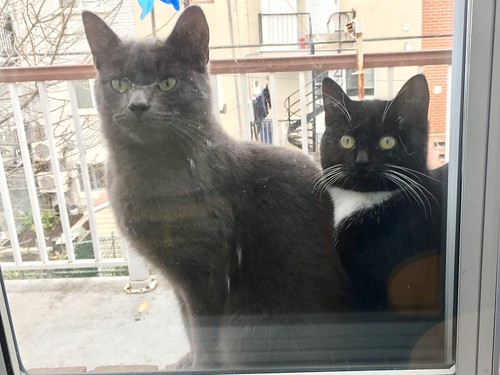
J’aimerais porter à votre attention un grave problème de gestion animalière. La ruelle derrière mon duplex est envahie par des chats errants et je suppose que c’est le cas de la majorité des ruelles du quartier. Ce n’est pas tant la présence de ces chats errants qui m’embête que les graves lacunes dans leur gestion. En fait, ils mettent un peu de vie dans un milieu urbain parfois trop dénaturé et contribuent à éliminer la vermine (rats, souris, mulots, pigeons, etc.).
Je ne les blâme aucunement pour leur prolifération car ils n’en sont pas responsables. C’est nous, les humains, qui avons créés cette situation en abandonnant des animaux (particulièrement des chats) et les laissant se reproduire librement sans la moindre intervention ni contrôle. Je ne crois pas que ces animaux devraient souffrir inutilement suite à une situation dont ils ne sont pas responsables. Nous devrions tenter de gérer la situation le plus humainement possible mais ce n’est pas le cas: la gestion actuelle n’est ni adéquate, ni humaine.
However, I still found some time to stay acquainted (a bit) with the affairs of the world. Here’s a “few” notable news & links that I came across this month and that I’d like to share with you, after the jump (in no particular order, in both french and english):
The Cheese curd’s army, the infamous Peach Melba, are baking great progress in regaining Tarty and Cereal territories from the Anemic Steak pea’s addicts, putting them in devious bubble. Those cereal killers must be harvested and juiced in a creamy gourd.
En passant chez mes amis d’Alire j’ai remarqué, entre autres, le dernier Patrick Sénécal, L’Autre reflet, l’impressionnant Détectionnaire de Norbert Spehner (qui était d’ailleurs l’un des invités d’honneur du salon), et noté la parution prochaine de L’Année de la science-fiction et du fantastique québécois 1996 (enfin)! Étrangement j’ai remarqué qu’il y avait au salon cette année beaucoup de livres de cuisine végane (un signe des temps, sans doute) et j’ai aperçu ce qui semble être la réédition (pas si récente que ça) du manga de UFO Robot Goldorak. Toutefois, je n’ai rien remarqué de frappant dans les nouveautés et je n’ai pas trouvé le manga de Marie-Antoinette que je cherchais (une nouveauté qui date quand même de septembre! — ça m’a tout de même aidé à mieux résister à la tentation d’acheter quoi que ce soit!).
Je ne comprends vraiment pas pourquoi les éditeurs et distributeurs poussent au salon seulement leur gros titres et meilleurs vendeurs alors que le salon devrait être le lieu pour faire connaître et promouvoir les nouveautés et les titres moins connus!
Autre étonnement: je constate l’absence de kiosques pour les bibliothèques de Montréal et pour la BANQ. Pourtant, par les années passées, ils avaient au moins des kiosques statiques (juste des affiches et des dépliants) ou même partageaient ensemble un kiosque (comme l’an passé). Mais, cette année, rien du tout! Pourtant si les biblios ont besoin d’une chose c’est bien de promotion. Ils pourraient faire la démontration des nouveaux postes d’auto-prêt, ou du catalogue Nelligan Découverte, parler des nouvelles biblios, de celles avec des projets de rénovations, des services en ligne, du prêt numérique, du tout nouveau service de prêt d’instruments de musique, offrir des abonnements (pour augmenter le taux d’abonnés par habitant qui est plus bas au Québec que dans le reste du pays), etc, etc.
Bien sûr, avoir un kiosque au salon et du monde sur le plancher ça coûte de l’argent et la ville (ou le gouvernement) semble penser que la culture c’est pas important. Et pourquoi investir et promouvoir si au bout du compte ça rapporte rien? Les bénéfices rapportés par les bibliothèques, c’est bien connu, ça ne se voit pas alors ça ne compte pas vraiment. C’est tellement Trump! On est vraiment entré dans une nouvelle ère. Argh! Quelle horreur… Saint-Lovecraft venez à notre secours!
Donc, cette année, un salon plutôt décevant. Heureusement que je ne manque pas de livres à lire!
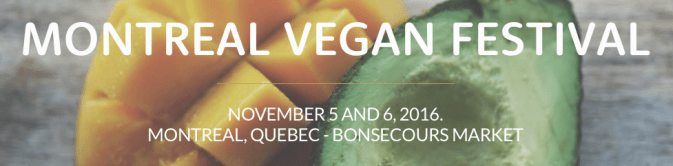
Last week my wife dragged me to a vegan festival. I went only because I was curious to see what vegans looked like…
I mean, I’m all for eating healthy and I want to encourage local production so I was appalled that people would want to eat food from a distant solar system. And I had never seen little green people up-close…
Oh… You mean Vegan are not actually people from Alpha Lyrae, a.k.a. Vega? So why are they also called the green people? Umm. I was wondering why someone would bother to import food from a place 25 light-years away. Now it makes sense. My mistake.
So I stand corrected: Vegans are practitioners of veganism and therefore abstains from consuming any animal products like meat (including fish and seafood), eggs, dairy and all their derivatives (might even includes honey!). It also sometimes goes as far as opposing the use of any animal products (like leather) and advocating for animal wellfare. They must not be confused with vegetarians, who abstain only from consuming meat, but can sometimes be called vegetalians (because they consume only food from the vegetal order: seeds, vegetables, fruits, mushrooms, etc.). For some it’s not only a diet, but a philosophy, a religion even.
I am a very tolerant person and believe that people can do whatever they want as long as they don’t bother me with it. Lives and let live. I think that we should consume locally-produced food as much as possible and that we should be very careful with what we eat: avoid eating too much red meat for example and avoid processed food. However, I really don’t understand those vegans.
“Sa véritable Histoire, pour la première fois en manga !“
“Marie-Antoinette est l’une des personnalités historiques les plus adaptées en fiction. Sophia Coppola, Chantal Thomas ou Riyoko Ikeda… de nombreux créateurs ont donné naissance à un personnage en adéquation avec leurs idéaux.”
“Cependant, quand Fuyumi Soryo s’attaque au mythe, ce n’est pas pour reproduire une énième icône malmenée par la vision trop partiale de Stephan Zweig, mais pour restituer dans la réalité historique une jeune fille dénuée de tout artifice.”
“Avec la précision qu’on lui connaît déjà sur Cesare et grâce au soutien du Château de Versailles, ce n’est plus un simple manga, mais une plongée virtuelle au cœur de la cour au XVIIIe siècle que l’auteur vous offre. Que vous soyez adepte des fresques historiques, lecteur de manga ou tout simplement curieux de nouveauté, ne passez pas à côté de cette création ! D’autant plus que les Éditions Glénat, co-éditeur dans ce projet, auront la chance de publier ce titre en avant-première de sa sortie japonaise !!” (Texte du site de l’éditeur)
Hier, je regardais les nouvelles sur NHK World et on y présentait un reportage sur le tout dernier manga de Fuyumi Sōryō, Mars. On y mentionne que la mangaka travaillait maintenant sur une biographie de Marie-Antoinette (voir aussi ANN, Le Monde) alors que je croyais qu’elle travaillais à la suite de Cesare. La mangaka aurait-elle décidé de mettre fin abruptement à Cesare (avec le volume 11)? D’autant plus que l’article mentionne que son futur projet serait une biographie de Dante Alighieri (poursuivant sur le sujet de la renaissance Italienne). Mais peut-être (j’espère) a-t-elle juste temporairement mis Cesare sur pause afin de travailler sur Marie-Antoinette, qui ne comporte d’ailleurs qu’un seul volume (un “one-shot” comme on dit).
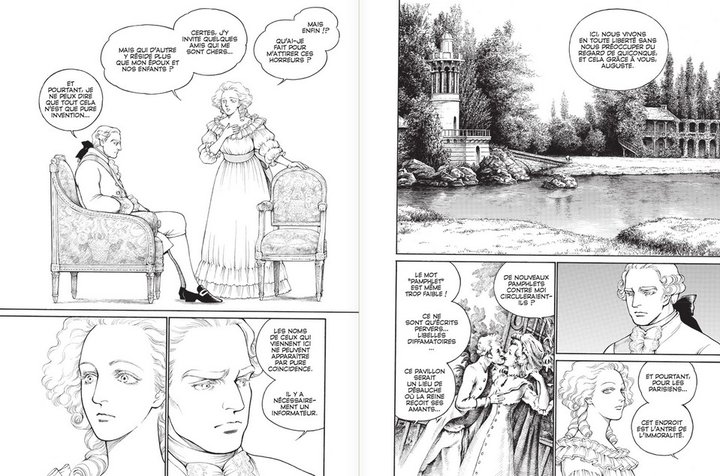
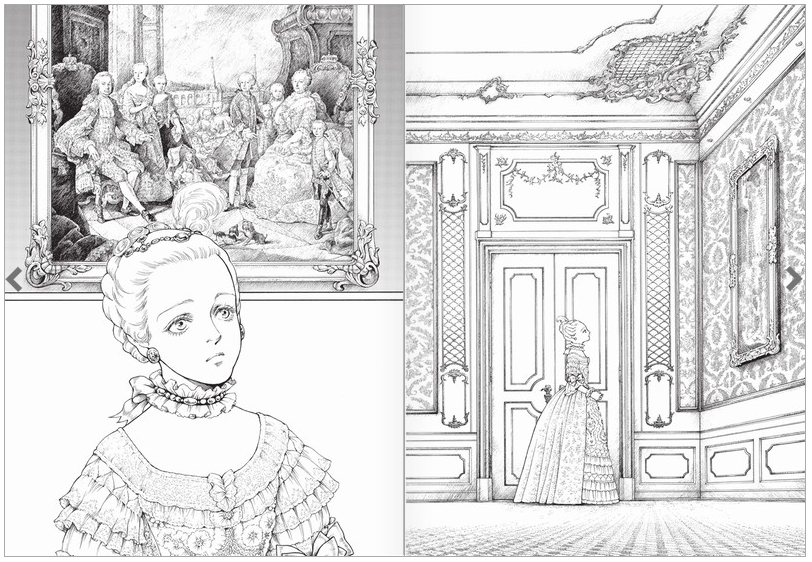
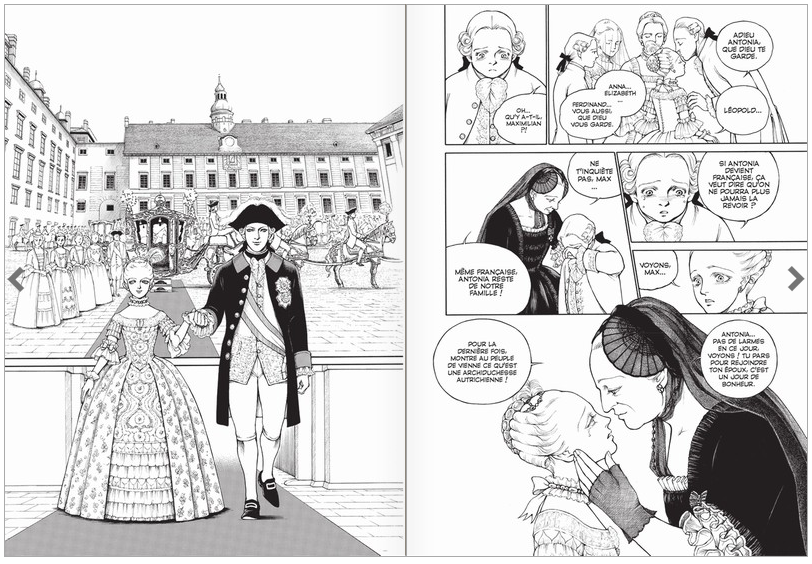
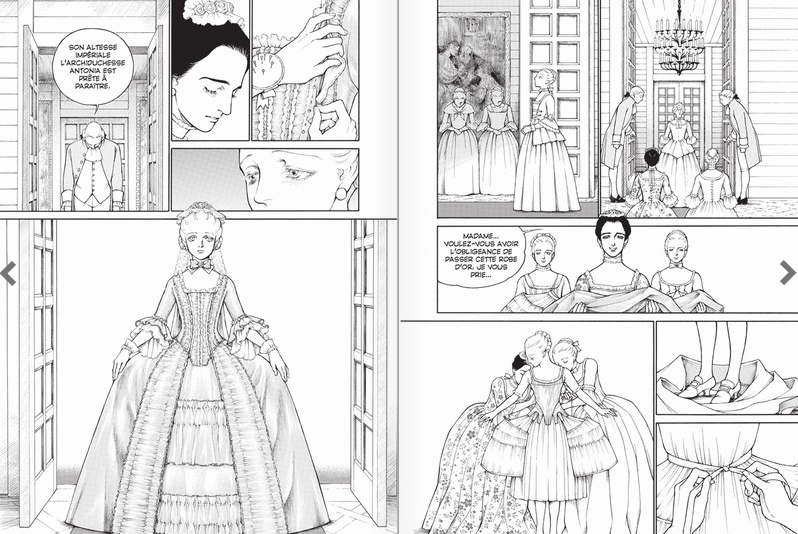
Extrait des pages 10-11, 20-21, 24-25, & 40-41 (lire de droite à gauche):
pp. 10-11
pp. 20-21
pp. 24-25
pp. 40-41
Marie-Antoinette (マリー・アントワネット) est un manga historique seinen par Fuyumi Sōryō qui a d’abord été pré-publié en feuilleton dans Morning (et son pendant digital: D Morning), un magazine hebdomadaire de Kōdansha. Il a débuté dans le numéro 38 (18 août 2016) et s’est étalé sur quatre publications (se terminant dans le numéro 41). Chose rare, la publication en volume (tankōbon) s’est faite au Japon en septembre 2016, soit quelques jours après la parution du volume en français!
Malgré certaines critiques négatives en France, on peut s’attendre à un ouvrage d’une grande qualité historique. Soryo est d’ailleurs reconnue pour la qualité de sa documentation, d’autant plus que le projet, co-publié par Kodansha et Glénat, est produit en collaboration avec le Château de Versailles, qui a ouvert ses portes et offert tout son soutient à l’artiste. Le magnifique style rococo qui caractérise l’époque sera donc fidèlement reproduit dans tous ses aspects: la mode, l’architecture, l’étiquette et les moeurs de la court royale, etc.
Si l’on prends pour exemple la qualité de son travail sur Cesare (tant les détails historiques que le travail artistique), on ne sera pas déçu. J’ai déjà commandé le manga et le commenterai dès que je l’aurai lu.
Remember! the numerous casualties of wars
Remember! that we once were canon fodder
— for some distant empire
But above all we shall now remember…
Remember! that democracy is always hard-won
— and sometimes so easily lost!
(Canon PowerShot S5 IS, document.write(“”); National War Memorial in Ottawa, 2015-05-20)
I also tried to read a little. I have so many books piling on my bedside table (haïku compilation, numerous mangas, Solaris #200, etc). However, I find it so hard to read lately. I am so busy that whenever I can read, I feel guilty and this sentiment is a distraction that make it difficult to concentrate on my reading. Quite annoying. And there’s plenty of other distractions… like watching TV! Beside the U.S. presidential election madness and the returning shows (7th season of Walking Dead, 2nd season of Poldark, 10th season of Murdock Mysteries, 14th season of NCIS, 2nd season of Blindspot, 3rd season of Z Nation, 8th season of Vampire Diaries, 4th season of A Place to call home), there’s very interesting newcomers like Westworld and Tutankhamun, or others like Class (a Doctor Who spin-off)! I’ve also watched on Dvd the Michael Moore documentary Where to invade next.
Maybe all that activity was too much, because I caught some bug (cold, stomach flu?) that left me tired, congestionned and with an upset stomach. But there’s no rest for the wicked and now I must work on my monthly accounting and pay the bills.
However, before I do that, I’d like to share with you a few notable news & links that I came across lately. Because, even with all this activity, I will always find some time to stay acquainted (a bit) with the affairs of the world. Here they are, after the jump, in no particular order, in both french and english):
Before the screening of the first movie, A Tale of Samurai Cooking, the attendees were treated with a few canapé and a degustation of sake. There was a presentation by the a staff member of the Japanese consulate in Montreal, followed by allocutions of the Cinémathèque general director, Marcel Jean, and the Consul General in Montreal, Hideaki KURAMITSU.
“Serving the Lord of Kaga not with the sword, but with the kitchen knife, the Funaki family has been known as “Kitchen Samurai” for generations. However, Yasunobu’s lack of culinary skills has placed the Funaki name in peril. To save her new family and its status as “Kitchen Samurai”, Haru decides to teach her new husband the refined art of Kaga cuisine from her point of view. Inspired by a true story.”
WARNING: May contains trace of spoilers! People allergic to the discussion of any plot’s elements before seeing a movie are strongly advised to take the necessary precautions for their safety and should avoid reading further.
This movie is based on a joseiyonkoma (4-panel comic strip aimed at an adult female readership) by Miri Masuda. This style of comic is very popular in Japan. S?-chan “follows the daily lives of women who deal with their anxieties regarding love and work”. It is published by Gentosha and “has sold over 280,000 copies” (up to March 2013). Four volumes have been released between April 2006 and November 2012 (the first volume came out in paperback in August 2009; a preview of the first six pages is available online — opposite: pp. 4-5). (Sources: ANN, Wikipedia Ja)
The movie adaptation, titled Sue, Mai & Sawa: Righting the Girl Ship, is a typical Japanese feel-good movie. However, despite the light tone, it seriously tackles the anxieties of Japanese single women. It tells the story of three women in their thirties who find themselves questioning their life situation and how they more or less succeed to find happiness.
Yoshiko Morimoto, nicknamed Sue-chan, is 34-year-old and works in a coffee shop where she can put to use her talent for cooking. She has feeling for the manager, but her hesitation prompts a younger, more aggressive colleague to secure his love before she can do anything. However, the owner ends up offering her the manager position. She’s insecure at first and makes mistake, but she slowly grows into the responsibility. She has good wisdom and is a great help to confort and give advise to her friends.
Maiko Okamura, nicknamed Mai-chan, is a 34-year-old office lady working in the sales department of an OA manufacturing company. She is stressed by the pressure at work and frustrated with the fact that her affair with a married man is going nowhere. When her dermatologist suggests that she should give up on some of her life’s problems, she decides to dump her boyfriend and registers with a marriage agency. One year later, she is married and pregnant. However, she worries that motherhood would change her, but finally learns to say goodbye to the woman she was and accepts whom she has become.
Sawako Hayashi, nicknamed Sawa-san, is a 39-year-old web designer. She helps her mother take care of the grandmother who’s bedridden and suffers from dementia. She worries that if she ever marry she would leave her mother to do the care-giving by herself. She meet by chance a former classmate and starts going out with him, but when he appears more concerned with having a descendance and requests a “fertility certificate”, she gets angry and dumps him. She comes to term with having to take care of her grandmother.
The movie feels a little like a sketch comedy in the beginning, but it quickly gets structured into a more uniform storytelling. It might have been intentional, in order to allude to the original 4-panel format which is, by definition, a series of short stories ending with a punch. Food is also a recurring theme in the movie (and a theme shared by all three movies screened at the festival this year) as the friends always gathered around a meal to discuss their problems. But since Ozu it seems that food and meals has been a frequent theme in Japanese movies.
All in all, Sue, Mai & Sawa is an interesting movie that provide some reflection about life and a good entertainment.
Sue, Mai & Sawa: Righting the Girl Ship (????????????????? / Sû chan Mai chan Sawako san). Japan, 2013, 106 min.; Dir.: Osamu Minorikawa; Scr.: Sachiko Tanaka (based on the 4-koma by Miri Masuda); Phot.: Gen Kobayashi; Prod.: Yoshitaka Takeda; Cast: Yôko Maki, Shinobu Terajima, Kou Shibasaki, Shota Sometani, Arata Iura, Hana Kino, Gin Pun Chou, Akiko Kazami, Megumi Sato, Mio Uema, Aoi Yoshikura, Ai Takabe.
“If you are cold, tea will warm you; if you are too heated, it will cool you; If you are depressed, it will cheer you; If you are excited, it will calm you.” ― William Ewart Gladstone










 Clodjee's Safe-House