Hibiscus / Rose-mallow
Malvaceae : Hibiscus : “Jazzberry Jam”

[ Nikon D3300, Jardin botanique, 2018-09-09 ]
Malvaceae : Hibiscus : “Jazzberry Jam”
[ Nikon D3300, Jardin botanique, 2018-09-09 ]
 Nous avons décidé de passer notre dimanche aux Portes Ouvertes sur les Fermes du Québec qui se déroulaient (entre autre) au Parc Olympique de Montréal. Nous avions déjà visité cet événement l’an dernier et, comme nous avions bien apprécié, nous avons décidé de récidiver cette année. C’est l’occasion pour les différents producteurs agricoles de la province de présenter et de promouvoir leur production au public. On peut donc y découvrir les différentes variétés de vaches qui sont élevées au Québec (Holstein, Ayrshire, Jersey, Suisse Brune, Canadienne, Limousin) ou les différentes variétés de grains qui y sont cultivés (Maïs, Soya, Orge, Blé, Canola, Avoine). Il y avait même une petite ferme avec une grande variété d’animaux que les enfants pouvaient caresser (chèvres, âne, Alpaga, etc.). C’était fort amusant… (quoique c’était exactement la même chose que l’an dernier!)
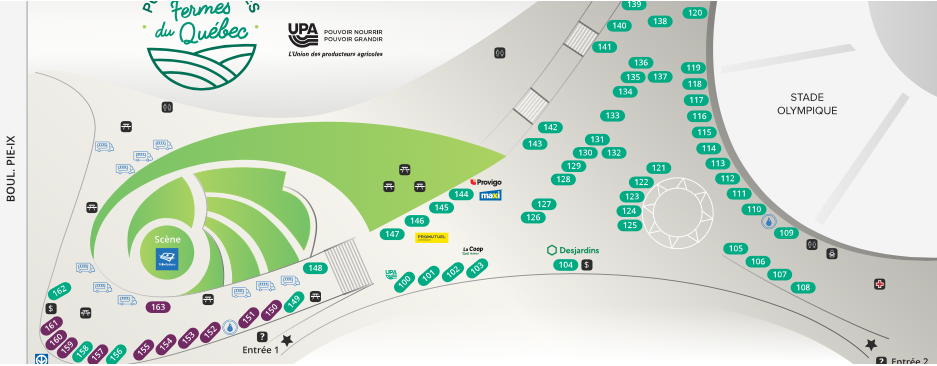
J’y ai découvert quelques nouveaux produits intéressants comme la bière bio artisanale Boldwin, l’huile de Caméline, les produits de la cidrerie Lacroix, la boutique de produits de laine Merlaine, etc.





[ Translate ]


[ iPhone 8+, 2018-09-04 ]
Caryophyllaceae : Silene [Lychnis] chalcedonica

[ Nikon D3300, Jardin botanique, 2018-06-26 ]

It has been a good festival this year.
There was no scuffle to get the credentials, no problem with the schedule or screenings and an excellent selection of titles.
Of course, it could be better. Apparently they brought back the Movie Market (and the press room?). I heard it was on the third floor of the Imperial, but couldn’t find how to get to it… In the past, they were always the practical places to access press information and to be able to screen video on our own schedule. However, what I really miss is the press conferences where we could have direct access to the film crew and cast of the movies in competition. Beside that, for me, the festival is already all I needs it to be.
As long as there’s good movies to watch, people should be happy. At least, as long as there’s Japanese movies, I’ll be happy. Although, come to think of it, the festival deserves a bigger audience. In the past, I used to see lots of people from the local Japanese community, but I saw very few of them this year. Most of the movie I’ve screened this year had barely an audience of a dozen people! Of course, there was absolutely no advertising this year and very little media coverage, so it certainly didn’t helped. And the last couple of years have had a fair share of scheduling and screening problems which might also have discouraged people from attending this year. If there is a festival next year (the same question come back every year lately), this really must be improved.
Another needed improvement, beside more advertising, would be more screens. The festival could use at least a couple more rooms of the Quartier Latin (if not the entire floor like in the good old years). However, for that to happen, the festival would need more budget. Not to put on lavish parties, but to make sure that all the movies can be screened at least a couple of times. Why not giving the festival a chance and give it again at least some subsidies?
The festival certainly has its share of detractors. People who don’t think it can improve or who want to see something else in its stead. Strangely, most of the criticism seems to come from the anglophone community (for example, the articles in The Gazette appears to be quite hostile). However, I don’t think that the majority of people in or around the local movie industry want the festival to continue in its downward spiral of death. But we don’t want a glamorous festival like Cannes or Toronto either (yeah, it’s nice to see Brad Pitt or the latest blockbuster with its load of stars, but what’s the use if that movie is gonna by in all theatres two weeks later?). Personally, I want a festival where I can see movies I couldn’t see anywhere else. Movies from all around the world. A festival that gives their chances to young or unknown directors, to small productions. A festival that doesn’t exclude stars, but that is not built around them. That’s what the festival was in the past and I think this formula can still works. There is no other festival like this one. And we can still mend its wounds. We must. Of course, every parties will need to water down its position a little. The government (local, provincial or federal) must look past previous disagreements and accept to provide a little help. And Losique needs to let go of his creation and prepare some sort of succession. Pass on the mantle while still remaining in the background to provide his knowledge and wisdom. If he doesn’t do that, the festival will surely die with him… We’ve seen a little improvement this year, so let’s hope it can continue in that direction…
All in all, this year, I’ve succeeded to watch five of the eight Japanese movies. I am pretty happy with this score. The selection included a great variety: a samurai movie, a docudrama-style movie, a comedy, a yakuza movie and a biopic — I wish I could have added to my score card the documentary, the action movie and the scary co-production! And almost all the titles I’ve seen were good movies — save one which was a disappointment. Beside this last entry, I was able to write seven articles (including five movie comments) about the festival (which represents more articles than La Presse, Le Devoir or The Gazette each wrote about the FFM !).


Your can also check the review of the Japanese movies at the FFM by Claude R. Blouin (in French: “FFM 2018: Cinq témoins japonais de la condition humaine” on Shomingeki.org)
[ Traduire ]
 In a dystopian future (Is it? It realistically could be just our future or it could be a “trumpian” future), the reality is too tough to take and people are looking to forget their troubles. What was originally created as a virtual reality game become the perfect source of escapism for the people. In virtual reality they can be whoever or whatever they want! It is based on the novel by Ernest Cline.
This is a typical fantasy story where the hero (with a group of companions) must find an artifact to save the world from an evil overlord (or a nefarious corporation plotting to control the world). The only difference is that, this time, the artifact is a legendary Easter Egg in a virtual reality video game. It is also a quest to find the heir to the Halliday’s fortune and ownership of the entire virtual world, known as OASIS (Ontologically Anthropocentric Sensory Immersive Simulation). The movie improves on the book by providing a great visual: the part inside the virtual reality (60% of the movie) was created with motion capture CGI. It is certainly not very original, but it’s brilliantly written and well orchestrated.
For me, what makes the movie interesting is that it’s a treasure trove of popular culture references (mostly related to movies and video games) from the 80s (including a few anime like Akira, Dragon Ball, Godzilla, or Gundam !) that plays on the nostalgia of a long gone era. In that aspect, it can particularly appeal to two different audiences: those who grew up in that era (the Millenials or Generation Y) or those who grew up hearing stories from their parents and have a glorified impression of the era (the Generation Z or iGen, Centennials). It is so rich in references that you could see the movie a dozen time and still discover new ones!
The movie was well received (with a Rotten Tomatoes critical score of 72% and a slightly better audience score of 78%) and did well at the box office (bringing back in revenue three time its budget of $175 millions). Unfortunately, even if it’s directed by Spielberg, it has the usual flaws of most teenage action movies: it offers an heroic but superficial story (and characters) where the exploding action (full of car races, fights and magic!), a shared cultural trivia, visual overload and an expedited storyline replace the depth and richness that usually make truly excellent movies. However, it remains a great and funny movie that celebrate geek culture. It is entertainment at its best. I enjoyed it immensely and, if you are in the right demographic, you will certainly too.
[ Amazon — Biblio — Google — IMDb — Wikipedia — Youtube ]
[ Traduire ]

Based on the true story of Shoji “Crybaby” Segawa, a talented player of shogi, a Japanese variant of chess. After rising quickly in a shore-kai, an organization that supervises professional shogi status, Shoji fails to fulfill the ironclad requirement of reaching the 4th rank by age 26. With the encouragement of his friends, he sets out to achieve the impossible: to be the first amateur to become a shogi professional. (FFM)
WARNING: May contain traces of spoilers! People allergic to the discussion of any plot’s elements before seeing a movie are strongly advised to take the necessary precautions for their safety and should avoid reading further.
This is a great feel-good movie based on the autobiographical book about the incredible career of Shoji Segawa, a Shōgi player. Shōgi (将棋 / “The game of generals”) is a Japanese strategy board game very similar to chess (as you have a king, surrounded by his gold generals, his silver generals, rook and bishop, knights, lances and finally pawns pieces). We often see this type of “sport competition” story (where sport is often replaced by any possible type of occupation) in manga or anime (the best similar example is Hikaru no Go manga by Yumi Hotta & Takeshi Obata, which is about Go, but there are plenty of manga about shōgi like March Comes in Like a Lion) but it is rare to see this type of story in a live-action movie.
The movie has a strong cast of stars, so it is not surprising that the acting is quite good (although I’ve notice poor performances in the case of some minor characters). The photography is good enough (it’s not always optimum, but I guess it’s due to the attempt to give the picture a look of the 70s or 80s). The storytelling is, however, excellent considering that it is not easy to make such a subject interesting and to keep the attention of the audience while showing two guys sweating over a board game! The upbeat music and some comedic devices are very helpful for that.
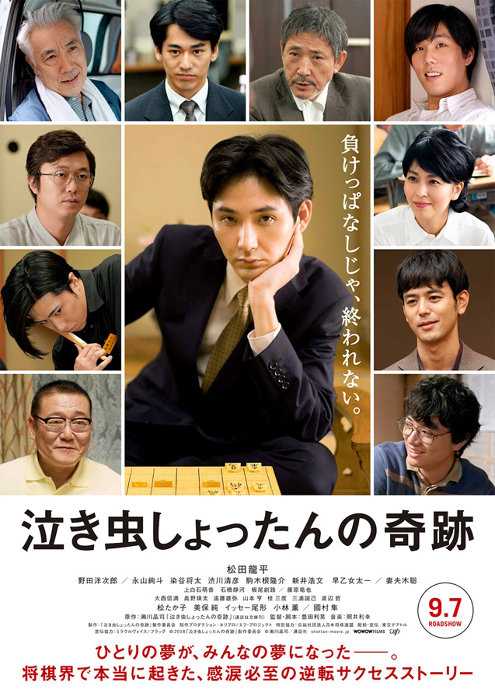
Shoji Segawa (nicknamed Shottan) is a shy, introverted boy who has been interested in playing shōgi since elementary school. Encouraged by his school teacher and his father (Jun Kunimura), he improves his skill playing against his neighbour Yuya. They both go to a shōgi dojo where they are tutored by the local master (Issey Ogata). He is known for sometime crying after a game (hence the other nickname of “crybaby”). Learning that you can become a paid professional player of shōgi, Shottan (Ryuhei Matsuda) decide to apply to the shore-kai (the Japan shōgi Association’s apprentice school) but he doesn’t give his all and fails to reach the 4-dan level by age 26. A good part of the movie is dedicated to showing him agonizing over his chance of success (despite being a little overconfident) and over his failures. He finds himself in his late 20s, with no high school diploma, no job and becomes depressed. He eventually finds a salaryman job, but keeps playing shōgi for pleasure. He becomes quite skilled as an amateur player and, eventually in his 30s, gets some fame as the amateur who keep beating professionals (a miracle record of 17 wins and 5 losses!). He then starts fighting for the JSA to give him a second chance at becoming professional…
Strangely, nowhere in the movie they talk about the rules or strategy of the shōgi game. I guess, if the movie is solely aimed at a domestic Japanese audience, they assume that everyone know them. Anyway, the knowledge of the game is totally irrelevant to the story. The movie is more about fighting for your dream, learning the discipline (not being too distracted) and to play for the right reasons (not to win but just for the pleasure of it). It is interesting to note that the director, Toshiaki Toyoda, attempted himself to become a professional player when he was younger.
All in all, The Miracle of Crybaby Shottan is an upbeat biopic that provide a very good entertainment. Well worth watching.
The Miracle of Crybaby Shottan (泣き虫しょったんの奇跡 / Nakimushi Shottan no Kiseki): Japan, 2018, 127 mins; Dir./Scr.: Toshiaki Toyoda (based on the autobiographical novel of Shoji Segawa); Phot.: Norimichi Kasamatsu, Kôji Naoi; Ed.: Masaki Murakami; Prod.: Ryo Otaki, Kyôichi Mori; Cast: Ryûhei Matsuda (Shoji), Yôjirô Noda (Yuya), Shota Sometani, Kento Nagayama, Satoshi Tsumabuki, Kiyohiko Shibukawa, Ryusuke Komakine, Hirofumi Arai, Takako Matsu, Issey Ogata, Kaoru Kobayashi, Jun Miho, Jun Kunimura.
Screened at the Cineplex Quartier Latin 13 (Thu. 8/30 at 21:30) as part of the “Focus on World Cinema” program of the 42nd Montreal World Film Festival. There was a little more than half-a-dozen people in the theatre.
[ AsianWiki / IMDb / Official / Youtube ]
[ Traduire ]

[ Nikon D3300, Jardin botanique, 2018-06-26 ]
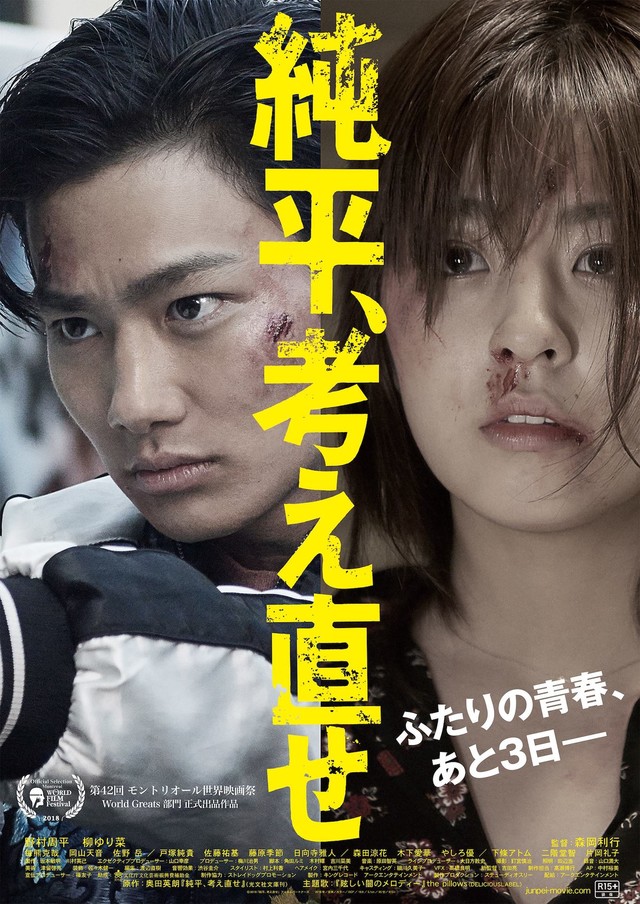
Junpei, 21, is a lower-ranking yakuza. One day, his boss assigns him the mission to kill a high-ranking yakuza of a rival group. Junpei, who wants to be recognized by his clan, agrees. Junpei meets OL Kana and they spend the night together. He evokes with her the task that awaits her, and she is both worried and excited. She stays with him for three days until he carries out his mission. (FFM)
WARNING: May contain traces of spoilers! People allergic to the discussion of any plot’s elements before seeing a movie are strongly advised to take the necessary precautions for their safety and should avoid reading further.
This is a good movie for the younger crowd. It’s a yakuza movie with an existentialist tone. I don’t have anything bad to say on this movie: the photography is nice and clean, the acting is good, the storytelling fluid, the music is catchy and support well the story. However, I feel that there is something missing. It has all the looks of a feel-good movie and yet it ends badly for the main character (not surprising in a yakuza movie after all).
Junpei is a young wanna-be yakuza. He worships his aniki (“big brother”) and would do anything for him. However, he has a good nature, too good for him, as he likes to help people and has strong principles. In order to help a friend who has been wronged by a real-estate agency, he pays them a visit and play the tough yakuza. Unfortunately, the place is ran by a rival group. This initiative probably displeased his big boss because, not long after, he is asked to make a hit against a rival boss with little chance of survival. He is given money and told to enjoy himself for the three days before the scheduled hit.
A young woman working at the real-estate agency, Kana, noticed him and is impressed by his guts and looks. They hook up, make love — and fall in love. He goes back to his hometown to see his mother, they help a homeless man, etc. During all that time, Kana is tweeting (or using some equivalent app) their every moves, they every mood, and the tweetosphere is reacting, pondering weather killing people is bad (who still order hits on their competition, anyway?), how romantic they are, that they should forget the hit and elope, will Junpei survives the hit, etc. They plan to leave for a tropical island after it. Junpei goes ahead with the plan, because he is too loyal to avoid his responsibilities, even if he was told that his boss was using him to get promoted…
However, the boy Junpei is now a man. A good man who does the right thing (for a yakuza). He loves a woman. He takes his own decision. He has nothing to regret. In three days he has lived a whole life, more than many could boast for their entire existence. What is to live, but to live fully? And yet it feels sad. What a waste, some could say. But a yakuza’s story has an inescapable end. Is there a point to all of this?
I really enjoyed this philosophical yakuza movie. It’s both entertaining and food for thoughts, particularly for the younger generation who still have a life to live! It is well worth watching.
Think Again, Junpei (純平、考え直せ / Junpei, Kangae Naose): Japan, 2018, 95 mins; Dir.: Toshiyuki Morioka; Scr.: Rumi Kakuta, Teru Kimura, Nami Kikkawa (based on a novel by Hideo Okuda); Phot: Shinji Kugimiya; Ed.: Naoki Watanabe; Prod.: Yukihiko Yamaguchi, Haruo Umekawa; Cast: Kisetsu Fujiwara, Shuhei Nomura, Yurina Yanagi, Reiko Kataoka, Manaka Kinoshita, Katsuya Maiguma, Suzuka Morita.
Screened at the Cinema Imperial (Thu. 8/30 at 16:30) as part of the “World Great” (Out of Competition) program of the 42nd Montreal World Film Festival. There was a little more than a dozen people in the theatre (but I was told that there was about fifty people in the previous day’s screening).
[ AsianWiki / IMDb / Official / Youtube ]
[ Traduire ]
Sometimes, when I start writing a comment on a book or a movie, I have no idea what I will be writing. It just comes along, one idea bringing the next and the whole comment is slowly taking form. Sometime, I have a pretty clear idea of what I want to say and I have to make a plan, a structure, detailing the basic elements of each idea or concept I want to cover in order not to loose the tread of my thoughts (which happens sometime if I wait too long before putting it down on paper or on the computer).
I don’t have a good memory, I usually don’t remember much about a book I’ve just read or a movie I’ve just watched after a little while. When I want to remember, I just read what I’ve written about it. In fact, that’s one of the reason I write.
Sometime, when I don’t know what to say about a book or a movie, I just sleep over it and it usually helps a lot. But I must not wait too long to write after that. If not I might just end up with some sketchy notes and not much substance…
[ Traduire ]
 I am not a big fan of horror movies but I like Helen Mirren. So I watched the movie with the expectation that I would not like it. It is not a bad movie after all. Not a great movie, but a good entertainment nonetheless.
The heiress (Helen Mirren) of the Winchester Repeating Arms Co is cursed and haunted by the spirits of all the people killed with a Winchester rifle. To appease their spirits and help them moving on she built for each of them a replica of the room where they were killed so her mansion is in constant construction, resulting in a huge building that doesn’t make much sense. The board of the company think she’s crazy and hires a doctor (Jason Clarke) to evaluate her mental state. He was himself widowed and almost killed in an incident involving a Winchester rifle and became addicted to laudanum as a result. Of course, the moment of his arrival at the mansion coincide with the appearance of an evil and vengeful spirit seeking pay back on the Winchester family! Will the rational mind of the doctor let himself be convinced and help fight against the murderous supernatural forces at play? Or is it all the result of the convergence of natural events and the power of suggestion of their own minds?
It is quite an interesting take on the legend of the Winchester mansion and of Sarah Winchester. I also like the way they used other events of the era to add to the story, so it is really based on “real” events. After all, the mansion is well known for being the most haunted building in America. The storytelling is good and managed to follow the Todorov definition of the fantastic genre (if the characters seem to believe in the supernatural aspects, at least the viewers are well aware of the possible rational explanations for them). The acting is respectable, and the visuals are good considering that this is a very low budget production (shot in Australia for $3.5 million). So it is nothing to get excited about (besides the cheap scary tactics), but it is still worth watching. Although the reception was not very good (the critics’ score on Rotten Tomatoes was 14%, with an audience score of 35%) the movie still managed to make over ten times its production cost at the box office!
[ Amazon — Biblio — Google — IMDb — Official — Wikipedia — Youtube ]
[ Traduire ]
Probably Cultivar Ladybird series yellow & orange


[ Nikon D3300 / iPhone 8+, Jardin botanique/home garden, 2018/06/26 & 07/05]
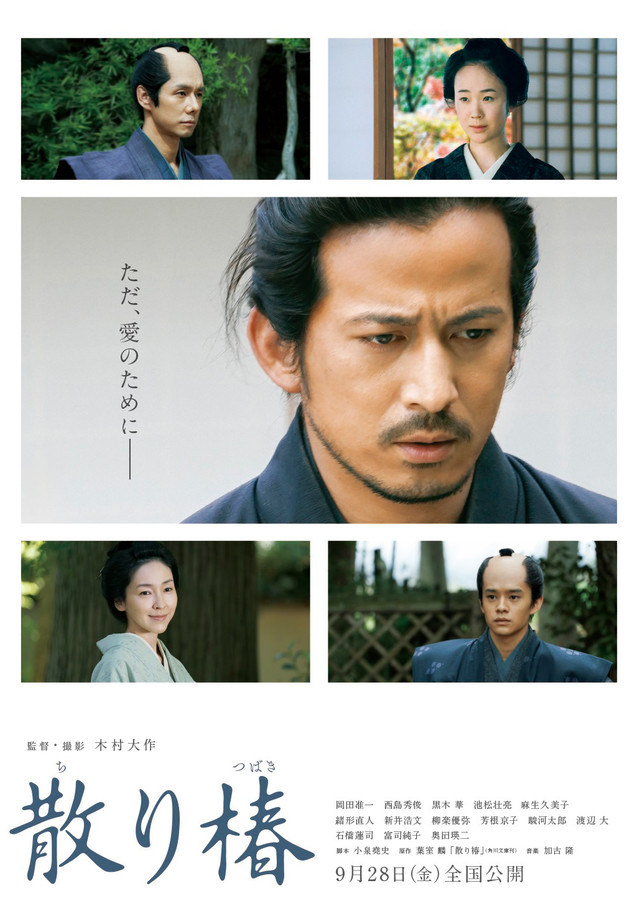
Shinbei is exiled from his clan for investigating its activities too closely. Eight years later, when Shinbei’s dying wife pleads with him to go to help his former best friend, Umeme, he returns to the clan. Infighting has produced turmoil within the clan, allowing Shinbei to discover the truth behind incidents involving his wife and his friend. Confronting Umeme, he understands the reason for his wife’s last wish. (FFM)
This is a very good movie. Its most noticeable aspect is that it offers an excellent photography (which is not surprising since director Kimura acted as his own photography director, a job he has hold many times for other directors like Kinji Fukasaku, Yasuo Furuhata, or Shin’ichirô Sawai). He made great use of the superb location in the Toyama Prefecture (anciently the Etchû province) showing as backdrop the fantastic landscape of the Hida mountains in the Northern Japanese Alps.
Another aspect that I quickly noticed was that the music was unfortunately very annoying. They used a soundtrack of classical music (which first accords sounded like The Godfather’s music by Nino Rota), playing it again and again recurrently. I think that, for a jidaigeki (samurai movie), a soundtrack of traditional Japanese music would have been better…
Shinbei (Jun’ichi Okada) is exiled from the clan after denouncing as corrupt a high-ranking officer of the clan — who is later mysteriously murdered leaving all the suspicion of culpability on Shinbei. Both Shinbei and his friend Uneme (Hidetoshi Nishijima) were courting Shino (Kumido Aso), but when Uneme’s family denies him the permission to wed Shino, she goes with Shinbei instead. The harsh condition of their exile put a toll on Shino’s health who eventually dies. She makes Shinbei promise to continue living, to go back to their village to observe the camellia falling in spring and to reconcile and help Uneme. When he tries to clear his name and find out the real assassin, he gets entangled in the complex politics of the clan…
Samurai’s Promise is a beautiful and interesting samurai movie. It has a smooth storytelling, although it is sometimes difficult (at the beginning) to understand who’s who and figure out all the plots and politics at play. The acting is good, and particularly the nice realistic combat scenes. It must not have been easy considering the fact that there was many fights in the rain or snow and that the dialogues were using an old form of Japanese.
Of course, we should expect nothing less from such a veteran director. During his sixty-year career, Daisaku Kimura worked on over fifty films and won many awards. He started his career as camera assistant on Akira Kurosawa’s Hidden Fortress (1958). He worked five years with him (on movies like Yojimbo and Sanjuro) and he learned a lot during this time. Eventually, he cames to direct his own movies (Mt. Tsurugidake in 2009 and Climbing to Spring in 2014), mostly about mountain climbing. Samurai’s promise is his first jidaigeki and he made it as a tribute to Kurosawa. It is a beautiful and authentic movie, well worth watching. These days we don’t see much movies like this…
Samurai’s Promise (散り椿 / Chiri Tsubaki / lit. “Falling Camellia”): Japan, 2018, 111 mins; Dir./Phot.: Daisaku Kimura; Scr.: Takashi Koizumi (based on the novel by Rin Hamuro); Ed.: Tomoni Kikuchi; Mus.: Takashi Kako; Prod.: Yoshihiro Sato. Cast: Jun’ichi Okada, Hidetoshi Nishijima, Haru Kuroki, Hirofumi Arai, Kyôko Yoshine, Sosuke Ikematsu, Kumido Aso, Naoto Ogata.
Screened as opening movie (in the “World Competition” program) of the 42nd Montreal World Film Festival (at the Cinema Imperial on Thursday August 23, 2018 at 19:00).
[ AsianWiki / IMDb / Official / Youtube ]
[ Traduire ]
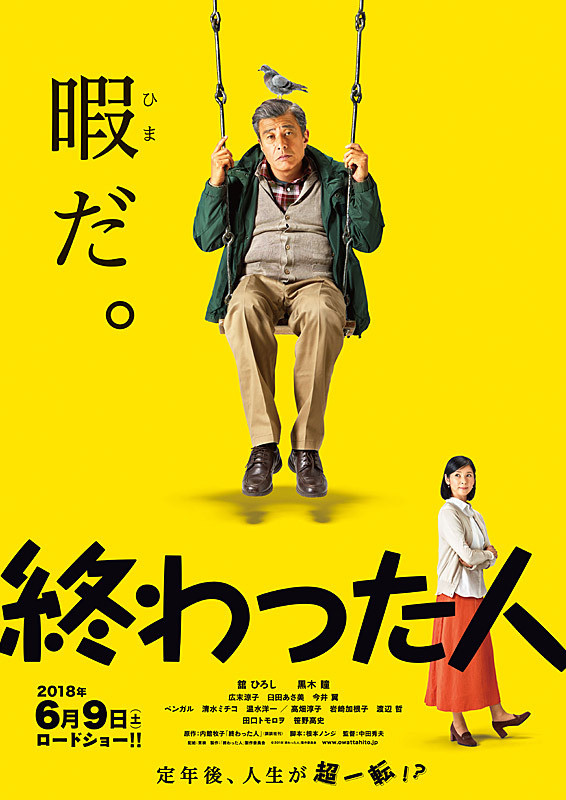
Sosuke Tashiro has a successful career in a large bank until he is transferred – or rather relegated – to a subsidiary until retirement. After decades of dedication to his work, he is lost and idle. He then decides to resume a professional activity, but realizes that the challenge is daunting. Over the course of two meetings, at the gym and at the adult education center, his life is on the move again. (FFM)
This is exactly the type of Japanese movie that I like the most: some sort of family drama that touches us (and often makes us cry) but which, in the end, makes us feel good and laugh. It is so perfectly enjoyable! And the seamless storytelling, the bright, well-framed and beautiful photography, as well as the nice soundtrack (particularly the beautiful song 「あなたはあなたのままでいい」 [Anatawa Anatano Mamadeii / “You can stay as you are”] by Miki Imai) really show the mark of an experienced filmmaker. Strangely, Hideo Nakata is mostly known for his horror movies (Ring, Chaos, Dark Water, Kaidan, etc.) so it is really surprising to see him direct for the first time a more traditional Japanese comedy! This is probably his way to tell us that he is not finished yet and that he can be a polyvalent creator. He does that brilliantly. Unfortunately, he didn’t arrive in time to present the movie and do the Q&A for the first screening at 11:30, and that was a great disappointment for me (I knew I should have gone to the 21:30 screening!). The quality of the production as well as Nakata’s fame makes of Life in Overtime a great contender for the competition. It is surely the best Japanese film I’ve seen at the festival so far this year.
Sosuke studied at the top university in Tokyo and finds himself on the path for an executive position at a large bank, but gets beaten by a rival and ends up finishing his career at a subsidiary branch. He already feels he’s a failure but, when he retires, he finds himself with no hobbies, no dreams, no job and no sympathy at home! What to do? He feels “Retirement is like a premature funeral (…) I don’t want my life to end like this!” It’s like the game is over but you continue to play in overtime in hope to finish on top (I like this idea)!
He tries to find a new purpose in order to make up for his failures. He looks for a new job but his impressive resume torpedoes his efforts. He considers going to graduate school to study literature, makes an attempt at a new romance or, after a chance meeting with the CEO of an IT company, try to start a new career but without any success. However, does it really matter as long as you have a life to enjoy?
Nakata succeeds in giving a realistic depiction of life struggles and relationships while tackling one of the hot topic of the decade: with its aging population, Japanese society has to deal with an ever increasing number of retirees. To keep them mentally and physically fit, it is important to make sure they feel their life is not finished yet and that they can make their experience or expertise valuable and useful to the society. It’s also a challenge on the domestic level as many couples, who never spent lots of time together because they were too busy working, find out that they don’t know much about what to do with each other! Retirement can surely be a shocking change but it is certainly not the end of your life (personally, I know very well that I’ll probably be even busier once I retired — in about 3192 days!). However, for some people, not knowing what to do or not feeling useful anymore can be an horrific experience and, in that aspect, maybe this is an horror movie after all…
Life in overtime, with its sadness and joy as well as its beautiful scenery, gives us plenty to ponder and an excellent movie experience. It is certainly a must see.
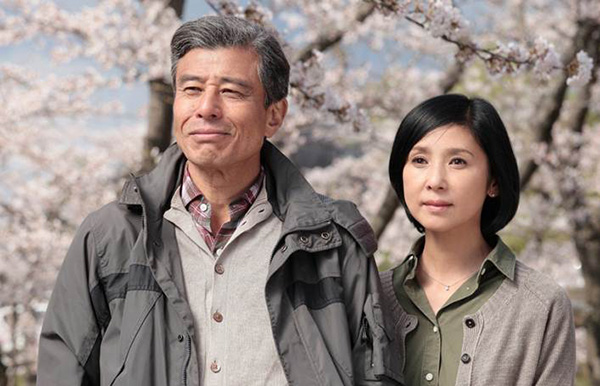
Life in Overtime (終わった人 / Owatta Hito / lit. “A finished man”): Japan, 2018, 125 mins; Dir.: Hideo Nakata; Scr.: Nonji Remoto (Based on the novel by Makiko Uchidate); Phot.: Koichi Saito; Prod.: Masatake Kondo; Cast: Hiroshi Tachi (Sosuke), Hitomi Kuroki (Chigusa), Ryoko Hirosue (Kuri), Asami Usuda (Michiko), Tomorowo Taguchi (Toshihiko), Tsubasa Imai.
Screened at the Cinema Imperial (Sun. 08/26 at 11:30) as part of the “World Competition” program of the 42nd Montreal World Film Festival.
[ AsianWiki / IMDb / Official / Toei / Youtube ]
[ Traduire ]
On October 1st the population of Quebec will have to vote to put their favourite candidates in the National Assembly. I find myself in quite an electoral conundrum since the lack of leadership makes it impossible to find anyone worth of my support. Every party has good ideas, but also so many stupid ones. I began this reflection when my union started a campaign advocating not voting for either the Liberals or the CAQ because “they are all the same” and that “we deserve better”… But if not them, who?
Kindergarten teacher, Chinatsu is always in a state of stress. And it is at this moment that a pupil of her class is murdered. Totally distraught, Chinatsu begins to sink into a world of illusion that she can not control. (FFM)
I don’t know what they have put in the water of that city but all the characters in this movie offer a whole catalog of mental illness: Chinatsu, a kindergarten teacher, cracks under the pressure brought by all those helicopter parents and develops schizophrenia; her acupuncture doctor, Yuichi, suffers from Capgras syndrome; Naoto, a salesman bullied by his seniors, has nomophobia; Akamatsu, the convenience store clerk, suffers from Asperger; Mitsuki, Haruka’s mother, suffer from Munchausen syndrome, etc. I guess it was the purpose of the director to show with this docudrama-style movie what it is to have such illness and how difficult it can be for the families.
It is a very dark movie and the end result is, unfortunately, barely average. The storytelling is awkward and not particularly skillful, the photography feels amateurish and the acting is so-so — although, the main actress is very charming and switching the actors who plays the two Yuichi toward the end of the movie in order to unexpectedly show the schizophrenia of Chinatsu is, I must say, quite brilliant. Also, the movie is really not well served by the poor translation (in the subtitles). When I noticed two typos in the very first sentence of the movie, I knew that this would spell trouble! (unless they made it on purpose to make us feel crazy!) If it was not already obvious with the production quality, the horrible translation really smelled of tiny budget…
Finally, to really give a last pathetic impression, the absence of a translator for the Q&A at the end of the presentation (due to the minimalistic ressources of the festival this year — what? they couldn’t even find a volunteer to take up the task?) left the poor director and main actress at the mercy of their basic English language skills and made for such a laughable exchange that you could only feel sorry for them.
However, undertaking such a difficult and serious subject requires some strength. I understand what the director was trying to achieve and I greatly appreciate his efforts (for that I give him extra points!). In a society that was repressed for so long, where you find a real epidemic of bullying (both at school and at the work place, including sexual harassment) and where an aging population is plagued by various forms of dementia, it is really not surprising to find that mental illness has become a great challenge in Japan today. Kudos to the director for trying to bring attention to this problem.
Zone Out / Regarder dans le vide (アウトゾーン / Out Zone): Japan, 2017, 115 mins; Dir.: Hiroshi Kanno; Scr.: Mari Takanashi; Phot.: Makoto Hayashi; Ed.: Aya Mitsuaka; Light.: Sousuke Yoshikado; Sound: Kazuyuki Tutiya; Mus.: Magumi Masui; Cast: Minami Matsunaka (Chinatsu), Masato Oki (Yuichi Akino), Kyoko Toyama (Kyoko), Gen Kuwayama (Naoto), Yusuke Ueda (Akamatsu), Yusuke Sugiyama (Yuichi Kagawa), Ben Hori (Hisashi Aoyama).
Screened at the Cinema Imperial (Sat. 8/25 at 16:30) as part of the “World Great” program (out of competition) of the 42nd Montreal World Film Festival.
[ IMDb ]


[ Traduire ]


[Nikon D3300, Botanical garden, 2018-06-26 ]
 Not long after the end of WW2, Juliet (Lily James) receives a letter from a pig farmer in Guernsey (who’s a member of a local literary club) asking her for the address a good bookstore in London. He got her address from inside a used book she sold before the war and which somehow had made its way to this island near the coast of France. She send him one book for free at the condition that he answers three questions to explain the name of their literary club and the circumstances of its creation. The tale of their ordeal under German occupation intrigues her, therefore, being a writer herself, she invites herself for a reading at their club to make some research in preparation for a newspaper article she was asked to write. Upon arrival she notices that the founder of the club, Elisabeth (Jessica Brown Findlay), is mysteriously absent and the club members seem very secretive about her circumstances. She starts asking questions around and her enquiry will unravel a painful past and make her fall in love with the island. It’s interesting how books can touch people and change their lives forever!
Of course, it is not a perfect movie as you find, for example, many stereotypical characters (like the self-centred and possessive American, the nationalist mean informer, the nosy and religious lodger, etc.). However, it remains a very beautiful movie, that offers a well-written and touching story about the hardship of war — a time when friendship and compassionate sentiments can be quite dangerous! It’s based on the novel by Mary Ann Shaffer and Annie Barrows. Interestingly, since nowadays Guernsey is too touristy, the movie was shot in North Devon with a cast in good part made of actors from Downton Abbey (Lily James, Jessica Brown Findlay, Matthew Goode, Penelope Wilton)! It is also noteworthy that the movie is distributed by Netflix as one of its original films (that’s where I watched it). All in all, it’s quite entertaining (critical response of 81% on Rotten Tomatoes) and an excellent movie experience.
[ Biblio — IMDb — Netflix — Wikipedia ]
[ Traduire ]
Orange cat with a butterfly and poppies in the countryside
Chat orange avec un papillon et des pavots à la campagne

© 2018 Miyako Matsuda
See more of Miyako’s art in this Flickr album
Voir d’autres peintures par Miyako sur cet album Flickr
This year the Festival des Films du Monde (FFM or MWFF, Montreal World Film Festival) strangely seems slightly more organized (at least for the accreditation) than the previous couples of years. They are probably getting used to extreme austerity and benefits from plenty of movie aficionado volunteers. Also, there’s more Japanese movies than last year (but still less than the usual dozen). Unfortunately, since there are only four screens (Cinéma Impérial and Quartier Latin 10, 12 & 13) to show ALL movies, they are shown only once (twice for the titles in competition) and mostly in the afternoon — which is not compatible with my own schedule, so I’ll probably end up viewing only half of the Japanese movies. Too bad, but that’s better than nothing!
However, I was happy that the title selected as opening film was one of the Japanese movies: Samurai’s Promise. No one from the cast or crew was present for the opening ceremony, although there was plenty of actors & actresses from other Japanese and Chinese movies (as well as local dignitaries) parading on the red carpet.


The only speech was given by the president of the festival, Serge Losique. He seemed tired, but still defiant (although slightly apologetic):
“The festival is a great cathedral open to all. Our role was not to imitate whoever but to be ourselves, to be authentic. (…) Our role was also to helped small unknown countries, like Cape Verde or Sri Lanka [to promote their films]. All we want is for the public, and the journalists, to appreciate the films.”
He continues saying he doesn’t want the glamour of the other festivals but only to showcase the diversity of the world cinema. That’s why it is the “Festival des Films du Monde” [also a word-play in French meaning the festival of the people]. People are asking for stars, he says, but the stars here are the films. He also argues that the directors and actors who come to Montreal are stars in their own countries, and many more have been discovered here, at the festival, and are now stars! [I might add that I’ve seen plenty of great stars at the FFM over the years: Catherine Deneuve, Sofia Loren, Jackie Chan, Robert de Niro, Tony Curtis, Mamoru Oshii, etc.]
He also announces the new policy for the festival to chose as president of the jury a director that has previously won the Grand Prix of the Americas. Also the jury members will not necessarily be present at the festival but will screen the titles in competition via video link (although the president of the jury will always be present in Montreal). He introduces the members of this year’s jury (critic Élie Castiel, Pierre-Henri Deleau, an executive from China Film Group Corporation and another jury whose name will be revealed at the end of the festival) as well as its president, Silvio Caiozzi [Chilean director, winner of last year’s Grand Prix des Amériques], who also said a few words:
“From the beginning this festival always chose nothing but films of cinematographic excellence. Nowadays, I can feel that around the world somehow (…) [in the movie industry] the true quality of films is not looked upon, really. What they look upon is (…) what film has the big budget (…) or the politics (…) but not really the quality of the films. So, really, honestly, (…) in my opinion this is perhaps the only festival that still remains absolutely independant.”
(I understand what Serge Losique is saying here. He is trying to explain and justify his position. The festival is his life-work, his baby, and he doesn’t want to relinquish its control. Indeed, if you accept public money you have to show transparency and do things the way the government wants them to be done… Unfortunately, if he doesn’t step down, pass the mantle to someone else soon (while maybe remaining on board as advisor), the festival will die with him…)
The theatre was not full, like we’ve seen for previous years, but considering the situation, it was full enough (maybe half?). Surprisingly, there was not that many people from the local Japanese community.
It was a short ceremony, a good movie (see my separate comment), the weather was nice, Radio-Canada / CBC was there to report on the event so, all in all, it was a good day for the festival.
[ Traduire ]
Geraniaceae : Geranium sanguineum : “Elke”

[ Nikon D3300, Jardin botanique, 2018-06-26 ]
Strangely, the more touched I am by a book or a movie, the more difficult it is to write about it. It seems easier to write about something I didn’t like so much… Maybe I am so overwhelmed that I just can’t organize the zillion things that I want to say. Or maybe I am just afraid to mess up something that I really like. I don’t know. I just find this strange…
[ Traduire ]
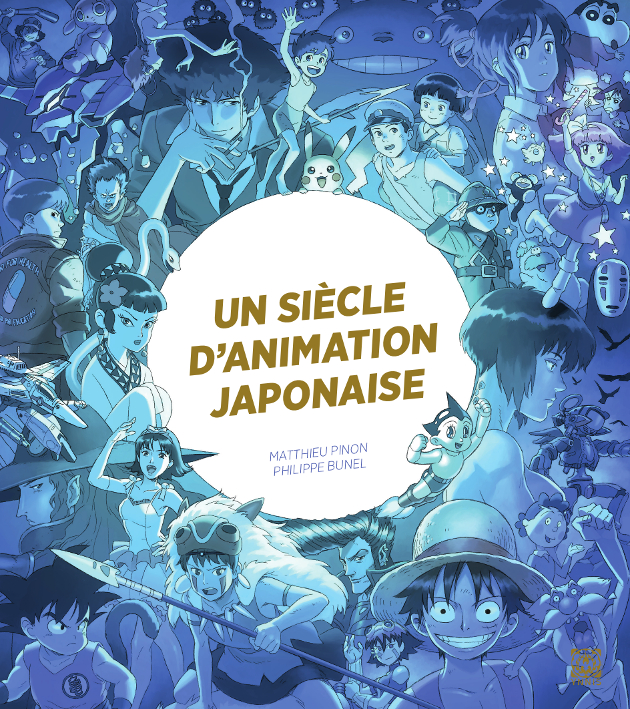
En 2017, l’animation japonaise est plus que jamais un rouage essentiel de la pop culture mondiale. Studios hollywoodiens historiques ou diffuseurs modernes nés avec Internet, les géants du divertissement investissent dans ce média dont les spécificités graphiques ont été adoptées par plusieurs générations de spectateurs.
À la fois composante et reflet de sa culture nationale, l’animation japonaise trouve pourtant sa source dans les expérimentations cinématographiques occidentales de la fin du XIXe siècle. En remontant à ses origines, Un siècle d’animation japonaise parcourt les évolutions marquantes vécues tant par les créateurs que par le public de ce média jusqu’à nos jours.
Avancées technologiques, prolifération des genres, mutations économiques, oeuvres et artistes majeurs, triomphes et débâcles, consécration mondiale publique et critique… Découvrez comment, en cent ans, une terre inexplorée est devenue un eldorado économico-culturel dont les ressources semblent aujourd’hui s’amenuiser. Accessible aux néophytes comme aux passionnés, Un siècle d’animation japonaise vous propose de revivre cette aventure afin de mieux comprendre un média définitivement ancré dans notre quotidien.
(Texte du site de l’éditeur; voir aussi la couverture arrière)
J’avais brièvement parlé de cet ouvrage en janvier et je viens tout juste de mettre la main dessus (en bibliothèque — car je n’en possède malheureusement pas de copie puisque mes demandes de service de presse sont restées sans réponse et que, comme je n’écris plus vraiment sur l’anime, je ne peu pas justifier de dépenser $50 pour un bouquin de référence aussi utile soit-il). Pas besoins de le consulter longtemps pour réaliser que c’est un excellent ouvrage. Je dirais même qu’il est essentiel pour tout amateur d’anime qui se respecte car il existe peu de références qui traitent de l’histoire de l’animation japonaise (surtout en français). Avec cet ouvrage, Animeland célèbre un siècle d’animation Japonaise…
L’ouvrage est divisé en quatre grandes périodes historiques:
Comme tout ouvrage de référence qui se respecte, ce livre se termine avec un glossaire, un index des noms propres mentionnés (étrangement non paginé!) et une (trop) courte bibliographie.
C’est un ouvrage bien écrit, agréable à l’oeil, amplement illustré et très informatif. Il n’est pas rébarbatif pour les néophytes mais reste suffisamment détaillé pour intéresser aussi les amateurs endurcis. Personnellement, j’ai trouvé trois aspects particulièrement intéressants dans Un Siècle d’Animation Japonaise: 1) le premier chapitre, car il y a peu de documentation sur les débuts de l’animation Japonaise; 2) le dernier chapitre, car cela fait longtemps que je suis plutôt déconnecté du sujet et c’est intéressant de lire sur ce qui s’est produit dans la dernière décennie; 3) les auteurs nous présentent, “à la fin de chaque période (…), une sélection récapitulative de douze oeuvres synthétisant les tendances majeures de l’époque” qui peut servir de recommendation pour ceux qui se demandent quels anime valent la peine d’être visionné.
Finalement, un dernier aspect m’a fait grandement apprécié Un Siècle d’Animation Japonaise: j’ai eu le privilège de vraiment vivre l’aventure de l’anime à une époque où le medium était à son sommet (de la fin des années ’80 au début des années 2000) et cet ouvrage a réveillé en moi la douce nostalgie de cette période dorée. Ah!, la joie de découvrir des anime comme Macross, Megazone 23 Part 2, Area 88, Bubblegum Crisis, Ranma 1/2, Orange Road, Nausicaä, Laputa, Grave of the Fireflies, Wings of Honneamise, Akira, Nadia, Windaria, Record of Lodoss War, Patlabor, Porco Rosso, Whisper of the Heart, Gunbuster, Neon Genesis Evangelion, Ghost in the Shell, Vision of Escaflowne, Cowboy Bebop… Je dois bien avouer que ce temps-là me manque. J’en ai un peu revécu l’excitation récemment quand j’ai visionné Your Name. de Makoto Shinkai. Oui, quelle belle nostalgie… Mais cette époque semble bien révolue. Si par le passé l’anime a eut un impact culturel sur l’ensemble de la planète, je ne vois plus beaucoup d’animation nippone qui soit suffisamment originale et innovatrice pour m’impressionner… À moins que que soit parce que je suis devenu plus exigeant et difficile.


En conclusion, si l’animation Japonaise vous intéresse moindrement, c’est un ouvrage essentiel à lire (en bibliothèque) ou a conserver sur votre étagère de référence (si vous en avez les moyens).
Un siècle d’animation Japonaise, par Matthieu Pinon et Philippe Bunel. Paris: Ynnis Éditions, novembre 2017. 208 pages, 24 x 27 cm, 29,90€ / $49.95 Can. ISBN 9791093376806. Pour lectorat tout public.
Pour en savoir plus vous pouvez consulter les sites suivants:
[ Amazon — Biblio — Goodreads — Google — WorldCat ]
© 2017, Ynnis Éditions.
[ Translate ]
At the library where I work we have a small to medium size collection of manga but only in French (very few in English). That’s to be expected since one of the mandates of our library is to foster the learning of French among the city’s (or the province’s) new-comer population. However, since the population we are serving is in majority anglophone, one of the librarians thought that it would be nice to develop a little more our nearly inexistant English manga collection. I am offering a few suggestions…
Most of the manga publishers target their releases toward kids and teenagers (kodomo, shōnen, shōjo) and just a few publishers put out manga really aimed at adults (seinen, josei, gekiga) — and I am not talking here about manga of sensual or erotic nature (LadiComi, yaoi, yuri, etc.).
The more traditional manga are translated and distributed by publishers like:
while the more serious and alternative titles (and unfortunately often less popular) comes from publishers like:
For this list, I avoided titles that we already had in our collection in French and — considering that we already had a few gekiga in French, that seinen or josei are also often targeted at teenagers, and that I think we should support local publishers like Drawn & Quarterly — I tried instead to favour more classical or serious manga (hence a selection of mostly gekiga, including mangaka in the likes of Shigeru Mizuki, Yoshihiro Tatsumi, Osamu Tezuka, or the more recent Jiro Taniguchi). I am indicating in the list if a title is already available in the Montreal Libraries’s network (even if it is only in French or only in one library).
[ Traduire ]
Passeriformes : Icteridae : Agelaius : Agelaius phoeniceus

[ Nikon D3300, Jardin botanique 2018-06-26 ]

© 2018 Miyako Matsuda
See more of Miyako’s art in this Flickr album
Voir d’autres peintures par Miyako sur cet album Flickr

 The 42nd Montreal World Film Festival will be held from August 23rd to September 3rd 2018. So far there is only
 seven eight Japanese films listed in the line-up. We will add more details as they are available.
Of course, the festival has had financial troubles for sometime and run on a very minimal staff, so we shouldn’t expect a smooth operation. It will certainly not be better than last year. But the most important part of the festival is that there is movies to watch. This year it will be the nineteenth year that we are covering this movie festival and we hope that it will recover from this difficult period and prosper for many years to come.
The schedule for the Cinema Imperial (CI) is now available (2018/08/22). And the schedule for the Cinéma Quartier Latin (QL) is now also available (2018/08/23). As for previous years, the closing film will be a mystery title to be screened for free at the Cinema Imperial Monday September 3rd at 18:30.
The FFM just announced the awards for the 42nd Montreal’s World Film Festival and for the 49th Student Film Festival (2018/09/03).
Two Japanese movies won an award: Samurai’s Promise by Daisaku Kimura won for the Special Grand Prix of the Jury (Ex-aequo) and Hiroshi Tachi won the Best Actor award for his role in Life in overtime by Hideo Nakata.
Please, read our comments on the festival:
[ Traduire ]
Here is the Japanese movies line-up (after the jump) :

[ Nikon D3300, Jardin botanique, 2018-06-26 ]
 Like last year, we have visited the Settimana Italiana di Montreal (the Italian Week), festival held all over Montreal (but mostly in Little Italy, on St-Laurent street between St-Zotique and Jean-Talon streets) from August 3rd to 12th.
This year the festival celebrated its 25th Anniversary with many activities: an exhibition of all its promotional posters, a Fiat 500 car exposition, guided tours, a film festival, an opera presentation of Puccini’s “La Bohème”, a parade of the Sbandieratori Borghi e Sestieri Fiorentini (a group of Italian flag-throwers keeping alive the old military flag-waving tradition), and lots of food, musical displays and entertainments. Each local Italian association has a booth to inform about their activities. It was very interesting.
Here is a photo album and a short video (15 mins) as a memento of this year’s festival:


[ Traduire ]
 This is a video showing a wild coyote coming down my street and stopping by the neighbour’s driveway before continuing on its way (toward the Émile-Journault entrance of the Frédéric-Back Park)… It was taken on August 10, 2018, at 22h44. If you think that they are NOT coming into your neighbourhood you are wrong. Keep an eye on your kids and your small pets!
They are here… but it doesn’t means that we cannot coexist with them [PDF in French]. We have to be vigilant (some might have agressive behaviour but, like here, most will avoid human contact). However, I am against the current city policy to kill the urban invaders. After all, aren’t we the one who are destroying their habitat?
[ Traduire ]
Souvenirs de Science-Fiction Québécoise
Manga, jeu vidéo et arts mineurs
A blog about the pursuit of knowledge
A blog about the pursuit of knowledge
Émission littéraire + Suggestions + Confidences
“If you are cold, tea will warm you; if you are too heated, it will cool you; If you are depressed, it will cheer you; If you are excited, it will calm you.” ― William Ewart Gladstone
A blog about the pursuit of knowledge
Book reviews and the occasional ramblings of a book blogger
Moi et les livres... dans cet ordre
Science, réflexion et poésie
Discussion, Resources, Roundtables, & Reviews
A blog about the pursuit of knowledge
A blog about the pursuit of knowledge
A blog about the pursuit of knowledge
 Clodjee's Safe-House