Haikara-San: Here Comes Miss Modern

My wife read an interview of Waki Yamato in Fujin Kōron (a Japanese women’s public opinion magazine) where she was talking about a recent anime adaption of her manga Haikara-san. My wife, who enjoyed the manga when she was a teenager, told me she would like to see this animation. Therefore I obliged.
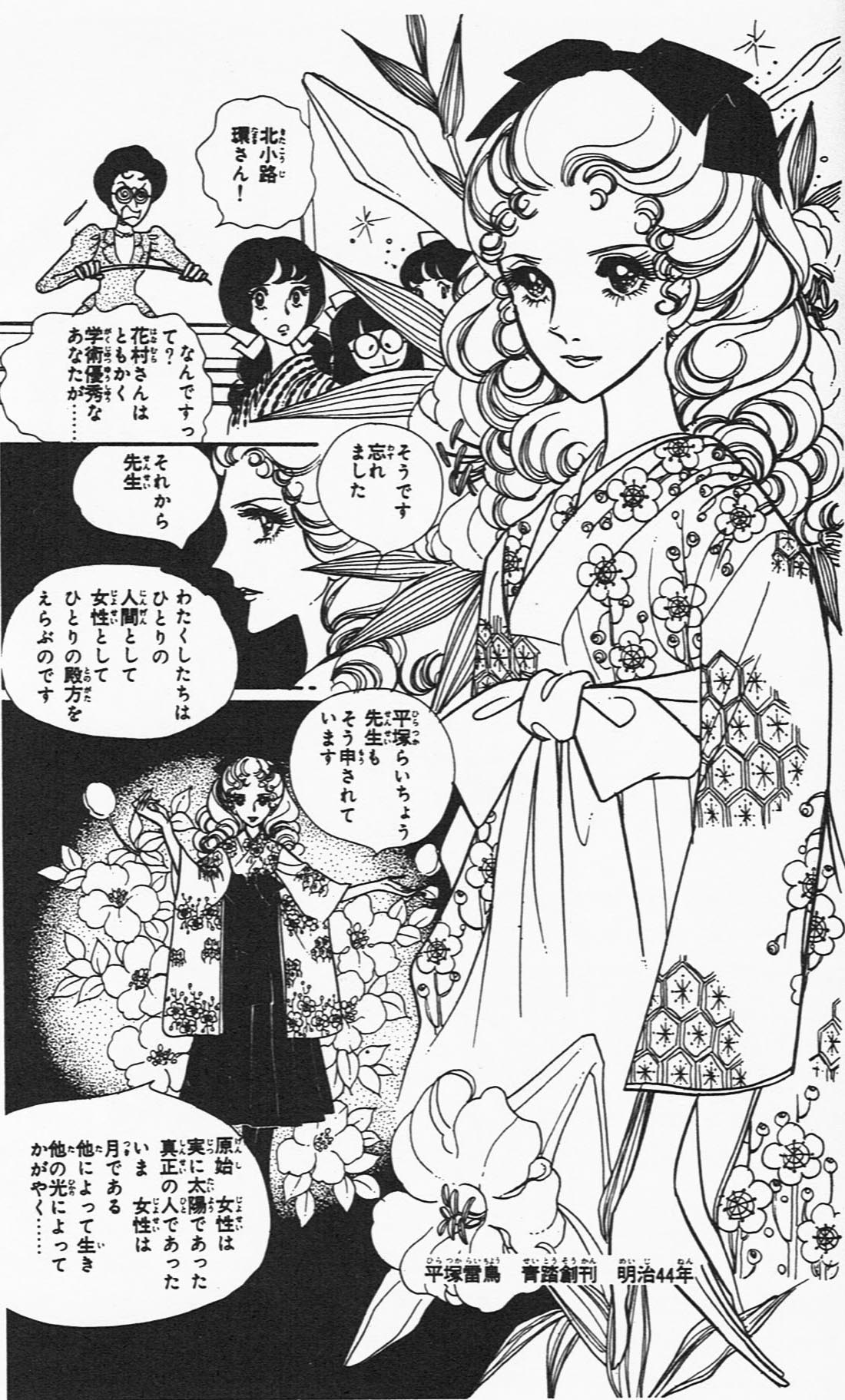
Haikara-san_ga_toru-manga

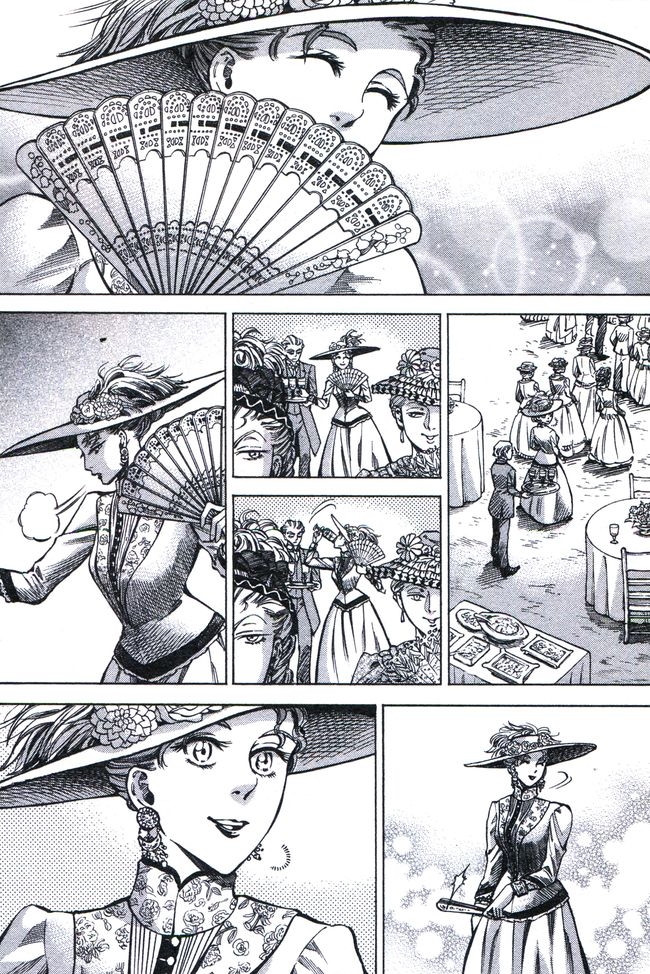
Excerpt from the manga (from Frederik L. Schodt Manga! Manga! The World of Japanese Comics, p. 90).

Haikara-San: Here Comes Miss Modern (はいからさんが通る / Haikara-san ga tōru) is one of those shōjo manga published in the 70s that I wish would be one day translated either in French or English so I could read them. This traditional shōjo style might not be very popular amongst today’s manga reader, but it was beautiful in many ways and their stories were always quite compelling. The manga was serialized in Shōjo Friend between 1975 and 1977 and compiled into 8 volumes by Kodansha. The manga was first adapted into an animated TV series (TV Asahi, 42 eps, 1978-1979), then into several live-action TV movies (on KTV in 1979, on Fuji TV in 1985, by Toei in 1987, and on TBS in 2002) and was even the subject of a Takarazuka revue in 2017. Finally, it was adapted into two anime movies: Gekijōban Haikara-san ga Tōru Zenpen – Benio, Hana no 17-sai  [劇場版 はいからさんが通る 前編 ~紅緒、花の17歳~ / lit. “Theatrical version, Here comes miss modern, first part: Benio, 17 years’ flower”] (November 2017, 97 mins, already available on Blu-ray from The Right Stuf) and Gekijōban Haikara-san ga Tōru Kōhen – Tokyo Dai Roman [劇場版 はいからさんが通る 後編 ~花の東京大ロマン~ / lit. “Theatrical version, Here comes miss modern, second part: Tokyo great romance of flower”] (October 2018, 105 mins). 

[ ¡ WARNING: The following MAY contain traces of spoilers! People allergic to the discussion of any plot’s elements before seeing/reading the story themselves are strongly advised to take the necessary precautions for their safety and should avoid reading further ! ]
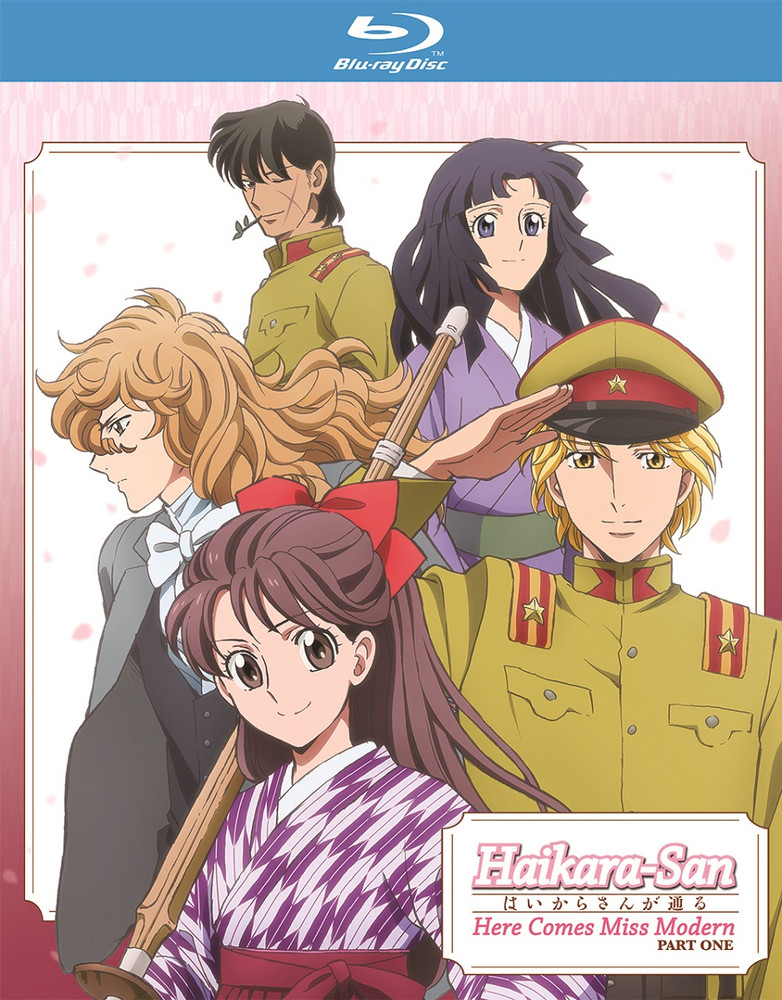
Haikara-San-Movie1-bluRayIn the first movie, we follow the life of 17-year-old Benio Hanamura who was raised by her military father. She is a tomboy who likes to practise kendo with the girly neighbour Ranmaru (who was raised to become a kabuki actor). The story is set in the Taishō era, when Japan is trying to “occidentalize” itself. She wants to be “modern” and believes in a woman’s right to have a career and to marry for love. Unfortunately, her father want to arrange a marriage with one of his young subordinate, lieutenant Shinobu Ijuin, because their grand-parents were in love but could never marry and made the pact that the Hanamura and Ijuin families would be one day reunited. Benio refuses and tries to elope with Ranmaru, who is secretly in love with her. She also discovers that her best friend Tamaki is in love with Shinobu. She is nevertheless sent to Shinobu’s household to help and learn the domestic duties of a wife. As she is finally falling in love with him, she infuriates her father’s superior and Shinobu is sent to the front in Siberia. Not long after, he is reported missing in action or maybe dead…

The movie was written and directed by Kazuhiro Furuhashi, with character designs by Terumi Nishii, art direction by Kentaro Akiyama and music by Michiru Oshima. The cast includes Mamoru Miyano as Shinobu, Saori Hayami as Benio, Asami Seto as Tamaki, Yuuki Kaji as Ranmaru, and Unshō Ishizuka as Major Hanamura.

In the second movie, Benio tries to go on with her life and hopes that Shinobu might come back one day. In the meantime, she keeps taking care of his grandparents household and tries to find a job. After many unsuccessful attempts she is finally hired as reporter by a small newspaper headed by Tosei, a handsome but misogynistic editor (he’s literally allergic to women due to issues with his mother). She goes to Manchuria to investigate a band of rebels supposedly headed by a Japanese deserter. She meets with him and discovers he is Onijima, a friend of Shinobu in the army, who tells her how Shinobu got missing after saving his life. Later, back in Tokyo, she is covering the visit of a Russian noble couple in exile, Count Michaellov and countess Larisa. Benio is shocked to see that the count looks exactly like Shinobu. Actually, it’s him but he suffers from amnesia. Larisa saved and nursed him to replace her dead husband Sasha (who was in fact Shinobu’s younger half-brother, because Shinobu’s German mother left to marry a Russian noble—yes, I know, it’s complicated). When Shinobu eventually recovers his memory, he cannot marry Benio because he is now married to Larisa and feels indebted to her as she is dying of tuberculosis. Heartbroken, Benio decides to marry Tosei instead (who has discovered that he actually loves her). But on their wedding day the great Kanto earthquake occurs and Larisa finally dies of her disease. Benio and Shinobu can finally be reunited…

The second movie was directed by Toshiaki Kidokoro, with a script by Kazuhiro Furuhashi, character designs by Terumi Nishii, art direction by Kentaro Akiyama and music by Michiru Oshima. The cast includes, besides the cast from the first movie, Kazuya Nakai as Shingo Onijima, Maaya Sakamoto as Larisa, and Takahiro Sakurai as Tōsei Aoe. 

[ ¡ END of possible spoilers warning ! ]

Haikara-San movies are beautifully animated, with crisp, up-to-date quality animation (quite different from the style of late-70s anime, which tend not to age very well—although the TV series is now also available on blu-ray in Japan). The story offers typical Japanese romantic drama filled with lots of comedy. However, despite the funny antics of the characters, the story tackles very serious subjects like feminism and war. I enjoyed it a lot and I highly recommend you to, at least, have a look. If only someone would translated the manga… stars-3-5

For more information you can consult the following web sites:

[ ANNGoogleIMDbOfficialRight StufWikipediaYoutube ]


© 2017 Waki Yamato, Kodansha / “Haikara-san” Partners.

[ Traduire ]
Il Nome della Rosa

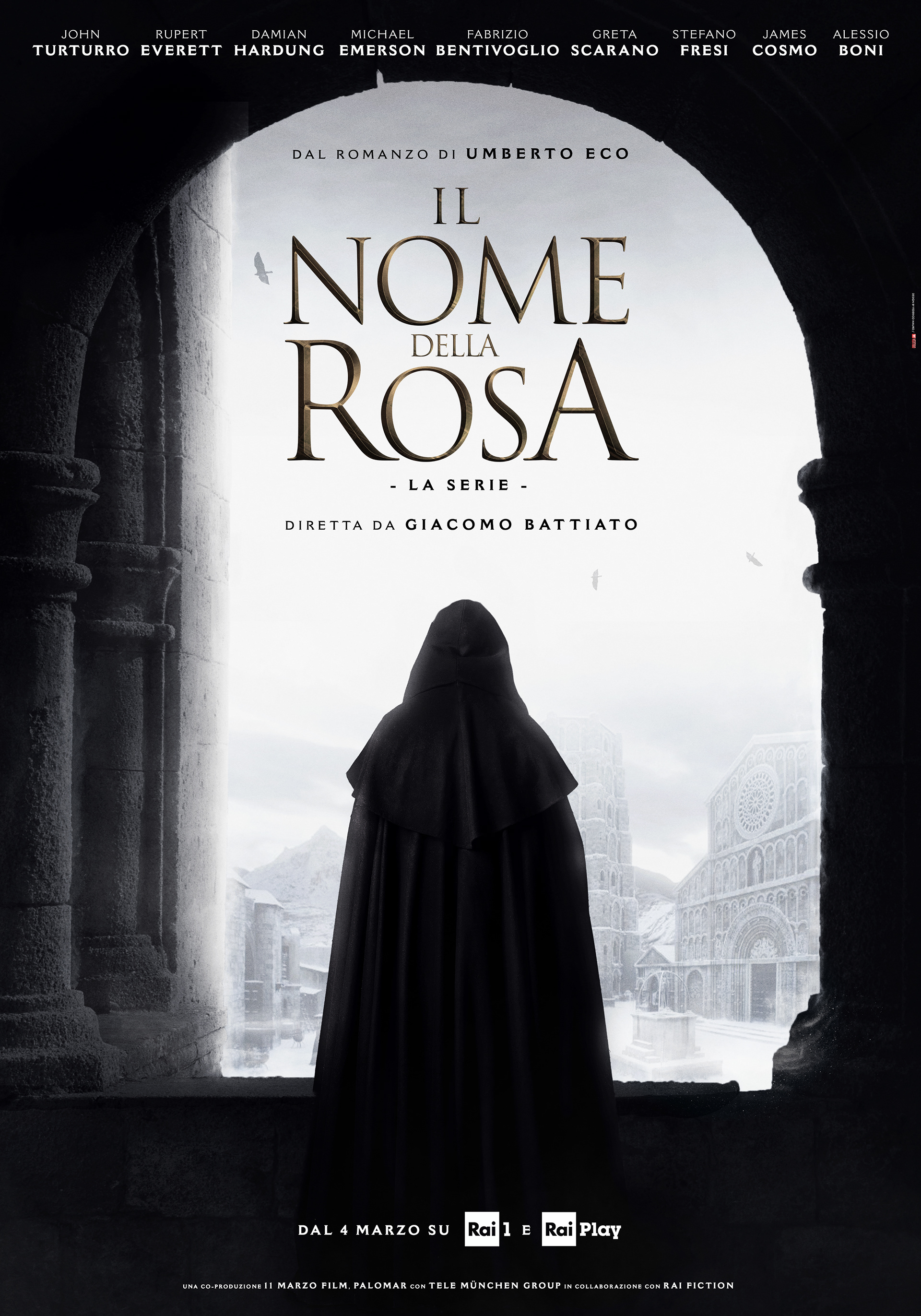
MV5BYTdhYzc0MmMtZDQwNS00ZTdlLTgzZmYtZWIxYzE4Zjk0YzQ4XkEyXkFqcGdeQXVyNTY2MzkxMjc@._V1_I stumbled by chance upon this TV series adaptation of the Umberto Eco famous novel (I thought I had read it, but, since I cannot remember anything about it, now I have doubt). I had seen, a long time ago, the movie adaptation with Sean Connery (and I have re-watched it just after seeing the series just for the fun of it!) and I was quite curious to see what it would look like as an eight-episode series (over six hours!)… 

The story is set in 1327. Brother William of Baskerville (an English Franciscan, whose name alludes both to Sherlock Holmes and William of Ockham), followed by the young novice Adso of Melk (the son of a German Lord), reaches an isolated Benedictine abbey in the Alps to participate in a debate between the Franciscan Order and the Avignon papacy about whether the Church should be poor as Christ was—a debate that would determine the very survival of the Franciscan Order. Upon arrival at the abbey the two find themselves caught up in a chain of mysterious deaths. William, a medieval sleuth, must untangle this knot of suspects (any of the multiple factions in the abbey, including a group of Heretics hiding amongst the Benedictines)—before the Dominican papal Inquisitor Bernardo Gui burn anyone at the stake—in order to solve the mystery that seems linked to the fabulous Abbey’s library and a coveted rare book!

The TV series is an Italo-German co-production, created, co-written and directed by Giacomo Battiato, starring John Turturro (William), Rupert Everett (Bernardo), Damian Hardung (Adso), Fabrizio Bentivoglio (Remigio), Greta Scarano (Margherita / Anna), Richard Sammel (Malachia), Tchéky Karyo (Pope John XXII), James Cosmo (Jorge) and Michael Emerson (the Abbot). It doesn’t have the star power of Jean-Jacques Annaud’s movie (Sean Connery, F. Murray Abraham, Christian Slater, Michael Lonsdale, Ron Perlman) but still offers many known actors. Strangely, despite being shot in Rome’s Cinecittà Studios, the movie was filmed in English. It aired on RAI in Italy, on BBC in the U.K. and on Sundance TV in the U.S. 

While the movie focuses on the heart of the mystery (the murders and the book), the TV series has ample time to develop around the multiple elements that the movie left out: how William and Adso met, who are the Dulcinian heretics, the Inquisition’s past of William, the particular and what’s at stake in the debate between the papacy and the Franciscan, who is the peasant girl that Adso meets and falls in love with.

Although I liked the movie a lot because of its multiple charms and its great photography, the TV series is a very good production that seems more faithful to the book — and it offers more plot and action. It is a beautiful, very interesting historical drama (I can only dream of all those old books!) which will hopefully soon stream online (possibly on Amazon Prime) so it will be more readily available. I enjoy it and recommend it to all aficionados of medieval history, rare books and mystery novels. stars-3-5

To learn more about this title you can consult the following web sites:

[ GoogleIMDbRAIWikipediaYoutube ]


[ Traduire ]

Capsules

“Natural History” – final research

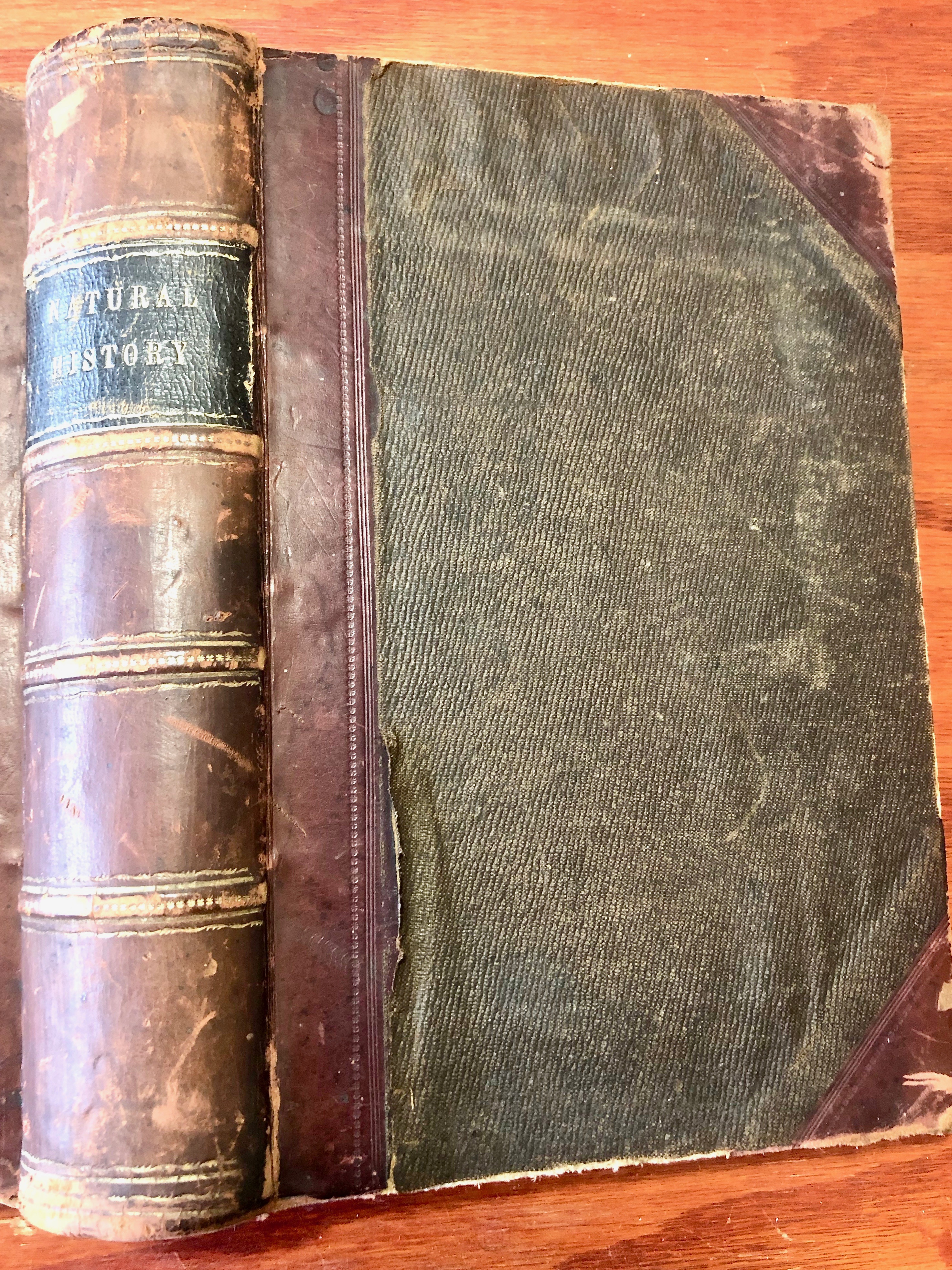
NHa-000_IMG_4392

My mystery book

Recently, the interest for one of my old books was rekindled when I found some new information about it on the internet. Since the prefatory pages of the book are missing the author and date of publication are unknown. I had only the title, Natural History, and the publisher:  William Milner of Halifax. Further investigation on WorldCat revealed more details allowing me to identify two possible authors for the book. Finally, I was able to compare my book with a microfiche copy at the University of Montreal, definitively identifying it as Richard COPE’s Natural History, which lead me to order a monograph about the work of William Milner in order to (hopefully) learn even more on this particular edition.

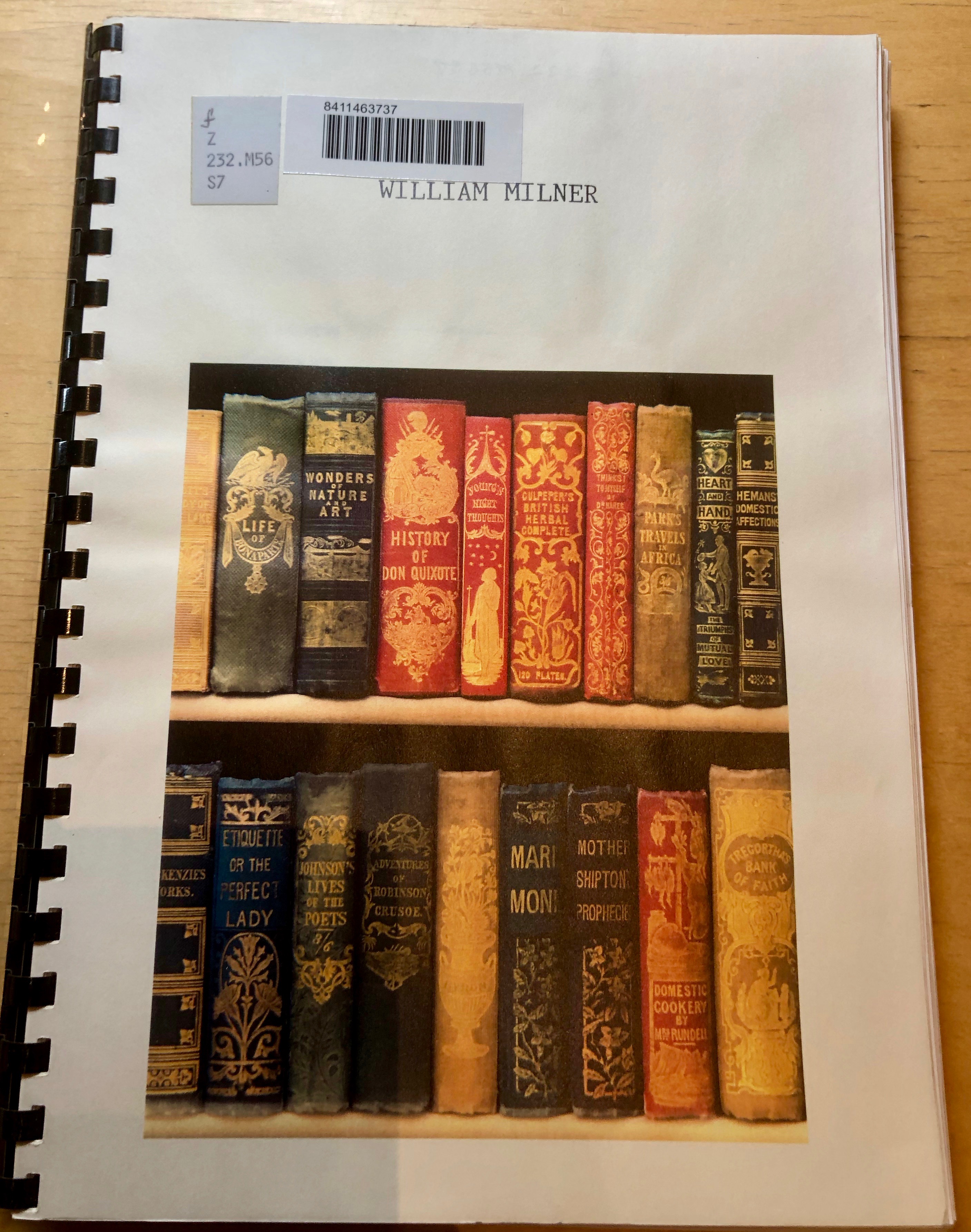
IMG_4437A little less than three weeks after filing the Inter-Library Loan (PEB) request, the Bernard BARR’s document about William Milner arrived at the National Library (BAnQ). Unfortunately, the whole process was utterly disappointing. The NYPL refused to lend its copy, so the book came from the University of St-Andrews’ library in Fife, Scotland, therefore the loan incurred a fee of $C 42.00 ! Not only the book was just a self-published monograph of sixty single-side pages with a simple plastic spiral binding, but the lending library requested that it had to be consulted on site, at the BAnQ. The book was on hold at the National Collection, a secure place where you have to check your coat and bag in a locker room before entering and you have to put all the material you need (notebook, pen, laptop, wallet, etc) in a basket that you carry with you. It was the first time I was visiting that place and it was all quite unexpected. Luckily, the staff was very nice and helpful. Instead of spending hours reading the book, I was allowed to digitize a copy on the photocopier (its control menu was not user-friendly at all and source of many frustrations). 

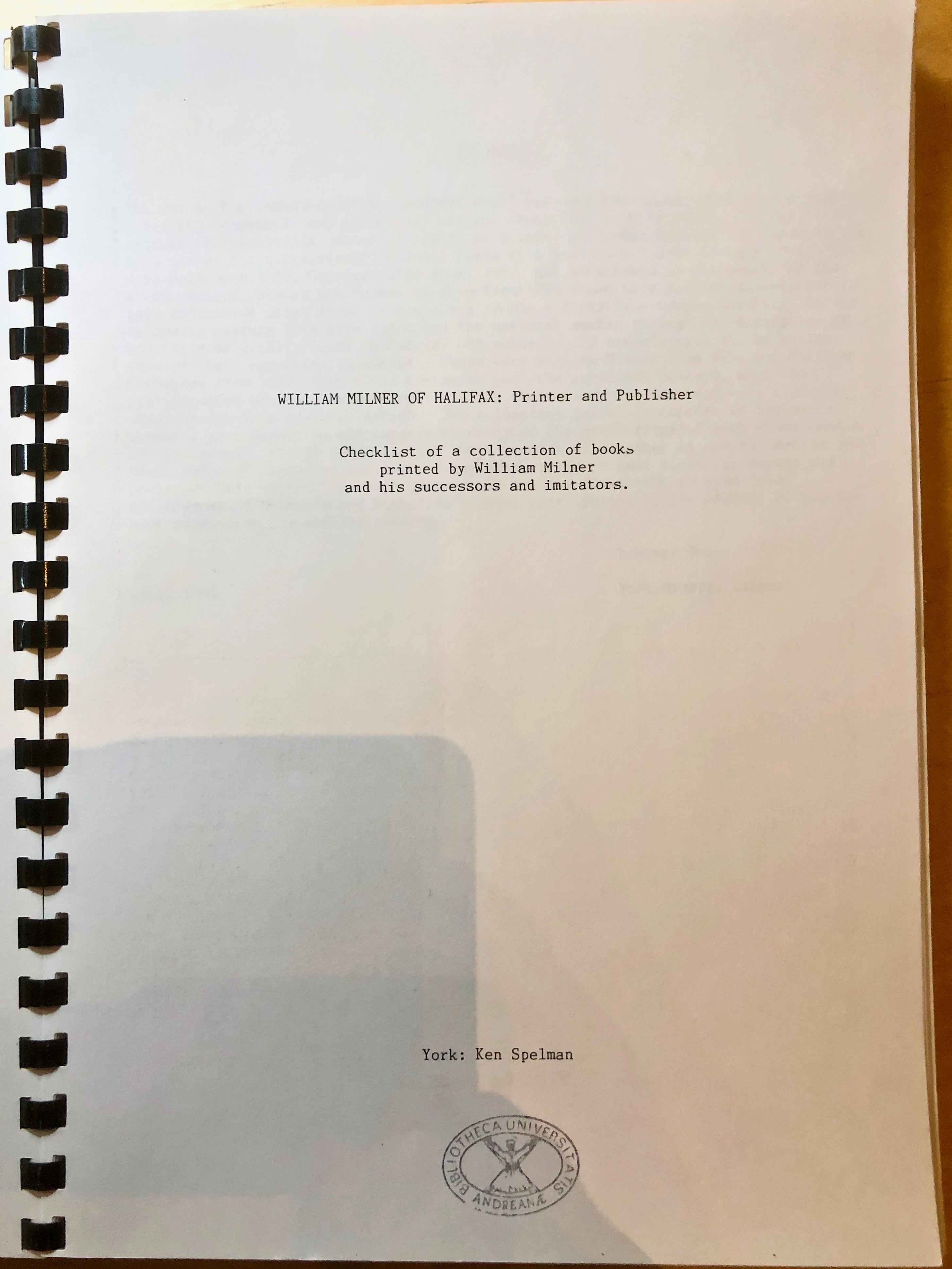
IMG_4441The book title is: “William Milner of Halifax: printer and publisher. Checklist of a collection of books printed by William Milner and his successors and imitators.” The only publishing information is “York: Ken Spelman”. No author is listed on the cover, but the notice from the University of St-Andrews’ library is helpful on that subject: the author is NOT Bernard BARR (who simply wrote the foreword) nor Ken Spelman (the “publisher”, but who was given as author by Amazon) but Peter MILLER and T. FOTHERGILL (who compiled the information).

Disappointingly, the book is of little use to me. It is far from exhaustive; its main source of information seems to be the Spelman’s bookshop collection as well as a few articles in Yorkshire’s newspapers and historical magazines (the bibliography also list a few references that briefly mention Milner, like Victor E. NEUBURG, The Popular Press Companion to Popular Literature, pp. 132-33 or Leslie SHEPARD, The History of Street literature, pp. 104-106). I was expecting a complete list of all titles published by Milner but it seems that such reference doesn’t exist. A search on Google doesn’t yield much either. In fact, the most useful tool in this research was probably WorldCat

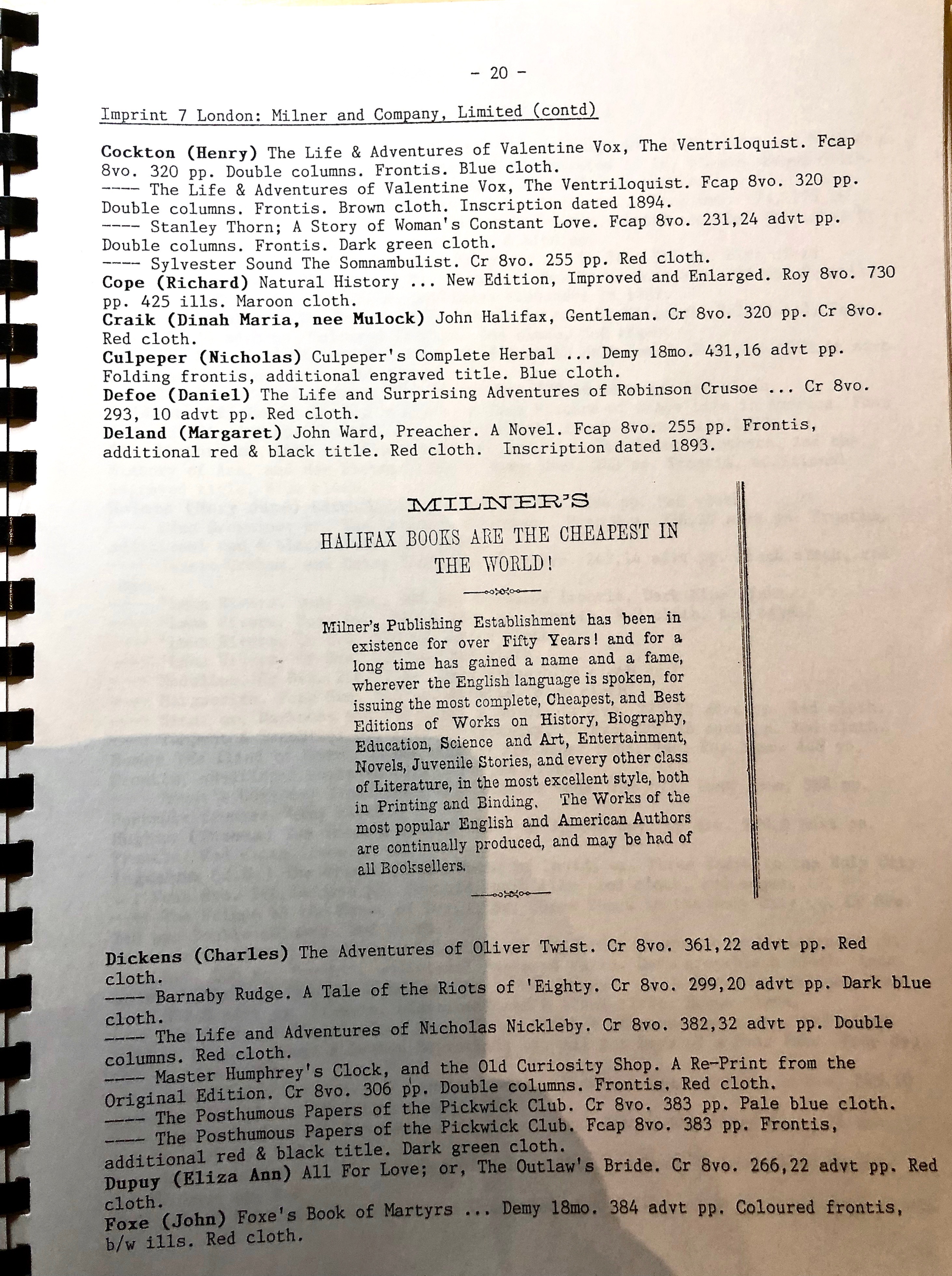
IMG_4440William Milner of Halifax: printer and publisher mentions Richard COPE’s Natural History only ONCE (“Cope (Richard) Natural History … New Edition, Improved and Enlarged. Roy 8vo. 730 pp. 425 ills. Maroon cloth”) in what the book calls the “Imprint 7”—which falls into the third incarnation of the publishing company, Milner & Co, located in London between 1883 and maybe 1900. “Maroon cloth” seems to describe well the cheap cover of my edition (and “Roy 8vo” means that it is a Royal octavo format, i.e. 10″ by 6¼” or 253 mm x 158 mm, therefore about the same size than my copy) but my book was clearly printed during the “Imprint 1” period (Halifax: William Milner, 1834-1851). Also the copy that I have seen at the University of Montreal unmistakably falls into the same imprint as it is dated from 1846 (while mine unfortunately has no printing date left—or never had one as it happened often with this publisher). This fact confirms that the Miller/Fothergill monograph is obviously incomplete.

I was not able to acquire more precise information on my book. However, it was not a complete waste of time since it has allowed me to learn more about the printing industry in nineteen century England. It seems that William Milner was a pioneer of cheap literature and remains an unsung hero of the poor Englishmen as he provided them with affordable literary classics (selling for as little as a shilling or even a sixpence) that would have without any doubts further their education and culture. Several other publishers, like William Nicholson, followed his example. 

IMG_4444

The Spelman’s collection ?

They printed books not only in great quantity (printing titles by the ten of thousands with total circulation often amounting over a hundred thousand!) but also in variety as they covered a large array of subject matter (from BurnsPoems, to Uncle Tom’s Cabin, Arabian Nights, Bunyan’s Pilgrim’s Progress, Defoe’s Robinson Crusoe, Richard Johnson’s The Seven Champion of Christendom, etc.) and offered a “range of plain and variously ornamented styles to suit differing tastes and pockets” [cf. Bernard Barr’s introduction to William Milner of Halifax and Shepard’s History of Street Literature]. The life of those publishers (and particularly of William Milner) and their cultural missionary work would certainly make quite an interesting subject for a historical TV series. 

[ Traduire ]

M.S. Gundam Unicorn (UC)

GundamUnicornLogo

Overview

I have not watch any Japanese animation in a while and I must admit that it feels great. I have never been a big fan of Gundam, but I have always admired the complexity of its plots, particularly its political and philosophical aspects and the variety of its character and mechanical designs. The fact that this is an Original Video Animation (OVA) mini-series — streaming on Netflix — makes it easier to reacquaint myself with the genre and the story. It is also a good way to introduce a novice to the phenomenon. Therefore, as in the good old days of P.A., here is an “Anime Story” (although a little shorter and with links — it’s fun, I should do this more often!).

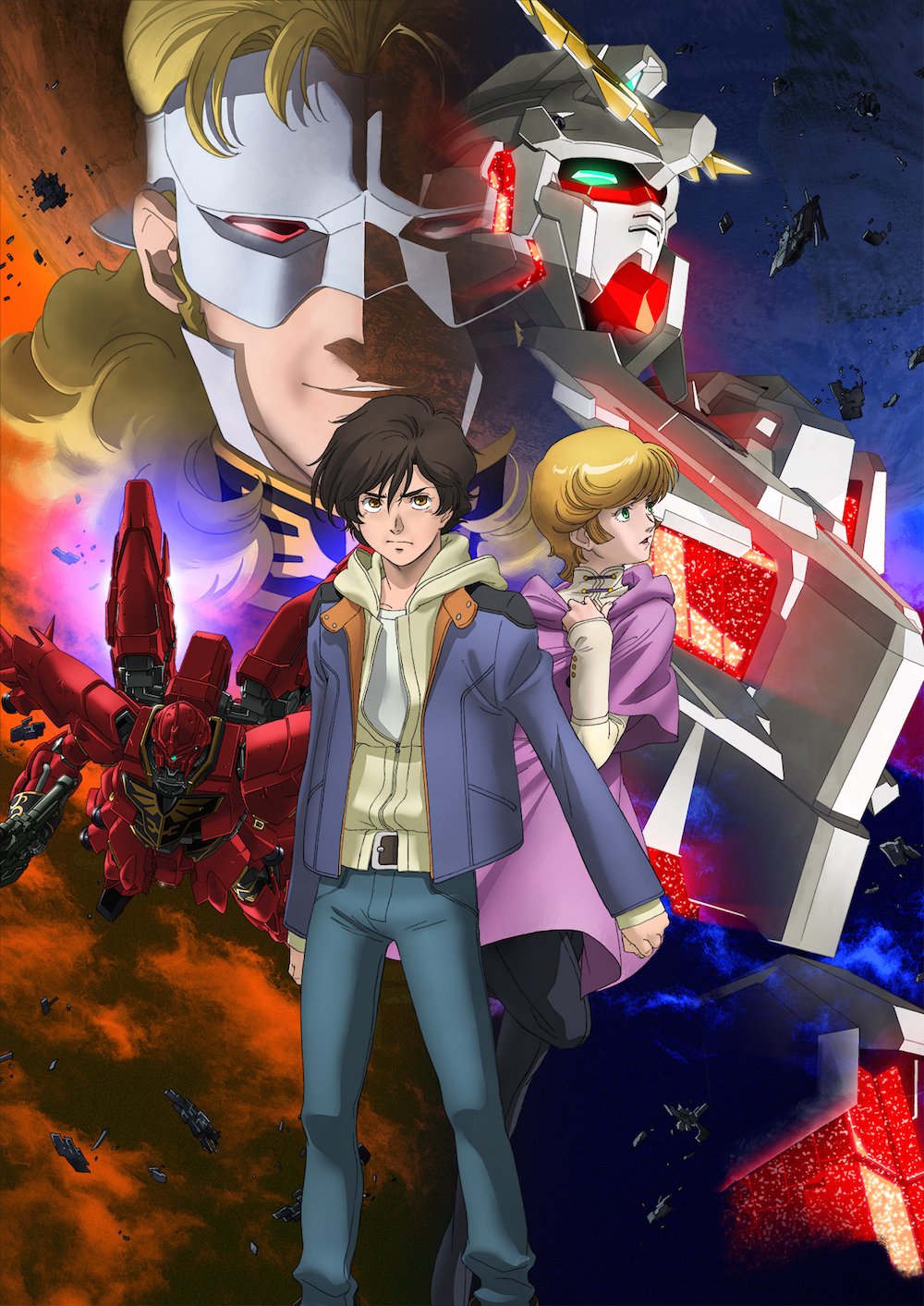
GundamUnicornPosterMobile Suit Gundam Unicorn (UC) (機動戦士ガンダムUC(ユニコーン) / Kidō Senshi Gandamu Yunikōn) is a sequel to the Mobile Suit Gundam story created by Yoshiyuki Tomino (made famous by its plentiful line of plastic models known as Gunpla). It takes place in the main timeline of the series, known as Universal Century (宇宙世紀 / Uchū Seiki). Earth is colonizing space by putting colonies (big space stations known as “Side”) in stable orbits around the planet (A.K.A. Lagrange Points).

Story

The story begins as the Earth Federation Prime Minister is about to unveil a new era of space exploration as well as a new Federation charter. The current era (A.D.) ends as the Universal Century begins. However, the Laplace space station—where the calendar change ceremony is taking place—is destroyed in a terrorist attack. The young Syam Vist discover a secret in the station wreckage: the Laplace’s Box, which contains a truth so terrible that it must never be revealed as it could destabilize the Federation — it also becomes a source of political power upon which he will build the Vist Foundation.

The story unfolds ninety-five years later, in UC 0096 (sixteen years after the One Year War), as the young orphan Banagher Links is going to school on the Industrial 7 space station. He will encounter a girl named Audrey Burne and get caught up in the struggle to locate and possess the Laplace’s Box…

Continue reading

Isabella Bird 4

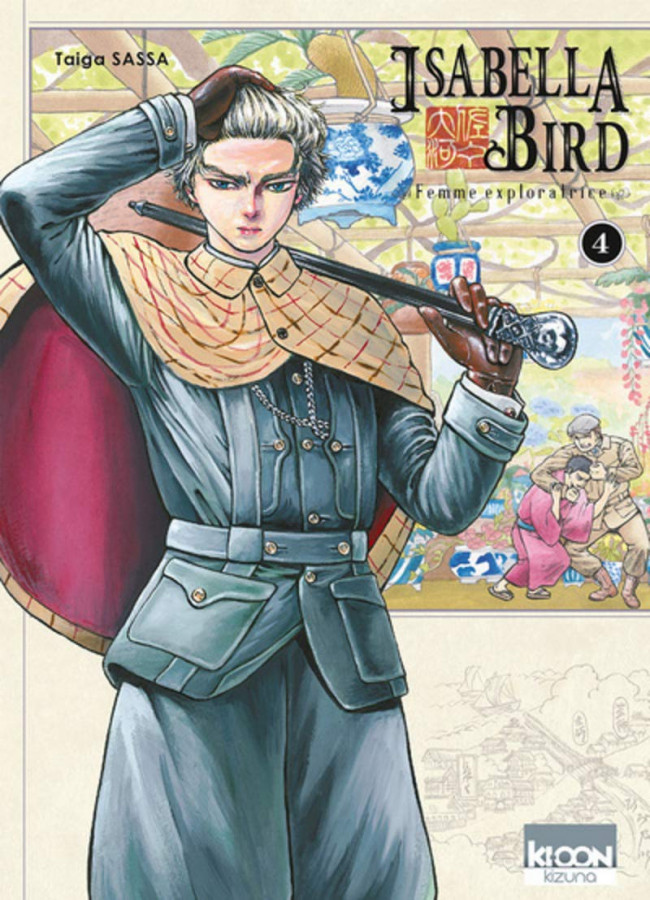
IsabellaBird_4-cov“Des choses se trament à Tokyo… Le botaniste Charles Maries souhaite récupérer son interprète, et malheureusement le contrat qu’il a établi avec Ito est toujours valable. Les Parkes ont beau lui mettre des bâtons dans les roues, le chasseur de plantes est prêt à tout pour parvenir à ses fins ! 

Inconsciente de la menace qui plane sur son expédition, Isabella Bird a quant à elle atteint Niigata, première grande étape de son voyage. L’aventurière se prépare maintenant à partir vers le nord, pour ce qui devrait être la partie la plus éprouvante du périple…

Lancez-vous à la découverte d’un Japon traditionnel désormais disparu à travers les yeux de l’intrépide Isabella Bird! Basé sur les écrits réels de l’aventurière, Isabella Bird, Femme Exploratrice est un récit passionnant sur les rencontre de deux mondes, dessiné avec un rare souci du détail par Taiga Sassa, nouveau talent prometteur !”

(Texte de la couverture arrière)

Isabella Bird, femme exploratrice (ふしぎの国のバード / Fushigi no Kuni no bādo [Bird] / littéralement: “Bird au pays des merveilles”) nous offre le récit de voyage de la célèbre exploratrice britannique au Japon du début de l’ère Meiji en se basant sur sa correspondance avec sa soeur Henrietta qui fut publiée en 1880 sous le titre Unbeaten Tracks in Japan.

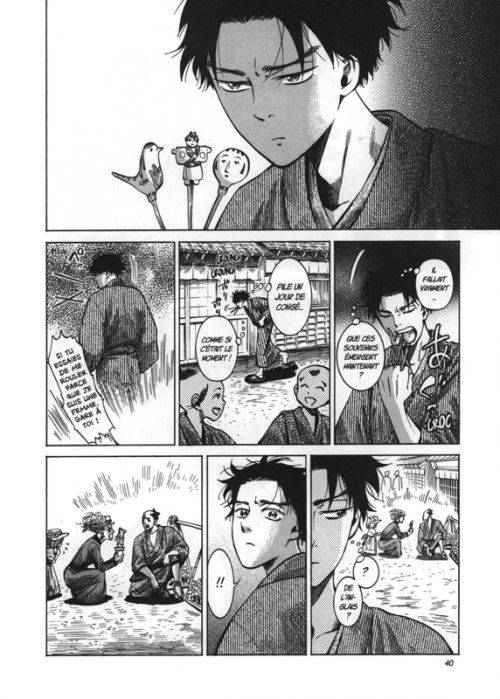
IsabellaBird_4-p040

Page 40

5 juillet 1878, Ito—l’interprète et guide de Isabella—se remémore sa rencontre avec le botaniste Charles Maries et les abus qu’il a subit sous son service. Le 12 juillet, ils quittent Niigata et, après avoir traversé le fleuve Shinano, prennent la longue route d’Echigo qui les mène vers Yamagata, puis Akita et, ultimememnt, à Aomori. Faute de chevaux, ils continuent la route à dos de vaches… Ils rencontrent un groupe de “bokka” (des femmes portant des marchandises sur leur dos). L’une d’elles, O-yu, est intéressée à apprendre l’écriture. Le 15 juillet, ils arrivent à Yamagata. Ils visitent l’hôpital local et Isabella est surprise (et un peu choquée) de voir les locaux habillés à l’occidental. La ville interdit même les habits traditionnels dans un effort d’entrer dans la modernité et d’obtenir la reconnaissance de l’Occident. Le dos d’Isabella la fait souffrir. 

IsabellaBird_4-p183

Page 183

À l’étape de Tateoka, ils rencontrent un vieux couple d’aveugles, lui est anma (masseur) et elle est azusa-miko (nécromancienne qui utilise une sorte d’arc pour appeler les esprits). Isabella est surprise que Ito, qui normalement  abhorre les superstitions, croit au chamanisme. Ito reçoit une lettre de sa mère, auprès de laquelle Maries s’est plaint de son ingratitude. Il joint une note à la lettre enjoignant Ito de revenir à son service sous peine d’être poursuivi en justice. Il lui offre une augmentation et l’averti qu’Isabella souffre d’une maladie qui ronge ses vertèbres et que le voyage pourrait lui être fatal! Et cette mise en garde est confirmée par les prédictions de la voyante… Il ne sait que faire et se sent dans une impasse. Le dernier chapitre raconte une anecdote de la vie de Fanny Parkes, l’exubérante épouse du ministre plénipotentiaire britannique Harry Parkes.

Au fur et à mesure que le récit avance, ce manga s’épanoui sous nos yeux. L’histoire est non seulement captivante mais elle est riche en détails tant géographiques, botaniques que ethniques sur la culture Japonaise de l’ère Meiji. On y discute entre autre l’épineuse question du développement d’un pays: est-ce que modernisation devrait nécessairement vouloir dire occidentalisation? La tentation est grande de chercher à imiter pour plaire et ainsi évider la condescendance et le mépris des impérialistes du genre de Charles Maries. Le style graphique est encore un peu inégal mais demeure généralement très riche, détaillé et précis. C’est même superbe par moment. C’est donc un excellent manga historique que je recommande chaudement.

Isabella Bird, femme exploratrice T04 par Taiga SASSA. Paris: Ki-oon (Coll. Kizuna), août 2018. 208 pg, , 13 x 18 cm, 7,90 € / $14.95 Can., ISBN 979-10-327-0305-2. Pour lectorat jeune (7+). stars-4-0

Vous trouverez plus d’information sur les sites suivants:

[ AmazonBiblioGoodreadsWikipediaWorldCat — Youtube ]

© 2017 Taiga Sassa. All Rights reserved.

Voir mes commentaires sur les volumes précédents (cliquez sur l’image pour activer le lien):

IsabellaBird-v1-cov IsabellaBird-v2-cov IsabellaBird-v3-cov

[ Translate ]

Capsules

Three haïku

I’d rather sleep and dream
Than live in this hurtful world —
Will the eternal night ever come ?

⊕­­­­ ­­­ ­­­ ­­⊕­ ­­­ ­­­ ­­⊕

Like for the law-men the librarian’s motto
Should always be “serve and protect” —
Protect the books and serve the readership !

⊕­­­­ ­­­ ­­­ ­­⊕­ ­­­ ­­­ ­­⊕

My haïku will always be free
As they are not bound by any form
But still cost me dearly to spawn

⊕­­­­ ­­­ ­­­ ­­⊕­ ­­­ ­­­ ­­⊕

[ Traduire ]

Les Vacances du Major

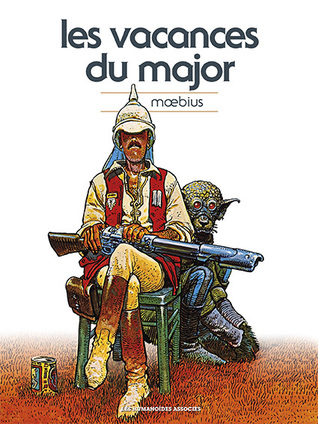
VacancesDuMajorEn feuilletant le catalogue de la bibliothèque, je tombe sur une BD de Moebius que je n’ai pas lu, alors je me la réserve. À la lecture, je me rend compte qu’en fait toutes ces histoires me sont familières. Je les ai déjà lu soit dans Métal Hurlant, soit dans la compilation Oeuvres Complètes 3: Major Fatal Mais, bon, c’était tout de même très agréable à relire.

Ce recueil rassemble seize histoires courtes de science-fiction: “Escale sur Pharagonesia” (26 pages), “Le Major Grubert: The Forbiden City Rides Again” (2 pages), “La Flore de Paradis 9” (1 page), “Une Aventure du Major Grubert” (2 pages), “Paradise Nine’s Strange Flowers – Continuation” (1 page), “Sans Titre” (1 page), “Une Planche” (1 page), “Deima” (3 pages), “Tueur à Gages” (12 pages en trois épisodes), “Grand Hôtel B” (2 pages), “Split le petit pionnier de l’espace” (2 pages), “Fable-Vite no 317” (1 page), “Y’a pas moyens” (2 pages), “La Chasse au Français en vacances” (6 pages en six épisodes), “L’Envahisseur” (1 page) et “Une aventure de John Watercolor le justicier anti-pique poquett’, avec sa fameuse redingote qui tue” (1 page).

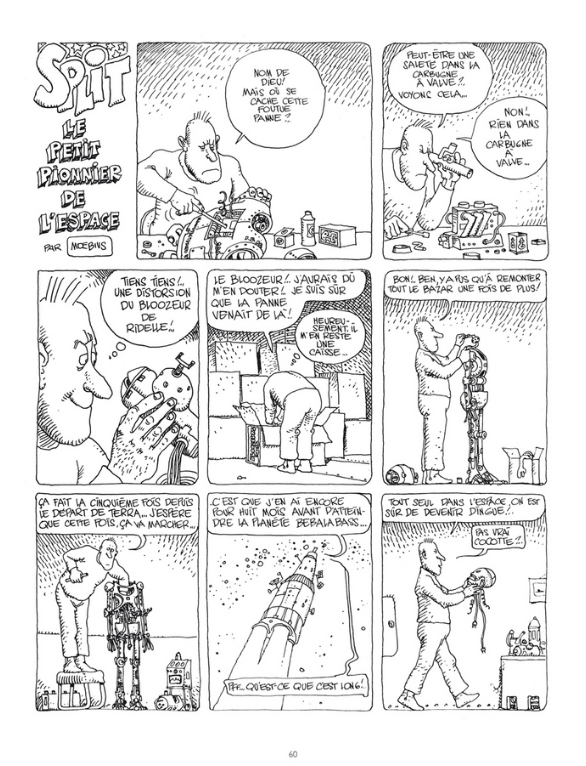
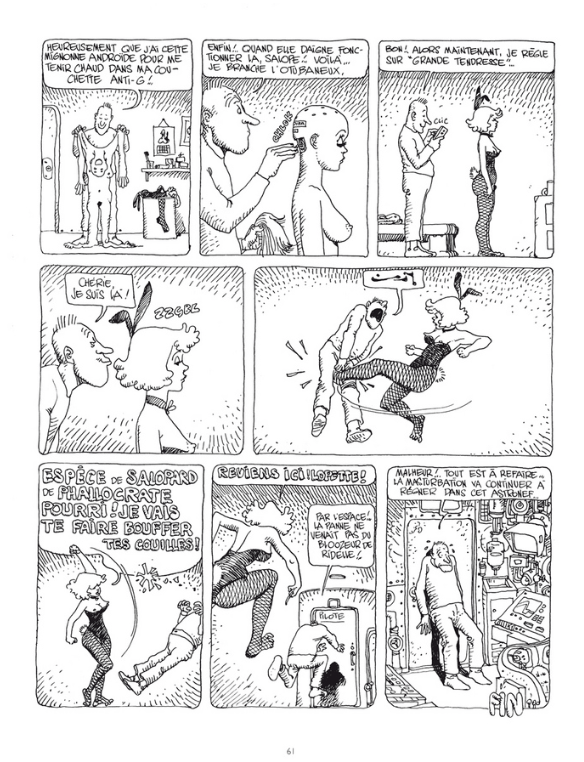
Split le petit pionnier de l’espace

La majorité de ces histoires ne font qu’une page ou deux et certaines seront reprises dans le recueil Oeuvres Complète 3: Major Fatal. Les récits les plus significatifs sont “Escale sur Pharagonesia” (où des touristes découvrent que lorsque vous faites escale sur un monde étranger, il peut vous arriver des choses plutôt étranges!), “Tueur à Gages” (le tueur à gages Edouardo est pris au piège par l’inspecteur Briggs, mais il s’échappe pour commettre un hold-up cinq ans plus tard; il rencontre par hasard l’inspecteur qui lui raconte l’histoire de la vieille mine…) et “La Chasse au Français en vacances” (qui donne d’ailleurs sont titre à l’album: suite à une chasse infructueuse le Major décide de prendre des vacances et tel est pris qui croyait prendre!).

Escale sur Pharagonesia (extraits)

Quelques unes de ces histoires seront traduites en anglais chez Epic/Marvel (et malheureusement mises en couleurs — car les amerloques ça n’aiment pas le noir et blanc) dans les recueils de la série “The Collected Fantasies of Jean Giraud”: Moebius 4: The Long Tomorrow (“Split the little space pioneer”) et Moebius 6: Pharagonesia (“Shore leave on Pharagonesia”, “The hunt for the vacationing frenchman”).

Jean Giraud (Gir) est surtout connu pour avoir dessiné la série western Blueberry (créée par Jean-Michel Charlier  et publiée dans Pilote entre 1963-1974, puis compilée en albums chez Dargaud jusqu’en 2005). Toutefois, lorsqu’il voulait écrire des histoires de science-fiction, il le faisait sous le pseudonyme de Moebius. Ce dernier est maintenant probablement beaucoup plus célèbre.

Ce sont surtout des histoires humoristiques et insouciantes qui reposent parfois sur un seul gag, avec un récit plutôt absurdes ou, comme disent les français, complètement déjantées (i.e. cinglées). C’est aussi parfois de l’excellente science-fiction, songée, avec des concepts plutôt innovateurs pour l’époque. Le dessin est toujours en noir et blanc, avec un niveau de complexité qui varie beaucoup d’une histoire à l’autre (ou même parfois d’un planche à l’autre!), allant du trait très simple aux arrière-plans très riches et texturés. On retrouve ici et là une petit influence de Blueberry, avec des paysages désertiques et ou des chevaux. Ce que j’ai surtout trouvé très intéressant, c’est la préface de Moebius où il explique que ces histoires sont nées d’un besoin de se faire son propre cinéma, de se laisser aller au délire créatif et libérateur afin de se détendre entre ses périodes d’activités professionnelles intenses (notamment lorsqu’il travaillait sur Blueberry). Il a adopté un style rapide offrant “un juste équilibre entre l’énergie consacrée au dessin et celle qui doit demeurer disponible pour la narration” sans “perdre le fil du récit”. Cela lui a permis d’expérimenter et de sortir du cadre traditionnel des genres. Et nous lui en sommes infiniment reconnaissant.

C’est donc une bande-dessinée amusante et intéressante dans le sens qu’elle nous permet de voir l’évolution de l’auteur et de comprendre la genèse de son oeuvre. Ça se lit vite et bien et on se marre. Que demander de plus? stars-3-0

Pour en savoir plus vous pouvez consulter les sites suivants:

AmazonBiblioGoodreadsHumanosWikipediaWorldCat ]

© 2011 Les Humanoïdes Associés

[ Translate ]

A new beautiful era of harmony

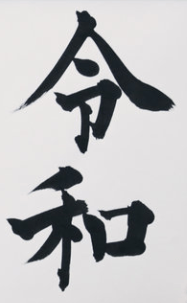
ReiwaThe Japanese government has announced last night that the name of the new Japanese era will be Reiwa (令和).

Each time that there is a new emperor, Japan’s calendar start a new era (時代 / jidai) or period (元年 / gannen). The era name (年号 / nengō or 元号 / gengō) is always selected carefully and has a great cultural significance. However, today it is mainly used only on government official paperwork (driving licenses, official calendar, etc.). Everyday use generally follows the Gregorian calendar. The previous era of modern Japan are Meiji (Prince Mutsuhito, 1868-1912), Taishō (Prince Yoshihito, 1912-1926), Shōwa (Hirohito, 1926-1989) and Heisei (Akihito, 1989-2019). Reiwa will be the 248th era name of Japanese history.

This change usually happens upon the death of the emperor, as his son ascend to the Chrysanthemum Throne. However, this time, the emperor Akihito chose to abdicate for health reason on April 30th and he will be succeeded by his elder son, Naruhito, on May 1st. Another departure from tradition is the fact that, in the past, the name was inspired by Chinese literature. This time, the panel of experts selected to choose the name took the idea from Japanese classical literature, as it is derived from the ancient poem anthology Man’yōshū. 

The first character of the name, Rei [], means good fortune (the “auspicious wave of energy of the plum blossoms carried by the wind”) and the second character, Wa [], means   gentle, harmonious or peace and tranquility.  It could therefore be translated as “fortunate harmony” or “auspicious harmony” (although some seems to translate it as “redolent harmony”).

The announcement was well received by the Japanese as they expect the name to embody their hope for a better future

[ Traduire ]

Détour

DetourLes week-ends se déroulent rarement comme prévu. Je planifiais de faire de menus travaux, de la comptabilité, de lire et commenter des mangas (surtout Isabella Bird et Moriarty) et je me retrouve finalement à lire (relire?) des vieilles BDs de Moebius, à regarder des animés sur Netflix (Gundam Unicorn !) et à rechercher une nouvelle adaptation animée d’un vieux manga shōjo des années ’70 par nulle autre que Waki Yamato (Haikara-san ga tōru) et dont je parlerai sans doute amplement dans un futur proche…
Encore un coup de nostalgie. Cela faisait un bout de temps que j’avais pas regardé d’animés… C’est bon. Ça fait du bien. Et sur Netflix, qui plus est (quoiqu’on y retrouve rien de bien nouveau puisque Gundam Unicorn date déjà de 2010). Et ce n’est pas fini puisque Netflix a annoncé plusieurs titres d’animés à venir (dont Evangelion en juin, Saint Seiya plus tard dans l’été et Ghost In The Shell Stand Alone Complex en 2020 !!!). Ce n’est vraiment plus de la culture populaire (geeky stuff) mais cela commence à faire partie de la culture courante (mainstream)…

[ Translate ]

Avengers: Infinity War

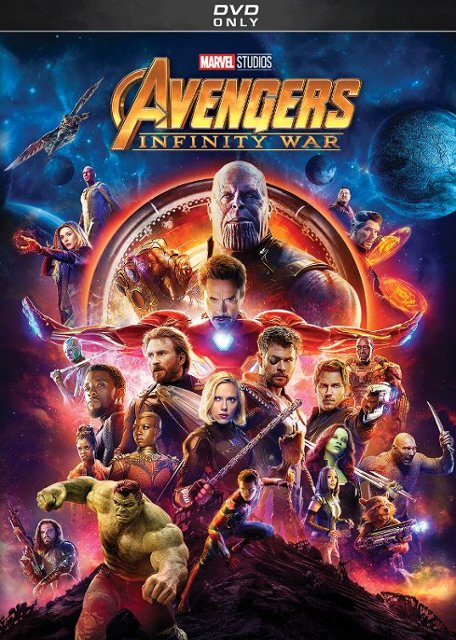
Avengers_InfinityWarThis is a very depressing movie mostly about sacrifice and loss. The sophisticated and over-the-top special effects are not enough to make you really appreciate this over compartmented story which is a literal who’s who of the Marvel Cinematic Universe as they pit almost EVERY Marvel superheroes against Thanos in order to try saving the universe. It is just too much (too much non-stop action, too many character killed). And it is also “To be continued” ! ;(

Of course, it was greatly appreciate by the Marvel Universe fans (score of 8.5 on IMDb and critic/viewer ratings of 85% / 91% on Rotten Tomatoes), but for me it wasn’t enough to prevent me from feeling bored (beside the occasional “what? Those characters are part of the same universe” or “oh no, they didn’t dare going there” or “you means, he’s dead, dead?”)—although I almost sympathized with the supervilains who has a very gordian way of solving the universe’s problem (who knew? Earth is not the only place with an overpopulation of idiots!). It might have helped to have watched some of the one shot movies (like Spider-Man: Homecoming,  Ant-Man or Doctor Strange) as well as some of the TV series. Now, they will really need new characters (oh, yeah, that’s probably why they dug out Ant-Man, Black Panther and Captain Marvel !). However, I am curious to see how the heroes will manage to find their way out of this dire situation… Which we will know, of course, with Avengers: Endgame coming out next month !

It is an entertaining movie, the kind you watch with friends, beer and chips, or that you distractingly watch while fiddling with your phone. stars-2-5

To learn more about this title you can consult the following web sites:

[ AmazonBiblioGoogleIMDbNetflixOfficialWikipedia ]

[ Traduire ]

Capsules

“Natural History” quest – a sequel

NHa-000_IMG_4392

My mystery book

My quest to identify a mystery book simply titled “Natural History” continues…

Today I went to the National Library (BAnQ) to renew my membership and request an Inter-Library Loan (PEB)  for Bernard BARR’s book about William Milner. Hopefully this time it will work and the fee won’t be too expensive. While I was there I had a look at their impressive manga collection and borrowed a volume of The Walking Dead comics (I am a book geek in various spectrum!)…

I have decided not to request an Inter-Library Loan (PEB) for Richard COPE’s book (the most likely candidate for the identity of the mystery book) but to directly go the University of Montreal library to check the copy they have and compare it to my book. After all, I am already downtown, so why not take the time now to resolve this question. It can be found at the media division (médiathèque) of the Library of Letters and Humanities (Bibliothèque des Lettres et sciences humaines – BLSH). Actually, they don’t have a copy of the book itself but a copy on microfiches.

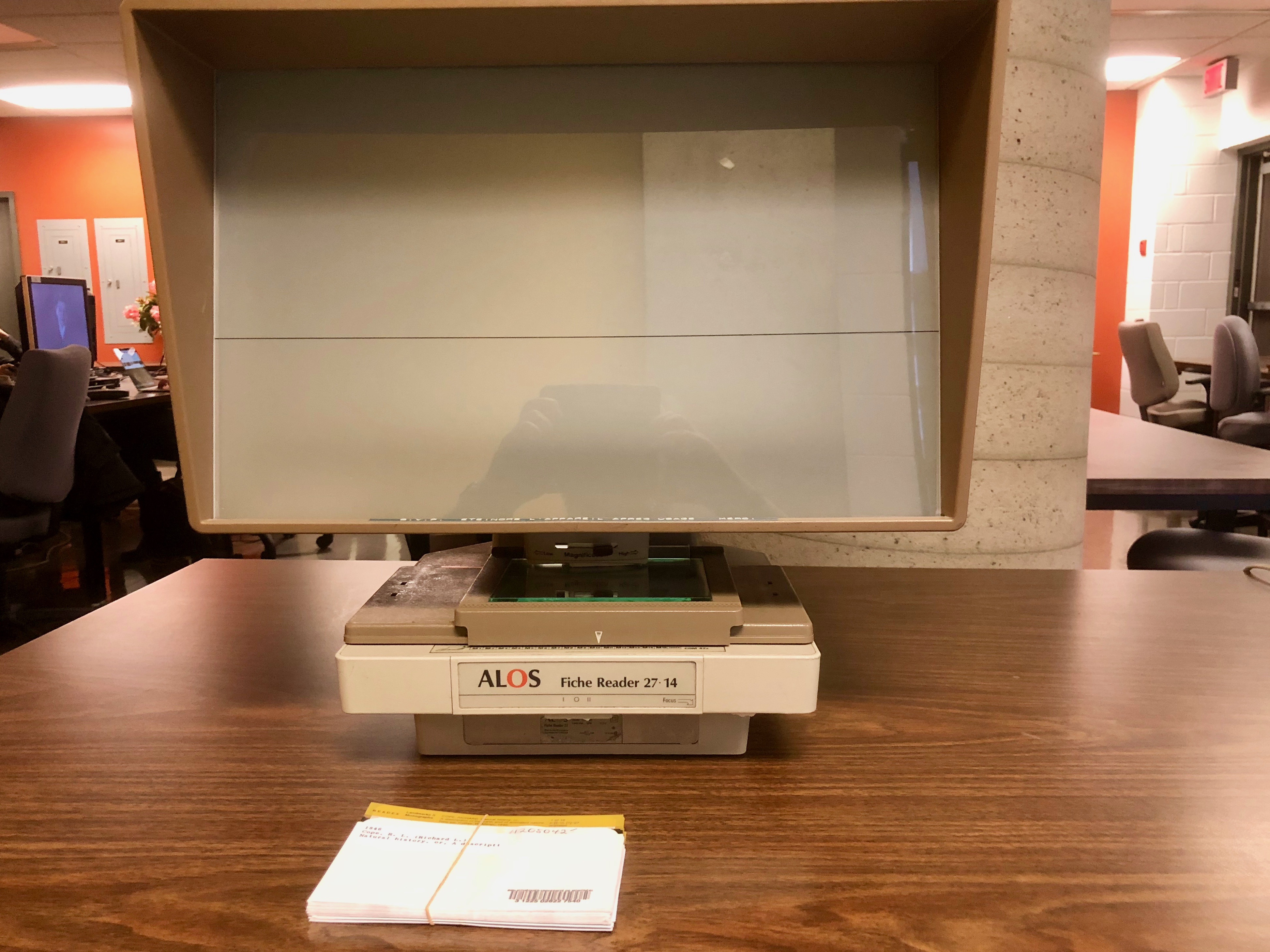
Unfortunately, despite the fact that the online catalog indicated an “on shelf” status, the entire Landmark Microfiche collection had been boxed as the media section is about to be moved. I was a little pissed but convinced the clerk to at least open a few boxes to see if he couldn’t find the microform set that I needed. He was clearly unwilling to help and said “You know, we’re closing in an hour and half!”. But I just needed ten minutes… It would be easy if they had been boxed alphabetically: since the author is “COPE” it would be in the first boxes. He reluctantly opened the first five boxes and indeed it was there (in box four)! I sat at one of the microform reader and had a look. Unfortunately, this machine was not equipped to make copies, so I simply took pictures with my iPhone (which I had to put together later at home, converting them from negative to positive). I took my time, but after fifteen minutes I was done. However, I could finally confirm the identity of my book!

First, I’ve been able to see the pages that were missing from my book (although nothing in the binding let us suspect that something is missing—or maybe the binding was changed at some point in the past?), mostly the title page, the introductory remarks (indicating that the original publishing date is 1840) and the index of subjects:

For me the most important aspect was to be able to see the title page:

NATURAL HISTORY;

OR,
A DESCRIPTION OF THE EARTH AND OF ANIMATED NATURE,
COMPILED FROM THE WORKS OF
BUFFON, GOLDSMITH, CUVIER, SHAW, VAILLANT, HUMBOLT, AUDUBON. &c., &c.

A NEW EDITION, IMPROVED AND ENLARGED

BY RICHARD COPE, LL.D., F.A.S.,
Author of the Pulpit Synopsis, Religious Anecdotes, Domestic Altar, &c., &c., &c.

“Creation teems with life,
From the gay flies that people the sunbeam,
To the huge whale whose home is in the deep,
And the wise elephant that shades him in the forest.”
MONTGOMERY

WITH FOUR HUNDRED & TWENTY-FIVE ENGRAVINGS
OF BIRDS, BEASTS, FISHES, REPTILES, &c.

HALIFAX:
PRINTED AND PUBLISHED BY WILLIAM MILNER,
CHEAPSIDE.
MDCCCXLVI. [1846]

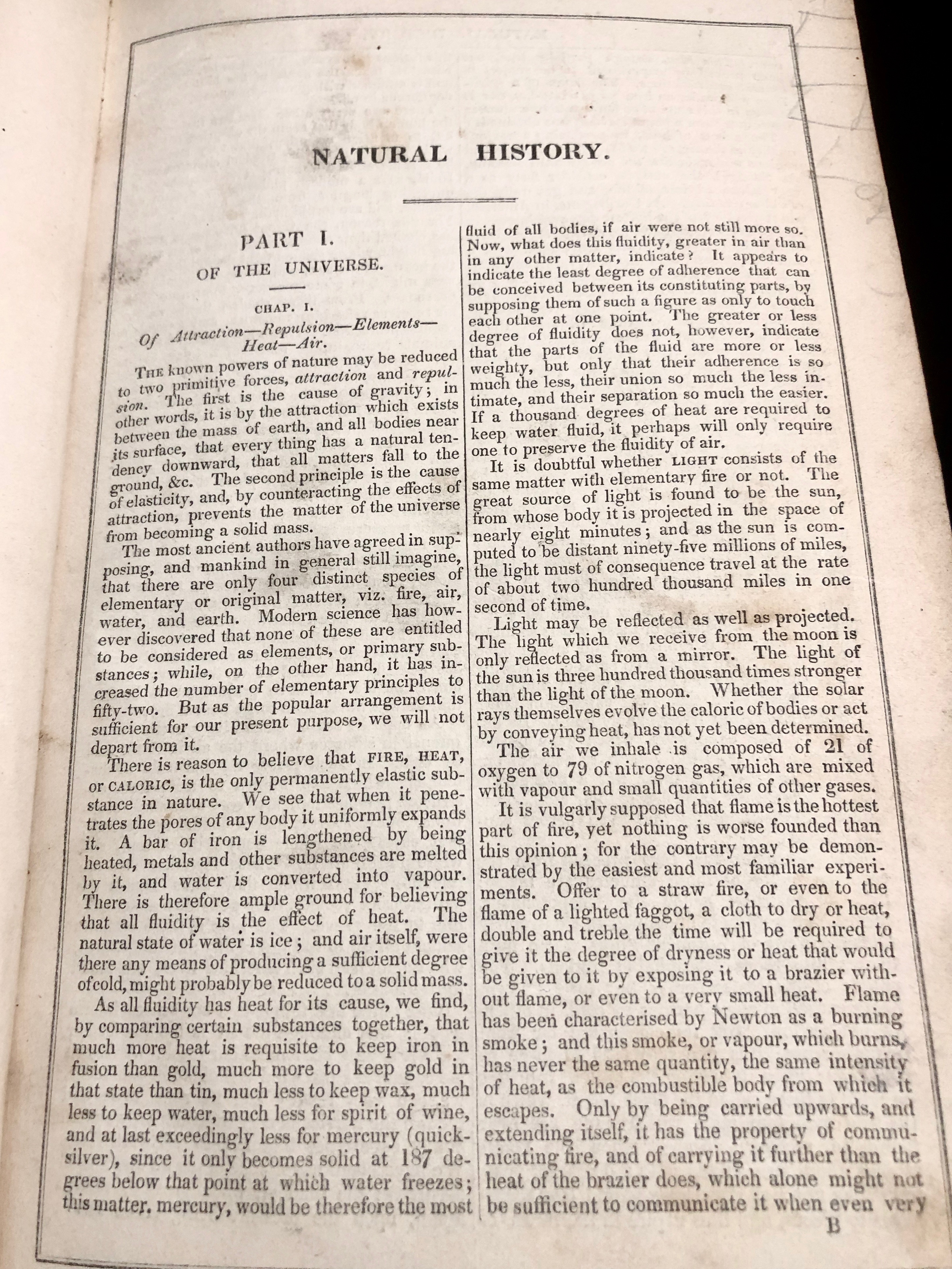
If we compare a few pages, we can see that it is the same book (my copy (a) on the left and the Université de Montréal microfiche copy (b) on the right):

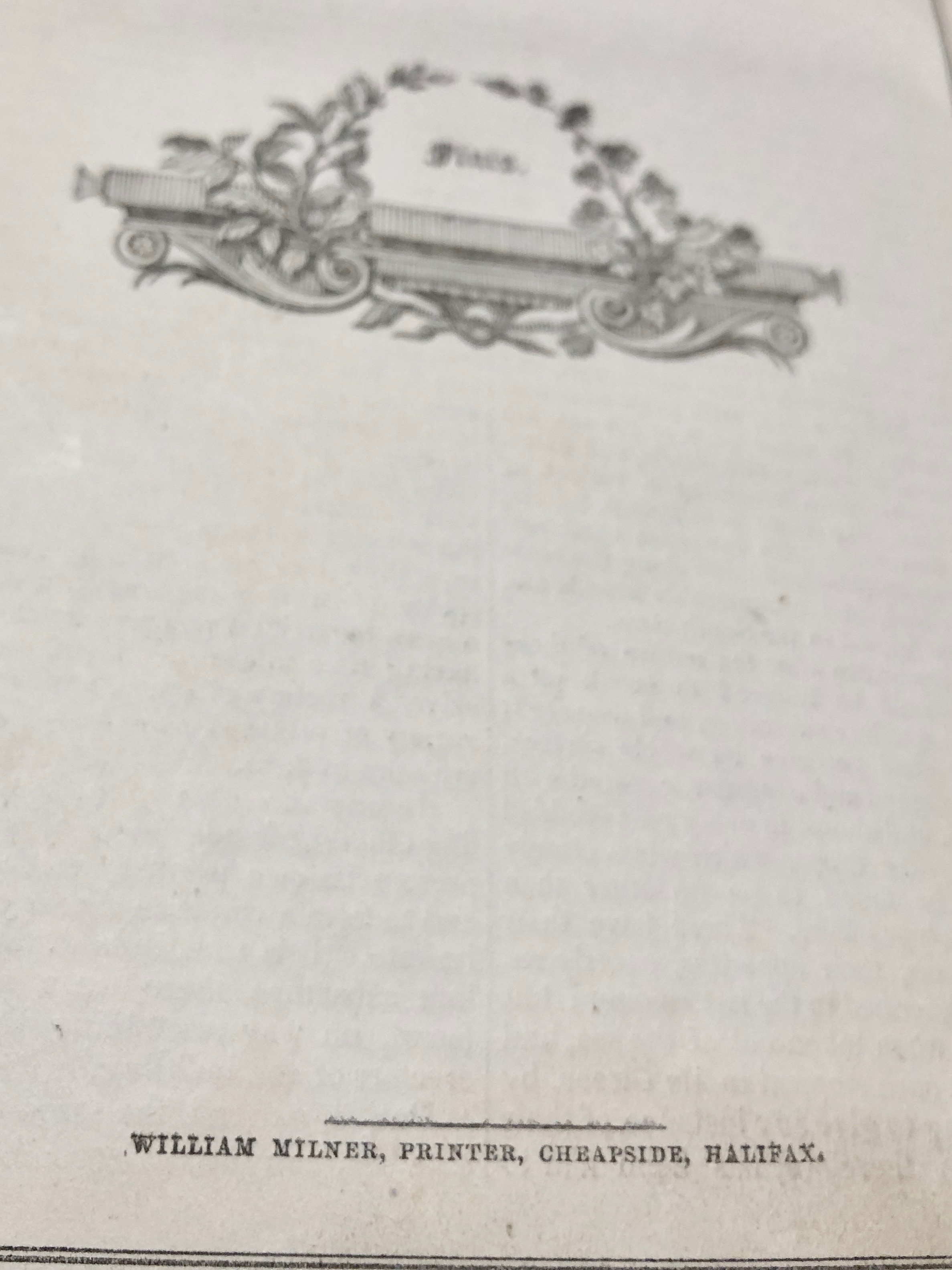
After comparison it is evident that the layout and the type are exactly the same. Beside the missing pages, the only differences are (possibly) the cover (my cover is a simple cloth on board, with raised bands and the title hot-stamped in gold on the spine while the microfiche copy is illustrated—although it is not clear if this is really a cover illustration or an inside cover page) and (definitely) the line of text at the very bottom of the last page of my book (“WILLIAM MILNER, PRINTER, CHEAPSIDE, HALIFAX.”) is completely missing for the microfiche copy. My conclusion is that it is indeed the same book, although a different edition (either a cheaper one or a different year of publication — but, save for the last page, it is clearly the same printing plates). 

Now that I have identified for sure the book as Natural History by Richard COPE, I only have to wait for the Bernard BARR’s book to see if I can learn more details about the publisher,  William Milner, and maybe also about the various editions of COPE’s Natural History. So, it is still to be continued…

[ Traduire ]

A Gentleman’s Murder

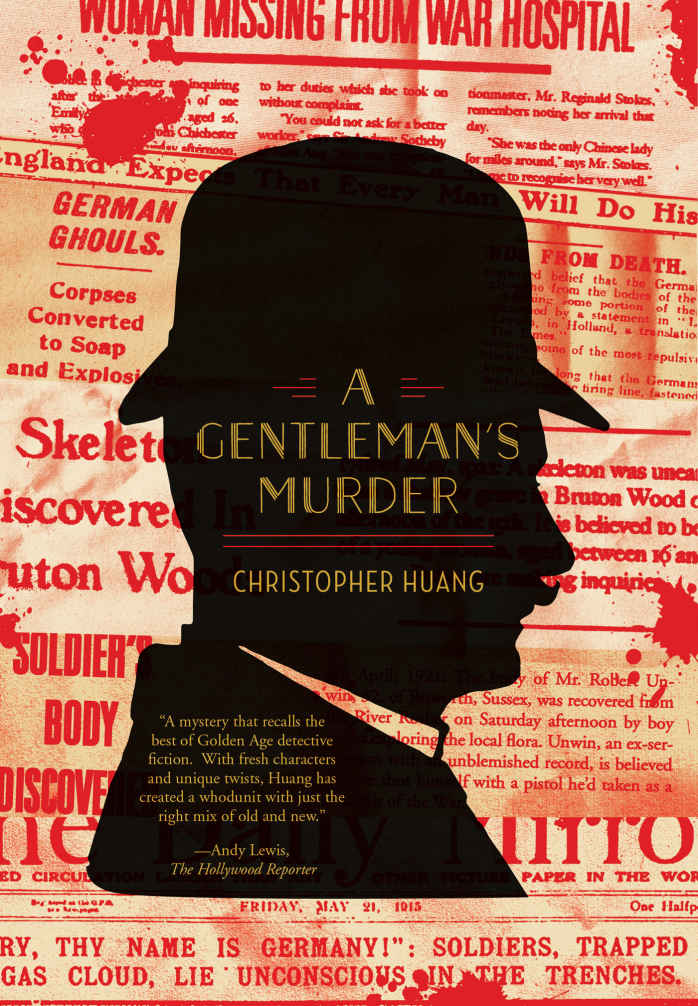
522362267When the newest member of Eric Peterkin’s London club is found stabbed to death, Eric throws himself into a quest for the truth: missing nurses, morphine addiction, shell shock. The Great War is over, but the memories remain…” (From the publisher’s website)

The year is 1924. The cobblestoned streets of St. James ring with jazz as Britain races forward into an age of peace and prosperity. London’s back alleys, however, are filled with broken soldiers and still enshadowed by the lingering horrors of the Great War. 

Only a few years removed from the trenches of Flanders himself, Lieutenant Eric Peterkin has just been granted membership in the most prestigious soldiers-only club in London: The Britannia. But when a gentleman’s wager ends with a member stabbed to death, the victim’s last words echo in the Lieutenant’s head: that he would “soon right a great wrong from the past.” 

Eric is certain that one of his fellow members is the murderer: but who? Captain Mortimer Wolfe, the soldier’s soldier thrice escaped from German custody? Second Lieutenant Oliver Saxon, the brilliant codebreaker? Or Captain Edward Aldershott, the steely club president whose Savile Row suits hide a frightening collision of mustard gas scars? 

Eric’s investigation will draw him far from the marbled halls of the Britannia, to the shadowy remains of a dilapidated war hospital and the heroin dens of Limehouse. And as the facade of gentlemenhood cracks, Eric faces a Matryoshka doll of murder, vice, and secrets pointing not only to the officers of his own club but the very investigator assigned by Scotland Yard.” (From the book flap)

In the roaring twenties, in the heart of the British Empire, a member of the Britannia Club is murdered. Eric Peterkin, a young half-Chinese man who usually spend his time reading submissions for a London publisher, cannot resist the urge to solve this mystery (with the occasional help of his sister Penny and his friend Avery). However, in order to discover who killed Benson—a man he barely knew—he will have to solve a cold case as well as a third murder. Amongst the prominent members of the club, who has done it? Aldershott, the club president? Bradshaw, the club secretary? Norris? Parker? Saxon? Wolfe? They all had possible motive and opportunity. Everything seems rooted in Flanders and in the manor turned into a makeshift hospital where some of them recovered or worked during the war…

A Gentleman’s Murder is  murder mystery novel inspired by the Golden Age of Detective Fiction. It follows all the rules of the genre (the Knox’s “Decalogue”) save for rule no. 5 (“no Chinaman must figure in the story”). It is set in the world of the military and retired officers’ club. The story particularly address the question of PTSD (or, as it was called then, “shell shock”) and, to a lesser extend, “the soldier’s disease” (aka morphine addiction).  As the author says in the book (p. 322) “Some scars weren’t visible. And some deaths weren’t physical.” The novel also talks about racial bias, as the character, who is half-English and half-Chinese, often struggle to be taken seriously because he doesn’t look like a gentleman. The author has probably drawn from his personal experience as he made his military service in Singapore (a city-state with the dual British and Chinese heritage) and is himself of Chinese origin.

The author seems to favour the post-WWI era because it is a beautiful era and doesn’t involved the complex methodology that investigators have to deal with in modern times (like DNA)—the mystery must remains in the reach of the amateur sleuth. As the author write in his postface, the 20s was a delicious time to write about because it was an exciting age of transition: you still have in place all the Victorian manners and mores but also all the innovation brought by the modern world (like telephone, radio, cars, electricity, etc.).

The story, which includes several unforeseeable twists, is very well written. The characters are detailed and quite believable. It seems that lots of efforts were put in describing all the setting with rigour (although most of the locations are fictional). Crime novel (particularly if set in the 20s) is a prolific genre and it’s hard to have such story not feel a little cliché. The only other caveat I can see is that the story offers so many characters and the protagonist takes so much time to imagine each possible permutation of culpability and action for EACH of those numerous suspects that, after a while, it gets a little tiring and confusing. It is almost impossible for the reader to guess who the murderer is — but, in this case, it is probably better that the dénouement come with a surprise.

A Gentleman’s Murder is a good novel. It is agreeable to read and, like all good murder mystery, you go through each new chapter with anticipation, reading faster and faster as the climax approaches. I recommend it warmly particularly because it is written by a local author. Christopher Huang, although born in Singapore, now lives in Montreal.

The publisher, Inkshares, is also of interest. It is a reader-driven publisher, which means that their books and authors are selected not by editors but by readers—through contests, pre-orders (as a form of crowdfunding you need 750 pre-orders to get published) and how much interest an online draft of the story is getting (i.e. follows, shares, and reads). Authors will receive 35% of net receipts (gross revenue minus the cost of production and distribution) in exchange of a full publishing service (editing, design, printing, marketing, as well as both direct and wholesale distribution). That seems a fair deal. It is an improvement on the self-publishing type publisher, where a publisher will “assist” an author in publishing his/her book. A good example of this type of publisher is the indie ebooks distributor Smashwords (one of my friends is using this service). Would-be writers have more and more options to publish their work.

A Gentleman’s Murder, by Christopher Huang. Oakland: Inkshares, July 2018. 348 pages. US$ 15.99 / C$ 19.99. ISBN 978-1-94264-595-5. For young adult readership (16+). stars-3-0

To learn more about this title you can consult the following web sites:

[ AmazonBiblioGoodreadsGoogleInksharesWorldCat ]

© 2018 Christopher Huang

[ Traduire ]

A Natural History Investigation Update

Here’s a quick follow up on my research to identify one of my old books…

My first attempt to get Bernard BARR’s book about William Milner failed because the Montreal libraries have a policy not to get an Inter-Library Loan (PEB) if it will incur a fee for the borrower. Actually, I wouldn’t have minded but I’ll check if the National Library (BAnQ) has a similar policy. The last resort would be to travel to NYC where the NYPL has a copy… Or I could get a copy through Google books or Amazon… Although, it doesn’t seem available… We’ll see…

In the meantime, I dug deeper into WorldCat and found possible candidates for my book.

The first candidate could be: Georges Louis Leclerc BUFFON, comte de. Natural History (containing a full and accurate description of the animated beings in nature : illustrated with upwards of three hundred engravings of birds, beasts, fishes, reptiles, insects, etc.). Milner & Co., [188-?], 224 pages. Interesting description of the binding (red cloth over boards stamped with black ink, gilt title on top board, gilt spine ornaments) but it’s too recent and there’s not enough pages to be my book…

The second candidate looks more interesting: Richard COPE & Thomas BEWICK, Natural History (or a description of the earth and of animated nature, compiled from the works of Buffon, Goldsmith, Cuvier, Shaw, Vaillant, Humboldt, Audubon, &c.). Milner & Co., [1860]. It was first published in 1840 and has 730 pages, its size is 23 cm and includes 425 engravings [by or after T. Bewick]. I could compare my book with it since the Université de Montreal has a copy (but is it available to the public? And it doesn’t say which specific library…). There’s another edition of 1846 (but the size is 27 cm) again with a copy at the UdeM. Among the numerous editions (many seems to be microform copies) of the same book, the oldest seems to date from 1842. One specifically says “by William Milner, Cheapside, 1846” (with also a copy at the UdeM!). Too bad there are no pictures. 

The Cheapside 1846 edition seems the best option, so I’ll first see if I can get it through Inter-Library Loan (despite the age of the book). If not, I’ll go to the UdeM to investigate further… 

To be continued

[ Traduire ]

Doodling girls

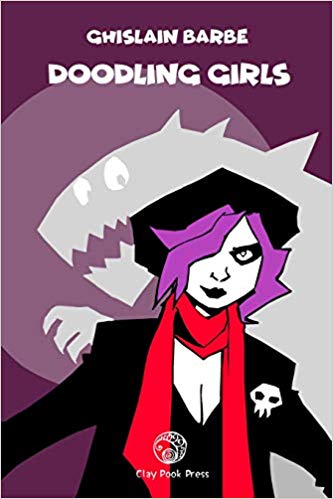
DoodlingGirls-covGhislain Barbe is best known for designing the visual aspects of several science fiction franchises such as Heavy Gear, Jovian Chronicles and Tribe 8. He also created the visuals for the characters of PBS’s cartoon TV series Sagwa, the Chinese Siamese Cat and worked as Art Director in the videogame industry. Doodling Girls 2017 is a collection of girls illustrations taken from his 2016 and 2017 Sketchbooks. (From the publisher’s website)

All these doodles were made for the fun of it (i.e. no commercial purposes) between January 1st of 2016 and December 31st of 2017. Some might have been inspired by pictures seen here and there, other are pure products of the need to fill a piece of paper. (Book’s introduction)

The reason I find difficult to read books written by people I know is that I am always afraid that I might not like them and have to make negative comments… I really want to talk about this book, but unfortunately I found it quite disappointing. So, I guess it will be a case of “Qui bene amat bene castigat”…

Above all, I must say that Ghislain Barbe is without contest one of the best artist I have ever known. He is incredibly fast and extremely creative. His art is usually quite great. I particularly like his character designs (although he can do great mechanical designs too). I still remember this young man, both shy and quite volubile, from Quebec City knocking on our office door with his portfolio under the arm. We were impressed right away by his work and I have always had great respect for him. After doing cover and illustration works for Ianus Publication/Protoculture and, later, Dream Pod 9 (Alternate Reality Cyberpunk, Heavy Gear, Jovian Chronicles, Tribe 8), he worked at CinéGroupe as character designer (on animation like Sagwa the Chinese Siamese Cat, Lion of Oz, Pig City), and then as concept artist as well as art director for Behaviour Interactive (on videogames like Carmen Sandiego and the Secret of the Stolen Drums, Disney’s Planes or Warhammer 40,000: Eternal Crusade MMO). He also illustrated Annie Bacon’s series “Le gardien des soirs de bridge published by Les Éditions Druide. His talent is well recognized.

DoodlingGirls-3The Doodling Girls’ illustrations themselves are quite good even if they are simple sketches. Barbe made those morning doodles every day to keep is drawing hand and his creativity sharp (and probably also to keep his sanity through the vicissitudes and trials of life — a widower rising three teenage girls might certainly have its challenges). I understand that perfectly since that’s what I am trying to do with this blog, trying to write a few hundreds words each day to keep my mind sharp and my sanity. Here, this book gathers some of those doodles that all share one thematic: girls — in all styles or situations, from the silly to the macabre. It is an interesting concept to make use of those doodles, and gather them in an impromptu portfolio. He probably got tired of working on other’s people books and wanted to do one just for himself (and his girls) — for the fun of it ! So, he self-published it (under the name Clay Book Press) using Lulu.com. Hopefully more books will follow, like Doodling Girls 2018-19, Doodling Creatures (as he draws more than girls), or simply Morning Doodles, or even Meeting Doodles (as I know he was also doodling in production meetings!)…
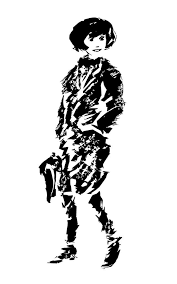
DoodlingGirls-5If the artist is great and the concept is interesting and the drawings themselves are good, then what’s the problem? The disappointment lies in the annoyingly sloppy execution of the concept — although none of this is really the fault of the artist. First, the book offers very little introduction (less than fifty words!) and there are no page numbers, titles, descriptions, production dates or commentaries for the illustrations. This book definitely lacks text. Second, I am sorry to report that my copy has a defect in the printing of the cover (the cover is badly cut: the spine titles are actually on the cover itself and there’s a white bands on the left side of the back cover where we can see crop marks!). Very bad quality control! That printer should be hanged: defective copies should never make it to distribution!! Please choose your printer wisely! Third, the book was printed in the USA, purchased via Amazon.ca and shipped by Book Depository in the U.K. ! That’s the worse example of a wasteful distribution chain I’ve ever seen. Please choose your mean of distribution even more wisely! Finally, that kind of book would usually sell for $15 to $30… $53.76 [although it depends on the seller: from US$ 31.72 on AbeBooks and US$33.22 on Barnes & Noble to C$ 44.17 on Amazon.ca] is a little too much (particularly for artwork that are already available for free on the internet: Behance, Facebook, Pinterest, Tumblr, etc.)! That’s what happens when there are too many intermediaries, each taking their share (Lulu.com, the printer, the seller, the distributor, the shipping cost, etc.). All inclusive “publishers” like Lulu.com are not always the perfect solution, unfortunately (but, I’ll admit, they are convenient). In a way, I don’t really mind because I wanted to encourage the artist in his endeavour no matter the price. Otherwise, it’s really too expensive! Sorry, Ghis! I am sure you could have done better!

All in all, despite its shortcomings, it IS a nice book. It is an artbook, so it’s not something you will really “read”, but it makes for a pleasing coffee table or bedside book. So, don’t hesitate to purchase this book to encourage the artist. However, if you want to see his best works, it’s probably better to buy one of his other books (like a Heavy Gear Rulebook for example)! 


Doodling Girls, by Ghislain Barbe. Montreal: Clay Book Press (Lulu.com), December 2018. 160 pages, 15 x 23 x 1.7 cm, US$ 33.22 / C$ 44.17, ISBN 978-0-359-20459-5. For readership of all age. (See back cover). stars-3-0

For more information you can check the following websites:

[ AmazonGoodreadsGoogleIMDbWikipediaWorldCat ]

© 2018 by Ghislain Barbe.

[ Traduire ]

Un parc toujours glacé

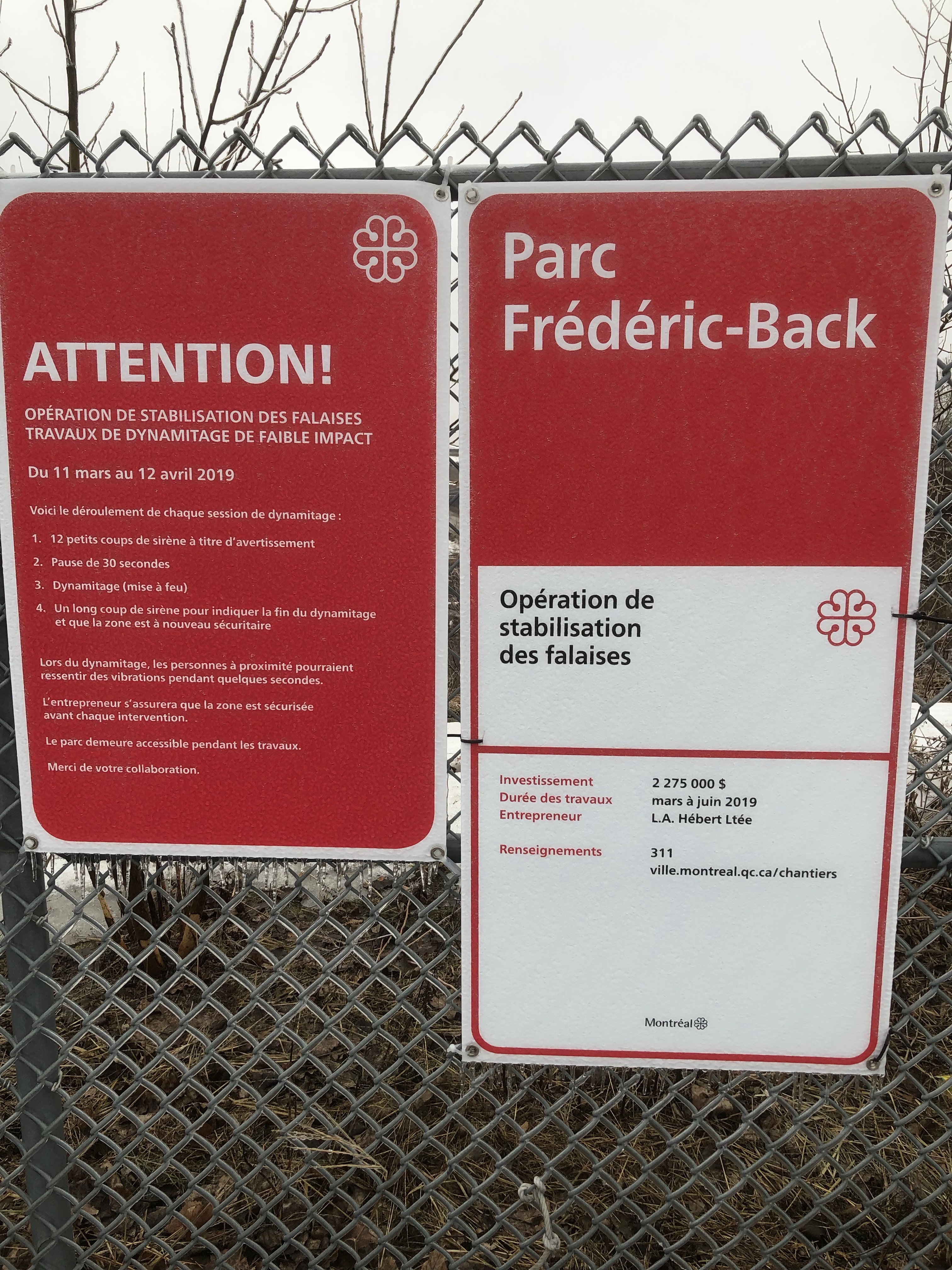
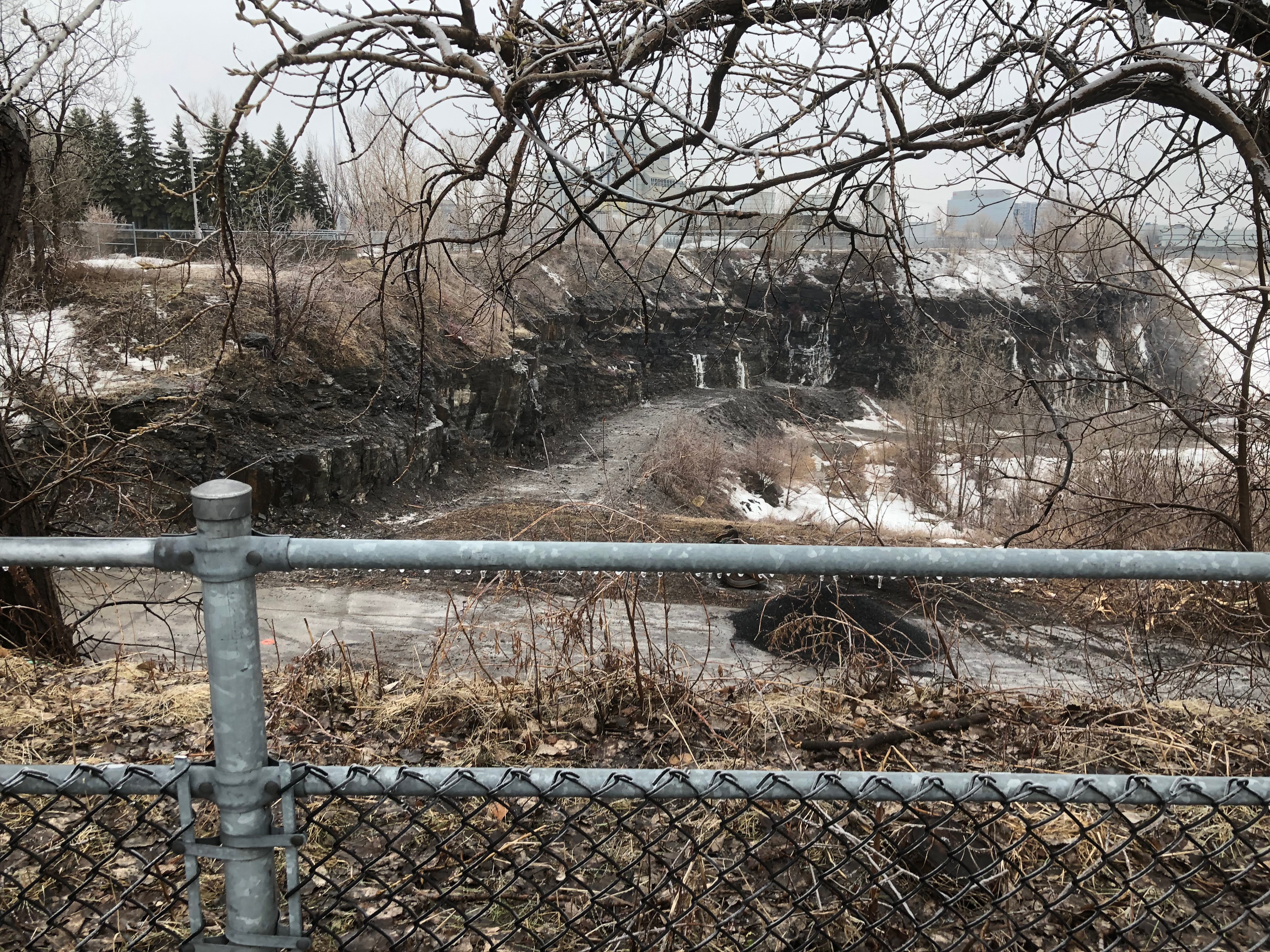
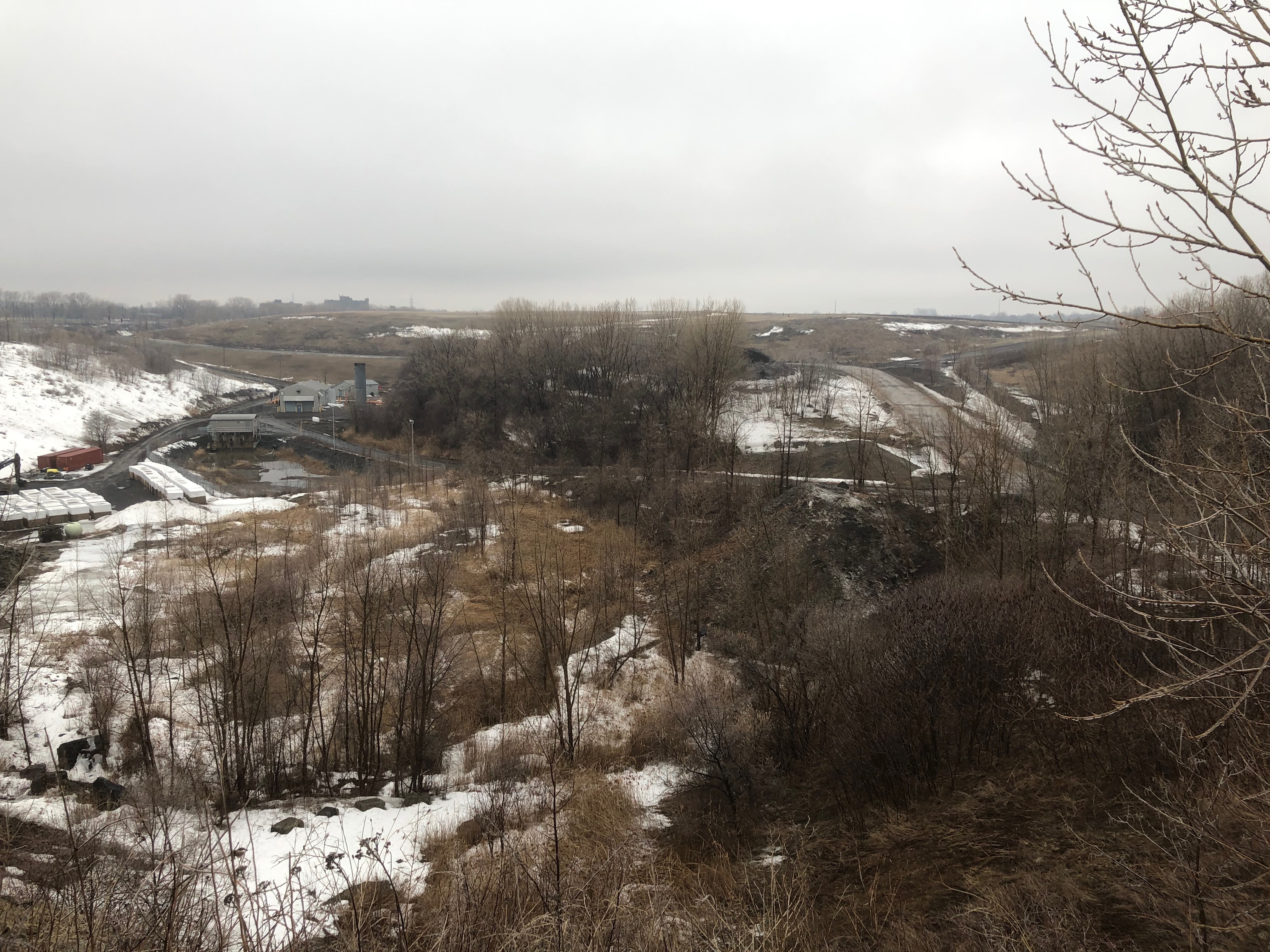
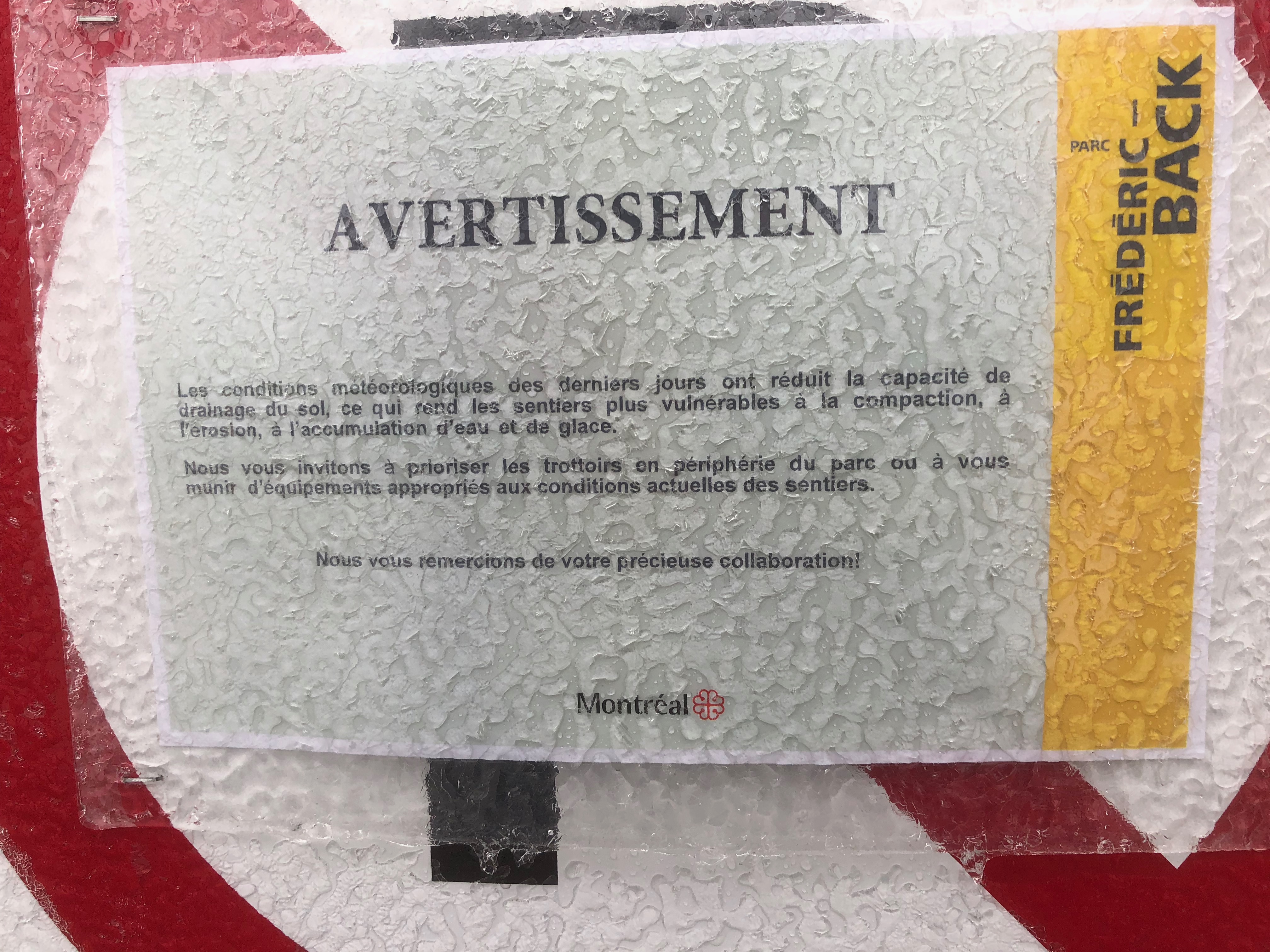
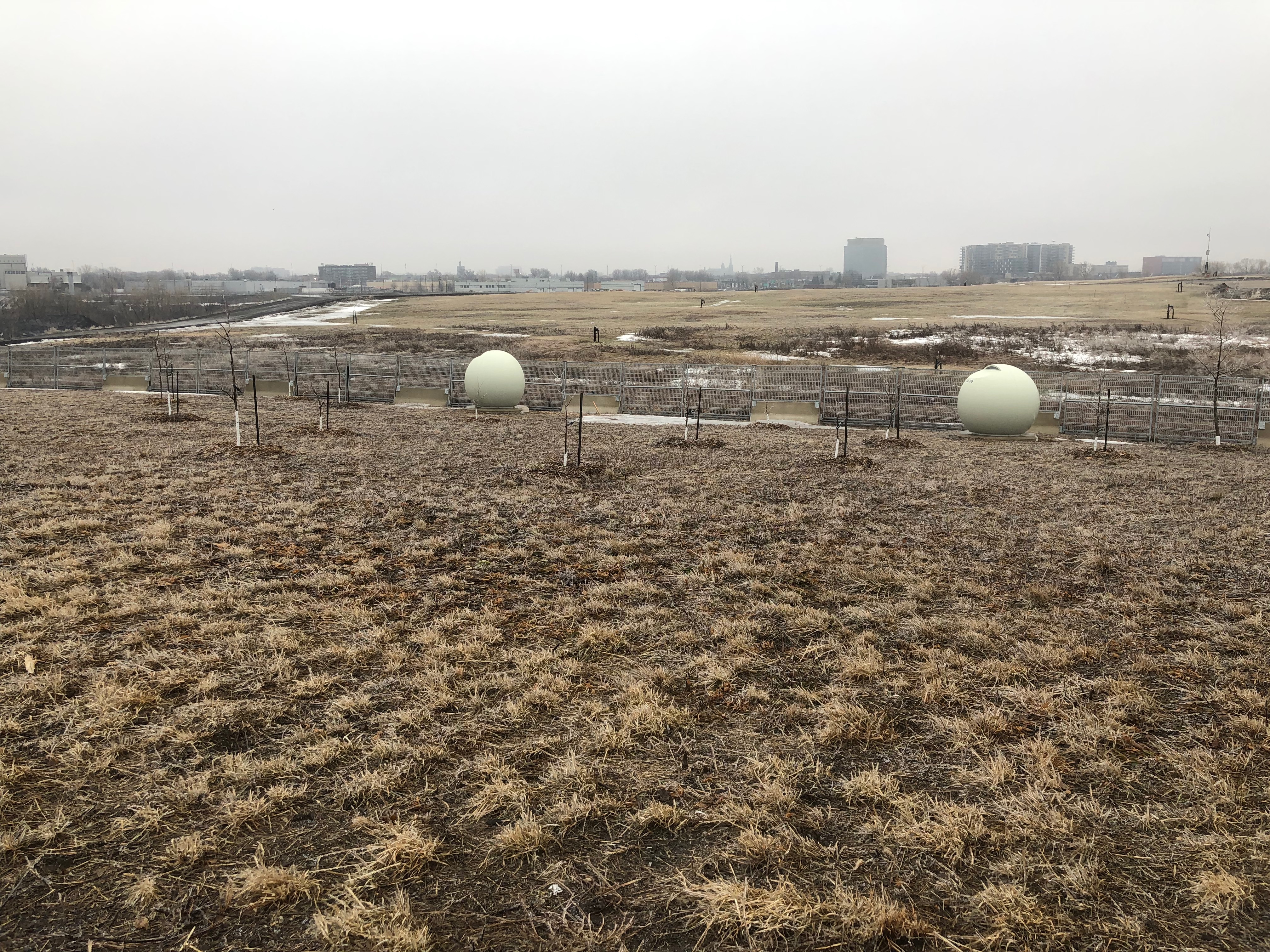
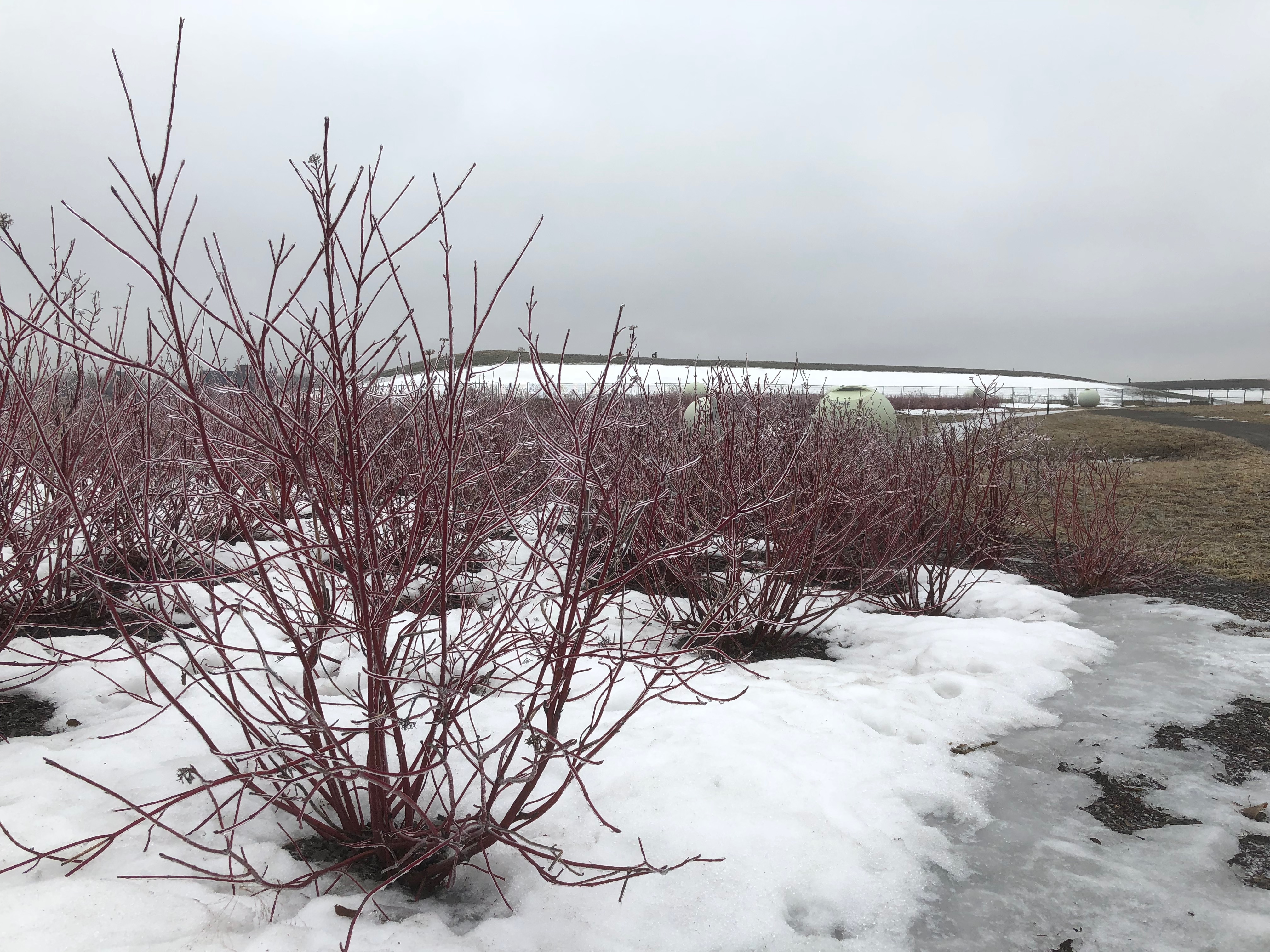
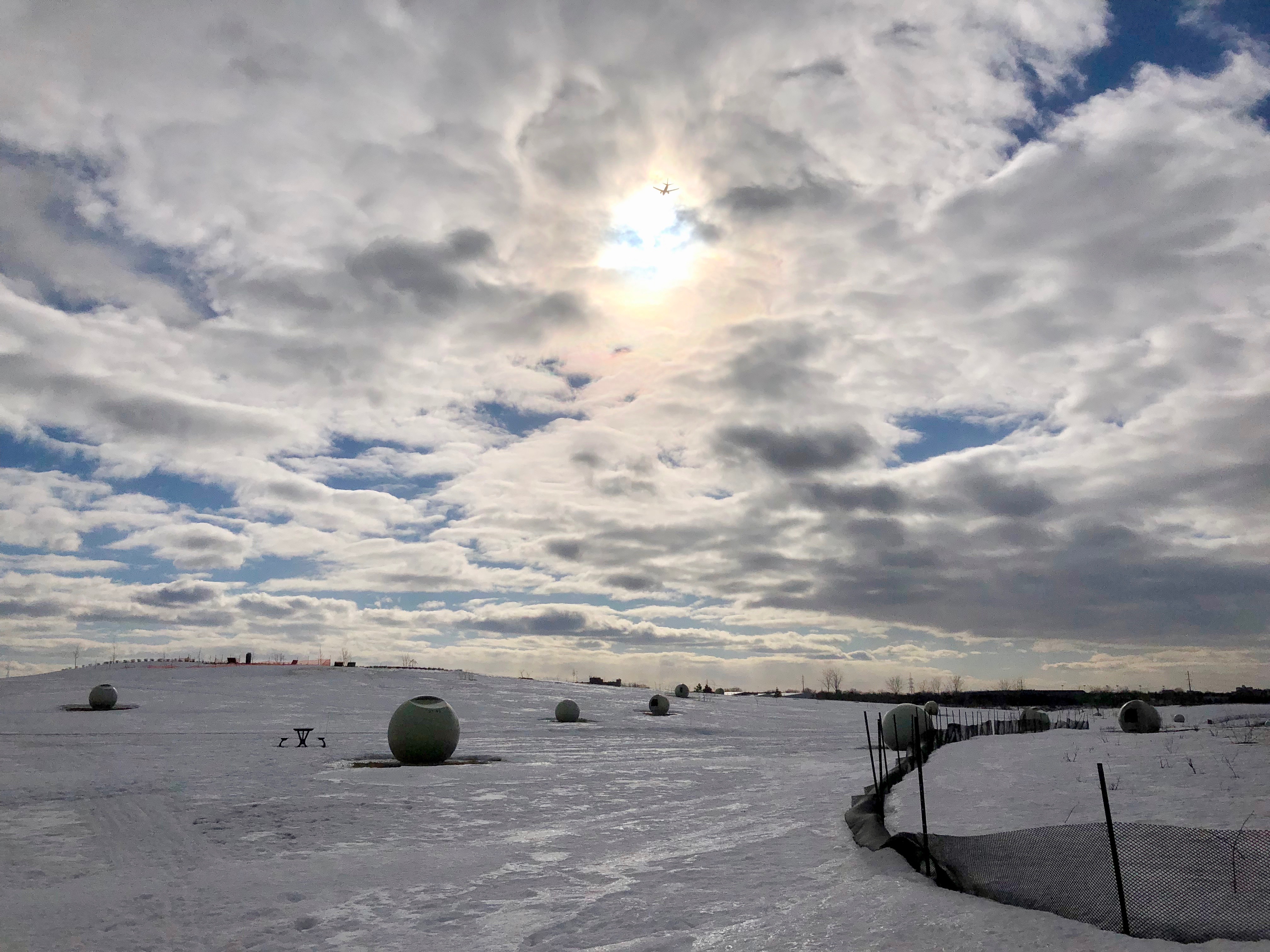
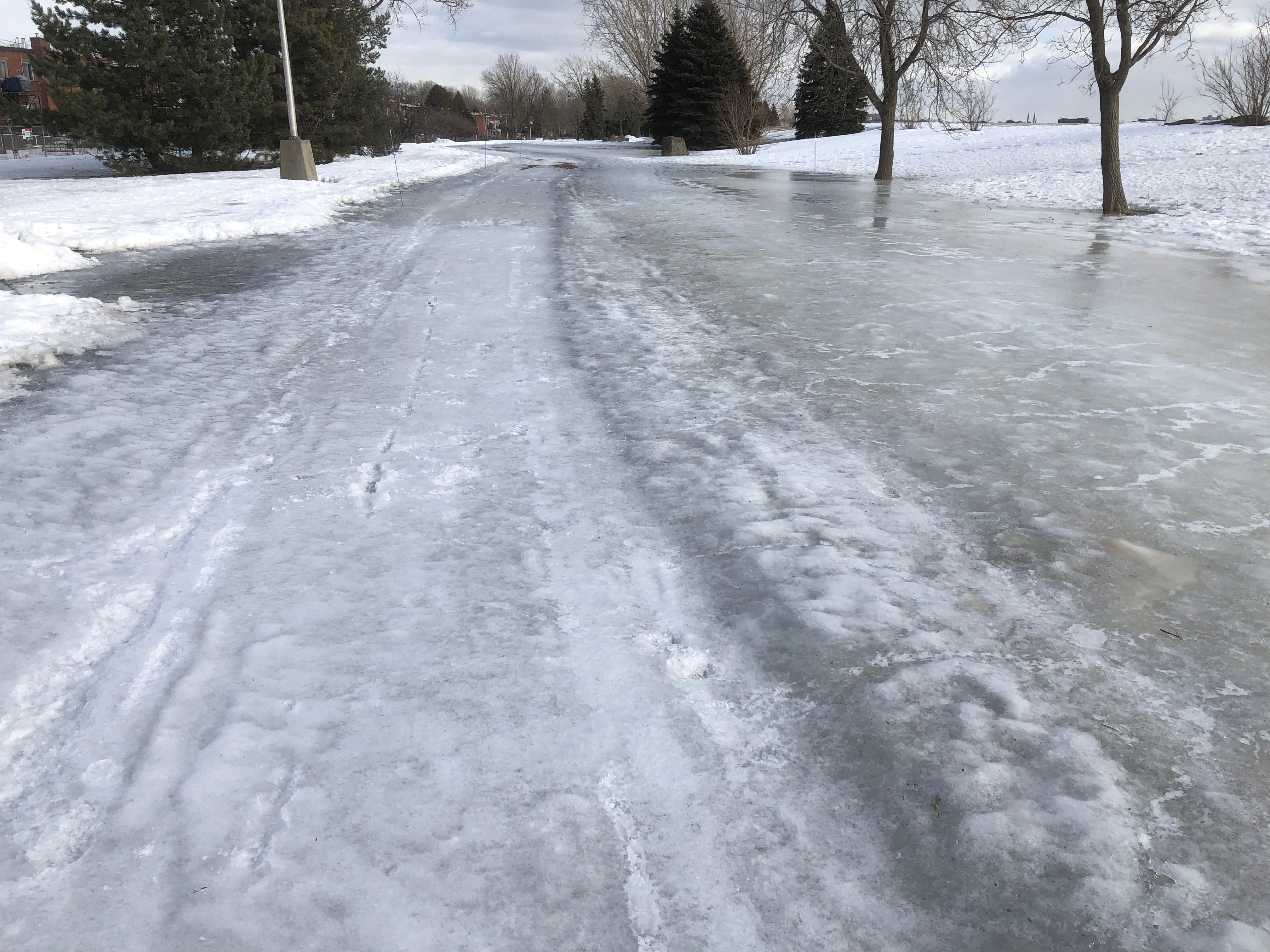
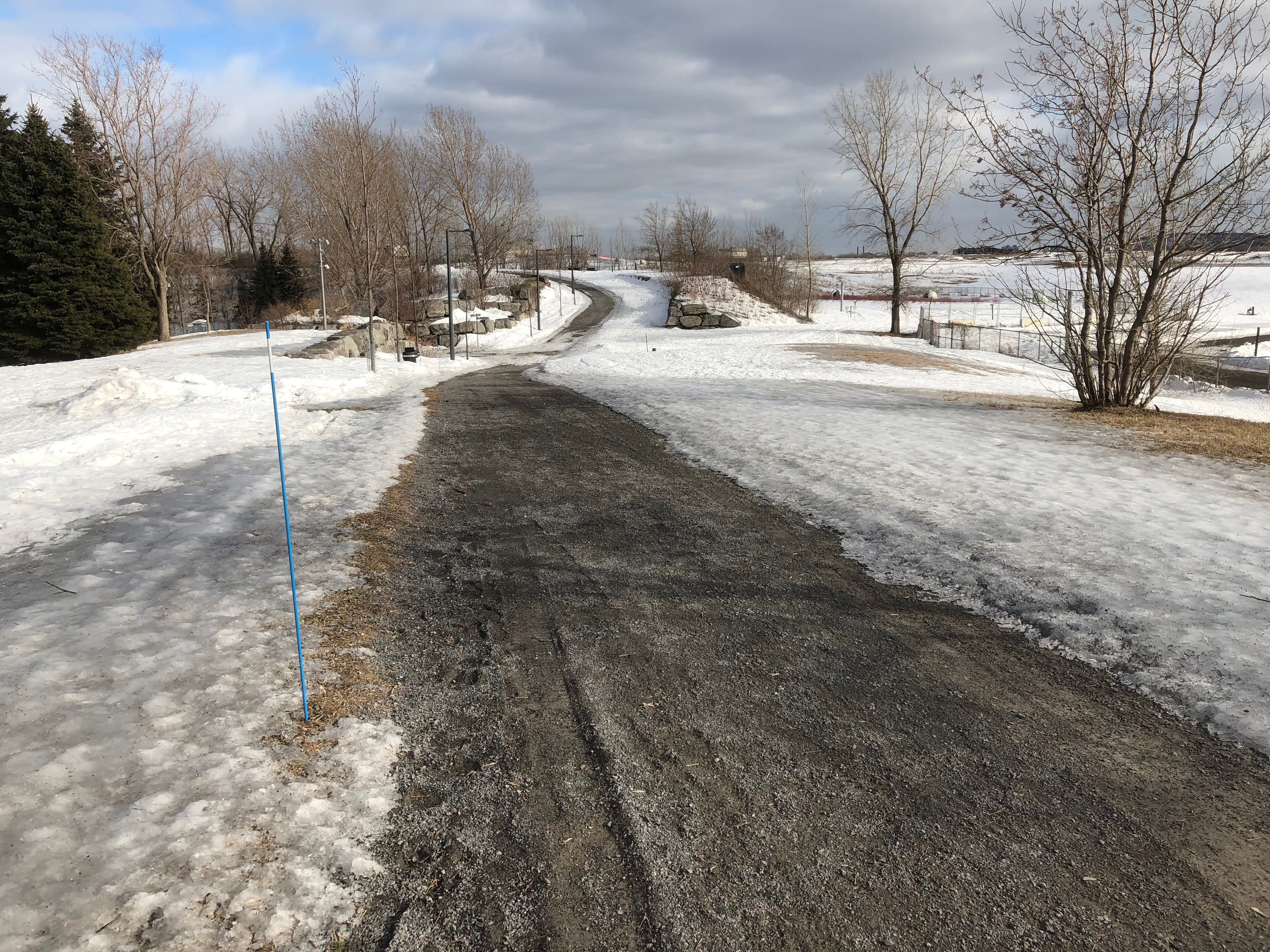
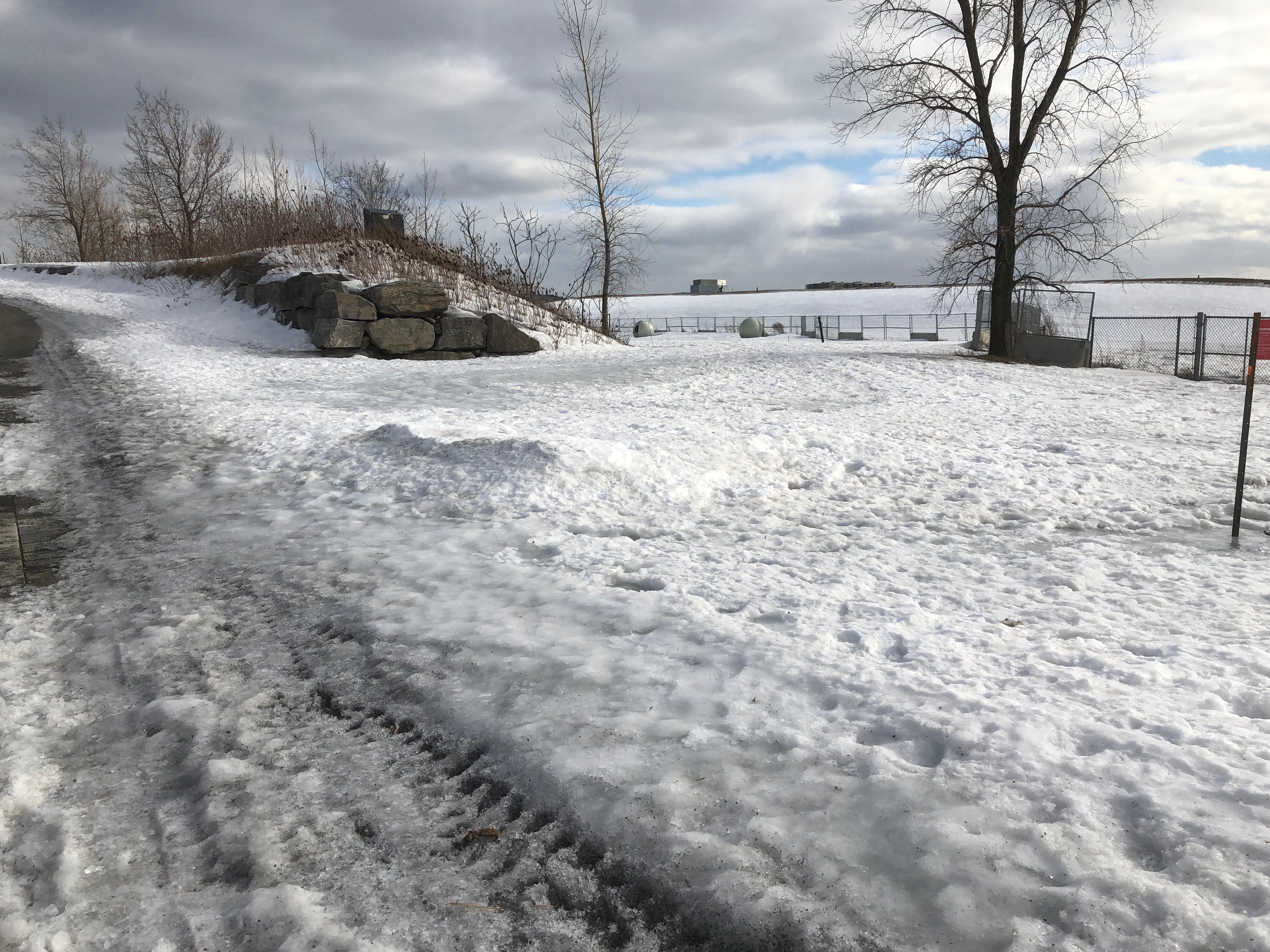
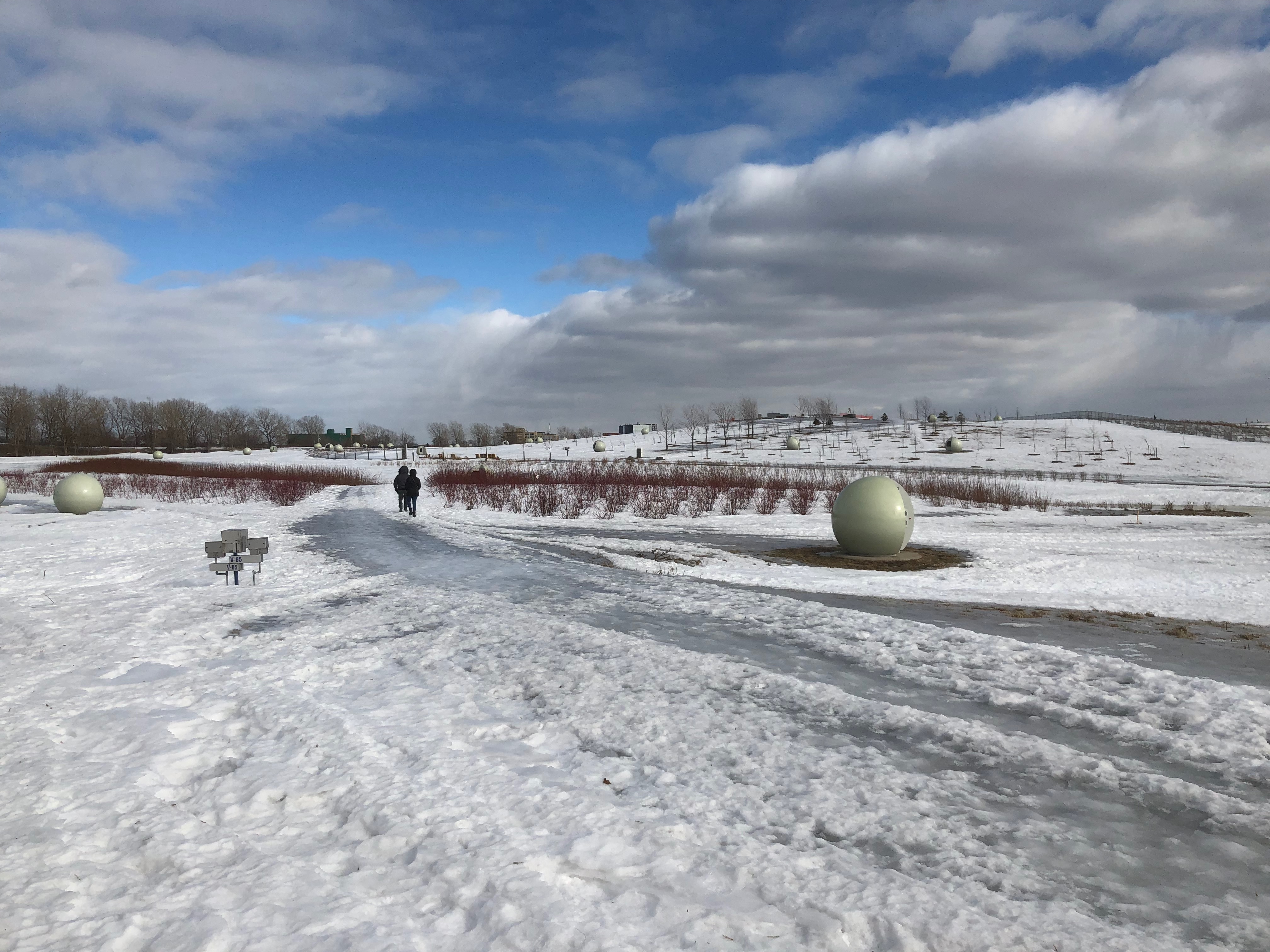
Constatant que les rues et les trottoirs étaient largement libre de glace, j’ai décidé d’aller prendre ma marche de santé sans mettre mes crampons. Quelle Erreur! Le Parc Frédéric-Back est lui toujours glacé sur la majorité de ses sentiers (et ceux qui sont libre de glace sont évidemment plutôt boueux)…

J’ai pris le sentier polyvalent par le parc Champdoré, comme à mon habitude, et dans ce secteur c’est toujours une patinoire qui nécessiterait un épandage généreux d’abrasifs. C’est le cas jusqu’après la côte, passé l’entrée Legendre, et après cela c’est fondue. Toutefois, n’ayant pas été déneigé de tout l’hiver, l’accès Émile-Journault vers l’intérieur du parc est encore enneigé et glacé. Par contre, comme la neige a fondue un peu et est durcie, cette entrée est maintenant accessible sans trop d’acrobaties. À partir de là, le sentier qui fait le tour de la butte du “boisé” est en grande partie dégagé.

Je suis donc très déçu que le Parc Frédéric-Back, qui devrait normalement être accessible en toute saison tant aux piétons, coureurs et cyclistes, qu’aux skieurs et raquetteurs, n’a reçu que très peu d’entretien cet hiver, le rendant pratiquement inaccessible aux randonneurs qui n’ont pas de crampons et le laissant au plaisir exclusif des skieurs et raquetteurs. Cela n’a d’ailleurs rien à voir avec la quantité de neige ou de pluie reçue cet hiver et tout à voir avec la quasi absence de déneigement et d’épandage d’abrasifs dans le parc. Le parc était beaucoup mieux entretenu durant l’administration précédente. Comme la mairesse de VSP m’a informé que le “parc se trouve dans notre arrondissement cependant la gestion ne nous reviens pas” et qu’il “fait partie du réseau des grands parcs et donc c’est la ville centre qui le gère,” je vais donc dorénavant adresser mes doléances à la ville centre (Ville de Montréal, Valérie PlanteParc Frédéric Back) qui malheureusement réponds pas mal moins souvent (jusqu’à maintenant je n’ai jamais eut de réponses) aux commentaires que les arrondissements…

Voir mes autres commentaires sur l’état glacé des sentiers du Parc Frédéric-Back avec mes billets Coeur de glaceN’ice park, et Stat’ice report.

Aussi, suite à cette malencontreuse chute sur le sentier polyvalent du parc (où j’ai  déchiré mon pantalon), j’ai décidé de faire une réclamation à la ville (pour le remplacement de mon pantalon et l’achat de crampons!). J’ai reçu une confirmation écrite (dans un language un peu intimidant!) et par téléphone. On me demande si j’ai reçu des dommages physiques. Je réponds que si c’était le cas je l’aurais mentionné dans ma réclamation. “À part le pantalon déchiré et une petit ecchymose, non, il n’y a pas eut de dommage physique”. Sur ce on me répond (je paraphrase), “une ecchymose? Ben là, à cause de ce dommage à votre personne il va y avoir un délais d’un mois avant que l’on puisse poursuivre la réclamation” ! Maudite ville à marde!

[ Translate ]

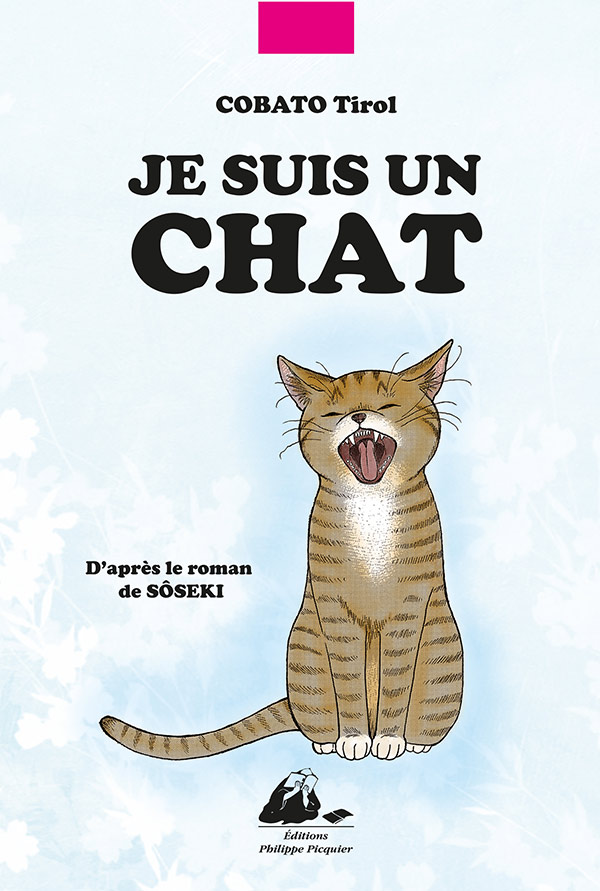
Je suis un chat

Je-suis-un-chat“Le célèbre roman de Sôseki devient un manga. Célèbre et désopilant. Vue par l’œil ironique d’un chat doté de remarquables talents d’observation et d’analyse, voici la vie d’un professeur d’anglais et de son entourage au début du vingtième siècle, lorsque le Japon est secoué par l’essor des valeurs mercantiles venues d’Occident.

Le professeur Kushami, double de l’auteur, sa famille, ses visiteurs, l’étudiant amoureux, le tireur de pousse-pousse, le riche industriel, la maîtresse de koto, sans oublier les chats, l’univers fantaisiste et débridé du roman est parfaitement restitué, avec toute sa richesse et sa profondeur.”

(D’après le site de l’éditeur; voir aussi la couverture arrière)

Je suis un chat (吾輩は猫である / Wagahai wa, neko de aru / lit. “Moi qui suis un chat”) est l’adaptation en manga d’un classique de la littérature japonaise par le romancier Sôseki. Le roman avait d’abord été publié en feuilletons dans la revue littéraire Hototogisu entre 1905 et 1906. 

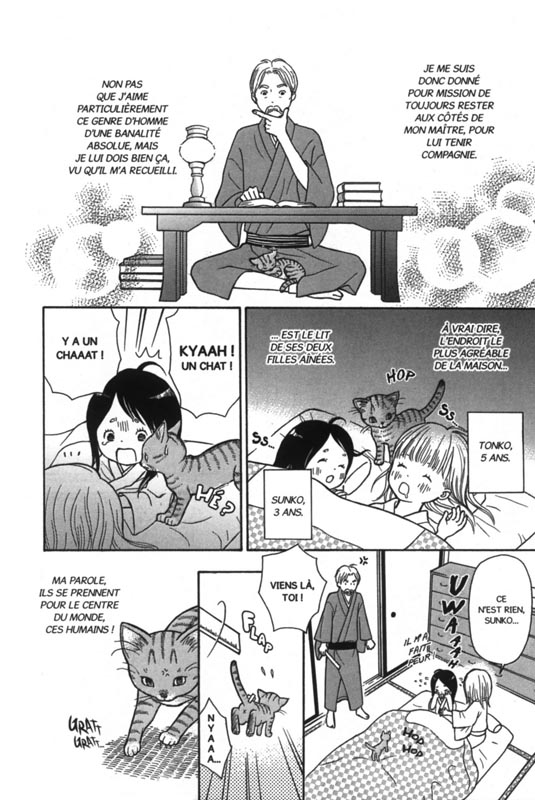
9782809711905_pgKushami est professeur de littérature anglaise à l’ère Meiji et tout un monde orbite autour de lui: ses étudiants (Meitei, Kangetsu), ses amis, sa famille, ses voisins. Le témoin de cette vie quotidienne est un chat sans nom, qui prends ici la place d’un narrateur omniscient. Il s’agit d’un récit satirique, qui parodie la classe moyenne japonaise ayant adopté tant bien que mal les coutumes de l’occident et qui se prends des airs arrogants. Une bonne partie de l’intrigue se déroule autour des spéculations sur le possible marriage de Kangetsu avec Tomiko, la fille des Kaneda — un riche marchand. Malheureusement, l’histoire finit mal pour le chat…

Le récit est très amusant et assez proche de l’oeuvre originale. Par contre, le style graphique est plutôt décevant: il est très simple (épuré, voir primitif) mais il fait tout de même le travail et illustre bien le récit. C’est une excellente façon de faire connaître cet oeuvre de Natsume Sōseki — dont le personnage est un peu l’alter ego de Sōseki qui était lui aussi professeur de littérature anglaise.

Je suis un chat, par Cobato Tirol (Traduction par Patrick Honnoré). Arles: Éditions Philippe Picquier, août 2016. 208 pages, 14,50€ / C$ 26.95, ISBN-13 : 978-2-8097-1190-5. Pour lectorat de tout âge. stars-3-0

Pour en savoir plus vous pouvez consulter les sites suivants:

[ AmazonBiblioGoodreadsGoogleWikipediaWorldCat ]

© Tirol Cobato / Home She, 2010. © Éditions Philippe Picquier 2016 pour la traduction française.

A noter que l’on retrouve d’autre mangas aux Éditions Philippe Picquier:

Miss Hokusai Tome 1, par SUGIURA Hinako.
Dix Nuits Dix Rêves, par KONDÔ Yôko (D’après le roman de Sôseki).
La porte,  par INOUE Daisuke (d’après le roman de Sôseki).

[ Translate ]

Capsules

Latest acquisition

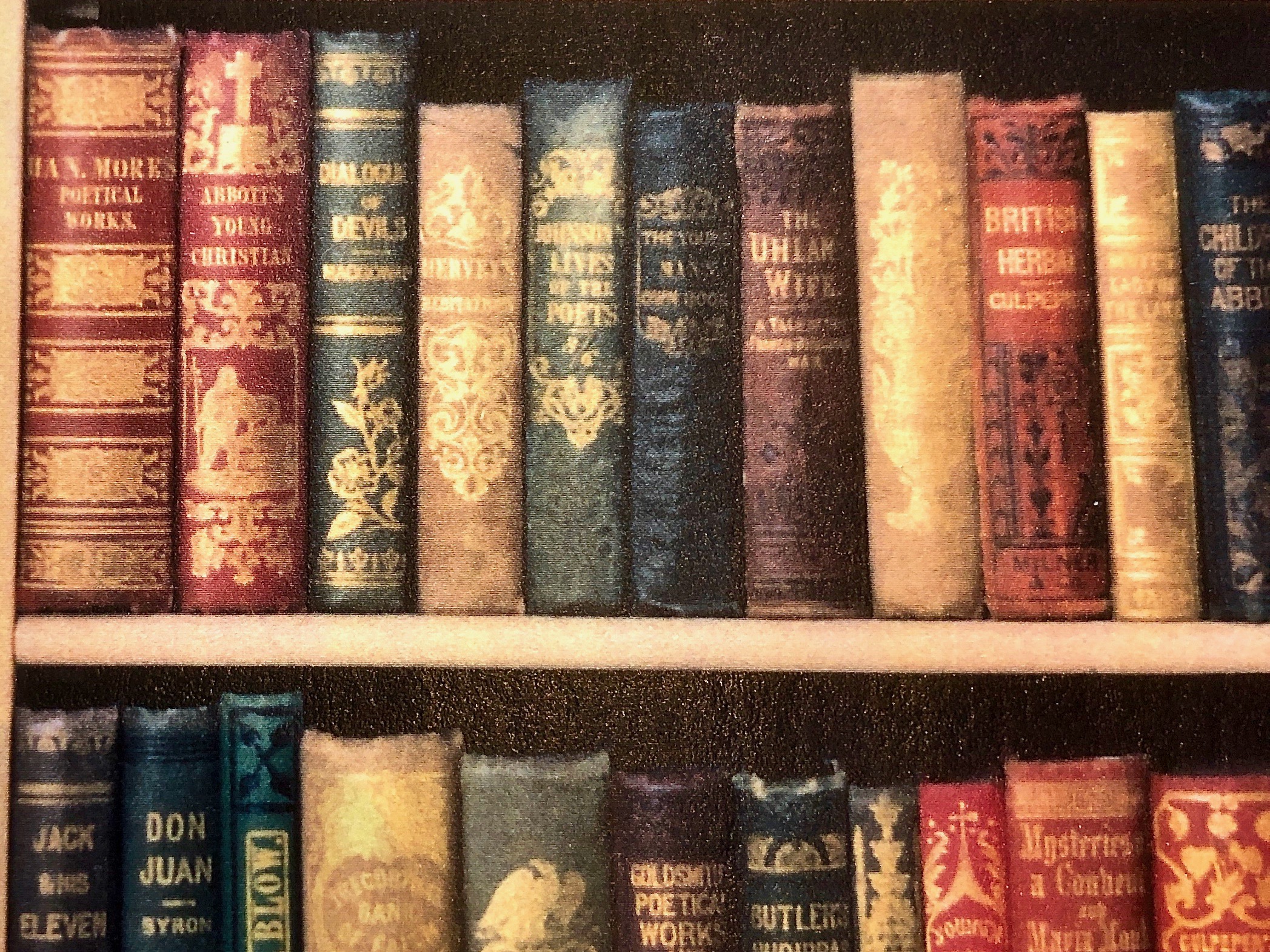
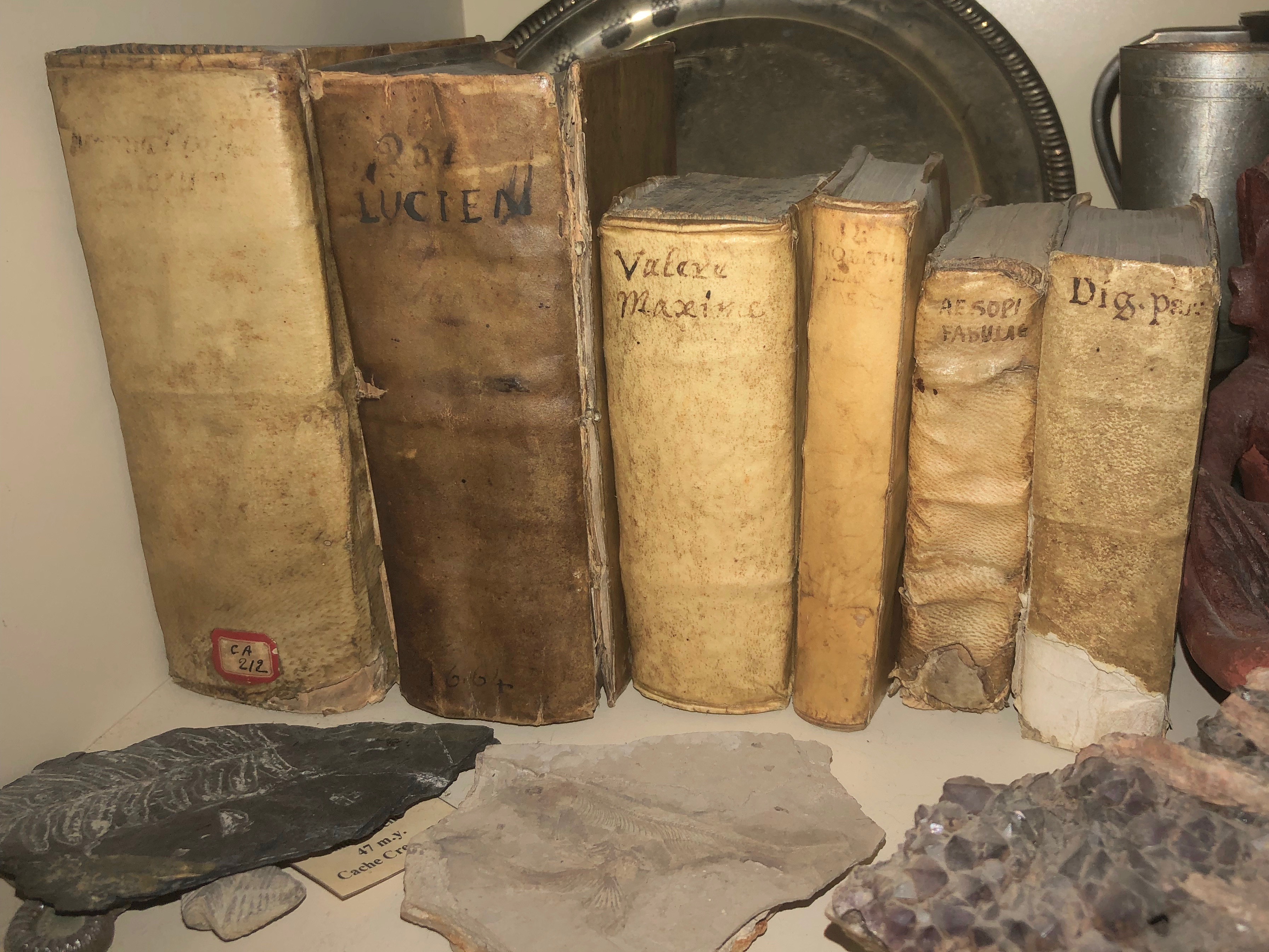
A couple of years ago I’ve talked about my collection of ancient books. Well, I just made a new acquisition. I never thought I would find more interesting (but affordable) books to add to this collection…

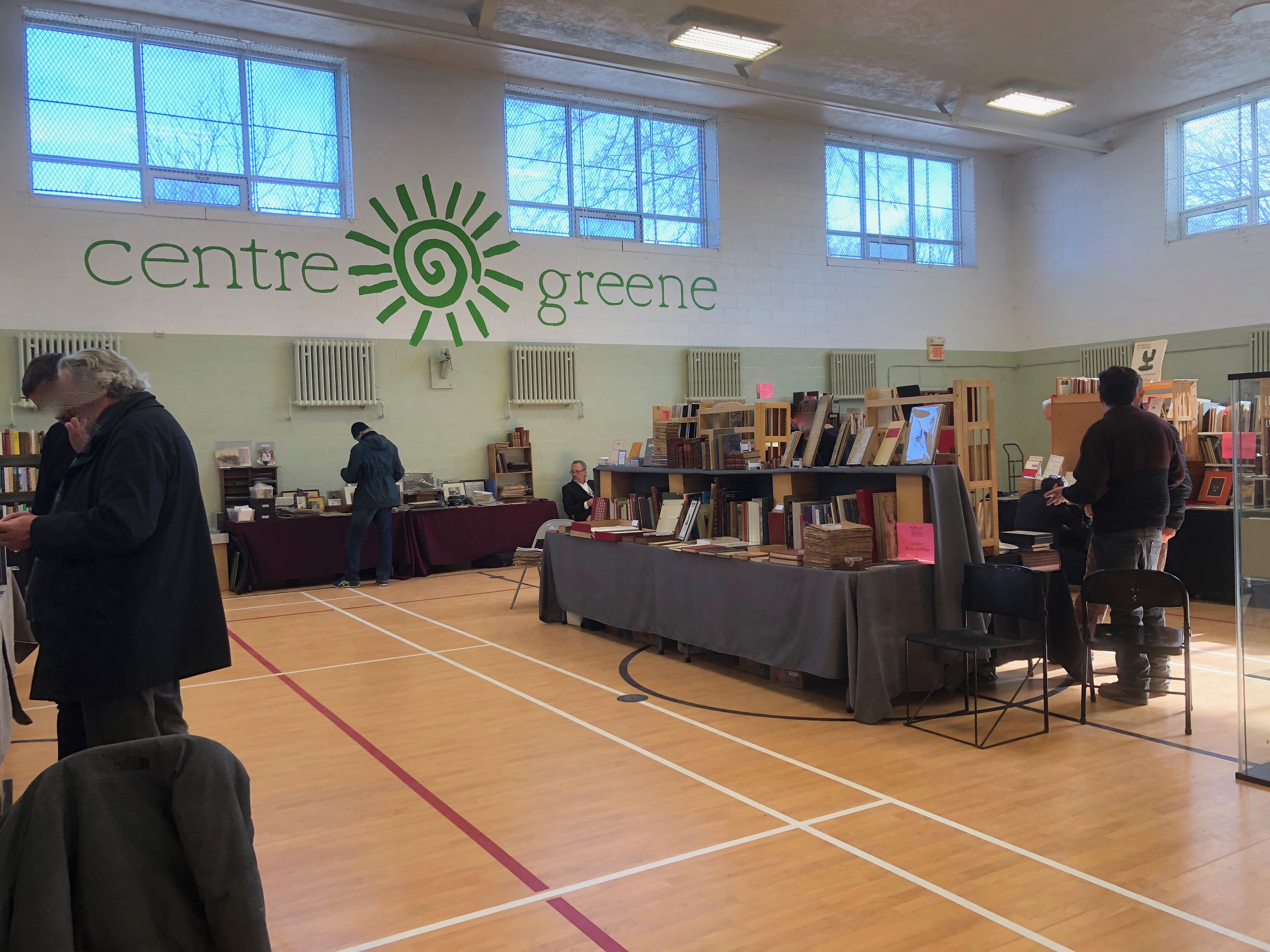
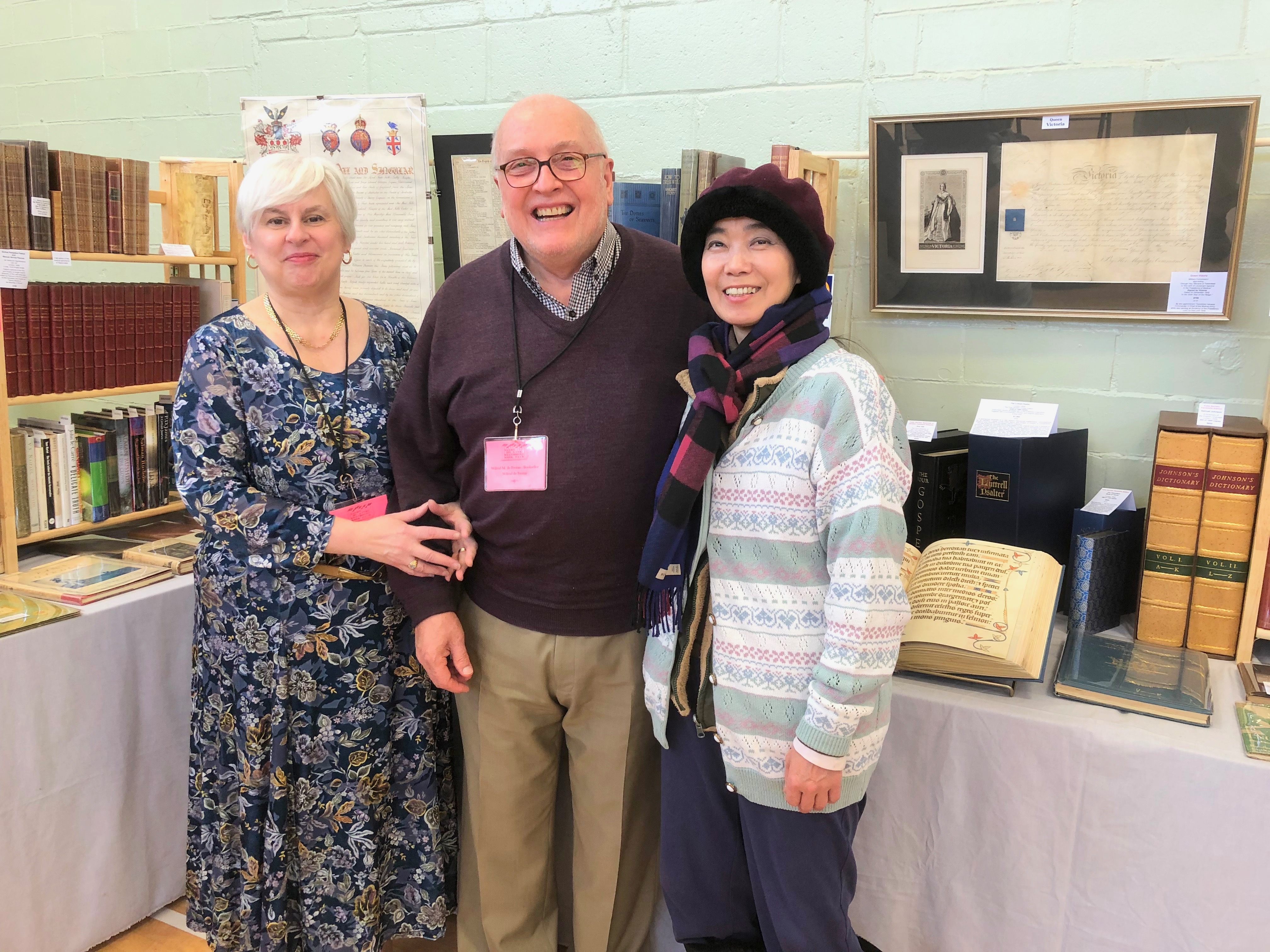
This week-end I went to the Westmount Book Fair at the Green Center in Westmount. I’ve been hearing about this bi-annual antiquarian book fairs for a while and always wanted to have a look but was always too busy. When I saw another one advertised on facebook, I thought now was the time. Although I was rather apprehensive that I would find a very interesting (and expensive) book.

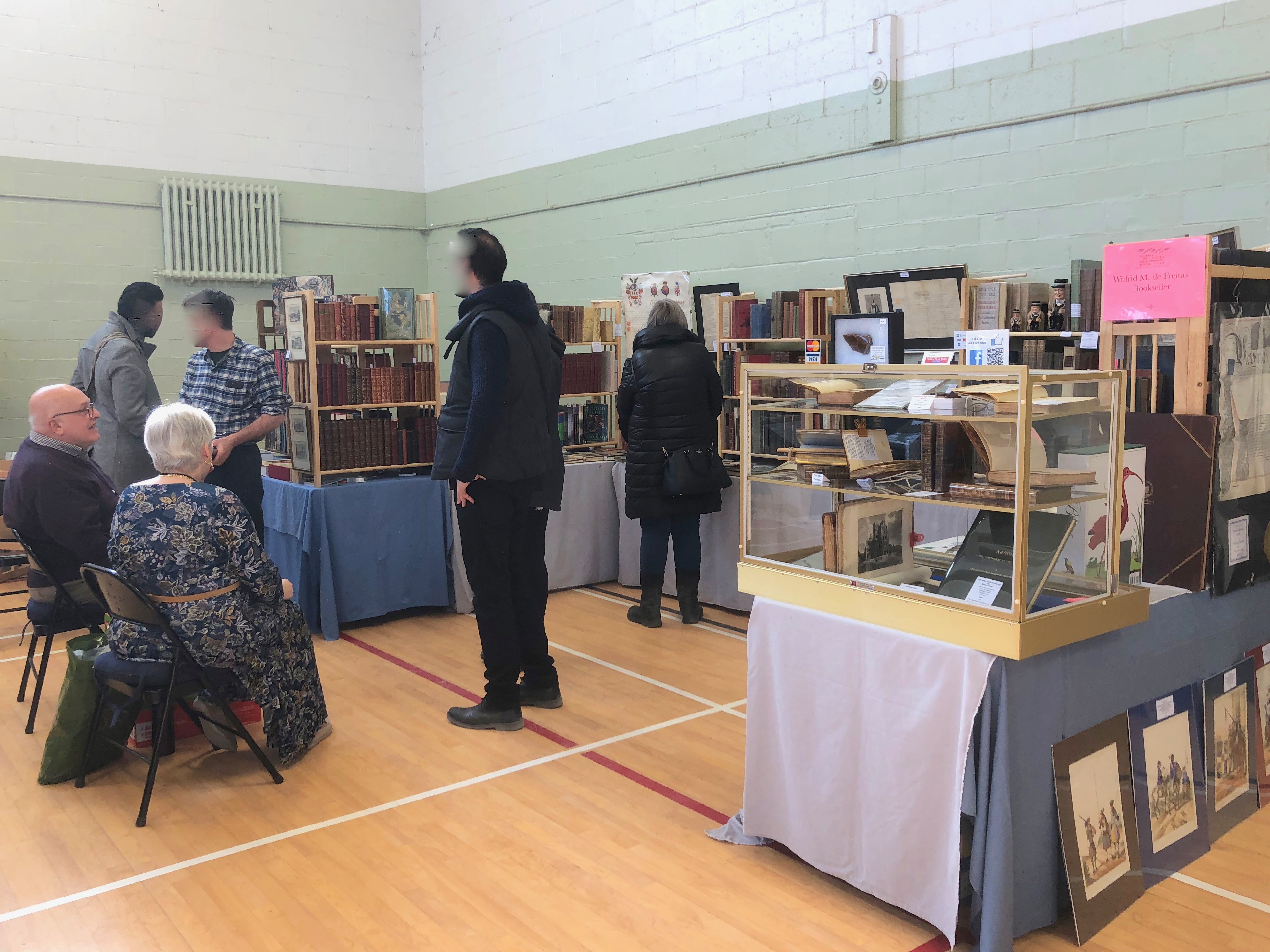
The Westmount Book Fair was organized by Wilfrid M. de Freitas, who is himself a bookseller. It was the 27th edition of what is advertised as “the smallest ancient books fair in Canada, where booksellers from Quebec and Canada will help you discover a wide selection of books, brochures, maps, printed matter and small papers”. It was indeed a small venue with a little more than a dozen stands.

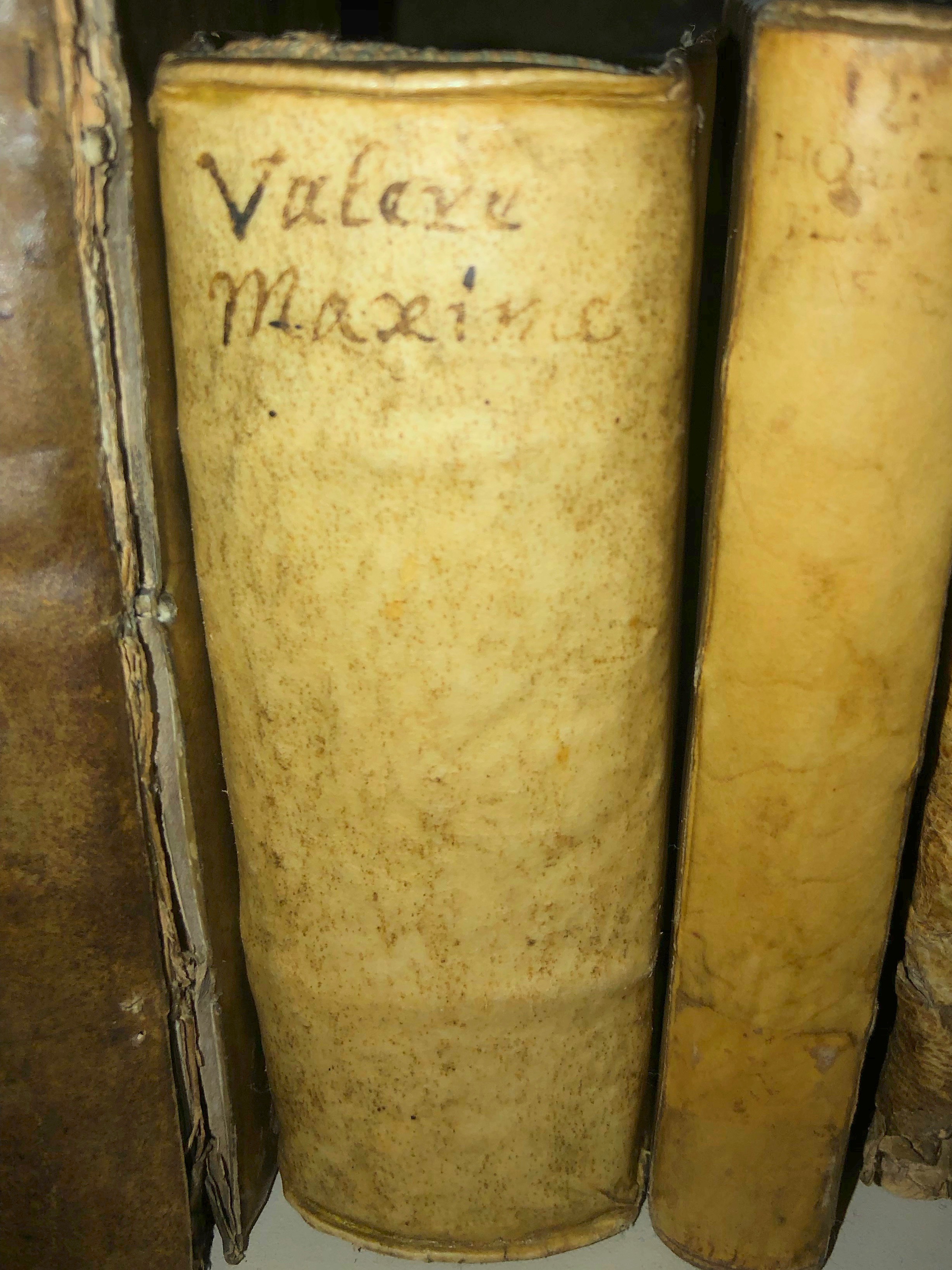
I took a quick look and identified all the books the would interest me and fit into my unfortunately small budget: the Caesar commentaries (in French, 1763, $125), the work of Tacitus (2 vols in latin, 1772, $350), and the work of Valerius Maximus (1659, $275). More affordable but out of my subjects of interest for this type of books (ancient authors, 16th to 18th century editions) there was also a Short French Dictionary (in English, 1701, only $100). There was also a big format velum book (about 25 cm hight and 8 cm thick) from the 17th century about mythology (a mere $5000 !), the works of Bossuet in a big volume ($4500), a few sheets from German old books (incunable?) or a large format book (in-folio) about the myth of the wandering jew illustrated by Gustave Doré for which I didn’t even dare looking for the price tag. Out of interest and price range, I also noticed the first annual compilation of the bande-dessinée magazine Pilote ($500-$700). It gave me a few interesting books to choose from. After, deliberating over the interest (age, condition of the binding, subject) and the price, I finally chose the Valerius Maximus. It was the only 17th century edition in my list, in relatively good condition and at an affordable price. It was sold by Mr. de Freitas and he even gave me a small discount.

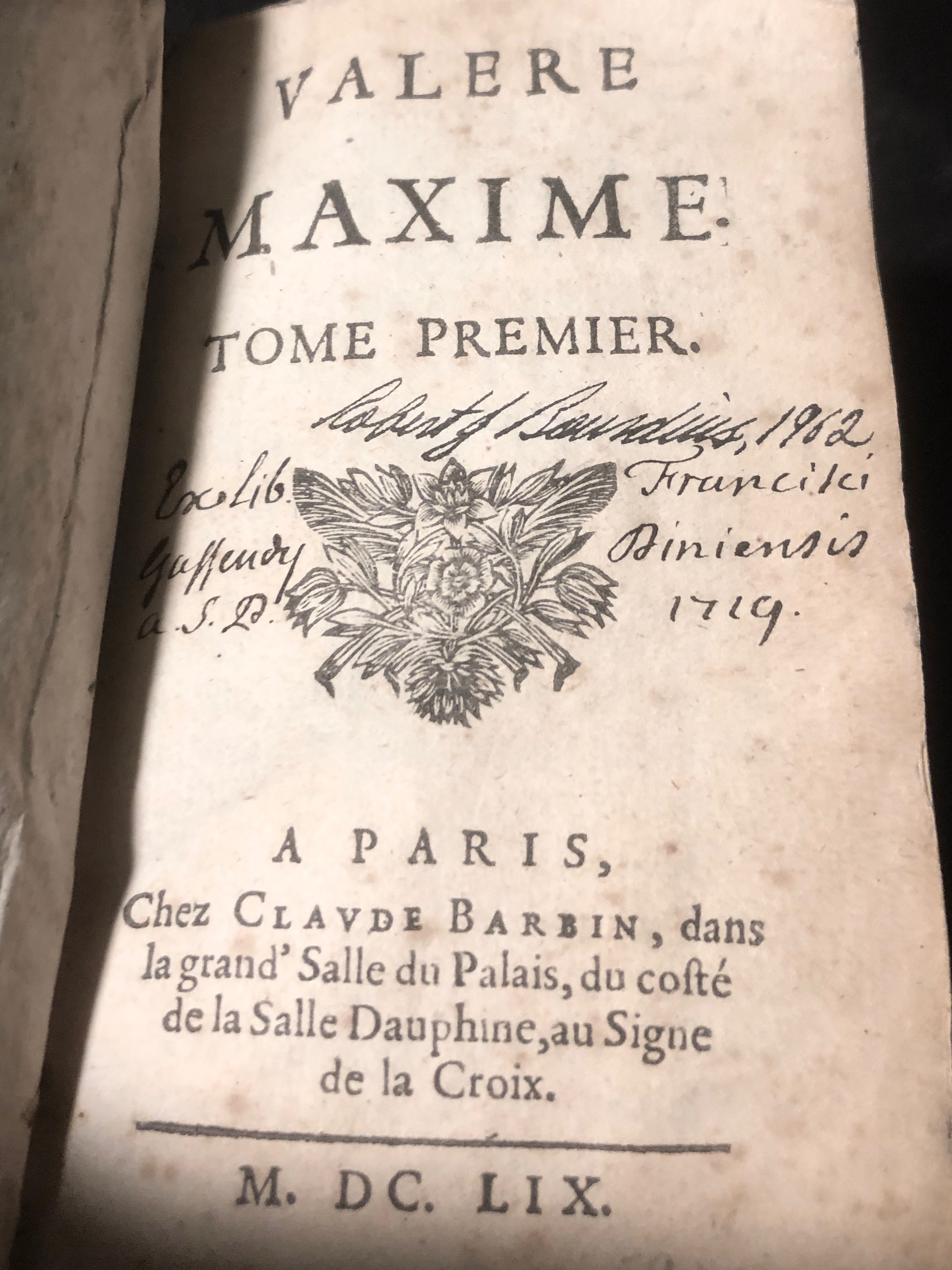
IMG_4317VALERE MAXIME, A PARIS, CLAVDE BARBIN, dans la grand’ Salle du Palais, du cofté de la Salle Dauphine, au Signe de la Croix. M.DC.LIX. [1659]”

The title of the book (which doesn’t appear on the first page) is “Factotum ac dictorum memorabilium libri IX” [nine books of memorable deeds and sayings]. The binding (pork skin?) includes two volumes (it’s 4.5 cm thick), in the sextodecimo format (in-16, in this case 8 x 12.75 cm) . According to the note from Mr. de Freitas, it’s the second edition in French, translated by Jean Claveret. It is a collections of a thousand historical anecdotes, many lifted from earlier Roman writers, re-drafted by Valerius Maximus as moral and social models. It was written during the reign of Tiberius (around around CE 30 or 31). It is quite interesting…

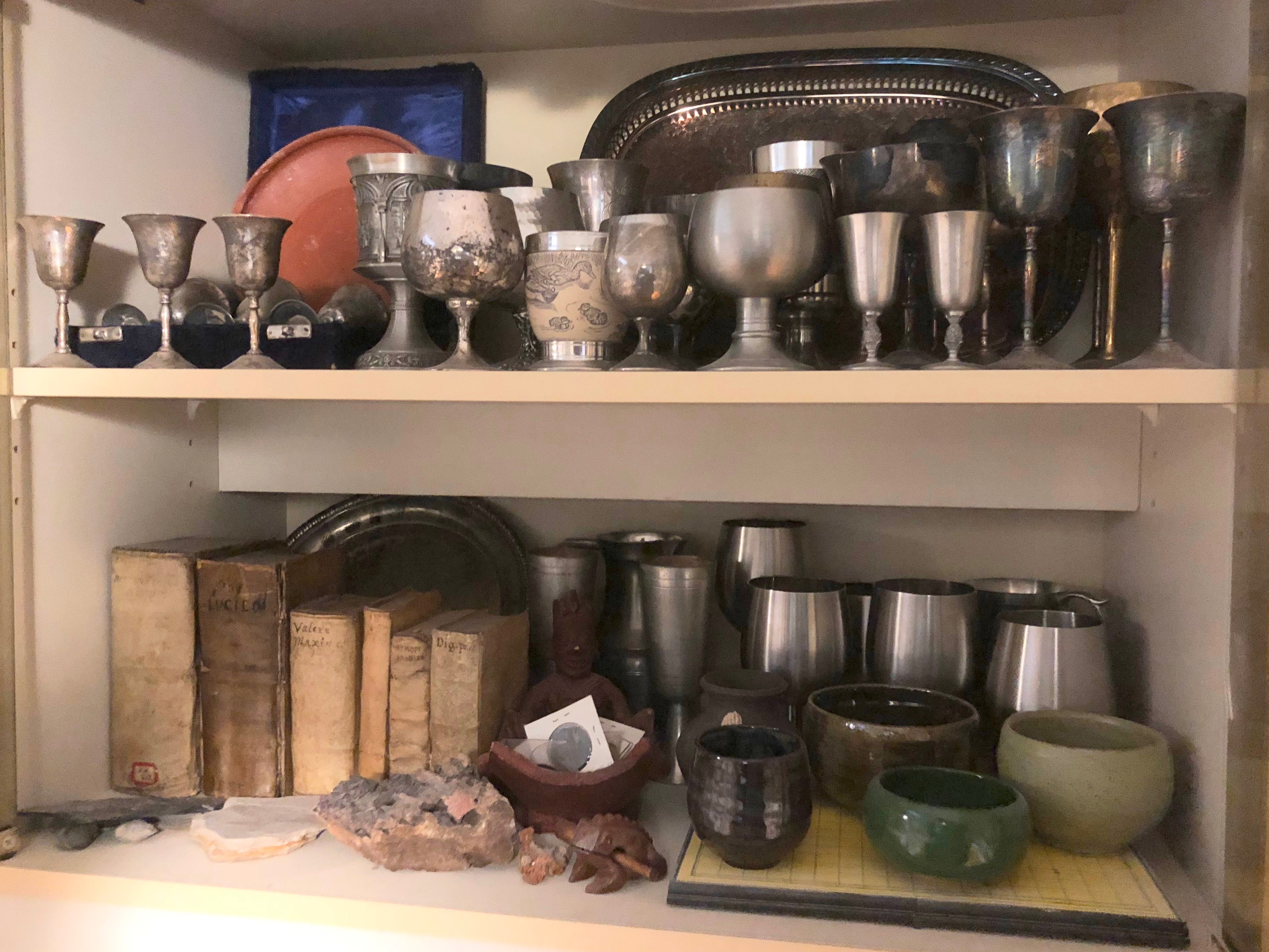
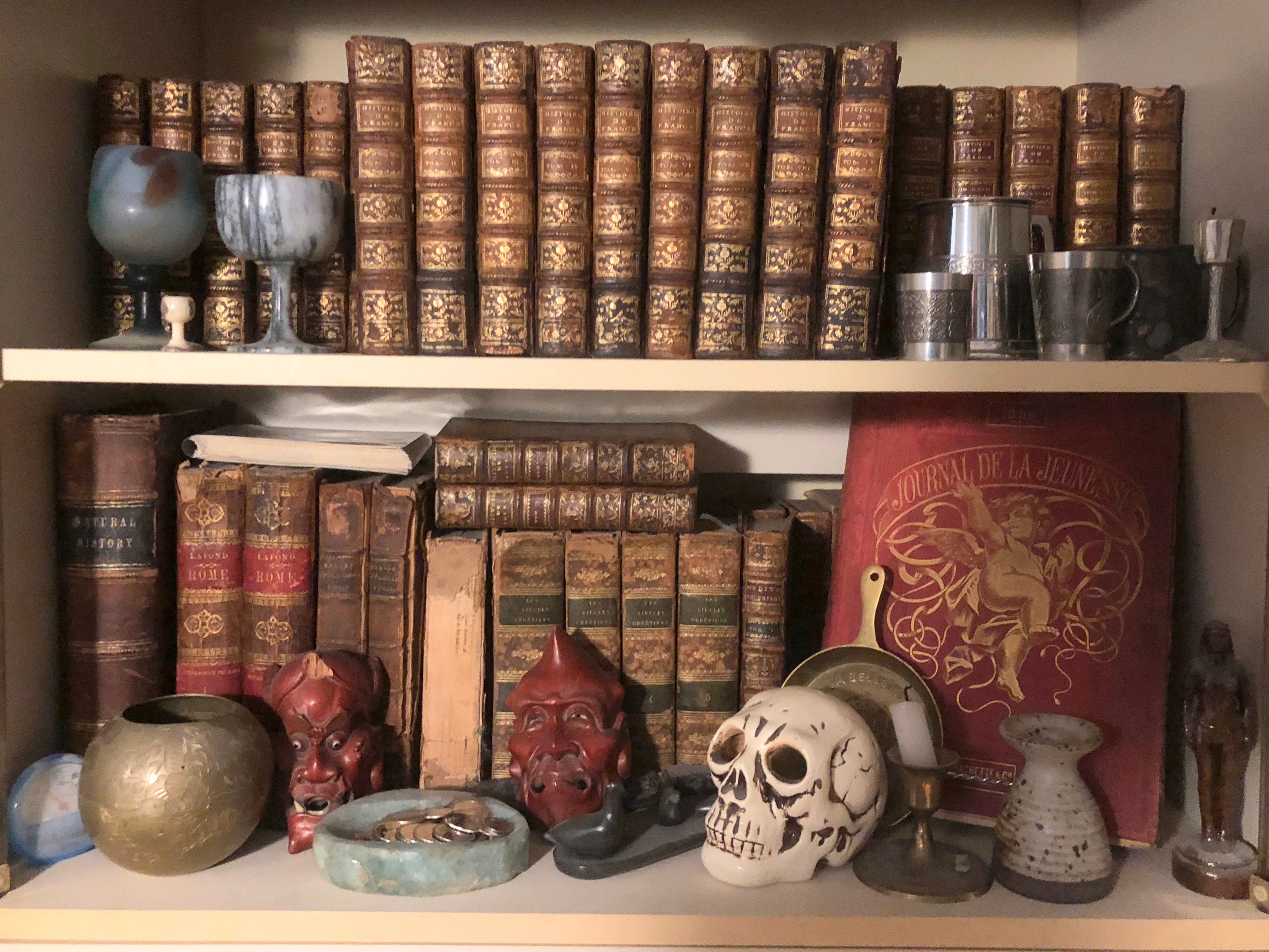
The Collection (or my cabinet of curiosities)


The next book fair, organized by the Confrérie de la Libraries Ancienne du Québec, will be the 36th Antiquarian Book Fair held at the Concordia University (Pavillon McConnell, 1400 bout Maisonneuve O.) Saturday September 28th (from 12:00 to 18:00) and Sunday September 29th (from 11:00 to 17:00).

IMG_4304While having my nose in old books, I decided to do some more research on one of my (very interesting) books on which I have little information. It’s an octavo volume (15 x 24 x 5 cm) titled Natural History. It has a cardboard cover, covered with brown cloth and thin leather. It doesn’t have a title page and the only publisher information appear on the very last page: “WILLIAM MILNER, PRINTER, CHEAPSIDE, HALIFAX.” I first thought it was printed in the maritime provinces in mid-19th century (I think my father purchased it in Gaspésie in the 60s, for $35). It has 730 pages and is in average condition (yellowed pages and several stains, little tears in the cloth of the cover).

It seems inspired by Pliny’s Naturalis Historiae, but it is not its translation as it has a different content organization and covers more modern subjects: Part I : Of the Universe, Part II-XXII: Animals (mostly mammals), Part XXIII: Unclassified Animals, Part XXIV-XXX: Birds; then A History of the Fishes in General (including cetaceous, crustaceous, frogs, lizards, serpents, turtles, and insects !) Part I-XII.

With a closer examination and more research, I discovered new information about this book. First, it seems that the printer is NOT from Nova Scotia but rather from England. Cheapside is a street in Halifax, West Yorkshire, England. William Milner (1803-1850) is a printer who was known for publishing lots of cheap books (selling for sixpence (2 pence) and a shilling (5 pence)). He apprenticed as a printer, but started publishing his own books, first with local printers and then setting up his own press in the 1830s (or in 1844). After his death, his stepsons took over the business under the name Milner & Sowerby. Therefore, my books must have been published between the 1830s and 1850. I will try to find more about this publisher. There is a book that seems to list some of his production, so I will probably start there. To be continued…

[ Traduire ]

Deserved end

I am exasperated by human behaviours. Most animals will never shit where they eat and will never hurt others unless in self-defence, self-preservation or to eat. While humans, lately, don’t care about anyone but themselves and will go out of their way to hurt others simply by pleasure, by revenge or even for no reasons at all. It is a mean, selfish creature that is slowly killing everything on this planet just because it wants stuff. Frankly, why fight against our own destructive nature and try to save ourselves? Or why try to even give our worthless selves a peaceful end? Why not go all the way toward a well deserved end?

I wish I was a recluse, away from all this stupidity. But I am not, so I always do my best not to hurt anyone and to help when I can. To give the other cheek. And it hurts to see all the others not giving back the same respect. People act selfishly, stupidly, against their own interest because they don’t make the effort to understand, to learn, to follow logic. I am exasperated and I am afraid. Afraid that I will eventually become like them, a beast. I am already becoming grumpy and resentful. If it is indeed our true nature to be not an animal but a beast, maybe it is also for me a deserved end…

[ Traduire ]