Two weeks ago I’ve ordered from Amazon.ca some memory chips for my Mac-Mini (it was really getting too slow with Maverick installed so I’ve decided to maximize its RAM) and a few manga. Included in this order were the first two volumes of Taniguchi’s Seton, document.write(“”); which I was missing. Volume 2 was available in the Kana (Coll. Made In) French edition I already owned, but I couldn’t find volume 1, which I assumed maybe sold out. However, I found the first volume in English from Ponent Mon. I thought (without further investigation) that it was a recent released. I was pleased, I could then review both English and French edition at the same time.
Last monday I received my order and, to my greatest stupefaction, the Seton vol. 1 included in the package was in Spanish!
I went back to the Amazon site to check if I didn’t make an error, but the product was clearly listed as being in English. However, I noticed that the publisher was indicated as “Ponent Mon” and NOT “Fanfare / Ponent Mon” like it should have been for an English edition. I checked Ponent Mon site and, indeed, Seton was only published in Spanish and not in English. I have no idea how such an error could have been made on Amazon website.
Unfortunately, the processus to return a product on the Amazon website was only offering me an option for a replacement. If the product listed doesn’t exist, I would end up getting the same damn Spanish edition again if I would request a replacement. It was specified that for a refund I needed to contact the customer service.
I decided it would be easier to explain the situation in an email. And since my amazon.ca account is set-up in french, I wrote the e-mail in french (silly me). I was expecting them to answer by e-mail and all day I regularly checked my mail box to see if I didn’t get the answer. I though they should be quick. It’s a big corporation.
The next morning (at 5:20 am), to my sleepy astonishment, I received a phone call from amazon customer service! First, I told them that, despite being happy that they answered my request, I was wondering why they were waking me up by calling at such an early time in the morning. It appears that their French calling center is located in Europe and employees are probably too stupid to realize that–the earth being round–it’s not the same time all around and that, if you call from Europe to America without checking a time-chart, you end up waking your customer up!!! And, if I contact them by e-mail, why do they answer by phone? What incompetence!
I nevertheless explained my predicament and was told that an e-mail (ah! an e-mail, finally!) would be sent with a code allowing for a refund. Thank you very much Mr. Bezos!
One more thing!
Last sunday, my parents came to visit as we were celebrating my father’s eighty-fifth anniversary. Most of the time, when my parents have to travel from their rest home, they use the paratransit (transport adapté in french). Basically, it’s a regular taxi but you pay the same fee that you would if using the city transit system. It is, of course, reserved for the people with mobility problems (like my parents). It’s suppose to be reliable and punctual.
They were waiting in their apartment for the paratransit to show up. When the reception called to announced that it had arrived they quickly put their coats on and came down the elevator. When they arrived at the door, the paratransit had already left! I know they have many people to pick up but couldn’t they just wait a few minutes?
At the end of the evening, we went down to the sidewalk to wait for the paratransit pre-arranged pick-up to arrive. We came out a little earlier to be sure not to miss it this time. It never showed up. Thanks Mr Mayor for the crappy service! (Actually, it was on municipal election day).
It really seems that in our days (an era of selfishness), companies really don’t care anymore for giving a proper service. And it’s a damn shame!
De plus, j’ai aussi décidé de cesser d’être représentant syndical (pour le local 429 (SFFM) du SCFP). Je sais c’est dommage car il y a un réel manque de représentation pour les bibliothèques mais ces temps-ci j’ai vraiment trop de choses à faire dans ma vie personnelle (et j’accorde déjà à mon travail environ cinquante-cinq heures par semaine en comptant les heures de repas et de transport) de sorte que je ne crois pas que je pourrais faire un bon travail de représentant (selon ma satisfaction). J’avoue aussi avoir été un peu déçu et frustré par la chose syndicale (c’est difficile d’y faire bouger les choses et ce n’est pas toujours un environnement très vertueux). Et je ne veux pas non plus trop ambitionner sur ma santé tant physique que mentale! Mais, bon, je serai tout de même toujours disponible pour donner des information et des conseils à mes collègues, ou faire suivre l’information et les requêtes auprès du syndicat…
D’ailleurs, un collègue (Zenodotus) qui a récemment reprit le site d’information syndicale alternative “Le Canardo Pressé”, m’a demandé si je ne voulais pas me joindre à lui pour animer le blogue. J’y songe. J’y avais déjà collaboré dans le passé et ce serait une bonne manière de continuer d’informer les collègues des bibliothèques sur l’actualité syndicale. Mais, bon, on verra…
Last friday, document.write(“”); I came back from work in a violent wind storm. It was blowing so hard sometime that I had trouble walking. I was particularly careful to mind flying objects that could quickly become deadly projectiles. Fortunately, I made it to the subway without incidents. No interruption in the subway service either, although I slept most of the time because I was really feeling badly (very tired, with a slight fever, my whole body was hurting: I was afraid that I was starting some cold or flu). I made a quick pit-stop at the Apple Store to pick up an iPad Air. I was eager to go home, have a hot meal and go to bed. Instead, in found my house in total darkness. A note from my wife on the table was telling me that power went out around 1:30 PM. It was a little past 8 PM.
The power outage was affecting only one or two blocks (60 to 120 multiplex-type homes). Everybody in the neighbourhood had power beyond that. It was quite frustrating. My battery backup UPS (for Uninterruptible Power Supply) were both dead despite that they usually provides enough backup power to work through most power outages (the computer one usually last a couple of hours, and the one for the cable modem and phone router usually last nearly six hours). So I had no computer, no wi-fi, no IP phone and my cellphone (after a long day at work) was nearly dead too. I lighted a few candles and I ate my supper cold, while browsing the news on my old iPad 2 using the wi-fi of my cellphone’s personnal hotspot. Later, I switched to a battery-powered emergency radio. The wind storm had caused lots of power outages around the city and elsewhere in the province.
Later, I tried to call Hydro-Quebec to have an estimated time for the return of the power. That proved to be a frustrating experience as you have to go through many automated menu and their voice-recognition system is far from perfect (“our files tell us your address is … please say confirm”, “confirm”, “I cannot understand what you are saying, please say again” etc). I had to call twice since the call dropped the first time. The problem had been already reported but they hadn’t assessed the nature of the outage yet (i.e. nobody had been sent to check it yet) and they couldn’t give a time for the return of the power. This call killed my cellphone. But I was optimistic: the outage would probably not last more than a few more hours. That’s what I told my wife when she came back from work around midnight.
I did not sleep well that night. My body was still hurting and I was expecting the power to come back anytime. Fortunately it was not too cold. However, the house was too silent (well, not completely: I always thought that the refrigerator was making a lot of noise, but I realized that night that most of this noise was due to my tinnitus!). In the morning, twenty-one hours after the beginning of the outage, the power was still out. I was still not feeling very well (even more because I didn’t sleep well) so I decided to call in sick at work. Unfortunately, both my IP phone and my cellphone were dead and all my contact numbers were locked inside my dead cellphone or computer. Luckily the cellphone of my sister (who lives upstair) was still (barely) working. I waited for the library to open and called the only phone number I could remember: my post. I couldn’t reach anyone since my coworkers had forgotten to turn the answering machine off. I searched through some papers to find another phone number and could finally tell someone I would not come to work. There was just enough power left in my sister’s cellphone to call Hydro-Québec again and learn that the outage was due to a broken equipment (probably a transformer blowing up) and they were expecting the power to return before 8 PM!
I needed to put some hot food in my stomach so my sister, my wife and I went to Tim Hortons to have breakfast. After that we went to my parents place to charge both our cellphones and kill time in a warm place. Late afternoon, we came back home after stopping to pick up some warm fast-food. My sister reflected that since we had picked up supper, the power would probably be back. Indeed it was. Looking at the micro-wave clock I estimated that power came back around 4 PM. Does it really take that long to replace a transformer? I guess that restoring power to our couple of blocks was not a priority for them. Maybe they were too busy repairing downed power in other (better off) neighbourhood. But in the afternoon, we drove by an Hydro-Quebec office and the parking was full of trucks that should have been on the road doing repairs! Lack of personnel? They knew for several days that this wind storm was coming and what kind of damages it could do. They should have recalled more personnel in anticipation. Of course, if I take my time to pay their bill they will charge me interest. And they will always have good excuses to justify their failure to quickly restore power. No consideration for our loss of life’s enjoyment (in my case I was pretty miserable) and never mind the loss of our freezer’s content!
With this event I broke my personal record for a power outage. This time we were out of power for nearly twenty-seven hours while the previous record was during the infamous ice storm with a mere twenty-four hours outage! Way to go Hydro-Quebec!
Update: I just received a notice from HQ that they will soon install their new “smart” meters in my neighbourhood. I’m not worried about the so-called waves that are emitted by the meters. It cannot be worse than wi-fi or a cellphone (and I already use both). However, I just read an article (in french) about some meters catching fire, and THAT worries me. The article also questions the qualification of the people doing the installation…
Continuez après le saut de page >>
«Papa, c’est quoi cette plante ?» (page 2-3)
Au supermarché, Hana convainc son père d’acheter un petit plant de tomate rachitique. Elle le rempote, l’arrose, le protège des chenilles et il grandit. Hana aime s’occuper des plantes, peut-être parce que son nom veut dire “fleur” en japonais. L’été venue, elle se rend chez sa grand-mère et, contre l’avis de ses parents, amène son plant avec elle. Tout de suite grand-mère lui propose de la replanter dans son jardin. Elle grandira mieux en pleine terre mais restera plus petite que les autres plants de tomates car c’est une variété de tomates cerises. Au bout de quelques jours, des fleurs jaunes apparaissent, puis deviennent de petites tomates vertes. Bientôt, elle pourrons être mangées.
Un soir, la météo annonce un terrible typhon, alors Hana et sa grand-mère plantent des piquets pour attacher les plants. Pendant la nuit, Hana est inquiète mais le lendemain le soleil est de retour et les plants, quoique secoués par les vents violents, ont survécu. Deux jours plus tard, Hana cueille et goûte à sa première tomate, toute rouge et chaude de soleil. Quand ses parents viennent la chercher, Hana et grand-mère leur prépare un merveilleux festin avec le fruit du potager: tomates, carottes, concombres, radis, et pommes accompagnés de chrysanthèmes et de sushis. Ils reviendront à la maison avec un carton rempli de tomates, et Hana se demande ce qu’elle fera pousser l’an prochain.
Gauche: “Un matin, catastrophe, Hana s’aperçoit qu’il y a de petits trous dans les feuilles” (pg 5)
Droite: «Est-ce que tu crois que les tomates ont peur, elles aussi ?» (pg 19)
C’est une très belle histoire qui enseigne aux enfants la valeur de la terre et du jardinage. C’est aussi très bien illustré, avec une technique peut-être un peu classique pour ce genre d’album mais qui donne un très beau résultat. Si l’auteur vit maintenant à Paris, elle illustre tout de même des scènes typiques de la vie quotidienne japonaise, telle que le supermarché, la campagne avec ses maisons aux toits de tuiles, les intérieurs japonais avec leur tables basses, les tatamis et les futons, l’utilisation de bambou dans le jardins et la préparation des repas où les fruits et légumes sont sculptés et présentés avec du feuillage et des fleurs. L’album peut donc aussi constituer une introduction è la culture japonaise. J’aime bien.
La fête de la tomate, écrit et illustré par Satomi Ichikawa. Paris, L’École des loisirs, octobre 2012. 22 x 27.2 x 0,8 cm, 30 pg., 13,20 € / $19.95 Can. ISBN: 978-2-211-21139-0. Recommandé pour les enfants de 5 à 7 ans.
Continuez après le saut de page >>
Situé dans l’univers de Madame Mo, créé en 2003 par Agnès Lafaye et Pascale Moteki pour illustrer des objets inspirés de la tradition japonaise, ce livre pour enfants nous introduit aux fêtes japonaises. Il y a une fête pour chacun des mois de l’année et chacune nous est présentée à l’aide d’une petite histoire, d’une activité de bricolage et d’une recette. Ainsi, pour janvier, où l’on fête le nouvel an japonais (Oshogatsu), les auteurs nous racontent ce que les personnages font cette journée là, puis nous présente le jeu Fukuwarai (où les joueurs doivent épingler les différentes parties du visage (comme les yeux, les sourcils, le nez et la bouche) sur un dessin de face vierge) et une recette de Oyako don (Omelette au poulet sur bol de riz). Les fêtes pour le reste de l’année sont en février: chasser les mauvais esprits (Setsubun); mars: la fête des poupées (Hina Matsuri); avril: fête des cerisiers en fleur (Hanami); mai: la fête des garçons (Kodomo no Hi); juin: saison des pluies (Tsuyu); juillet: fête des étoiles (Tanabata Matsuri); août: fête des ancêtres (O-Bon); septembre: fête de la lune (O-Tsukimi); octobre: fête du sport dans les écoles (Undokai); novembre: fête des enfants (Shichi-go-san); et décembre: denier jour de l’année (O-Misoka).
Ce n’est pas le genre de livre que l’on lit d’un bout à l’autre mais plutôt une référence que l’on utilise pour introduire la culture japonaise aux enfants en leur lisant une histoire chaque mois et leur présentant des activités thématiques culinaires ou ludiques en relation avec la fête du mois. C’est une très bonne façon de développer la diversité culturelle des jeunes tout en s’amusant. Les illustrations sont simples et très colorés, mais le style des personnages de l’univers de Madame Mo est un peu excentrique (“personnages dotés d’une tête surdimensionnée avec un oeil plus grand que l’autre”). C’est un livre très amusant, riche en idées et en information.
Update: After nearly an hour of intensive research on the internet trying different descriptive keywords and inspecting picture after picture, I think I finally identified this flower. It seems to be a Tradescantia pallida (Rose) also called Setcreasea purpurea BM Boom and more commonly known as “purple heart”, “purple queen” or “wandering jew”. Does it sound right?
“Close your eyes. Open your mind. You will be unprepared.”
“Sucker Punch is an epic action fantasy that takes us into the vivid imagination of a young girl whose dream world provides the ultimate escape from her darker reality. Unrestrained by the boundaries of time and place, document.write(“”); she is free to go where her mind takes her, and her incredible adventures blur the lines between what’s real and what is imaginary.”
“She has been locked away against her will, but Babydoll (Emily Browning) has not lost her will to survive. Determined to fight for her freedom, she urges four other young girls—the outspoken Rocket (Jena Malone), the street-smart Blondie (Vanessa Hudgens), the fiercely loyal Amber (Jamie Chung) and the reluctant Sweet Pea (Abbie Cornish)—to band together and try to escape their terrible fate at the hands of their captors, Blue (Oscar Isaac), Madam Gorski (Carla Gugino) and the High Roller (Jon Hamm).”
“Led by Babydoll, the girls engage in fantastical warfare against everything from samurais to serpents, with a virtual arsenal at their disposal. Together, they must decide what they are willing to sacrifice in order to stay alive. But with the help of a Wise Man (Scott Glenn), their unbelievable journey—if they succeed—will set them free.” [Official Synopsis]
I just caught this movie on Showcase the other day and I was blown away. I had heard about it and seen some promising illustrations, but on release it was demolished by the critics (Rotten Tomatoes gave it a 23% rating for the critics and 46% for the audience) and I forgot about it. However it’s created by a reputable director, Zack Snyder (300, Watchman, Man of Steel), and even if it far from perfect it is quite a piece of beautiful entertainment. It is told with very little dialog, lots of music and astonishing CGI.
It starts with a sad story: a mother dies leaving her fortune to her two daughters. The abusive stepfather is unhappy with this and, as he is about to take it out on the girls, the oldest escapes her room and tries to kill him. However, the bullet ricochets on a steel pipe and kills the younger sister instead. The stepfather seizes this opportunity and has her institutionalized because of her supposedly violent and murderous behaviour. He makes a deal with the orderly that runs the place that she will be “taken care of”. In a few days, a special doctor will come to lobotomize her. That’s just the introduction. The girl, known as Babydoll, uses her imagination to escape her grim circumstances. The mental hospital becomes a brothel where’s the girls entertain the customers. But the Babydoll of the imaginary world escapes her own ordeal in a fantasy world where she is a warrior and has to gather five items in order to free herself: a map, a lighter, a knife, a key and a mysterious item that will be revealed at the end. The Babydolls of all worlds are determined to fight for their freedom.
The use of music and its sketch movie style reminds me of the eclectic storytelling of Heavy Metal where you had several unrelated segments united by one main story. Here you have an Inception‘s style asylum mindfuck that opens into segments set into four anachronistic mishmash fantasy world worthy of the most excessive mecha anime and video games: a Kungfu Panda style samurai fight where Babydoll acquires her only weapons: a katana and a Gluck, a WWI steampunk nazi zombie world where they acquire the map, a WW2 dragonslaying medieval fantasy world where they acquire the fire and a futuristic high train robbery meet bomb squad mission with a Vietnam war era helicopter where they acquire the knife (but not without a cost).
Snyder succeeds in capturing the pop culture of the current generation in the same way that Tarentino (Pulp Fiction, Kill Bill, Djando Unchained) captured the pop culture of the baby boomers. With its story inside a story, inside a story, the movie offers a clever storytelling. It also has a fascinating and beautiful visual. Unfortunately, the story is uneven and doesn’t always make sense, the acting is rather average, and the ending is quite disappointing: it delivers a soppy philosophical moral about self-determination and strength of character. I find solace in the fact that it is not really an happy ending. And, yes, it is sexist! But it is well worth watching (for a sci-fi loving male audience of course)!
Continuez après le saut de page >> J’ai découvert Amélie Nothomb avec le superbe film Stupeur et tremblements d’Alain Corneau (IMdB, bande annonce et extraits sur Youtube). Jusqu’alors, je ne sais pourquoi, j’avais cru qu’elle était une auteur américaine ou britannique, très populaire, qui parlait bien français (un peu comme Kristin Scott Thomas) et qui était un peu dingue. Le film m’avait intrigué parce qu’il traitait du Japon et que je croyais le réalisateur québécois. Après avoir visionné le film (que j’avais emprunté à la bibliothèque) j’étais suffisamment impressionné pour faire quelques recherches et découvrir que non seulement Corneau était français mais encore que le film était basé sur le roman très autobiographique de Nothomb, qui était en fait une auteur belge, quoique plutôt excentrique et névrosée! Comme quoi qu’on ne peut pas toujours être dans l’erreur.
Son père étant diplomate belge en poste au Japon, Amélie Nothomb est née dans l’archipel nippon, plus précisément dans la banlieue de Kobe. Elle y passa les cinq premières années de son existence. Elle fut extrêmement traumatisée lorsque son père fut relocalisé en Chine, puis ailleurs, et qu’elle dû quitter ce Japon tant aimé. Pendant “les années qui ont suivi cet exil, j’ai souffert au-delà du dicible” nous dit-elle. Toutefois, vers le milieu des années ’90, elle décida d’y retourner et se trouva un emploi de traductrice dans une firme Japonaise à Tokyo. C’est là qu’elle vécu l’enfer corporatif nippon, où les salaryman et les ?eru sont cruellement abusé pendant les premières années de leur service, afin de les “briser” et qu’ils deviennent les employés serviles, malléables et robotisés typiques du Japon. Elle survécut en se jetant mentalement dans le paysage urbain tokyoïte et en découvrant l’écriture où elle épanchait ses frustrations. Elle finit par raconter cette expérience dans le roman Stupeur et tremblements (qui fut très mal reçu au Japon), qui éventuellement devint aussi un film. Elle cru qu’elle ne reviendrait jamais au Japon…
J’ai eu vent pour la première fois de La nostalgie heureuse en lisant un article dans Le Monde (et éventuellement un autre dans le Huffington Post) qui annonçait un documentaire de France 5 où l’équipe de télévision suivait Amélie Northomb alors qu’elle effectuait un retour au Japon. Intitulé “Amélie Nothomb, une vie entre deux eaux”, le reportage de cinquante-deux minutes réalisé par Luca Chiari nous montre une Amélie Nothomb qui, au printemps 2012, retrace ses souvenirs d’enfance, retrouve sa nounou Nishio-san, son fiancé Rinri, elle visite le quartier de sa jeunesse à Kobe, son école primaire, le pavillon d’or, une pièce de théâtre Nô, la corporation où elle travailla à Tokyo, et même le village dévasté de Soma près de Fukushima.
Elle se rassure: ses souvenirs, s’ils sont un peu devenu fiction par le processus littéraire, sont néanmoins réels; elle a bel et bien vécu son enfance au Japon. Et surtout, en un rare interview du genre, elle se confie. Elle nous parle de la correspondance qu’elle entretiens avec ses lecteurs, de l’agression sexuelle dont elle a été victime au Bangladesh, de l’anorexie qui l’affligea adolescente, de ses démons intérieures et que “l’écriture est un moyen de me vider de toute la souillure que je contiens.” On découvre un personnage tourmenté né de l’instabilité d’une vie nomade, en proie à une profonde crise d’identité et d’estime de soi, à des angoisses sans fin. Tout “cela a développé un attachement au langage et, par conséquent à la littérature. Le langage était ma seule conscience stable. Le mot c’est vraiment la chose. C’est aussi pour cela que j’ai tellement besoin d’écrire” L’écriture est sa thérapie, la façon d’exprimer sa musique intérieure.
La nostalgie heureuse est le pendant littéraire à ce voyage cathartique. Elle relate le déroulement du tournage, nous fait de nouvelles révélations (entre autre elle développe beaucoup plus sur ses retrouvailles avec Rinri, qui avait refusé de prendre part au reportage télévisé) mais passe plusieurs éléments du reportage sous silence. Elle entr’ouvre encore un peu le voile sur son processus de pensée intérieur, sur ses souffrances personnelles. Elle exprime une profonde nostalgie, dont on ne sais pas trop si elle est traumatique ou heureuse. Et je me demande quelle est la différence entre un roman autobiographique et une simple autobiographie. Cela veut-il dire que le récit est romancé et, si oui, dans quelle mesure?
Je comprend bien pourquoi Amélie Nothomb est une auteur si populaire. On sympathise et on s’identifie un peu à elle. Après tout nous avons tous nos moments sombres, nos craintes et nos démons intérieurs. Une douce folie. Une soif de rédemption par l’écriture passive ou active. Mais je dois toutefois avouer qu’elle est un personnage incroyablement égocentrique. Toutes ses histoires sont autobiographiques à un niveau ou à un autre, et elle fait la couverture de tout ses livres! Par contre, elle a une belle écriture, simple et fluide, qui est empreinte de beaucoup d’images. La nostalgie heureuse est un livre intime, beau et touchant que j’ai lu d’une seule traite en un peu plus d’une heure (c’est assez court, cent-cinquante-deux pages mais en caractère plutôt gros). Je le recommande. Pour ma part, je suis intrigué et aimerais bien en lire plus. Elle a écrit une vingtaine d’autres ouvrages. Trouverais-je le temps?
Continuez après le saut de page >> Le court récit de cet album pour enfants nous raconte l’histoire d’un chat errant qui avait la particularité de parfois lever la patte droite, comme si il souhaitait la bienvenue aux gens. C’était un bobtail japonais principalement de couleur blanche mais avec une queue noir et orange. Il fut recueilli par le moine d’un temple en ruines qui le nomma Tama, en souvenir de son enfance sur les rives du fleuve Tama. Un jour, durant un violent orage, un seigneur avait cherché refuge sous les branches d’un magnifique cerisier en fleur. Le cerisier lui semblait un meilleur abris que le temple délabré, mais voyant le chat sur le seuil du temple qui semblait l’inviter à entrer, il changea d’avis. Aussitôt la foudre frappa le cerisier et une grosse branche s’écrasa lourdement à l’endroit où le seigneur se tenait quelques instant plus tôt. Pour remercier le chat qui lui sauva la vie, le seigneur fit restaurer le temple et fit de généreuses donations de sorte que le moine et le chat ne fûrent plus jamais dans le besoin. Le chat porta chance et apporta le bonheur tant au seigneur qu’au moine. C’est pourquoi il est honoré en tant que Chat du Bonheur.
Cette histoire n’est qu’une des nombreuses légendes qui expliquent l’origine du Maneki Neko (??? / littéralement le “chat qui invite”) dont on retrouve la représentation dans une grande variété de formes dans la plupart des boutiques et restaurants Japonais ou même du Chinatown. L’origine du geste provient du chat qui se lave l’oreille, qui s’apparente au geste japonais d’invitation, d’où l’idée du chat qui invite le bonheur. Dans l’émission Must Love Cats (en anglais, qui donne pour origine la légende de la vieille femme d’Imado), on explique que si le chat lève la patte droite il apportera la chance et si c’est la gauche il apportera la fortune (financière) et que parfois il lève les deux (ou même les quatre pattes)! Dans la postface de ce livre pour enfants, l’auteur explique qu’elle a choisit de raconter la variante du chat du temple, qui date du début de l’ère Edo, parce que c’est la plus populaire. Le temple serait celui de Gotokuji et le seigneur serait Naotaka Ii.
C’est un beau conte, bien écrit mais illustré plutôt sobrement, qui raconte un aspect intéressant de la culture japonaise. Je le recommande. Le site de l’éditeur comporte un extrait des dix premières pages du livre si vous désirez en avoir une meilleur idée avant d’en faire l’achat — quoiqu’il est également disponible en bibliothèques.
Update (2013-11-01): Une amie botaniste (et collègue aide-bibliothécaire) me dit que c’est un Begonia boliviensis “Santa Cruz Sunset”. Merci! / A botanist friend (and co-worker at the library) tells me that it is a Begonia boliviensis “Santa Cruz Sunset”. Thanks!
Press review — Not much in the news lately, beside the U.S. government shutdown, which now enters in its second week. I just don’t understand how the american people can let a radical minority in the Republican party take their government hostage like that. They hope to hurt Obama and force him to repeal Obamacare, but it should backfire on them. Obamacare was passed by both Congress and the Senate, then Obama was reelected for a second mandate on it and it was even confirmed by the Supreme Court! And yet the Republican are fiercely and unrelentingly trying to kill it (okay it’s not perfect but it’s much better than nothing; and the Republican are the one who made it such a mess in the first place!). How can they disregard the will of the people so undemocratically? And how could some americans still blame Obama for the shutdown?
Anyway, you’ll find links to the news stories that I considered the most interesting, right after the jump:
Any recent compact point-and-shoot would have been better than the Canon, but since I am a sucker for gadgets, I was quite intrigued when Sony announced their “Smartphone Attachable Lens-Style Camera.” If it is a camera in its own right it can also be considered as a smartphone accessory, just adding to the capability of the phone while remaining compact and handy. It was quite promising. I read all the articles about the upcoming products and felt that this would be the perfect replacement for the Canon PowerShot S5IS. Maybe I was wrong?
Of the two models announced by Sony [see their respective specs as an image or online], I chose the QX10 even if the QX100 offered a better picture quality (20 megapixels instead of 18 for the QX10 and a bigger CMOS sensor [1 inch instead of 0.53 inch for the QX10]) because the QX10 offered the most zoom (10x versus 3.6x for the QX100) and a much cheaper price ($250 versus $500 for the QX100 !). And a good zoom (even if it was not as strong as the Canon) was all I needed to add to the iPhone (particularly when shooting movies). I also considered the Olloclip Telephoto, but, if it was quite cheaper ($100), it was only adding a mere 2x optical magnification so there was no comparison with the Sony QX10. Therefore I purchased it as soon as it was available (on september 25th).
The controls — Basically, the Qx10 looks like a camera lens and therefore has no viewfinder. It also has very simple controls: a power button on top [1] near the microphone [2], a tiny LCD display [3] indicating whether there’s a memory card inserted or not and the remaining battery capacity, a hook for the strap [4], a tripod socket [5], a status light [7] showing whether it’s turned on, charging or recording, the zoom lever [8], the shutter button [9], a Micro-USB plug [10] to transfer pictures and recharge the battery and a reset button [11] both hidden behind a small trap-door. The viewfinder, extra controls and settings are provided by the smartphone to which the camera is connected to (either via NFC or wi-fi direct, depending of the smartphone model–for the iPhone it’s via wi-fi since it has no Near Field Communication capability).
Battery & memory card — The bottom of the camera (opposite side to the lens) opens to reveal the Lithium Ion type N battery and a slot to insert either a microSD memory card or Memory Stick Micro media [here it’s a Nexxtech 16 Gb microSD]. Printed inside the camera’s battery cover (and on the “Quick Start Guide”) you’ll find the SSID password [here it’s blured] needed to connect with the software (you’ll need to enter it the first time only). The battery can be charged either by connecting the camera to a computer via a micro-USB to USB cable (provided), a USB AC power adapter (AC-UD10 or AC-UD11 [this one is more compact and the less expensive option at only $20, but it is currently out of stock], sold separately) or a battery charger (BC-TRX, also sold separately).
Attachment to smartphone — The camera comes with an attachment ring that fits most smartphone. It fits the iPhone without any problem even if it’s in a case. You first fix the camera to its attachment by inserting the camera into the slots, aligning the index marks on both the camera and the attachment, and then rotating the attachment until it clicks (there’s a level that you must slide to free the camera when you want to remove the smartphone attachment). You then open the attachment clamps and extend them to attach the camera to the smartphone. Just be careful not to swing the camera around too much as the smartphone might slip out of the clamps.
The software — To operate the camera with your smartphone you’ll need Sony’s software PlayMemories Mobile (available on iTunes apps store for the iPhone, iPad or iPod Touch). Once you’ve downloaded the software, connected the camera and the smartphone via wi-fi (in iPhone’s setting >> wi-fi; see picture above, on the left), you can open the app which will then connect with the camera (it takes a few seconds; see picture above, in the middle). You can now see the camera’s view, control its settings and shoots images using the touchscreen of the smartphone (see picture above, on the right).
On the top left of the apps’ screen you have the auto settings (Intelligent Auto, Superior Auto and Program Auto) and, just bellow it, the various auto settings it has selected. On the top right you have the indicator of the space left on the memory card (in number of pictures; here there’s 2450 pictures left) and the still image size (here: 4:3 18 Megapixels). Inside the picture (bottom left) you have the zoom control (Wide and Telephoto). Just bellow the picture, clicking on the arrow up or down ( sideway) removes the settings from the screen or brings them back. At the bottom left, the tools symbol opens the main settings panel for the Self-Timer (off, 2 sec, 10 sec), the Still Image Size (4:3 18M, 4:3 5M, 16:9 13M, 16:9 2M), the duration of the review image (on, off, 2 sec), the save to smartphone option (on, off), the size of the review image (original, 2M), as well as option to copy pictures from the smartphone, set the beep (on, off, shutter) and format the memory card. At the bottom center you have the shutter button and on the bottom right the mode control (photo for still images and movie). You can change the aperture and the focus by touching an area of the picture (the area of the picture that you want in-focus and best lighted).
After testing the camera in both indoor and outdoor conditions, I must admit that I am VERY disappointed by this product. It is a very cool and interesting concept: a small and compact camera that uses a smartphone for screen and storage, taking high quality pictures and movies. However, I found several serious problems:
The worse problem is that the PlayMemories Mobile software is constantly freezing and crashing. It seems that the latest version (3.0, dated June 26th) is not compatible with iOS 7! Without it the camera is totally useless!
The advantage of a smartphone camera is its portability. When you see an interesting subject, you can take your smartphone out of your pocket and QUICKLY take a picture. Unfortunately, attaching the camera to the smartphone, connecting them via wi-fi and then opening the software takes a lot of time (one or two minutes at least). By the time you’re done, your subject has moved or disappeared!
If you chose to save the pictures to the smartphone, it takes several seconds to do so (particularly in 18M mode), increasing considerably the time it takes to shoot a subject. It is therefore quite difficult to take quickly several pictures.
You can have only one wi-fi connection at a time, therefore when you are using your camera you can use only the cellular connection to upload your pictures to the cloud or share them.
For some reasons, even after disconnecting the camera, pictures taken with the QX10 don’t upload to iCloud. Maybe it’s because they are too big? That’s annoying because you have to plug either the camera or the smartphone to your computer to transfer them.
The date/time on the camera is supposed to automatically set itself to that of the smartphone to which it is connected via wi-fi. Well, it doesn’t work and the date/time started with January 1st, messing up the sorting of the pictures in iPhoto. Also quite annoying.
[Update: Oops! I forgot this one] It can be a little tricky to focus properly and results can be a little disappointing, particularly with the maximum zoom (10x)–which is somewhat to be expected for that type of camera.
The camera has no flash and the software doesn’t make use of the smartphone’s flash.
It saves the pictures only in jpeg (for still images) and mp4 (for movies). There’s no option to save in raw format.
There’s no manual controls or Aperture Priority setting (although it is available on the QX100).
There’s a serious lack of proper documentation. The camera comes only with a “Quick Start Guide” flyer and there’s no manual available online. Only sale sheets.
After my series of tests I almost decided to bring the camera back to the store and ask for a refund. That Bad. However, it is small and compact, and takes excellent pictures and movies. Most of the problems seems related to the fact that the PlayMemories Mobile software is poorly designed and has not been updated to work with iOS 7 (it is unbelievable that a company like Sony has failed to timely update its software considering that the iPhone market share is at its highest [even more since the release of the new models], the adoption rate of iOS7 is the fastest so far and the iPhone 4S & 5 are the most popular camera on Flickr!). Once that problem is solved it will be a pretty interesting products. So, I’ve decided to wait and see. Even if Sony doesn’t update the software soon, PinGuo has announced that the next update of its popular Camera360software (4.7, due in October) will be compatible with the QX models. In the meantime, the QX10 is rather difficult to use and requires lots of patience.
Update (2013-10-07): Apple Insider has revealed that Sony recently promised to quickly fix their QX series’ connection problems with the iPhone. PlayMemories Mobile should be updated in “the coming weeks.” Apple Insider also says that another third-party developers, TapTapTap, is working to make its Camera+photo apps compatible with the QX series. It should be available “shortly.”
Update (2013-10-08): Sony has updated PlayMemories Mobile very early this morning. Now the camera is more stable–it doesn’t freeze as much–the date/time problem is solved and it does upload to iCloud even in the 18M format. The focus is still tricky, but I guess it is something we could get used to. Camera+ has been updated too, but there’s still no sign of QX compatibility… Anyway, this improvement comes just in time for a few days vacation, so I will have plenty of occasions to test the updated software.
Continuez après le saut de page >> J’ai déjà introduit dans des billets précédents la collection de classiques de la littérature de East Press, Manga de Dokuha, ainsi que le second volume de cette série, La Bible (2): Le nouveau testament (oui, je sais, j’ai lu le second volume en premier mais c’est lui qui était disponible en premier). Je serai donc plutôt bref dans mon commentaire.
La Bible (vol. 1): L’Ancien Testament (??????????? / Manga de Dokuha: Ky?yaku Seisho / littéralement “Lisez en manga: L’Ancien Testament de la Bible”) est un manga seinen publié en novembre 2010 par East Press dans la collection Manga de Dokuha. Peu de détails sont connu sur le studio Variety Art Works qui a fait l’adaptation des textes et le dessin de ce manga qui se veut, comme tout les autres volumes de la collection, une sorte de condensé (style Readers’ Digest) de la Bible pour un public japonais qui n’en connait rien. Il ne s’agit pas ici de propagande religieuse mais simplement d’une introduction au texte originale (“un écrit religieux en même temps qu’un trésor d’histoires très variées qui abondent de détails et de savoirs divers” comme le précise le manga en conclusion), qui offre au lecteur un point de départ qui lui permettra ensuite, si il le désir, “d’aller jusqu’au texte d’origine.” [à droite: page 13, Dieu crée Adam et Eve]
En occident, l’histoire de l’Ancien Testament est relativement bien connue (ne serait-ce que par les nombreux films bibliques qui jouent à la télé chaque année à Pâques ou à Noël). Je me permet néanmoins un petit rappel. L’Ancien Testament est composé de nombreux livres (dont le nombre varie selon les différents canons), divisés en quatre grandes parties: le Pentateuque (Genèse, Exode, Lévitique, Nombres et Deutéronome), les livres historiques (Josué, Juges, Ruth, Samuel, Rois, Chroniques, Esdras, Néhémie, Esther, Tobie, Judith, Maccabées), Poésies et Sagesses (Job, Psaumes, Proverbes, Ecclésiaste, Cantique des Cantiques, Sagesse de Salomon, Ecclésiastique), et les prophètes (Isaïe, Jérémie, Lamentations, Baruch, Ezéchiel, Daniel, et les Douze). Ce manga s’attarde surtout sur le Pentateuque (la Genèse et l’Exode) et les livres historiques qui racontent l’histoire du peuple d’Israël depuis son entrée en Terre Promise avec Josué jusqu’à l’exil à Babylon. [à gauche: page 19, Caïn et Abel font des offrandes à Dieu]
Le manga se divise en quinze chapitres. Il s’ouvre avec un prologue (p 5-11) qui explique brièvement ce qu’est l’Ancien Testament (un peu comme je viens de le faire), puis enchaîne avec la Génèse (p. 12-17: la création, Adam & Eve). Il poursuit avec Caïn et Abel (p. 18-25), puis l’arche de Noé (p. 26-41), la tour de Babel (p. 42-47), Abraham (p. 48-64), Sodome et Gomorrhe (p. 65-72), Isaac le sacrifié (p.73-82, où Dieu demande à Abraham de sacrifier son fils [image à droite]), Esaü et Jacob (p. 83-89), Joseph en Egypte (p. 90-113) et termine le récit du Pentateuque avec un très long chapitre sur l’Exode (p. 114-237, où Moïse libère son peuple de l’Egypte, reçoit les Dix Commandements et construit l’Arche d’Alliance). Josué (p. 238-257) lui succède et conquiert les territoires allant de Jéricho à Canaan. Puis aux temps des Juges, Gédéon (p. 258-282) poursuit la conquête de la terre promise. Un dernier gros chapitre, Le temps des Rois (p. 283-374), nous raconte brièvement l’histoire de Saul (qui défend et protège Israel), David (qui y apporte la prospérité) et Salomon (qui rend des jugement juste envers son peuple). Le tout se termine avec un prologue (p. 375-382) qui raconte en quelques pages que par la suite le royaume, affaiblit, fut divisé puis conquit par Babylone. Libéré par la conquête Perse, les israélites reprennent foi en leur Dieu qui leur envoie de nombreux prophètes et, finalement, le Messie.
Pages 194-95: Moïse sépare les eaux de la Mer Rouge pour échapper à l’armée du Pharaon
Toute cette histoire est plutôt violente et très répétitive: Dieu choisit un homme pour diriger son peuple, ce chef fait un bon travail jusqu’à ce qu’il tourne le dos à Dieu en commettant quelque péché, le chef disgracié amène la misère sur son peuple qui est conquit, puis libéré, puis le repentir amène un nouvel âge d’or. On rince et on recommence inlassablement. C’est un peu ennuyeux à lire, quoique c’est pas mauvais de se faire rappeler toute cette vieille histoire. Mais, bon, c’est pas ma période préférée. Par contre, j’ai beaucoup plus apprécié ce volume comparativement au second (le Nouveau Testament), dont j’avais trouvé le dessin plutôt moche, car justement le dessin de celui-ci est plutôt bien (bon, on s’entend, c’est tout de même pas un chef-d’oeuvre). Dans l’ensemble, c’est un manga amusant et didactique qui mérite d’être lu si vous êtes curieux ou désirez rafraîchir vos connaissances bibliques (quoique ça reste au niveau de base, la Bible 101 en quelques sortes, et en super accéléré).
La Bible (vol. 1): L’Ancien Testament, par Variety Art Works (traduction: Anne Mallevay). Toulon, Soleil Manga (Coll. Classiques), septembre 2012. 12,8 x 18,2 x 2,7 cm, 224 pg., 8,99 € / $16.95 Can. ISBN: 978-2-30202-242-3. Lecture dans le sens occidental (de droite à gauche) et recommandé pour jeunes adultes (14+).
“Oh my God! It’s full of kittens!” An alternate version of 2001 Space Odyssey? No: my backyard in the last couple of weeks! Two separate litters of kittens roam in the backyard. I had a scare when, one day, they all disappeared (I was dismayed: who had stolen my kittens?! It was a hard blow to take after the unexpected departure of my beloved Spotty) but they were all back the next day. I don’t know what happened but I was glad to see them back (actually it was to be expected because mothers tend to move their kittens after a while for security reasons, so it could happen again; although the shed is providing them shelter and there’s always food). If they are still around next month I am planning to adopt one of them, whose shown us great interest and affection…
Press review — Lately the news have been dominated by two stories: Apple releasing new products (iPhones 5s and 5c, iOS 7) and lots of discussions on the charter of Quebec values. I could say a lot on this subject, but I’ll try to be brief.
I totally agree on the principle that Quebec society (and particularly its government) should be totally secular. I’ve always said that religion should take place only in your head [not on your head!], your home and your temple. No need to broadcast your beliefs with ostentatious signs (and certainly not blocking the metro entrance or wake me up in the morning to distribute leaflets of religious propaganda!). Unfortunately, the government (PQ) has handled the whole situation quite badly, which has been blown out of proportion by its opponents and gave it the bitter taste of xenophobia (some conspiracy theorists say it was done on purpose: either to distract from their poor economical performance or, even crazier, to drive immigrants out of the province to increase their chance in a future sovereignty referendum). However, it should be done fair and square, equally and evenly. Catholic signs of faith should receive the same treatment. That also means no crucifix in classes or in the parliament, no prayers before council meetings.
Personally, I don’t see the problem. I don’t wear any signs of my belief, so why should other people do? Religion is a private matter. That’s the way it should be done here, so why not adapt to this? It is a question of equality. People want to be treated equally? Then it works both ways. And, in this case, the charter is not attacking their liberty of whatever at all: it only asks people not to wear any religious signs if they work for the government, and only during the working hours! Outside of that they can do whatever they want! Someone on the internet compared this with wearing a uniform at work. Is that too much to ask? Of course, it is a delicate and complex subject. The veil that some muslim women wear: is it a religious or cultural expression (after all the Koran only asks women to be “modest”)? Same situation for the turban wore by the Sikhs: in itself it is not an ostentatious sign as it is only used to contains the long hair that their religion requires them not to cut, ever. We should think carefully about all this. Maybe some exceptions, some compromises, are necessary. Unfortunately, many are using this to further their own agenda. If the debate gets ugly, we should try to put ourselves in the others’ place. The fact that we are debating the subject is quite healthy in itself. I am sure we can find a solution that will be acceptable for all and thus preserve the beautiful cultural diversity of our society.
On a lesser extend there also talks about two upcoming elections: municipal and for my union executive team. As usual, I’ve gathered links about the most interesting news and I am sharing them with you:
L’irrésistible succès du manga algérien (Le Monde) [Baka! Manga = BD japonaise, alors comment un manga algérien peut être possible? Vous voulez probablement dire bande-dessinée algérienne de style manga?]
“Le plus grand respect de l’oeuvre originale a présidé à l’édition de Gen d’Hiroshima, tant dans la première édition qu’en a proposé Vertige Graphic que dans cette édition à format réduit. Ainsi, le sens de lecture japonais a été conservé, afin de garder la conception graphique de l’auteur. Les panneaux ou bandeaux comportant des inscriptions sont restitués tels quels et traduits en note. De même, la forme des bulles originales a été sauvegardée, en dépit des problèmes posés par des bulles verticales dans lesquelles un texte plutôt horizontal doit être inséré. Cette réédition en plus petit format ne nuit nullement à la qualité de l’oeuvre, puisqu’elle se rapproche du format dans lequel Gen a été originellement publié au Japon.”
“Ce premier volume est accompagné de l’introduction qu’Art Spiegelman, le célèbre auteur de Maus, avait rédigée pour la version américaine, qui montre bien l’impact considérable de Gen d’Hiroshima lors de sa première parution en Occident.” [ Texte de l’Avant-propos de l’éditeur ]
Continuez après le saut de page >> Au début d’août, au moment de l’anniversaire du bombardement d’Hiroshima, NHK World a présenté un reportage (dans le cadre de l’émission “Today’s Close-up”) sur Gen d’Hiroshima et son créateur, Keiji Nakazawa (le reportage est disponible dans son intégralité sur Youtube). Cela m’a incité à en lire tout au moins le premier tome (ce que je me promettais depuis longtemps). Il est étrange que ce titre, pourtant considéré comme un classique, n’ait jamais été publié par les grands éditeurs de manga mais par de petits éditeurs ou des éditeurs mainstream qui n’ont pas su en faire la mise en marché proprement — et ce tant en français qu’en anglais. Je possède l’une des premières éditions anglaise du premier tome (New Society Publishing, 1987), mais j’ai préféré en emprunter la version française à la bibliothèque afin de la commenter car je la considère plus intéressante et plus respectueuse de l’original.
Gen d’Hiroshima (?????? / Hadashi no Gen / lit. “Gen aux pieds nus”) voit le jour au Japon lorsque Keiji Nakazawa (qui est déjà un mangaka professionnel depuis 1963) publie Ore wa mita [“Je l’ai vu”, qui sera publiée en anglais par EduComics en janvier 1982], un court récit autobiographique d’une cinquantaine de pages, dans le numéro d’octobre du magazine Monthly Sh?nen Jump. L’histoire est si bien reçu que l’éditeur lui propose d’en faire une série qui sera prépublié en feuilletons dans Weekly Sh?nen Jump (1973-74). Cependant, après avoir été abandonné par Shueisha, son éditeur, c’est Chuokoron-Shinsha qui le publiera en volumes (tank?bon) en 1975 et la prépublication en feuilletons se poursuivra dans divers petits magazines intellos (1975-85, Shimin [Citoyen], Bunka Hy?ron [Critique Culturelle] et Ky?iku Hy?ron [Critique d’Éducation]).
Gen d’Hiroshima a d’abord été traduit en anglais par Project Gen, un groupe d’étudiants pacifistes de Tokyo formé en 1976 (Yukio Aki, Alan Gleason [fondateur du groupe qui fera plus tard, entre autre, des traductions pour Dark Horse, tel que Oh My Goddess!], Ann Gleason, Yuko Kitaura, Katsuhiko Mochizuki, Hiroyo Mori, Masahiro Oshima, Noriko Oshima, Leonard Rifas [fondateur du petit éditeur EduComics], Frederik L. Schodt [auteur d’ouvrages sur les manga et sur Osamu Tezuka, traducteur des romans de Gundam, entre autres], Akiko Sugiura, Toshihide Suzuki). Il est publié pour la première fois en anglais par EduComics (et c’est d’ailleurs le premier manga a avoir été traduit dans une langue européenne [Schodt, Manga! Manga!, p. 238]) mais seulement deux fascicules en format “comics” paraitront (1980-81). Cette publication connait un succès critique fracassant mais cela fut loin d’être une réussite commerciale. EduComics eut un peu plus de succès avec la publication de I Saw It (1982), en y ajoutant de la couleur et des ombrages pour y donner une apparence plus familière au public américain, mais toute la controverse autour du sujet a presque détruit le petit éditeur [Schodt, Dreamland Japan, p. 309]. La publication fut reprise plus tard (1987-88) par New Society Publishing, cette fois en format livre (graphic novel), mais s’arrêta après seulement quatre volumes [Adams, p. 94]. Penguin en publia aussi quelques volumes. L’édition actuelle par Last Gasp (2003-10), qui y ajouta une introduction par Art Spiegelman, est finalement complète (dix volumes, quoique le premier est pour l’instant épuisé).
Pour ce qui est de l’édition française, Gen d’Hiroshima fut d’abord publié par Les Humanoïdes Associés en 1983 (mais seulement un volume de deux-cent pages). Ce fut d’ailleurs le premier manga publié en France. Albin Michel fit également une tentative (un volume titré Mourir pour le Japon) en 1990. C’est finalement Vertige Graphic qui publiera la série au complet (2003-11), à la fois en grand format (17 x 24 cm) et en format poche. Certains tomes de la version poche sont manquants mais on me dit qu’ils seront réimprimés en 2014. Je ne peux malheureusement pas vous donner de lien direct vers le catalogue de Vertige Graphic car leur site est en construction et, pour l’instant, seulement une vingtaine de titres y apparaissent (il en manque encore une bonne centaine, dont Gen d’Hiroshima) mais le site devrait être à jour vers la fin octobre.
Inspiré par Shin Takarajima de Tezuka, Keiji Nakazawa commence à dessiner dès le milieu des années cinquante, vers l’âge de quinze ans. Il déménage à Tokyo en 1961 pour devenir mangaka et se trouve un travail d’assistant. Il publie sa première histoire, Spark 1, dans Sh?nen Gah? en 1963. Il publiera dans d’autres magazines mais sans beaucoup de succès. Ce n’est qu’en 1966, à la mort de sa mère, qu’il revient à Hiroshima et découvre sa vocation. Il est choqué tant par le fait que le US Atomic Bomb Casualty Committee avait réquisitionné le corps de sa mère pour en faire l’autopsie afin d’étudier les effets des radiations [Adams, p. 92], que par la constatation qu’après la crémation il ne restait plus que des cendres de ses os (un effet du césium qui affaiblit la structure osseuse). “Je me sentais comme si ma mère me disait de transmettre au monde entier la vérité sur la bombe” [Gravett, p. 57]. Il confronta donc ses souvenirs et utilisa son travail de mangaka pour décrire l’indicible horreur d’Hiroshima et de ses conséquences.
Nakazawa commence donc à produire des histoires anti-guerres. Il en publiera huit, dont Kuroi ame ni utarete (Sous la pluie noire, 1968), Aru hi totsuzen (Soudain un jour, 80 pages, 1970) et Ore wa mita (Je l’ai vu, 46 pages, 1972). Avec cette dernière, il en vient à un point tournant où, après avoir raconté des histoires de survivants (appelés hibakusha), il nous offre son propre témoignage et décrit comment, à l’âge de six ans, il a survécu au bombardement d’Hiroshima, la perte son père, son frère cadet et de sa soeur dans l’incendie qui suivi, et comment tout cela l’amena à devenir un mangaka anti-guerre [Schodt Manga! Manga! p. 155]. Après avoir écrit des histoires de plus en plus longues, Nakazawa s’attaque maintenant à une série. Avec Hadashi no Gen (1973-85) il reprend sa propre histoire mais en se concentrant seulement sur son enfance. Il modifie le récit, l’étend considérablement (totalisant près de deux mille pages!) et change les noms [Adams p. 90]. Keiji devient alors Gen, qui signifit “racine”. Nakazawa espère ainsi que son récit fera germer chez ses lecteurs une compréhension de la guerre et de ses atrocités, les inspirant à travailler pour la paix. Le manga engendrera également trois long-métrages, un film d’animation et même un opéra.
L’histoire du premier volume de Gen d’Hiroshima est entièrement consacrée à décrire les conditions de vie quotidienne de la population japonaise durant les dernier moments de la guerre: le rationnement et la pénurie de nourriture, la pauvreté et la misère, les entrainements quotidiens (et futile) avec des lances de bambou, la constante propagande et répression militaire, la cruauté des entrainements militaires, le mépris pour la vie des jeunes soldats et l’entêtement dans une guerre sans espoir [Schodt Manga! Manga! p. 75; Thompson p. 21]. La souffrance de la famille de Gen est d’autant plus grande que le père est un artiste ouvertement pacifiste qui s’insurge contre le privilège des riches, l’injustice faite aux coréens et critique le militarisme excessif, ce qui, en temps de guerre, équivaut à la trahison. Ils seront donc ostracisés et persécutés tant par leur voisins que par la police [Schodt Manga! Manga! p. 238]. Je ne doute pas de la véracité de ces dures conditions car ma femme m’a raconté que la famille de son père (heureusement trop jeune pour être conscrit) devait cultiver du riz pour les soldats mais ne pouvait en manger car la population n’avait droit qu’aux patates!
Les volumes subséquents traitent surtout de la souffrance des hibakusha. Les “chanceux” qui ont survécu à l’explosion et aux radiations doivent maintenant faire face à la famine, au désordre social (incluant la monté du crime organisé et les marchés noirs qui en découlent), à l’indifférence de l’occupant américain et, surtout, à la discrimination que leur condition de “contaminés” leur fera subir pour le reste de leur existence [Schodt Manga! Manga! p. 238]. Par la suite, dans l’espoir sans doute d’accroitre la popularité de son oeuvre, Nakazawa consacre un peu plus de temps aux gamineries espiègles des jeunes survivants désoeuvrés. Malgré cela, la représentation réaliste et parfois trop “graphique” de la dureté des conditions des survivants et des effets de la bombe [Schodt Manga! Manga! p. 238], de même que la critique qu’il fait tant du militarisme japonais que des comportements de l’occupant lui vaudront des objections sérieuses venant des deux côtés du Pacifique [Adams p. 92], ce qui nuira beaucoup à la diffusion de son oeuvre. La controverse se poursuit même de nos jours, alors qu’une commission scolaire du sud-ouest du Japon a décidé de retirer le manga des bibliothèques de ses écoles primaires et secondaires à cause de la représentation de la brutalité commise par les troupes japonaises (certains d’ailleurs nient que ces atrocités aient même eu lieu) [ANN, The Asahi Shimbun].
Gen d’Hiroshima est un drame historique, un manga documentaire, qui nous offre une histoire extrêmement émouvante ainsi qu’un message pacifiste puissant et universel [Schodt Manga! Manga! p. 238; Thompson p. 21]. On y retrouve le même style caricatural que chez les autres mangaka de sa génération (Ishinomori, Mizuki, Tatsumi, Tezuka), simple mais très expressif, “stylisant les émotions les plus dramatiques” [Manga Dico p. 372], mais qui n’est pas apprécié de tous puisque certains qualifient son dessin de “médiocre et empesé” [Groensteen p. 112]. Son style narratif est assez fluide. Malgré le sujet, il ne cherche pas a impressionner mais présente simplement les faits, variant les éléments de l’histoire pour conserver l’attention du lecteur. Il évite la dramatisation outrancière en contre-balancant d’une bonne dose d’humour, certaines scènes de bagarres approchant même le burlesque, et sait faire preuve de techniques narratives plus complexes (comme lorsqu’il marque le temps en représentant régulièrement le soleil–symbole impérial japonais–qui emplit la case).
L’édition anglaise de Last Gasp offre une excellente traduction, une bonne qualité d’impression et de papier mais malheureusement les planches ont été inversées afin de présenter l’histoire dans le sens de lecture occidental (de gauche à droite). Pour cette raison, je préfère l’édition française en format de poche de Vertige Graphic, qui nous présente le manga dans sa forme originale. La traduction, par Koshi Miyoshi et Vincent Zouzoulkovsky, est toute aussi bonne (quoique la qualité du papier et de l’impression laisse un peu à désirer). Un seul bémol cependant: pour une raison étrange l’édition française comporte douze pages de moins en fin de volume (j’espère qu’elles se retrouvent au début du volume suivant!).
Nakazawa a conçu Gen d’Hiroshima comme un manga pour enfant (sh?nen), mais la complexité, le sérieux et la dureté du sujet font qu’il est souvent considéré en occident comme un manga seinen, voir un gekiga. Quoiqu’il en soit c’est une lecture incontournable tant par son importance dans l’histoire du manga, que par la valeur didactique de son message pacifiste. Donc, à lire absolument.
Gen d’Hiroshima, vol. 1 (de 10), par Keiji Nakazawa. Paris, Vertige Graphic, 2007. Format poche (13 x 18 x 2 cm), 275 (+ XIII) pg., 9.00 € / $14.95 Can. ISBN: 978-2-8499-9051-3. Sens de lecture Japonais. Recommandé pour adolescents (14+ à cause du language, l’humour grossier, nudité et violence).
Aussi disponible en version anglaise:
Pour plus d’information vous pouvez consulter les sites suivants:
Pour en savoir plus sur ce titre vous pouvez également consulter les entrés qui lui sont consacrées (en anglais) sur Anime News Network, The Comic Journal (un interview et une nécrologie), Goodreads et Wikipédia. En français, j’ai également trouvé un interview et une biographie bien illustrée.
Autres sources:
ADAMS, Jeff. Documentary Graphic Novels and Social Realism. Bern, Peter Lang (Série “Cultural Interactions: Studies in the Relationship between the Arts, vol. 7”), 2008. 214 pg, ISBN 978-3039113620. [cet ouvrage est disponible en partie sur Google Books; voir particulièrement les pages 90-109]
FINET, Nicolas et al. Dico Manga: Le Dictionnaire encyclopédique de la bande dessinée japonaise. Paris, Fleurus, 2008. 624 pg, ISBN 978-2-2150-7931-6.
GRAVETT, Paul. Manga: Sixty Years of Japanese Comics. New York, Harper Design International, 2004. 176 pg, ISBN 978-1-8566-9391-2.
GROENSTEEN, Thierry. L’Univers des mangas. Tournai, Casterman, 1996. 144 pg, ISBN 978-2-2033-2606-4.
SCHODT, Frederik L. Dreamland Japan: Writings On Modern Manga. Berkeley, Stone Bridge Press, 1996. 360 pg, ISBN 978-1-8806-5623-5.
SCHODT, Frederik L. Manga! Manga! The World of Japanese Comics. Tokyo, Kodansha International, 1983. 260 pg, ISBN 0-87011-752-1.
THOMPSON, Jason. Manga: The Complete Guide. New York, Ballantine Books/Del Rey, 2007. 560 pg, ISBN 978-0-345-48590-8.
Finalement, pourquoi ne pas visionner le reportage de NHK World disponible sur Youtube:
The work of Jir? Taniguchi has been repeatedly recommended to me and I must admit that I was bewitched from my first reading. Its superb, precise and poignant style as well as his concise and clever narrative–which always move forward at a very slow and almost contemplative pace–make him a must-artist and the most zen of all mangaka I know! And it is precisely his detailed craftsmanship and profound stories that closely resembles European comics (of which he acknowledges the influence) and that’s probably why he is much more popular in Europe that America.
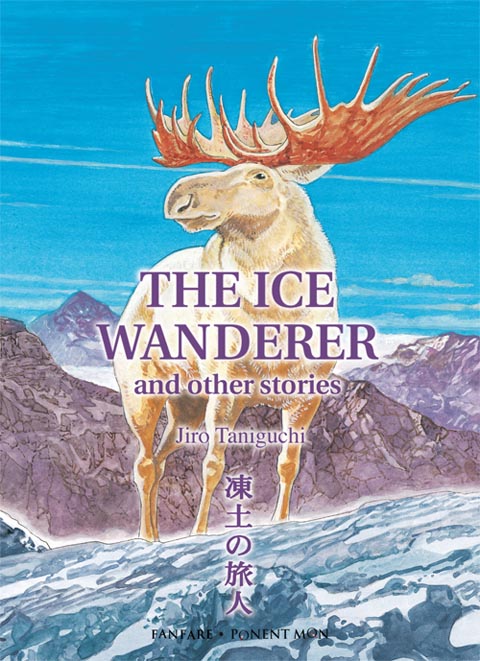
The Ice Wanderer [????? / T?do no Tabibito / lit. “the tundra’s traveler”], first published in 2004, is no exception and is a superb example of Taniguchi’s talent. It is a collection of six short stories. The overall general theme of this collection is very Japanese and a very dear subject to the author: the respect and communion with nature. This is particularly evident in the last story, “Return to the Sea”. A man is studying whales in Alaska. Following an accident, the whale known as Old Dick saves his life. In fall, after the start of the great seasonal whales migration, Old Dick stayed behind and, like told in Inuit folklore, returned to his origin in the deep sea abyss. The man follow the whale to witness this “death rite” and almost dies himself. This story was first published in Japan in Big Comic Spirits (March 28th, 1994).
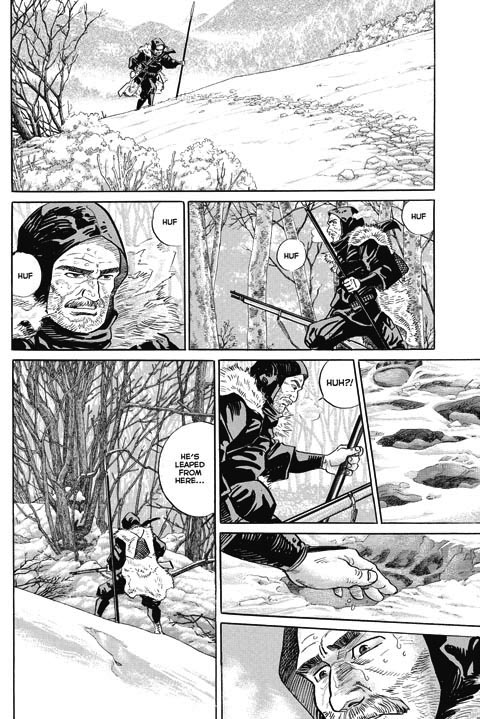
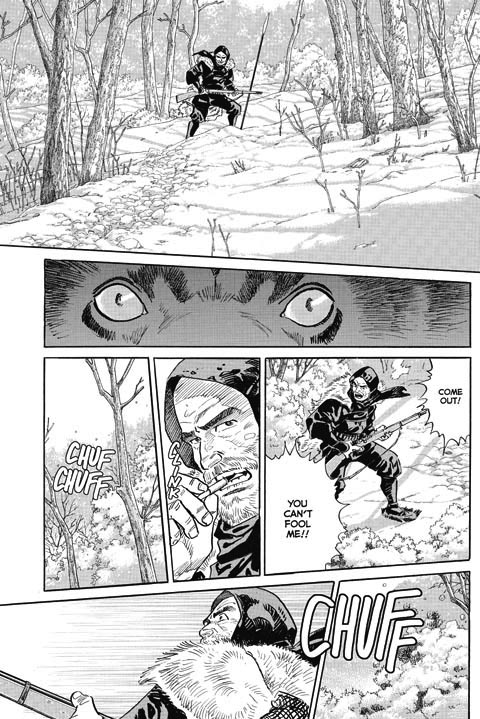
As for the first three stories, they deal more with the confrontation against wilderness and the fight for survival. In “The Ice Wanderer”, two men, who are lost in the Klondike region (Yukon) in 1897, owe their survival only to the providential appearance of an old hunter, who tells them a strange legend (first published in Big Comic Original Extra Edition, on July 2nd, 2003). In “White Wilderness”, two explorers travelling in the Yukon river basin (Alaska) to bury one of their companions, are struggling to survive as they are surrounded by wolves (this is a retelling of the first part of Jack London’s White Fang; first published in Big Comic Original Extra Edition, on December 28th, 2003). In “Our Mountains”, at the beginning of the Showa period (in the 20s) in the Senhoku district (Akita prefecture), a man goes on the trail of the bear that killed his son (first published in Big Comic Special Extra Edition, on December 1st, 2002).
The two remaining stories of the collection are distinguishing themselves by focusing more on another theme very dear to the author: they are touching stories telling every day’s life with a kind of urban nostalgia which sometimes feels autobiographical. In “Kaiyose-Jima” (“The island where the wind brings the seashells“, first published in Big Comic Original Extra Edition, on July 1st, 2004) we already find a more human environment. Following his parents’ divorce and his mother’s illness, the young Takashi spends the summer with his uncle in a small fishing village. With Yae-chan, an orphan taken in by his uncle and who taught him to swim, he gradually forgets the grief caused by his mother’s absence. One day, as they were gathering seashells together, a storm pushed their boat out to sea and they have to spend a terrible night on a small island.
In “Sh?kar?” (first published in Big Comic, January 10th, 1998), the story takes place in a more urban environment. Set in the 45th year of the Showa period (1970), it tells of a young mangaka who is influenced by the atmosphere of his new apartment, located in a former brothel. I do not think these two stories break completely with the theme of nature, because here Taniguchi seems to tell us that we can always communicate with our environment, whether it’s natural or urban.
Excerpts from “Our Mountains”; above: pages 127-28; below: pages 129-30
All in all, although this collection of short stories is a bit uneven, it is nevertheless a very good reading. It is worth noting that the work done by Fanfare (for the editing, translation and notes) and Ponent Mon (for the publishing) is excellent. I particularly appreciate that they respected the original format (reading from right to left) and did not flip the art (which unfortunately seems to happen often in North American editions). This is a high quality book (fine printing, good paper and binding) that everyone should read, as it is perfect to get acquainted with the work of Taniguchi.
The Ice Wanderer and other stories, written & illustrated by Jiro Taniguchi, translation by Elizabeth Tiernan and Shizuka Shimoyama. Rasquera (Tarragona, Spain), Fanfare/Ponent Mon, October 2007. B&W, 5.8 x 8.25 x .75 in, 240 pgs. £11.99 / $21.99 US. ISBN: 978-84-96427-33-4. Original Japanese format (right to left). Recommended for older teens (16+).
Also available in French: L’Homme de la Toundra, par Jir? Taniguchi. Casterman (Coll. Sakka), 2006. B&W, 15 x 21 cm, 248 pgs. 11.50 € / $23.95 Can. ISBN: 9782203373846. Recommandé pour jeunes adultes (16+).
For more information you can check the following sites:
To know more about this title you can also check articles on about.com and Anime News Network.
I was recently reminded of the existence of this collection because one of its titles, The Future Is Japanese, is featuring a short story that just won the 2013 Hugo Award for Best Short Story at LoneStarCon 3, in San Antonio, Texas. The short story is “Mono no Aware” by Chinese-American science fiction writer Ken Liu. It “tells the tale of the last Japanese survivor aboard an American space habitat after an asteroid has destroyed the Earth. This is the second story for which Ken Liu has won a Hugo Award”.
The Future Is Japanese, “edited by Nick Mamatas and Masumi Washington, is an anthology collecting science fiction from, and about, Japan, by some of the world’s best genre writers” (Pat Cadigan, Toh EnJoe, Project Itoh, Hideyuki Kikuchi, Ken Liu, David Moles, Issui Ogawa, Felicity Savage, Ekaterina Sedia, Bruce Sterling, Rachel Swirsky, TOBI Hirotaka, Catherynne M. Valente). Published in May 2012, it is available from most major North American book retailers (and an eBook edition is also available for the Amazon Kindle, Apple’s iBooks Store, the Barnes & Noble’s Nook Books Store, and the Sony Reader™ Store).
The Future Is Japanese. San Francisco, Haikasoru, 2012. 365 pages, 5 1/4 x 8 in., $14.99 USA / $17.99 CAN / £9.99 UK (iTunes & Kindle eBook: $8.99 USA), ISBN: 978-1-4215-4223-2.
“If you are cold, tea will warm you; if you are too heated, it will cool you; If you are depressed, it will cheer you; If you are excited, it will calm you.” ― William Ewart Gladstone

 Toffee et sa petite soeur (?) Roussette (photo à venir) sont à donner. Quelqu’un est-il intéressé? / Toffee and his little sister (?) Roussette (picture to come soon) are to give away. Anyone interested ?





 Clodjee's Safe-House