Papillon du céleri • Black swallowtail
Lepidoptera : Papilionidae : Papilio : Papilio polyxenes




[ Nikon D3300 + Tamron Tele-Macro, Jardin Botanique, 2019/08/20 ]
[ Nikon D3300 + Tamron Tele-Macro, Jardin Botanique, 2019/08/20 ]

[ Nikon D3300, Jardin botanique, 2019/08/20 ]
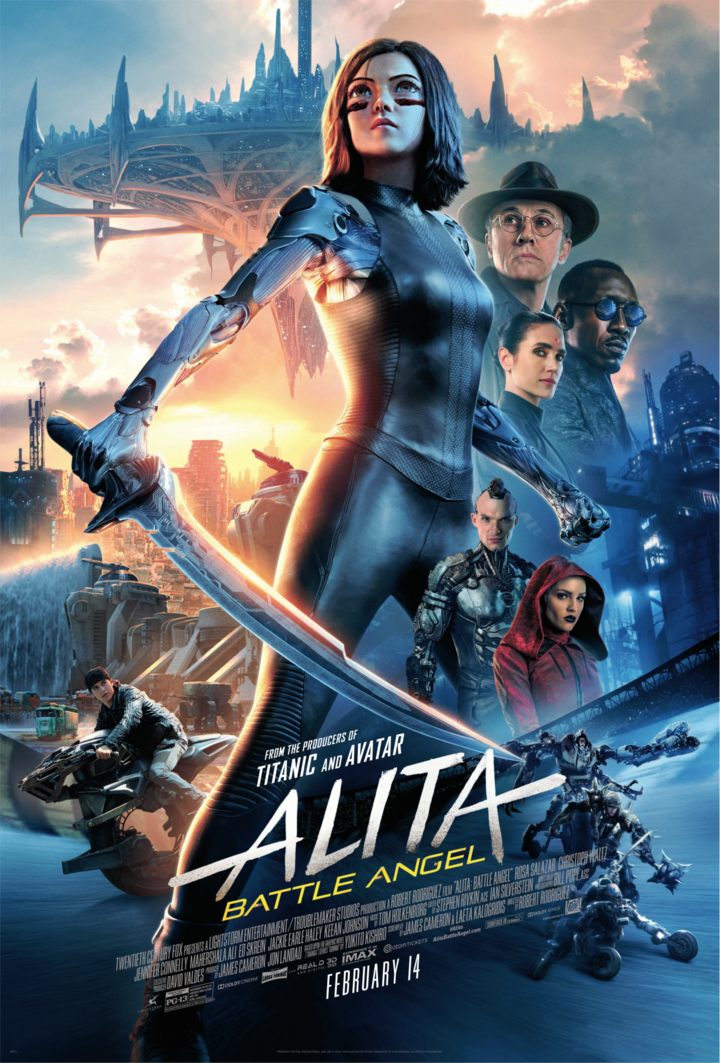
When Alita (Rosa Salazar) awakens with no memory of who she is in a future world she does not recognize, she is taken in by Ido (Christoph Waltz), a compassionate doctor who realizes that somewhere in this abandoned cyborg shell is the heart and soul of a young woman with an extraordinary past. As Alita learns to navigate her new life and the treacherous streets of Iron City, Ido tries to shield her from her mysterious history while her street-smart new friend Hugo (Keean Johnson) offers instead to help trigger her memories. But it is only when the deadly and corrupt forces that run the city come after Alita that she discovers a clue to her past – she has unique fighting abilities that those in power will stop at nothing to control. If she can stay out of their grasp, she could be the key to saving her friends, her family and the world she’s grown to love. — (Promotional text)
This movie is based on the manga series Battle Angel Alita by Yukito Kishiro (which I recently commented). James Cameron had been interested in the story for a long time (he optioned the titled in 2000 and used it as inspiration for his TV series Dark Angel) but, being too busy with Avatar and its sequels, he passed the directorial torch to Robert Rodriguez. It is a good thing that Cameron and Jon Landau waited to produced Alita because it gave them the time to perfect the motion-capture CGI technology with Avatar. The type of fast action combat scenes needed to adapt the manga would not have been possible otherwise. It also gave them time to work on the script to make it shorter.
It’s an excellent movie, with superb special effects and great storytelling. It is both entertaining and compelling. They succeeded to tell the story within two hours while keeping enough elements of the manga to be faithful. I was afraid at first that they would not be able to adapt the story properly, but all the essential themes are there: the identity quest, the love story, the desire to protect the weak against evil, the dark post-cataclysmic world, the hopeful cyberpunk technology, the fabulous combat scenes, even the social comment about the stupidity of war and social inequity.
The only major changes are that they explain early in the story the cause of the Earth’s destruction (the war between Earth and Mars — in the manga they just mentioned that Earth was hit by a meteorite without saying, at first, that it was intentional) and the nature of Alita (a martian soldier/berserker). Hugo (Yugo in the manga) also appears in the beginning of the movie (while he only appears in chapter eight in the manga). Most of the changes are minor and without consequence: Ido names Alita (Gally) from his dead daughter (instead of from his dead cat), his ex-wife Chiren doesn’t appears in the manga (that character was created for the anime), his assistant is different (she looks more like Myra, the doctor who replaces Yugo’s hand in chap. 10 of the manga), the Berserker replacement body is not found by Alita but by Ido, the speech in the “Kansas” bar to try to get the Hunter-Warriors’ help against Grewishka (Makaku) is made not by Alita but by Ido (who still has his Zalem symbol on the forehead in the manga), etc. The movie also adds the fact that Nova can see and speak through Vector. Despite those few differences, the movie seems quite similar (even more if we compare to the anime version, Battle Angel).
Annoyingly, the movie ends on a sort of cliff-hanger: will Alita succeed to reach Zalem and get her revenge from Nova? That’s what we will know in the sequels — if they are ever produced. It all depends on the success of the first movie. Despite mixed reviews, it seems that it was well received (the sales more than doubled the budget and ratings were good enough on IMDb [7.4] and Rotten Tomatoes [60% for the critics but 93% for the audience]). For my part (but I was already an Alita fan), I think it was an excellent adaptation and I enjoyed it greatly. I warmly recommend it. 
To learn more about this title you can consult the following web sites:
[ Traduire ]

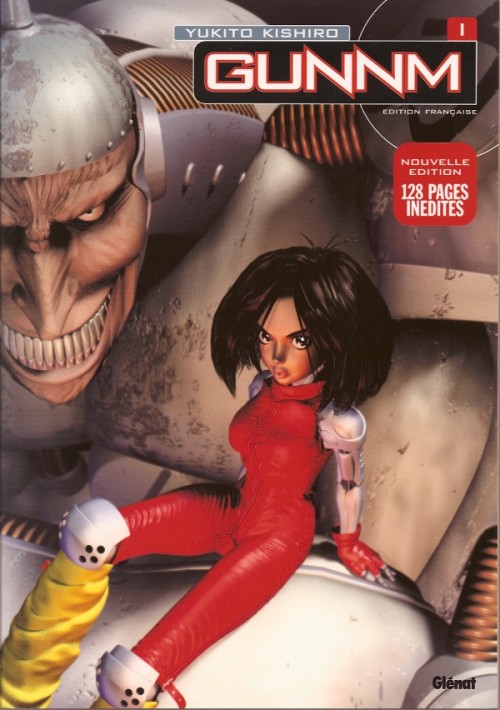 Gunnm (銃夢 / Gun-mu ou Jūyume / contraction de l’anglais “gun” (fusil) et du japonais “yume” (rêve) donc lit. “Rêve d’arme”) est un manga par Yukito KISHIRO qui a été publié en feuilleton dans Business Jump dès 1990 et dont le premier volume parait au Japon en septembre 1991 chez Shueisha. Suite à un conflit avec son éditeur en 2010, la parution de la série continue chez Kodansha. En 1995, une première édition en France se fait en neuf volumes chez Glénat (ce sera d’ailleurs parmi les premiers mangas à recevoir une traduction française). À peu près au même moment la version anglaise parait chez Viz Comics sous le titre “Battle Angel Alita” (puis réédité chez Kodansha Comics). En 2000, Glénat publie un édition deluxe grand format en six volumes. Ces éditions ne sont plus disponible mais Glénat a récemment rééditée Gunnm avec une nouvelle traduction.
Gunnm n’est que la première de trois séries de manga et l’histoire se poursuit avec Last Order (19 vols.) et Mars Chronicle (6 vols jusqu’à maintenant). Un recueil de quatre histoires courtes, Gunnm Other Stories, a également été publié mais trois des histoires sont incluses dans l’édition deluxe grand format. Le manga a été adapté en un roman de Yasuhisa Kawamura, en animation (deux OVA de 30 min.) en 1993 par Hiroshi Fukutomi, puis au cinéma par Robert Rodriguez et James Cameron sous le titre Alita: Battle Angel.
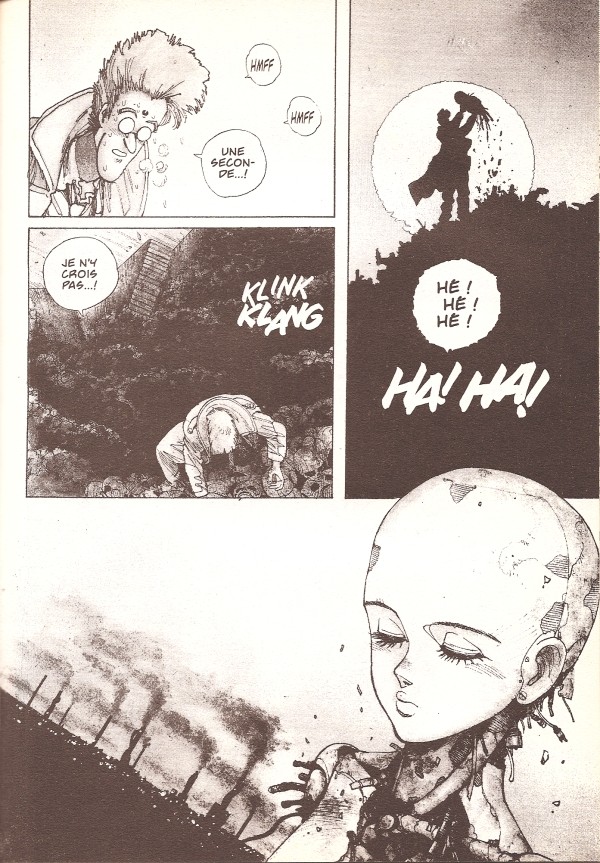
Page 9
Sur une Terre post-cataclysmique (suite à l’impact d’une météorite), ce qui reste de l’humanité survit à Kuzutetsu, dans l’ombre de la cité flottante Zalem (où réside l’élite). Dans la décharge à déchets de la cité, le cyber-docteur Daisuke Ido découvre la tête d’une femme cyborg dont le cerveau humain est miraculeusement encore en vie. Il la soigne et la nomme Gally (Alita), car celle-ci est amnésique et ne se souviens plus de rien. Il finit par lui fabriquer un corps.
Il n’y a plus d’autorité pour faire régner la loi et l’ordre dans les bas fonds de Kuzutetsu, alors l’usine 33 (qui alimente Zalem en énergie et en vivres par un long cable) fait appel à des chasseurs de primes, les Hunter-warrior. De nombreux criminels s’attaquent aux cyborgs pour leur voler des pièces ou des membres (la colonne vertébrale est d’ailleurs très prisée). Pour émuler Ido, mais surtout pour traquer et éliminer ceux qui s’attaquent aux faibles, Gally décide de devenir Hunter-warrior.
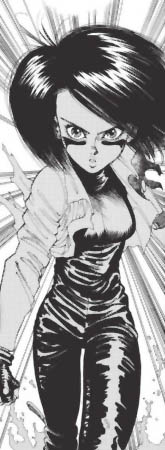 Après une altercation avec le cyber-monstre Makaku, le corps de Gally est détruit. Toutefois, Ido le remplace par le corps d’un berserker, un guerrier cybernétique qu’il avait découvert plus tôt dans les ruines d’un vaisseau spatial. C’est une véritable machine de guerre, résultant d’une technologie et d’un savoir-faire oubliés depuis longtemps. Si Gally ne se souviens pas de sa vie antérieure, elle est capable d’utiliser intuitivement une ancienne technique de combat cyborg appelé Panzer Kunst, et de controller les fonctions de son nouveau corps. Cela fait d’elle un combattant d’exception et lui permet de défendre Ido contre la vengeance de Makaku… Mais qui est-elle vraiment?
En plus des sept chapitres du récit, ce volume contient également des informations sur les usines et les bornes de Kuzutetsu, le court récit “Douce Nuit” (en trois parties, 100 p.) qui traite des origines de Ido, ainsi qu’un “art book” de vingt-deux pages qui offre des notes et des croquis sur la création de Gunnm.
Ce manga nous offre donc une quête existentielle dans un univers cyberpunk post-cataclysmique, teinté d’un commentaire sociale sur la division des richesses. C’est un manga seinen mais avec un récit très inspiré par le sous-genre shōnen du nekketsu, où le héros — souvent orphelin — doit réaliser une quête initiatique qui l’amène à affronter de nombreux obstacles et des adversaires en tournoi ou combat singulier.
J’ai lu ce manga il y a une vingtaine d’années et j’en avais gardé un très bon souvenir. C’est effectivement une série qui avait été très bien reçu tant en France qu’aux U.S.A. En prévision de la sortie de l’adaptation cinématographique, j’ai décidé d’en faire une relecture et celle-ci n’a pas altérée ma première impression. C’est un très bon manga, plein d’action mais aussi d’émotions et d’idées qui appelles à la réflexion. Je vous le recommande.
Gunnm, t. 1 par Yukito KISHIRO. Paris: Glénat, juillet 2000. 362 planches, N&B, 18 x 25.5 cm, ISBN 2-7234-3293-9. Sens de lecture occidental. Pour un lectorat adolescent (16+). 
Vous trouverez plus d’information sur les sites suivants:
[ Amazon — Biblio — Goodreads — Google — Wikipedia — WorldCat ]
© 1991, Yukito KISHIRO. © 2000, Éditions Glénat pour la traduction française.
[ Translate ]
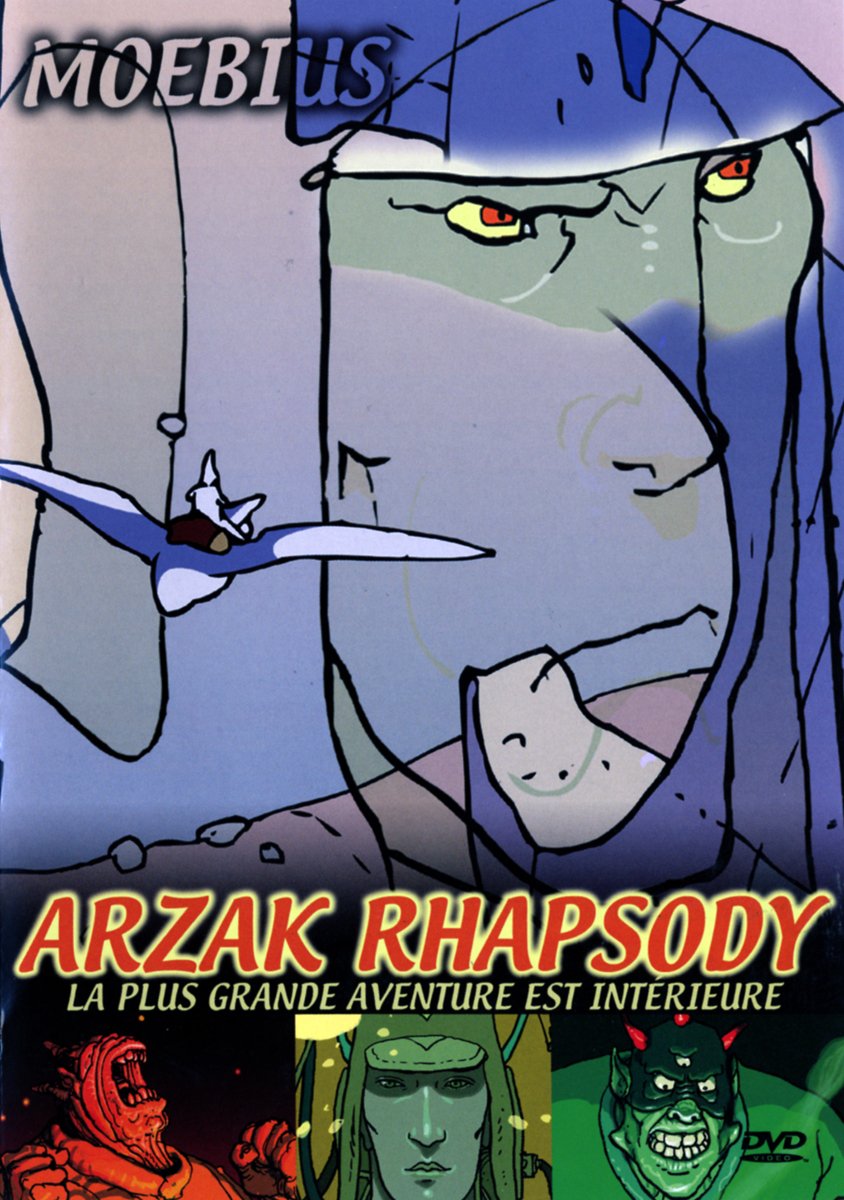
Perché sur son fidèle Ptéroïde anti-gravité (où rien de grave ne peut l’atteindre), Arzak explore le Désert ‘B’, un monde parallèle peuplé de créatures étranges, situé aux frontières du rêve et d’une réalité au-delà du réel. Mais Arzak ne rêve-t-il pas d’un univers qui est en lui…ou en chacun de nous ?
(Texte promotionnel — voir aussi la couverture arrière de la jaquette)
Ce dessin animé est une série de quatorze capsules de 3:30 min. chacunes qui offrent un dessin minimaliste qui est terriblement animé. On y retrouve différentes aventures (et mésaventures) du célèbre guerrier solitaire et (généralement) silencieux alors qu’il parcours le désert B, affrontant l’herbe-serpent ou diverses autres créatures. C’est un peu sans queue ni tête mais les récits sont étoffés par une narration et Moebius donne, pour la première fois, la parole à Arzak. Tout comme les planches de Moebius, ces capsules sont un peu inégales en qualité (et en intérêt). L’univers d’Arzak est un peu tourné en ridicule avec des personnages clownesques (où l’on pourrait peut-être discerner une influence de Winsor McCay?).
C’est mauvais mais tout de même amusant et intriguant. À la défense de cette curiosité décevante, il faut admettre qu’elle est définitivement produite pour un public jeune alors que la série originale s’adressait aux adultes. On s’attendrait néanmoins à mieux de la part d’un créateur comme Moebius. C’est trop court et plein de potentiel inexploité (quoique le graphisme s’améliore avec les derniers épisodes). Cela aurait pu être tellement mieux…
Il est intéressant de constater que l’on voit déjà le début de la convergence des différents univers (et styles) de Giraud / Moebius avec des éléments qui rappellent Le Garage Hermétique, d’autres qui font définitivement partie du monde SF déjanté et imaginatif de Moebius — parfois hilarant et absurde, parfois mystique et obscure (avec des allusions au Arzach original ou à Edena) — et même des relents d’atmosphère western à la Blueberry. Cette série d’histoires nous laisse donc présager la suite — L’Arpenteur…
À voir par amusement ou par curiosité.
Arzak Rhapsody: France, 2002, 51 min., série télévisée d’animation (14 episodes); Dir., Scr., Des.: Moebius; Dir. Art.: Alexandre Brillant; Ass. Réal.: Francois Narboux; Mus.: Zanpano; Studio: Millimages Online; Prod.: Wolfland Pictures, Carrere Group, France 2. 
Pour en savoir plus vous pouvez consulter les sites suivants:
[ Translate ]

[ iPhone 8+, .mov video clip converted to .gif, 2019/06/28 ]
Thirty seconds of relaxation with a family of ducks at the botanical garden
Trente secondes de relation avec une famille de canards au jardin botanique
[ iPhone 8+, Jardin botanique, 2019/05/24 ]
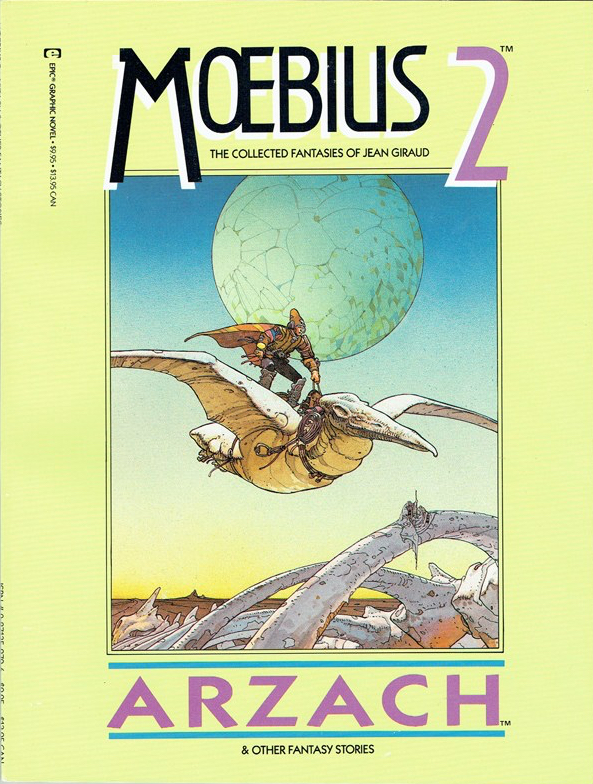 Strangely, this edition of Arzack, published by Epic / Marvel, offers the stories in a different order than the French edition.
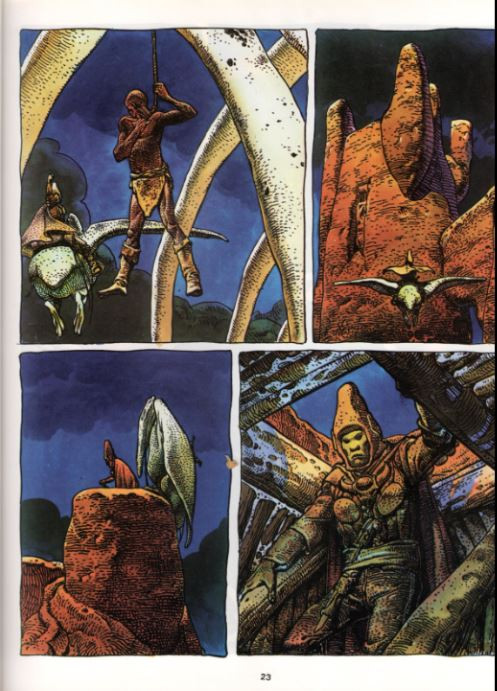
In the first story, ”Arzach” (8 colour pages), the protagonist spies on a naked woman who dresses but he is surprised by her husband. He captures and suspends him to a giant skeleton but all for nothing because, finally, the beauty of the woman leaves something to be desired…
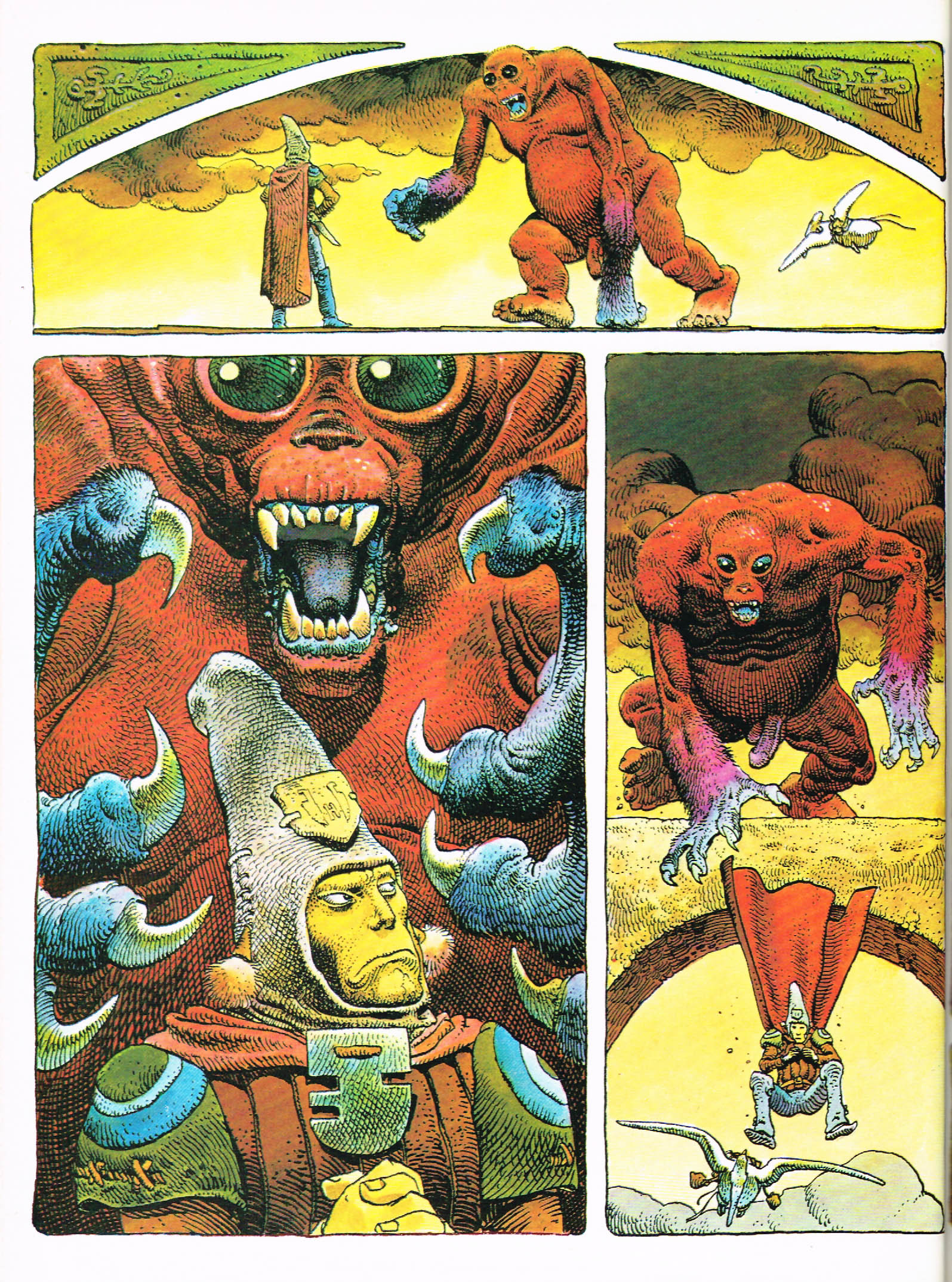 In the second story, “Harzak” (8 colour pages), our heroes flies over the carnivorous plain on his faithful Pteroid, his luggage being on the back of a second bio-mechanical pterosaur. But after a long flight, the latter is tired and plunges into the killer grass. Harzak must rest his mount but the only haven possible is a kind of arch occupied by a giant primate, red and fierce. Full of nonchalance, the hero triumphs. This is my favorite story thanks to Moebius’ beautiful drawings. In my youth, I made a poster out of one of these boards.
In the third story, ”Arzak “(8 colour pages), a man arrives by car near some sort of stone temple. He enters, passes through a crowd of passive / aggressive green men, then enters a room where he repairs equipments. In the distance, an inanimate Pteroid wakes up. His task accomplished, the man leaves with his car…
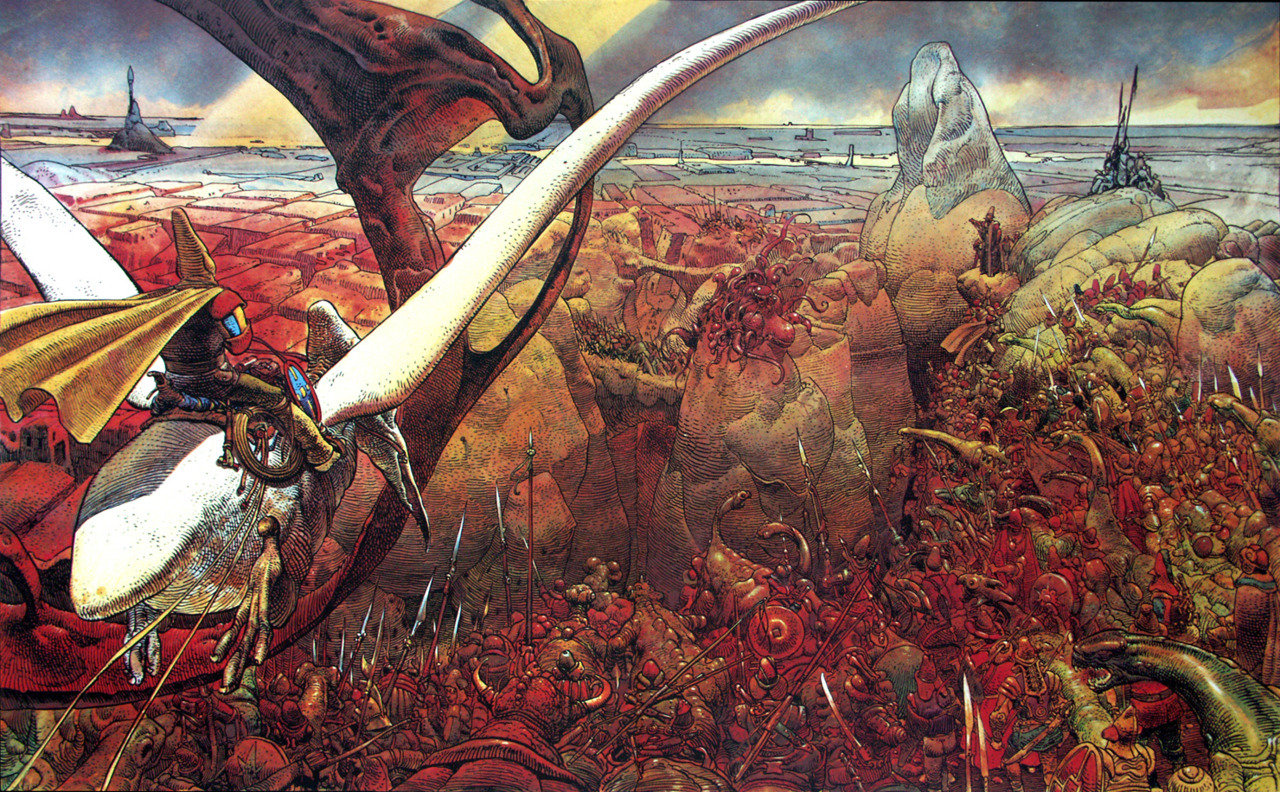 The fourth “story” is a series of eight colour pages that do not seem related but which may form an enigmatic story titled Harzach… The quality and style of each is quite uneven, the best being a double-page fresco depicting an army.
When it comes to the “other fantasy stories”, this part includes a selection of completely different stories (except one).
In “The Detour” (7 p., B&W), Jean Giraud’s family take a detour on their way to the island of Re and makes strange encounters. The story doesn’t make much sense tout the art is beautifully detailed.
In “The Ballade” (9 colour pages), a young explorer crosses the bio-forest reciting Rimbaud. He meets a fauness, who saves him from the attack of an Euchinus and decides to join him to discover distant human cities full of wonders. But in their first meeting with a troop of these townspeople, they are massacred without questions. Moebius said that he used an absurd, sudden and tragic ending because he was coming close to the deadline… This story shows us a beautiful, intriguing and original universe.
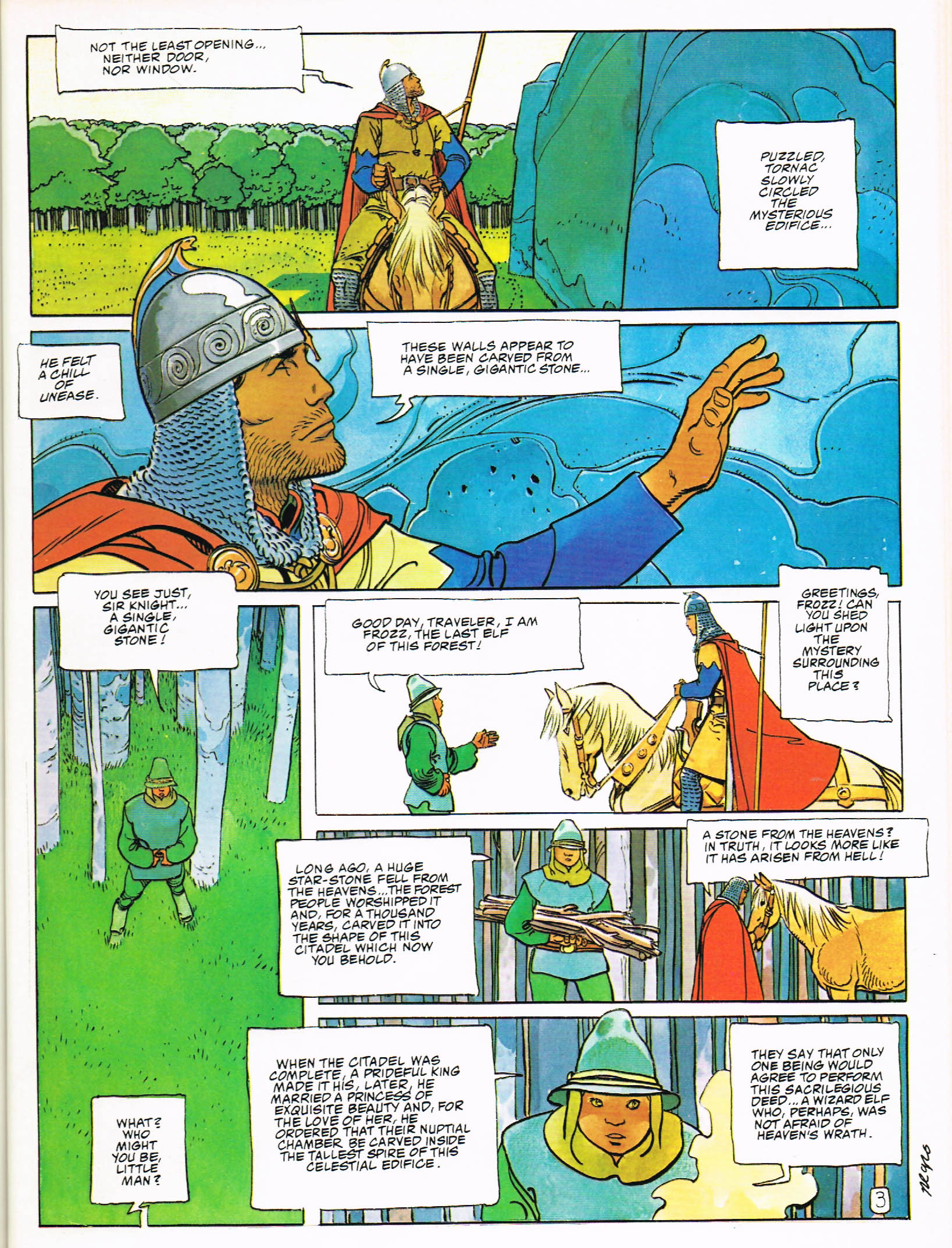 In “The White Citadel” (6 colour pages), a knight crossed for months the wilderness until he encountered a citadel carved in one single stone. An elf appears and tells him the story of a prideful king who wed a beautiful princess, but as soon she entered the nuptial chamber it closed down, trapping her. The king was barred from entering by a dark creature. Soon the knight fall asleep, possessed by the king spirit, and in his dream fights the dark creature again. In the morning the traveling knight wakes up blind, deaf and mute… Moebius notes in the preface that his friends commented that his stories were always very negative, so to prove them wrong he wrote this one but failed as it ended up again dark and morbid!
In “Ktulu” (5 colour pages), after a last meeting the president goes down a dark tunnel to meet the hunt master who will grant him the agreed privilege to hunt the Ktulon… A short and unremarkable story. Moebius notes that this is a little humorous fable referencing Lovecraft’s mythology and, at the same time, criticizing the French president “using the privilege of his office to go to Africa and hunt wild game” which he found shocking.
The book ends with one last “Arzach” story (5 colour pages) giving some humorous background to the character, the last ptero-warriors helping an artist retrieving the red stone stolen by an evil wizard. Amusing.
As for the French edition of Arzack and the compilation of stories that included it, this book offers some of the best examples of science fiction stories by Moebius. It is very interesting (and entertaining) to read. It’s really worth a look.
Moebius 2, The Collected Fantasies of Jean Giraud: Arzach & Other Fantasy Stories, by Moebius. New York: Epic/Marvel, April 1987. 72 p. $US 9.95 / $C 13.95. ISBN 0-87135-279-6. 
To know more you can consult the following sites:
© Starwatcher Graphics
[ Traduire ]


[ iPhone 8+, Parc Frédéric-Back, 2019/07/10 ]
“Il n’y a aucune raison pour qu’une histoire soit comme une maison, avec une porte pour entrer, les fenêtres pour regarder les arbres et une cheminée pour la fumée… On peut très bine imaginer une histoire en forme d’éléphant, de champ de blé ou de flamme d’allumette souffrée.” — Moebius 1976
[ Texte de la couverture arrière ]
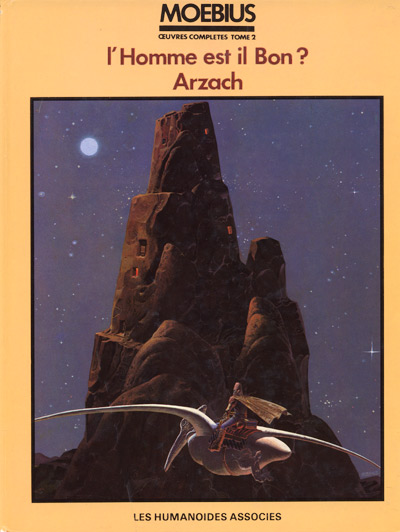
Cette compilation de 45 planches regroupe deux différents albums de Moebius.
Le premier album est Arzach qui nous offre quatre histoires sans dialogues et un peu plus d’une douzaine de planches (dont une avec dialogues, certaines en couleurs, d’autres en noir et blanc, certaines sur deux pages) qui semblent plus être des illustrations que des histoires et qui n’ont pas de lien apparent entre elles. Les titres sont des variations orthographiques de Arzach: Harzack, Harzak, Arzak, Harzakc, Harzach, Arrzak.
 Dans une première histoire qui précède la préface (deux planches, en N&B), Harzack pisse derrière un building et se fait prendre, mais la flaque d’urine prends des allures tentaculaires et saisie le policier. (Parue dans Métal Hurlant #3 (2e trim. 1975): 6-7)
Dans une deuxième histoire (huit planches couleurs), Arzach espionne une femme nue qui s’habille mais est surprit le mari de celle-ci. Il capture celui-ci et le suspend à un squelette géant mais tout ça pour rien car, finalement, la beauté de la femme laisse à désirer… (Parue dans Métal Hurlant #1 (1er trimestre 1975): 19-26)
Dans une troisième histoire (huit planches couleurs), Harzak vole au-dessus de la plaine carnivore sur son fidèle Ptéroïde, son bagage étant sur le dos d’un deuxième ptérosaure bio-mécanique. Mais après un long vol, ce dernier fatigue et s’abime dans les herbes tueuses. Harzak doit reposer sa monture mais le seul havre possible est une sorte d’arche occupé par un primate géant, rouge et féroce. Plein de nonchalance, le héros triomphe. Celle-ci est mon histoire préférée grâce au superbe graphisme de Moebius. Dans ma jeunesse, j’avais fait un poster avec l’une de ces planches. (Parue dans Métal Hurlant #2 (2e trim. 1975): 19-26)
Dans la quatrième histoire (huit planches couleurs), un homme arrive en voiture près d’une sorte de temple en pierre. Il y entre, traverse une foule d’hommes verts passifs/agressifs, puis entre dans une pièce où il répare un équipement. Au loin, un Ptéroïde inanimé se réveille. Sa tâche accomplie, l’homme repart avec sa voiture… (Parue dans Métal Hurlant #4 (4e trim. 1975): 19-26)
Le deuxième album, L’Homme est-il bon?, nous offre onze histoires courtes: “Les clans de la lune alphane” (1 p.), “Le jeudi noir” (2 p.), “L’Homme est-il bon?” (10 p.), “Quelques books” (1 p.), “Le cerveau du Major (The Long Tomorrow, 16 p.)”, “Le café” (1 p.), “Science Fiction Chronicle” (1 p.), “Babel 17” (1 p.), “Une famille de nageur” (1 p.), “L’univers est bien petit” (8 p.) , et “Ballade” (9 p.). La plupart de ces histoires sont très courtes et souvent constituent une sorte de commentaires de lecture illustrés de romans de SF. Seulement quatre histoires méritent vraiment notre attention.
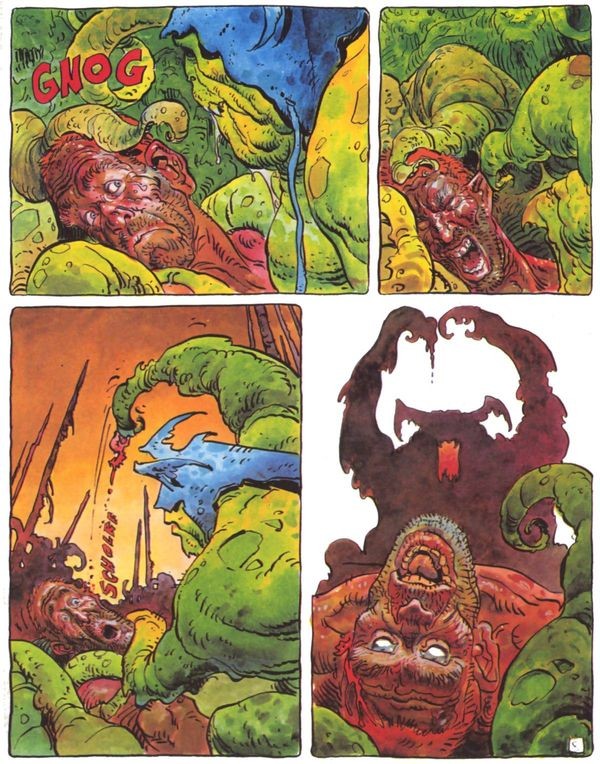 Dans l’histoire titre, un soldat est poursuivi par une troupe de créatures féroces et vertes. Ils le rattrapent, lui arrachent ses vêtements, puis leur chef lui arrache l’oreille gauche à l’aide d’un tentacule et la goûte. Il fait une grimace, et la recrache! La troupe poursuit son chemin laissant l’homme penaud et nue. On en déduit donc que la réponse à la question du titre est, non, l’homme n’est pas bon!
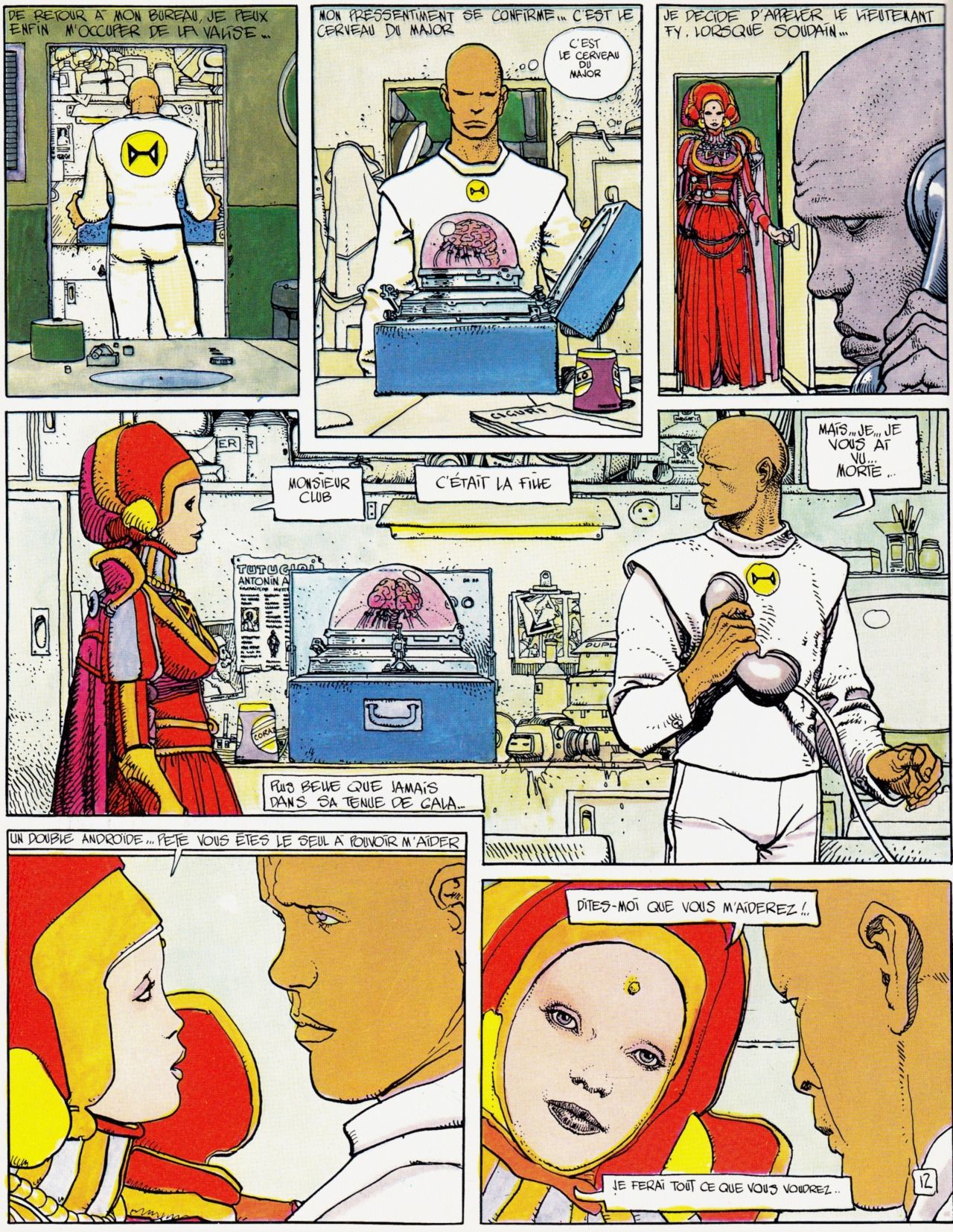 Dans de “The Long Tomorrow”, un détective privé est engagé par une riche dame pour récupérer un colis dans les bas fonds de la cité (dans un casier à bagage de la station de sub du 199e niveau). Il récupère la malle sans trop de mal, mais lorsqu’il revient au 12e niveau pour la remettre à la dame, le conapt de celle-ci est occupé par la police. La fille a été tué et torturé abominablement. On lui apprend qu’un espion arcturien rôde dans la ville à la recherche du cerveau du Major. Sur le chemin du retour, un assassin tente de le tuer mais il réussit à l’éliminer près de l’astroport. Chez lui, il ouvre la malle qui contient, bien sûr, le cerveau du Major. La fille lui rend visite inopinément, expliquant que la morte était un double androïde. Alors qu’il baise la fille, le lieutenant Fy l’appelle pour l’avertir que l’espion est en fait la fille. Le camouflage télépathique de celle-ci étant tombé, elle lui apparait comme une masse tentaculaire, qu’il élimine malgré ses suppliques. Le cerveau retrouve son propriétaire… affaire classée! Cette superbe histoire, ma favorite de l’album, créée sur un scénario de Dan O’Bannon, est en quelques sorte la genèse de l’Incal.
Dans “L’univers est bien petit”, un couple en voyage interstellaire atterrit sur une planète et y découvre un naufragé qui s’avère être un vieil ennemi. Toute le monde s’entretue…
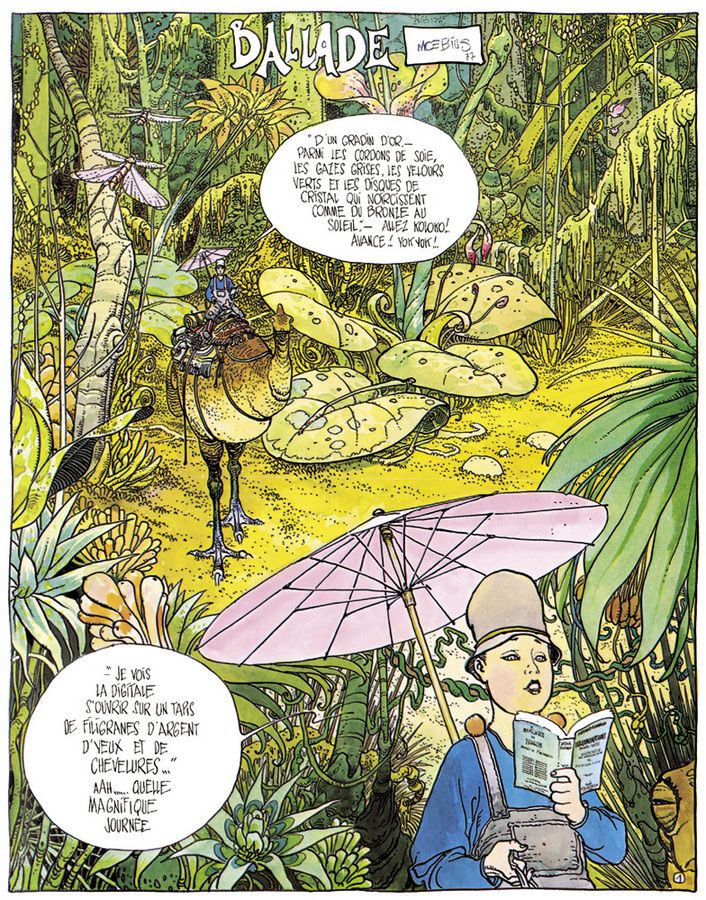 Dans “Ballade”, un jeune explorateur traverse la bio-forêt en récitant du Rimbaud. Il rencontre une faunesse, qui le sauve de l’attaque d’un Euchinus et décide de se joindre à lui pour découvrir des villes humaines lointaines et pleines de merveilles. Mais dès leur première rencontre avec une troupe de ces citadins, ils sont massacrés sans questions. Moebius aime bien ces fins absurdes, subites et tragiques… Cette histoire nous montre un bel univers original et intriguant.
Cette compilation nous offre quelques uns des meilleurs exemples d’histoires de science fiction par Moebius. Très intéressant (et divertissant); à lire.
Cette édition compilant les deux albums n’est plus disponible mais ils sont sans doute encore disponible séparément (comme dans l’édition couleur USA: Arzach [ Amazon • Biblio ], L’Homme est-il bon? [ Amazon • Biblio ])…
Moebius, Oeuvres Complètes tome 2: l’Homme est il bon ? / Arzach, par Moebius. Paris: Les Humanoïdes Associés, février 1981. 124 p. ISBN 2-7316-0098-5. Pour un lectorat adolescent (14+).
Pour en savoir plus vous pouvez consulter les sites suivants:
[ Amazon — Goodreads — Google — Humanos — Wikipedia — WorldCat ]
© Les Humanoïdes Associés 1981.
[ Translate ]
What is it with this new trend? Many paying TV services like AMC Premiere, HBO Now (U.S. only), PBS Passport (U.S. only), etc., start appearing. Look, I am already paying for the damn channel and now you tell me I have to pay some more to get access to your back-catalog streaming, bonuses, extra, previews or advance screening ? Man, that’s harsh. That’s being greedy. That’s exploitation of the masses. I really effing hate you, TV.
And now a special word for PBS: I am already paying for your damn stations (three, in fact) with Bell Fibe TV. How come when I go to your website I cannot watch ANYTHING because “this video is not available in your region due to rights restrictions” ? And it’s the same damn thing for Passport ! Isn’t your call sign saying “Mountain Lake PBS : Plattsburg, Burlington, Montreal” ? I can even donate some money to your station. And yet I cannot use your website or the iPad app ? That’s nonsense! Just go to hell. I’ll donate money when I’ll be treated as a real customer and be able to use your online service!
[ Traduire ]
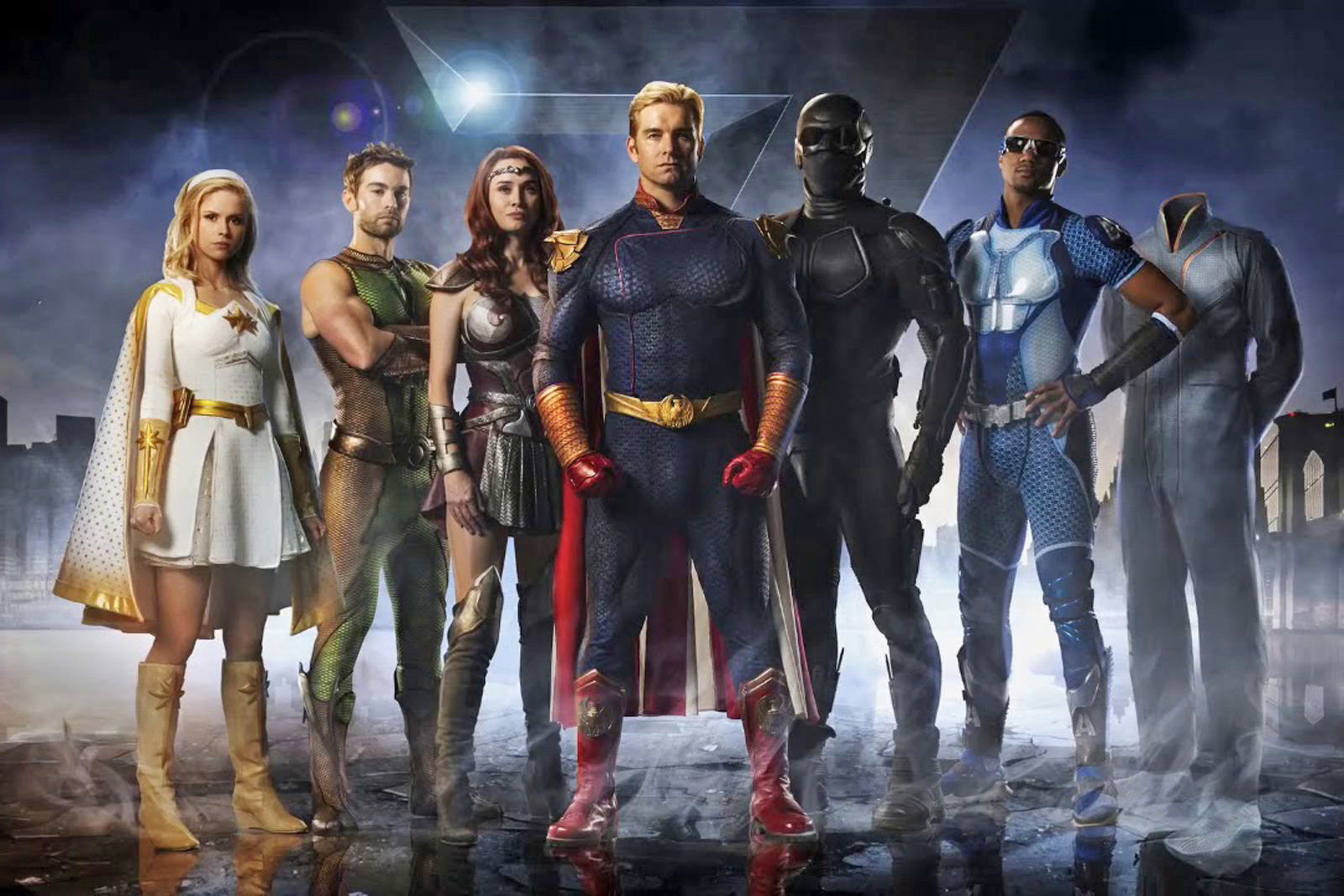 Now I’ve watched the entire first season. Impressive. It’s funny, dark and, if not entirely original (it reminds me of several other superheroes shows or movies), fresh enough to be interesting. However, not enough for me to increase my appreciation to four stars. So it remains at .
Maybe it’s my imagination, but it looks to me that Vought International is some kind of allegory for the Trumpian White House, where Homelander represents Trump, the rest of the Seven being his cabinet members and the corporation’s high hierarchy being the PAC that finance and control the whole thing… Of course, the comic book was published in 2006-2012 and couldn’t have predicted such a freak president, so it’s probably just my mind playing a trick on me (although the show producers could have put a slight emphasis on this aspect…).
A friend, who has read the beginning of the comic, told me it was quite violent and he was rather disappointed by how tame the TV series was. The comic intended to out do the violence and sexuality of Preacher, but unfortunately it appears that Amazon Video is not as daring as AMC or HBO when it comes to TV adaptation.
The way it ends offers a little closure, but this end most likely calls for more. Indeed, Amazon has renewed it for at least another season. Now what?
Check my first comment for more information on The Boys.
 I’ve caught up to the episodes I had missed at first and even watched the complete first season. This show is a mess — but a beautiful mess. It’s intriguing and even enthralling — almost addictive. It gets better and and better with each new episode. The characters grow on you and it makes the drama created by Rue’s self-destructing behaviour or the misunderstanding and missed opportunities of everyone’s relationships even more painful to watch at time. That’s the sign of excellent writing. That’s not the type of show I would normally watch, but now I feel I would like to see more. Too bad the first season is over… Although it is still available on streaming and the show has been renewed for another season next year… However, if THAT’s the life of today’s teenagers, I weep for the future…
This one definitely deserves to be upgraded to or maybe even a !
Check my first comment for all the show details.
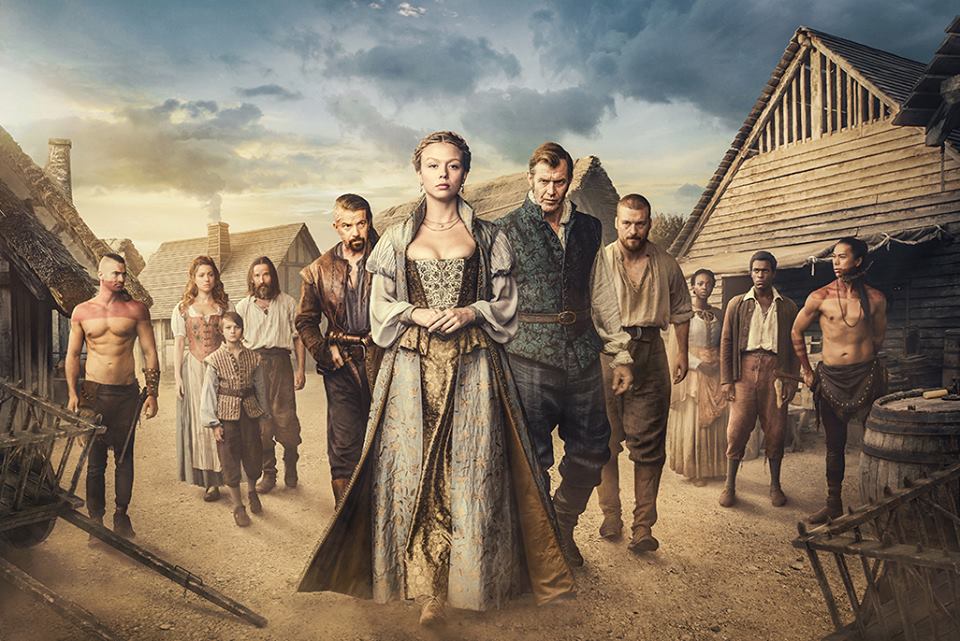 Tonight on PBS, the Jamestown series is concluding with the end of its third season. It started as an interesting historical drama about one of the first successful British colonies in America — although it is not clear how much “historical” it really is (the series is shot in Hungary; they use the names of some of the colonists, like James Read, but mostly of the Governor Yeardley and his wife Temperance, as well as the Pamunkey King, Opechancanough — Pocahontas is NEVER mentioned). After the failure of Roanoke in 1585, Jamestown was established in 1607 and the story begins twelve years later with the arrival of the first women and, in second season, of the first indentured “servants” (African slaves). At first, it focuses on the politics of the colony and the schemes behind the Virginia Company. Unfortunately, it quickly turns into fantasy with lots of supernatural plot elements and ends abruptly with the massacre of 1622 — when the local native tribes, the Pamunkey and the Powhatan Confederacy, get fed up with the abuses and false promises of the Englishmen. The reviews were probably so bad in the U.K. (however ratings on IMDb [6.9] and Rotten Tomatoes [78%] were relatively good) that it was quickly brought to a conclusion and terminated. It was an entertaining drama, but it could have been so much more. Disappointing.
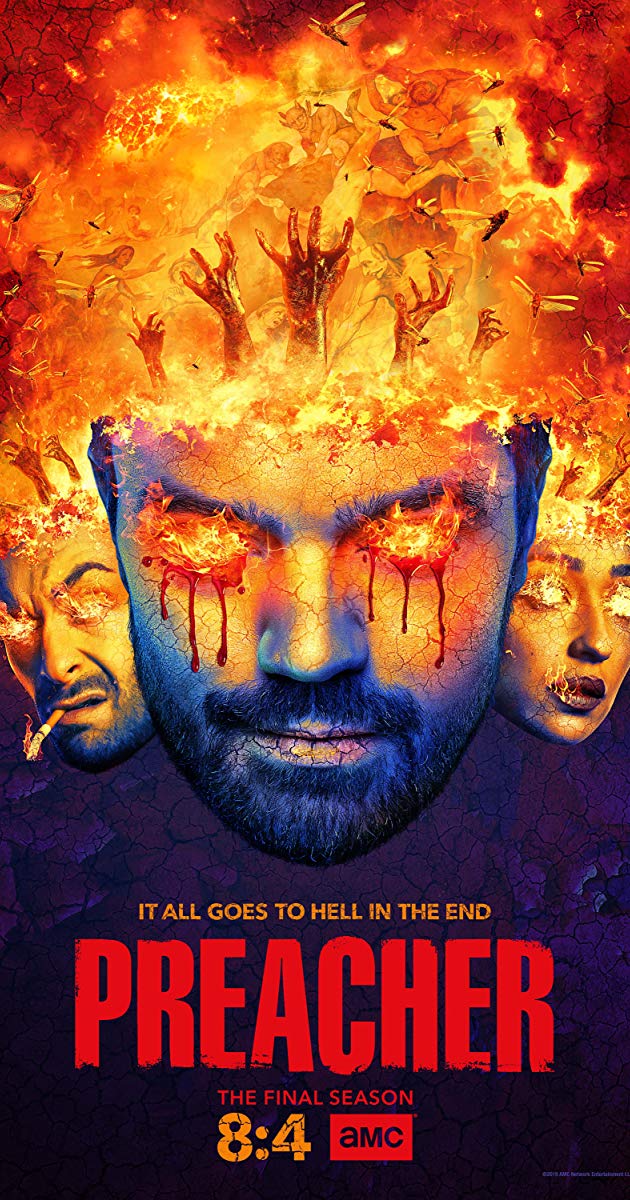 Preacher has restarted but it will be the last season. I can’t wait to see how they will end this one. The first episodes are set at Masada, in the Middle East, and then it will move to Australia. Actually, it was all shot in Australia. An amusing splatter & gory series that I will not really miss after it’s gone. Check the trailer.
Poldark is also concluding with a story line that covers the gap between the two book series. So it has more to offer for those who has loved the books. I’ll be sad when this fifth season comes to an end. I really liked those characters. After tonight, there will be only three episodes to go… Check the trailer.
Pandora continues its disappointing run. Its not good enough to really appreciate it, but it’s not bad enough to drop it. So, I’ll continue watching it hoping for improvements…
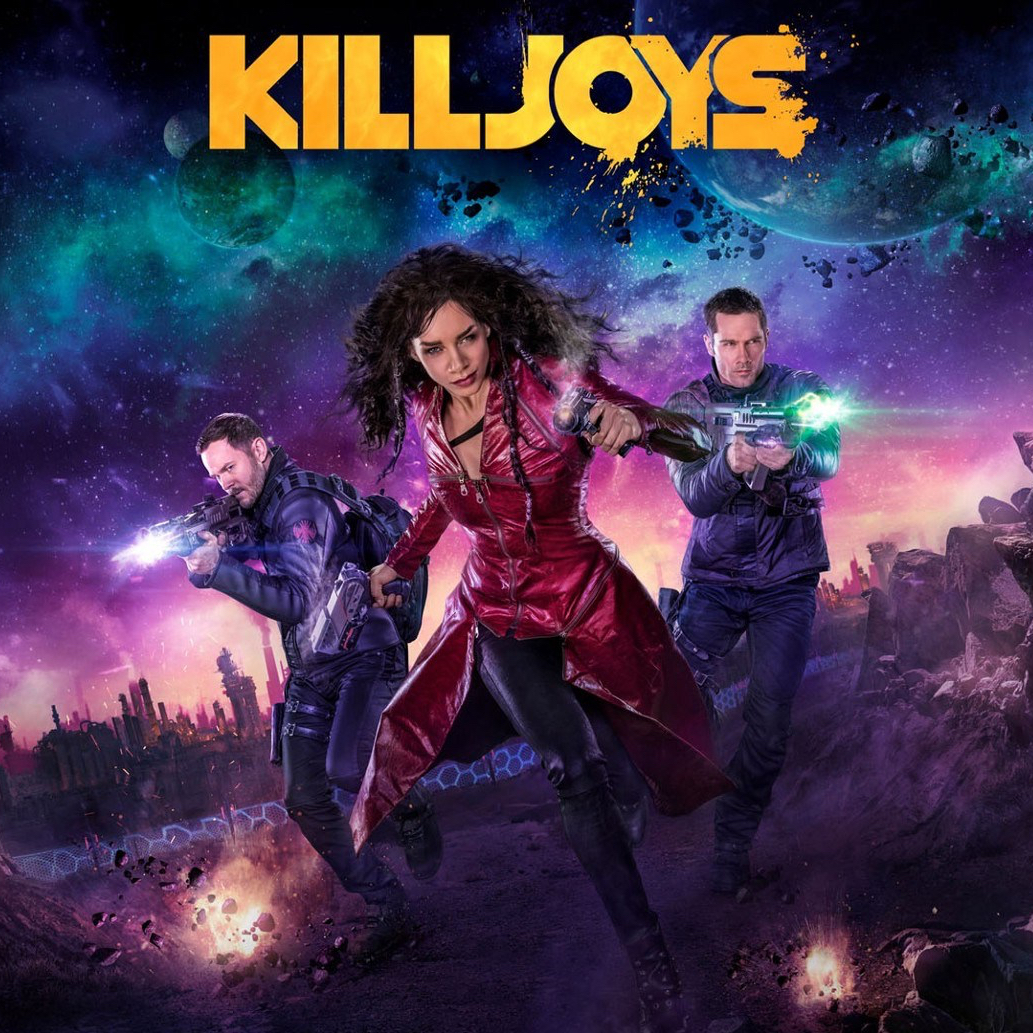 Killjoys has also restarted for a fifth season. The team is struggling hard to escape the grip of the Lady… A beautiful and excellent Canadian sci-fi series (second only to The Expanse) that will unfortunately conclude in September. Check the trailer.
The first season of Blood & Treasure has ended but the series was renewed for a second season. A cute but quite ordinary action/adventure series.
The seventh season of Elementary will end next week and that will conclude the series. It was an interesting modern adaptation of Conan Doyle‘s Sherlock Holmes (more palatable for the general public than the excellent but frantic Sherlock). I liked the idea of making Watson into a woman (played by Lucy Liu!). It was nice while it lasted but I won’t miss it too much as it was getting a little repetitive and stale…
The sixth season of The 100 has ended and there is only one more season to go as it was announced that the series will end next year. It is not super original, but the story and setting are quite interesting — I can’t miss on a post-apocalyptic series! Good sci-fi drama.
Tonight, the second part of the fifth season of Fear the Walking Dead is restarting (check the sneak peek). I didn’t like the first season, but now I like this series even better than the original The Walking Dead. I don’t see the horror in it, but I like the post-apocalyptic survival aspect. The fifth season will end in September and it was renewed for at least another season. It’s an interesting drama.
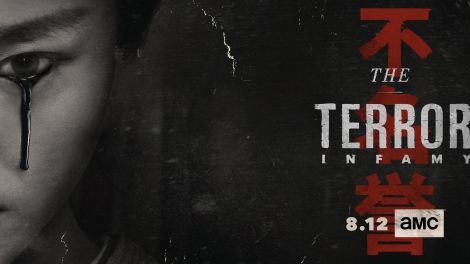 The second season of The Terror is starting tomorrow. The first season about the Franklin’s lost expedition in the Northwest passage was quite good (see my comment). This new season offers an entirely new story and cast (including Derek Mio, Kiki Sukezane, Naoko Mori, C. Thomas Howell, and… George Takei !). Subtitled Infamy, it is now set in a Japanese-american internment camp during WW2 as some characters are haunted by a ghost from their past and the camp is terrorized by a bakemono! It airs Mondays 9e/8c PM on AMC. Check the official trailer.
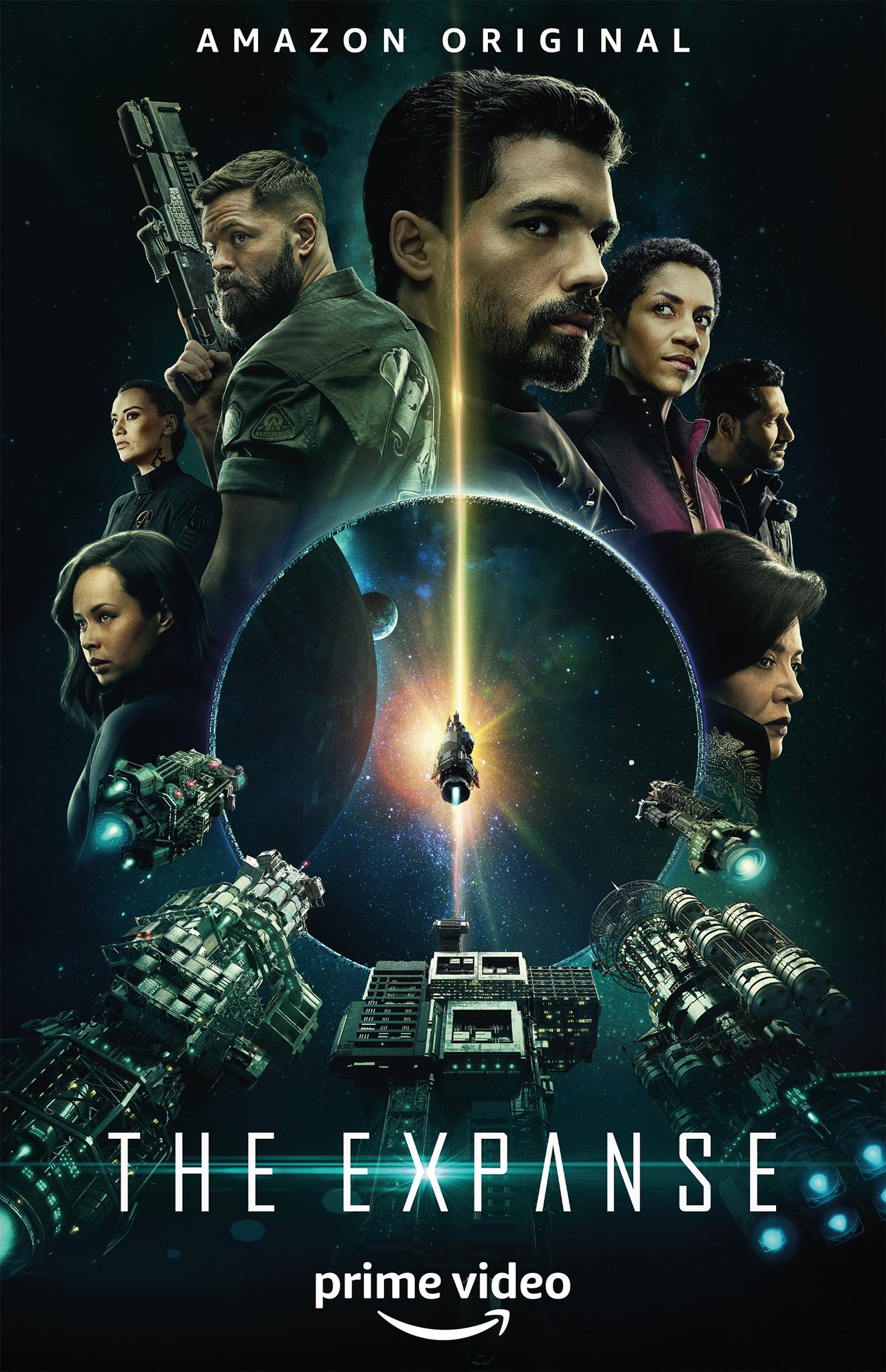 There’s now a longer trailer for the Watchmen playing on TV (HBO, October 2019). The visuals still doesn’t excite me and the story will definitely be different from the comic or the movie, but it looks intriguing. We’ll see. There’s also a longer trailer for His Dark Materials (HBO, late 2019), which seems even more intriguing and appealing. I can’t wait for this one…
You will be glad to learn that The Expanse is coming back in December for a fourth season and that it has even been renewed for a fifth !!! However, it moved from SyFy to Amazon Video (check the production trailer). Also, there is still no news on the third season of Westworld set for broadcast in 2020… Finally, everyone is asking where is the twelfth season of Doctor Who ??? Apparently it is currently in production, but the release has been delayed to 2020.
While writing this article, I have discovered Carnival Row, a very intriguing victorian (“Neo-noir”) fantasy that will start on Amazon Video on August 30. It certainly deserves a look. Check the trailer.
It really seems that there’s a lot of good TV series coming ahead. The competition between all those independent or internet pay channels (like AMC, HBO, Prime Video, Netflix and soon Apple TV+) is bringing out all the good stuff. Where/when will I find the time ?!
[ Traduire ]

[ iPhone 8+, 2019/07/27 ]
Unusually exhausted at night —
Wish that the summer rain could
Wash away all the pain and weariness
[ Traduire ]
Urubu à tête rouge / Turkey vulture / Cathartes aura septentrionalis


[ iPhone 8+, Parc Frédéric-Back, 2019/06/17 ]

[ iPhone 8+, Parc Frédéric-Back, 2019/07/10 ]
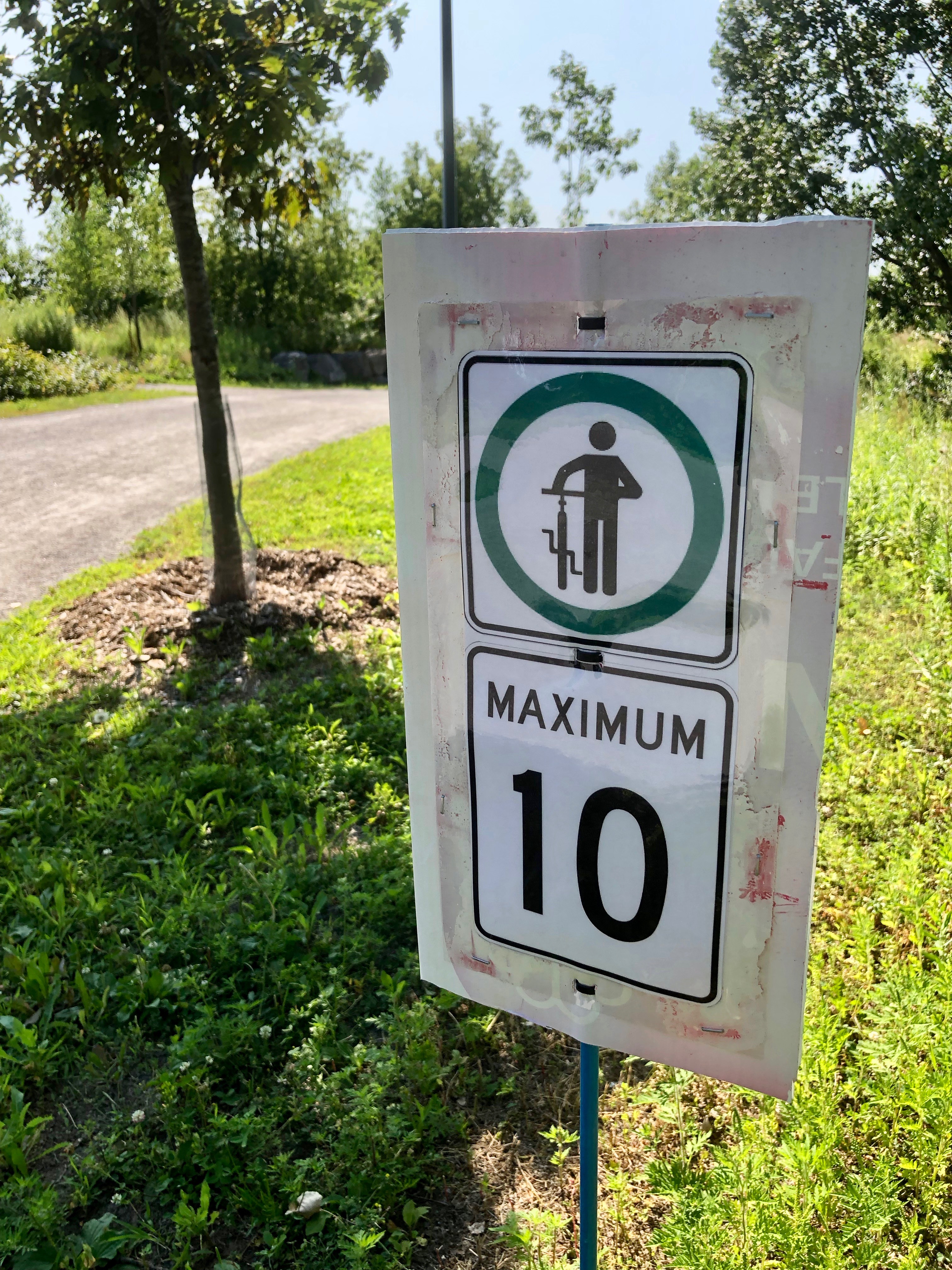 This afternoon I have noticed a new signage in the park urging cyclists to slow down — and even just walk along-side their bike — while approaching the hill going down to the Émile-Journault entrance. This signage is quite welcomed since I have often noticed cyclists going down the hill (in both direction) at very high speed at the risk of hitting pedestrians or other cyclists coming in or out the park though the Émile-Journault entrance and having limited visibility on the polyvalent trail because of the vegetation. There was probably complaints (or even accidents) prompting the introduction of this new signage. Unfortunately, the signs are small and not very visible and, of course, I haven’t seen a single cyclist respecting it (among the dozen that passed by while I was walking —when do cyclists respect the signs after all ?). Nice try, though.
[ Traduire ]


[ iPhone 8+, my little garden in VSP, 2019/08/02-04 ]


[ iPhone 8+, VSP, 2019/08/02-04 ]
[ Traduire ]

[ iPhone 8+, 2019/07/27 ]


[ iPhone 8+, Parc Frédéric-Back & Parc-Ex, July]
[ Traduire ]
[ iPhone 8+, jardin, 2019/06/24 ]
Beside the usuals (season 5 of Poldark, season 7 of Elementary, season 5 of Killjoys), this week I also watched episode 12 (season 6) of The 100, a Hunger Game look-alike; the third episode of Pandora, a Star Trek wannabe; and episode 12 of Blood & Treasure, an amusing Indiana Jones facsimile. Yes, I was entertained, but could only wonder: “is there any really original TV shows left for us to watch?”
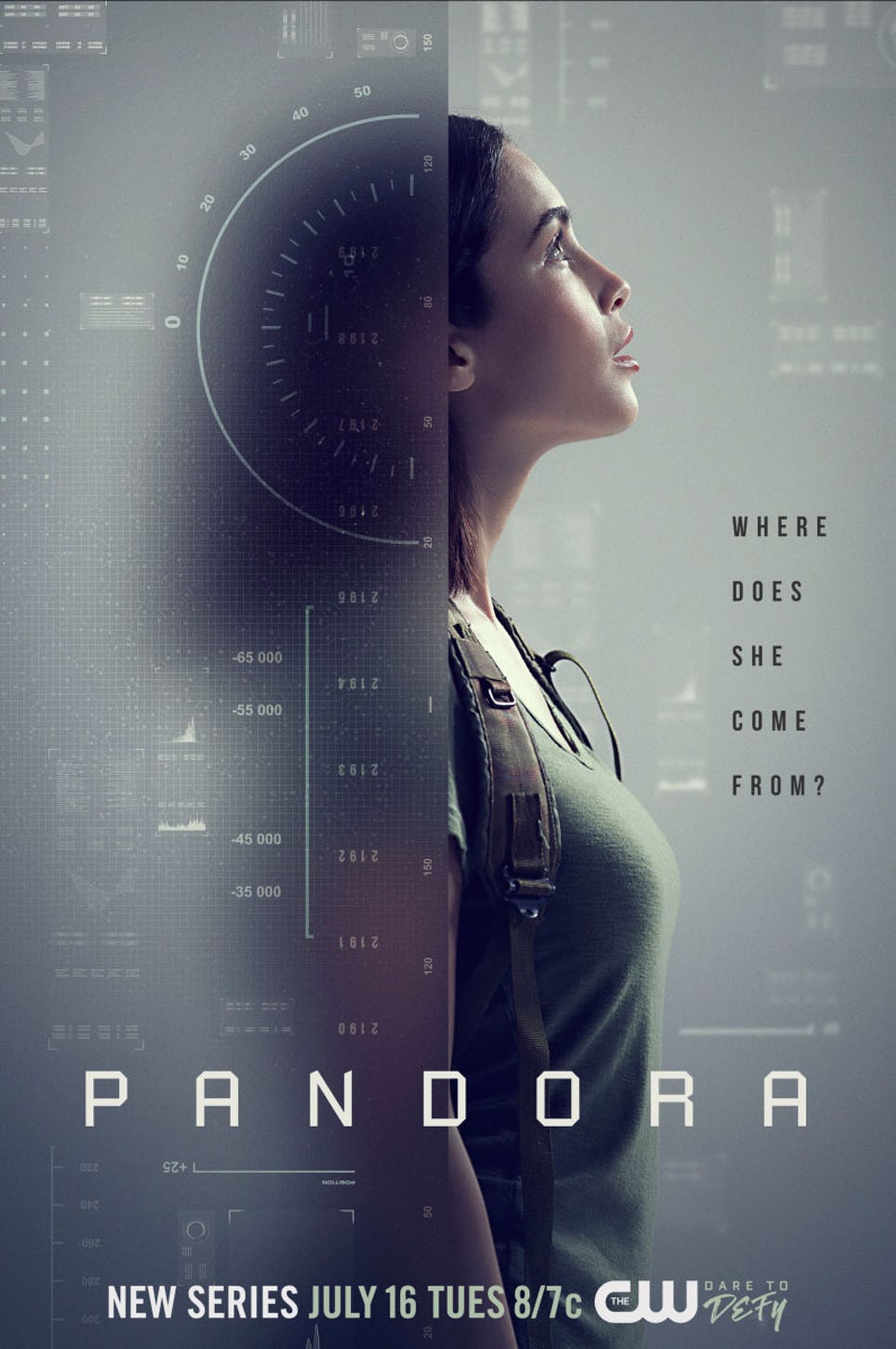
The third episode of Pandora offers good enough writing (nothing genius but that’s okay). The plot thickens, the special effects improve and the actors seem to find some sort of balance — but it is still not a stellar performance. Maybe worth continuing watching…
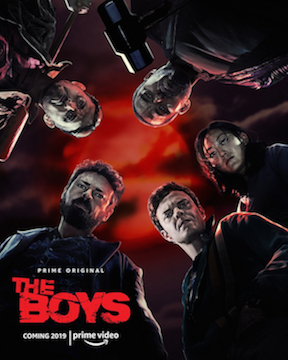 Another new show is The Boys on Amazon Prime Video which is based on a comic book that I haven’t read or even heard about until now. It is a superheroes TV series with some dark humor (a little like Deadpool) which shows the darker side of the supes (it also reminds me a lot of Watchmen), presenting them just as merchandizing pawns of a corporation — each one is a kind of parody of an existing superhero: Superman, Flash, Wolverine, Aquaman, Wonder Woman, etc. They are being targeted by a rag tag group of people who all suffered from the superheroes exploits’ collateral damage and want to get back at them. It is entertaining, well made and, so far (after three episodes), good enough to keep my interest (ratings of 9 on IMDb and of 79% on Rotten Tomatoes). It’s well worth watching.
To learn more about this title you can consult the following web sites:
[ Google — IMDb — Prime Video — Wikipedia ]
[ Traduire ]
This week-end I watched a few episodes of two puzzling Teen/YA TV drama with enigmatic titles.
Set in the year 2199, a young woman who has lost everything finds a new life at Earth’s Space Training Academy where she learns to defend the galaxy from intergalactic threats.
The first one is titled Pandora and is a Star Trek wannabe with poor special effects and quite average acting — after all they are young adults in college so maybe it’s normal if they sound contrived. With just two episodes it is difficult to judge the writing, but so far it is intriguing enough that I might watch more. After all, series like the original Star Trek or Doctor Who have managed very well despite their low-budget production. Everything is in the writing. We shall see. It airs Tuesdays on The CW at 20:00 ET. It’s too early to have a rating on aggregators (but IMDb gives it a 3.8).
To learn more about this title you can consult the following web sites:
A group of high school students navigates drugs, sex, identity, trauma, social media, love and friendship.
The second is a teen drama based on a 2012 Israeli series and is titled Euphoria. So far seven episodes have already aired but I’ve seen only the latest. It is diverse, brutal, scary even, sometimes psychedelic, but seems brilliantly written with generally pretty good acting. It is really modern: filmed video clip style, crazy fast-paced, with lots of violence and nudity, and, of course, it is making use of social media as narrative device. The main character is a bipolar drug addict who’s trying to make sense of her world… A little exhausting to watch, but promising. It airs Sundays on HBO at 22:00 ET. It has been rated 79% on Rotten Tomatoes and 8.2 on IMDb.
To learn more about this title you can consult the following web sites:
[ Traduire ]
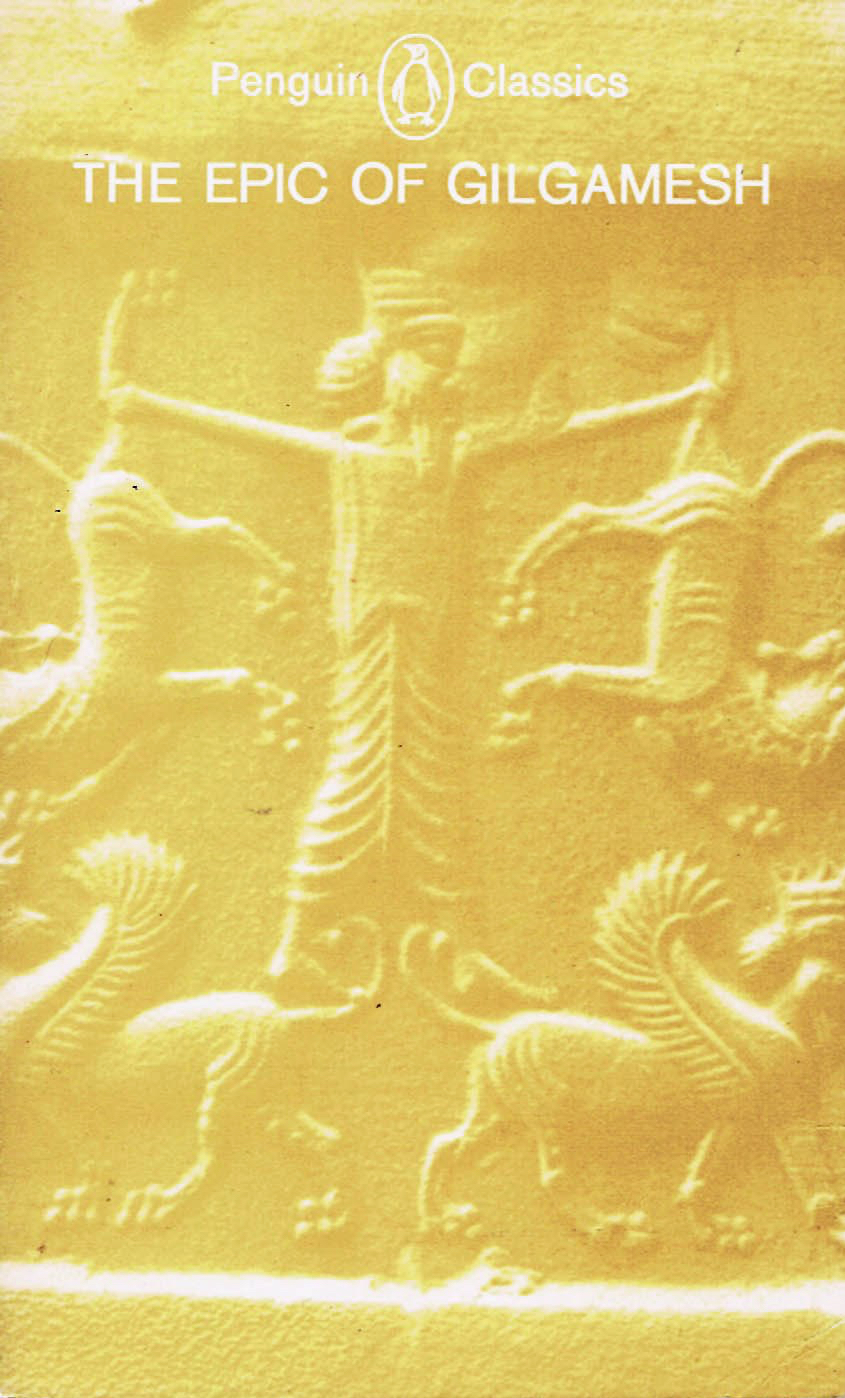
Gilgamesh, King of Uruk, and his companion Enkidu are the only heroes to have survived from the ancient literature of Babylon, immortalized in this epic poem that dates back to the third millennium BC. Together they journey to the Spring of Youth, defeat the Bull of Heaven and slay the monster Humbaba. When Enkidu dies, Gilgamesh’s grief and fear of death are such that they lead him to undertake a quest for eternal life. A timeless tale of morality, tragedy and pure adventure, The Epic of Gilgamesh is a landmark literary exploration of man’s search for immortality.
N. K. Sandars’s lucid, accessible translation is prefaced by a detailed introduction that examines the narrative and historical context of the work. In addition, there is a glossary of names and a map of the Ancient Orient.
[Text from the publisher’s website; see also the back cover]
I first read this book in 1985 (after purchasing it during a research trip to Boston for my master degree). I read it again recently after reading a comic adaptation by Jens Harder as I wanted to compare the two versions.
The Epic itself is very short (fifty-nine pages) but the text is preceded by a sizeable introduction by Nancy K. Sandars, the translator. Beside discussing the various versions of the text and her choices for the translation, she puts the work in perspective by talking about the discovery of the tablets, their historical and literary backgrounds as well as the significance of the story. It is very interesting.
The Epic of Gilgamesh is a tragic tale of adventure and morality. It is the oldest epic poem to have survived so we could read it four millennia later. It started around 2100 BCE as independent Sumerian poems that were compiled into an epic, in the Akkadian language, in the 18th century BCE under the title Shūtur eli sharrī (“Surpassing All Other Kings”) —but only a few fragments remain of that version. The definitive and more complete version of the Epic, titled Sha naqba īmuru (“He who Saw the Abyss”), was compiled around the 13th to the 10th century BCE by a scribe named Sîn-lēqi-unninni. The best preserved version was found on twelve clay tablets written in cuneiform and comes from the ruins of Ashurbanipal’s library in 7th-century Nineveh. The Epic is a “poem in twelve songs (…) of about three hundred lines each (…) written in loose rhythmic verse with four beats to a line”.
To make the text more intelligible, Nancy K. Sandars chose not to present it in verse and not divide it into tablets. She compiled the story from all sources: the old Sumerian, the Akkadian (from the Assyrian tablets of Nineveh) as well as the Hittite (from Boghazköy).
The story begins with a prologue that introduces Gilgamesh (“I will proclaim to the world the deeds of Gilgamesh”). He was created by the gods with a “perfect body” that is two-third god and one-third man. He is praised for having built the walls of Uruk and a temple for Anu and Ishtar.
Chapter 1: The coming of Enkidu. Gilgamesh is an arrogant despot who oppresses his people to such an extent that the gods decide to create a rival for him, Enkidu, the wild man. Gilgamesh sends him a courtesan to civilize him (as wisdom weakened him). Their duel ended in mutual respect and it’s the beginning of a long “bromance” (male bonding). [tablets I-II]
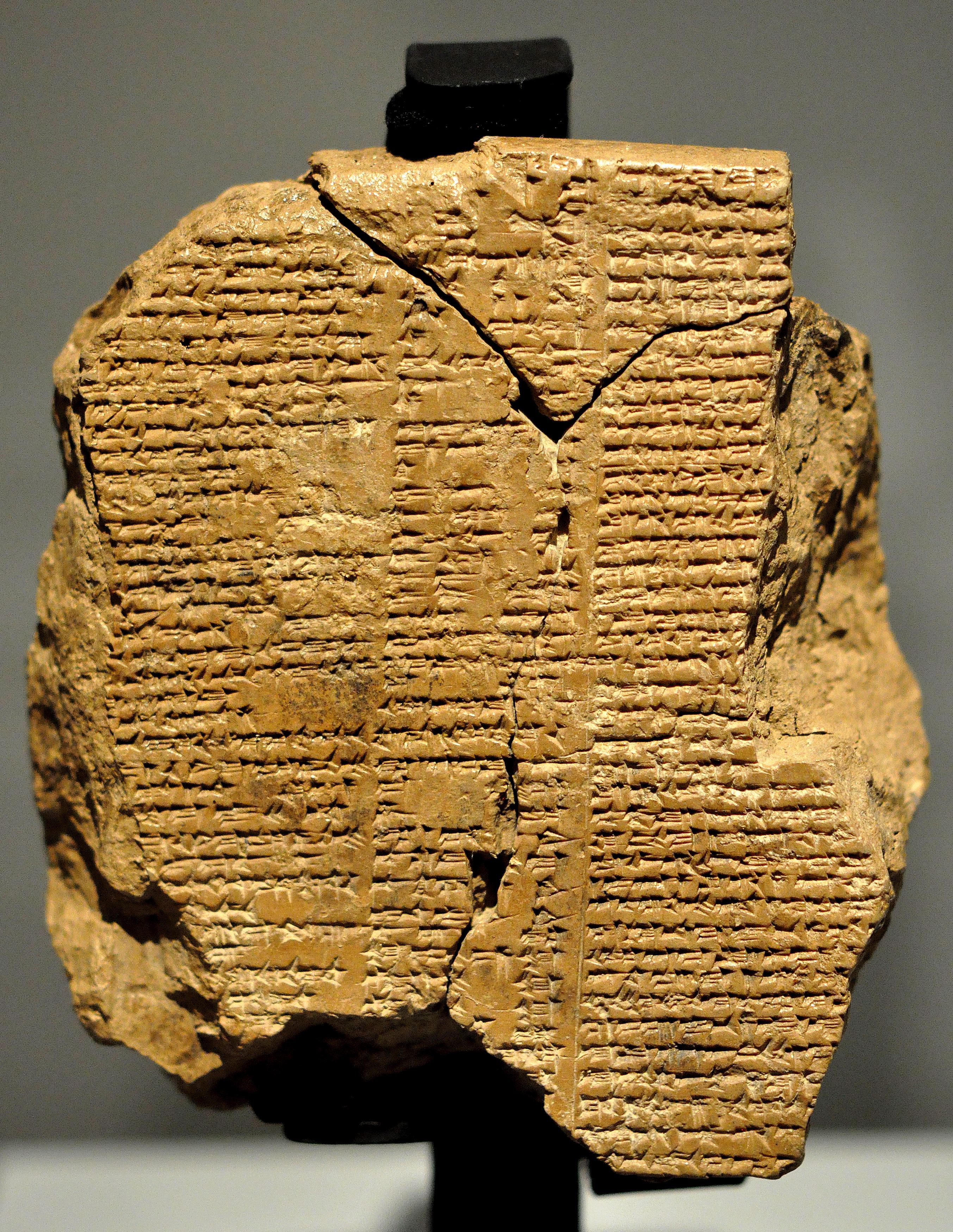
Tablet V
Chapter 2: The Forest Journey. Gilgamesh decides that he will go to the Cedar Forest to cut down trees and make a name for himself by destroying the evil. Together, Gilgamesh and Enkidu, defeat and kill the giant Humbaba. [tablets III-V] The forest (which is either located in the east in Elam or in the west in Amanus, north Syria, or Lebanon) represents real historical timber expeditions needed to bring raw materials to the cities. The forest is also full of “enchantments” that could represent the dangers of the mountains (earthquake, volcano, etc.).
Chapter 3: Ishtar and Gilgamesh, and the death of Enkidu. The goddess Ishtar (Inanna) tries to seduce Gilgamesh but he refuses her. She complains to her father, Anu, who sends the Bull of Heaven to devastate Uruk, but Gilgamesh and Enkidu kill him, redoubling the affront. To avenge themselves, the gods cause Enkidu to die of sickness. [tablets VII-VIII]
Chapter 4: The Search for Everlasting Life. Inconsolable, Gilgamesh wandered in the wilderness in search of ancestral wisdom, to question Utnapishtim about the meaning of death and life. Losing his companion made him terrified of death and he is wondering if there is a remedy. After meeting the scorpion-men, Siduri the wine-maker in the Garden of the gods, and finally the ferryman Ur-Shanabi, who carries him beyond the waters of death, he arrives at the end of the world to meet Utnapishtim. Like Siduri, who told Gilgamesh that he would never find immortality because death is the destiny that the gods allotted to all men—masters and servants, Utnapishtim tells him that there is no permanence in the world, and accordingly men should not expect to live forever. However, Gilgamesh asks him, “how was it that you came to enter the company of the gods and to possess everlasting life?”. Utnapishtim agrees to tell him a secret of the gods. [tablets IX-XI] Sandars notes many similarities with the homeric epics, which might have been inspired by the Epic of Gilgamesh — one of them is that Circe bears some likeness with Siduri.
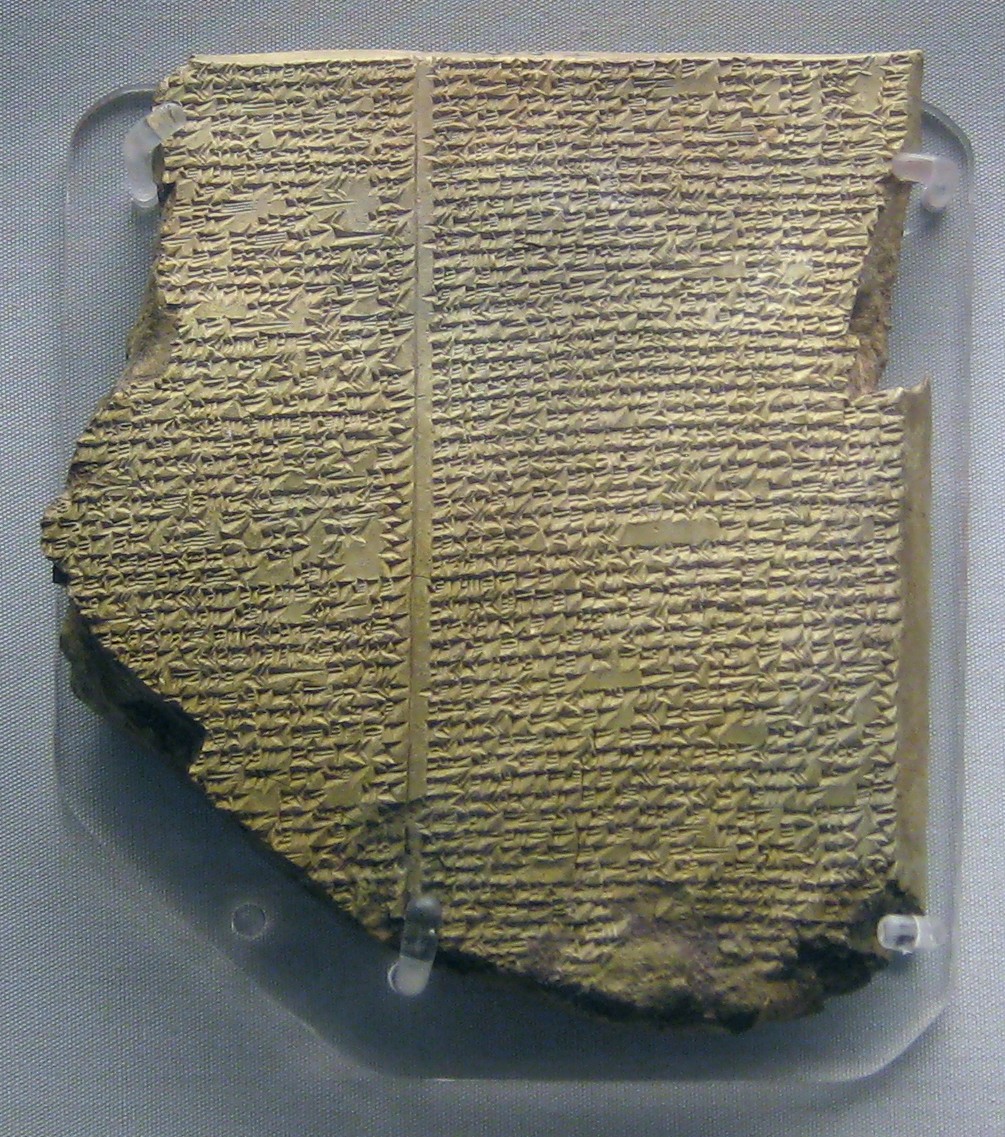
Tablet XI
Chapter 5: The Story of the Flood. As a lesson to Gilgamesh, Utnapishtim tells him how he survived the flood and became immortal. People having multiplied so much that they had become too noisy (“The uproar of mankind is intolerable and sleep is no longer possible by reason of the babel”), Enlil decided to exterminate mankind. However, Ea warns Utnapishtim in his dream and tells him to build an ark. He loads it with all his gold “and living things, my family, my kin, the beast of the field both wild and tame, and all the craftsmen.” The story is quite similar to the Great Flood as told in the Bible, save that it lasted only seven days. The gods are angry at Enlil for having acted alone and they reward Utnapishtim and his wife with everlasting life and make them “live in the distance at the mouth of the rivers” (a way of saying “sorry for the trouble” while making sure he would not tell this secret to anyone!). [tablet XI cont.]
Chapter 6: The Return. Utnapishtim nevertheless tells Gilgamesh how to get a plant that “restores his lost youth to a man (…) [and] all his former strength” — however, as Gilgamesh bathes, a serpent snatched it away. He returns to Uruk, the strong-walled city, empty-handed but wiser. “Gilgamesh, the king who knew the countries of the world (…) was wise, he saw mysteries and knew secret things, he brought us the tale of the days before the flood. He went a long journey, was weary, worn out with labour, and returning engraved on a stone the whole story”. [tablet XI cont.] Another possible influence on the Bible is the story where Gilgamesh, after arriving to the Garden of the gods, some sort of paradise, and finding the flower of youth, is sent back by Utnapishtim only to have his prize stolen by a serpent — which is somewhat reminiscent of the fall of man.
Chapter 7: The Death of Gilgamesh. “Gilgamesh, the son of Ninsun, lies in the tomb.” His destiny was fulfilled: it was not to have everlasting life, but his fate was to die. “None will leave a monument for generation to come to compare with his.” However heroes have both bright and dark sides. He was “given the kingship, (…) power to bind and to loose, to be the darkness and the light of mankind. He was given unexampled supremacy over the people (…) but do not abuse this power, deal justly with your servants in the palace, deal justly before the face of the Sun.” The people of the city chant, they lift up the lament, they weighed out their offerings. “O Gilgamesh, lord of Kullab, great is thy praise.”
Here Sandars chose not to include the text of tablet XII, “Enkidu and the Netherworld”, where Enkidu (despite having previously died on tablet VII) “goes down alive into the Underworld in order to bring back (…) [the] drum and drumstick that Gilgamesh has let fall into it”. Having broken the rules, Enkidu must remain in the Underworld but is allowed to briefly come back and tell Gilgamesh all about it. As it feels incompatible with the rest of the story, Sandars includes instead the “death of Gilgamesh”, which only appears in the Sumerian version, because “it makes a more satisfactory end”.
The Epic of Gilgamesh offers a simple text, easy to read and there’s no need to be an assyriologist to understand and enjoy it. It offers a glimpse into a very ancient and fascinating time of our civilisation about which we still have so much to learn. It is a shame that, in the last twenty years, instead of uncovering new information, we have been destroying those buried secrets because of the upheaval caused by the Irak war, the Syrian civil war and the madness of Daesh (ISIS).
Reading very old classics like The Epic of Gilgamesh or the Homeric epics (the Iliad and the Odyssey) remind us of how little the human mind has changed over the millennia (at least since the agricultural revolution during the Neolithic, 12,000 years ago). It is an interesting story that everyone should read at least once (or twice) in their life. Have you?
The Epic of Gilgamesh (by Anonymous, translated by Nancy K. Sandars). Harmondsworth: Penguin Books (Penguin Classics), 1972. 128 pages, $US 2.50 / $C 2.95, ISBN 014044100X.
The translated version by N.K. Sandars seems to be more difficult to find lately, and the new translation by Andrew Georges (2003) seems more easily available.
To learn more about this title you can consult the following web sites:
[ Amazon — Biblio — Goodreads — Google — Wikipedia — WorldCat ]
© N.K. Sandars, 1960, 1964, 1972. All rights reserved.
[ Traduire ]


[ iPhone 8+, Parc Frédéric-back, 2019/06/25 ]
L’Épopée de Gilgamesh est le plus ancien récit de l’histoire de l’humanité. Il nous est parvenu sous la forme de tablettes d’argile lacunaires, rédigées en sumérien, datées de la fin du IIIe millénaire avant JC.
Personnage hors du commun de la Mésopotamie antique, roi de la cité d’Uruk, Gilgamesh est un tyran mais il accomplit, avec l’aide de son ami Enkidu, des exploits qui permettent aussi de voir en lui le premier super-héros.
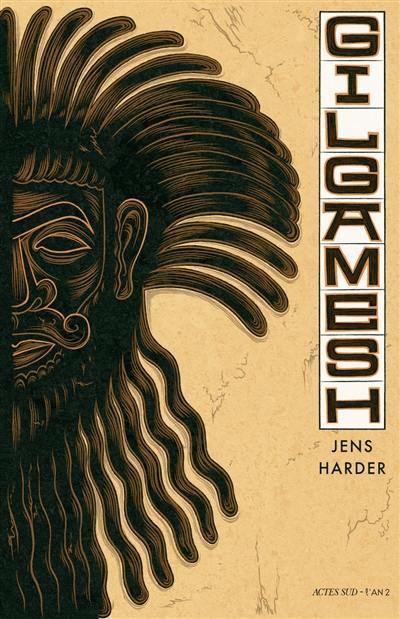
Avec le sens de la démesure qu’on lui connaît, Jens Harder a pris ce texte mythique à bras-le-corps. Tout en restant fidèle à l’esthétique des bas-reliefs témoins de ce lointain passé, il en fait une vraie bande dessinée, avec des décors grandioses, des monstres, des combats, des rêves, des dieux, de l’amour aussi.
Avec Jens Harder pour guide, suivez Gilgamesh et Enkidu dans la forêt de cèdres d’Humbahba, sur les rives de la Mer morte et jusqu’aux enfers. Une expérience de lecture unique, et une formidable porte d’entrée pour découvrir la civilisation mésopotamienne.
[Texte du site de l’éditeur; voir aussi la couverture arrière]
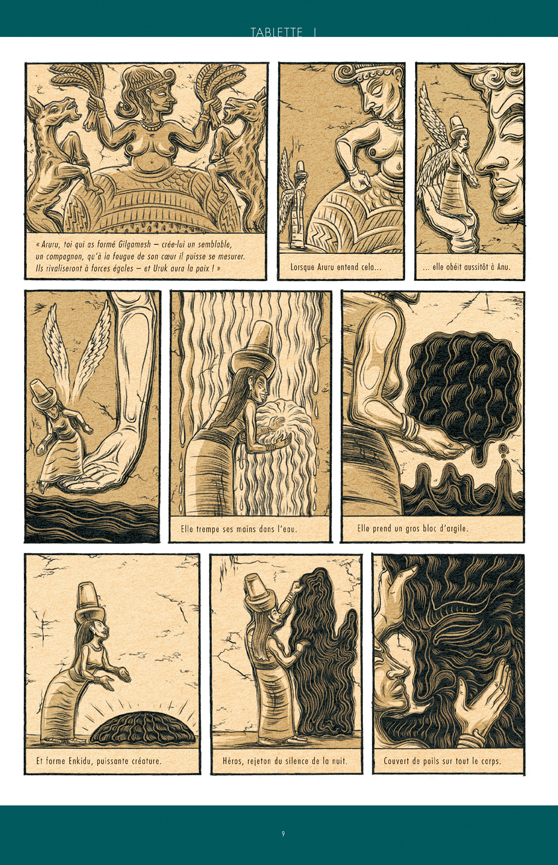
Page 9
C’est tout un accomplissement que d’adapter en bande dessinée l’Épopée de Gilgamesh, la plus vieille histoire d’aventure à nous être parvenue — plus vieux que Le dit du Genji [premier roman datant du XIe siècle de notre ère] ou que Les Mille et Une Nuits [contes aux source indo-persanes datant des IIIe-VIIe siècles mais compilés dans le monde musulman du IXe siècle], plus vieux que la Bible [l’Ancien Testament aurait été écrit entre le VIIIe et le IIe siècle avant notre ère (AEC)], au moins 1,500 ans plus vieux que les récits Homériques [une tradition orale du XIIe siècle mais écrite au VIIIe siècle AEC], ou possiblement même plus vieux que les épopées sanskrites indo-européennes qui auraient inspiré ces derniers (Mahabharata et Ramayana — tradition orale du XXIe siècle AEC mais transcrite au IVe siècle AEC). L’Épopée aurait été composé en sumérien vers la fin du IIIe millénaire (XXIIe-XXIe siècle AEC) mais n’a eut une forme écrite que vers les XVIIIe-XVIIe siècle AEC. La version définitive et la plus complète de l’Épopée a été retrouvé à Ninive et est écrite sur douze tablettes d’argile en akkadien cunéiforme et date du VIIe siècle AEC.
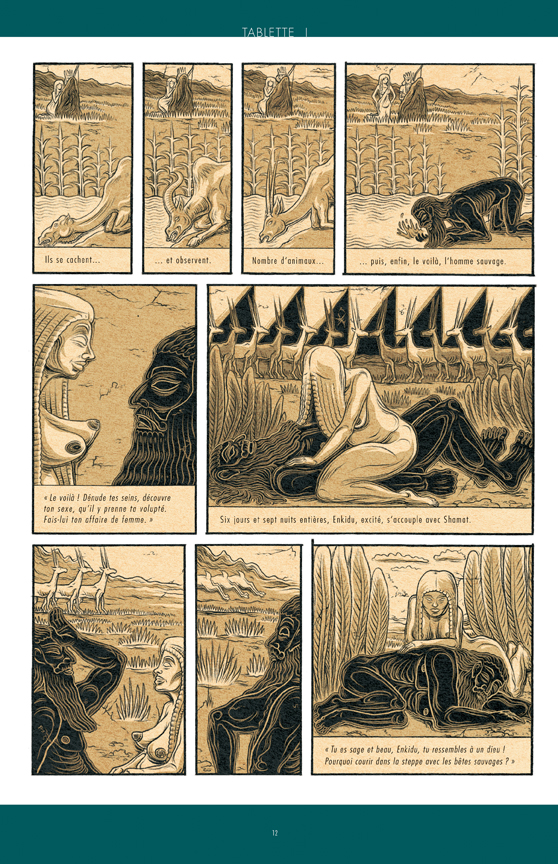
Page 12
Le récit se présente comme suit. Tablette I: Gilgamesh est le roi de la cité d’Uruk. C’est un despote arrogant qui oppresse son peuple, à un tel point que les dieux décident de lui créer un rival, Enkidu, l’homme sauvage. Tablette II: Gilgamesh lui envoie une courtisane pour le civiliser. Leur duel se solde par un respect mutuel, et c’est le début d’une longue “bromance” (amitié virile). Tablettes III-V: Ensemble, ils vont terrasser le géant Humbaba, dans la Forêt de Cèdre (Liban?). Tablette VI: La déesse Ishtar (Inanna) tente de séduire Gilgamesh mais celui-ci l’éconduit. Elle se plaint à son père, Anu, qui envoie le Taureau céleste pour dévaster Uruk, mais Gilgamesh et Enkidu le tue, redoublant l’affront. Tablettes VII-VIII: Pour se venger, les dieux font mourir Enkidu de maladie. Tablette IX-X: Inconsolable, Gilgamesh erre dans le désert à la recherche de son ancêtre Uta-napishti pour l’interroger sur le sens de la mort et de la vie. Après avoir rencontré les hommes-scorpions, la tavernière Siduri, et finalement le batelier Ur-Shanabi, qui l’emporte au-delà de l’océan de la mort, il arrive au bout du monde. Tablette XI: Uta-napishti lui raconte comment il a survécut au déluge et est devenu immortel. Il avertit Gilgamesh qu’il n’aura jamais l’immortalité mais lui indique néanmoins comment obtenir une plante qui redonne la jeunesse — toutefois Gilgamesh se la fait voler par un serpent. Il revient à Uruk bredouille mais plus sage. Tablette XII (fragment probablement ajouté ultérieurement): Gilgamesh échappe ses instruments de pouvoir dans les Enfers et Enkidu décide de les lui rapporter mais s’y retrouve prisonnier. Gilgamesh obtient de revoir brièvement son compagnon qui lui raconte son expérience aux Enfers.
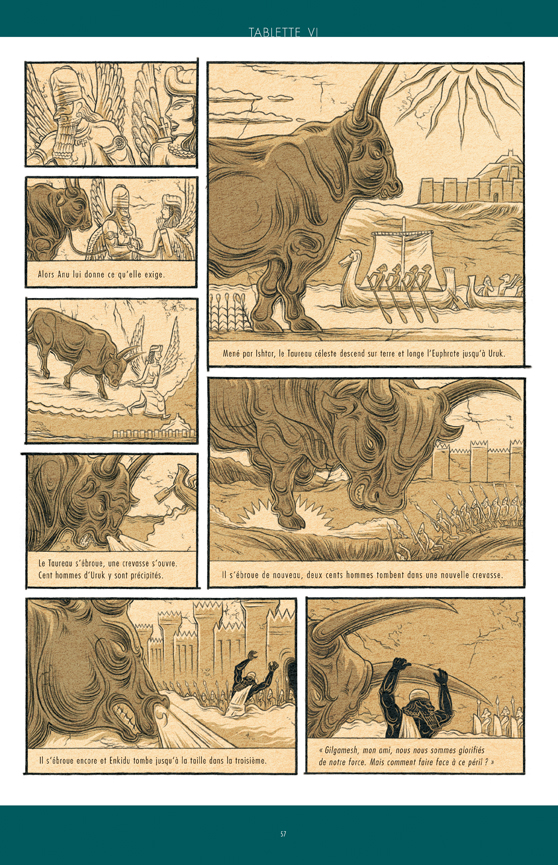
Page 57
Gilgamesh a été adapté et illustré par Jens Harder, un artiste allemand qui a entreprit déjà plusieurs récit historiques ou journalistiques (Leviathan, La Cité de dieu, Alpha… directions, Beta… civilisations vol. 1, Cités: Lieux vides, rues passantes — presque tous primés et publiés en français chez Actes Sud – L’An 2). Comme il nous le fait remarquer dans sa postface, c’est une histoire qui a beaucoup influencé les mythes (Herakles) et les récits épiques subséquents (la Bible, le cycle troyen, les Milles et Une Nuits, etc.) et qui a encore des échos même aujourd’hui. Il souligne d’ailleurs les dimensions politiques de l’Épopée, qui est d’abord ancrée dans des faits géo-économiques réels (la nécessité d’abattre des cèdres pour répondre à la pénurie de bois en Mésopotamie et de se protéger du risque constant d’inondations (déluges), puisque le territoire est situé entre deux grands fleuves: le Tigre et l’Euphrate). Puis il y a un aspect socio-politique, où le peuple oppressé par un tyran implore les dieux, qui l’envoient dans une quête de gloire qui finira par l’assagir (étrangement, le fait que celui-ci soit arrogant, vaniteux, débauché — il invoque le droit de cuissage — braillard et reconnu pour avoir construit un mur de protection autour de la ville évoque une similitude amusante avec le quarante-cinquième président américain, l’héroïsme en moins!).
Le concept de cette BD est superbe. Elle nous offre un intéressant récit qui est très fidèle au texte original de l’Épopée. Toutefois, comme tout texte ancien, c’est plutôt formel et donc un peu laborieux à lire. Et l’auteur a du faire certains choix, narratifs d’abord (comme de ne pas inclure dans son adaptation la mort de Gilgamesh, qui n’apparait que dans la version Sumérienne de l’Épopée) et aussi visuels. En effet, l’adaptation est aussi un peu difficile à lire du point de vue graphique, car Harder ne suit pas la forme traditionnelle de la bande dessinée mais s’inspire plutôt de l’art mésopotamien. Il représente l’action en bichromie et aussi comme si c’était une fresque bidimentionnelle (les personnages étant vus exclusivement de face ou de profil!), faisant toutefois quelques concessions à la perspective afin de rendre le sujet visuellement compréhensible. C’est tout de même beau (dans son genre) et visuellement fascinant.


Somme toute c’est très intéressant si vous êtes curieux de connaître l’Épopée de Gilgamesh et surtout si vous êtes amateur d’Histoire.
Gilgamesh, par Jens Harder (traduit de l’allemand par Stéphanie Lux). Mouthiers-sur-Boëme: Actes Sud – L’An 2, janvier 2018. 144 pages, cartonné, 19,5 x 30,5 cm, 19,80 € / $C 43.95, ISBN 978-2-330-09248-1. Pour lectorat adolescent (14+).
Vous trouverez plus d’information sur les sites suivants:
[ Amazon — Biblio — Goodreads — Google — Wikipedia — WorldCat ]
© Jens Harder, 2018 pour le texte et les dessins. © Actes Sud 2018 pour la traduction française.
[ Translate ]



[ iPhone 8+, Parc Frédéric-Back, 2019/07/24 ]
[ Traduire ]
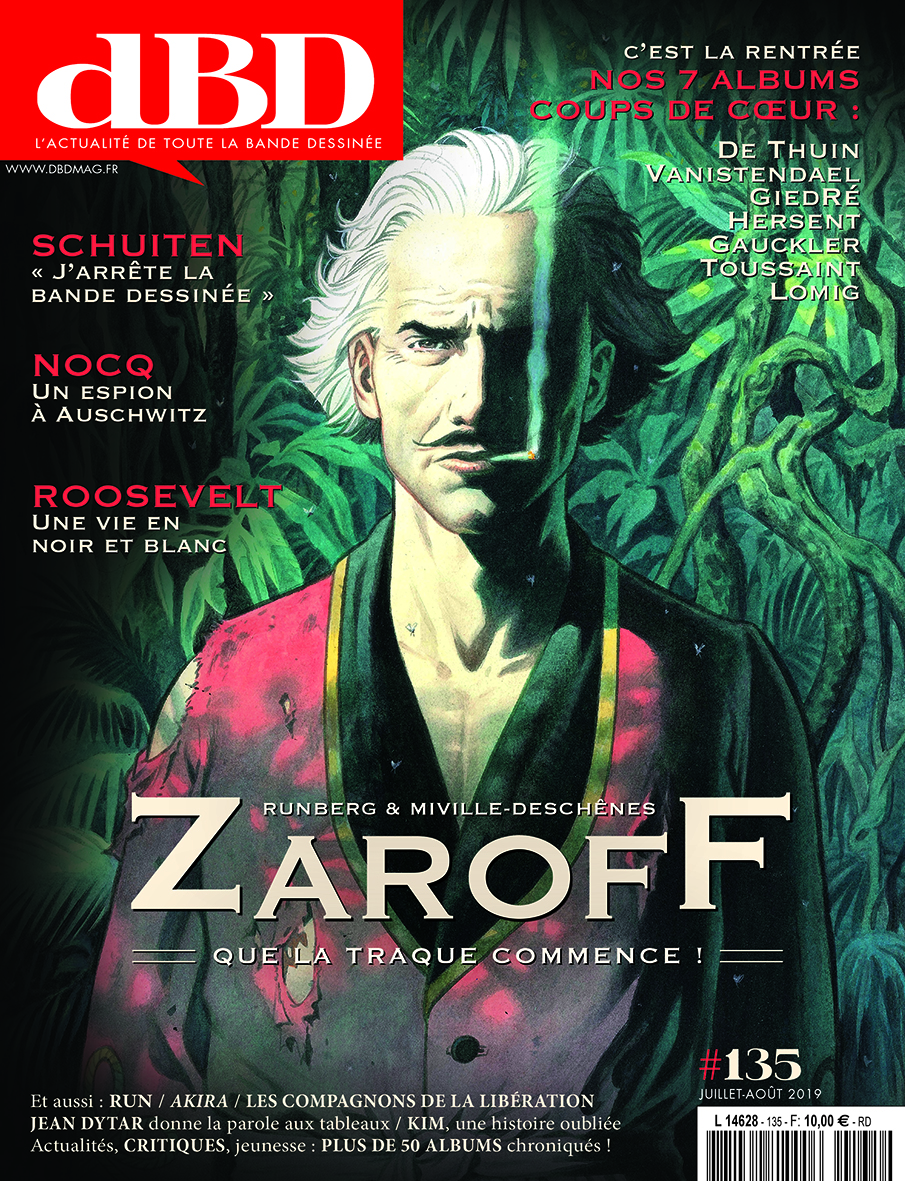 Enfin un numéro avec d’excellentes nouvelles! Ce numéro double — un peu plus volumineux (132 pages pour 10,00 € !) — nous offre à la une un interview avec le bédéiste gaspésien François Miville-Deschênes sur Zaroff qu’il dessine avec le scénariste Sylvain Runberg chez Lombard. On retrouve également des interviews avec François Schuiten (qui explique qu’il prends sa retraite de la BD parce qu’il en a marre des conditions difficiles que les éditeurs imposent aux créateurs), avec Gaétan Nocq sur Le Rapport W: Infiltré à Auschwitz aux Éditions Daniel Maghen, avec José Roosevelt sur CE T.13: Acrostiche aux Éditions du Canard, avec les québécois Émile Gauthier et Sébastien Lévesque sur Distorsion: 13 histoires étranges de l’ère numérique aux Éditions de l’Homme (des récits fantastiques tirés de leur podcast et illustrés par RUN), et avec KIM sur Un rêve d’ailleurs aux Éditions du Long Bec.
Dans les actualités, on retrouve notamment un article sur le 30e anniversaire du manga Akira par Katsuhiro Otomo, sur Les compagnons de la libération: Pierre Messmer par Catherine Valenti & Philippe Tarral aux Éditions Grand Angle, et on mentionne la publication du manga Hi Score Girl par Rensuke Oshikiri chez Mana Books.
dBD nous propose également un dossier sur leur “7 coups de coeur de la rentrée” (avec extraits): Le roi des bourdons par David de Thuin chez Glénat, Les Deux Vies de Pénélope par Judith Vanistendael chez Le Lombard, La Boîte de petits pois par GiedRé & Holly R chez Delcourt, Le Boiseleur T.1 par Hubert & Hersent aux Éditions Soleil, Kebek T.1: Le puits du temps par Philippe Gauckler aux Éditions Daniel Maghen, Louisiana T.1 par Léa & Toussaint chez Dargaud, et Dans la forêt par Lomig d’après Hegland aux Éditions Sarbacane.
Dans le cahier critiques je remarque des commentaires sur Quenotte et le monde fantastique T.1 par Ryô Hirano chez Casterman (“Bien; On s’étonne de moins en moins de la surenchère surréaliste, on rit moins aussi. On est perdu, (…) dans ce qui semble (…) se limiter à une expérience narrative et graphique.”), Humanitas par Aki Yamamoto chez Glénat (“Super: trois belle réflexions sur l’humanité, servies par un graphisme incisif et efficace. À découvrir”), Mes voisins les esprits T.1 par Ushio Shirotori chez Doki-Doki (“Bien: bien fichue (…) dessin efficace, malgré un petit goût de déjà-vu”), Mermaid Prince par Kaori Ozaki chez Delcourt/Tonkam (“Bien; À découvrir”), BL Métamorphose T.1 par Kaori Tsurutani chez Ki-oon (“Super”), et Time Shadows T.1 par Tanaka Yasunori chez Kana (“Super: un premier tome très dense, qui ouvre beaucoup de piste, et qui rend cette série particulièrement prometteuse”).
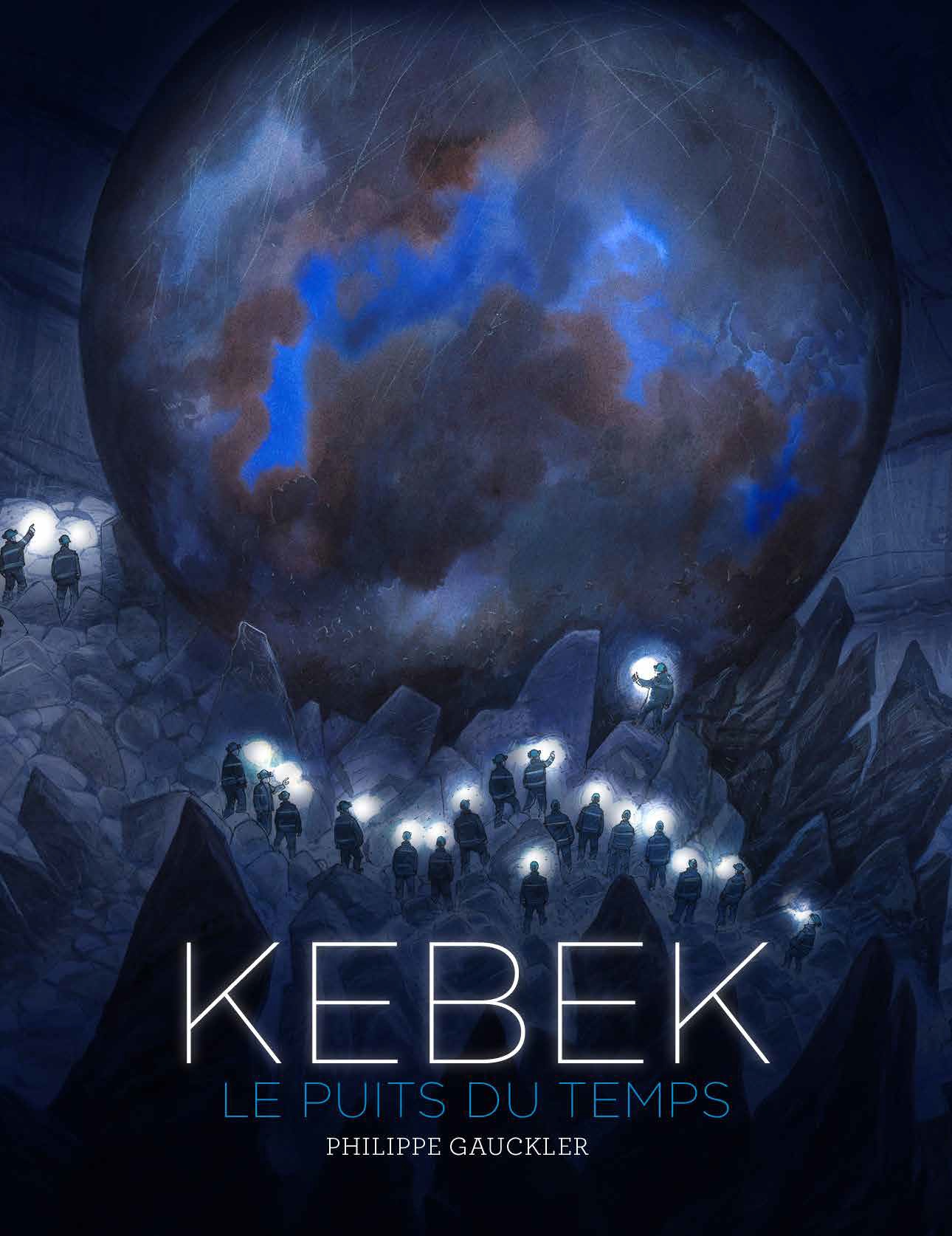 Pour moi la meilleure nouvelle c’est l’annonce d’un nouveau Gauckler (voir ci-haut dans les coups de coeur de la rentrée). J’avais vu sur Facebook qu’il travaillait sur un nouvel album (j’espérais une suite à Koralovski mais cette révélation est encore mieux!). Il en parlait depuis longtemps mais là, c’est fait, il nous offre finalement son adaptation libre de La nuit des Temps, le chef-d’oeuvre de René Barjavel (il s’inspire également un peu du roman La sphère d’or de Erle Cox qui avait aussi probablement influencé Barjavel). Cette série d’au moins deux albums, dessinée en couleurs directes sur papier, prend cette fois pour décor (au lieu de l’Antarctique) le nord du Québec (et l’avocat qui apparait dans les premières pages est inspiré par un ami commun!). C’est très prometteur: un de mes romans préférés adapté par un artiste que j’admire beaucoup! J’ai bien hâte de lire ça!
Kebek T.1: Le puits du temps par Philippe Gauckler aux Éditions Daniel Maghen, 88 pages, 19€, ISBN 978-2-35674-074-8, disponible (en Europe) dès le 22 août. dBD nous présente un extrait de cinq pages!
Donc, un numéro plein de découvertes et de bonnes nouvelles. Une excellente lecture!
[ Translate ]
Souvenirs de Science-Fiction Québécoise
Manga, jeu vidéo et arts mineurs
A blog about the pursuit of knowledge
A blog about the pursuit of knowledge
Émission littéraire + Suggestions + Confidences
“If you are cold, tea will warm you; if you are too heated, it will cool you; If you are depressed, it will cheer you; If you are excited, it will calm you.” ― William Ewart Gladstone
A blog about the pursuit of knowledge
Book reviews and the occasional ramblings of a book blogger
Moi et les livres... dans cet ordre
Science, réflexion et poésie
Discussion, Resources, Roundtables, & Reviews
A blog about the pursuit of knowledge
A blog about the pursuit of knowledge
A blog about the pursuit of knowledge


 Clodjee's Safe-House