Torlonia Collection
The Collection


The Torlonia Collection is probably the biggest private collection of ancient art in the World. It was gathered in the 19th century by a family of rich ennobled Italian bankers, the Torlonia, through the acquisitions of other collections and archaeological digs on their own estates. To showcase the collection’s 620 sculptures, Prince Alessandro Torlonia founded the Torlonia Museum in 1875. The museum closed during WW2 and the collection was put in storage in 1960. It was therefore out of the public sight for a very long time. Following an agreement with the Italian government, the Torlonia Foundation was created in 2014 to conserve and promote the collection and a new museum was opened in 2016.
A special selection of the collection, comprising nearly sixty pieces (only one-tenth of the collection!), was gathered for a travelling exhibition. It was first exhibited at the Villa Caffarelli of the Capitoline Museum of Rome from 14 October 2020 to 27 February 2022. Then it went to the Gallerie D’Italia in Milan (from 25 May to 18 September 2022), to the Louvres Museum, in Paris (France), from 26 June 2024 to 6 January 2025, to the Art Institute of Chicago (from 15 March 2025 to 29 June 2025) and the Kimbell Art Museum, in Fort Worth (Texas), from September 14 2025 to January 25 2026. It is now shown at the Montreal Museum of Fine Art from 14 March to 19 July 2026, after which time the exhibition will return to Italy.


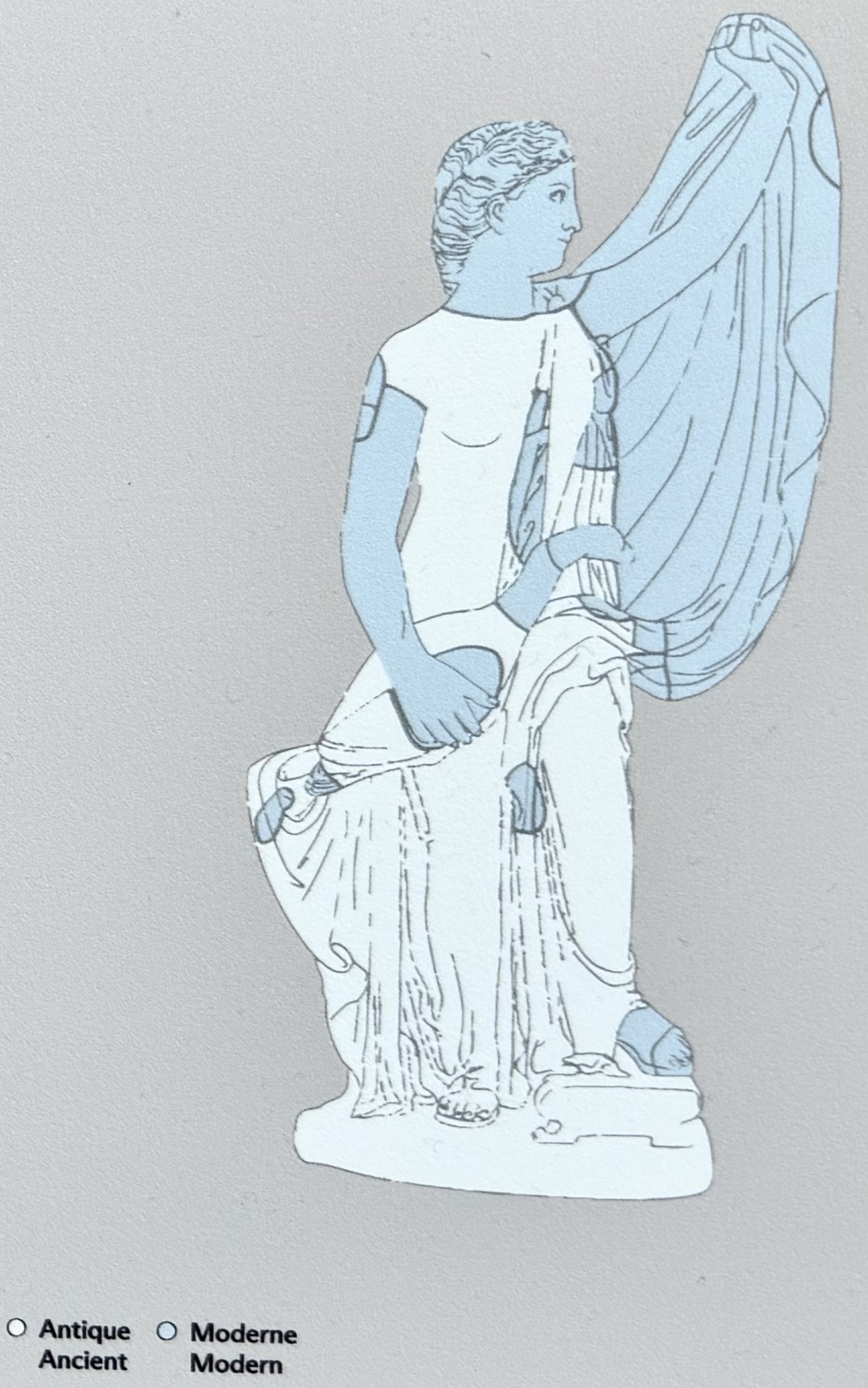
“Statue of Leda and the Swan” composition; the “modern” additions are in dark blue
The first room introduces us to the collection as well as to the conservation and restoration work done by the Laboratori Torlonia. A great emphasis is put on the fact that most ancient sculptures were not found complete and some restorative work was done on them at some point. Each descriptive panel clearly shows for each piece that the sculpture combines ancient and later elements (characterized as “modern”, the restoration could date from the Renaissance or the 18/19th century). Sometime, it even includes parts of another ancient work that was not originally related to the sculpture. For example, on the Germanicus statue (the only bronze work of the collection), both arms, the right leg and its draped stump support as well as the head are all “modern” restorative additions. In the case of the “Statue of Leda and the Swan”, the head, both arms, the cloth, the left foot as well as the head of the swan are also later additions.
Funerary statuary
The next room shows how the Romans used art (monuments and sculptures) to commemorate the death of their loved ones. We particularly note the statue of a couple holding hands, the funerary monument of a fourteen year-old boy, and two sarcophagi illustrating the labours of Hercules, one with a lid depicting a reclining couple.


“A population of statues”
The Romans surely loved their sculptures as they were everywhere in their cities and their homes. They were not only the expression of the Romans appreciation for art, but also a form of visual communication. Monuments, reliefs and statuary were used for advertising, for commemoration, for showing off one’s status, and also for political propaganda. Today, they can also tell us a lot about the Roman culture: their clothing, hairstyles, beliefs, occupations, architecture, etc. Statuary is not only beautiful, it is also, in many ways, useful. Notable are a statue of a youth and, particularly, the Portus relief which was probably a votive offering from a merchant to bring good luck. It depicts in detail the harbour of Portus, with its building (the lighthouse!) and ships, as well as many auspicious symbols and protective deities, and still shows some traces of polychromy.
![Statue of a youth [Amelung Athlete] (MT 470, Marble, late 1st-early 2nd c., 1864 excavations at Palazzo Imperiale, Porto)](https://i0.wp.com/clodjee.com/wp-content/uploads/2026/03/img_0594.jpeg?w=161&h=285&ssl=1 "IMG_0594")

Imperial portraits
For me, one of the most interesting aspects of Roman sculpture is the imperial portraits. They are usually an idealized portrait of the emperor which (along with coinage) serves the imperial propaganda by making the emperor easily recognizable and promoting his greatness. This exhibition uses them to explain the strategies of succession, where emperors use strategic adoptions and marriages to ensure their dynastic continuity. Notable are the portraits of Augustus, Marcus Aurelius, Lucius Verus, Crispina, Commodus, Septimius Severus, young Commodus and Julia Domna.


![Portraits of Marcus Aurelius [MT 553] and Lucius Verus [MT 556]](https://i0.wp.com/clodjee.com/wp-content/uploads/2026/03/img_0630.jpeg?w=340&h=191&ssl=1 "IMG_0630")
![Portraits of Crispina [MT 560, 2nd c.], Commodus [MT 559, 2nd c.], Septimius Severus [MT 566, early 3rd century.], young Commodus [MT 558, c170-180] and Julia Domna [MT 573, early 3rd c.]](https://i0.wp.com/clodjee.com/wp-content/uploads/2026/03/img_0620.jpeg?w=340&h=191&ssl=1 "IMG_0620")
Lucius Verus
I would be lying if I was not admitting that the main reason for me to visit this exhibition was not to see the bust of the emperor to whom I dedicated seven years of higher education. It is really nice to be able to see this bust of Lucius Verus in Montreal. However, the Torlonia Collection holds another bust of Verus that is unfortunately not part of this exhibition. It is sad because it is a beautiful one: an antique black marble head on a “modern” alabaster bust with armour and paludamentum coming from the Giustiniani Collection (MT 350). I was also hoping to see a relief from the Palazzo Giraud-Torlonia depicting a Clementia scene where Verus stands with a kneeling barbarian, probably coming from a triumphal arch or the arch of Divus Verus. I have never seen it and it was not part of the exhibition (it’s not even mentioned in the collection’s catalogue).


Realism of life
One characteristic of Roman sculpture, in opposition to its Greek counterpart which tended to be more formal and sober, is that it depicts life with great realism and even, sometimes, a little extravagance. Whether they represent children (often as gods or with animals), a goddess or old men, the body and facial features are realistic and includes genitals, love handles, wrinkles and warts. Also, contrary to common belief, the statuary was never plain white marble, but was generally painted with rich and vivid colours, of which we can sometimes still find traces. Notable are the statues of Cupid and Psyche, a boy with dogs, crouching Aphrodite, the old man of Otricoli and Euthydemus of Bactria.


The Myths & Gods
Another thematic very popular in sculptures is the depictions of myths and gods: the labours of Hercules, Leda and the Swan, the Mithraic mysteries, the personification of the Nile, Apollo, Aphrodite, Artemis Ephesia (with her multiple breasts) or Athena.


Conclusion
I’ve been waiting to see this exhibition for several months now and I am really glad it is finally here. I intend to go visit several times. It is a unique chance to see this exceptional collection and to be able to appreciate Roman sculptures without having to travel far. Of course, I am a little disappointed that the exhibit didn’t include more imperial portraits (particularly of Lucius Verus). Also, despite having studied ancient history, I am quite surprised (and disappointed) to discover that those superb pieces of art are largely made of restorations (I wouldn’t say they are “fake”, but the vision of the original artist might have been distorted by the perception that we had of it in the Renaissance or the 19th century). I knew that noses, fingers and genitals often had to be recreated or that sometimes heads were swapped, but I never imagine that the restoration work was so extensive.
Nevertheless, this is an exceptional exhibition that everyone interested in art or ancient history must see. The Torlonia Collection: Masterpieces of Roman Sculpture exhibition takes place at the Montreal Museum of Fine Arts until July 19, 2026. Don’t miss it.
Mediagraphy
For further information, you can consult those web sites:
- “Ancient Roman sculptures provide a portal to the past at MMFA” (The Gazette, March 11, 2026)
- Wikipedia: Torlonia Family [FR / EN / IT], Torlonia Collection [FR / EN], Alessandro Torlonia [FR / EN / IT], Torlonia Museum [FR / EN / IT].
- Youtube videos: Dolce-Italia [3:41], Villa Torlonia walking Tour [1:16:08].
 Clodjee's Safe-House